
September’s theme for Genre Grandeur is “Secret Agent/Spy Movies”. As soon as I learned this would be Genre Grandeur’s theme, the 2000 made-for-TV movie, Murder, She Wrote: A Story to Die For, immediately came to mind. This is because the protagonist of the series, Jessica Fletcher, tries to solve the murder mystery of a former KGB agent. Jessica and her show are no strangers to 18 Cinema Lane, as I have reviewed episodes of Murder, She Wrote from time to time. But, until this review, I have never covered any of the series’ television films. Sure, I’ve referenced them in the past. That, however, is the closest I had come to talking about the tv movies. Though I have seen two of the four Murder, She Wrote films; Murder, She Wrote: South by Southwest (which I thought was fine) and Murder, She Wrote: The Celtic Riddle (which felt very cinematic to me). How will Murder, She Wrote: A Story to Die For compare to these other two titles? Solve this mystery by reading my review!
Things I liked about the film:
The dialogue: In the realm of made-for-TV movies, dialogue is an underrated component. If the dialogue is well written, it can captivate the audience’s attention to the point they forget they’re watching a program for the small screen. For me, Murder, She Wrote: A Story to Die For’s dialogue was such a pleasant surprise because of how much thoughtfulness was woven into the script. In one scene, Jessica is questioned by an FBI Agent about her encounter with Yuri Malenkovich, a former KGB agent who had planned to publish a nonfiction book about his KGB experiences. When Jessica says she and Yuri had exchanged words, the FBI Agent asks her “What kind of words?”. Jessica then responds by saying in a matter-of-fact, yet sweet way, “Oh, the usual. Nouns, verbs, adjectives, to round things out”. Though this response is simple, it’s a clever way to compliment Jessica’s personality through speech. During the aforementioned conversation between Jessica and Yuri, Yuri questions Jessica’s involvement in solving murder mysteries, even accusing her of using her involvement to attract clout. Jessica answers Yuri’s question by respectfully telling him, “If you bring something special to a situation that may be of help and if the circumstances merit your intrusion, don’t you think it’s the responsibility of every citizen to become involved if a crime has been committed?”. That answer alone was written so eloquently and professionally, it left a strong impression. It also shows how Jessica, as a writer, carefully crafts her responses as well as her perspective.
The acting: Angela Lansbury reprises her role as Jessica Fletcher in not just Murder, She Wrote: A Story to Die For, but in the other Murder, She Wrote television films as well. Speaking specifically about the 2000 movie, Jessica carries herself in the charming, warm way fans of the show have come to expect from her. Yet, she also takes her writing and her amateur sleuthing very seriously in the film, just like she does on the show. The consistency of Angela’s performance helped her character’s personality maintain continuity between the show and film. As I already mentioned in this review, Yuri Malenkovich is a former KGB agent who had planned to publish a nonfiction book about his KGB experiences. Though he appears in Murder, She Wrote: A Story to Die For for a limited period of time, Duncan Regehr uses the acting material given to him and helped create such a memorable character! Whenever Yuri was on screen, he possessed both an intimidating and suave presence. This creative decision made Yuri come across as a man with classy, sophistication. Yet, menace pokes through that professional persona. It can heard in Yuri’s dialogue, as his sharp tongue warns viewers he is not to be messed with. Because of his strong performance in Murder, She Wrote: A Story to Die For, it would be interesting to see Duncan portray a villain with more screen-time.
Before he portrayed Jin-Soo Kwon on Lost, Daniel Dae Kim starred in Murder, She Wrote: A Story to Die For as a motivational speaker named Everett Jang. He attends a conference with his friend and fellow motivational speaker, William Batsby (portrayed by Steven Culp). What works in both Daniel’s and Steven’s favor is how their performances allow their characters to be memorably distinct from one another. William is an energetic man who desires more appreciation and recognition. Meanwhile, Everett consistently carries a calm and laid-back personality, even offering public speaking advice to a fellow conference attendee named Penny Ryan. Because of how memorable and strong Steven’s and Daniel’s performance was, they helped William and Everett stand out among the collection of suspects!
Scenes that felt cinematic: I mentioned in the introduction of this review how, to me, Murder, She Wrote: The Celtic Riddle felt very cinematic. In a similar fashion, Murder, She Wrote: A Story to Die For contains moments that made me forget I was watching a television movie. A great example is when Joseph Brennan (the president of Speakers INC.) and Mack Rolands (one of the clients of Speakers INC.) have an argument over Mack’s behavior. Their agitated voices rise as the argument goes on. The camera presents each character in close-up shots, emphasizing the bitterness and anger in the faces of Mack and Joseph. Suspenseful music can be heard in the background during the argument. These elements came together to create a scene that was intense enough to leave viewers on the edge of their seat.

What I didn’t like about the film:
A distracting subplot: As I said earlier in this review, Everett attends a conference with his friend and fellow motivational speaker, William. When a dead body is discovered at the hotel hosting the conference, William is eager to solve the mystery before Jessica. He even tries to persuade Everett to help him discover the culprit. But by the end of the movie, this subplot didn’t receive a satisfying conclusion. Plus, the time it took to present William’s part of the story took away opportunities to show Jessica collecting clues and questioning suspects. In my opinion, it would have made more sense to have William and Jessica solving the case together.
Jessica’s prolonged involvement: A criticism I’ve had about Murder, She Wrote, especially in the later seasons, is how an episode’s mystery doesn’t start until about the episode’s halfway point. What’s frustrating is how a typical episode of Murder, She Wrote is about an hour long, so there’s very little time for the audience to engage in the mystery alongside Jessica. Even though Jessica tries to solve the mystery in Murder, She Wrote: A Story to Die For, she doesn’t get involved in the case until about forty minutes in the hour and thirty-five minute film. She, at first, passes on the opportunity because she claims she doesn’t want to interfere with the authorities. While her initial decision is understandable, it’s quite different from what the show’s fans have come to expect; Jessica eagerly getting involved in cases. Plus, the movie’s run-time gave Murder, She Wrote: A Story to Die For’s creative team an excuse to have Jessica take her time when it came to sleuthing.
Inconsistent sense of urgency: Like I just said in this review, the run-time for Murder, She Wrote: A Story to Die For is an hour and thirty-five minutes. The creative team behind the 2000 film received more time to tell their story, compared to a typical episode of Murder, She Wrote (which is about an hour long). But this extension of time made the story’s sense of urgency inconsistent. Yes, there were suspenseful moments sprinkled throughout the movie. However, chunks of the story gave the impression Jessica (as well as other characters) were unfazed by the murder that took place at the hotel hosting the conference. In fact, the story seems to emphasize how Jessica is taking her time when it comes to the case. A solution for the inconsistent sense of urgency could have been to tighten up the script.

My overall impression:
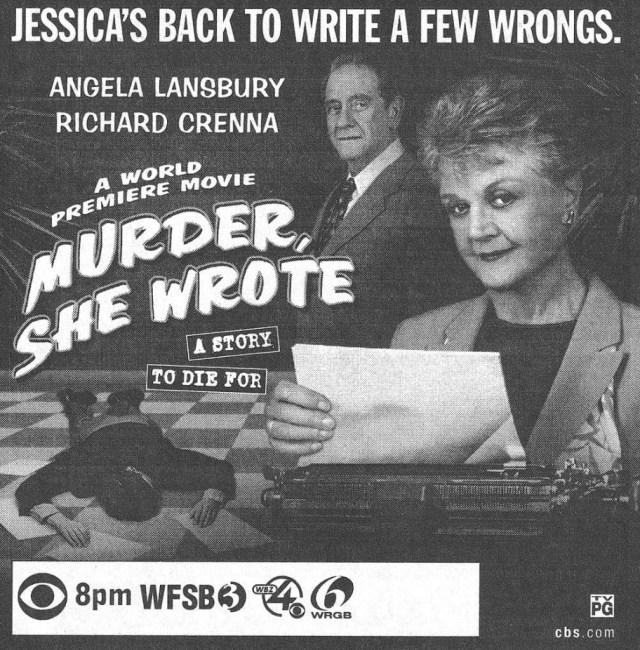
According to a clipping from a 2000 edition of TV Guide, Angela Lansbury claims Murder, She Wrote: A Story to Die For was put together “in 21 days”. If what she said is true, then this movie turning out as interesting and entertaining as it did is a miracle! Those who enjoy watching the television show will find themselves eagerly solving the mystery alongside Jessica. Even though she has more time to solve the crime (see what I did there?), Jessica is still the charming, sophisticated self she is known for, perfectly represented through Angela’s performance as well as the dialogue. There are even moments throughout Murder, She Wrote: A Story to Die For that felt cinematic, making me forget I was watching a movie intended for the small screen. However, some flaws hold the 2000 picture back from being stronger. The hour and thirty-five-minute run-time became both a blessing and a curse for the film, as the story’s sense of urgency was inconsistent. It didn’t help how Jessica didn’t get involved in solving the case until about forty minutes into the movie. I also found William’s subplot distracting, taking away opportunities to show Jessica gathering clues or talking to suspects. But, despite these flaws, I would still recommend Murder, She Wrote: A Story to Die For, especially if you like the show.
Overall score: 7.3 out of 10
Have you seen Murder, She Wrote: A Story to Die For? Would you like to see me review the other Murder, She Wrote TV movies? Let me know in the comment section below!
Have fun at the movies!
Sally Silverscreen

