
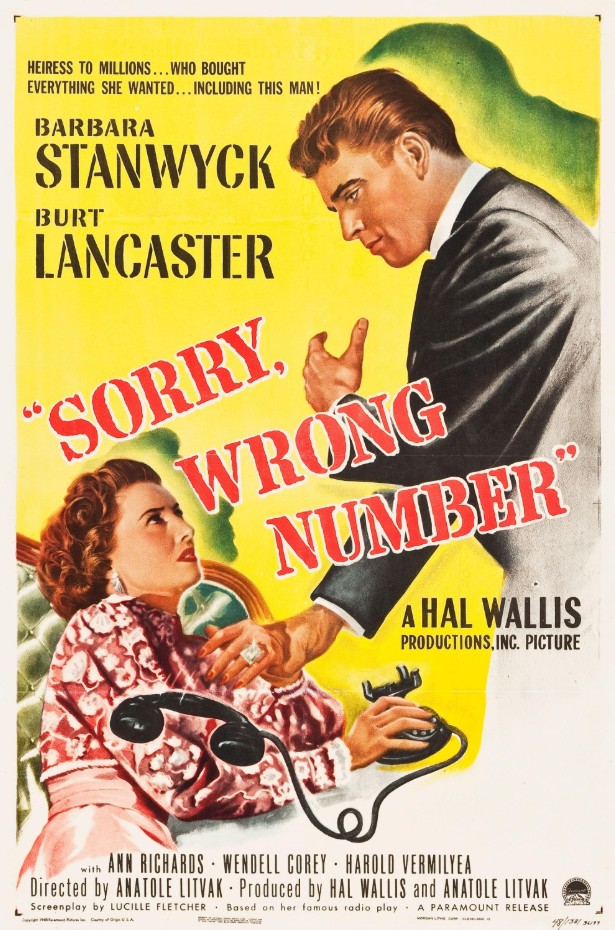
Film Noir is a genre that is infrequently covered on 18 Cinema Lane. This fact, along with the desire to expand my cinematic horizons, is why I joined Back in Black: Another Film Noir Blogathon! For this event, I wanted to select a film recommendation from one of my readers. Fortunately, I had seven suggestions that would have fit the blogathon’s criteria. Out of those titles, I chose 1948’s Sorry, Wrong Number, recommended by a reader named Noel! But this is not the only reason why I selected Sorry, Wrong Number for the event. The 1948 movie shares a similar premise to the Murder, She Wrote episode, ‘Crossed Up’. In both stories, the protagonist hears about an upcoming murder over the phone. I have reviewed the aforementioned Murder, She Wrote episode on my blog. While I thought it was ok, I think it would have made more sense to have put that episode somewhere in season one. Will I have similar feelings about Sorry, Wrong Number? Keep reading my review to find out!
Things I liked about the film:
Barbara Stanwyck’s performance: While the cast of Sorry, Wrong Number was solid, I want to specifically bring up Barbara’s performance, as the movie rested on her shoulders. Portraying the protagonist, Leona Stevenson, Barbara perfectly captured how frightening her character’s situation would be for anyone. Whether her voice was wavering due to being scared over the whereabouts of her husband, Henry, or her eyes becoming very wide when she discovers information about her past, Leona’s reactions appeared realistic because of the fluidity of Barbara’s acting talents. There was even a shot where only her hand was shown as she was dialing the phone, visibly shaking as she’s trying to make a call. Reactions like this one emphasized the suspense found in Sorry, Wrong Number.
How character development was established: Sorry, Wrong Number shares a major similarity with the Murder, She Wrote episode, ‘Crossed Up’; the protagonist discovers an upcoming murder over the phone. This discovery leads Leona to learn more about the mystery through various phone conversations. These conversations helped establish character development, as the audience learns more about the characters the longer they talk. Visuals also provided opportunities for the audience to discover more about the characters. One great example is when Leona calls her dad, James. As James talks with his daughter, the camera pans over the walls and the rest of his office. Pictures of Leona are placed around the room, with a portrait of Leona as a young girl hanging over the fireplace. Not only are guns mounted on the wall, taxidermic animals are also displayed as office décor. Through the cinematography, the things and people important to James are on full display, presenting a capsule of his life. The example I just described perfectly represented the concept of “showing instead of telling”.
An engaging presentation: Like I just mentioned in this review, Leona’s discovery of an upcoming murder over the phone leads her to learn more about the mystery through various phone conversations. This discovery happens almost immediately in the story, which allows the mystery to start right away. Leona receives details about the mystery as Sorry, Wrong Number progresses. Having the protagonist try to solve the mystery as she’s learning about it gives the audience a chance to solve the mystery alongside her, creating an interaction between the audience and the character. Even when Leona makes shocking discoveries, the audience experiences those moments with her as if the moments are shared. The creative decisions I just referenced make Sorry, Wrong Number an engaging presentation!
A balance between slow burn and sense of urgency: Film noir stories typically adopt a “slow burn” approach to storytelling, which allows the story to take its time being told. On the other hand, mystery stories usually incorporate a sense of urgency, especially if the story involves the characters racing against the clock. Sorry, Wrong Number is, in my opinion, one of those rare times when a balance between slow burn and sense of urgency is achieved! Even though the 1948 film is classified as “film noir” (according to IMDB), the majority of the story would be considered “slice of life” because of the focus on Leona’s life and her interactions over the phone. Yet her desire to discover what’s going on with Henry as well as the upcoming murder discovery gave Sorry, Wrong Number a sense of urgency. Lucille Fletcher, the screenwriter of the 1948 movie, held an understanding for how to balance these two different storytelling approaches, which was effectively showcased through her writing!
What I didn’t like about the film:
A dialogue heavy story: As I mentioned in the introduction of this review, Sorry, Wrong Number shares a similar premise to the Murder, She Wrote episode, ‘Crossed Up’, where the protagonist hears about an upcoming murder over the phone. Even though I was aware of this prior to watching Sorry, Wrong Number and even though the story allowed the audience to learn about the mystery alongside Leona, the 1948 film is dialogue heavy. This means viewers are forced to actively pay attention to what they’re watching or else they’ll miss important context. There were a few times when I had to rewind the movie in order to hear what the characters were saying, so I could catch essential information. Because I did that, however, it was kind of disruptive to my movie-viewing experience.
An ignored part of the script: Through one of her many phone conversations, Leona connects with Sally, a woman she knew in college. Both Leona and the audience not only learn Sally married a district attorney lawyer named Fred, he has been working on a case related to Leona. This part of the script adds intrigue to Sorry, Wrong Number as well as provides a “cat and mouse chase” for the movie. But as the story progresses, Fred and his case become forgotten about. In fact, after Leona’s phone conversation with Sally, Fred’s investigation isn’t brought up again. I wish this part of the script had been referenced, at least, another time in Sorry, Wrong Number, especially since the movie was released during the Breen Code era, when a theme like good vs. evil was typically adopted.
My overall impression:
I have brought up in this review how Sorry, Wrong Number and the Murder, She Wrote episode, ‘Crossed Up’ share a similar premise where both protagonists hear about an upcoming murder over the phone. I also addressed how I thought the episode was ok. Though it isn’t fair to compare Sorry, Wrong Number to ‘Crossed Up’, I found myself enjoying the movie more than the tv episode. The 1948 picture is an effective film, achieving this sentiment through several creative channels. Thanks to Lucille Fletcher’s screenwriting, the story effectively balanced a slow burn and sense of urgency. The screenwriting also allowed the overall presentation to be engaging, such as giving the audience a chance to solve the mystery alongside the protagonist. Barbara Stanwyck’s performance helped present a frightening situation that could happen to anyone due to how believable Leona’s reactions were. While I found Sorry, Wrong Number to be a good movie, I can’t say it was great, as the film was held back by two major flaws. However, I would definitely recommend this film, especially as an introductory title to the genre!
Overall score: 7.8 out of 10
Have you seen 1948’s Sorry, Wrong Number? Are there any movies from the Film Noir genre you’re interested in checking out? Let me know in the comment section!
Have fun at the movies!
Sally Silverscreen

