
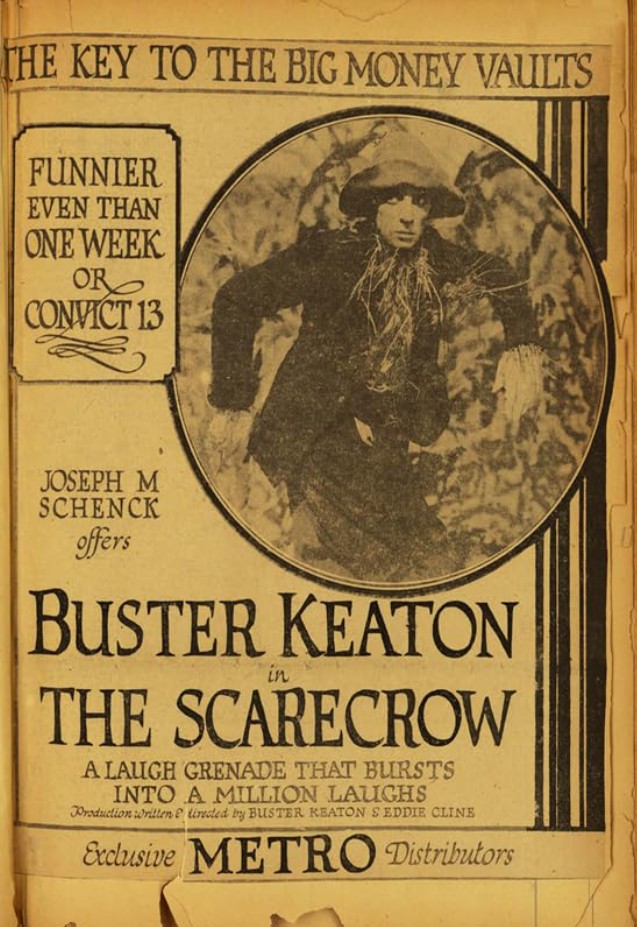
Last March, I participated in The Silent Pioneers Blogathon, which was hosted by Classic Film And TV Corner. In that event, I wrote about a double feature; 1920’s The Garage and 1925’s The Phantom of the Opera. This time around, for the Silent Movie Day Blogathon (hosted by Silentology and The Everyday Cinephile), I’m writing about another double feature. However, for this double feature, I will be reviewing two of Buster Keaton’s films! When I reviewed The Garage, I was recommended Buster Keaton’s complete short films collection by Maddy (from the aforementioned Classic Film And TV Corner). Out of the listed titles, I wanted to select a movie for my Silent Movie Day Blogathon entry that was more seasonal/festive to the Fall/Autumn season because of the blogathon’s September 29th date. When I saw The Scarecrow and The Haunted House on the short films list, I thought they’d both be the perfect choices I was looking for! So, without further delay, let’s begin this double feature with 1920’s The Scarecrow!
Things I liked about the film:
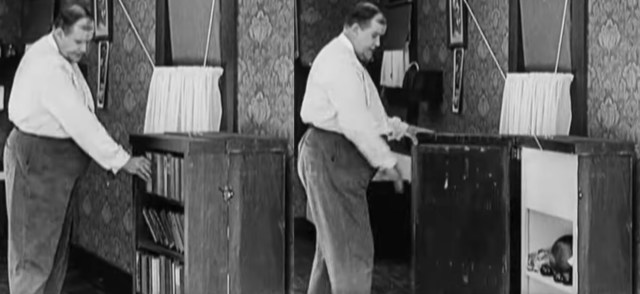
The set pieces: When I bring up the sets/background of a film, I will sometimes praise the scenery or set design. The reasons can range from aesthetically pleasing landscapes to historically accurate settings. However, I don’t often talk about specific set pieces. The Scarecrow has become the exception due to how impressively multi-functional the set pieces are. A title card reveals how “All the rooms in this house are in one room”, referring to the house Buster Keaton’s character and Joe Roberts’ character share. Because of this limited space, each set piece possessed more than one function. A giant record player is located next to the door. As Buster’s character helps prepare a meal, the record player reveals itself as both a stove and an oven. During these same meal preparations, Joe’s character shows the audience how a refrigerator was hiding behind a bookshelf. Even a tub transforms into a small loveseat, complete with a convenient drainage system. While watching The Scarecrow, it was fun to see the different ways each set piece was utilized!
The incorporation of Luke the Dog: Silent films will usually bring to mind actors or actresses having to rely on their facial expressions, body language, and interactions with other cast members to help visually tell a story. For comedic silent pictures, an actor’s or actress’s physical comedy, such as slapstick humor, will typically provide most of the story’s comedy. But in the case of The Scarecrow, the incorporation of a dog added some of the movie’s humor. After eating a cream pie intended for the Farmer, The Dog (portrayed by Luke the Dog) ends up chasing Buster’s character for about four minutes. When paired with Buster’s physical, slapstick comedy, The Dog’s reactions allowed both the chase and the laughs to continue. During the chase, Buster’s character climbs a ladder in order to get away from The Dog. Refusing to see the ladder as an obstacle, The Dog effortlessly climbs the ladder as well. As the chase leads Buster’s character to his and Joe’s character’s house, Buster’s character tries to escape The Dog’s path by hiding in the tub and exiting the house through its drainage system. Meanwhile, The Dog conveniently locates the house’s compost shute, which is also how The Dog leaves the house. Weaving The Dog into the story allowed The Scarecrow to provide creatively comedic moments in the film!
Buster Keaton’s facial expressions: Buster Keaton is one of the most celebrated actors from the Silent Film Era, claiming his fame through comedic stunts and slapstick comedy. But what The Scarecrow showed me is how well Buster utilized facial expressions throughout his performance. In one great example, Buster’s character is being chased by The Dog along the edge of an abandoned ruin. He removes a wooden board that was used as a bridge between a gap in the wall, believing The Dog would give up the chase. When The Dog jumps over the gap in order to get closer to Buster’s character, the look on Buster’s face says so much without saying anything at all. From the appearance in his eyes to the slight frown of his mouth, the feelings of defeat, frustration, and weariness are painted on Buster’s face. The excellent mastery of facial expressions helped make Buster’s performance one of the most entertaining aspects of The Scarecrow!
What I didn’t like about the film:
The scarecrow’s limited presence: As I mentioned in this review’s introduction, I wanted to write about The Scarecrow because I wanted to select a movie for my Silent Movie Day Blogathon entry that was more seasonal/festive to the Fall/Autumn season. With scarecrows typically present within Fall/Autumn themed décor and imagery and with the title of the movie being The Scarecrow, I believed the titular scarecrow would serve a significant role in the story. When I watched The Scarecrow, however, there were no scarecrows featured on screen until almost fifteen minutes into the twenty-minute story. I recognize the scarecrow was incorporated into one of Buster’s physical comedic parts of his performance. But with everything said, I wish the scarecrow was given more inclusion in the film.
Little to no context: Like I just brought up in this review, The Scarecrow has a run-time of twenty-minutes. This shorter length of time prevents the script from further exploring certain topics addressed by the characters, leaving viewers like me confused by verbal loose ends. One example is mentioned toward the beginning of the movie. Joe’s character has his heart set on marrying the Farmer’s Daughter. He even tells Buster’s character, “I don’t care how she votes – I’m going to marry her”. Yet, none of the title cards explain why the voting preferences of the Farmer’s Daughter held any significance within the script. As soon as Joe brought up the Farmer’s Daughter voting, it was quickly forgotten about.
An underutilized character: After the Farmer’s Daughter bakes a cream pie for her father, a woman shows the Farmer’s Daughter a magazine advertisement featuring ballet dancers. Through this interaction, the audience learns the Farmer’s Daughter is a very talented dancer. But this is the only scene the woman appears in. In fact, this character and the actress who portrayed her isn’t listed on IMDB or Wikipedia. I was actually disappointed by the underutilization of this character, as I was curious to see how she would affect the story’s events.
My overall impression:
I selected The Scarecrow as one of my entries for the Silent Movie Day Blogathon because I wanted to choose a title that was more seasonal/festive to the Fall/Autumn season. With appearances of hay bales, piles of hay, and a corn field, there were definitely scenes that felt reminiscent of Fall/Autumn. But what The Scarecrow also provides were effectively humorous moments and a simplistic, yet easier to follow story. The strengths of the 1920 picture added to my movie-viewing experience, such as Buster’s excellent utilization of facial expressions and set pieces that were both creative and ingenious. Even adding Luke the Dog to the story helped deliver more comedy, actually complimenting Buster’s slapstick antics. However, The Scarecrow does have its flaws. One of the major issues is how the titular scarecrow doesn’t appear in the movie for very long, showing up almost fifteen minutes into the twenty-minute story. Despite these flaws, The Scarecrow is certainly a worthy silent film to check out, even if it’s your first time watching a Buster Keaton film!
Overall score: 7.7 out of 10
Have you seen The Scarecrow from 1920? What movies remind you of Fall/Autumn? Please tell me in the comment section!
Have fun at the movies!
Sally Silverscreen


I love The Scarecrow! The scene at the table is one of my favorites of all of Keaton’s work and I love how Buster uses the bathtub during his chase with Luke.
LikeLiked by 1 person
Thanks for reading my review and for sharing your thoughts on The Scarecrow! The scene at the table and even Buster’s chase with Luke was so entertaining to watch partly due to how creative and ingenious the set pieces were.
LikeLike
I have to see this! Buster Keaton is awesome.
LikeLiked by 1 person
Thanks, Rebecca, for reading my review! If you do check out The Scarecrow, I’d be interested in hearing your thoughts on the film.
LikeLike