Take 3: The Haunted House (1921) Review (Buster Keaton Double Feature Part 2)

As I mentioned in the introduction of my review for 1920’s The Scarecrow, I wanted to select a movie for my Silent Movie Day Blogathon entry that was more seasonal/festive to the Fall/Autumn season because of the blogathon’s September 29th date. Out of the listed titles from Buster Keaton’s complete short films collection (recommended by Maddy from Classic Film And TV Corner), I thought The Scarecrow and The Haunted House would be the perfect choices I was looking for! This is especially true considering Halloween is on the horizon. Looking back on all the movies I’ve reviewed that would fit the Halloween season, the only pictures predominantly featuring a haunted house are 1983’s House of the Long Shadows and 1961’s The Innocents. While I found The Innocents confusing, House of the Long Shadows turned out to be a hidden gem. Similar to House of the Long Shadows, 1921’s The Haunted House is classified on IMDB as both a “horror” and “comedy” film. But will the short film be a hidden gem as well? Keep reading my review to find out!
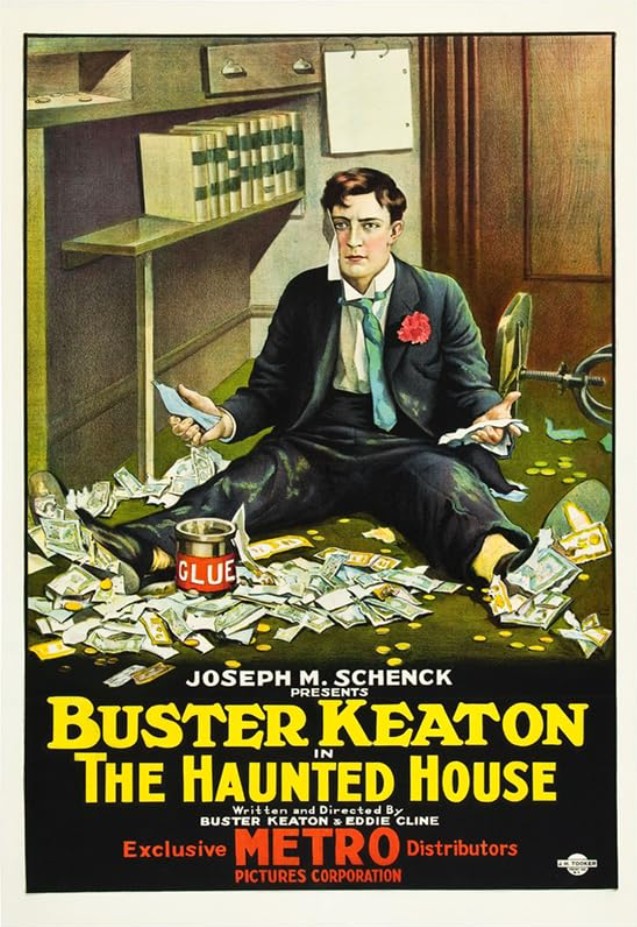
The Haunted House (1921) poster created by Joseph M. Schenck Productions and Metro Pictures Corporation

Things I liked about the film:

The exterior of the “haunted house”: In The Haunted House, the titular house was considered “haunted” because a group of thieves intentionally created an environment where people would be too scared to discover their stolen money. While the interior of the “haunted house” was on full display, I was impressed by the exterior of the house. This three-story structure was covered in pristine white wood. A long shot reveals the house possesses a wrap-around porch, as well as a small balcony on the third floor. The large, surrounding trees not only nicely frame the house, they also allow the house to stand out. There’s even a beautiful wrought-iron fence and gate displayed at the front of the property. Even though there were two scenes where the exterior of the “haunted house” was shown, I wish there was, at least, one more shot to showcase the gorgeous architecture of the house!

How spooky elements were utilized: As I said in the introduction of this review, I selected The Haunted House for the Silent Movie Day Blogathon because Halloween is on the horizon. When Buster Keaton’s character (the Bank Clerk) enters the “haunted house”, that’s when the spookiness enters the story. Two people dressed up as skeletons construct a mannequin who magically comes to life. The mystery of how these skeletons could make the mannequin animate adds a hint of magic sometimes associated with Halloween. A headless man asks the Bank Clerk to hold his head. Though this headless man appears in only one scene, he was reminiscent of the iconic Headless Horseman, a character usually affiliated with the Halloween season. When an actor portraying Faust has his cape catch on fire, he is followed by fire and smoke, making him appear scarier than he actually is. Though the actor escaped to the “haunted house” following a bad stage performance, his presence complimented the spookiness of the setting. With The Haunted House being a silent picture, the creative team behind the short film displayed an understanding of how to craft a visually memorable location. Combining costuming, the actors’ performances, and special effects, how the spooky elements of The Haunted House were utilized made scenes within the “haunted house” feel appropriate for the holiday of Halloween!

Physical comedy: When I reviewed The Scarecrow, I didn’t discuss the utilization of physical comedy too much. That’s because I took the time to praise how the incorporation of Luke the Dog complimented Buster’s slapstick antics. But, in The Haunted House, the actors were solely responsible for providing the film’s physical comedy. Even though the “haunted house” was intended to be a scary location, it was a great environment for physical comedy to take place. In an upstairs hallway, the Bank Clerk becomes fed up with ghosts constantly crossing and blocking his path. To remedy the problem, he pulls out a whistle and directs traffic in the hallway. When the Bank Clerk motions for the ghosts to stop, they obey his command and stop in the middle of the hallway, waiting for his cue in order to move again. While this example of physical comedy is simpler, it was a creative and effective way to combine Buster’s acting performance and the spooky elements the “haunted house” had to offer!
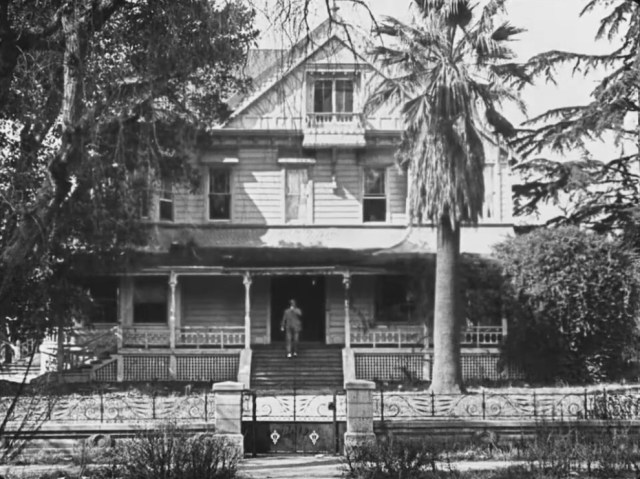
I provided a picture of the exterior of the “haunted house” because I knew my description wouldn’t do it justice. “Haunted house” image created by Joseph M. Schenck Productions and Metro Pictures Corporation

What I didn’t like about the film:

Prolonged appearance of the “haunted house”: With a title like The Haunted House, I expected the titular setting to be prominently featured in the story. While the “haunted house” appeared more in The Haunted House than the scarecrow did in The Scarecrow, the appearance of the “haunted house” was prolonged. In the 1921 picture, the “haunted” nature of the “haunted house” didn’t take place until almost thirteen minutes into the twenty-four-minute story. The first half of The Haunted House revolved around the mishaps at the bank, with some of that time given to the disastrous performance of the Daredevil Opera Company. I wish the “haunted house” had appeared earlier in the movie, so the script could get to the spooky point sooner.

Things left unexplained: During my discussion of The Scarecrow’s flaws, I pointed out how the movie’s twenty-minute run-time prevented the script from further exploring certain topics addressed by the characters. The Haunted House shares a similar flaw. Only this time, the film’s twenty-four-minute run-time left little room to provide explanation when necessary. Like I just brought up in this review, the Daredevil Opera Company had a disastrous performance. To escape the wrath of their audience, the actors run away to the “haunted house”. But, as the story progressed, the Daredevil Opera Company actors disappeared, with their further whereabouts unknown. Since the creative team behind The Haunted House knew their project’s run-time would be short, they should have included a title card providing a brief explanation of what happened to the Daredevil Opera Company actors.

An overwhelming story: Like I’ve been saying in this review, there are three parts of The Haunted House’s story; the mishaps at the bank, the Daredevil Opera Company’s disastrous performance, and the antics within the “haunted house”. As I’ve also said in this review, The Haunted House possesses a twenty-four-minute run-time. This left the creative team so little time to tell so much story. With everything happening on screen, there were a few times I felt overwhelmed while watching The Haunted House. In fact, I had to watch the movie a second time just to gain a better understanding of what was going on in the story. This plan ended up working for me, however, as I had a better grasp on the story’s context.
The Silent Movie Day Blogathon banner created by Lea (from Silentology) and Shawn (from The Everyday Cinephile)

My overall impression:

Halloween being on the horizon is one of the reasons why I chose The Haunted House for the Silent Movie Day Blogathon. Because of how the spooky elements were utilized in the titular “haunted house”, the scenes within the “haunted house” certainly felt reminiscent of Halloween. But what also worked in the space of the “haunted house” was the physical comedy, as the spooky elements and Buster Keaton’s performance provided an entertaining, visually memorable combination. Though the exterior of the “haunted house” only appeared in two scenes, it left such a beautiful impression. I honestly wish the house’s exterior had appeared in the movie, at least, one more time, to find more opportunities to show off the house’s gorgeous architecture. Even though The Haunted House had its strengths, it also had its flaws. With so much taking place in the story and so little time to tell that story, the 1921 picture left me overwhelmed a few times. The shorter run-time also prevented the movie’s creative team from providing explanations when necessary, such as what happened to the Daredevil Opera Company actors. I was disappointed by the prolonged appearance of the “haunted house”, as the “haunted house” itself is a major reason why I chose to review the film in the first place. However, I still enjoyed watching The Haunted House almost as much as The Scarecrow.

Overall score: 7.6 out of 10

Have you seen 1921’s The Haunted House? Is there a movie featuring a haunted house you thought was entertaining? Tell me in the comment section!

Have fun at the movies!

Sally Silverscreen
Take 3: The Scarecrow (1920) Review (Buster Keaton Double Feature Part 1)

Last March, I participated in The Silent Pioneers Blogathon, which was hosted by Classic Film And TV Corner. In that event, I wrote about a double feature; 1920’s The Garage and 1925’s The Phantom of the Opera. This time around, for the Silent Movie Day Blogathon (hosted by Silentology and The Everyday Cinephile), I’m writing about another double feature. However, for this double feature, I will be reviewing two of Buster Keaton’s films! When I reviewed The Garage, I was recommended Buster Keaton’s complete short films collection by Maddy (from the aforementioned Classic Film And TV Corner). Out of the listed titles, I wanted to select a movie for my Silent Movie Day Blogathon entry that was more seasonal/festive to the Fall/Autumn season because of the blogathon’s September 29th date. When I saw The Scarecrow and The Haunted House on the short films list, I thought they’d both be the perfect choices I was looking for! So, without further delay, let’s begin this double feature with 1920’s The Scarecrow!

The Scarecrow (1920) poster created by Joseph M. Schenck Productions and Metro Pictures Corporation

Things I liked about the film:

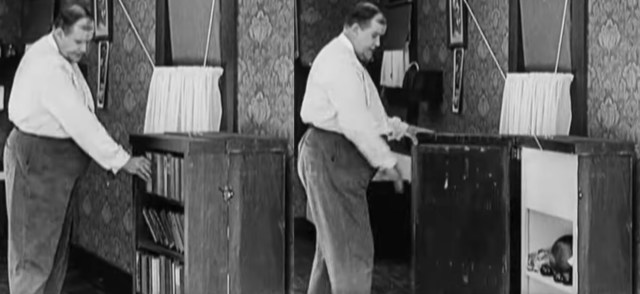
The set pieces: When I bring up the sets/background of a film, I will sometimes praise the scenery or set design. The reasons can range from aesthetically pleasing landscapes to historically accurate settings. However, I don’t often talk about specific set pieces. The Scarecrow has become the exception due to how impressively multi-functional the set pieces are. A title card reveals how “All the rooms in this house are in one room”, referring to the house Buster Keaton’s character and Joe Roberts’ character share. Because of this limited space, each set piece possessed more than one function. A giant record player is located next to the door. As Buster’s character helps prepare a meal, the record player reveals itself as both a stove and an oven. During these same meal preparations, Joe’s character shows the audience how a refrigerator was hiding behind a bookshelf. Even a tub transforms into a small loveseat, complete with a convenient drainage system. While watching The Scarecrow, it was fun to see the different ways each set piece was utilized!

The incorporation of Luke the Dog: Silent films will usually bring to mind actors or actresses having to rely on their facial expressions, body language, and interactions with other cast members to help visually tell a story. For comedic silent pictures, an actor’s or actress’s physical comedy, such as slapstick humor, will typically provide most of the story’s comedy. But in the case of The Scarecrow, the incorporation of a dog added some of the movie’s humor. After eating a cream pie intended for the Farmer, The Dog (portrayed by Luke the Dog) ends up chasing Buster’s character for about four minutes. When paired with Buster’s physical, slapstick comedy, The Dog’s reactions allowed both the chase and the laughs to continue. During the chase, Buster’s character climbs a ladder in order to get away from The Dog. Refusing to see the ladder as an obstacle, The Dog effortlessly climbs the ladder as well. As the chase leads Buster’s character to his and Joe’s character’s house, Buster’s character tries to escape The Dog’s path by hiding in the tub and exiting the house through its drainage system. Meanwhile, The Dog conveniently locates the house’s compost shute, which is also how The Dog leaves the house. Weaving The Dog into the story allowed The Scarecrow to provide creatively comedic moments in the film!

Buster Keaton’s facial expressions: Buster Keaton is one of the most celebrated actors from the Silent Film Era, claiming his fame through comedic stunts and slapstick comedy. But what The Scarecrow showed me is how well Buster utilized facial expressions throughout his performance. In one great example, Buster’s character is being chased by The Dog along the edge of an abandoned ruin. He removes a wooden board that was used as a bridge between a gap in the wall, believing The Dog would give up the chase. When The Dog jumps over the gap in order to get closer to Buster’s character, the look on Buster’s face says so much without saying anything at all. From the appearance in his eyes to the slight frown of his mouth, the feelings of defeat, frustration, and weariness are painted on Buster’s face. The excellent mastery of facial expressions helped make Buster’s performance one of the most entertaining aspects of The Scarecrow!

In these pictures, Joe’s character reveals a delicious surprise hiding behind the bookshelf. Refrigerator bookshelf set piece images created by Joseph M. Schenck Productions and Metro Pictures Corporation.

What I didn’t like about the film:

The scarecrow’s limited presence: As I mentioned in this review’s introduction, I wanted to write about The Scarecrow because I wanted to select a movie for my Silent Movie Day Blogathon entry that was more seasonal/festive to the Fall/Autumn season. With scarecrows typically present within Fall/Autumn themed décor and imagery and with the title of the movie being The Scarecrow, I believed the titular scarecrow would serve a significant role in the story. When I watched The Scarecrow, however, there were no scarecrows featured on screen until almost fifteen minutes into the twenty-minute story. I recognize the scarecrow was incorporated into one of Buster’s physical comedic parts of his performance. But with everything said, I wish the scarecrow was given more inclusion in the film.

Little to no context: Like I just brought up in this review, The Scarecrow has a run-time of twenty-minutes. This shorter length of time prevents the script from further exploring certain topics addressed by the characters, leaving viewers like me confused by verbal loose ends. One example is mentioned toward the beginning of the movie. Joe’s character has his heart set on marrying the Farmer’s Daughter. He even tells Buster’s character, “I don’t care how she votes – I’m going to marry her”. Yet, none of the title cards explain why the voting preferences of the Farmer’s Daughter held any significance within the script. As soon as Joe brought up the Farmer’s Daughter voting, it was quickly forgotten about.

An underutilized character: After the Farmer’s Daughter bakes a cream pie for her father, a woman shows the Farmer’s Daughter a magazine advertisement featuring ballet dancers. Through this interaction, the audience learns the Farmer’s Daughter is a very talented dancer. But this is the only scene the woman appears in. In fact, this character and the actress who portrayed her isn’t listed on IMDB or Wikipedia. I was actually disappointed by the underutilization of this character, as I was curious to see how she would affect the story’s events.

The Silent Movie Day Blogathon banner created by Lea (from Silentology) and Shawn (from The Everyday Cinephile)

My overall impression:

I selected The Scarecrow as one of my entries for the Silent Movie Day Blogathon because I wanted to choose a title that was more seasonal/festive to the Fall/Autumn season. With appearances of hay bales, piles of hay, and a corn field, there were definitely scenes that felt reminiscent of Fall/Autumn. But what The Scarecrow also provides were effectively humorous moments and a simplistic, yet easier to follow story. The strengths of the 1920 picture added to my movie-viewing experience, such as Buster’s excellent utilization of facial expressions and set pieces that were both creative and ingenious. Even adding Luke the Dog to the story helped deliver more comedy, actually complimenting Buster’s slapstick antics. However, The Scarecrow does have its flaws. One of the major issues is how the titular scarecrow doesn’t appear in the movie for very long, showing up almost fifteen minutes into the twenty-minute story. Despite these flaws, The Scarecrow is certainly a worthy silent film to check out, even if it’s your first time watching a Buster Keaton film!

Overall score: 7.7 out of 10

Have you seen The Scarecrow from 1920? What movies remind you of Fall/Autumn? Please tell me in the comment section!

Have fun at the movies!

Sally Silverscreen
Take 3: The Death of Poor Joe (1901) Review (A Month Without the Code #5)

As Pure Entertainment Preservation Society’s A Month Without the Code comes to a close, I wanted to review a movie that served as the grand finale. Since I found every movie I reviewed so far to be just ok, I knew whichever film I chose had to be memorable in some way. The more I think about my choice, the more confident I feel it will leave an impression. The Death of Poor Joe is not only the oldest film I have written about, it is the shortest film featured on 18 Cinema Lane! This movie is a minute long, revolving around the death of Joe from Bleak House. I read this book several years ago, with Joe being my favorite character. I’m not going to lie; I was not a fan of Charles Dickens’ decision to have Joe die in the story. But after reading Oliver Twist, I gained an understanding for why that decision was made. The Death of Poor Joe also serves as an important piece of film history. It is the oldest existing adaptation of any work from Charles Dickens. It is a former lost film as well, with a curator from the British Film Institute, Bryony Dixon, finding the film in 2012.

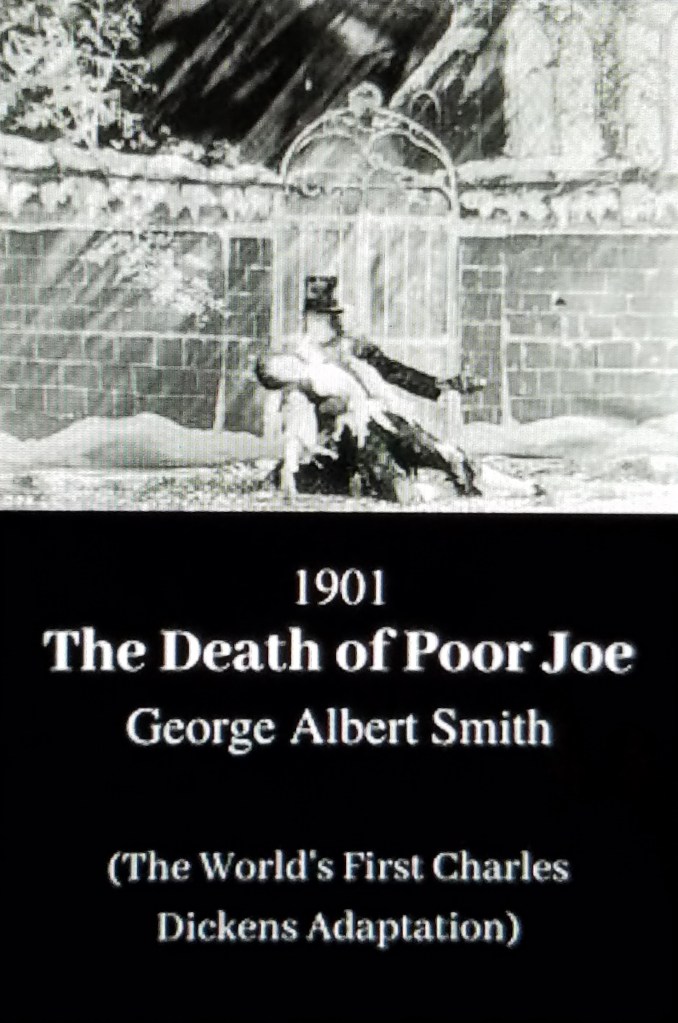
This is a screenshot from my phone of the film’s image. It is the closest thing to a film poster I was able to find on the internet. Screenshot taken by me, Sally Silverscreen.

Things I liked about the film:

The acting: As I said in my Wild Oranges review, the actors in a silent film have to rely on body language, facial expressions, and actions/behaviors to portray what their characters are saying and feeling. Laura Bayley, the actress who is cast as the titular character, does a great job using these acting techniques to show what her character is experiencing. Right before Joe dies, the audience sees him looking toward the sky and holding his hands in a praying position. This tells them that Joe is begging God for mercy. The only other actor in this film is Tom Green, who portrays a police officer. Similar to Laura’s performance, Tom also utilized body language, facial expressions, and actions/behaviors in his favor. When the police officer first encounters Joe, he is seen pointing at the protagonist and waving his hand. These gestures indicate the police officer telling the young boy to move off the sidewalk.

The costume design: Another important piece of a silent film is costume design, as this specific component can help express character development. Though the movie’s costume designer is unknown, I was impressed with the costume design I saw! Both outfits, Joe’s and the police officer’s, appeared historically accurate and fit each characterization. They were also distinct, allowing the characters to contrast one another. The police officer can be seen wearing a dark suit and a top hat. This ensemble signifies the police officer’s importance and social standing within that time period. Meanwhile, Joe is shown wearing a shirt and pants that are torn and ragged. Joe’s outfit reminds the audience of how he lacks a parental figure who will look out for his best interests.

The use of snow: I don’t remember if it was snowing when Joe died, as it has been several years since I last read Bleak House. In this short film, however, I like how snow was incorporated into the characters’ surroundings! Snow has a consistent presence in this story, as it covers the ground and top of the wall behind Joe and the police officer. It can also be seen falling from the sky. Because of the black-and-white presentation of the movie, the snow helps create an image that is haunting. The presence of snow instills a feeling sadness as well, warning the audience that an uncontrollable fate is about to take place in the story.

A Month Without the Code Blogathon banner created by Tiffany and Rebekah Brannan from Pure Entertainment Preservation Society. Image found at https://pureentertainmentpreservationsociety.wordpress.com/2020/07/27/announcing-amonthwithoutthecode2020/.

What I didn’t like about the film:

Lack of title cards: Most silent films feature title cards, which help give context to what is happening on screen. This staple of silent movies was absent from The Death of Poor Joe. Audience members who are not familiar with the source material might wonder why they should care about the characters. There is no preparation leading up to Joe’s death, as the event itself happens in mere seconds. If title cards had been included in this film, it may have resolved some of these issues.

No music: Music can strength a movie’s tone and set the mood for the story. But music was excluded from The Death of Poor Joe, causing the film to be very silent. While the narrative itself is sad, music could have enhanced the movie-viewing experience. Dramatic sounds from a violin or a somber piano tune could accompany the visuals well. Certain beats might match up with specific events, promoting a sense of musicality. I know live music would play during a silent film if it were presented in a movie theater. But I wish music was added to The Death of Poor Joe.

A shorter run-time: In this review’s introduction, I mentioned how The Death of Poor Joe was a minute long. Even though I knew this was a short film, I still feel it should have received a longer run-time. Pieces of Joe’s and the police officer’s backstory could have been included in the movie. The audience might be able to spend more time with Joe as a character, which would have made his death more heartbreaking. Seeing how the police officer deals with Joe’s death is an interesting concept to think about. Because The Death of Poor Joe’s run-time was only a minute long, it limits how much story was allowed to be told.

Sketch of London image created by Archjoe at freepik.com. <a href=’https://www.freepik.com/free-vector/hand-drawn-houses-of-parliament_1133950.htm’>Designed by Archjoe</a>. <a href=”https://www.freepik.com/free-photos-vectors/background”>Background vector created by Archjoe – Freepik.com</a>. Image found at freepik.com.

My overall impression:

The history of The Death of Poor Joe might be more interesting than the film itself. In its 119-year lifespan, the film gained the mysterious title of “lost film”. This status has been placed on the project for about 66 years. Eight years ago, the movie received a new title: found. As someone who has taken an interest in lost media, I am grateful for Bryony Dixon’s and the British Film Institute’s efforts to preserve The Death of Poor Joe! As for the film itself, I thought it was fine. The story was straight-to-the-point and the production quality was impressive. However, I wish the film was longer. As someone who has chosen Joe as their favorite character from Bleak House, it would have been nice to see his story fleshed out more. Music and title cards also would have added to the movie-viewing experience as well. Joe’s on-screen death is the only thing that would need to change if this was a Breen Code era film. While this event is an important part of the story, it would need to meet Breen Code standards.

Overall score: 7 out of 10

Have you seen any adaptations of Charles Dickens’ work? Are there any found films you’d like to see? Let me know in the comment section!

Have fun at the movies!

Sally Silverscreen