Take 3: The Haunted House (1921) Review (Buster Keaton Double Feature Part 2)

As I mentioned in the introduction of my review for 1920’s The Scarecrow, I wanted to select a movie for my Silent Movie Day Blogathon entry that was more seasonal/festive to the Fall/Autumn season because of the blogathon’s September 29th date. Out of the listed titles from Buster Keaton’s complete short films collection (recommended by Maddy from Classic Film And TV Corner), I thought The Scarecrow and The Haunted House would be the perfect choices I was looking for! This is especially true considering Halloween is on the horizon. Looking back on all the movies I’ve reviewed that would fit the Halloween season, the only pictures predominantly featuring a haunted house are 1983’s House of the Long Shadows and 1961’s The Innocents. While I found The Innocents confusing, House of the Long Shadows turned out to be a hidden gem. Similar to House of the Long Shadows, 1921’s The Haunted House is classified on IMDB as both a “horror” and “comedy” film. But will the short film be a hidden gem as well? Keep reading my review to find out!
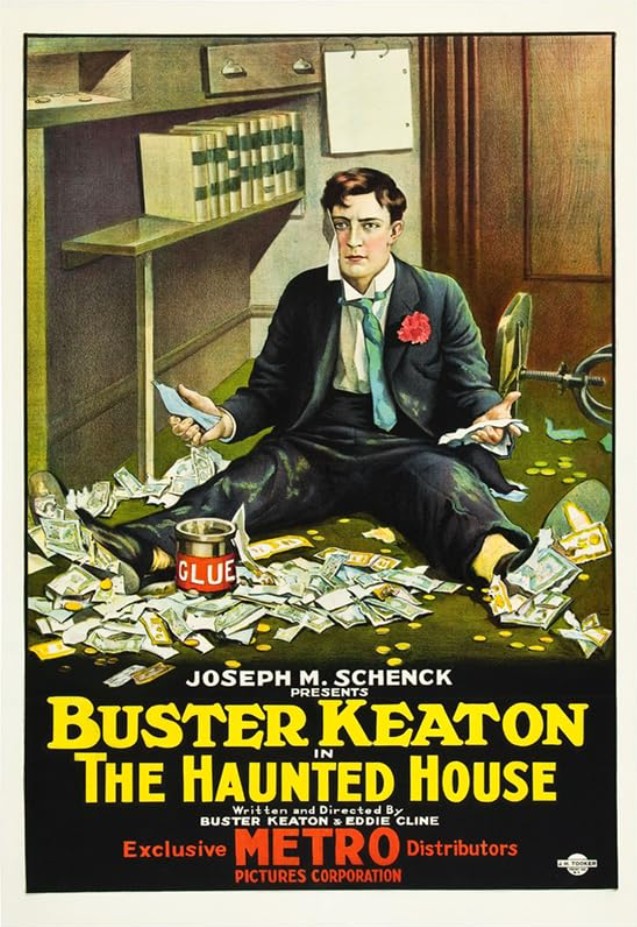
The Haunted House (1921) poster created by Joseph M. Schenck Productions and Metro Pictures Corporation

Things I liked about the film:

The exterior of the “haunted house”: In The Haunted House, the titular house was considered “haunted” because a group of thieves intentionally created an environment where people would be too scared to discover their stolen money. While the interior of the “haunted house” was on full display, I was impressed by the exterior of the house. This three-story structure was covered in pristine white wood. A long shot reveals the house possesses a wrap-around porch, as well as a small balcony on the third floor. The large, surrounding trees not only nicely frame the house, they also allow the house to stand out. There’s even a beautiful wrought-iron fence and gate displayed at the front of the property. Even though there were two scenes where the exterior of the “haunted house” was shown, I wish there was, at least, one more shot to showcase the gorgeous architecture of the house!

How spooky elements were utilized: As I said in the introduction of this review, I selected The Haunted House for the Silent Movie Day Blogathon because Halloween is on the horizon. When Buster Keaton’s character (the Bank Clerk) enters the “haunted house”, that’s when the spookiness enters the story. Two people dressed up as skeletons construct a mannequin who magically comes to life. The mystery of how these skeletons could make the mannequin animate adds a hint of magic sometimes associated with Halloween. A headless man asks the Bank Clerk to hold his head. Though this headless man appears in only one scene, he was reminiscent of the iconic Headless Horseman, a character usually affiliated with the Halloween season. When an actor portraying Faust has his cape catch on fire, he is followed by fire and smoke, making him appear scarier than he actually is. Though the actor escaped to the “haunted house” following a bad stage performance, his presence complimented the spookiness of the setting. With The Haunted House being a silent picture, the creative team behind the short film displayed an understanding of how to craft a visually memorable location. Combining costuming, the actors’ performances, and special effects, how the spooky elements of The Haunted House were utilized made scenes within the “haunted house” feel appropriate for the holiday of Halloween!

Physical comedy: When I reviewed The Scarecrow, I didn’t discuss the utilization of physical comedy too much. That’s because I took the time to praise how the incorporation of Luke the Dog complimented Buster’s slapstick antics. But, in The Haunted House, the actors were solely responsible for providing the film’s physical comedy. Even though the “haunted house” was intended to be a scary location, it was a great environment for physical comedy to take place. In an upstairs hallway, the Bank Clerk becomes fed up with ghosts constantly crossing and blocking his path. To remedy the problem, he pulls out a whistle and directs traffic in the hallway. When the Bank Clerk motions for the ghosts to stop, they obey his command and stop in the middle of the hallway, waiting for his cue in order to move again. While this example of physical comedy is simpler, it was a creative and effective way to combine Buster’s acting performance and the spooky elements the “haunted house” had to offer!
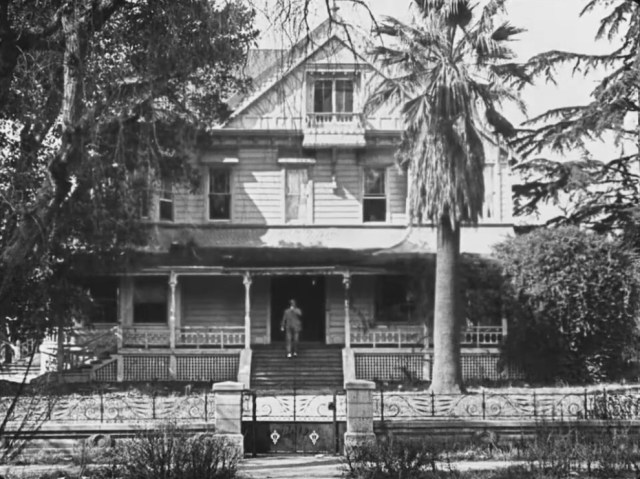
I provided a picture of the exterior of the “haunted house” because I knew my description wouldn’t do it justice. “Haunted house” image created by Joseph M. Schenck Productions and Metro Pictures Corporation

What I didn’t like about the film:

Prolonged appearance of the “haunted house”: With a title like The Haunted House, I expected the titular setting to be prominently featured in the story. While the “haunted house” appeared more in The Haunted House than the scarecrow did in The Scarecrow, the appearance of the “haunted house” was prolonged. In the 1921 picture, the “haunted” nature of the “haunted house” didn’t take place until almost thirteen minutes into the twenty-four-minute story. The first half of The Haunted House revolved around the mishaps at the bank, with some of that time given to the disastrous performance of the Daredevil Opera Company. I wish the “haunted house” had appeared earlier in the movie, so the script could get to the spooky point sooner.

Things left unexplained: During my discussion of The Scarecrow’s flaws, I pointed out how the movie’s twenty-minute run-time prevented the script from further exploring certain topics addressed by the characters. The Haunted House shares a similar flaw. Only this time, the film’s twenty-four-minute run-time left little room to provide explanation when necessary. Like I just brought up in this review, the Daredevil Opera Company had a disastrous performance. To escape the wrath of their audience, the actors run away to the “haunted house”. But, as the story progressed, the Daredevil Opera Company actors disappeared, with their further whereabouts unknown. Since the creative team behind The Haunted House knew their project’s run-time would be short, they should have included a title card providing a brief explanation of what happened to the Daredevil Opera Company actors.

An overwhelming story: Like I’ve been saying in this review, there are three parts of The Haunted House’s story; the mishaps at the bank, the Daredevil Opera Company’s disastrous performance, and the antics within the “haunted house”. As I’ve also said in this review, The Haunted House possesses a twenty-four-minute run-time. This left the creative team so little time to tell so much story. With everything happening on screen, there were a few times I felt overwhelmed while watching The Haunted House. In fact, I had to watch the movie a second time just to gain a better understanding of what was going on in the story. This plan ended up working for me, however, as I had a better grasp on the story’s context.
The Silent Movie Day Blogathon banner created by Lea (from Silentology) and Shawn (from The Everyday Cinephile)

My overall impression:

Halloween being on the horizon is one of the reasons why I chose The Haunted House for the Silent Movie Day Blogathon. Because of how the spooky elements were utilized in the titular “haunted house”, the scenes within the “haunted house” certainly felt reminiscent of Halloween. But what also worked in the space of the “haunted house” was the physical comedy, as the spooky elements and Buster Keaton’s performance provided an entertaining, visually memorable combination. Though the exterior of the “haunted house” only appeared in two scenes, it left such a beautiful impression. I honestly wish the house’s exterior had appeared in the movie, at least, one more time, to find more opportunities to show off the house’s gorgeous architecture. Even though The Haunted House had its strengths, it also had its flaws. With so much taking place in the story and so little time to tell that story, the 1921 picture left me overwhelmed a few times. The shorter run-time also prevented the movie’s creative team from providing explanations when necessary, such as what happened to the Daredevil Opera Company actors. I was disappointed by the prolonged appearance of the “haunted house”, as the “haunted house” itself is a major reason why I chose to review the film in the first place. However, I still enjoyed watching The Haunted House almost as much as The Scarecrow.

Overall score: 7.6 out of 10

Have you seen 1921’s The Haunted House? Is there a movie featuring a haunted house you thought was entertaining? Tell me in the comment section!

Have fun at the movies!

Sally Silverscreen
Take 3: The Scarecrow (1920) Review (Buster Keaton Double Feature Part 1)

Last March, I participated in The Silent Pioneers Blogathon, which was hosted by Classic Film And TV Corner. In that event, I wrote about a double feature; 1920’s The Garage and 1925’s The Phantom of the Opera. This time around, for the Silent Movie Day Blogathon (hosted by Silentology and The Everyday Cinephile), I’m writing about another double feature. However, for this double feature, I will be reviewing two of Buster Keaton’s films! When I reviewed The Garage, I was recommended Buster Keaton’s complete short films collection by Maddy (from the aforementioned Classic Film And TV Corner). Out of the listed titles, I wanted to select a movie for my Silent Movie Day Blogathon entry that was more seasonal/festive to the Fall/Autumn season because of the blogathon’s September 29th date. When I saw The Scarecrow and The Haunted House on the short films list, I thought they’d both be the perfect choices I was looking for! So, without further delay, let’s begin this double feature with 1920’s The Scarecrow!

The Scarecrow (1920) poster created by Joseph M. Schenck Productions and Metro Pictures Corporation

Things I liked about the film:

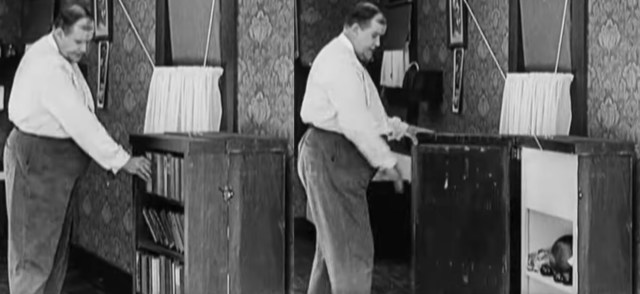
The set pieces: When I bring up the sets/background of a film, I will sometimes praise the scenery or set design. The reasons can range from aesthetically pleasing landscapes to historically accurate settings. However, I don’t often talk about specific set pieces. The Scarecrow has become the exception due to how impressively multi-functional the set pieces are. A title card reveals how “All the rooms in this house are in one room”, referring to the house Buster Keaton’s character and Joe Roberts’ character share. Because of this limited space, each set piece possessed more than one function. A giant record player is located next to the door. As Buster’s character helps prepare a meal, the record player reveals itself as both a stove and an oven. During these same meal preparations, Joe’s character shows the audience how a refrigerator was hiding behind a bookshelf. Even a tub transforms into a small loveseat, complete with a convenient drainage system. While watching The Scarecrow, it was fun to see the different ways each set piece was utilized!

The incorporation of Luke the Dog: Silent films will usually bring to mind actors or actresses having to rely on their facial expressions, body language, and interactions with other cast members to help visually tell a story. For comedic silent pictures, an actor’s or actress’s physical comedy, such as slapstick humor, will typically provide most of the story’s comedy. But in the case of The Scarecrow, the incorporation of a dog added some of the movie’s humor. After eating a cream pie intended for the Farmer, The Dog (portrayed by Luke the Dog) ends up chasing Buster’s character for about four minutes. When paired with Buster’s physical, slapstick comedy, The Dog’s reactions allowed both the chase and the laughs to continue. During the chase, Buster’s character climbs a ladder in order to get away from The Dog. Refusing to see the ladder as an obstacle, The Dog effortlessly climbs the ladder as well. As the chase leads Buster’s character to his and Joe’s character’s house, Buster’s character tries to escape The Dog’s path by hiding in the tub and exiting the house through its drainage system. Meanwhile, The Dog conveniently locates the house’s compost shute, which is also how The Dog leaves the house. Weaving The Dog into the story allowed The Scarecrow to provide creatively comedic moments in the film!

Buster Keaton’s facial expressions: Buster Keaton is one of the most celebrated actors from the Silent Film Era, claiming his fame through comedic stunts and slapstick comedy. But what The Scarecrow showed me is how well Buster utilized facial expressions throughout his performance. In one great example, Buster’s character is being chased by The Dog along the edge of an abandoned ruin. He removes a wooden board that was used as a bridge between a gap in the wall, believing The Dog would give up the chase. When The Dog jumps over the gap in order to get closer to Buster’s character, the look on Buster’s face says so much without saying anything at all. From the appearance in his eyes to the slight frown of his mouth, the feelings of defeat, frustration, and weariness are painted on Buster’s face. The excellent mastery of facial expressions helped make Buster’s performance one of the most entertaining aspects of The Scarecrow!

In these pictures, Joe’s character reveals a delicious surprise hiding behind the bookshelf. Refrigerator bookshelf set piece images created by Joseph M. Schenck Productions and Metro Pictures Corporation.

What I didn’t like about the film:

The scarecrow’s limited presence: As I mentioned in this review’s introduction, I wanted to write about The Scarecrow because I wanted to select a movie for my Silent Movie Day Blogathon entry that was more seasonal/festive to the Fall/Autumn season. With scarecrows typically present within Fall/Autumn themed décor and imagery and with the title of the movie being The Scarecrow, I believed the titular scarecrow would serve a significant role in the story. When I watched The Scarecrow, however, there were no scarecrows featured on screen until almost fifteen minutes into the twenty-minute story. I recognize the scarecrow was incorporated into one of Buster’s physical comedic parts of his performance. But with everything said, I wish the scarecrow was given more inclusion in the film.

Little to no context: Like I just brought up in this review, The Scarecrow has a run-time of twenty-minutes. This shorter length of time prevents the script from further exploring certain topics addressed by the characters, leaving viewers like me confused by verbal loose ends. One example is mentioned toward the beginning of the movie. Joe’s character has his heart set on marrying the Farmer’s Daughter. He even tells Buster’s character, “I don’t care how she votes – I’m going to marry her”. Yet, none of the title cards explain why the voting preferences of the Farmer’s Daughter held any significance within the script. As soon as Joe brought up the Farmer’s Daughter voting, it was quickly forgotten about.

An underutilized character: After the Farmer’s Daughter bakes a cream pie for her father, a woman shows the Farmer’s Daughter a magazine advertisement featuring ballet dancers. Through this interaction, the audience learns the Farmer’s Daughter is a very talented dancer. But this is the only scene the woman appears in. In fact, this character and the actress who portrayed her isn’t listed on IMDB or Wikipedia. I was actually disappointed by the underutilization of this character, as I was curious to see how she would affect the story’s events.

The Silent Movie Day Blogathon banner created by Lea (from Silentology) and Shawn (from The Everyday Cinephile)

My overall impression:

I selected The Scarecrow as one of my entries for the Silent Movie Day Blogathon because I wanted to choose a title that was more seasonal/festive to the Fall/Autumn season. With appearances of hay bales, piles of hay, and a corn field, there were definitely scenes that felt reminiscent of Fall/Autumn. But what The Scarecrow also provides were effectively humorous moments and a simplistic, yet easier to follow story. The strengths of the 1920 picture added to my movie-viewing experience, such as Buster’s excellent utilization of facial expressions and set pieces that were both creative and ingenious. Even adding Luke the Dog to the story helped deliver more comedy, actually complimenting Buster’s slapstick antics. However, The Scarecrow does have its flaws. One of the major issues is how the titular scarecrow doesn’t appear in the movie for very long, showing up almost fifteen minutes into the twenty-minute story. Despite these flaws, The Scarecrow is certainly a worthy silent film to check out, even if it’s your first time watching a Buster Keaton film!

Overall score: 7.7 out of 10

Have you seen The Scarecrow from 1920? What movies remind you of Fall/Autumn? Please tell me in the comment section!

Have fun at the movies!

Sally Silverscreen
Take 3: Speak Easily Review

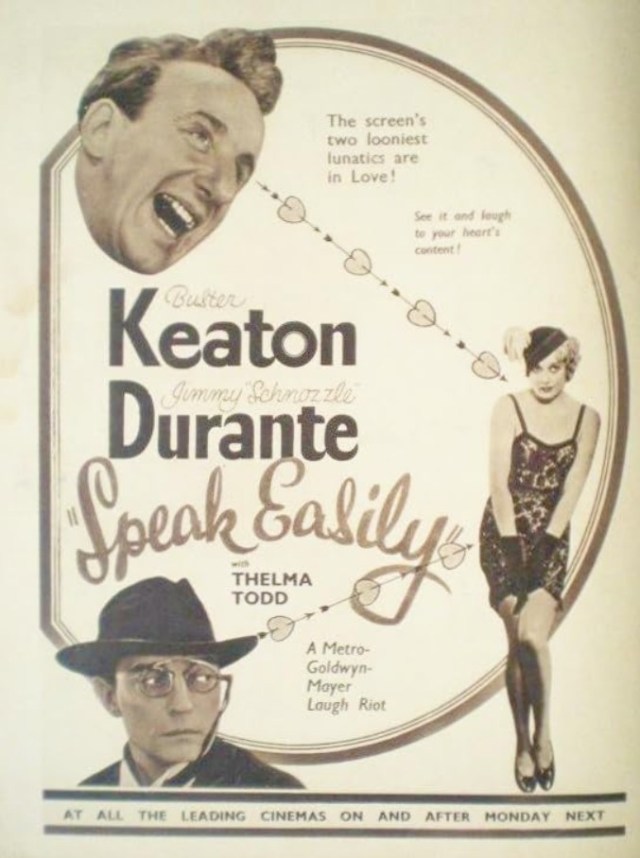
When I participated in the 10th Annual Buster Keaton Blogathon last year, I reviewed Buster’s episode of The Twilight Zone; “Once Upon a Time”. In that review, I stated how his episode would be a good place to start if one were introduced to the show, partly due to the story’s light-hearted nature. For this year’s event, hosted by Lea from Silent-ology, I wanted to check out one of Buster’s films. After taking a trip to his IMDB filmography, I selected the 1932 picture, Speak Easily! One of the reasons why I chose this movie for the blogathon was the story itself. According to the Internet Movie Data Base, “a timid professor inherits a large sum of money and decides to fund a terrible musical”. Another reason for choosing Speak Easily is how Buster starred in a “talking picture” (movies with sound). Because he’s known as a silent screen legend, I was curious to see how he’d perform in a film with audible dialogue. So, with all that said, let’s begin this review of the 1932 presentation!

Speak Easily poster created by Metro-Goldwyn-Mayer

Things I liked about the film:

The acting: As I mentioned in the introduction, Buster Keaton is known as a silent screen legend. His forte was “slapstick” comedy, which worked in the format of silent films. With Speak Easily, Buster had to incorporate both physical movement and dialogue in order to help tell the story. Honestly, I think he did a good job with the provided material! In the 1932 production, Buster portrays Professor Post, an intelligent yet isolated man. This allowed Buster to adopt eloquent words, a sense of awkwardness, and responses that are too literal. Add his signature “slapstick” comedy for good measure and you have a character that was charming in his own right! Along the way, Professor Post becomes friends with a theater performer named James Dodge. Portrayed by Jimmy Durante, James had a big personality, brighter than all the lights of Broadway. This vibrancy was consistent throughout the movie, a strength of Jimmy’s performance! Ruth Selwyn and Thelma Todd join the cast as Pansy Peets and Eleanor Espere. Both actresses did a good job making their characters feel distinct from each other. During Speak Easily, Ruth displayed a gentle persona and was more soft spoken. Meanwhile, Eleanor adopted a flirtatious personality.

The dialogue: Prior to reviewing Speak Easily, I have seen a few of Buster’s “talking pictures”. However, his roles in these movies were smaller, meaning he was given fewer lines to work with. Though Buster received more opportunities to incorporate dialogue in Speak Easily, I was more impressed with the dialogue itself. Throughout the film, I caught on to how well-written the dialogue was. One good example can be heard toward the beginning of the film. Professor Post doesn’t go to a local event at his college because he claims he wasn’t invited. His colleague, Jenkins, thinks this is an excuse for Professor Post to stay in his comfort zone. During a visit to Professor Post’s office, Jenkins tells Professor Post, “if you only go out and find life, you’ll enjoy living it”. This line serves as a friendly yet firm reminder how life is too short to miss out on.

The messages and themes: Like I said earlier in this review, Professor Post is an intelligent yet isolated man. After he receives a large sum of money, Professor Post chooses to travel to New York and, eventually, funds a musical. As the story progresses, he tries to form connections with his peers. Eventually, Professor Post successfully finds friends by staying true to himself. The trials and triumphs of forming relationships, whether romantic or platonic, is a relatable subject. What’s also relatable is having a genuine persona/personality and doing the right thing. The incorporation of these messages and themes was one of the things I liked about Speak Easily!

The 11th Buster Keaton Blogathon banner created by Lea from Silent-ology

What I didn’t like about the film:

A drawn-out film: Speak Easily has a run-time of an hour and twenty-one minutes. However, the movie’s run-time felt longer. This is because parts of the story were drawn-out. As Professor Post boards a train, there’s a running joke about how he forgot his trunk. The joke then transforms into a couple forgetting their baby. That entire joke lasts for about four minutes. Had the joke just focused on Professor Post forgetting his trunk, maybe some of Speak Easily’s run-time could have trimmed.

An overshadowed musical: I’ve mentioned twice in this review how Professor Post funds a musical after receiving a large sum of money. This concept made me curious how Professor Post’s involvement would influence the musical. While the musical was featured in the movie, you have to wait over fifty minutes into an hour and twenty-one minute story just to see the musical come to life. Preparations for the musical were shown, but only in two scenes. The majority of the story focuses on Professor Post’s relationships with the other characters. That focus causes the musical to be over-shadowed.

Limited amount of “slapstick” comedy: I said earlier in my review how “slapstick” comedy was Buster’s forte. This part of his career has been incorporated into his “talking picture” projects, such as The Twilight Zone episode; “Once Upon a Time” and Speak Easily. But in the 1932 production, Buster’s “slapstick” comedy was used sparingly. That creative decision was the result of the film’s run-time, as Buster’s silent films were, more often than not, shorter. The limited amount of “slapstick” comedy felt like the movie was missing something. I wish Speak Easily’s creative team had capitalized on Buster’s forte a bit more.

String of musical notes image created by Freepik at freepik.com. <a href=’https://www.freepik.com/free-vector/pentagram-vector_710290.htm’>Designed by Freepik</a> <a href=”https://www.freepik.com/free-photos-vectors/background”>Background vector created by Freepik</a>. Image found at freepik.com. 

My overall impression:

In Speak Easily, Professor Post sees working on a musical as trying something new. By moving out of his comfort zone, he was able to make new friends, find success, and travel beyond the walls of his office. By starring in this film, Buster Keaton was, in a way, trying new things. This time, he had to rely on more than just physical movement and “slapstick” comedy to carry the story. Even though I liked Buster’s performance in the 1932 presentation, the project itself was, in my opinion, just ok. I was pleasantly surprised by how well-written the dialogue was! The acting, as well as the messages and themes, were Speak Easily’s other strengths. But there were aspects of the movie I didn’t like, from the drawn-out nature of the film to the musical becoming overshadowed. By reviewing this project, I found an excuse to write about a pre-Breen Code era title. Since the only pre-Breen Code era movies I’ve reviewed this year, so far, were The Garage and 1925’s Phantom of the Opera, Speak Easily will easily fill that void!

Overall score: 6-6.1 out of 10

Have you seen Speak Easily? Which “talking picture” from Buster Keaton’s filmography would you like to see me review? Let me know in the comment section!

Have fun at the movies!

Sally Silverscreen
Take 3: The Garage (1920) Review (Silent Pioneers Double Feature Part 1)

Before participating in the Silent Pioneers Blogathon, I had only seen, and even reviewed, four projects from Buster Keaton’s filmography. To, kind of, make up for lost time, I chose to review The Garage for the event. The other reason why I selected this movie was because it was recommended by Lea S. from Silent-ology. I will admit silent films are rarely covered on 18 Cinema Lane. In the seven years my blog has existed, I’ve only reviewed seven silent film titles. The last time I wrote about a silent picture was 1920’s Pollyanna back in 2021. So, reviewing another silent movie has been long overdue. So far, my experience with silent films has been pretty positive. But will that change with The Garage? Keep reading my review to find out!

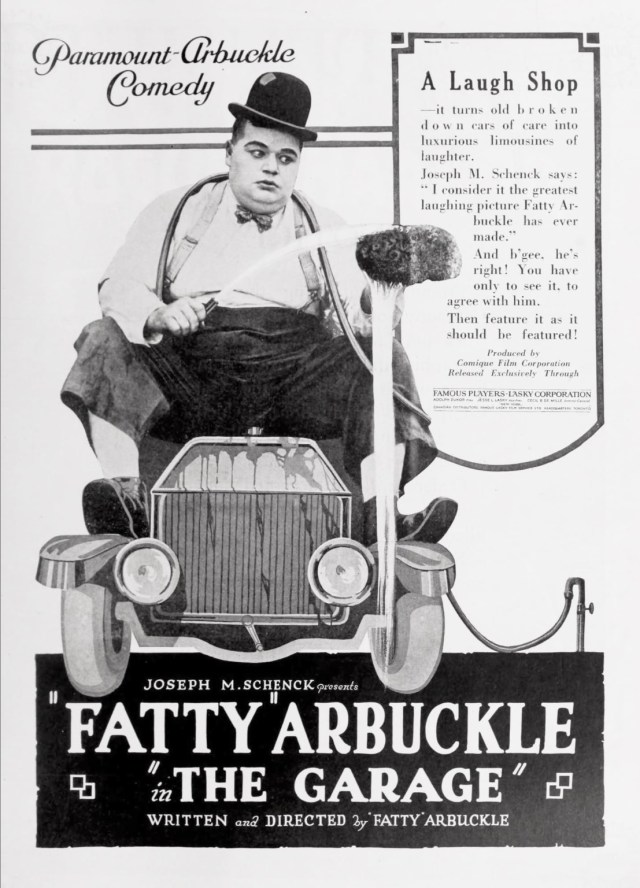
The Garage (1920) poster created by Comique Film Company and Paramount Pictures

Things I liked about the film:

The acting: In silent films, actors and actresses heavily rely on facial expressions, emotions, and body language to show what their characters are thinking and feeling. While on-screen text can help elaborate what is happening on screen, the way actresses and actors appear in a silent film can show what can’t be said. At the beginning of The Garage, Roscoe ‘Fatty’ Arbuckle is upset Buster Keaton made a car he just washed dirty. He gestured toward the spot of dirt on the car by repeatedly pointing toward it. Roscoe ‘Fatty’ Arbuckle even has a frown on his face, emphasizing how upset he is. Later in the film, Buster is chased by a dog. When he gets stuck in a fence, he appears scared as the dog is ripping up his pants. Fear is in Buster’s eyes as he looks to be screaming. Molly Malone is the only actress in The Garage. Any time she was included in a scene, she was just as expressive as her male co-stars! When Molly is first introduced in the story, she is so excited to see Jim. She is smiling the entire time, making her happiness clearly visible.

The slapstick comedy: When I reviewed The Twilight Zone episode, “Once Upon a Time”, I talked about a scene where Buster’s character, Woodrow, and a man named Rollo walk past a rack of suit pants. After Woodrow grabs a pair of pants, Rollo picks Woodrow up so he can put the pants on. When I saw this comedic trick in The Garage, I was happy to recognize it from The Twilight Zone! The trick was just as well performed in the movie as in the television episode! Another comedic trick utilized a piece of spinning floor. When Roscoe ‘Fatty’ Arbuckle walked on the spinning floor, he was able to effortlessly walk off the circle. But, when Buster got on the spinning floor, he stumbled and tumbled to the ground. The only way Buster could escape was when Roscoe ‘Fatty’ Arbuckle tumbled to the ground himself and pulled Buster to the circle’s edge. These two examples showcased the simplicity and creativity of The Garage’s slapstick comedy!

An overarching narrative: Earlier in this review, I brought up how excited Molly was to see Jim. This is because they are in a romantic relationship. In The Garage, Jim and Molly’s relationship served as an overarching narrative. It even intersected with the events taking place in and around the garage. For me, I looked forward to seeing what would happen next with Molly and Jim. The strong acting performances and nice on-screen chemistry kept me invested in their part of the story! There was also a sense of mystery to Jim and Molly’s relationship. A contributing factor was the couple experiencing situations as they took place in the film.

The Silent Pioneers Blogathon banner created by Maddy from Classic Film And TV Corner

What I didn’t like about the film:

Inconsistent slapstick comedy: The Garage consists of three separate stories: Roscoe ‘Fatty’ Arbuckle washing a customer’s car, Jim becoming covered in car grease, and the garage being set on fire. While there was plenty of slapstick comedy in the first and third stories, the slapstick comedy was limited in the second story. This is because so much of that story was focused on Jim and his relationship with Molly. Besides becoming dirty from car grease, Jim gets a dog to scare off Molly’s potential admirers. With everything I said, the emphasis on Jim and Molly’s relationship in the second story kind of overshadowed Roscoe ‘Fatty’ Arbuckle and Buster Keaton.

Tonally inappropriate music: Like I just said in this review, there are three stories in The Garage. The third story involves the garage being set on fire. During that story, cheery piano music can be heard in the background. Though this type of music plays throughout the movie, it felt tonally inappropriate in the third story. The reason is Jim and Molly’s lives being in danger, which raises the story’s stakes. Because the stakes are lower in the first and second stories, cheery music playing in the background makes sense.

A confusing timeline: So much is happening in The Garage due to the film consisting of three separate stories. In one story, customers either rent cars or have their cars washed. The residents from the garage’s neighborhood have a scheduled lunch-time. But the title-cards sprinkled throughout the film never clarify when events like the aforementioned two take place. Is The Garage set in a singular day or are the situations happening over an extended period of time? Had the title-cards mentioned when events were taking place, those title-cards could have provided transitions between stories.

Image of vintage movie camera created by Macrovector at freepik.com. <a href=”https://www.freepik.com/free-photos-vectors/background”>Background vector created by macrovector – http://www.freepik.com</a>. Image found at freepik.com.

My overall impression:

As I said in my review’s introduction, my experience with silent films has been pretty positive. This experience is, so far, remaining positive due to my thoughts on The Garage! For the most part, the 1920 picture is a fine, pleasant production. The strength of the acting and the creativity of the slapstick comedy led to an overall enjoyable time. I even liked how Molly and Jim’s relationship served as an overarching narrative. Even though the film itself was pleasant, it did contain some flaws. Without contextual information, I found the story’s timeline confusing. There was also one part of the movie where the music was tonally inappropriate. But like I said, I found The Garage a fine, pleasant title! This movie could be a good introduction to Buster Keaton’s filmography.

Overall score: 7.1 out of 10

Have you seen The Garage? Which film from Buster Keaton’s filmography would you like to see me review? Tell me in the comment section!

Have fun at the movies!

Sally Silverscreen
Sunset Over Hope Valley: Making Everything Seem Possible

In Elizabeth’s opening monologue in this When Calls the Heart episode, Elizabeth says Fiona “makes everything seem possible”. Looking back on Fiona’s time on this show, there’s truth to Elizabeth’s statement. Ever since her debut in season six, Fiona has accomplished whatever she’s set her mind to. She has helped bring telephone technology to Hope Valley, started her own business, and even assisted Rosemary with her radio show. Fiona has also been a friend to lean on, a provider of advice, and a contributing member of Hope Valley. Fiona is just one example of how the show’s characters have found success not only in Hope Valley, but in the world of When Calls the Heart. In fact, I can’t think of a character on this show who hasn’t received a success story. I haven’t read the books this series is based on. However, I would assume some of the overarching themes in those books are achieving personal success and accomplishing goals.

Just a reminder: If you did not see this episode of When Calls the Heart, there will be spoilers within this re-cap.

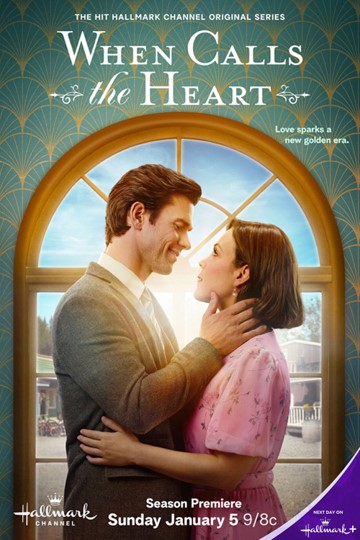
When Calls the Heart season twelve poster created by Hallmark Media, Crown Media Family Networks and Hallmark Channel

Season: 12

Episode: 7

Name: Dance the Night Away

Major stories:

Elizabeth surprises Nathan with tickets to Buster Keaton’s new movie! So, the pair travel to the city to embark on their adventure. After enjoying the movie, Nathan and Elizabeth cross paths with Toddy Davis, who still believes Nathan is an estate dealer named Danny. When Toddy’s wife, Trudy, approaches the group, she invites Elizabeth and Nathan to a party she and Toddy are hosting that night. Keeping up the appearance of Danny and his wife, Diane, Nathan and Elizabeth accept the invitation. At the Davis’ party, Elizabeth and Nathan make up their relationship’s backstory as they go along. As Elizabeth and Nathan talk about “their song”, Trudy encourages them to sing it. So, the pair effortlessly perform “their song” in front of the party guests. Before Elizabeth and Nathan leave, Toddy offers Nathan some gold pocket watches with a double-headed bird on them. Toddy claims the watches came from a rancher who passed away the previous year. Nathan tells Toddy he’ll check in with his “buyer”.

After seeing a performance of The Importance of Being Earnest in Cape Fullerton, Rosemary is inspired to host her own presentation of that play. She recruits some of Hope Valley’s residents to fill each role. One eager participant is Ava. One evening, at rehearsal, Ava presents her knowledge of the play by reciting some lines from the script. She claims she performed The Importance of Being Earnest at her boarding school in Maryland. Surprised by Ava’s acting experience, Rosemary puts her in charge of the prop department. Ever since Ava came to Hope Valley, Rosemary hasn’t liked her. That evening, after rehearsal, Rosemary shares with Lee how she thinks Ava is too dramatic. Lee reminds his wife how she was once known for being too dramatic and how there’s no one like her. Eventually, Rosemary decides to give Ava a part in her production.

Theater seats image created by weatherbox at freeimages.com. “FreeImages.com/weatherbox.”

Minor stories:

While hiking in the forest, Oliver and Allie discover an unclaimed pasture. This discovery inspires the duo present their findings to Lucas. Allie and Oliver propose a solution for the cows to roam and the salmon to spawn. Lucas actually likes their idea, believing it could be the best of both worlds. He even presents the idea to Edie. She encourages Lucas to draft a proposal for the idea to, at least, be considered. But later in the episode, during a card game, Edie tells him to forget the unclaimed pasture even exists. When Lucas asks her why, Edie says it’s lawyer/client confidentiality. Not happy with this response, he ends the card game early.

Fiona receives an offer for her barber shop. Before she can accept the offer, Fiona needs to check with her business partner, Mr. Weaver, first. While she’s waiting for Mr. Weaver’s approval, Mei pays Fiona a visit at the barber shop. Sensing Fiona may be sacrificing her own happiness, Mei reminds her friend how she has a spark and must follow it. After hearing this advice, Fiona gets the call from Mr. Weaver approving of the barber shop’s offer. A few moments later, a sold sign to put on the barber shop’s door.

Pair of joker playing cards created by Outanmax at freepik.com. <a href=’https://www.freepik.com/free-photo/2-joker-cards_1127202.htm’>Designed by Freepik</a>. <a href=”https://www.freepik.com/free-photos-vectors/background”>Background image created by Outanmax – Freepik.com</a>. Image found at freepik.com.

Some thoughts to consider:

  • As I said in this re-cap, Elizabeth and Nathan play the roles of Diane and Danny. What works in their favor is how no one at the party knew who they were. But I find it hard to believe no one recognized Elizabeth, especially after she became an author. Elizabeth’s book about living in Hope Valley drew Ava to visit the town for herself. She even recognized Elizabeth the moment they met. It’s unknown if Elizabeth’s book was a bestseller in the world of When Calls the Heart. If her book or even her project-based learning lesson plans bring her any amount of celebrity status, the idea of Elizabeth being unrecognizable seems unrealistic.
  • Season twelve of When Calls the Heart is now a little past the half-way point. At this time, Hearties are no closer to learning the truth about Ava, as her story has just given them more questions. I understand the show’s creative team need to keep their audience invested in the story throughout the season. But I’m worried all this build-up may lead to an underwhelming reveal of who Ava truly is. This, kind of, feels reminiscent of how Mei’s story was drawn-out back in season nine.
  • In this re-cap, I mentioned Fiona selling her barber shop. While it’s sad to see a beloved Hope Valley business sold, I wonder what the fate of the barber shop will be? Will it remain as a barber shop or become a completely different establishment? With Elizabeth and Nathan going to the movies and Rosemary producing a play, could this be foreshadowing Hope Valley finally receiving a theater?
Sunset image created by Photoangel at freepik.com. <a href=”https://www.freepik.com/free-photos-vectors/background”>Background image created by Photoangel – Freepik.com</a>.<a href=’https://www.freepik.com/free-photo/red-sunset-clouds-over-trees_1254327.htm’>Designed by Freepik</a>. Image found at freepik.com.

What are your thoughts on this episode? What new business would you like to see in Hope Valley? Tell me in the comment section!

Have fun in Hope Valley!

Sally Silverscreen

Sally Watches…The Twilight Zone

When the curtains rose and the golden gates of Hollywood opened for him, Buster Keaton likely had one goal: to make people laugh. After conquering Vaudeville and starring in over a hundred film and television credits, Buster not only made people laugh, he left behind a legacy of humor, joy, and timeless entertainment! So, you probably saw the title of this article and wondered, “What does The Twilight Zone have to do with Buster Keaton”? One of Buster’s many film and television credits was an episode of The Twilight Zone. This is a show I am familiar with, having seen several episodes prior to The 10th Annual Buster Keaton Blogathon (hosted by Lea from Silent-Ology). However, on paper, The Twilight Zone and Buster Keaton seem like a random combination. Buster’s forte was comedy, while The Twilight Zone incorporates elements of science-fiction and horror. But is this episode, “Once Upon a Time”, an example of “opposites attract”? Let’s step into another dimension to find that answer through this review!

The 10th Annual Buster Keaton Blogathon banner created by Lea from Silent-Ology

Episode Name: Once Upon a Time

Season 3, Episode 13

Premiere Date: December 15th, 1961

What I liked about this episode:

As I stated in this review’s introduction, Buster’s forte was comedy. His specific acting forte was physical, “slapstick” performances. The creative team behind this episode paid attention to Buster’s comedic work, as Buster was given plenty of opportunities to showcase his comedy skills! One scene shows Buster’s character, Woodrow Mulligan, trying to hide from a police officer. At first, he walks behind Rollo, a character Woodrow meets in the “future”. When both men turn a corner, Rollo moves behind Woodrow, allowing Woodrow to walk in front of him. As they pass a rack of suit pants, Woodrow not only grabs a pair, Rollo picks Woodrow up so he can put the pants on. No beats were missed during this scene. The writing and delivery of this performance was simple, yet effective when it comes to the comedy!

What I didn’t like about this episode:

The run-time for “Once Upon a Time” is twenty-five minutes. Even though the script told a story that could be wrapped up in a short amount of time, there were parts of the episode that were drawn out. Chase scenes serve one example of moments lasting longer than necessary. When Woodrow first travels to 1962, the Time Helmet becomes misplaced. He spends several minutes trying to get the Helmet back, with the Helmet itself getting destroyed in the chase. Another drawn out scene is when Rollo argues with a man who owns a repair shop. While this argument takes place, Woodrow marvels at the “modern” inventions surrounding him. He also discovers a clothing store near the repair shop. In this part of the story, I found Woodrow’s observations hilarious. But I didn’t find the argument interesting.

Masks of comedy and tragedy images created by freepik at freepik.com. <a href=”https://www.freepik.com/free-photos-vectors/background”>Background vector created by freepik – http://www.freepik.com</a>. Image found at freepik.com.

The story itself:

Throughout this review, you’ve read references to a Time Helmet and Woodrow traveling to the “future”. That’s because “Once Upon a Time” is a story revolving around time travel! When the episode begins in 1890, Woodrow is disgruntled about the world around him. One of his major issues is how noisy his world is. However, this part of the story is presented as a silent film. After he seeks a quieter time period to travel to, he discovers the “future” (1962) is much noisier than he expected. Through this visual and auditory juxtaposition, the creative team behind this episode addressed how sounds can constitute our lives. If you know anything about The Twilight Zone, not everything is what it seems. Each episode shares a lesson or message with its audience, with the story leading up to that message or lesson. Without spoiling “Once Upon a Time”, the way the events play out provide a lesson that members of the audience can relate to.

The other factors from this episode:

For this part of my review, I will be spoiling “Once Upon a Time”. If you have not seen this episode and are interested in watching it, skip ahead to the second point in this section.

  • When the Time Helmet is first introduced in the story, Woodrow overhears how the Helmet can allow someone to travel in time for only thirty minutes. This is the conflict Woodrow experiences after he travels to 1962. Because Rollo finds 1890 an appealing time period, he is taken back to 1890 through the Time Helmet when Woodrow is on his way home. Toward the end of the episode, a title card states the story is now taking place one week later. Rollo is still in 1890, adjusting poorly to his new surroundings. If the Time Helmet can allow someone to explore different time periods for only thirty minutes, how has Rollo been able to stay in 1890 for a week?
  • Like I have mentioned in this review, the parts of the episode taking place in 1890 are presented as a silent film, complete with title cards and an overarching tune. Viewers familiar with Buster Keaton’s filmography will know he is one of the most celebrated actors from the silent film era. This creative choice in presentation was such a nice nod to Buster’s career! It also gave this episode its own distinct identity!
  • During Woodrow’s time in 1962, Rollo admits he is not only a scientist, he is also an expert on 1890. Yet, Rollo and Woodrow take the Time Helmet to a repair shop to get it fixed. Why didn’t Rollo fix the Helmet himself, especially since he seemed capable of knowing how to repair it? Had Rollo repaired the Helmet himself, there wouldn’t be the need for his argument with the man from the repair shop.
Image of vintage movie camera created by Macrovector at freepik.com. <a href=”https://www.freepik.com/free-photos-vectors/background”>Background vector created by macrovector – http://www.freepik.com</a>. Image found at freepik.com.

My overall thoughts:

 I said in this review’s introduction how I have seen several episodes of The Twilight Zone before. But this was the first time I saw “Once Upon a Time”. What surprised me was how light-hearted the story was compared to other episodes I’ve watched. The Twilight Zone is a show known for dabbling in the strange and even the sad. The best parts of “Once Upon a Time” were Buster’s comedic performances! Every comedy scene was written and delivered well, effectively making me laugh! What didn’t work in this episode were the drawn-out scenes. Even though the story was short, some scenes were just too long. When I reviewed television show episodes, I have stated if that episode would serve as a good introduction to its respective show. In my opinion, “Once Upon a Time” is a good place to start for those who either have never seen The Twilight Zone or who are just getting into the show. The story is strange, but not in an unsettling way. It even contains a happy ending. But if you want to know what that happy ending is, you’ll have to enter The Twilight Zone!

Rating: A 3.5 out of 5

Have fun on television!

Sally Silverscreen

Take 3: In The Good Old Summertime Review

Earlier this month, I said I would review In The Good Old Summertime for the Van Johnson Blogathon. Now, with the arrival of the aforementioned event, it’s time to talk about this film! There are two reasons why I selected the 1949 movie. The first is it was recommended to me by Becky, the same reader who suggested Easy to Wed. The second was how the summer season is winding down. Because the movie is titled, In The Good Old Summertime, I figured it would serve as a sort of last hurrah. As of 2022, the 1949 title is the fourth one of Van Johnson’s I’ve seen. While I found both Plymouth Adventure and Easy to Wed just ok, I was not a fan of Where Angels Go, Trouble Follows. Therefore, it’ll be interesting to see what I thought of In The Good Old Summertime!

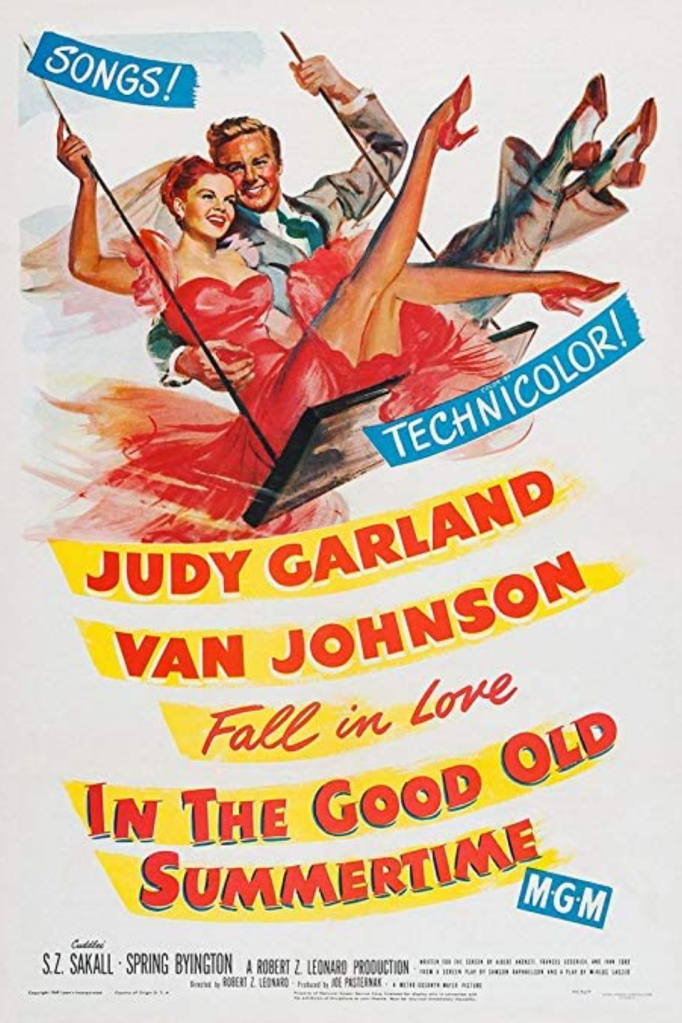
In The Good Old Summertime poster created by
Metro-Goldwyn-Mayer

Things I liked about the film:

The acting: As I said in the introduction, In The Good Old Summertime is the fourth film of Van Johnson’s I have seen. Therefore, I knew what to expect from Van, talent wise. While portraying Andrew, Van utilized emotions well. A great example is when Andrew and Veronica are attempting to sell some sheet music to a customer. The sheet music in question was “Put Your Arms Around Me, Honey”. During this song, Andrew looks threatened, like he knows Veronica is doing a better job at selling the music than he would have. Because of the quality of his acting talents, Van was able to make scenes like this one feel believable.

In The Good Old Summertime is the fifth movie of Judy Garland’s I have watched. Looking back on those films, I have noticed how Judy is a more versatile actress than I feel she gets credit for. While waiting for her secret admirer, Veronica, Judy’s character, appears visibly nervous. She’s glancing around the restaurant and constantly readjusting her flower and poetry book. When Andrew arrives, Veronica’s unpleasant feelings toward her co-worker grow stronger. Her face appears troubled, frustrated over the fact he won’t leave. At some points during this interaction, Veronica raises her voice. When she eventually returns home, Veronica appears deflated, her night not going as she expected.

I am not familiar with Spring Byington as an actress. Despite this, I enjoyed her portrayal of Nellie Burke! Her on-screen personality was so pleasant. Even when she was upset at Otto Oberkugen, she was still a character worth rooting for. Spring and S.Z. Sakall had good on-screen chemistry. One good example is when Nellie is trying to explain a misunderstanding. During this conversation, Otto reveals his insecurities as a musician. This explanation comes across as genuine, as a businessman trying to save face. Meanwhile, through gentleness and kind words, Nellie reassures Otto he is the only man she cares about. It was nice to see two older characters fall in love, especially since this type of romance story doesn’t seem as common as those featuring younger couples. Through the acting performances and screenwriting, Spring and S.Z. brought forth a couple that was interesting to watch!

The musical numbers: At Otto’s music store, a harp is introduced among the instrumental stock. In order to sell the harp to a potential customer, Veronica plays the harp to a song called “Meet Me Tonight in Dreamland”. With the combination of Judy’s vocals and the harp instrumental sound, the song exuded the dreamlike tone the film’s creative team was striving for. Even with the inclusion of a piano, these sounds complimented one another. The aforementioned song, “Put Your Arms Around Me, Honey”, was performed in two tempos. At Veronica’s suggestion, the first tempo is slower, providing a romantic tone. But with the second, faster tempo, a jollier tone is presented. Because of this musical, creative decision, it was interesting to hear how one change can make a song sound so different.

The historical accuracy: In The Good Old Summertime takes place around the late 1800s to early 1900s. With that said, there are many aspects of this movie that appeared historically accurate! One of these areas was the wardrobe. Louise Parkson, portrayed by Marcia Van Dyke, is Andrew’s friend. She is attempting to win a prestigious audition. When this audition arrives, Louise wore a white dress with a full, floor length skirt. The sleeves are medium length, covering Louise’s upper arms. The dress also had a higher neckline. These design choices represented modesty in women’s fashion from that time.

The Sixth Van Johnson Blogathon banner created by Michaela from Love Letters to Old Hollywood

What I didn’t like about the film:

The underutilization of Buster Keaton: I haven’t seen many of Buster Keaton’s films. But based on what I know about his filmography, he seems like he’s a comedic actor who utilizes physical comedy. In In The Good Old Summertime, however, Buster wasn’t given much material to work with. There were two scenes where Buster’s character, Hickey, trips and falls. But these felt like weak attempts at giving Buster something to do. If anything, it seems like Buster was cast in the film just for the sake of it.

A drawn-out plot: The story of In The Good Old Summertime revolves around Veronica’s and Andrew’s search for their respective pen-pals. While this plot can lend itself to a good story, it was drawn-out throughout the entire movie. It got to the point where, after Veronica’s secret admirer was revealed, she was being manipulated into believing the secret admirer is someone else. This was likely done to keep the plot going. But it just felt too cruel for my liking.

No strong subplots: So much time was given to the aforementioned main plot in In The Good Old Summertime. As a result, there were no strong subplots. Some aspects of the narrative could have lent themselves to good side stories. But because the script focused so much on the main plot, these ideas weren’t able to reach their full potential. For example, Otto is experiencing difficulty selling some harps. This felt like a running joke that didn’t lead anywhere. An interesting story idea would have been if a wealthy customer was looking for a specific harp. Otto would then spend the rest of the movie trying to locate this instrument.

String of musical notes image created by Freepik at freepik.com. <a href=’https://www.freepik.com/free-vector/pentagram-vector_710290.htm’>Designed by Freepik</a> <a href=”https://www.freepik.com/free-photos-vectors/background”>Backgroundvector created by Freepik</a>. Image found at freepik.com.

My overall impression:

This is the third time I have participated in the Van Johnson Blogathon. While I reviewed Van’s episodes of Murder, She Wrote the first time around, I wrote about Plymouth Adventure last year. Both Plymouth Adventure and In The Good Old Summertime have one thing in common: there were ok. With the 1949 film, I enjoyed the musical numbers. They were not only entertaining, but creative as well. But there were times where I felt more effort was placed in the musical numbers than the script. This movie adopted the “enemies to lovers” trope, which could work in a story. Unfortunately, this part of the script was drawn-out. While watching In The Good Old Summertime, I kept thinking back to Meet Me in St. Louis. The 1944 musical not only takes place in the early 1900s, but also stars Judy Garland. Personally, I think In The Good Old Summertime is a weaker version of Meet Me in St. Louis.

Overall score: 6.9 out of 10

Have you seen any of Van Johnson’s films? If so, which one is your favorite? Let me know in the comment section!

Have fun at the movies!

Sally Silverscreen