
This review is from my series, Comparing with the Critics. If you’d like to learn more about the series, click on the link below.
Introducing my new series, Comparing with the Critics!
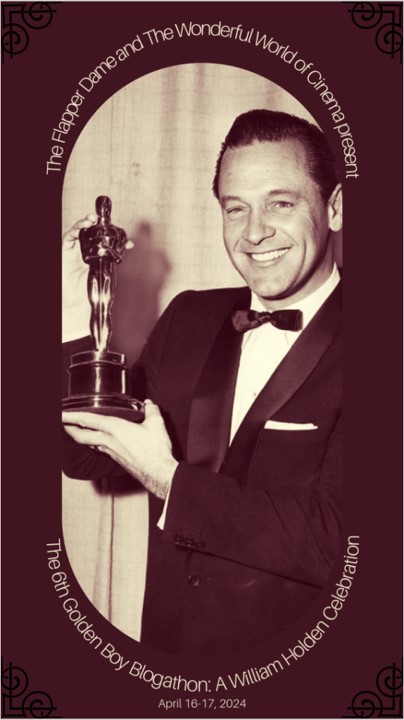
There are two reasons why I chose Network for my first review of Comparing with the Critics. The first reason is how the movie is an appropriate title for The 6th Golden Boy Blogathon: A William Holden Celebration, hosted by Virginie and Emily from The Wonderful World of Cinema and The Flapper Dame. Network appearing on Gene Siskel’s and Roger Ebert’s list of the top five films from 1976 is the second reason. When I looked through William Holden’s IMDB filmography in preparation for the blogathon, I remembered how Ebert and Siskel liked Network. In fact, it was one of the few films they agreed on. I was aware of Network prior to the Comparing with the Critics series because I had heard it was adapted into a stage play. Toward the beginning of the ‘Best Films of 1976’ episode, Siskel proclaimed how “1976 was a pretty lousy year for movies”. I can’t speak on the cinematic year of 1976 as a whole. But based on my thoughts on Network, this movie would fit Siskel’s argument about the state of 1976 when it comes to film.

When it’s his turn to talk about Network, Siskel says
“I think she’s gonna win an Oscar for this picture”, referring to Faye Dunaway’s
performance in the film. Siskel got his wish when Faye did win the Best Actress
award at the 49th Academy Awards. While I can’t compare her portrayal
of Diana Christensen to the other performances that were nominated that year, I
can comment on how interesting some of Faye’s interactions were with William
Holden’s character, Max Schumacher. While having dinner one evening, Diana asks
Max a series of questions, in order to learn more about her co-worker. The more
personal the questions become, the more reserved Max appears. This reserved demeanor
is consistently carried by William throughout the movie, using emotion more
subtly. When Max does become more emotional, it happens at certain moments,
such as when he’s recalling a story about his first broadcasting job. Meanwhile,
Diana expresses her emotions more openly. She’s more honest when it comes to
her perspective, believing no subject is off limits. The pairing of Max and Diana,
portrayed by William and Faye, represents the “old school” and “new school”
mentality of the world of broadcast television. It also represents “old” and “new”
Hollywood.

Some of Hallmark’s movies have pulled back the curtain on
certain industries. One great example, Cooking with Love, shows a
behind-the-scenes look at how to create a television show. As you’re reading
this editorial, you’re probably wondering what a film such as Cooking with
Love has to do with Network. Similar to the 2018 aforementioned production,
the 1976 film explores the behind-the-scenes operations of network television. Network shows the various steps that are needed
to make network television run as smoothly as possible. The movie also
addresses how television programs are brought to the screen. During a typical
work day, Diana was presented with a set of tv pilots. Hearing the premise of these
pilots makes her realize how similar they all sound. This revelation inspires Diana
to create a program that is drastically different. While talking about Network,
Siskel shares how “I also like movies that deal with what’s really going on in
the world”. Because the movie, more often than not, grounds itself in reality,
the realistic presentation of network television’s behind-the-scenes are
insightful and even educational for the audience.
As I just wrote about in this editorial, Network explores
the behind-the-scenes operations of network television. While I liked this
aspect of the movie, there were times when I felt the movie’s creative team
expected their audience to know what they were talking about. The mention of “shares”
is just one example. The term “shares” was thrown around like confetti on New
Year’s Eve. Diana even dreams about creating a show that will earn a certain number
of shares. Trying to figure out what this part of network television was, I was
confused if the characters were referencing the Stock Market or a program’s
viewership. According to Wikipedia, Network is considered a “satirical
drama”. I could tell when moments were intended to be satire. But, in my
opinion, effective satire is when a story’s creative team knows when to play it
straight and when to acknowledge the joke. Network’s creative team
played it a little too straight, taking their production too seriously. All of
this led to a movie that was pretentious.

In this review’s introduction, I mentioned how Network was one of the few films Ebert and Siskel agreed on. They both stated how comedic Network was. While Ebert called the film “funny”, Siskel said “I laughed a lot at Network”. Comedy, like cinema, is subjective. With that said, the only time I giggled during the film was when Max Schumacher suggests hiring a psychic to report the weather. The story overall was not only dry, it took itself too seriously, as I already mentioned in this review. Network’s first half was a drawn-out search for a resolution to the story’s conflict. The movie’s second half turned into a contest to figure out which character could yell the loudest and angriest. To me, this was a recipe for a headache and not a hilarious two hours. Then again, I don’t find characters yelling and screaming at each other funny.

Network was one of the films featured in the ‘Best Films
of 1976’ episode of Opening Soon…at a Theater Near You. As stated in
this review’s introduction, the movie appeared on Gene Siskel’s and Roger Ebert’s
list of the top five films of 1976. If I made a guest appearance on the show, Network
would not be on my top five or even top ten films list of that year. In fact, I’d
consider the movie as one of the “Dogs of the Year”. Network, for me,
was an endurance test that almost made me fall asleep. Taking itself too
seriously by expecting too much from the audience and telling a dry, boring
story didn’t help Network’s case. Though comedy is subjective, I didn’t
find the film very funny. However, there were aspects of the film I liked, such
as the acting and the peek behind network television’s curtain. But, like
network television itself, there are many parts needed to make a movie work. As
I wrap up this review for Comparing with the Critics, I’d like to respond to
the film’s overarching quote; I’m bored as heck, and I wish Network used
its indoor voice.
This review was brought to you by
Sally Silverscreen
 18 Cinema Lane
Pingback: Day 2 of The 6th Golden Boy Blogathon: A William Holden Celebration – The Wonderful World of Cinema
That comparing with the critics concept is very interesting, Sally! I enjoyed reading your thoughts on Network, a film like no other! I’m sorry you didn’t like it better but to each his own. It’s a personal favourite although I never really thought of it as a comedy. However, I agree with you when you say “there were times when I felt the movie’s creative team expected their audience to know what they were talking about.” Yeah, although I love the films, there are times I’m a bit lost. However, I always thought it was a film that always had new elements to appreciate each time I watch it. It’s complex!
Thanks so much for participating in our blogathon! Check out my review of Dear Ruth when you have time 🙂
LikeLiked by 1 person
You’re welcome and thank you for reading my review! ‘Comparing with the Critics’ is a series I recently started, so there will be more reviews like ‘Network’. In fact, I’m planning on publishing two more ‘Comparing with the Critics’ articles in May, so stay tuned!
LikeLiked by 1 person
That’s great!
LikeLiked by 1 person
Pingback: Many thanks to the participants of The 6th Golden Boy Blogathon: A William Holden Celebration! – The Wonderful World of Cinema
Pingback: The Top Ten Worst Movies I Saw in 2024 – 18 Cinema Lane