Comparing with the Critics – Best of 1986 – The Fly

This review is from my series, Comparing with the Critics. If you’d like to learn more about the series, click on the link below.

Introducing my new series, Comparing with the Critics!

Out of the movies Roger Ebert and Gene Siskel picked in Siskel & Ebert & the Movies’ ‘Best of 1986’ episode, I believe Eddie Munson would choose The Fly. As I explained in my 1986 introduction of Comparing with the Critics, Eddie’s story teaches that, sometimes, there’s more than meets the eye. Plus, Eddie’s imagination and creativity not only works in his favor as a Dungeon Master, it’s also helped his friends during their time in the Upside Down. From the way Gene and Roger described The Fly in the aforementioned ‘Best of 1986’ episode, it seemed like a different kind of horror and sci-fi film. Roger claims “the poignancy” of The Fly “is interesting in a horror film”. Meanwhile Gene not only states “there was, if you think about it, a certain nobility to The Fly”, he also says “the movie is beautifully made”. Films from the horror and sci-fi genre are infrequently covered on 18 Cinema Lane. In fact, the only sci-fi and/or horror movies included in the Comparing with the Critics series, so far, are The Bride and Mad Max Beyond Thunderdome, which were both released in 1985. But what can be appreciated is the creativity and imagination woven into those two genres, whether it’s how the duel in the Thunderdome was filmed in Mad Max Beyond Thunderdome or giving Viktor a “hero’s journey” in The Bride. Though The Fly ended up on Roger’s top twenty best films of the year list, it did earn a place on Gene’s ten best films of ’86 list at number ten. However, despite not seeing every or most of the movies from 1986, The Fly would not be on my list of the top ten best films of that year. I also don’t think the film would be on Eddie’s top ten best films list either.
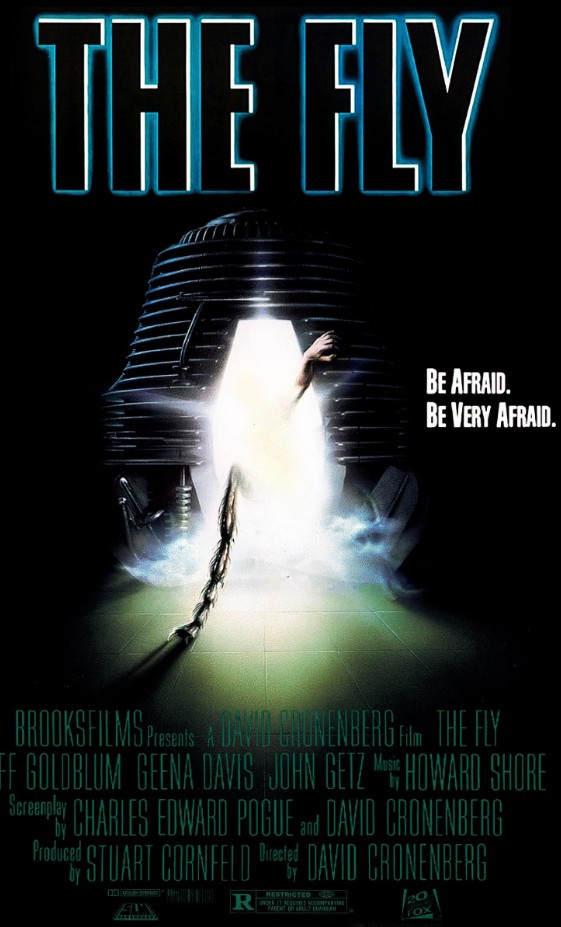
The Fly (1986) poster created by 20th Century Fox, Brooksfilms, Province of British Columbia Production Services Tax Credit, and SLM Production Group

While sharing his thoughts on The Fly, Roger tells Gene, “Goldblum, I think, deserves an Academy Award nomination”. While I agree with Roger’s sentiments on Jeff Goldblum’s portrayal of Seth Brundle, I also believe Geena Davis (who portrayed Veronica “Ronnie” Quaife) deserved a nomination from the Academy. Individually, Geena’s and Jeff’s performance was solid. From the tearful heartbreak Ronnie displays as Seth becomes unrecognizable to Seth’s erratic behavior over the course of the story, Jeff and Geena made their characters interesting to watch. But together, Geena and Jeff share very nice on-screen chemistry! In The Fly’s very first scene, Seth and Ronnie meet at a scientific event. Their interaction contains a sense of awkwardness, as they don’t yet know how they feel about the other person. But because Ronnie and Seth appear comfortable with who they are as individuals, the conversation isn’t embarrassing or cringey. Instead, it kind of comes across as flirty. Incorporating smiles, Seth’s widening eyes, and Ronnie’s glances away from Seth add to their growing feelings for each other. Even tilts of the head indicate how equally engaged they are in their interaction. The more I saw Seth and Ronnie together, the more I wished Jeff and Geena starred in another movie together portraying a couple!

Movie award essentials image created by Freepik at freepik.com. <a href=”https://www.freepik.com/free-photos-vectors/background”>Background psd created by freepik – http://www.freepik.com</a>. Image found at freepik.com. 

Gene tells Roger during their discussion of The Fly how he doesn’t believe science fiction movies, but was able to believe The Fly. One of the reasons why, according to Gene, is “it has to do with makeup”. The Academy certainly agreed with Gene, as The Fly won the Best Makeup category at the 59th Academy Awards. I also agree with Gene and the Academy. The idea of a human transforming into a fly sounds pretty disturbing and grotesque. Through the makeup design of Stephan Dupuis and Chris Walas, that aforementioned transformation was brought to life on screen in a believably horrifying way. At the start of Seth’s transformation, he develops little hairs on his back and his face appears discolored. But as the story progresses, so does his transformation. Seth’s teeth become pointy before falling out. His fingers morph together as his hands turn into the feet of a fly. Seth’s body even develops lumpy growths that make him look like a complete stranger. What adds to the horrifying nature of the makeup design is not just how believable the transformation itself appears, but also how realistic the effects look.
The “Eddie’s Year” Blogathon banner created by me, Sally Silverscreen. Original image created by 21 Laps Entertainment, Monkey Massacre, Netflix, and Upside Down Pictures.

During their coverage of The Fly in the ‘Best of 1986’ episode of Siskel & Ebert & the Movies, Roger comments on the believability of the movie. He tells Gene how “the screenplay was written and acted smart”. Roger also appreciated how Seth wasn’t a scientist “who speaks in cliches out of the thirties”. To add to Roger’s compliments, I’ll say that I liked how the story’s scientific ideas were woven into the script. Throughout The Fly, the topic of teleportation is discussed by Ronnie and Seth. What started as a magazine interview turns into a collaborative book. Over time, the focused topic changes to genetic fusion between Seth and a fly. Ronnie’s discovery and Seth’s computer lead to this specific topic being brought up. The way these scientific subjects were written into the story, as well as the dialogue, sounded intelligent enough to make the characters seem like they knew what they were talking about. As a viewer, I wasn’t confused by these concepts or didn’t feel like homework before watching the movie was required.

Scared audience image created by Katemangostar at freepik.com. <a href=’https://www.freepik.com/free-photo/terrified-friends-watching-horror-movie-in-cinema_1027311.htm’>Designed by Freepik</a>. <a href=”https://www.freepik.com/free-photos-vectors/people”>People image created by Katemangostar – Freepik.com</a>. Image found at freepik.com.

As Gene sings the praises of The Fly, he refers to the movie as “a great adventure”. In my experience watching adventure stories unfold on screen, there’s usually a sense of urgency. This urgency can be the reason for reaching a particular destination, exploring a specific location, or finding a person or object. A featured scene from The Fly on Siskel & Ebert & the Movies’ ‘Best of 1986’ episode shows Seth revealing to Ronnie his continual transformation toward becoming a fly. That scene made me believe there would be a race against the clock to either slow down or reverse Seth’s transformation process. Sadly, the script did not provide a race against the clock because the movie lacked a sense of urgency. In fact, The Fly contains a slow-burn story where Seth slowly becomes a fly over the course of most of the film. The 1986 movie is one of those movies where the audience waits for the inevitable to happen. Because the title of the film, The Fly, gives the inevitable away, it makes the film itself predictable. This predictability removes some of the story’s suspense and intrigue.
Comparing with the Critics banner created by me, Sally Silverscreen. TV show title cards created by WTTW National Productions, WTTW, Public Broadcasting Service (PBS), Lifetime Television, Tribune Entertainment, Buena Vista Television, and Disney-ABC Domestic Television

In the introduction of this review, I stated how The Fly would not be on my list of the top ten best films of 1986. I also said I didn’t think the film would be on Eddie’s top ten best films list either. The reasons are the movie’s lack of urgency and predictability. I could honestly picture Eddie either falling asleep during the movie or leaving the theater during the film. As I said in my review, The Fly is a slow-burn story and its predictability removes some of the story’s suspense and intrigue. But I don’t believe The Fly is a bad movie. The individual and combined performances of Jeff Goldblum and Geena Davis made their characters interesting to watch, as well as gave their characters nice on-screen chemistry. Chris and Stephan’s makeup effects effectively elaborated on the horrifying concept of a human becoming a fly. I also liked how the story’s scientific ideas were woven into the script. But despite all that praise, I didn’t like or love The Fly as much as Gene or Roger did.

This review was brought to you by

Sally Silverscreen
Comparing with the Critics – Worst of 1986 – King Kong Lives

This review is from my series, Comparing with the Critics. If you’d like to learn more about the series, click on the link below.

Introducing my new series, Comparing with the Critics!

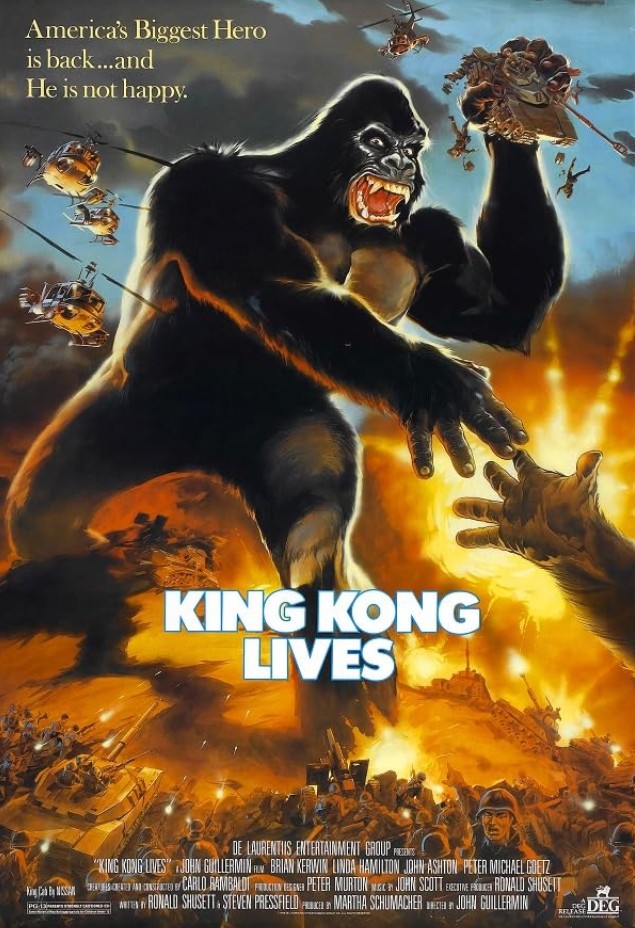
In the 1986 introduction of Comparing with the Critics, I said Eddie Munson would see Roger Ebert’s and Gene Siskel’s warnings about King Kong Lives as a challenge. That’s because this movie was deemed so bad, no clips from it were featured on ‘The Worst Movies of 1986’ episode of Siskel & Ebert & the Movies. According to Roger and Gene, they received letters from King Kong Lives’ film company stating no clips of the movie were allowed to be shown on Gene and Roger’s national show, yet could be shown on their local show in Chicago. Wikipedia states the film company, DEG (De Laurentiis Entertainment Group), forbade the critics from showing clips on Siskel & Ebert & the Movies “unless they promised to give positive reviews”. Because neither Roger or Gene complied with DEG’s request, they used the experience as a warning to their audience not to see King Kong Lives, with Gene saying, “If you don’t believe me or Roger, believe the film company that, think about it, couldn’t find a single scene that it wanted you to see”. From my experience watching the “Best of” and “Worst of” episodes of Gene and Roger’s show, a featured movie with no clips presented for it is extremely rare. That’s why King Kong Lives not only became so memorable to me, but why I wanted to review the movie, wondering if it was truly that bad. But now that I’ve seen King Kong Lives, saying it’s so bad it justified the refusal of featuring clips on Siskel & Ebert & the Movies is a stretch.

King Kong Lives poster created by De Laurentiis Entertainment Group (DEG)

Gene claims King Kong Lives, which is a sequel to King Kong from 1976, “should have been a classy production”. I’m not sure “classy” is the right word to describe this film. What I will say is King Kong Lives is interesting. One of the factors that made the movie interesting was the use of suits to bring King Kong and Lady Kong to life. In order for King Kong to be saved, Lady Kong is incorporated into the story to provide a blood transfusion for King Kong. Over the course of the film, Lady Kong and King Kong develop a romantic relationship. Through the performances of Peter Elliott and George Antoni/Yiasoumi, King Kong and Lady Kong’s interactions became such a pleasant surprise! The blend of body language, tilts of the head, and movements of the eyes and mouth effectively expressed emotions, thoughts, and feelings without any dialogue. The actual construction of the suits allowed King Kong and Lady Kong to appear believably realistic. With all that said, I found Lady Kong and King Kong’s relationship adorable!

Heart image created by Dashu83 at freepik.com. <a href=”https://www.freepik.com/free-photos-vectors/background”>Backgroundimage created by Dashu83 – Freepik.com</a>. <a href=’https://www.freepik.com/free-photo/happy-valentines-day-and-heart-card-with-happy-valentines-day-and-heart_1747001.htm’>Designed by Freepik</a>. Image found at freepik.com.

When Hank “Mitch” Mitchell (portrayed by Brian Kerwin) is introduced in King Kong Lives, he gives the impression of being hungry for money and fame. This is because Mitch agreed to give Lady Kong to the Atlantic Institute. But as the movie goes on, Mitch subverts expectations by showing how he genuinely cares about Lady Kong’s wellbeing. One example is Mitch’s observation of how King Kong appeared to be treated better than Lady Kong. He’s even concerned about the wellbeing of Dr. Amy Franklin (portrayed by Linda Hamilton). When Amy tells Mitch how she’s spent her evening keeping an eye on King Kong after his heart surgery, Mitch encourages Amy to get some sleep. Mitch’s empathy and compassion toward Lady Kong, Amy, and even King Kong made him such a likeable character!

Heartbeat image created by Freepik at freepik.com. <a href=’https://www.freepik.com/free-vector/medical-logo_763775.htm’>Designed by Freepik</a>. <a href=”https://www.freepik.com/free-photos-vectors/logo”>Logo vector created by Freepik</a>. Image found at freepik.com.

Speaking of Brian Kerwin and Linda Hamilton, I’d like to take some time to talk about their performance. Over the course of King Kong Lives, Amy and Mitch’s attraction for one another grows. The on-screen chemistry between Linda and Brian was, in my opinion, very sweet. The relationship between Mitch and Amy felt genuine because of the combined performance of Brian and Linda. But, individually, they gave solid performances as well. When Lady Kong arrives at the Atlantic Institute through a plane trip, some photographers attempt to break into the plane to take Lady Kong’s picture. Mitch pulls those photographers out of the plane, taking note of how stressed Lady Kong appears. In that moment, Amy gains respect for Mitch as he puts Lady Kong’s needs before his own desires. When Mitch looks at Amy, she nods toward him, a look of understanding in her eyes. Later in King Kong Lives, Amy performs heart surgery on King Kong. As Mitch watches the operation unfold, he is consistently shown grimacing or appearing worried. From the look in his eyes to the movements of his mouth, Mitch’s reactions throughout the surgery appear believable. The examples I provided illustrate how both Linda and Brian put genuine effort into their performances!

The “Eddie’s Year” Blogathon banner created by me, Sally Silverscreen. Original image created by 21 Laps Entertainment, Monkey Massacre, Netflix, and Upside Down Pictures.

Prior to watching and reviewing King Kong Lives, I had never seen a King Kong movie. Therefore, my knowledge of the King Kong Cinematic Universe is very limited. Based on what I do know about King Kong, he is, sometimes, presented as a threat to humans. This depiction was chosen for the 1976 film, with clips from that film shown at the beginning of King Kong Lives. With that said, I was really confused why the Atlantic Institute would spend the time, energy, and money (seven million dollars to be exact) to keep King Kong alive? I was hoping an explanation would be provided through the dialogue. But, unfortunately, no explanations were included in the script. It seems like the creative team behind King Kong Lives expected their audience to already know why certain events were happening. But when certain things happen, such as a change in attitude toward King Kong, explanations that make sense within the world of that film’s story need to be shared. Lack of explanations in King Kong Lives is my biggest criticism of the movie.

Adhesive bandage image created by aopsan at freepik.com. Background photo created by aopsan – www.freepik.com

During their discussion of King Kong Lives, Roger recounts his experience seeing the movie at a theater. He tells Gene about a swinging door located behind the theater’s back row of seats. The children who attended Roger’s screening of King Kong Lives found that swinging door more entertaining than the film itself because, according to Roger, “there was nothing on the screen that was even slightly entertaining to them”. Though I found the film interesting enough to keep me invested in the story, I can understand why those children would find the movie boring. When someone chooses to watch a King Kong picture, they typically expect King Kong to be destructive. While he was destructive in King Kong Lives, those moments were far and few between. From my limited knowledge of the King Kong Cinematic Universe, King Kong Lives tells a different kind of story from previous films, including its directly connected predecessor from 1976. I appreciate this newer approach to the lore of King Kong instead of repeating the same ideas. On the other hand, however, it seems like King Kong Lives’s creative team may have told a story that felt too different to the audience.

Comparing with the Critics banner created by me, Sally Silverscreen. TV show title cards created by WTTW National Productions, WTTW, Public Broadcasting Service (PBS), Lifetime Television, Tribune Entertainment, Buena Vista Television, and Disney-ABC Domestic Television

As a movie blogger, I totally understand Roger’s and Gene’s decision to refuse DEG’s request of showing clips of King Kong Lives on their Chicago show, but not their national show. In fact, I commend the critics for sticking to their morals and integrity. But DEG’s refusal to have clips of their film shown on Siskel & Ebert & the Movies did more harm to their film than good. Not only did this decision deny Gene’s and Roger’s audience an opportunity to choose for themselves whether they wanted to see the movie, it also made King Kong Lives, in my opinion, seem worse than it was. To me, the 1986 picture is a fine, interesting-enough presentation that kept me invested in the story. It took the King Kong lore in a newer direction than its predecessors, even addressing unique ideas, such as what it would take to save King Kong. But the lack of explanations left me confused why certain events were happening. In fact, the more I think King Kong Lives, the more questions I have about the King Kong Cinematic Universe. Are the King Kongs in the series’ later films a direct descendent of King Kongs from earlier chapters? Is there an overarching story woven into the series? Which events are officially a part of canon? Though these questions won’t get answers in this review, there is one thing I will say. King Kong Lives is another movie I disagree with the critics on.

This review was brought to you by

Sally Silverscreen

Comparing with the Critics – 1986 – Introduction

Any fan of Eddie Munson from Stranger Things knows 1986 is “Eddie’s year”. So, when I dedicated this year’s blogathon to the fortieth anniversary of “Eddie’s year” and since it’s been a while since I last reviewed a movie for one of my blogathons, I decided to make up for lost time by reviewing a “best” and “worst” movie for my Comparing with the Critics series! When it came to selecting titles to write about, I took a different approach; asking myself, “What would Eddie choose”? Had he received an opportunity to make a guest appearance on Siskel & Ebert & the Movies, I’m not sure how many of Eddie’s choices would overlap with Gene Siskel’s and/or Roger Ebert’s year-end selections. Based on the films Roger and Gene did pick, however, I think I know what Eddie would choose. If Eddie’s story teaches anything, it’s that, sometimes, there’s more than meets the eye. His imagination and creativity not only works in his favor as a Dungeon Master, it’s also helped his friends during their time in the Upside Down. So, for the Best of 1986, I have selected The Fly! As for the Worst of 1986, I have chosen King Kong Lives. I believe Eddie would see Roger’s and Gene’s warnings about the movie as a challenge.

Comparing with the Critics banner created by me, Sally Silverscreen. TV show title cards created by WTTW National Productions, WTTW, Public Broadcasting Service (PBS), Lifetime Television, Tribune Entertainment, Buena Vista Television, and Disney-ABC Domestic Television

Comparing with the Critics – Worst of 1980 – When Time Ran Out…

This review is from my series, Comparing with the Critics. If you’d like to learn more about the series, click on the link below.

Introducing my new series, Comparing with the Critics!

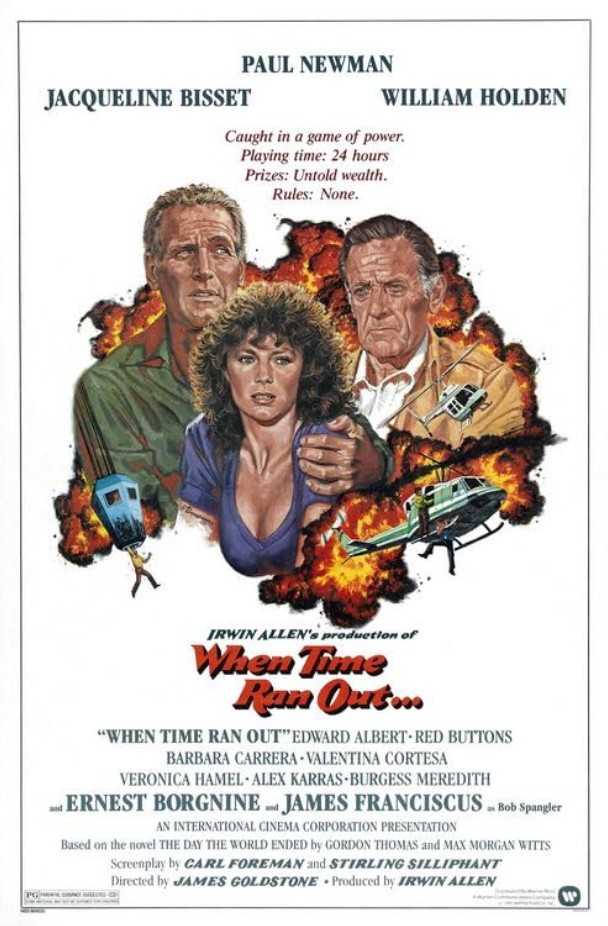
My first review for my Comparing with the Critics series was the 1976 picture, Network. Not only is this one of William Holden’s films, I reviewed Network for the 6th Golden Boy Blogathon: A William Holden Celebration. Two years later, I’m doing it again; participating in the 7th Golden Boy Blogathon: A William Holden Celebration and selecting one of William’s movies for my Comparing with the Critics series. As the title states, that film is 1980’s When Time Ran Out…. I had heard of this movie because it was featured in Sneak Previews’ ‘The Worst Movies of 1980’ episode. In this episode, the overarching theme, according to Gene Siskel, was examining “some of the year’s lousiest films in terms of what they reveal about what’s wrong with the American film industry”. When it came to When Time Ran Out…, the problem was “some producers, Irwin Allen being one of them, who have a very low opinion of the audience. They think they can fool the audience and rope them into the same story over and over again”. I will admit I don’t watch as many “disaster” movies as Gene and Roger Ebert did when they were hosting their show. But based on the “disaster” films I’ve seen (and even reviewed), I don’t believe When Time Ran Out… should be considered one of the worst movies of 1980.

When Time Ran Out… poster created by International Cinema and Warner Bros.

A Lifetime movie I remember liking is 2009’s The Christmas Hope. Though it’s been years since I’ve seen the film, I do recall the interconnectivity between the characters, with each connection becoming more intriguing as the story went on. Interconnectivity between characters is an aspect from When Time Ran Out… I liked. When the story starts, the cast of characters are introduced living their own lives and dealing with their own situations. William Holden portrays Shelby Gilmore, a man who owns multiple hotels, including the Kalaleu Gilmore. Paul Newman also stars in When Time Ran Out… as Hank Anderson, whose work on oil rigs leads him to suspect a local volcano may erupt. Hank’s story connects with Shelby’s story because Hank warns Shelby, as well as Shelby’s business partner, Bob Spangler, about the volcano’s potential eruption. Each character’s connection, along with the cast’s on-screen chemistry, kept me invested in the movie while waiting for the eruption of the volcano. I was not only interested in how each character’s path crossed, but also how the volcano and its aftermath would affect the characters.

Image of Hawaiian poster created by Freepik at freepik.com. <a href=”https://www.freepik.com/free-photos-vectors/poster”>Poster vector created by freepik – http://www.freepik.com</a>. Image found at freepik.com.

Gene claims the problem with When Time Ran Out… is how “some producers” “think they can fool the audience and rope them into the same story over and over again”. As I admitted in this review’s introduction, I don’t watch as many “disaster” movies as Gene and Roger Ebert did when they were hosting their show. However, based on my experience watching When Time Ran Out…, I noticed how the story prioritized the characters’ reactions to the disaster instead of the spectacle of the disaster itself. While the erupting volcano is shown on screen, it isn’t sensationalized like one might expect from a “disaster” movie. The decision to prioritize characters’ reactions shows viewers how natural disasters can indeed have consequences. Some characters get hurt and even die, stressing how no one is invincible while nature has a mind of its own. The threat of a volcanic eruption alone can impact multiple industries, ranging from hospitability, natural resources, and scientific. When the story of When Time Ran Out… progressed, various responses to the eruption were on display. One example is how some of Kalaleu Gilmore’s guests are so desperate to leave the island, they board a helicopter and try to fly it themselves. Everything I just said made this “disaster” picture feel realistic.

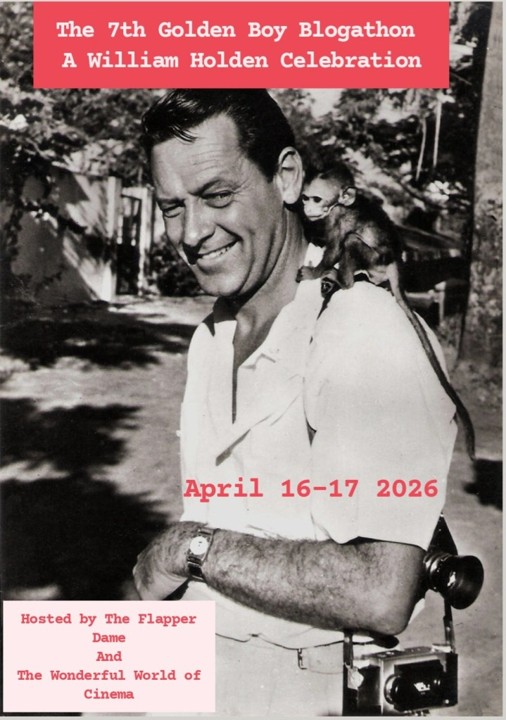
The 7th Golden Boy Blogathon: A William Holden Celebration banner created by Emily from The Flapper Dame and Virginie from The Wonderful World of Cinema

During the segment about When Time Ran Out… in Sneak Previews’ ‘The Worst Movies of 1980’ episode, Roger says “the whole movie is made out of basic scenes we’ve seen dozens of times before”. Meanwhile, Gene criticizes the repetitive nature of When Time Ran Out…’s script as “cruel manipulation”, elaborating by saying “when the audience walks into a film like this and they see that there’s nothing there but that same old formula, I think they feel burned, I think they feel bad about movies in general.” While I agree with Gene and Roger that When Time Ran Out… possesses flaws, I disagree about the types of flaws the movie contains. I understand witnessing the connectivity between characters gave the script build-up to the inevitable volcanic eruption. However, the eruption itself took place at about the film’s halfway point, forcing the audience to wait half the movie for the eruption to happen. This creative decision also caused some of the characters’ resolutions to be wrapped up a little too conveniently for the sake of the run-time. I wish some more of the characters’ reactions to the eruption’s aftermath had been included in the script.

Comparing with the Critics banner created by me, Sally Silverscreen. TV show title cards created by WTTW National Productions, WTTW, Public Broadcasting Service (PBS), Lifetime Television, Tribune Entertainment, Buena Vista Television, and Disney-ABC Domestic Television

In When Time Ran Out…, Shelby talks to Bob about “son of a famous father syndrome”, sharing how he always felt like he was under his father’s thumb. When his father passed away, Shelby says he felt a huge weight lifted off his shoulders. But when he found success, he believed it was hollow because his father wasn’t there to witness his success. Bob disagrees with Shelby’s view of success, saying how sweet success is. I find this discussion between Shelby and Bob ironic, as it takes place in a film Roger claimed was “a major box office flop”. When it comes to When Time Ran Out… itself, I found the film fine, intriguing, and interesting-enough. Due to the connections between the characters, I was invested in how they responded to the eruption and its aftermath. I also appreciate the creative team’s decision to adopt a more realistic approach to the eruption. That creative choice provides a strong reminder how unpredictable nature can sometimes be. Yes, When Time Ran Out… has its flaws. But because I don’t consistently watch “disaster” films, I didn’t pick up on the repetitiveness Roger and Gene did. Similar to when I reviewed Network, the 1980 picture is one I disagree with Gene and Roger on.

This review was brought to you by

Sally Silverscreen

Comparing with the Critics – Best of 1978 – Autumn Sonata

This review is from my series, Comparing with the Critics. If you’d like to learn more about the series, click on the link below.

Introducing my new series, Comparing with the Critics!

March’s theme for Genre Grandeur is “Oscar Losing Movies (Oscar nominees that failed to garner even one win)”. Upon learning this theme, I was going to select a movie nominated for the 76th Academy Awards, when The Lord of the Rings: The Return of the King won a history-making eleven awards. But after researching which films were nominated the evening of February 29th, 2004, I discovered other pictures besides The Lord of the Rings: The Return of the King walked away with a trophy. This discovery meant there weren’t as many Oscar “losers” as I initially believed. So, as I continued my research for March’s Genre Grandeur, I learned Autumn Sonata was nominated for two awards at the 51st Academy Awards. These categories were Best Writing and Best Leading Actress. Sadly, Autumn Sonata lost both categories to a movie titled Coming Home. I have heard of Autumn Sonata prior to choosing it for this particular review. Not only was the film recommended to me by Virginie (from The Wonderful World of Cinema), it was also featured in ‘The Best Films of 1978’ episode of Gene Siskel’s and Roger Ebert’s show, Sneak Previews. In that episode, both Roger and Gene admitted to placing Autumn Sonata on their lists of the ten best films of 1978. Now that I’ve seen the movie for myself, I can understand why it would find a place on their lists. I can also understand why Autumn Sonata was nominated for its respective categories at the 51st Academy Awards in 1979.

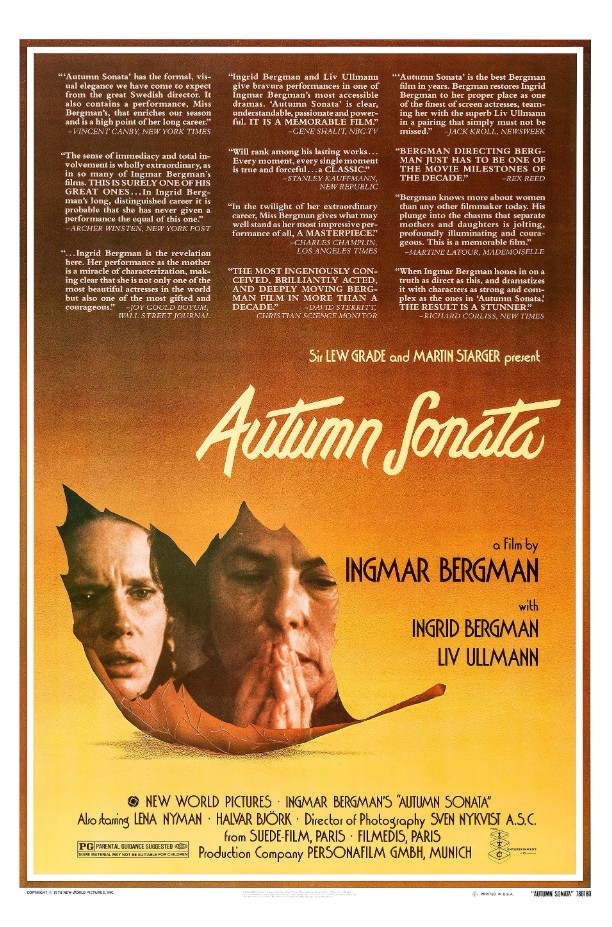
Autumn Sonata poster created by Persona Film, Suede Film, Incorporated Television Company (ITC), Svensk Filmindustri, Constantin Film, ITC Film Distributors, and New World Pictures

As I just mentioned in this review’s introduction, Autumn Sonata was nominated for two awards at the 51st Academy Awards. One of these categories was Best Leading Actress, with Ingrid Bergman as one of five actresses to receive a nomination. While discussing Autumn Sonata in Sneak Previews’ ‘The Best Films of 1978’ episode, Gene called Ingrid’s portrayal of Charlotte Andergast “riveting”. Even after a scene featuring Ingrid and Liv Ullmann (who portrayed Charlotte’s daughter, Eva) is presented in the episode, Gene says “Again, some real pain there”, referring to the emotions on display through Liv’s and Ingrid’s performance. Though I agree with Gene’s assessment of Ingrid’s portrayal of Charlotte, the word I’d use to describe it (as well as Liv’s portrayal of Eva) is captivating. In one of the best scenes from Autumn Sonata, Charlotte shares with Eva how her close friend, Leonardo, passed away. Throughout her recount of Leonardo’s last days in the hospital, Charlotte has a pained, disgusted look on her face. With a glossy, teary-eyed stare and a drawn-out frown, Charlotte is heartbroken over the loss of her friend. When I saw that scene, I wasn’t watching an actress portraying a character. I was witnessing a woman experiencing grief, with Ingrid’s performance possessing a strong sense of realism.

String of musical notes image created by Freepik at freepik.com. <a href=’https://www.freepik.com/free-vector/pentagram-vector_710290.htm’>Designed by Freepik</a> <a href=”https://www.freepik.com/free-photos-vectors/background”>Background vector created by Freepik</a>. Image found at freepik.com. 

Like I also said in my review, Liv Ullmann’s portrayal of Charlotte’s daughter, Eva, was captivating. This is because Liv was able to go toe-to-toe with Ingrid, acting-wise, understanding how to utilize emotion to her character’s advantage, as well as when to increase or decrease the intensity of those emotions. As I previously mentioned, there was a scene from Autumn Sonata featuring Ingrid and Liv in Sneak Previews’ ‘The Best Films of 1978’ episode. In that scene, Charlotte and Eva share an emotionally explosive conversation over the reasons why their relationship is strained. Eva states how she didn’t like Charlotte’s desire to turn her daughter into someone she wasn’t. During her reflections of her past, Eva is visibly distraught. With gritted teeth and eyes overflowing with tears, even shaking at one point, Eva confesses how Charlotte’s decisions have deeply impacted her and her life choices. Because of her performance in Autumn Sonata, I wish Liv Ullmann had been nominated for an Oscar as well.

Image by macrovector on Freepik

During their discussion of Autumn Sonata in ‘The Best Films of 1978’ episode of Sneak Previews, neither Roger nor Gene brought up the film’s screenwriting. This is a shame, as the screenwriting was one of the movie’s strengths. Autumn Sonata is a character-driven, “slice of life” story. However, the quality of the dialogue made conversations between characters sound emotionally deep and thought provoking. In one scene, Eva asks her husband, Viktor, if he thinks she’s an adult. Viktor responds by telling her, “I guess being an adult is being able to handle your dreams and hopes, not longing for things”. He could have simply given his wife a “yes” or “no” answer. But Viktor’s response gives Eva, as well as the audience, meaningful insight about growing up, managing expectations, and even gratitude. Later in Autumn Sonata, Charlotte confesses one of her realizations to Eva. She says, “I have never grown up. My face and my body have aged. I acquire memories and experiences but inside all that I haven’t even been born.” Similar to Viktor’s aforementioned quote, Charlotte’s quote addresses growing up. In Charlotte’s case, however, her reflections sound more regretful. Disappointment can even be heard in her voice, with those pent-up feelings finally being addressed through words. As I stated in this review’s introduction, Autumn Sonata was nominated for the Best Writing category. Through a thoughtfully crafted script, that nomination was, in my opinion, earned.

Envelope with hearts image created by Freepik at freepik.com. <a href=’https://www.freepik.com/free-photo/hearts-and-pink-envelope-for-mothers-day_1950691.htm’>Designed by Freepik</a>. <a href=”https://www.freepik.com/free-photos-vectors/love”>Love image created by Freepik</a>. Image found at freepik.com.

While continuing their discussion of Autumn Sonata, Roger tells Gene about a call he received from a reader who was interested in seeing Autumn Sonata. Roger then says the reader told him, “I couldn’t make head or tail of it. What is it about?” Meanwhile, Gene claims “the conflict is how do you reconcile your public career with your personal responsibilities to your family”. Based on my experience watching Autumn Sonata, I think it’s not just about balancing a public and personal life. I think it’s also about the brutal honesty of strained familial relationships. When Eva and Charlotte talk about the past, no figurative punches are held back. They tell each other exactly what’s on their minds and hearts, no matter who’s feelings get hurt. It would have been easy for Autumn Sonata’s creative team to paint either Charlotte or Eva as the “villain” of the story. Instead, both women are not only flawed, they have valid points to their sides of the narrative. How the story plays out kind of reminds me of The Royal Tenenbaums, where the strained relationship between Eva and Charlotte is the result of little things culminating over time. The acting performances and the screenwriting successfully bring a sense of realism to Autumn Sonata.

Norway’s past and present image created by Macrovector at freepik.com. <a href=”https://www.freepik.com/free-photos-vectors/poster”>Poster vector created by macrovector – http://www.freepik.com</a>. Image found at freepik.com.

According to IMDB, Autumn Sonata was filmed in Norway. Based on the scene where Charlotte drives to Eva and Viktor’s house, the Norwegian scenery looked like a beautiful painting. But the majestic hills, mountains, and large body of water from Norway wasn’t incorporated into Autumn Sonata beyond that one scene. I wish the “autumn” in Autumn Sonata played a larger role in the story, perhaps visually representing some of the movie’s themes. Another aspect of the story I wish had been utilized more was Eva’s sister, Helena. When Charlotte first arrives at Eva and Viktor’s house, Eva reveals how Helena is now living at their house instead of at a hospital. Throughout Autumn Sonata, Helena deals with an illness that greatly affects her mobility. I thought she was intended to be a bridge between Eva and Charlotte, helping them find a more peaceful middle ground. One reason for this belief came from Helena falling out of her bed during an emotionally explosive conversation between Charlotte and Eva. Sadly, it seems like Helena was in Autumn Sonata just for the sake of it.

Comparing with the Critics banner created by me, Sally Silverscreen. TV show title cards created by WTTW National Productions, WTTW, Public Broadcasting Service (PBS), Lifetime Television, Tribune Entertainment, Buena Vista Television, and Disney-ABC Domestic Television

Prior to reviewing Autumn Sonata, the only movie I agreed with Gene and Roger on was 1984’s Amadeus. I could also see why the film was, at least, nominated for an Oscar. Now I can confidently say that Autumn Sonata is the second film I agree with Roger and Gene on! While I typically don’t gravitate toward “slice of life” stories, the 1978 movie works because of the strength of the screenwriting and acting performances. Similar to The Royal Tenenbaums, the brutal honesty woven into the script brought a sense of realism when to came to addressing strained familial relationships. The story itself was emotionally deep and thought provoking because of the effort put into it by Autumn Sonata’s creative team. I understand why the movie is titled Autumn Sonata, as music plays an integral role in Charlotte’s life. However, I wish the “autumn” in Autumn Sonata was utilized more in the story, especially considering how beautiful the Norwegian landscape was in the film. The movie also doesn’t have a high rewatchability rate due the some of the heavier subject matter incorporated into the story. But I can honestly say that Autumn Sonata is one of the best films I’ve seen in 2026, so far!

This review was brought to you by

Sally Silverscreen
Comparing with the Critics – Best of 1988 – Wings of Desire

This review is from my series, Comparing with the Critics. If you’d like to learn more about the series, click on the link below.

Introducing my new series, Comparing with the Critics!

Five years ago, I advocated for the release of The Crow: City of Angels’ Tim Pope cut. This version of the movie was not only supposed to be 160-minutes, it was also supposed to tell a different story from its predecessor. The Crow: City of Angels’ intended conflict showed the protagonist, Ashe, choosing between reuniting with his son, Danny, in the afterlife or staying on Earth to form a romantic relationship with Sarah, who appeared in The Crow. When Roger Ebert brought up Wings of Desire in Siskel & Ebert’s Best of 1988 episode, he said the film was “about an angel who wants to be a human because he would rather have real, physical feelings than live forever”. His explanation of Wings of Desire reminded me of The Crow: City of Angels’ intended conflict I described. Since I don’t know if and/or when the Tim Pope cut of The Crow: City of Angels will be released, Wings of Desire will be my unofficial placeholder in terms of storytelling. The other reason why I chose Wings of Desire for my Comparing with the Critics series’ Best of 1988 review is because it was on Roger’s list of the ten best films of 1988, even though both he and Gene Siskel liked it. I approached this film with an open mind because I had never seen or heard of it prior to my series. Now that I have seen Wings of Desire, I think calling it one of the best movies of the year is giving the film a little too much credit.

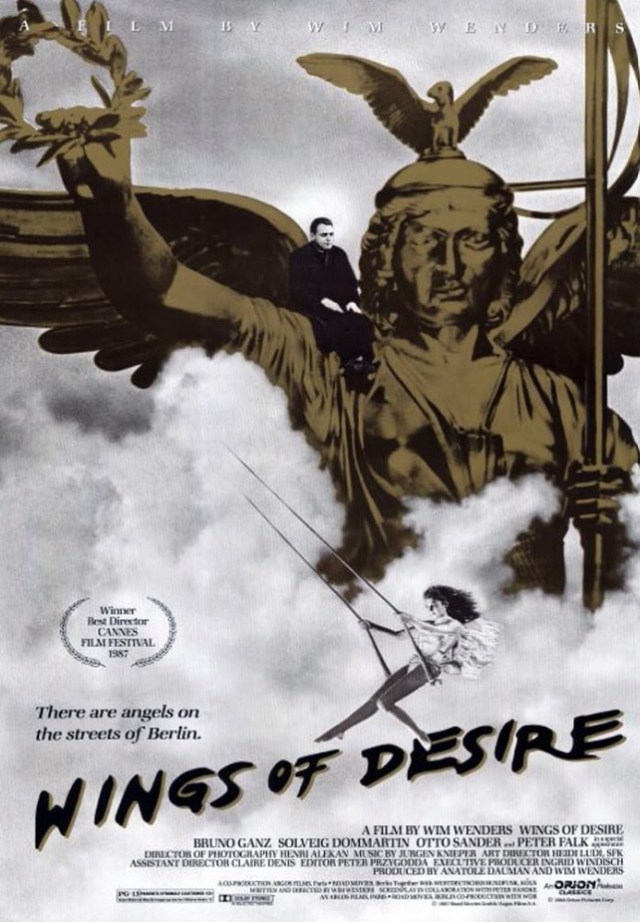
Wings of Desire poster created by Road Movies Filmproduktion, Argos Films, Westdeutscher Rundfunk (WDR), Wim Wenders Stiftung, Orion Classics, Basis-Film Verleih, and Filmverlag der Autoren

As I said in the introduction of this review, both Roger and Gene liked Wings of Desire. In an episode of Siskel & Ebert, they gave the film a thumbs-up. Roger commented on how the movie “has a mood to it. It takes the time to establish that mood”. Meanwhile, Gene points out that Wings of Desire “gives more than equal time to the angels’ thoughts”. What Roger and Gene said was achieved through mise-en-scène and music. A great example is when Damiel (portrayed by Bruno Ganz) is at a crossroads over whether he truly wants to become human or remain an angel. The majority of the scene is presented through “shaky cam”, giving the illusion Damiel is quickly turning his head and moving in circles. Sharp, quick violin sounds play over the scene, heightening Damiel’s panic and confusion. Shots of humans crying or looking frightened are interspersed throughout the scene. This creative choice reflects Damiel’s thoughts and feelings. Whenever “shaky cam” is incorporated into a movie, it is usually met with criticism due to how the film-making technique distorts a scene to the point of becoming unwatchable. However, the use of “shaky cam” in Wings of Desire is one of the few times where it works. This is because that creative decision was utilized purposefully to enhance the emotional aspect of the story.

Since there are angels in Wings of Desire, I thought adding this angel picture to my review made sense. Screenshot taken by me, Sally Silverscreen.

Wings of Desire is mostly presented in black-and-white imagery. But there are a handful of scenes shown in color. This creative choice differentiates the perspective between the angels and the humans. Damiel and Cassiel, two angels from the film’s main cast of characters, see the human world in black-and-white, as they are outsiders looking in. The humans’ environment is visually represented in color, showcasing life in 1980s West Berlin. Black-and-white and color imagery’s incorporation into Wings of Desire is purposeful as it addresses concepts like a sense of belonging, unique points of view, and what it means to be a part of a community. Wings of Desire’s creative decision reminded me of Schindler’s List, a black-and-white movie that occasionally utilized color to emphasize certain ideas.

Map of Germany image created by Macrovector at freepik.com. Background vector created by macrovector – www.freepik.com. Image found at freepik.com.

Another visual aspect of the movie I liked was Marion’s wardrobe. In Wings of Desire, Marion (portrayed by Solveig Dommartin) is a trapeze artist who is afraid her dream may be coming to an end due to the circus’ struggling finances. Her performances give her an excuse to wear gorgeous costumes! When she is first introduced in the story, Marion wears a long-sleeved leotard with an attached skirt. This costume is made up of a beige velour-like material and covered in diamond-esque gems. The shoulders of the costume feature a shiny applique. To give circus attendants the impression Marion is a flying angel, she wears large, white wings while performing in the air. The exquisiteness of Marion’s costumes makes me wish they were shown in color more consistently. I also wish Wings of Desire’s costume designer, Monika Jacobs, was nominated for, at least, one award.

Group of clowns image created by Freepik at freepik.com. Image by Freepik

After a clip of Wings of Desire was presented on Siskel & Ebert, Gene declares “the juiciest part of this picture is how close we get to everyday people, their joys, their heartbreaks”. He also says, “director, Wim Wenders, does a real remarkable thing here; he praises life as it is lived, yet making sense out of life’s confusions to the point where we enjoy being alive in a fresh way”. While I agree with Gene about the realistic portrayal of the humans’ lives, I wish the dialogue had sounded more realistic. Every time a character speaks, they deliver philosophical speeches instead of conversations. This made the characters sound like they were spending more time expressing ideas than putting ideas into action. Though looking back on Wings of Desire, I wonder if that was intended commentary on how people spend less time solving problems and more time talking about them?

Breaking heart image created by Kjpargeter at freepik.com. <a href=’https://www.freepik.com/free-vector/broken-heart-valentine-background_1041991.htm’>Designed by Freepik</a>. <a href=”https://www.freepik.com/free-photos-vectors/background”>Background vector created by Kjpargeter – Freepik.com</a>. Image found at freepik.com.

Like I mentioned earlier in my review, Damiel and Cassiel are outsiders looking in on the human world. Despite this, both angels observe, listen, and occasionally intervene in the humans’ lives. That means Wings of Desire’s audience can hear the thoughts of the humans Cassiel and Damiel cross paths with. But because the angels are disconnected from the human world, story ideas are either loosely connected or not connected at all. A man’s parents concerned over his musical ambitions serve as one example, with the concerns themselves brought up but never resolved. There are four main plots within Wings of Desire. However, only three of them were related to each other. Plus, these three plots didn’t connect until toward the end of the movie. Waiting for the bridges of the plots to form felt tedious, in my opinion.

Comparing with the Critics banner created by me, Sally Silverscreen. TV show title cards created by WTTW National Productions, WTTW, Public Broadcasting Service (PBS), Lifetime Television, Tribune Entertainment, Buena Vista Television, and Disney-ABC Domestic Television

In the introduction of this review, I said calling Wings of Desire one of the best movies of the year is giving the film a little too much credit. It’s not a bad movie, I just didn’t like or love it as much as Roger and Gene did. Wings of Desire is a fine, interesting film that kept me invested in what was happening on screen. The movie also has artistic merit due to creative decisions purposefully incorporated into the project. But major flaws lie in the script. I wish dialogue between characters sounded more conversational, as it would have complimented the realistic depiction of life in 1980s West Berlin. Story ideas should have developed stronger connections to one another, especially among the four main plots. Waiting for three of those main plots to connect was, in my opinion, tedious. During their discussion of Wings of Desire on their show, Siskel & Ebert, Gene tells Roger how Wim Wenders “doesn’t sweeten life to the point that it’s false”. Looking back on my experience watching the movie, I can see, and even appreciate, Gene’s point. Wings of Desire captures Germany before the Berlin Wall would eventually fall.  The Wall itself is even featured in a few scenes. Through visuals, text, and even musical selection, the edge of change I addressed in my 1988 introduction of Comparing with the Critics was brought to life on the big screen. The creative team behind Wings of Desire played a small role in history, even if they didn’t know it at that time.

This review was brought to you by

Sally Silverscreen
Comparing with the Critics – 1988 – Introduction

1988 is known as a year on the edge of change. In the United States, a Presidential election let Americans decide how they wanted their country to be led. The foundations of the “Disney Renaissance” were laid into place before Disney made a splash heard around the world. And one year later, President Ronald Reagan’s words to “tear down this wall” were finally put into practice. Reflecting on 1988’s box office, especially the highest-grossing films of that year, this edge of change could be seen and felt. Who Framed Roger Rabbit proved it was, indeed, possible for live action and animation to join forces. Tim Burton helped Beetlejuice walk so Batman could soar. In May of 1988, two films made contributions that would cause ripple effects throughout cinema. Though Gene Siskel and Roger Ebert appreciated one of these efforts more than the other. These movies are Wings of Desire and Willow. The Best of 1988 episode of Siskel & Ebert showed Wings of Desire earning a spot on Roger’s list of the year’s best movies, even though both he and Gene liked it. Meanwhile, in the show’s Worst of 1988 episode, Gene and Roger believed Willow was just a retread of Star Wars. However, the film only ended up on Gene’s list of 1988’s worst pictures. If you read my review of Willow from last year, you would know I selected it for Comparing with the Critics’ Worst of 1988. As for Wings of Desire, that is my choice for Best of 1988 in my Comparing with the Critics series.

Comparing with the Critics banner created by me, Sally Silverscreen. TV show title cards created by WTTW National Productions, WTTW, Public Broadcasting Service (PBS), Lifetime Television, Tribune Entertainment, Buena Vista Television, and Disney-ABC Domestic Television

Comparing with the Critics – Best of 1985 – Mad Max Beyond Thunderdome

This review is from my series, Comparing with the Critics. If you’d like to learn more about the series, click on the link below.

Introducing my new series, Comparing with the Critics!

In my Comparing with the Critics review of Amadeus, I mentioned the Falco song, “Rock Me Amadeus”, being one of the reasons why I was intrigued to review the movie. I actually have a similar experience with Mad Max Beyond Thunderdome. Every time I think of this film, I think of the Tina Turner song, “We Don’t Need Another Hero (Thunderdome)”. This is an ironic coincidence, as “We Don’t Need Another Hero (Thunderdome)” and “Rock Me Amadeus” were released in 1985. Another ironic coincidence is how, for the Comparing with the Critics series, I, once again, selected an ‘80s film both Roger Ebert and Gene Siskel liked. Though Mad Max Beyond Thunderdome only appeared on Roger’s list of the top ten best films of 1985, each critic gave the movie a thumbs-up when they reviewed it on an episode of At The Movies. Before this Comparing with the Critics review, I had never seen any of the Mad Max movies, let alone Mad Max Beyond Thunderdome. Therefore, I couldn’t agree or disagree when Roger stated that Mad Max Beyond Thunderdome was “the best of the Road Warrior movies” or when Gene declared it was “a great, violent, fun picture”. Now that I have seen the film, I can honestly say I don’t agree with Gene’s and Roger’s praise. It’s not that Mad Max Beyond Thunderdome is a bad movie, I just didn’t like or love it as much as the critics did.

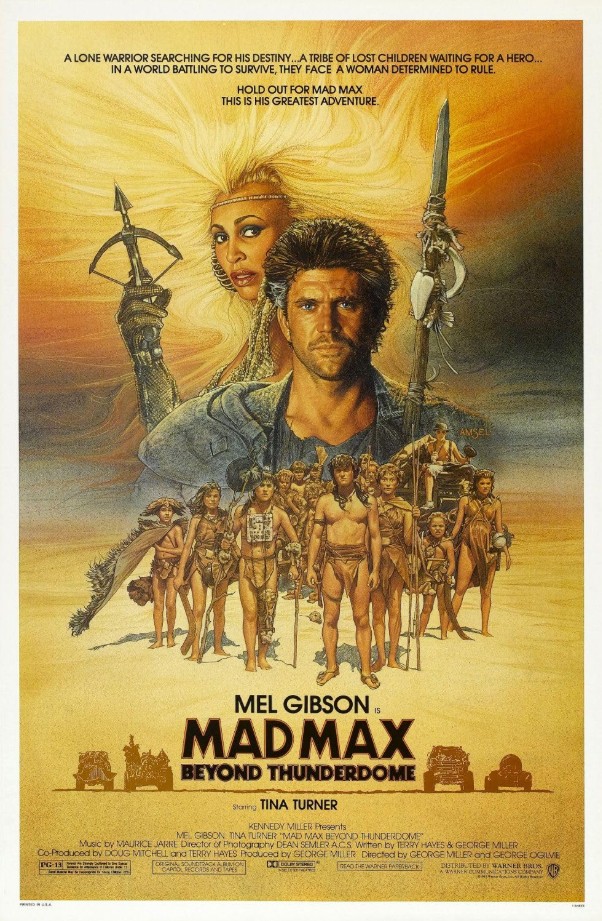
Mad Max Beyond Thunderdome poster created by Kennedy Miller Productions and Warner Bros.

While sharing his opinion on Mad Max Beyond Thunderdome in an episode of At The Movies, Gene complements the directors, George Miller and George Ogilvie, as both of them “successfully creates a complete alien world on film”. To add to Gene’s statement, Roger commented how the film’s “world is as rich as Casablanca or as rich as Oz”. I admit one of the strengths of Mad Max Beyond Thunderdome was its set design, as the movie’s creative team presented an atmosphere that felt immersive! One of the conflicts in the story is Max battling in a duel against a character named Blaster, in order to retrieve his stolen items. They fight within the titular Thunderdome, a circular caged structure built out of steel-like material. What adds to the scene’s immersion is the medium and close-up shots captured within the Thunderdome. The combination of these creative choices helps the audience feel like they are right in the middle of the excitement! Even the sign advertising the Thunderdome is a blend of color, light, and dirt. This specific prop captures the thrill of the dueling action while also consistently displays the film’s aesthetic.

Image by Freepik

As I said in this review’s introduction, Mad Max Beyond Thunderdome ended up on Roger’s list of the top ten best films of 1985. One of his reasons was how he “was overwhelmed by the wealth of new ideas they came up with in the third picture”. Specifically speaking about Max and Blaster’s aforementioned duel, Roger explains how this scene presents two new ideas; “a new place to put the audience, which is over the top of the dome, and a new way to fight by putting the people on elastic bands so they have a three or a four dimensional, if you will, fight instead of regular punching it out”. Adding to Roger’s explanation, both Max and Blaster were given more freedom to move around the Thunderdome because of their elastic harnesses. While there was fist-fighting in the duel, flips and large jumps were incorporated in the fight choreography. Blaster and Max were presented with a variety of weapons, which added to the duel’s unpredictability. It also shows how the duel itself was a battle of strategy. This scene is definitely one of the most memorable from Mad Max Beyond Thunderdome!

Back to 1985 Blogathon banner created by Quiggy from The Midnite Drive-In and Hamlette from Hamlette’s Soliloquy

While Gene and Roger sang the praises of Mad Max Beyond Thunderdome, I was disappointed they ignored Tina Turner’s portrayal of Aunty Entity. Personally, I think Tina is a better actress than some people give her credit for. Her performance in this film proves that. A great example is when Master confronts Aunty Entity about the true leadership of Bartertown. Before this confrontation, Aunty Entity is confident in her ability to rule over this little community. Master calls her out by questioning who’s in charge. Aunty’s confidence gradually turns into anger. She develops a stern look on her face, the anger itself filling her eyes. There’s even a point where Aunty’s bottled-up anger causes her to shake. This scene shows how Tina’s performance was able to say so much while utilizing very little dialogue.

Illustrated image of Arizona desert created by pikisuperstar at freepik.com. Background vector created by pikisuperstar – www.freepik.com

Like I brought up in my review’s introduction, I didn’t like or love Mad Max Beyond Thunderdome as much as Roger and Gene did. A reason for my opinion is how the script left several questions unanswered. When Max meets the children of the Planet Erf tribe, the children believe he is Captain Walker. They describe Captain Walker as a plane pilot who will lead them to a better land. Because Jedediah was introduced in Mad Max Beyond Thunderdome as a man who could successfully fly a plane, I thought he could be Captain Walker, connecting him to the Planet Erf tribe’s part of the story. But this wasn’t the case, leaving questions about Captain Walker’s whereabouts. I was also not a fan of the creative team’s decision to prioritize telling over showing. A good example is when Blaster is about to be defeated in his and Max’s duel. Master begs Max not to kill Blaster, as he has a lot of respect for Blaster. However, this respect isn’t shown leading up to that scene. The only interactions with Master and Blaster are Master simply using Blaster as a means of transportation. Had the respect and camaraderie between Blaster and Master been better displayed, the duel itself and even its aftermath would have carried more emotional weight.

Comparing with the Critics banner created by me, Sally Silverscreen. TV show title cards created by WTTW National Productions, WTTW, Public Broadcasting Service (PBS), Lifetime Television, Tribune Entertainment, Buena Vista Television, and Disney-ABC Domestic Television

When Roger Ebert placed Mad Max Beyond Thunderdome on his list of the top ten best films of 1985, he called it “a great looking, high styled thriller”. Gene Siskel even claimed that “kids are gonna want toys out of this film” and “people are gonna dress like out of this film”. I can only speak for myself, but I wouldn’t go out of my way to seek out merchandise related to this movie or even revisit this movie. That’s because I thought Mad Max Beyond Thunderdome was just a fine, well-made picture. I couldn’t become fully invested in this story because of the collection of unanswered questions, which left me confused. I did not like the creative team’s decision to emphasize telling over showing as well. But the movie does have its merits. The world-building was one of the strongest aspects of the production, as the directors helped create an on-screen world that felt immersive. I not only liked the acting, I also believe the Thunderdome duel was one of the film’s most memorable scenes. So, this is yet another review where I didn’t agree with the critics. Now, if you’ll excuse me, I’ve got to go sing along to Tina Turner’s song, “We Don’t Need Another Hero (Thunderdome)”!

This review was brought to you by

Sally Silverscreen
Comparing with the Critics – Worst of 1985 – The Bride

This review is from my series, Comparing with the Critics. If you’d like to learn more about the series, click on the link below.

Introducing my new series, Comparing with the Critics!

The summer of 1985 was a disappointing time for Gene Siskel and Roger Ebert. They were so let down by that particular time of the year, At The Movies dedicated an entire episode to discussing the worst movies of the summer. The Bride, which was released on August 16th, was the first film featured in this episode. It left such a bad impression on Roger and Gene, it also appeared on the ‘Worst of 1985’ episode of the show. In each of these episodes, Roger describes The Bride as “an ambitious film that lost it’s way” and a movie that “shot for the stars and failed miserably”. Because I hadn’t even heard of The Bride before starting my Comparing with the Critics series, I couldn’t agree or disagree with Roger’s sentiments. From the way the movie was described, it seemed to answer the question of what would happen if Victor Frankenstein’s female creation fell in love with him? This is a question that is infrequently asked in Frankenstein related media. As someone who has read Mary Shelley’s source material, I was curious to see how the film’s creative team would answer this question. But now that I have seen The Bride, I’m disappointed by how this question was approached. Unlike Gene and Roger, though, I wouldn’t go so far to say the movie is bad.

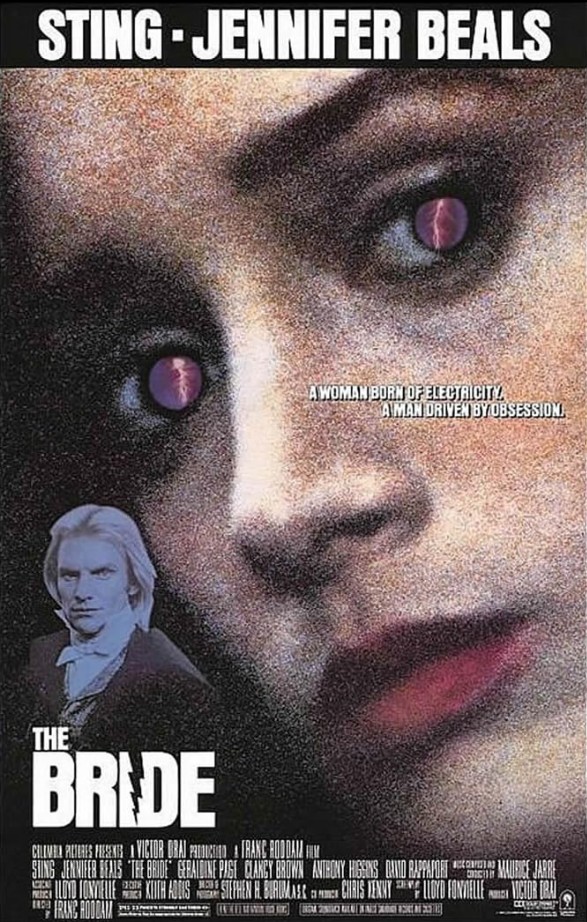
The Bride poster created by Colgems Productions Ltd., Delphi III Productions, Lee International Studios, and Columbia Pictures

After showing a clip from The Bride in At The Movies’ Worst Movies of the Summer episode, Roger claims the film “didn’t know whether it wanted to be a serious movie about the philosophical issues raised by the whole Frankenstein legend or whether it just wanted to be a glamourous, sleek remake”. I personally believe the movie’s creative team knew exactly what they were doing, accomplishing two goals in one picture. Throughout The Bride, there are two parallel stories; the first about Frankenstein and his female creation (Eva) and the second about Frankenstein’s male creation (Viktor) and Rinaldo. These stories show Viktor and Eva learning about the world around them as well as interacting with those they depend on. Every time Rinaldo introduces Viktor, he always refers to Viktor as “his friend”. Meanwhile, Frankenstein calls Eva “his ward”. The stories in The Bride were, in my opinion, intended to take a specific approach to the Nature vs. Nurture debate, presenting how two creations created by the same man could journey to the same outcome.

In Mary Shelley’s original source material, there aren’t really any heroes in that story. That’s because it focuses on the main message of some good intentions possibly leading to bad results. In The Bride, Viktor receives a “hero’s journey”, where he not only gets to fall in love, he also gets to save the day. His name, according to Rinaldo, even means “He will win”. As I mentioned in this review’s introduction, I have read Mary Shelley’s novel. From what I remember, Frankenstein destroys his female creation and his male creation is presented in the story as more of a cautionary tale. With that said, I think this creative liberty added an interesting dynamic to The Bride!

Hand-written letter image created by Veraholera at freepik.com. <a href=”https://www.freepik.com/free-photos-vectors/background”>Background vector created by Veraholera – Freepik.com</a>. <a href=’https://www.freepik.com/free-vector/love-letter-pattern_1292902.htm’>Designed by Freepik</a>. Image found at freepik.com.

While talking about The Bride’s two parallel stories, Gene says the story of Viktor and Rinaldo “was much more interesting than Frankenstein and the monster”. I find myself agreeing with Gene, especially since this story included a “hero’s journey” and a conflict that needed to be resolved. But another reason why I liked Rinaldo and Viktor’s story is David Rappaport’s portrayal of Rinaldo. When Rinaldo first meets Viktor, he’s surprisingly not intimidated by Viktor’s size. Instead, Rinaldo’s confidence helps Viktor find a sense of belonging as well as build a friendship between himself and Viktor. Rinaldo’s charisma shows the audience his good intentions, always striving to give Viktor a better life than Frankenstein did. As he’s giving Viktor a new shirt, Rinaldo is horrified by the scars on Viktor’s back. The sight immediately brings concern to Rinaldo’s face, his saddened tone of voice concluding how Viktor must have been mistreated. The scene I just described shows how David’s performance gave Rinaldo a genuineness that allowed him to be a likeable character. Though this film is titled The Bride, Rinaldo became this movie’s MVP!

Back to 1985 Blogathon banner created by Quiggy from The Midnite Drive-In and Hamlette from Hamlette’s Soliloquy

Both Roger and Gene agreed that Viktor and Eva should have spent more screen-time together. Roger proclaims “if we’re gonna have those parallel stories for two hours, let’s have a pay-off at the end”, with Gene adding “a pay-off for half an hour, not for five minutes”. Like I talked about earlier in this review, I believe the creative team’s intention for The Bride was to present a specific approach to the Nature vs. Nurture debate, as well as giving Viktor a “hero’s journey”. However, my biggest criticism with these parallel stories was the editing. The way these stories were sewn together made the movie feel disjointed. This is because some parts of the story were longer than others. One scene shows Eva studying a series of pictures by herself for only a few seconds. The very next scene shows Viktor and Rinaldo on their journey to the circus, with the scene itself lasting several minutes. Frankenstein and Eva receiving shorter screen-time sometimes prevented the audience from seeing interesting interactions between these two characters. This creative decision also gave Eva and Frankenstein’s story less intrigue.

Group of clowns image created by Freepik at freepik.com. Image by Freepik

When I was introduced to The Bride, I was given the impression the film was trying to answer the question of what if Victor Frankenstein’s female creation fell in love with him. This made me curious to see how the movie’s creative team would answer this question. But like I said in my review’s introduction, I’m disappointed by how this question was approached. That’s because the film’s creative team didn’t answer or explore the question at all. They bring up an equally interesting and infrequently asked question of what if Frankenstein fell in love with his female creation? However, so much time was spent focusing on Eva learning about the world around her, the aforementioned question was given little time for exploration or discussion. When it came to Frankenstein’s love for Eva, it simply came across as possessive and controlling. As I’ve been saying throughout this review, Viktor was given a “hero’s journey”. This means the story always intended to have Eva fall in love with Viktor, not Frankenstein. Even though I liked the creative decision of Viktor’s “hero’s journey”, I’m still disappointed by the potential questions that were left unanswered.

Comparing with the Critics banner created by me, Sally Silverscreen. TV show title cards created by WTTW National Productions, WTTW, Public Broadcasting Service (PBS), Lifetime Television, Tribune Entertainment, Buena Vista Television, and Disney-ABC Domestic Television

Toward the beginning of At The Movies’ Worst Movies of the Summer episode, Gene claims the summer of 1985 “happened to be one of the dullest, most juvenile, most homogenized summer movie seasons in recent memory”. Out of the movies that premiered during that time, I’ve only seen six pictures in their entirety, including The Bride. Personally, I didn’t find any of these films to be bad or disappointing. Specifically speaking about The Bride, I thought it was a fine, serviceable, interesting enough title. Though I was disappointed the movie’s creative team didn’t answer the question of what if Victor Frankenstein’s female creation fell in love with him, there were aspects of the film I liked. While the acting was one of the strengths of The Bride, David Rappaport’s portrayal of Rinaldo shined the brightest! Rinaldo was such a likable character, he became my favorite! Another strength of this film was Viktor receiving a “hero’s journey”. Even though it was a creative liberty, it added an interesting dynamic to The Bride’s story. It was also interesting to see the creative team’s approach to the Nature vs. Nurture debate. I apologize for sounding like a broken record, but this is yet another Comparing with the Critics review where I disagreed with Roger and Gene. As I continue with my series, I have to wonder how often this will keep happening?

This review was brought to you by

Sally Silverscreen

Comparing with the Critics – 1985 – Introduction

Looking back on 1985, one can see the abundance of stand-alone films released that year. While cinemas welcomed sequels, these movies were exceptions to the rule, compared to the box office of 2025. That’s because studios and film companies were more selective about which titles received another chapter. Mad Max Beyond Thunderdome joined this exclusive club. It even left such a good impression, it earned a place on Roger Ebert’s list of the top ten best films of 1985. As I mentioned earlier in this introduction, 1985 saw an abundance of stand-alone movies. However, these projects were not created equally. The Bride tried to find an answer to the infrequently asked question of what would happen if Victor Frankenstein’s female creation fell in love with him?  Both Roger and Gene Siskel were so disinterested in finding an answer to this question, that the film was not only featured in At The Movies’ Worst Films of 1985 episode, it also made an appearance in the show’s Worst Movies of the Summer episode. At this point in the introduction, you probably think Mad Max Beyond Thunderdome and The Bride being singled out is purely a coincidence. But these titles were specifically chosen for Midnite Drive-in’s and Hamlette’s Soliloquy’s Back to 1985 Blogathon, where I’m reviewing The Bride as the Worst of 1985 and Mad Max Beyond Thunderdome as the Best of 1985!

Comparing with the Critics banner created by me, Sally Silverscreen. TV show title cards created by WTTW National Productions, WTTW, Public Broadcasting Service (PBS), Lifetime Television, Tribune Entertainment, Buena Vista Television, and Disney-ABC Domestic Television