
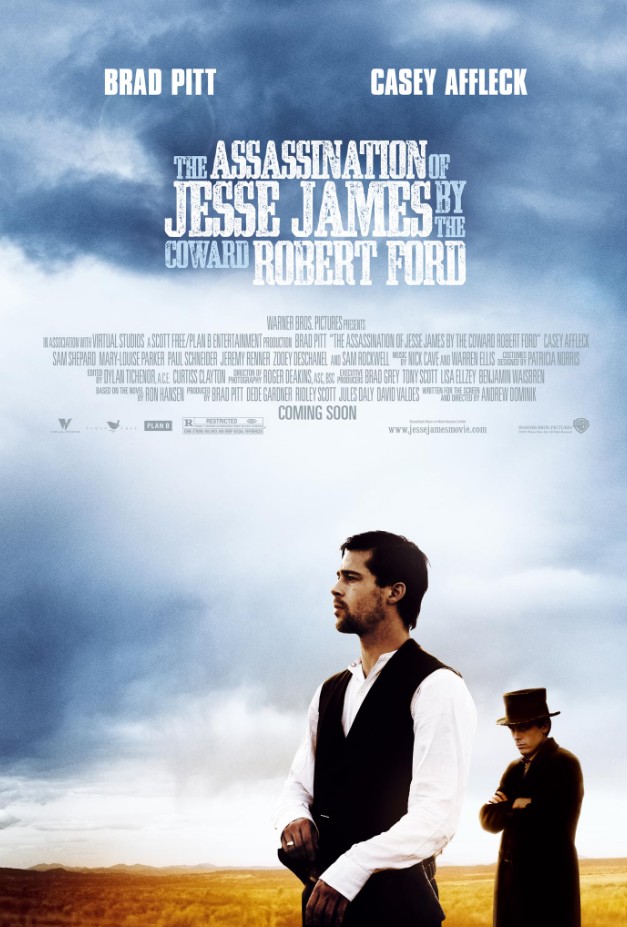
June’s theme for Genre Grandeur is “Movies With Genre Bending themes”. I spent a lot of time researching potential titles due to how specific this theme is. But with this month’s Genre Grandeur overlapping with the Legends of Western Cinema Week Blogathon, I chose the 2007 movie, The Assassination of Jesse James by the Coward Robert Ford. According to an article of The 10 Best Genre-Bending Movies Of All Time from the website, Taste of Cinema, “What makes the film [The Assassination of Jesse James by the Coward Robert Ford] one of the true genre-bending westerns is how it chooses to present it mythology of the west”. The author of the article, Mark Serravalle, explained how “The characters are more life-like and complicated than how they are made out in the stories that are told about them”. I will admit that, even though I’ve heard of him, I know very little about Jesse James. In fact, the titles I’ve selected for past Legends of Western Cinema Week Blogathons have revolved around either fictional or fictionalized stories. Therefore, reviewing The Assassination of Jesse James by the Coward Robert Ford is not only a learning opportunity for 18 Cinema Lane, it’s allowing my blog to travel newer paths within the realm of blogathons.
Things I liked about the film:
The acting: The Assassination of Jesse James by the Coward Robert Ford received two nominations at the 80th Academy Awards. One of those nominations was given to Casey Affleck for his portrayal of the titular Robert Ford. Looking back on the 2007 movie, I can agree with the Academy’s decision! What I liked about Casey’s performance is his ability to say so much without saying anything at all. A perfect example is when Robert is reflecting on the similarities he and Jesse share. Throughout this recollection, Robert appears disappointed and even defeated. His eyes and the slight frown his mouth adopts give these feelings away. But every now and then, a smile shows up on Robert’s face and his eyebrows even move upwards. This moment effectively illustrates how Robert has become disillusioned by the reality of who Jesse really is, yet fondly remembers his fabricated image of him.
If I had to be brutally honest, I think Brad Pitt should have been nominated for his portrayal of Jesse James. This is because, through his acting talents, Brad presented Jesse as the opposite of what one might expect. When it comes to legendary figures like Jesse James, presentations of being “larger than life” and a “showman” could give the impression Jesse was an untouchable, unstoppable force. But Brad’s portrayal of Jesse emphasizes the human he was; capable of feeling fear, making mistakes, and constantly looking over his shoulder. A perfect example of this point is when Jesse is interrogating Robert’s cousin, Albert. When Albert claims he doesn’t know Robert’s whereabouts, Jesse beats Albert up because he thinks Albert is lying. During the beating, the anger on Jesse’s face is very evident. But as he realizes Albert is, indeed, telling the truth, Jesse’s face quickly goes from angry to confused. He adopts a “thousand yard stare” as well as a look of disbelief, wondering how he could be so wrong. Several minutes later, as he’s preparing to leave on horseback, Jesse bursts into tears, realizing he just crossed a line.
The cast of The Assassination of Jesse James by the Coward Robert Ford gave performances that were well-done. However, I was pleasantly surprised to see Jeremy Renner star in the film as Wood Hite! Before reviewing the 2007 film, I had seen Jeremy’s portrayal of Clint Barton/Hawkeye throughout the Marvel Cinematic Universe (MCU) and his portrayal of Aaron Cross from The Bourne Legacy. But what was different about Jeremy’s portrayal of Wood is how he had to rely more on emotion in order to carry the character through the story. During an exchange between Wood and Robert, Wood shares how his mother is Jesse’s father’s sister. He tries to use his familial connection as leverage against Robert, smugly smiling and his tone of voice sounding very arrogant. When Robert questions this familial connection, Wood’s face quickly changes to a look of shock. His tone of voice becomes defensive and his eyes grow wide. This example shows how, even though Jeremy appeared in The Assassination of Jesse James by the Coward Robert Ford for a limited period of time, the versatility of his acting talents were on full display!
The cinematography: Remember when I said The Assassination of Jesse James by the Coward Robert Ford received two nominations at the 80th Academy Awards? Well, the other nomination was given to Roger Deakins for the Cinematography category. Once again, this is a decision I agree with the Academy on! Two of the best examples of the cinematography’s mastery in The Assassination of Jesse James by the Coward Robert Ford happens during a train robbery taking place toward the beginning of the movie. When the train stops right in front of Jesse, only the train’s front light is shining. White smoke forms around both the train and Jesse. Because of the minimal lighting, Jesse is presented as a silhouette. He’s presented as a silhouette again when he’s walking beside the train, emerging from the aforementioned white smoke. Only the light from the train’s window illuminates the scene, giving the scene itself a warm, orange glow. Through the cinematography, these two examples elaborate how Jesse was depicted by those who didn’t know him well; a mysterious myth who seized the attention of others.
More unique ideas brought to the Western genre’s table: It seems like the two most common settings in the Western genre are deserts and plains. But what if I told you a forest is where parts of The Assassination of Jesse James by the Coward Robert Ford take place? While there were plains in the 2007 film, I’d argue forests were featured in the story the most. Because forests are usually not known for being a Western genre location, The Assassination of Jesse James by the Coward Robert Ford brings something more unique to the genre’s table. In Western genre films revolving around legendary figures like Jesse James, the script typically focuses on the prime of the figure’s life, highlighting the most exciting, thrilling parts of their story. But The Assassination of Jesse James by the Coward Robert Ford showcases Jesse and his gang’s life after crime. Even the train robbery I referenced earlier was not presented as a thrilling, exciting event. Instead, that train robbery is shown as a scary event full of uncertainty, fear, and even violence. These screenwriting choices gave the 2007 movie a sense of honesty that isn’t always found in the Western genre.
What I didn’t like about the film:
The run-time: As listed on IMDB, The Assassination of Jesse James by the Coward Robert Ford’s run-time is two-hours and forty-minutes. Similar to my thoughts about Gods and Generals’s run-time, the 2007 film’s run-time can definitely be felt. The story of Jesse James and his gang’s life after crime is told at a slower pace. That paired with the aforementioned run-time causes The Assassination of Jesse James by the Coward Robert Ford to feel unnecessarily stretched out. I found myself zoning in and out while watching the movie, concerned I’d fall asleep during my movie-viewing experience. One solution to this flaw would have been to trim scenes that linger, such as a scene where Jesse stares at his brother, Frank, for what seems like a minute.
A somewhat misleading title: When I recently reviewed The Naked Jungle, I criticized the movie for its somewhat misleading title. Even though the titular jungle played a role in the story, it didn’t appear until about the last forty minutes of the hour and thirty-five minute film. The Assassination of Jesse James by the Coward Robert Ford possesses the same flaw. Based on the title alone, one would believe the titular event would serve as the story’s primary focus. But that event doesn’t end up happening until the film’s last twenty-seven minutes. This means during The Assassination of Jesse James by the Coward Robert Ford’s two-hour and forty-minute run-time, most of that time is spent leading up to the event itself. The audience is forced to wait over two hours for Jesse’s other shoe to drop.
The dialect: The Assassination of Jesse James by the Coward Robert Ford takes place during the late 1800s. This setting in time encouraged the film’s creative team to adopt historical accuracy. While that aspect of filmmaking was achieved visually, it was also achieved vocally, as the cast spoke with the dialect (as well as the dialogue) of the story’s time. Despite these historically accurate achievements, there were times I found it difficult to understand what the characters were saying. Because I don’t hear that dialect (and dialogue) consistently, I was forced to actively pay attention to what was being said. Otherwise, there’s a good chance I would have missed important context.
My overall impression:
The more I think about The Assassination of Jesse James by the Coward Robert Ford, the more it reminds me of Gods and Generals and The Naked Jungle. Not only does the 2007 movie possess a run-time that is, in my opinion, too long (like Gods and Generals), its title is also somewhat misleading (like The Naked Jungle). While I appreciate the creative team’s efforts to make their film look and sound historically accurate, I sometimes found it difficult to understand what the characters were saying. But despite these flaws, it’s evident there was merit put toward the project. Besides the historically accurate appearance of The Assassination of Jesse James by the Coward Robert Ford, the cinematography made the film visually interesting. The train robbery scene proves how the movie’s creative team took advantage of film’s visual medium to present their intended ideas. The cast as a whole gave good performances, especially Casey Affleck, Brad Pitt, and Jeremy Renner. But what I appreciate the most about The Assassination of Jesse James by the Coward Robert Ford is how more unique ideas were brought to the table of the Western genre. From setting parts of the story in a forest to showcasing Jesse and his gang’s life after crime, these creative choices prevent the Western genre from becoming stagnant. It also illustrates how creatively diverse the Western genre can be.
Overall score: 6 out of 10
Have you seen The Assassination of Jesse James by the Coward Robert Ford? What creatively unique ideas from the Western genre have stood out to you? Let me know in the comment section below!
Have fun at the movies!
Sally Silverscreen
Here’s the link to the article I referenced in this review if you’re interested in reading it: https://www.tasteofcinema.com/2023/the-10-best-genre-bending-movies-of-all-time/


I got a 10 movie collection from WB earlier this year. One of the movies was this one. Still haven’t watched it yet, but its on my to do list. Good review.
Quiggy @ The Midnite Drive-In
LikeLiked by 1 person
Thanks for checking out my review, Quiggy! If you decide to write about The Assassination of Jesse James by the Coward Robert Ford, I’d be interested in reading your thoughts on the movie!
LikeLike
This is such a unique film. I’ve only seen it once, but it has haunted me ever since.
And I totally agree that Brad Pitt shines extra brightly in this. He shows us a lot of complexity and depth inside a man who was mythologized long before he died.
But I love the title. The whole film is about all the tiny puzzle pieces slowly getting slotted into place, without which the assassination wouldn’t happen. And it tells you right off the bat what is coming, which means it builds tension and suspense over HOW it’s going to happen, not WHAT is going to happen. (Plus, it plays off lines in the famous ballad “Jesse James,” which tickles me, because I was the kind of weird kid who memorized that ballad when she was like ten. I only remember the refrain super well anymore, though.)
I definitely agree it could have used tighter pacing, though. It’s almost languid.
LikeLiked by 1 person
Thank you for reading my review and for sharing your thoughts on The Assassination of Jesse James by the Coward Robert Ford! To add to your point about Brad Pitt’s performance, he effectively utilized his eyes in the train robbery scene to convey emotions, despite having a bandanna covering most of his face. Like I said in my review, Brad should have been nominated for his portrayal of Jesse James.
LikeLike
This is one of the best looking films I’ve ever seen thanks to the masterwork from Deakins behind the camera. I agree it’s a bit bloated and could be trimmed down a bit, but it’s also a film I think anyone debating on seeing it should watch. Great analysis.
LikeLiked by 1 person
Thanks for checking out my review and for sharing your thoughts on The Assassination of Jesse James by the Coward Robert Ford!
LikeLiked by 1 person
The Assassination of Jesse James by the Coward Robert Ford is beautiful to look at. Zooey Deschanel’s cameo appearance was a nice surprise too.
LikeLiked by 1 person
Thanks, Paul S., for reading my review and for sharing your thoughts on The Assassination of Jesse James by the Coward Robert Ford!
LikeLiked by 1 person