
This review is from my series, Comparing with the Critics. If you’d like to learn more about the series, click on the link below.
Introducing my new series, Comparing with the Critics!
March’s theme for Genre Grandeur is “Oscar Losing Movies (Oscar nominees that failed to garner even one win)”. Upon learning this theme, I was going to select a movie nominated for the 76th Academy Awards, when The Lord of the Rings: The Return of the King won a history-making eleven awards. But after researching which films were nominated the evening of February 29th, 2004, I discovered other pictures besides The Lord of the Rings: The Return of the King walked away with a trophy. This discovery meant there weren’t as many Oscar “losers” as I initially believed. So, as I continued my research for March’s Genre Grandeur, I learned Autumn Sonata was nominated for two awards at the 51st Academy Awards. These categories were Best Writing and Best Leading Actress. Sadly, Autumn Sonata lost both categories to a movie titled Coming Home. I have heard of Autumn Sonata prior to choosing it for this particular review. Not only was the film recommended to me by Virginie (from The Wonderful World of Cinema), it was also featured in ‘The Best Films of 1978’ episode of Gene Siskel’s and Roger Ebert’s show, Sneak Previews. In that episode, both Roger and Gene admitted to placing Autumn Sonata on their lists of the ten best films of 1978. Now that I’ve seen the movie for myself, I can understand why it would find a place on their lists. I can also understand why Autumn Sonata was nominated for its respective categories at the 51st Academy Awards in 1979.
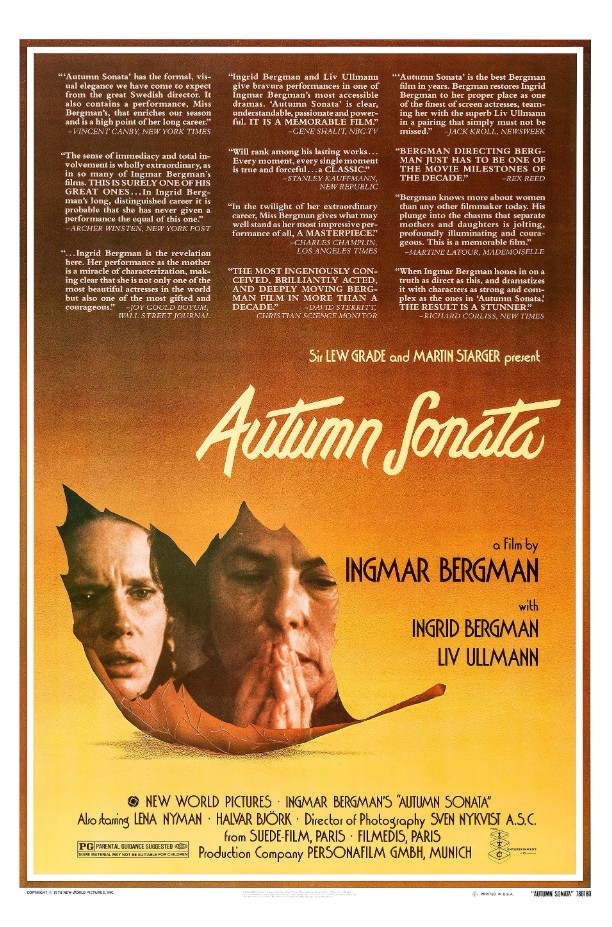
As I just mentioned in this review’s introduction, Autumn Sonata was nominated for two awards at the 51st Academy Awards. One of these categories was Best Leading Actress, with Ingrid Bergman as one of five actresses to receive a nomination. While discussing Autumn Sonata in Sneak Previews’ ‘The Best Films of 1978’ episode, Gene called Ingrid’s portrayal of Charlotte Andergast “riveting”. Even after a scene featuring Ingrid and Liv Ullmann (who portrayed Charlotte’s daughter, Eva) is presented in the episode, Gene says “Again, some real pain there”, referring to the emotions on display through Liv’s and Ingrid’s performance. Though I agree with Gene’s assessment of Ingrid’s portrayal of Charlotte, the word I’d use to describe it (as well as Liv’s portrayal of Eva) is captivating. In one of the best scenes from Autumn Sonata, Charlotte shares with Eva how her close friend, Leonardo, passed away. Throughout her recount of Leonardo’s last days in the hospital, Charlotte has a pained, disgusted look on her face. With a glossy, teary-eyed stare and a drawn-out frown, Charlotte is heartbroken over the loss of her friend. When I saw that scene, I wasn’t watching an actress portraying a character. I was witnessing a woman experiencing grief, with Ingrid’s performance possessing a strong sense of realism.

Like I also said in my review, Liv Ullmann’s portrayal of Charlotte’s daughter, Eva, was captivating. This is because Liv was able to go toe-to-toe with Ingrid, acting-wise, understanding how to utilize emotion to her character’s advantage, as well as when to increase or decrease the intensity of those emotions. As I previously mentioned, there was a scene from Autumn Sonata featuring Ingrid and Liv in Sneak Previews’ ‘The Best Films of 1978’ episode. In that scene, Charlotte and Eva share an emotionally explosive conversation over the reasons why their relationship is strained. Eva states how she didn’t like Charlotte’s desire to turn her daughter into someone she wasn’t. During her reflections of her past, Eva is visibly distraught. With gritted teeth and eyes overflowing with tears, even shaking at one point, Eva confesses how Charlotte’s decisions have deeply impacted her and her life choices. Because of her performance in Autumn Sonata, I wish Liv Ullmann had been nominated for an Oscar as well.

During their discussion of Autumn Sonata in ‘The Best Films of 1978’ episode of Sneak Previews, neither Roger nor Gene brought up the film’s screenwriting. This is a shame, as the screenwriting was one of the movie’s strengths. Autumn Sonata is a character-driven, “slice of life” story. However, the quality of the dialogue made conversations between characters sound emotionally deep and thought provoking. In one scene, Eva asks her husband, Viktor, if he thinks she’s an adult. Viktor responds by telling her, “I guess being an adult is being able to handle your dreams and hopes, not longing for things”. He could have simply given his wife a “yes” or “no” answer. But Viktor’s response gives Eva, as well as the audience, meaningful insight about growing up, managing expectations, and even gratitude. Later in Autumn Sonata, Charlotte confesses one of her realizations to Eva. She says, “I have never grown up. My face and my body have aged. I acquire memories and experiences but inside all that I haven’t even been born.” Similar to Viktor’s aforementioned quote, Charlotte’s quote addresses growing up. In Charlotte’s case, however, her reflections sound more regretful. Disappointment can even be heard in her voice, with those pent-up feelings finally being addressed through words. As I stated in this review’s introduction, Autumn Sonata was nominated for the Best Writing category. Through a thoughtfully crafted script, that nomination was, in my opinion, earned.

While continuing their discussion of Autumn Sonata, Roger tells Gene about a call he received from a reader who was interested in seeing Autumn Sonata. Roger then says the reader told him, “I couldn’t make head or tail of it. What is it about?” Meanwhile, Gene claims “the conflict is how do you reconcile your public career with your personal responsibilities to your family”. Based on my experience watching Autumn Sonata, I think it’s not just about balancing a public and personal life. I think it’s also about the brutal honesty of strained familial relationships. When Eva and Charlotte talk about the past, no figurative punches are held back. They tell each other exactly what’s on their minds and hearts, no matter who’s feelings get hurt. It would have been easy for Autumn Sonata’s creative team to paint either Charlotte or Eva as the “villain” of the story. Instead, both women are not only flawed, they have valid points to their sides of the narrative. How the story plays out kind of reminds me of The Royal Tenenbaums, where the strained relationship between Eva and Charlotte is the result of little things culminating over time. The acting performances and the screenwriting successfully bring a sense of realism to Autumn Sonata.

According to IMDB, Autumn Sonata was filmed in Norway. Based on the scene where Charlotte drives to Eva and Viktor’s house, the Norwegian scenery looked like a beautiful painting. But the majestic hills, mountains, and large body of water from Norway wasn’t incorporated into Autumn Sonata beyond that one scene. I wish the “autumn” in Autumn Sonata played a larger role in the story, perhaps visually representing some of the movie’s themes. Another aspect of the story I wish had been utilized more was Eva’s sister, Helena. When Charlotte first arrives at Eva and Viktor’s house, Eva reveals how Helena is now living at their house instead of at a hospital. Throughout Autumn Sonata, Helena deals with an illness that greatly affects her mobility. I thought she was intended to be a bridge between Eva and Charlotte, helping them find a more peaceful middle ground. One reason for this belief came from Helena falling out of her bed during an emotionally explosive conversation between Charlotte and Eva. Sadly, it seems like Helena was in Autumn Sonata just for the sake of it.
Prior to reviewing Autumn Sonata, the only movie I agreed with Gene and Roger on was 1984’s Amadeus. I could also see why the film was, at least, nominated for an Oscar. Now I can confidently say that Autumn Sonata is the second film I agree with Roger and Gene on! While I typically don’t gravitate toward “slice of life” stories, the 1978 movie works because of the strength of the screenwriting and acting performances. Similar to The Royal Tenenbaums, the brutal honesty woven into the script brought a sense of realism when to came to addressing strained familial relationships. The story itself was emotionally deep and thought provoking because of the effort put into it by Autumn Sonata’s creative team. I understand why the movie is titled Autumn Sonata, as music plays an integral role in Charlotte’s life. However, I wish the “autumn” in Autumn Sonata was utilized more in the story, especially considering how beautiful the Norwegian landscape was in the film. The movie also doesn’t have a high rewatchability rate due the some of the heavier subject matter incorporated into the story. But I can honestly say that Autumn Sonata is one of the best films I’ve seen in 2026, so far!
This review was brought to you by
Sally Silverscreen
 18 Cinema Lane