
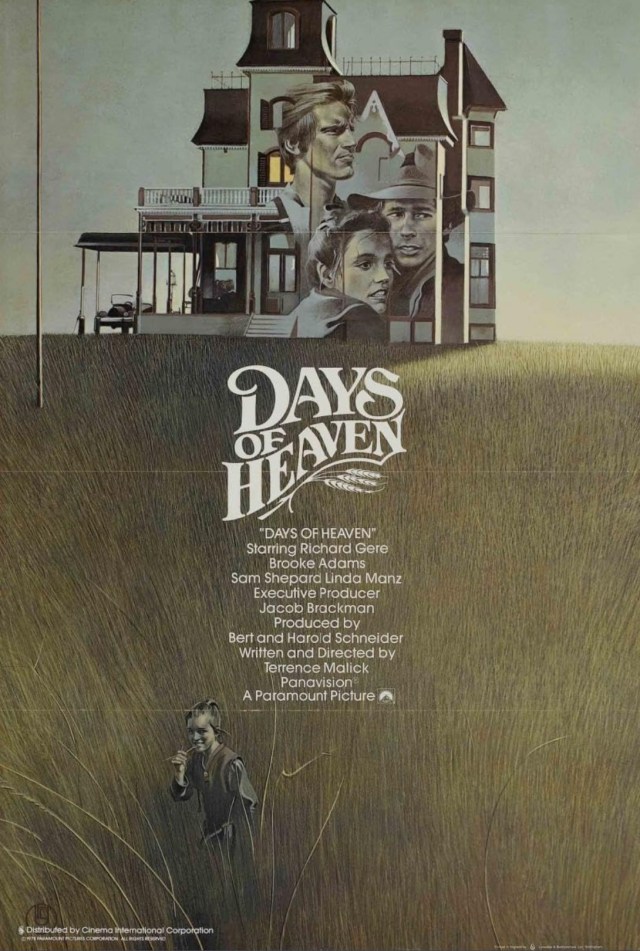
Have you ever stumbled upon a film that was “new to you” and think, “I’ve never even heard of this”? That was my experience discovering the 1978 movie, Days of Heaven. Prior to the Legends of Western Cinema Week Blogathon, I had never heard anyone talk about the aforementioned Western. With the blogathon fast approaching, Days of Heaven crossed my path at the right time! This is my fourth year participating in the Legends of Western Cinema Week. Looking back on the programs I reviewed for the event, I realized the stories fell into one of two categories: cowboys seeking justice or some aspect of farming. While Days of Heaven belongs in the latter category, the primary perspective focuses on the actual farming. This is different from a movie like O Pioneers!, where the story’s priority was the relationships between the characters. How does Days of Heaven rank among the films I reviewed for the Legends of Western Cinema Week? Before traveling on those “happy trails”, let’s read my review!
Things I liked about the film:
The scenery: The majority of Days of Heaven takes place in the wheat fields of Texas. Despite how monotonous that type of location may sound, the wheat fields offered up many glimpses of natural beauty! My favorite shot in the movie was when a storm cloud approached the story’s wheat fields. Large, gray clouds dominated the sky, appearing larger than life on screen. The presence of these clouds provided a small window into the blue sky above the fields. The golden yellow of the wheat was a pop of bright hue against the sky’s blue and gray palette. This shot was so beautifully captured, it, honestly, looked like a painting!
The historical accuracy: Days of Heaven is set in the 1910s. Like any historical period film, it’s important for the story to feel immersive due to its historical accuracy. Based on what the movie presented, the creative team behind Days of Heaven paid attention to how historically accurate their project looked! The finer details visually prove that point! In a scene where the story’s protagonists, Bill, Abby, and Linda, go swimming, their swimsuits are reflective of the clothing styles of the early 1900s. While Bill wore what would be described as a short-sleeved unitard, Linda and Abby wore swimming dresses, complete with stockings. When it came to transportation, the trains and tractors appeared to be coal powered. Even their exterior designs looked industrial, considered antique be the standards of today. The historical accuracy paired with the aforementioned scenery made Days of Heaven an appealing film to look at!
Richard Gere and Brooke Adams’ on-screen chemistry: As I mentioned in my previous point about the movie’s historical accuracy, Bill and Abby are two of the protagonists in Days of Heaven. Portrayed by Richard Gere and Brooke Adams, these characters are in a romantic relationship. When Abby and Bill are together in a romantic context, the on-screen chemistry between Brooke and Richard was sweet. It felt like the on-screen couple truly got along with one another. During their interactions, there was a gentleness shared and understood between them. Whether walking in the water or cuddling on top of a train, Abby and Bill’s relationship was pleasant to watch because of Brooke and Richard’s acting abilities. Without spoiling Days of Heaven, I will say Bill and Abby’s relationship was not consistent throughout the story. This is a shame, as I liked seeing these characters together.
What I didn’t like about the film:
An unclear motive: According to the film’s synopsis, Bill, his younger sister, Linda, and his girlfriend, Abby, plan to con a farmer out of his money and wheat fields. Throughout the movie, however, their motive for conning The Farmer (what Sam Shepard’s character is referred to) is not made clear. I understand Bill, Abby, and Linda don’t like working under someone’s thumb. But the man who they try to con doesn’t seem to deserve a comeuppance. In fact, The Farmer, more often than not, is respectful toward Abby, even going so far as to allow Bill and Linda to live in his house, in order to keep Abby’s “family” together. In a series of voice-overs, Linda claims The Farmer is dying of an unnamed illness. Later in the film, though, she states how The Farmer’s health is staying the same, neither improving or regressing. Yet again, it is never made clear if The Farmer’s health issues are the reason for the con. I wonder why I was supposed to care about Bill, Linda, and Abby’s conning scheme when I don’t even know why The Farmer was being conned in the first place?
A drawn-out story: Days of Heaven has a run-time of about an hour and thirty minutes. Yet the story itself was drawn-out longer than necessary. This issue was caused by establishing shots littered throughout the movie, which served as the production’s padding. I know establishing shots are meant to set up a given scene. But if the creative team of Days of Heaven had cut some of the film’s establishing shots, the run-time would have been trimmed down to about an hour and ten to twenty minutes.
Distance from characters: Through a combination of acting talent, screenwriting, and direction, a movie’s audience can not only be introduced to a character, they can also get to know that character as the story progresses. In Days of Heaven, however, it feels like the characters are kept at a distance from the audience. Sure, the characters share pieces of information about themselves. But this information only allows the audience to become familiar with them. Because of the aforementioned distance, the audience is prevented from connecting with the characters. That disconnection also prevents emotional investment in the story.
My overall impression:
The first movie I reviewed for a blogathon this year was Black Narcissus. In my review of the 1947 movie, I said that while Black Narcissus was a competently made film, it was one of the most confusing movies I’d ever seen, due to the story providing little to no explanations. I feel similarly about Days of Heaven. The film itself is very photogenic, from the scenery to the presentation of the story’s historical accuracy. But the story was confusing. No motive for why Bill, Abby, and Linda are conning The Farmer is made clear in the script. Emphasis on style over substance affected any connection the audience could have had with the characters. Throughout the movie, several questions arose that weren’t really answered, such as how The Farmer knew a group of circus performers who came to visit his home. This added to the story’s confusion. As a film, I thought it was just ok. But as a Western, it provides a perspective that is different from the typical cowboy or cattle farmer.
Overall score: 6 out of 10
Have you seen Days of Heaven? Which Westerns would you like to see me review? Tell me in the comment section!
Have fun in Texas!
Sally Silverscreen
 18 Cinema Lane
I’m always a little leery of 1970s movies, especially the westerns, and that feeling of being held off at a distance from the characters seems to crop up a lot in ’70s westerns. It’s like the filmmakers want to use the scenery and tropes of a western, but they don’t really like westerns, and they really don’t want the audience to like them either, so they put up this weird barrier between us and the characters. I find it very vexing.
The scenery sounds lovely, though!
LikeLiked by 1 person
Thank you for reading my review, Hamlette! Before writing about ‘Days of Heaven’, I reviewed two westerns from 1977: ‘Another Man, Another Chance’ and The White Buffalo’. ‘Another Man, Another Chance’ was a western story from a uniquer perspective, but the build-up toward the main romantic relationship was longer than necessary. While ‘The White Buffalo’ does a good job at combining the western and horror genres, the story’s sense of urgency is limited. If you plan on seeking out any of these films, I’d love to hear your thoughts on them!
LikeLike
Well, I saw The White Buffalo 30ish years ago when I was going through a teenage crush on Charles Bronson, and let’s just say that was way too weird for me.
LikeLiked by 1 person
Very interesting… It does sound like an unusual and beautiful setting so too bad about the vexing aspects going along with it.
Thanks so much for sharing and joining in LOWCW!
LikeLiked by 1 person
You’re welcome and thanks for checking out my review! Looking forward to the next blogathon!
LikeLike
It’s interesting that even a relatively short film can feel long when it’s not done very well. Great review, though. 🙂
LikeLiked by 1 person