
One of the best parts about participating in blogathons is being introduced to movies that may be new to you. This is my experience with the 1989 film, In Country! For Taking Up Room’s Norman Jewison Blogathon, I wanted to choose a movie that was more underrated. While searching through Norman’s IMDB filmography, I came across the aforementioned ‘80s title. The synopsis reminded me of My Girl 2, where Vada is attempting to learn more about her mother. What sets In Country apart from the 1994 sequel is how the 1989 movie explores the aftermath of the Vietnam War by having the protagonist search for answers about her father. In 2024, I have reviewed four other films from the 1980s, so far. Similar to titles like Amadeus and Hallmark Hall of Fame’s Pack of Lies, In Country incorporates historical elements into the story. But will the 1989 movie be a pleasant surprise like Amadeus or a disappointment like Pack of Lies? Keep reading my review to find out!
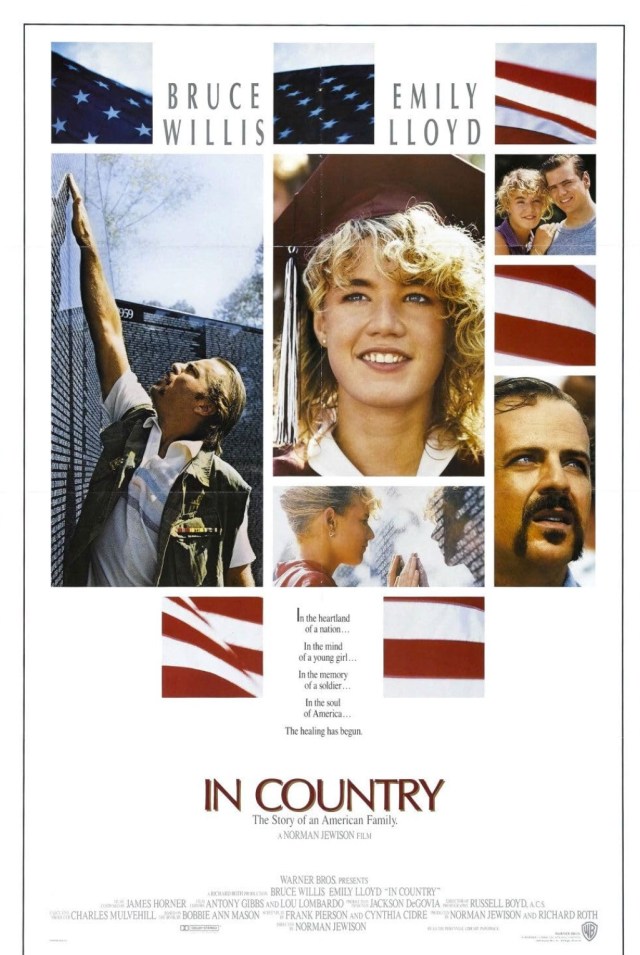
Things I liked about the film:
The acting: In any story, especially one that features a young protagonist, the main character’s likability can determine if the story is worth investing time in. I can only speak for myself, but I liked Samantha “Sam” Hughes’ personality! Though naïve at times, Sam was like a bright ray of sunshine, caring about the people in her life and trying to make her world a better place. What made Sam a likeable character was how genuine her emotions were. After finding a box of her father’s belongings in her mother’s room, Sam leaves a voice message on the phone explaining to her mother how upset she is by her mother’s silence about her father. When she hangs up the phone, the sad look in her eyes and the slight frown perfectly show how hurt Sam feels about her mother’s choices. This is just one example of Emily Lloyd bringing that genuineness to life, allowing her performance to be memorable!
Prior to watching and reviewing In Country, I had seen some of Bruce Willis’ films. His portrayal of Emmett Smith is different from some of his other roles, as he had to rely on emotion instead of action to carry his character through the story. A thunderstorm is causing chaos outside Emmett’s home one evening. Because of his time serving in the Vietnam War, he flinches whenever thunder strikes due to the flashbacks he is experiencing. At the same time, Emmett carries irritation in his voice because he wants the storm to stop and he wants to avoid Sam’s questions. Similar to what I said about Emily Lloyd’s performance, Bruce’s performance felt genuine. Beneath the tough exterior Emmett consistently displayed, he was a man who was trying to live a civilian life as best as he knew how.
Honesty about war and its impact on veterans: Like I just mentioned in this review, Emmett experiences flashbacks one stormy evening due to his time serving in the Vietnam War. These flashbacks not only cause Emmett to flinch every time thunder strikes, they also cause him to go outside, climb up a tree, and yell for someone to show their face. Throughout this scene, Sam asks Emmett questions about what is happening. Unfortunately for Sam, these questions are left unanswered. When Emmett goes outside, Sam calls for Emmett to come back in the house. As Emmett’s mind and heart are beyond the borders of his Kentucky home, Sam feels powerless, unsure of how to help Emmett. The scene I just wrote about is one example of the film’s honesty when discussing war and its impact on veterans. The candid way these subjects were talked about in the movie shows how the movie’s creative team understood the subjects’ significance.
The mise-en-scène: I’ve explained before that mise-en-scène is how a scene is presented in a movie. Mise-en-scène was utilized in several scenes’ favor in In Country. Toward the beginning of the film, a group of U.S. soldiers are wading through the swamps of Vietnam. This moment is presented as a long shot with the view appearing as if the camera is hiding behind the swamp’s foliage. How this scene is showcased to the audience emphasizes the soldiers’ need to stay unseen. Sam, Emmett, and Mamaw travel to Washington D.C. to visit the Vietnam Veterans Memorial. While walking past the monument, a close-up shot captured Mamaw as the names on the monument were gliding past her face. The visuals symbolized how the Vietnam veterans have touched the lives of not just their loved ones, but those in their communities as well.

What I didn’t like about the film:
Sam’s attraction for Tom: While trying to learn more about her father, Sam turns to a veteran named Tom. At the Vietnam veterans’ dance, Sam invites Tom to share a slow-dance with her, where they get a little too close for comfort. After the dance, Sam spends the night at Tom’s house and has sex with him. Up until the slow-dance at the veterans’ dance, Sam never expressed any romantic interest in Tom. Plus, she just graduated from high school and Tom appears old enough to be her father. Not only was this part of the story random, its inclusion in the film was unnecessary, especially since it has no impact on the plot.
The “slice of life” parts of the story: As I’ve been saying in this review, Sam wants to learn more about her father who served and died in the Vietnam War. This part of the story, as well as the parts exploring the veterans’ perspective, was interesting. But those parts made up half the movie. The other half revolved around subplots that were more “slice of life”. When the story turned to the “slice of life” events, I found myself wishing the movie would go back to Sam learning more about her father or Emmett interacting with the other veterans. In fact, I think the movie should have primarily focused on those aforementioned parts of the story.
On-the-nose songs: The inclusion of songs in a movie can make or break a given scene. Sometimes, a song can be so on-the-nose, it doesn’t leave the intended emotional impact. This happened on more than one occasion in In Country. The opening lines of the Bruce Springsteen song, “I’m On Fire” are “Hey, little girl, is your daddy home? Did he go away and leave you all alone?”. This song can be heard on two occasions after Sam decides to learn more about her father, pointing out what the audience already knows. Earlier in this review, I brought up how Sam invites Tom to share a slow-dance with her, where they get a little too close for comfort. The song they dance to is Hank Williams Jr.’s “Ain’t Misbehavin’”, which narrates what’s happening on screen and foreshadows what’s about to come. That song paired with the events that unfold created a scene that left me uncomfortable.

My overall impression:
When I watch a movie, I sometimes imagine how the story would turn out if it was presented in a different way. One recent example is how Hallmark Hall of Fame’s Brush with Fate would have, in my opinion, benefitted by being presented as a multi-part mini-series. I feel similarly about 1989’s In Country. For the most part, the creative team behind the movie appeared to have their hearts in the right place. The honesty about war and its impact on veterans was included in the story in such a candid way, it showed the movie’s creative team understanding the significance of the subjects woven into the script. But this aforementioned honesty, as well as Sam’s search for answers about her father, should have been the film’s primary focus. Therefore, I wish this story had been a road-trip movie, where Sam, Emmett, and Mamaw go to visit the Vietnam Veterans Memorial in Washington D.C., with Sam learning about her father and important life lessons along the way.
Overall score: 6.1 out of 10
Have you seen 1989’s In Country? What’s your favorite film from 1989? Tell me in the comment section!
Have fun at the movies!
Sally Silverscreen


Pingback: The Norman Jewison Blogathon Has Arrived – Taking Up Room
I’ve never heard of this film, either, but it would have been interesting to see if it would have worked as a miniseries. Such a huge topic and so much nuance. Thanks again for joining the blogathon–glad you got to see something new!
LikeLiked by 1 person
You’re welcome and thanks for reading my review! I hadn’t thought about this story as told through the format of a miniseries. But now that you mention it, I think ‘In Country’ might have benefitted from being a miniseries about Sam, Emmett, and Mamaw going on a road trip to Washington D.C..
LikeLike