
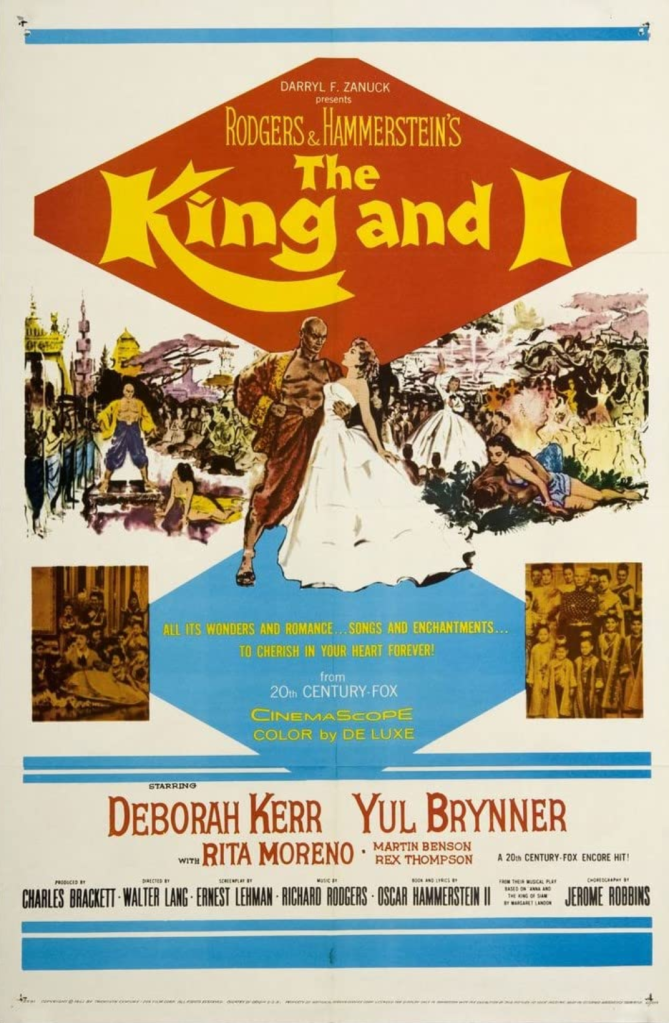
For the Fourth Broadway Bound Blogathon, I chose to review the 1956 version of The King and I! Years ago, I had seen the 1999 animated adaptation of the musical. Since I vaguely remember it, I can’t provide an honest opinion of that movie. Because I had only seen pieces of the 1956 film and because it was recommended to me by Maddy from Maddy Loves Her Classic Films, I now found a good excuse to finally check the film out! While I knew the play itself was successful, I was surprised to discover it had won a Tony award. As this year’s blogathon focuses on Tony winners, it gave me an opportunity to learn something new. This is one of the reasons why I love participating in blogathons! Now, let’s start this review of 1956’s The King and I!
Things I liked about the film:
The acting: Deborah Kerr is a dramatic actress, as her strengths can be seen in drama films. Because there were plenty of dramatic moments in The King and I, this allowed the best of Deborah’s acting abilities to be placed on display! In scenes that allowed Anna to stand up to King Mongkut, Deborah adopts a serious persona without any sarcasm. Her tone of voice is stern, while also standing up straight and looking directly at King Mongkut. Because there were light-hearted moments as well, it gave Deborah an opportunity to incorporate humor into her performance. This balance made the role suit Deborah well! This is the first time I had ever seen any of Yul Brynner’s performances. However, I was quite impressed by his portrayal of King Mongkut of Siam! Similar to Deborah Kerr’s role, there was a good balance of drama and comedy. In a scene where King Mongkut is talking to his son about what he learned in school, Yul speaks with a serious tone of voice. He also moved around the set with a posture that reflects his character’s royal power. However, when he introduced Anna to his children, King Mongkut would make silly faces in order to get them to smile. Before watching The King and I, the only film of Rita Moreno’s I had seen is West Side Story. Because of this, it was interesting to see Rita work with different material. While Anita, Rita’s character in West Side Story, is sassy and confident, Tuptim is more reserved and sensitive. When Rita didn’t have speaking lines, facial expressions and body language helped convey what Tuptim was thinking. As I liked her portrayal of Tuptim, it makes me wish Rita had appeared in more scenes.
The musical numbers: A musical is only as good as its musical numbers. With The King and I, I found the musical numbers to be entertaining! The most interesting one is the Siamese interpretation of Uncle Tom’s Cabin. Because Tuptim is reading a copy Anna gave her, she decides to write a play based on her own version of the novel. This particular number features traditional dancing, stylized face masks, and practical effects, such as a white sheet representing ice. It served as a good example of how everyone can view a text differently. The rest of the musical numbers in The King and I ranged from dramatic to comedic. One of them is ‘Getting to Know You’. In this scene, Anna dances with one of King Mongkut’s wives. Some of the children circled around their mother in order to mimic Anna’s skirt. This was a simple way humor was incorporated into some of the musical numbers.
The costume design: The King and I is known for being an elaborate musical, with elegance being found within the costume design. Bright colors were worn by almost all the characters. In a scene where Anna is introduced to King Mongkut’s children, the children’s outfits featured hues of pink, red, and green. The members of the royal family sometimes wore plaid, which complimented the rich color palette of the movie. Metals like gold could also be seen in the royal family’s attire. Some of King Mongkut’s jackets featured gold embroidery, a reminder of his wealth and affluence. Bronze coated the children’s headpieces as well. With the costume design being so exquisite, I wonder how much of this movie’s budget was devoted to it?

What I didn’t like about the film:
The under-utilization of Rita Moreno: As I mentioned earlier, the only film of Rita’s I had seen is West Side Story. Therefore, I was looking forward to seeing her performance in The King and I. I was disappointed to see Rita’s talents under-utilized. In this two hour and thirteen-minute movie, Rita appeared in a handful of scenes. While she did participate in the story’s musical components, she was only given one duet and the narration during the Uncle Tom’s Cabin play. I understand The King and I was released five years before West Side Story. But if the 1961 film has taught me anything, it’s how Rita is, talent wise, capable of so much more.
Drawn out storylines: The storylines in The King and I were drawn out because of the film’s two hour and thirteen-minute run-time. King Mongkut’s story, where he attempts to save his reputation, is one example. For about half the movie, King Mongkut wants to prevent other world leaders from thinking he is “barbaric”. Since this particular storyline lasted for so long, the resolution/payoff was fine, but somewhat anti-climactic. Lun Tha and Tuptim’s storyline took place throughout the whole movie. However, by the end of the film, it was left unresolved. It makes me wonder if it would have been resolved if The King and I’s run-time had been shorter?
Songs interrupting the story: In a typical musical, the musical numbers help progress the story forward. But in The King and I, the musical numbers interrupt the over-arching story, causing the transition between story and song to feel less seamless. After an elegant party at the palace, King Mongkut discovers Tuptim is missing. King Mongkut’s search is disrupted by Anna singing ‘Shall We Dance?’. This then turns into a private dance between Anna and King Mongkut, which is interrupted by a guard. The guard informs King Mongkut that Tuptim has been found. Moments like this one cause the story to pause for the sake of a musical number.

My overall impression:
So far, I have seen four of Deborah Kerr’s movies. Out of those titles, I’d say The King and I is her best one! As I said in my review, the material complimented her acting abilities. There was enough drama to show off her strengths, while also having enough comedy to let Deborah have fun with the role. The film gave me a chance to see interesting performances and musical numbers, from Rita’s portrayal of Tuptim to a Siamese interpretation of Uncle Tom’s Cabin. The exquisite costume design and sets are definitely photogenic, highlighting the wealth and power within the royal family. Even though the movie as a whole is good, there are musicals I would choose over it. The songs interrupting the story instead of progressing it forward is one reason why I feel this way. I’ve heard Anna and the King is a non-musical version of this particular story, so I’d be interested in seeing how lack of musical numbers affects the overall story-telling. I’d also be interested in watching Deborah Kerr and Yul Brynner’s other film, The Journey.
Overall score: 7.7 out of 10
What are your thoughts on The King and I? Which version is your favorite? Let me know in the comment section!
Have fun on Broadway!
Sally Silverscreen


Pingback: Broadway Bound 2021: Afterparty – Taking Up Room
This post was awesome! I agree with you about Rita Moreno being underutilized, but the film is gorgeous. It’s hard to think of anyone but Yul Brynner in this. Thanks again for joining the blogathon. 🙂
LikeLiked by 1 person
You’re welcome and thanks for reading my review! You host some of the best blogathons! Hope there is another event next year!
LikeLiked by 1 person
Thanks, Michaela, and you’re very welcome! Yeah, I have some ideas for next year. It was kinda fun doing a theme for Broadway this time. 🙂
LikeLiked by 1 person
Pingback: The Top 10 Best Movies I Saw in 2021 – 18 Cinema Lane