
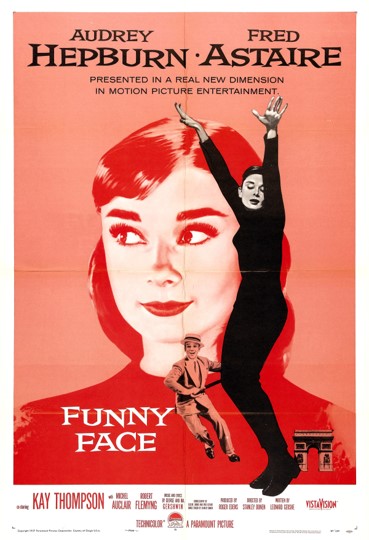
For the second part of my Fred Astaire and Gene Kelly double feature, I’ve chosen to review the 1957 film, Funny Face! Last September, when 18 Cinema Lane received 135 followers, I reviewed my first Fred Astaire movie. That was The Sky’s the Limit, which I thought was just ok. Speaking of firsts, reviewing Funny Face is a first for 18 Cinema Lane, as it is the first musical film starring Aubrey Hepburn I’ve seen! Even though I have seen Breakfast at Tiffany’s and The Nun’s Story, those films would be classified as dramas. Since this was my first time seeing Audrey perform in a different genre, I was curious to see if she would be able to hold her own. When I read the synopsis for Funny Face, it sounded similar to another musical starring Audrey: My Fair Lady. Because I haven’t seen that movie, I can’t make a comparison between it and Funny Face.
Things I liked about the film:
The acting: The one word I’d use to describe the cast in Funny Face is comfortable. I chose this word because every actor and actress appeared comfortable in their role! This presented the characters as if they were real-life people dealing with real-life situations. Watching Audrey’s performance in this movie reminded me of her performance in The Nun’s Story for this reason: her character grows over the course of the movie. In Funny Face, Jo opens her heart and mind to a new chapter in her life that she never thought she’d embark on. She steps out of her comfort zone to not only follow her dream of meeting her favorite philosopher, but she also creates new dreams for herself. Audrey’s ability to adapt to any scenario helped her make Jo’s journey seem believable! As I mentioned in the introduction, I saw The Sky’s the Limit last September. Personally, I liked Fred’s character in Funny Face more than his character in the 1943 film. This is because Dick Avery had a better personality. He came across as easy-going and approachable, someone who you would want to tour Paris with. This made Dick Avery worth rooting for! Kay Thompson stood out to me as Maggie Prescott! While her character was no-nonsense and straight-forward in what she wanted, she was never cold-hearted or mean for the sake of it. This is different from other characters of this specific type. What’s also different is how Maggie was allowed to be silly, as could be seen when she and Dick are attempting to find Jo at the home of Jo’s favorite philosopher. This gave Kay an opportunity to apply her acting abilities to various situations!
The use of color: I love how color was used in Funny Face! Whenever scenes had a primarily plain color palette, like white or beige, objects or pieces of clothing were added to bring a pop of color to the space. The opening scene is such a great example! Each door of Quality magazine’s office was painted a bright shade of various colors, providing visual appeal to a mostly white lobby and hallway. Maggie’s office adopted a beige hue for about 85% of that location. However, certain pieces of fabric and even an assistant’s green coat add bold colors to a place that would have remained dull without them. This decision to use color was very detail oriented and showed how the film’s creative team really paid attention to how their project would be presented!
The musical numbers: Funny Face’s musical numbers were not only entertaining to watch, they also incorporated creative ideas that made them memorable. The very first musical number, “Think Pink!”, showed a montage of the different ways the color pink could be worn. Through the use of colorful visuals, it helped illustrate the point Maggie was trying to stress to her assistants as well as the audience. “Bonjour, Paris!” showed Maggie, Dick, and Jo simultaneously in a split screen shot. I have never seen a musical use a split screen before, so this detail is the one I remember the most! Each performer in these musical numbers looked like they truly enjoyed what they were doing! “Basal Metabolism” showed Audrey Hepburn having fun performing her dance trio. She appeared in her element and joy radiated from her routine. This definitely added to the overall enjoyment of Funny Face’s musical numbers!

What I didn’t like about the film:
No major conflict: While watching Funny Face, I noticed something was missing from this movie. That would be a major conflict, which I think would have made the story a little more interesting. Smaller conflicts, like finding a new face for Quality magazine, kept the film moving forward. But, because a major conflict was absent, it made situations feel like they worked out too easily in the characters’ favor. One idea could have shown Dick struggling to decide if he should continue to be a fashion photographer or become a stage performer. If this would have been a conflict in the story, it would have presented a mystery as to which career path Dick will choose.
A prolonged transformation: Like I said in the introduction, I haven’t seen My Fair Lady. Therefore, I can’t compare the two movies. What I will say about Funny Face is how Jo’s transformation doesn’t happen until the film’s halfway point. In the first half of the story, Jo’s perspective starts to change, allowing her to expand her intellectual horizons. But the physical transformation, from bookworm to fashion model, happens a lot later than most movies of this nature. When a character makes a dramatic change to their appearance, that moment may be the audience’s most anticipated moment. If they are forced to wait too long, they may start to lose interest.
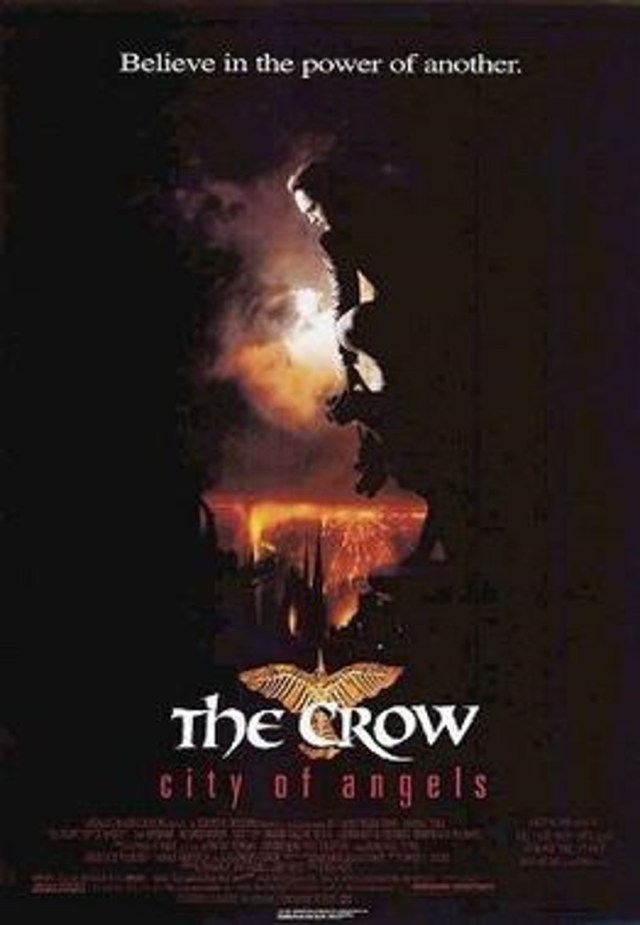
An attraction that happened too quickly: In my review of The Crow: City of Angels, I pointed out how, to me, Ashe and Sarah’s attraction for one another was a flaw of that movie because it came about so quickly. The attraction between Jo and Dick in Funny Face makes the same error, as it also happens too quickly. Minutes after meeting for the first time, Jo and Dick share a kiss. Shortly after this encounter, Jo sings “How Long Has This Been Going On?”, a song about falling in love. If this song had been sung later in the film, after she had spent more time with Dick, the song itself would have been more impactful. Even though it is somewhat predictable for Jo and Dick to form a relationship, it should have taken its time to come to fruition.
My overall impression:
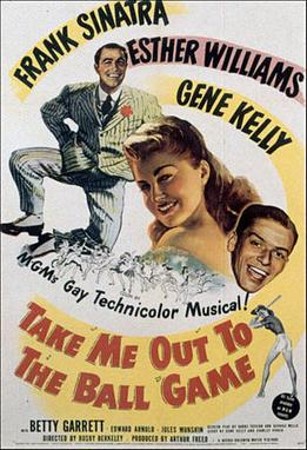
Funny Face is a film I had heard of for years, but had never seen. Whenever I heard about classic films or even movies starring Aubrey Hepburn, this film has, more often than not, been brought up. Now that I have seen Funny Face, I have developed an understanding for why this is the case. This is not just a good musical or a good Audrey Hepburn title. It is a good movie in general! Creative ideas within this project help it stand out. Some examples include using a split screen and incorporating objects with color into scenes with plain color palettes. Musical numbers were well-choreographed, featuring performers that appeared to enjoy the material they were given. Every actor and actress seemed comfortable in their roles, giving their characters a life of their own. While Funny Face does have its strengths, it has its weaknesses as well. Just one example is how Jo’s transformation happens much later in the film. Despite having seen only two of Fred Astaire’s movies, I’d pick Funny Face over The Sky’s the Limit. I would even choose Funny Face over Take Me Out to the Ball Game!
Overall score: 7.8 out of 10
Have you seen Funny Face? Which Fred Astaire musical is your favorite? Please share your thoughts in the comment section!
Have fun at the movies!
Sally Silverscreen




















.jpg)
