Comparing with the Critics – Best of 1986 – The Fly

This review is from my series, Comparing with the Critics. If you’d like to learn more about the series, click on the link below.

Introducing my new series, Comparing with the Critics!

Out of the movies Roger Ebert and Gene Siskel picked in Siskel & Ebert & the Movies’ ‘Best of 1986’ episode, I believe Eddie Munson would choose The Fly. As I explained in my 1986 introduction of Comparing with the Critics, Eddie’s story teaches that, sometimes, there’s more than meets the eye. Plus, Eddie’s imagination and creativity not only works in his favor as a Dungeon Master, it’s also helped his friends during their time in the Upside Down. From the way Gene and Roger described The Fly in the aforementioned ‘Best of 1986’ episode, it seemed like a different kind of horror and sci-fi film. Roger claims “the poignancy” of The Fly “is interesting in a horror film”. Meanwhile Gene not only states “there was, if you think about it, a certain nobility to The Fly”, he also says “the movie is beautifully made”. Films from the horror and sci-fi genre are infrequently covered on 18 Cinema Lane. In fact, the only sci-fi and/or horror movies included in the Comparing with the Critics series, so far, are The Bride and Mad Max Beyond Thunderdome, which were both released in 1985. But what can be appreciated is the creativity and imagination woven into those two genres, whether it’s how the duel in the Thunderdome was filmed in Mad Max Beyond Thunderdome or giving Viktor a “hero’s journey” in The Bride. Though The Fly ended up on Roger’s top twenty best films of the year list, it did earn a place on Gene’s ten best films of ’86 list at number ten. However, despite not seeing every or most of the movies from 1986, The Fly would not be on my list of the top ten best films of that year. I also don’t think the film would be on Eddie’s top ten best films list either.
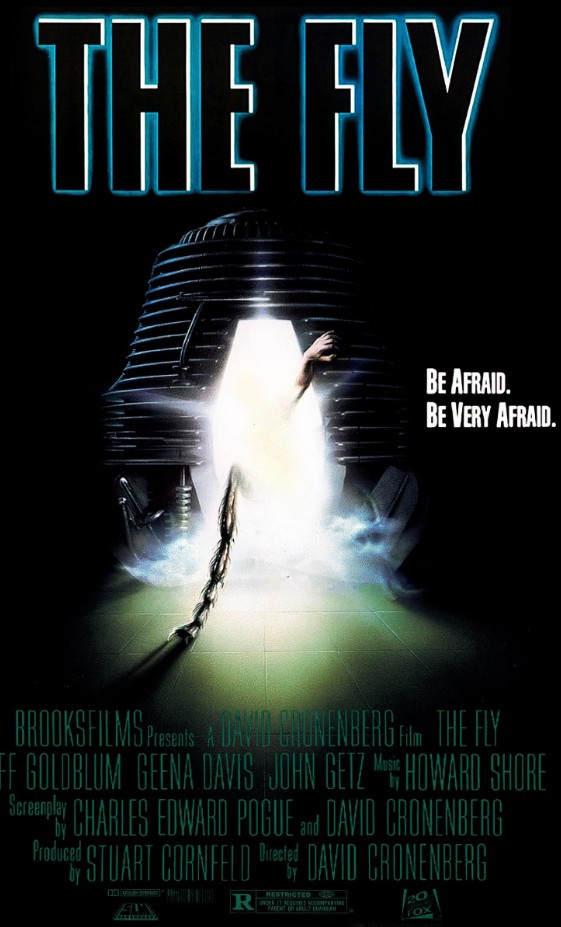
The Fly (1986) poster created by 20th Century Fox, Brooksfilms, Province of British Columbia Production Services Tax Credit, and SLM Production Group

While sharing his thoughts on The Fly, Roger tells Gene, “Goldblum, I think, deserves an Academy Award nomination”. While I agree with Roger’s sentiments on Jeff Goldblum’s portrayal of Seth Brundle, I also believe Geena Davis (who portrayed Veronica “Ronnie” Quaife) deserved a nomination from the Academy. Individually, Geena’s and Jeff’s performance was solid. From the tearful heartbreak Ronnie displays as Seth becomes unrecognizable to Seth’s erratic behavior over the course of the story, Jeff and Geena made their characters interesting to watch. But together, Geena and Jeff share very nice on-screen chemistry! In The Fly’s very first scene, Seth and Ronnie meet at a scientific event. Their interaction contains a sense of awkwardness, as they don’t yet know how they feel about the other person. But because Ronnie and Seth appear comfortable with who they are as individuals, the conversation isn’t embarrassing or cringey. Instead, it kind of comes across as flirty. Incorporating smiles, Seth’s widening eyes, and Ronnie’s glances away from Seth add to their growing feelings for each other. Even tilts of the head indicate how equally engaged they are in their interaction. The more I saw Seth and Ronnie together, the more I wished Jeff and Geena starred in another movie together portraying a couple!

Movie award essentials image created by Freepik at freepik.com. <a href=”https://www.freepik.com/free-photos-vectors/background”>Background psd created by freepik – http://www.freepik.com</a>. Image found at freepik.com. 

Gene tells Roger during their discussion of The Fly how he doesn’t believe science fiction movies, but was able to believe The Fly. One of the reasons why, according to Gene, is “it has to do with makeup”. The Academy certainly agreed with Gene, as The Fly won the Best Makeup category at the 59th Academy Awards. I also agree with Gene and the Academy. The idea of a human transforming into a fly sounds pretty disturbing and grotesque. Through the makeup design of Stephan Dupuis and Chris Walas, that aforementioned transformation was brought to life on screen in a believably horrifying way. At the start of Seth’s transformation, he develops little hairs on his back and his face appears discolored. But as the story progresses, so does his transformation. Seth’s teeth become pointy before falling out. His fingers morph together as his hands turn into the feet of a fly. Seth’s body even develops lumpy growths that make him look like a complete stranger. What adds to the horrifying nature of the makeup design is not just how believable the transformation itself appears, but also how realistic the effects look.
The “Eddie’s Year” Blogathon banner created by me, Sally Silverscreen. Original image created by 21 Laps Entertainment, Monkey Massacre, Netflix, and Upside Down Pictures.

During their coverage of The Fly in the ‘Best of 1986’ episode of Siskel & Ebert & the Movies, Roger comments on the believability of the movie. He tells Gene how “the screenplay was written and acted smart”. Roger also appreciated how Seth wasn’t a scientist “who speaks in cliches out of the thirties”. To add to Roger’s compliments, I’ll say that I liked how the story’s scientific ideas were woven into the script. Throughout The Fly, the topic of teleportation is discussed by Ronnie and Seth. What started as a magazine interview turns into a collaborative book. Over time, the focused topic changes to genetic fusion between Seth and a fly. Ronnie’s discovery and Seth’s computer lead to this specific topic being brought up. The way these scientific subjects were written into the story, as well as the dialogue, sounded intelligent enough to make the characters seem like they knew what they were talking about. As a viewer, I wasn’t confused by these concepts or didn’t feel like homework before watching the movie was required.
Scared audience image created by Katemangostar at freepik.com. <a href=’https://www.freepik.com/free-photo/terrified-friends-watching-horror-movie-in-cinema_1027311.htm’>Designed by Freepik</a>. <a href=”https://www.freepik.com/free-photos-vectors/people”>People image created by Katemangostar – Freepik.com</a>. Image found at freepik.com.

As Gene sings the praises of The Fly, he refers to the movie as “a great adventure”. In my experience watching adventure stories unfold on screen, there’s usually a sense of urgency. This urgency can be the reason for reaching a particular destination, exploring a specific location, or finding a person or object. A featured scene from The Fly on Siskel & Ebert & the Movies’ ‘Best of 1986’ episode shows Seth revealing to Ronnie his continual transformation toward becoming a fly. That scene made me believe there would be a race against the clock to either slow down or reverse Seth’s transformation process. Sadly, the script did not provide a race against the clock because the movie lacked a sense of urgency. In fact, The Fly contains a slow-burn story where Seth slowly becomes a fly over the course of most of the film. The 1986 movie is one of those movies where the audience waits for the inevitable to happen. Because the title of the film, The Fly, gives the inevitable away, it makes the film itself predictable. This predictability removes some of the story’s suspense and intrigue.
Comparing with the Critics banner created by me, Sally Silverscreen. TV show title cards created by WTTW National Productions, WTTW, Public Broadcasting Service (PBS), Lifetime Television, Tribune Entertainment, Buena Vista Television, and Disney-ABC Domestic Television

In the introduction of this review, I stated how The Fly would not be on my list of the top ten best films of 1986. I also said I didn’t think the film would be on Eddie’s top ten best films list either. The reasons are the movie’s lack of urgency and predictability. I could honestly picture Eddie either falling asleep during the movie or leaving the theater during the film. As I said in my review, The Fly is a slow-burn story and its predictability removes some of the story’s suspense and intrigue. But I don’t believe The Fly is a bad movie. The individual and combined performances of Jeff Goldblum and Geena Davis made their characters interesting to watch, as well as gave their characters nice on-screen chemistry. Chris and Stephan’s makeup effects effectively elaborated on the horrifying concept of a human becoming a fly. I also liked how the story’s scientific ideas were woven into the script. But despite all that praise, I didn’t like or love The Fly as much as Gene or Roger did.

This review was brought to you by

Sally Silverscreen

Why Dr. Ian Malcolm is my Favorite Character in Jurassic Park

Imagine; you’re at a party that you’ve been invited to. You don’t know anyone there and you have no idea if you’re going to have a good time. Then, they show up. That one person that stands out from the rest. They seem so different, in a good way, from everyone else. Yet, they immediately catch your attention because of how interesting they seem. When they show up, that’s when you know this party just got a lot more memorable. This made-up scenario is similar to how I became a fan of Dr. Ian Malcom from Jurassic Park. I had seen this movie for the first time last year and I didn’t know if I was going to like it. When Ian showed up on screen, he instantly got my attention because of how cool he seemed. As the film went on, he became my favorite character in Jurassic Park. This list illustrates why Dr. Ian Malcolm is the one that became my favorite. I’ll bring up examples directly from the movie. Before I begin, I want to take the time to thank the moderators of the Jeff Goldblum Blogathon, Gill from Realweegiemidget Reviews and Emma from emmakwall (explains it all). Because of you, I now have an excuse to talk about one of my favorite characters!

Jeff Goldblum Blogathon banner
The Jeff Goldblum Blogathon banner created by Gill from Realweegiemidget Reviews and Emma from emmakwall (explains it all). Image found at https://weegiemidget.wordpress.com/2019/06/09/the-jeff-goldblum-blogathon/.

Breaking Down “Nerdy” Stereotypes

Over-sized glasses. Suspenders. Obsessive conversations about “geek” or “nerd” related topics. These are some of the stereotypes that we’ve seen in books, movies, and television shows when it comes to characters that are labeled as “nerdy”. Because Dr. Ian Malcom is a mathematician and earned a doctorate degree, he would be someone that could get easily labeled as a “nerd”. His actions, behaviors, and even his wardrobe goes against the created image of what some people expect from a “nerd”. He looks as if he’s on his way to lead a sold-out concert at any moment. Confidence and a healthy dose of self-esteem are the things he carries in his pocket. The way that people interact with Ian in Jurassic Park shows the audience that not only is he well respected, but that he’s popular enough to get invited to theme parks before they’re open. This film was released in 1993, a time when we still saw characters display the stereotypical idea of a “nerd”, such as on Full House and Family Matters. The idea of a character with “nerdy” qualities going against the grain is something that was probably mind-blowing back in the day.


Influencing Other Characters

In my review of Queen of the Damned, I mentioned that Dr. Ian Malcom was probably one of the factors that influenced the creation of that film. My reasoning was that because Ian is a likable rock-star-esque mathematician, Lestat became a mostly likable rock-star-esque vampire compared to the film’s predecessor. Almost two decades after the release of Jurassic Park, the world was introduced to Iron Man. Robert Downey Jr.’s depiction of this character helped create a superhero that a large number of people would choose to be a fan of. Tony Stark is quick-witted, popular, and grows as an individual over the course of the Marvel Cinematic Universe. Similar to Ian in Jurassic Park, Tony becomes well-respected within the Avengers group. But beyond the glitz and glamour associated with this character, he has the qualities that would classify him as a “nerd”. He’s an inventor, works with Bruce Banner on scientific experiments, and has one of the most gifted minds in the MCU. Because a character like Dr. Ian Malcom broke the mold of what it means to be a “nerd”, it allowed Iron Man to distance himself from the stereotypes and portrayals of yesteryear.

168714-OVJRD7-558
Chalkboard image created by Freepik at freepik.com. <a href=’https://www.freepik.com/free-photo/mathematical-operation-written-on-blackboard_1357576.htm’>Designed by Freepik</a>. <a href=”https://www.freepik.com/free-photos-vectors/background”>Backgroundimage created by Freepik</a>. Image found at freepik.com.

The Voice of Reason

The reason for the existence of Jurassic Park was because John Hammond wanted to create a unique experience for people of all walks of life. When all of the key characters come together to Jurassic Park and learn about the logistics of the operation, Ian Malcolm is the only person that’s bold enough to tell John that the park is a bad idea. Throughout the film, Ian’s point is proven right while John’s dream falls apart. Among these characters, Ian represents the Voice of Reason through a sense of realism and common sense. He doesn’t let the magnificence of the idea of Jurassic Park deter him from his beliefs. No matter how much objection he faced, he still stood up for what he believed in. Ian even became physically injured because of the violent nature of Jurassic Park. Instead of letting his emotions get the best of him, he helped the other characters find a way to stop the madness.


Great Writing and Acting

When it comes to movies, a character is only as good as the performance of its actor, as well as the screen-writing. Both acting and screen-writing need to work together, instead of contradicting each other. Ian Malcom is a good example of these two factors working side by side. The script allowed this character to be a likable and unique individual. It also gave the screen-writers the opportunity to go against the grain when it comes to how their characters are presented. If it wasn’t for the screen-writers taking creative risks, we would have never gotten the iteration of Ian that we did. Jeff Goldblum also helped when it came to bringing this character to life. With the right amount of charisma, Jeff gave audiences a character that they wanted to root for. What also added to his performance was a good amount of well-roundedness. Every emotion was expressed by Jeff with realism and believability. Because of the quality of his acting performance, it helps the audience stay invested in what was happening to Ian.

Jurassic Park poster
Even though I’m not talking about the movie itself, putting a picture of Jurassic Park‘s poster does make sense within this article. Screenshot taken by me, Sally Silverscreen.

Final Thoughts

Jurassic Park is a film that has captivated the world for over twenty years. The thrill of the adventure and the beauty of prehistoric creation are the things that, prior to its release, would be considered “the stuff of dreams”. While the idea of dreams is not necessarily a bad thing, reality shouldn’t be entirely excluded. This is why Dr. Ian Malcolm is so important in this story. He was the only one that kept his feet on the ground when everyone else was ready to fly toward John Hammond’s dream. John was so obsessed with the idea of Jurassic Park, that he, pretty much, forgot about the reality behind it. When we pair dreams with a healthy sense of reality and common sense, there is a chance that we can find more satisfaction. Our goals can be more attainable and results can be beneficial for ourselves, as well as the people around us. Had the characters in Jurassic Park paid more attention to what Ian had to say, they would have learned some important lessons a lot sooner.


Have fun at the movies!

Sally Silverscreen