The results of The 3rd Annual Gold Sally Awards were many months in the making! Like last year’s awards, I continued the tradition of nominating films and talent not exclusive to Hallmark. I also started presenting two voting polls at a time. In 2022, I will publish two polls in each post, as a way to move the polls along at a smoother pace. But, for now, let’s start the moment you’ve been waiting for: the results of my annual awards!
A collage of this year’s winners I created on PowerPoint. Screenshot taken by me, Sally Silverscreen.
Best Movie and Story: From Up on Poppy Hill
Best Ensemble: If You Believe
Best On-Screen Couple: Ally Walker and Tom Amandes — If You Believe
Best Actress: Margaret O’Brien – The Unfinished Dance
Best Actor: Neal McDonough – Grace & Glorie
Best Supporting Actress: Collin Wilcox Paxton – To Kill a Mockingbird
Best Supporting Actor:Fred Savage – The Boy Who Could Fly
For the remaining days of October, I will try my best to “clean house”. This means I will be publishing articles that I’ve been meaning to post for some time. One of these posts is my conclusion to last month’s National Read a Book Day Double Feature! In September, I sought to answer the question, Would these adaptations [of Saint Maybe and At Home in Mitford] encourage the viewers to read their source material or any other book? Now that I’ve seen and reviewed both films, I’ve come to therealization how difficult it is to answer this question.
While reading some of Saint Maybe’s reviews on IMDB, one of them stood out to me. Its title read “Made me want to readthe book”. Written by someone named bkgmoonstar, they claim the movie was missing too much detail. After they read thenovel, they said “the movie was actually quite faithful to the book”. This review represents the opinion of just one reader. There are many readers who choose to read a given book for various reasons. They also have their own preferences and literary interests.
Like readers, there are many movie-goers with their own tastes in cinema. Some of the films of their choosing may be an adaptation. But even if they enjoy an adaptation, it doesn’t mean they’ll reach for the source material. This decision couldbe made for a variety of reasons. When I asked my aforementioned question in my reviews of Saint Maybe and At Home inMitford, I wasn’t really able to give a definitive answer. That’s because the only reader I can speak for is myself. Therefore, if I had to answer the question, I think it all depends who you ask.
Have fun at the movies!
Sally Silverscreen
If you want to read the other articles associated with this double feature, I’ll provide the links here:
Happy National Read a Book Day! I want to let you know there will be spoilers for both the book and movie in this review. If you want to check out this double feature’s introduction, you can visit this link:
Anne Tyler’s Saint Maybeposter created by Hallmark Hall of Fame Productions and CBS
1. How did you come to know of this film?
If you’ve been following my blog, you would know that my least favorite Hallmark Hall of Fame movie is Back When We Were Grownups. Like a lot of Hallmark Hall of Fame productions, the 2004 film was based on pre-existing source material; a novel written by Anne Tyler. Over the years, I discovered that two other Hallmark Hall of Fame movies have been based on Anne’s work: Breathing Lessons and Saint Maybe. Before this double feature, I had never seen either film. All I knew about Hallmark’s 1998 adaptation was that a man took in a deceased relative’s children and that the story had something to do with forgiveness. I also remember how the film would sometimes air during Hallmark Movies & Mysteries’ ‘Miracles of Christmas’ marathon.
2. How did you acquire this movie’s respective source material?
I purchased a second-hand copy of Saint Maybe at an estate sale earlier this year. As soon as I saw the book on a shelf, it reminded me of my Hallmark Hall of Fame Reading Challenge. Back in 2019, I created a reading challenge based on the books or plays that were adapted into Hallmark Hall of Fame titles. Since I’d like to read as many of these works as I realistically can, I purchased the book with that intention.
3. Have you read Anne Tyler‘s work before? What are thoughts on her writing?
As I said in the introduction, this was my first time reading anything by Anne Tyler. Based on what I read and based on what I saw in Back When We Were Grownups, I’m going to guess her forte is writing about larger families that are somewhat dysfunctional. Out of those two stories, I liked Saint Maybe more than Back When We Were Grownups. There was heart incorporated in the narrative and the Bedloe family had a legitimate reason for their dysfunctionality. I was also surprised by the inclusion of religion/faith. But I didn’t like how the chapters were too long. What Anne should have done instead is write shorter chapters and include them in separate sections for each character. I, personally, am not a fan of “slice of life” stories. About eighty percent of Saint Maybe is just that: a “slice of life” story. With all that said, I thought the novel was well-meaning and fine.
4. Was the movie different from its source material? If so, how?
For the most part, Saint Maybe was faithful to the source material, especially when it came to the most important parts of the story. But there were changes found in the adaptation. One of these changes was Agatha’s personality. In the book, when Agatha was introduced in the story as a young child, she came across as distant and matter-of-fact. As she grows up, Agatha comes to despise religion, as she feels religion was forced upon her life. The movie version of Agatha adopts the personality Thomas had in the book, coming across as sweet and mild-mannered. She grows up to be a friendly doctor who has no known opinion on religion. While she does criticize The Church of the Second Chance, she does this because she wants Ian to live his best life. Her criticism has nothing to do with religion itself.
Another difference between the movie and its source material is how Ian figures out the identity of Agatha and Thomas’ father. Agatha, in the book, is very protective over a jewelry box she claims belonged to her mother. Ian stumbles across this box by accident and finds Agatha’s and Thomas’ birth certificates among the jewelry and other items. These certificates reveal their father’s last name; Dulsimore. Ian learns this information differently in the movie. Similar to the book, Thomas and Agatha own a doll named Dulcimer. While Agatha is at Ian’s parents’ house, the audience can see her trying to remove something from the back of the doll. However, this information isn’t revealed until later in the movie. When the Bedloe family hires Rita diCarlo to organize their house, a lot of items end up getting thrown out. One of these items was Dulcimer the doll. As Ian is leaving the house, he sees the doll in a garbage bag. When he picks it up, he finds a slip of paper hidden in the doll’s back, revealing the doll’s name was also the last name of Agatha and Thomas’ father.
5. Do you think the movie was better than the book or was the book better than the movie?
Like its source material, I thought the movie adaptation of Saint Maybe was fine. Therefore, this is a difficult question to answer. But I will try to answer this question as best as I can by saying this: If you want to see a story about a family dealing with a personal tragedy, I’d recommend the movie. This is because the movie gets straight to the story’s point a lot sooner than the book did. If you’re interested in a story where the protagonist overcomes guilt and sin through religion/faith, I’d recommend the book. As I’ll explain later in this review, the movie didn’t feature religion/faith as much as in the book.
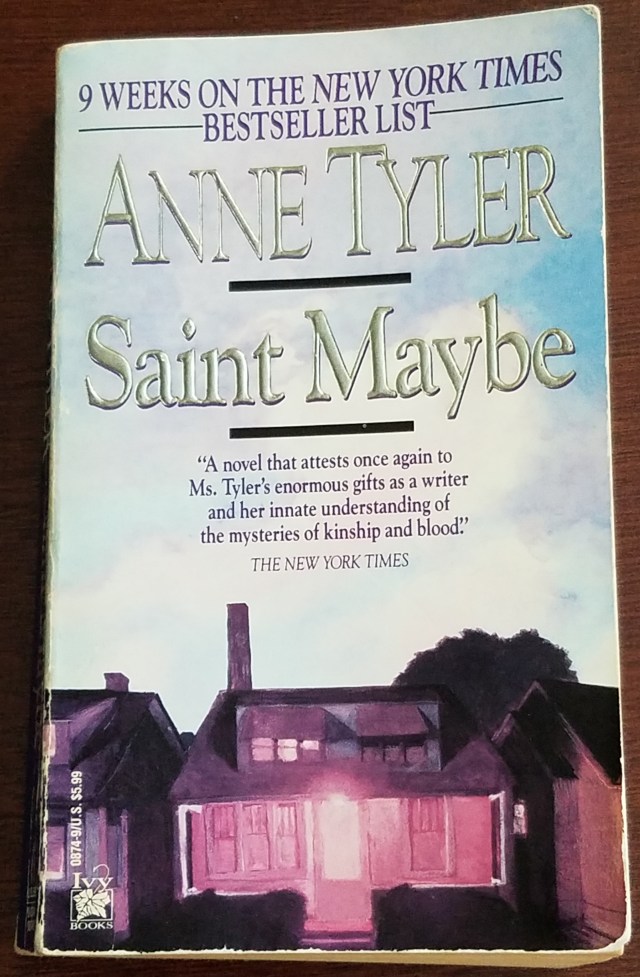
This is the copy of Saint Maybe I purchased earlier this year. Screenshot taken by me, Sally Silverscreen.
6. Saint Maybe and At Home in Mitford share some similarities, such as how both books were published in the 1990s. Are there any other similarities you can think of?
As I said in answer number three, I was surprised by the inclusion of religion/faith in Saint Maybe. Even though the movie and its source material are titled Saint Maybe, I wasn’t expecting religion/faith to play a large role in the text. But religion/faith is a cornerstone of both Saint Maybe and At Home in Mitford. References to God, the Bible, and Christianity can be found in each book. However, the way both authors incorporated these ideas into their stories is very distinct.Throughout Saint Maybe, the congregation of The Church of the Second Chance obeyed a rule that forbade them from consuming sugar. While this rule seems ridiculous on the surface, it is used as a metaphor for sin. Reverend Emmett, the leader of The Church of the Second Chance, explains that if one actively avoids sugar, they are actively avoiding sin. If someone tries to make excuses for consuming sugar, they are making excuses for committing sin.
7. Should Hallmark adapt Anne Tyler‘s other work? If so, why?
As of early September 2021, Hallmark has not made any announcements on whether they are bringing back the Hallmark Hall of Fame collection. But if Hallmark does choose to create more Hallmark Hall of Fame titles and would like to adapt more of Anne Tyler’s novels, there are plenty of stories for them to choose from. According to Goodreads, twenty-four books written by Anne Tyler have not been adapted into a Hallmark production. Since I’ve never read any of those books, I can’t say which one is more deserving of receiving an adaptation. But if I had to pick at least one title Hallmark should adapt into a film, it would either be A Patchwork Planet or Digging to America. This is based on each book’s synopsis, as I have not read either book.
Personally, I wouldn’t be opposed to seeing Hallmark adapt more of Anne Tyler’s stories. Based on my experience with Saint Maybe, the movie was mostly faithful to the source material. So, with the right creative team involved, maybe another Anne Tyler story could be lucky enough to receive similar treatment. Because three of Anne Tyler’s books have been adapted into Hallmark Hall of Fame titles, it appears Hallmark has had a good working relationship with the author. I’m not sure how much creative control Anne had on either film. But if Hallmark wants to work with Anne again, I’m pretty sure an agreement between both parties could be reached.
8. Is there anything about Saint Maybe you liked or didn’t like?
Saint Maybe is a story that takes place over the course of several years. In the movie, there were subtle clues revealing which time period was portrayed on screen. One establishing shot showed a boy riding his banana seat bicycle down the sidewalk. This brief image indicated how that specific part of the story took place in the 1970s, as banana seat bicycles were popular within that decade. During the movie, Ian adopted a pair of large rimmed glasses. Because this style of glasses was common in the 1980s, Ian’s accessory is very telling of how much time had passed since the beginning of the film. Movies are a visual form of story-telling. So, I liked how the film’s creative team took the initiative to show the passage of time in a creative way.
My favorite part of the book was when Daphne tried to set up Ian with her fifth-grade teacher, Miss Pennington. It was in this chapter that I started to like Daphne as a character, her free-spirited personality being introduced to me as the reader. Unfortunately, this part of the book wasn’t translated to the screen. I was disappointed by the omission of the book’s seventh chapter. The audience could have witnessed the evolution of Daphne’s personality, gaining an understanding of why she became who she was by the end of the story. Instead, there was a huge time jump from five-year-old girl to free-spirited woman. Because of missing context, this left questions without answers. But I recognize there is only so much story you can tell in eighty-four minutes.
9. Did you develop any thoughts and/or questions while watching this film?
While I didn’t develop any questions, I was surprised by how religion/faith was downplayed in Saint Maybe’s film adaptation. Yes, Ian’s introduction to The Church of the Second Chance was similar to the book. Agatha and Thomas tell Ian what they learned at summer camp, which was run by The Church of the Second Chance. Toward the end of the film, the Bedloe family are seen going to church. Other than these moments, religion/faith didn’t have an influence over the character’s lives. The Sugar Rule I talked about in answer number six was never brought up in the script. Reverend Emmett’s beliefs on how his congregation was led didn’t appear in any of the character’s dialogue. Even Reverend Emmett himself showed up in two or three scenes, having a much smaller presence than he did in the book. Saint Maybe’s film adaptation was released in 1998, a time when shows like Touched by An Angel were finding success on mainstream television. In hindsight, Hallmark choosing not to ride Touched by An Angel’s coattails kind of seems like a missed opportunity.
10. Would Saint Maybe encourage viewers to read either its source material or any other book?
I think it depends on what type of story someone wants to consume. As I said in answer number five, I’d recommend the book if you’re interested in a story where religion/faith is one of the key themes. But if you like films from the drama genre, those that explore relationships between characters, then the film adaptation is for you. I’ve said before that I am not a fan of “slice of life” stories. Like I mentioned in answer number three, Saint Maybe is primarily a “slice of life” story. If I hadn’t read the book beforehand, I would probably choose the movie over the text.
11. After watching this movie, is there anything you can take away from your movie viewing experience?
I now understand why Saint Maybe was sometimes shown during Hallmark Movies & Mysteries’ ‘Miracles of Christmas’ marathon. Several scenes took place during Christmas-time, with decorations associated with the holiday shown in the background. But I wouldn’t necessarily call Saint Maybe a Christmas story/movie. I said in answer number eight that this story took place over the course of several years. The themes and messages within the text are not exclusive to the Christmas season. In 2019, I created a tier rank list of every Hallmark Hall of Fame movie I’ve ever seen. Since posting that list, I have renamed each category. For Saint Maybe, I’d place this film adaptation in the category titled ‘Bought It at a Garage Sale for a Dollar’. The movie itself was fine, but I wouldn’t pay $20 if it was sold on DVD.
Back in March, I published my review of The Abominable Dr. Phibes. That post became my 500th. Every time I publish 100 posts, I host a special double feature. For months, I was trying to find the right theme for these reviews. Remembering how my first milestone double feature was published on Halloween, I decided to commemorate another holiday. However, I wanted to choose a holiday that is lesser known. After doing some research on the internet, I learned National Read a Book Day is celebrated on September 6th. This caused me to remember how I not only had the 2017 movie, At Home in Mitford, on my DVR, but I also owned a copy of the book it is based on. Then I remembered I had a copy of Saint Maybe, the same book that was adapted into a Hallmark Hall of Fame film. That was when the idea for this double feature was born! With every double feature, I try to answer a thought-provoking question related to both films. Since I read both aforementioned books before watching each movie, I am asking the following question:
Would these adaptations encourage the viewers to read their source material or any other book?
Prior to this double feature, I had never read anything by Jan Karon or Anne Tyler. I also have never seen the Hallmark Hall of Fame adaptation of Saint Maybe before. But this will be my second time watching At Home in Mitford, as I first saw the film when it released in 2017. Similar to my PB & J double feature, there are no pre-movie thoughts and/or questions this time.
Now is the time for the last polls of the Gold Sally Awards! This time around, you will be voting on which on-screen couple is the best one from a movie I saw last year. You will also be selecting a nominee for Sally’s Star of the Year. For the on-screen couple poll, you can vote for more than one nominee. But, you can only vote once per person. The link to the poll is at the bottom of the poll. Just click on the word, “PollMaker”. With the Sally’s Star of the Year Award, you can only choose one nominee per person. Your nomination can be submitted in the comment section of this post. You can learn more about the award at these links:
Both polls will be running from today, August 21st to August 28th. Due to technical difficulties, I’m unable to update the right side of the homepage. Because of that, my blog logo advertising the Gold Sally Awards Polls will still read “CLICK MY BLOG’S LOGO TO VOTE FOR THE GOLD SALLY AWARD’S BEST SUPPORTING ACTRESS AND BEST ENSEMBLE OF 2021”.
Who Was the Best On-Screen Couple of 2020?
Gene Kelly and Kathryn Grayson — Anchors Aweigh
Diane Lane and Neal McDonough — Grace & Glorie
Frank Sinatra and Pamela Britton — Anchors Aweigh
Omri Katz and Kellie Martin — Matinee
Jeff Daniels and Marlee Matlin — Sweet Nothing in My Ear
Ally Walker and Tom Amandes — If You Believe
Anne Hathaway and Charlie Hunnam — Nicholas Nickleby (2002)
Jay Underwood and Lucy Deakins — The Boy Who Could Fly
Michael Wincott and Bai Ling — The Crow
Jill Wagner and Kristoffer Polaha — Mystery 101: An Education in Murder
We are now toward the end of the Gold Sally Awards! Before I reveal this year’s winners, there are three polls left and the nomination of Sally’s Star of the Year. I’m going to try something different for these next two polls. The Best Supporting Actress Poll and the Best Ensemble Poll will be combined into one voting post. But the voting rules will still be the same as in previous polls. Even though you can vote for more than one nominee, you can only vote once per person. This set of polls will start today, July 30th and end on August 6th. The link to the polls are at the bottom of each individual poll. Just click on the word, “PollMaker”.
Last year was the first time I participated in Legends of Western Cinema Week! For that event, I reviewed some episodes of Walker, Texas Ranger and the movie, Forsaken. This year, I decided to review the 1999 Hallmark Hall of Fame film, Durango! One day, Hallmark Drama was airing several older titles from the Hallmark Hall of Fame collection, with Durango being one of them. Since I try to watch as many Hallmark Hall of Fame movies as realistically possible, I made sure to record this film on my DVR. This is not only my first time watching it, but this particular title was only sold on VHS. Hallmark has a history of selling some of their Hallmark Hall of Fame films for home entertainment. As I said in my review of the 1987 movie, Foxfire, some of them have been sold on DVD for $20 apiece. But there were some titles that were only given a VHS release. I don’t know what the original price of these VHS tapes were. But if the DVDs were $20, it makes me assume the VHS tapes might have been sold for a similar price. Would Durango be worth the price if it was re-sold on DVD? Keep reading my review if you want to find that answer out!
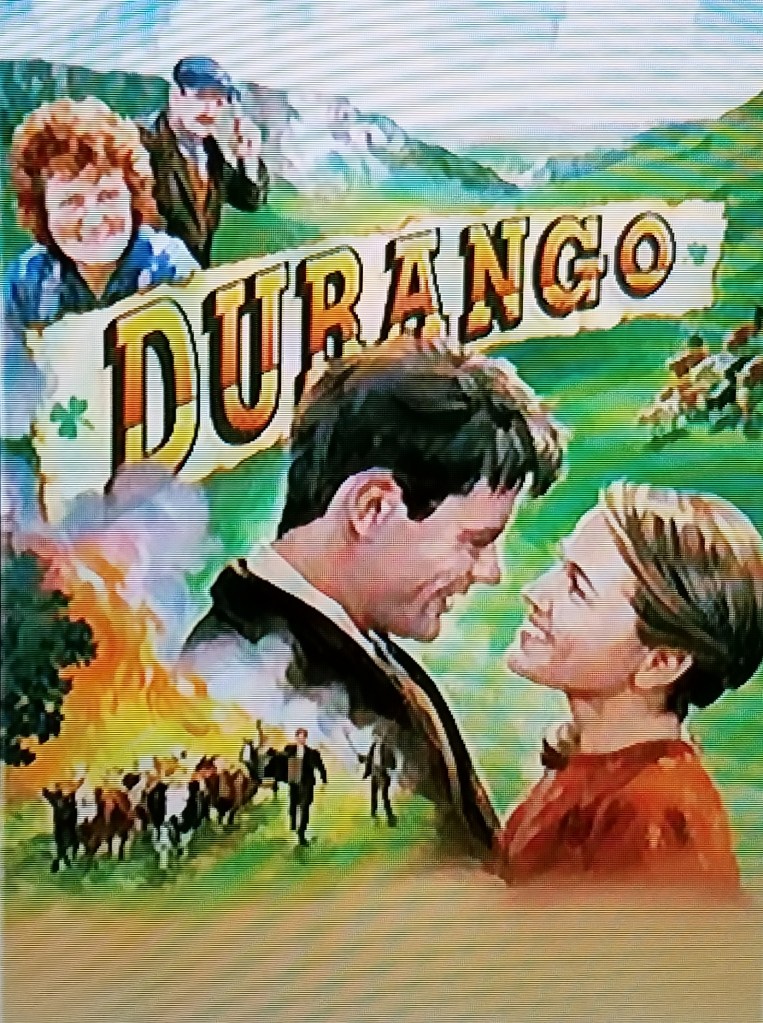
I really like the poster design for Durango, as it is reminiscent of posters from older western films. Screenshot taken by me, Sally Silverscreen.
Things I liked about the film:
Patrick Bergin’s performance: In Durango, Patrick Bergin portrayed Fergus Mullaney, the father of the protagonist’s girlfriend, Annie. Out of the whole cast, Patrick is the one that, for me, stole the show! Whenever his character came on screen, he delivered his performance with a strong sense of emotion. Toward the beginning of the movie, Fergus is giving a threat to the movie’s protagonist. During this scene, he truly came across as intimidating. The look in Fergus’ eyes was fiery, revealing the anger within him. His tone of voice was loud and stern, indicating he is not someone to be messed with. I wish Patrick had more appearances in this movie, so he could have had more opportunities to show off his acting talents!
The scenery: Within my review of Chasing Leprechauns, I discussed how the film looked drab. This was because that film’screative team didn’t take advantage of Ireland’s natural landscape. That was not the case for Durango, as the majority of the movie took place outdoors and there was a lot of greenery to be found! When the Mullaney family was taking a ride through the countryside, the rolling hills of Ireland were showcased in front of a clear blue sky. On the path, a small stone bridge was seen over a river. This river was surrounded by grassy, green fields. That type of landscape was consistently shown throughout the movie. However, it featured Ireland’s natural beauty, which could encourage someone to visit the country!
The music: In films like those from Hallmark Hall of Fame, orchestral tunes are commonly heard in the background. While that is the case for Durango, the music worked with what was happening on screen. During the protagonist’s journey, grand, sweeping orchestral music could be heard as cattle were traveling through the vast fields of Ireland. Because the scenery is so captivating, having this type of music playing makes sense, as the music represents the viewers’ awe for such a beautiful place. When Annie’s brothers were fighting in public, Mark, the film’s protagonist, tells Fergus what is going on. Even though orchestral music can still be heard, the music is reflective of one’s fear when facing an intimidating man like Fergus. Just like any component of a film, music can make or break a production. The music in Durango definitely worked!
Legends of Western Cinema Week banner created by Heidi from Along the Brandywine and Hamlette from Hamlette’s Soliloquy.
What I didn’t like the film:
Low stakes: A common staple in the western genre is including high stakes in the story. In the movie I reviewed last year, Forsaken, the future of the town was at stake. The fear of the unknown could be felt among the characters, with their dialogue and interactions elaborating this point. The major conflict in Durango was the transportation of cattle from one town to another in an effort to receive a fair price for them. But the stakes associated with this conflict were low, causing me not to feel like any of the characters or their cattle were in danger. This is because, nine times of ten, the characters’ plans work out perfectly. Come to think of it, these plans worked out too perfectly by the standards of the western genre. When a higher stake is introduced in the story, it doesn’t appear until the film’s last nineteen minutes. This stake feels like it was included simply for the script to shoehorn a subtle David and Goliath reference. What is frustrating about that creative decision is the movie’s creative team had the entire project to give us the aforementioned reference. Heck, Durango itself should have been a David and Goliath story.
Fergus Mullaney’s desire to protect his daughter: In a story where a young woman falls in love, it’s common for her father to be concerned for her well-being. This is no different for Durango, as Fergus Mullaney only wants to protect his youngest daughter, Annie. The way he went about protecting her is the issue, as it came across as possessive and bit over the top. Whenever Annie’s boyfriend, Mark, is expressing his love for her or seen interacting with her, Fergus becomes angry. It gets to the point where he threatens to physically harm Mark. If Durango were a comedy and Annie were a teenage girl going on her first date, maybe Fergus’ behavior would be justifiable. But because both Annie and Mark are adults and because this movie is more dramatic in tone, Fergus’ behavior felt out of place.
Matt Keeslar’s performance: I’m not really familiar with Matt Keeslar’s filmography. However, I wasn’t impressed with his portrayal of the protagonist, Mark Doran. He wasn’t as strong of a performer as other actors from Hallmark Hall of Fame productions. For most of the movie, Matt carried a “resting face”, making his face appear static. I could tell he was trying with the material he was given, as there were times where he expressed genuine emotion. But these emotions were, in my opinion, not delivered consistently. With everything I just said and the fact that Matt and Nancy St. Alban, the actress who portrayed Annie, didn’t have strong on-screen chemistry, I was not invested in Matt’s performance.
In my introduction, I mentioned how Durango was only sold on VHS. After watching the film, I now have an understanding of why this could be the case. Durango is one of the few Hallmark Hall of Fame movies I would consider a dud. With a weak lead performance and many low stakes, I found it difficult to stay invested in the characters and overall story. I also think the way Fergus tried to protect his daughter, Annie, felt out of place in this particular film. According to IMDB, Durango is “the first western set in Ireland”, so the fact this movie was not good is disappointing. On paper, an Irish western is an interesting idea that could have worked with a strong creative team. Unfortunately, Durango had a weak execution. I’m glad Hallmark Drama chose to air this movie, as I can honestly say it is not worth purchasing a copy. Personally, I think Irish cinema, the western genre, and Hallmark Hall of Fame deserve better.
Overall score: 4.7 out of 10
Have you seen Durango? Are there any Hallmark Hall of Fame movies you’d like to see re-released on DVD? Please let me know in the comment section!
Because yesterday was 4th of July, I wanted to review a movie that took place somewhere in the United States. While I wanted to publish this article on 4th of July, my day ended up being busier than expected. So, this review is published a day later than I had hoped. Recently, Hallmark Drama was airing several Hallmark Hall of Fame movies I had never seen before. One of these films was 1987’s Foxfire. Years ago, Hallmark’s stores sold select Hallmark Hall of Fame films on DVD for $20 apiece (yes, you read that price right), with Foxfire being one of the titles offered. Before recording it on my DVR, I didn’t know much about the movie. In fact, all I knew was that it was one of Hallmark Hall of Fame’s older titles. When I discovered the film took place in Appalachia, I thought it would be an interesting choice for this time of year. So, would I buy a DVD copy of Foxfire if I saw it at the store for $20? Before we head to the store’s checkout line, let’s start this review!
Like I’ve done in the past, I have taken a screenshot of Foxfire‘s poster that was featured on my TV. Screenshot taken by me, Sally Silverscreen.
Things I liked about the film:
The acting: I’m not familiar with Jessica Tandy’s acting abilities. While I have seen The Birds, I don’t remember her performance in that movie. Despite this, I did like her portrayal of Annie Nations in Foxfire! It was very expressive, using a variety of expressions and emotions throughout the film. When Annie receives an art project from her grandchildren, she appears genuinely overjoyed to receive the gift. A big smile is on Annie’s face and her demeanor is pleasant. At her son’s, Dillard’s, concert, Annie looks truly concerned as he sings a song about a broken relationship. Worry is in her eyes and she never lets Dillard out of her sight. Another actor whose career I’m not familiar with is John Denver. I have heard of his songs, but I didn’t know who he was. In fact, I thought John portrayed one of the brothers on The Waltons. This is because of the mannerisms he carried in Foxfire. When his character, Dillard, was happy, there was a youthful spirit about him. It highlighted how you can take the Appalachian man out of the mountains, but you can’t take the Appalachian culture and heritage out of the man. One of John’s strongest scenes was when, in Annie’s home, Dillard is reminding his mother about her age and potential risks of living alone. As he is talking to her, his eyes look like they are desperately searching for answers to his problems. Even the tone of his voice sounds concerned. A character that is close to both Annie and Dillard is Holly. Portrayed by Harriet Hall, this character kind of reminded me of Baby from Dirty Dancing. This is because when Holly cares about someone, she cares about them with her whole heart. What makes Holly differ from Baby is how her personality was gentler. Because she is a teacher, she chooses to put her students first. When Holly is talking to Dillard about her students, her mannerisms and tone of voice seem motherly. This gives the audience the impression that she truly cares about them.
The scenery: I haven’t seen many films that take place in Appalachia. In fact, I didn’t know Foxfire took place in this location until I read the synopsis. To my pleasant surprise, the scenery was very nice to look at! The Nation family house was surrounded by forestry, with the tall trees providing cozy seclusion and privacy. When Dillard wakes up one morning, he is greeted by the sight of rolling hills on a bright sunny day. These rolling hills could also be seen on a car ride Annie took. When a real estate agent named Prince gives Annie a trip to the market, he takes a scenic route. The aforementioned rolling hills steal the show, but are accompanied by a lake at the bottom and surrounding colonial style vacation homes that can be seen from the road. The locations in Foxfire appeared quaint, similar to the small towns in most of Hallmark’s films.
John Denver’s music: Before watching Foxfire, I had heard a few of John Denver’s songs. Even though I don’t listen to country music much, the songs I have heard were nice to listen to. Within Foxfire, John performed four songs. Most of them were slower, more soulful pieces. This fit the overall tone of the film. As I mentioned earlier in this review, Dillard performs a song about a broken relationship. After his concert, he performs an acoustic version of the song. What I’ve gathered about some country music is how emotional it can be. In that acoustic version of Dillard’s song, his heart and spirit sounded wounded. This can be heard in his voice.
A televised play: Hallmark Hall of Fame has a history of adapting stage plays into movies. One of these titles I really like is the 1996 film, The Boys Next Door. However, what sets the 1996 production apart from Foxfire is how the overall project was executed. Because The Boys Next Door contains more key characters and locations within the story, the way this adaptation was delivered to the audience looked and felt like a movie. Foxfire, on the other hand, contained a smaller cast and had a condensed story, as most of the film takes places at Annie’s house. Even some of the scenes were drawn-out and isolated, like a stage production. While the project was shot like a movie, it felt more like a televised play.
Re-created moments from the past: Throughout Foxfire, Annie brings up several memories from her and her family’s past. Instead of providing flashbacks, four scenes were dedicated to showing the characters re-creating some of these moments. For example, a current day Annie and her late husband, Hector, are reenacting when he first proposed to her. Watching grown adults act like teenagers was a bit jarring, as this prevented me from getting fully investing in these scenes. If anything, the scenes made it look like the film’s creative team didn’t have enough room in their budget to hire additional actors.
Inconsistent elements: At the beginning of the movie, Hector provides a voice-over, explaining the significance of his family and their land. Thinking Foxfire would be from his perspective, I thought this was an interesting way to tell the story. But this was the only time any voice-overs were provided. The end of the film showed Hector breaking the fourth wall for one scene. Not only was the inclusion of this element random, but it made me wonder why it wasn’t consistently woven into the movie.
Oranges in tree image created by Jose Luis Navarro at freeimages.com. “FreeImages.com/Jose Luis Navarro.”
My overall impression:
Whenever I watch and/or review a Hallmark Hall of Fame movie, I always ask myself this: “if this movie were sold on DVD for $20, would it be worth my money”? When it comes to Foxfire, that answer would be no. At best, the movie was ok. I appreciate the film’s positive light that was shone on Appalachia. While I haven’t been there myself and while I personally don’t know anyone from there, I have heard of the hardships that the members of the community face. But despite the good will this film seemed to give, the biggest flaw was its overall execution. If I choose to watch a Hallmark Hall of Fame title, I expect to watch a movie. With Foxfire, it felt more like a televised play. Also, I wasn’t a fan of the re-created moments from the past. I couldn’t get past the adult characters acting younger than they were in the “current day”. Now that I’ve seen another Hallmark Hall of Fame movie, I can add it to my Tier Rank List! Last year, I created a tier rank list of every Hallmark Hall of Fame film I have seen so far. While I’d like to revisit this list, I will focus on adding more titles for now.
Overall score: 6.2 out of 10
Have you seen Hallmark Hall of Fame’s Foxfire? Are there any Hallmark Hall of Fame titles you’d like to see me review? Please let me know in the comment section!
As I promised, I am hosting a re-vote for the Gold Sally Awards’ Best Supporting Actor Division. I also plan to wrap up the Awards voting, as there are three polls lefts. But don’t worry, Sally’s Star of the Year will still be included. This round of voting will start today, June 30th, and end on July 7th. Like before, you can vote for more than one nominee. But you can only vote once per person. The link to the poll is featured under the list of nominees.
Who was the Best Supporting Actor of 2020?
Gene Kelly — Anchors Aweigh
Fred Savage — The Boy Who Could Fly
Omri Katz — Matinee
Noah Valencia — Sweet Nothing in My Ear
Andrew Tarbet — If You Believe
Jamie Bell — Nicholas Nickleby (2002)
Brock Peters — To Kill a Mockingbird
Vincent Perez — Cyrano de Bergerac (1990)
Joe Penny — Perry Mason: The Case of the Shooting Star
Despite being busy with some blog and non-blog related projects, I am still continuing to host the Gold Sally Awards! For this round of voting, you get to choose who will receive the title of Best Supporting Actor. Like the previous polls, you can vote for more than one nominee. But you can only vote once per person. This poll will be active until June 7th and the link to the poll is under the list of nominees.












 18 Cinema Lane