Take 3: The Misfits (1961) Review

Marilyn Monroe is a woman who needs no introduction. One of the most popular actresses of all time, almost everyone knows who Marilyn is, even if they’ve never seen any of her movies. I remember a time when I would go to a store and find memorabilia with Marilyn’s picture or likeness on it, from metal wall signs to Christmas ornaments. I even recall a church named after her in the 1975 movie, Tommy. But when the Marilyn Monroe – 100th Birthday Anniversary Blogathon was announced, I remembered one of her films was recommended to me. That film is 1961’s The Misfits, suggested by Eric Binford (from Diary of a Movie Maniac)! On my blog’s Year-Long Bingo Card, one of the squares is labeled “Review a movie from the Western genre”. This became another reason why I chose to review The Misfits, as the movie is classified as a “contemporary western”. However, I had no idea Marilyn ever starred in a western genre picture until I selected the 1961 title for the blogathon. My aforementioned reasons, including the fact I don’t review western genre movies often, finally gave me an opportunity to write about The Misfits!
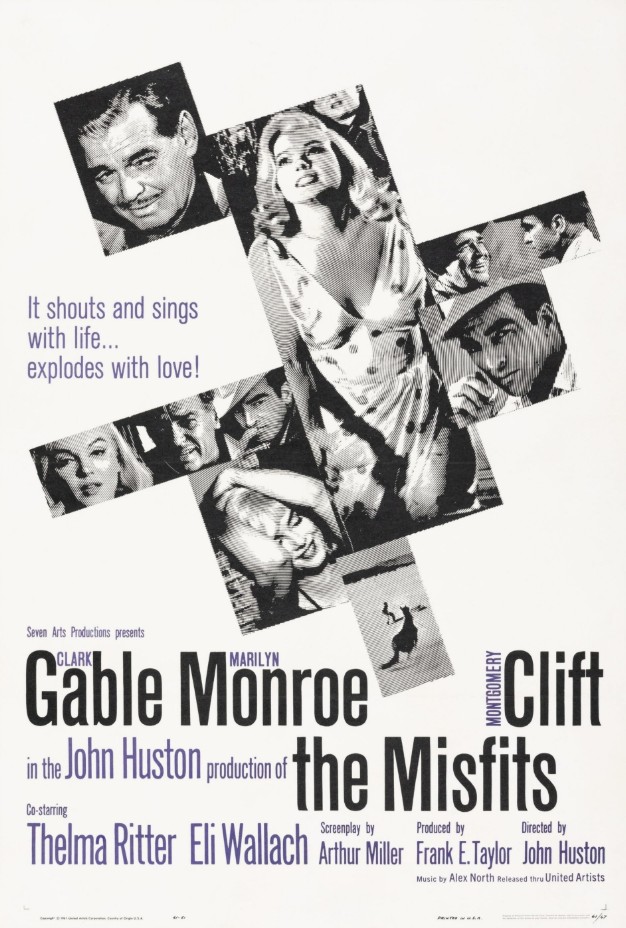
The Misfits (1961) poster created by United Artists and Seven Arts Productions

Things I liked about the film:

The acting: Throughout my years of watching and reviewing movies, I’ve heard Marilyn Monroe receive titles like “icon” and “sex symbol”. But as I reflect on her performance in The Misfits, I feel those titles do her acting talents a huge disservice. Toward the beginning of the 1961 film, Marilyn’s character, Roslyn, is questioning what her life will look like after her recent divorce. She’s hunched over her drink and her hands are folded, appearing as if she’s lost in thought. Roslyn’s eyes show how she’s trying to make a thousand decisions in a single moment, but not in a way that makes her look overwhelmed. She’s carefully processing what her new steps will be, coming up with a strategy that will prevent her from repeating her mistakes. As I watched this scene unfold, I was so focused on Roslyn and what decisions she was going to make, I had completely forgotten I was watching an actress portray a character. This is just one example of how Marilyn’s performance was one of the best parts of The Misfits!

Clark Gable is an actor I am definitely familiar with. Not only have I seen Gone with the Wind, I reviewed China Seas back in 2021. His portrayal of Gaylord in The Misfits is quite different from his two previously mentioned roles. That’s because it didn’t feel like Gaylord had something to prove, yet was emotionally versatile. One of the saddest scenes is when Gaylord is trying to find his children. As he drunkenly stumbles throughout and out of the saloon, he calls out his children’s names. A mixture of pain, confusion, and longing can be heard in his voice. Even his eyes were filled to the brim with sadness. In that scene, I, honestly, couldn’t help feeling sorry for Gaylord. Clark’s solid performance certainly contributed to that.

While I’m on the subject of the acting performances in The Misfits, I want to bring up Eli Wallach and Montgomery Clift. As I watched this movie, I was impressed by Eli’s portrayal of Gaylord’s friend, Guido, as well as Montgomery’s portrayal of a rodeo rider named Perce. One stand-out moment was when Guido is talking to Roslyn about his deceased wife. His voice quivers during the conversation and his eyes even appear on the verge of tears. Eli’s performance presents one of those times where a character can say so much as they say very little. In a different conversation with Roslyn, Perce shares his life story with her. Throughout his reflections, his wide eyes look like they’re searching for something. But it’s not because he’s lost, it’s because he’s trying to find something to focus on after a recent head injury. Montgomery’s expressive eyes are one of the reasons why his performance was captivating to watch!

The dialogue: Sometimes, a movie’s dialogue can be so thoughtfully written, it sounds profound without trying too hard to be. That was definitely the case for The Misfits! Honestly, it’s difficult to choose a favorite quote because several quotes were so thought-provoking. But I will provide a few examples to prove my previously stated point. At one moment in the movie, Isabelle, Roslyn’s former landlady and current friend, claims to know Nevada’s slogan. She says it’s “Anything goes, but don’t complain if it went”. Poignant reminders of how unpredictable life is and how some things were or were not meant to be are shared in that one line. During a conversation with Roslyn, Guido tells her, “You have the gift for life, Roslyn. The rest of us, we’re just looking for a place to hide and watch it all go by”. This piece of dialogue simply, yet effectively, differentiates between people who allow life to pass them by and those who fearlessly grab the steering wheel.

Providing creativity to the western genre: When it comes to means of travel within the western genre, horseback riding, horse drawn carriages/wagons, and trains are typically shown on screen. These modes of travel provide a stone in the western genre’s foundation, making the genre itself what it is. But what if I told you there was a plane in The Misfits? In the 1961 movie, Guido says he was a pilot in the war, likely referring to World War II. He uses his piloting skills to not only fly a plane, but to also wrangle a group of wild horses with that same plane. I bring this up because, prior to reviewing The Misfits, I had never seen, let alone heard of, a plane in a western genre film. Incorporating any aircraft into the movie added creativity to the western genre. It also gave The Misfits a unique identity.

Marilyn Monroe – 100th Birthday Anniversary Blogathon banner created by Kristen from Hoofers and Honeys

What I didn’t like about the film:

Guido’s unaddressed jealousy: At Guido’s house, Roslyn and Gaylord share a dance together. When Guido sees Gaylord and Roslyn together, the look on Guido’s face appears to be that of jealousy. But throughout The Misfits, this apparent jealousy wasn’t addressed. I honestly thought it was going to lead to a love triangle or Guido and Gaylord fighting for Roslyn’s love. Looking back on the 1961 movie, I wonder what the purpose was of showing Guido looking jealous if that feeling didn’t play a role in the story? Guido’s apparent jealousy could have led to an interesting conflict within the script had that feeling been acknowledged.

The run-time: IMDB lists The Misfits’ run-time as a little over two hours. Personally, I think that run-time is a bit excessive. Not only is the story pretty straightforward and easier to follow, the cast is smaller, which helps the audience remember who is who. These elements should have led to a tighter script. Plus, some scenes were drawn out too long, such as when Gaylord, Guido, and Perce wrangle the wild horses. If scenes like the one I brought up were trimmed down, the run-time of The Misfits could (and should) have been, at least, an hour and thirty to forty minutes. Important points in the story could have been reached sooner as well.

Perce’s underutilized backstory: In my opinion, Perce was the most interesting character in The Misfits. His backstory, along with his phone conversation with his mother, made him intriguing. I was genuinely curious about where Perce’s part of the story would go. But, unfortunately, his backstory became underutilized. During a conversation with Roslyn, Perce brings up how he was denied inheriting his father’s ranch. This could have provided Perce with a motive to carry his story forward. After his conversation with Roslyn, however, this detail is barely brought up again. In fact, Perce’s backstory becomes an afterthought as the movie progresses.

Joshua Tree National Park in California image created by Welcomia at freepik.com. <a href=”https://www.freepik.com/free-photos-vectors/tree”>Tree photo created by welcomia – http://www.freepik.com</a>. Image found at freepik.com.

My overall impression:

Have you ever watched a movie where you didn’t know what the movie’s creative team was trying to say? That was my experience watching The Misfits. I think I know what the film was supposed to tell me. But I don’t know for certain if that’s what The Misfits’ creative team wanted to tell their audience. However, I don’t believe the 1961 movie is bad. In fact, I thought it was just ok. The acting performances, including Marilyn Monroe’s, were certainly worth watching. Not only was the dialogue, at times, thought-provoking, the inclusion of a plane added creativity to the western genre. But there were flaws that held The Misfits back from being a stronger movie. I didn’t like how Perce’s backstory was underutilized and how Guido’s jealousy was unaddressed. Plus, the run-time was, in my opinion, a bit excessive. Despite those flaws, I am thankful to have received an opportunity to finally watch (and review) The Misfits!

Overall score: 6 out of 10

Have you seen The Misfits? Which film from Marilyn Monroe’s filmography would you like to see me review next? Let me know in the comment section!

Have fun at the movies!

Sally Silverscreen
Comparing with the Critics – Worst of 1976 – Gable and Lombard

This review is from my series, Comparing with the Critics. If you’d like to learn more about the series, click on the link below.

Introducing my new series, Comparing with the Critics!

In the ‘Best Films of 1976’ episode of Opening Soon…at a Theater Near You, Gene Siskel stated “1976 was a pretty lousy year for movies”. He emphasized that statement by saying “the year was littered with dogs”. Since I haven’t seen a lot of movies from 1976, I can’t agree or disagree with Siskel’s claim. But what I can do is talk about one of Siskel’s choices for worst movies of 1976. As I said in my 1976 introduction of Comparing with the Critics, one episode was primarily focused on discussing the best movies from a given year. This left Siskel and Ebert with only a few minutes to talk about some of the year’s worst films. Despite the 1976 episode’s limited selection of “bad” movies, I chose Gable and Lombard for this edition of Comparing with the Critics Worst of review. What made Gable and Lombard the most interesting title from the episode’s collection of “bad” movies was the story’s emphasis on Clark Gable and Carole Lombard’s relationship. I am somewhat familiar with Clark and Carole, as I have reviewed at least one of their movies on 18 Cinema Lane. Because I hadn’t heard of Gable and Lombard until I saw the ‘Best Films of 1976’ episode of Opening Soon…at a Theater Near You, I viewed the film as a way to expand my cinematic horizons and learn more about Carole and Clark. Now that I have seen the movie for myself, I believe Siskel’s, and even Roger Ebert’s, thoughts on the film were a tad harsh.

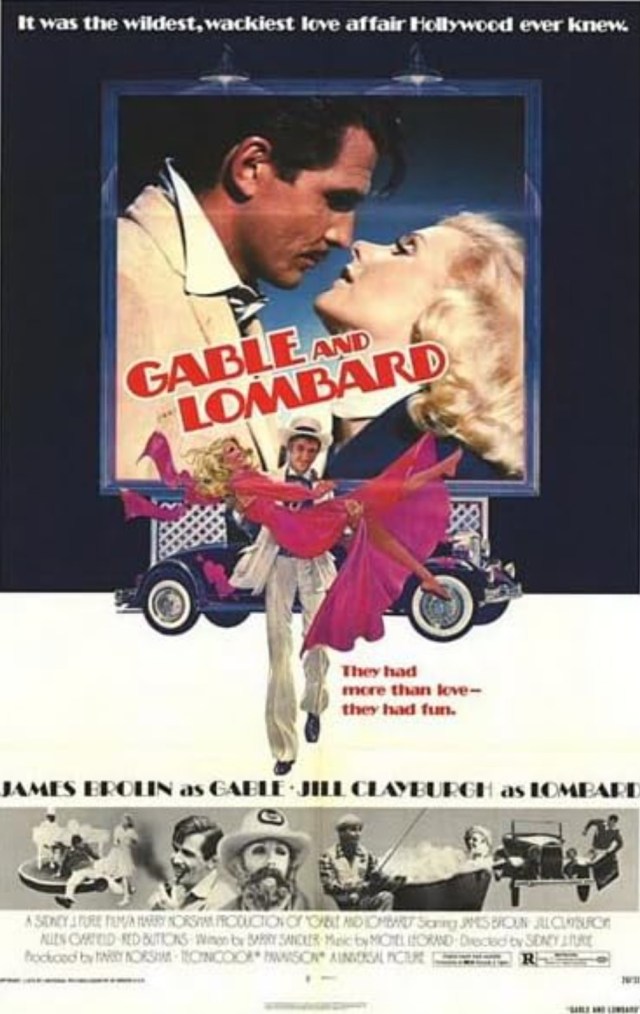
Gable and Lombard poster created by Universal Pictures

Before revealing his choices for the worst movies of 1976, Siskel says the year featured “two kinds of cinematic canines: cheap, lousy pictures and expensive, lousy pictures”. Based on what films he chose, Gable and Lombard was placed in the latter category. According to Wikipedia, the film’s budget was $4.5 million. It appears most of the budget was spent on Gable and Lombard’s set design. One scene took place outside, with the guests at a ball wearing white. Small candles surrounded the pool’s perimeter. In the pool were small islands of white flowers and candles, along with swans peacefully gliding through the water. Overall, this part of the set was absolutely gorgeous! Throughout Gable and Lombard, some scenes took place in Clark or Carole’s dressing room. These dressing rooms looked more like condominiums; distinct spaces that appear livable. Carole’s dressing room boasted a color combination of yellow and white. Featuring design choices like a white dining room set gave the dressing room a feminine style. Meanwhile, dark wood surrounded the fireplace in Clark’s dressing room. There was even a pool table located near the fireplace. These design choices created a more masculine space. Carole and Clark’s dressing rooms provided a good visual representation of how different they were despite having a similar career path.

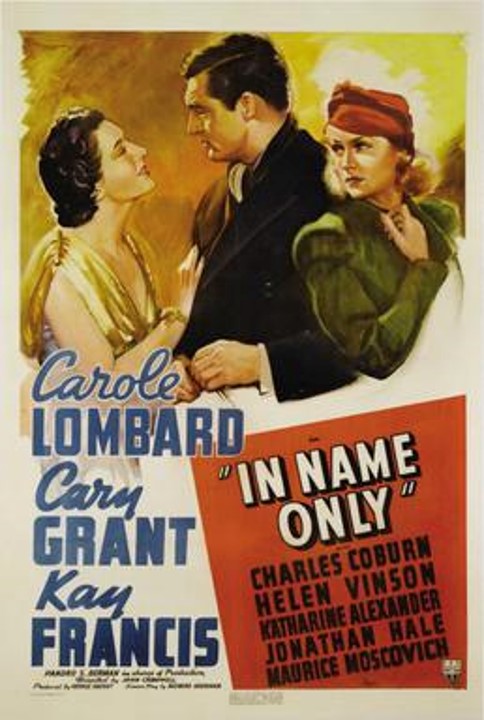
In Name Only poster created by RKO Radio Pictures. Image found at en.wikipedia.org/wiki/File:In_Name_Only.jpg

While Roger Ebert never shared his thoughts on Gable and Lombard in the ‘Best Films of 1976’ episode, he did write a review for the movie, which can be found on rogerebert.com. In his review, Ebert states “Brolin does, indeed, look a lot like Gable – but imitation here has nothing to do with flattery”. While I agree with Ebert’s opinion on James Brolin’s appearance in the movie, I disagree with the rest of Ebert’s statement. Not only did James look like Clark, he even sounded like him too! It almost felt like James transformed into another person. During Gable and Lombard, James consistently carried an easy-going attitude. This choice in acting and directing showcased Clark’s down-to-earth personality. Meanwhile, Carole was a comedic, life of the party. Portrayed by Jill Clayburgh, Carole’s up-beat personality made her one of the most popular actresses of her time. But behind closed doors, Carole had her doubts and insecurities. In one scene, Carole is sharing with Clark how she feels undeserving of a recent achievement. Her eyes reveal a sense of worry. Concern, even sadness, can be heard in her voice. During her conversation with Clark, Carole looks and sounds truly discouraged. Clark, with a warm smile and calming tone of voice, reassures Carole what’s most important is surrounding herself with people who support her. Jill’s and James’ performance is one of the reasons why this scene is one of my favorites in Gable and Lombard!

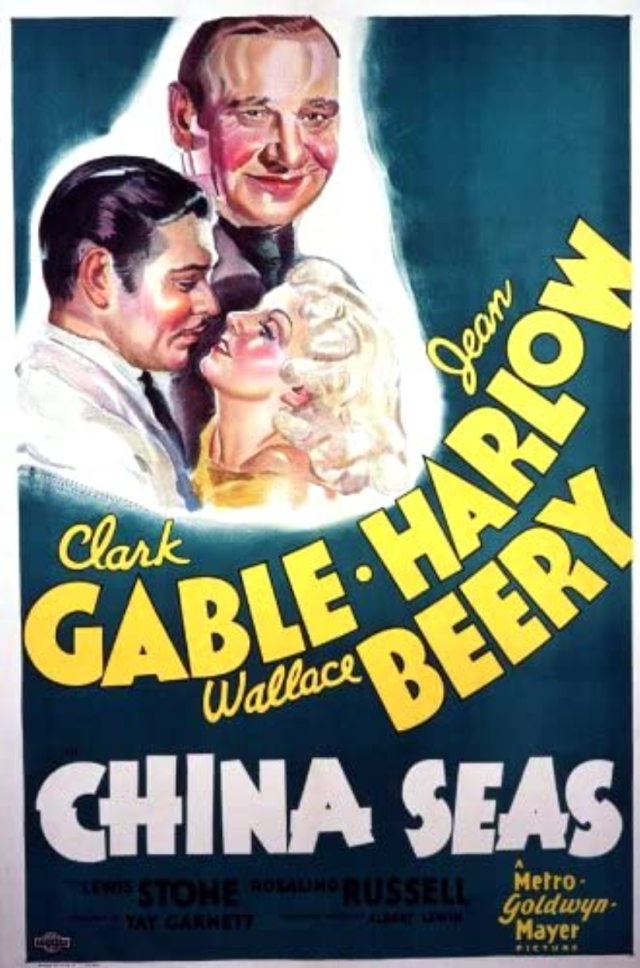
China Seas poster created by Metro-Goldwyn-Mayer.

Sidney J. Furie, the director of Gable and Lombard, chose to make “a movie about just folks”, primarily focusing on the personal lives of Clark Gable and Carole Lombard. While Ebert says this decision gave “the movie a certain originality”, he also criticizes Sidney’s choice, claiming that “by limiting itself to this aspect of their lives the movie never deals with the reasons we find them interesting in the first place”. As I said in this review’s introduction, I am somewhat familiar with Clark and Carole. Because I don’t know which parts of Gable and Lombard are factual or creative liberty, I took the story of Carole and Clark’s relationship with a grain of salt. From the way Louis B. Mayer (portrayed by Allen Garfield) talked to Clark about groups of people demanding certain elements of films be changed due to “indecency”, I knew he was talking about the Breen Code, a series of morality related guidelines enforced in Hollywood from 1934 to 1954. Therefore, I saw Gable and Lombard as a character study of how a portion of the Breen Code era affected the professional and personal lives of the Hollywood landscape, with Carole and Clark serving as just two examples. When Clark is accused of having an affair with a waitress, Carole volunteers to testify in court. Everyone from her inner circle knows if she testifies, she will expose her and Clark’s relationship as well as end her career. While explaining why he doesn’t want Carole to testify, Louis B. Mayer shares with Clark the ugly truth about what happened to some actresses after their careers ended. This scene is honest about the consequences if the Breen Code was broken. By viewing the film from the lens of the Breen Code, Gable and Lombard’s narrative is not only compelling, it is given higher stakes.

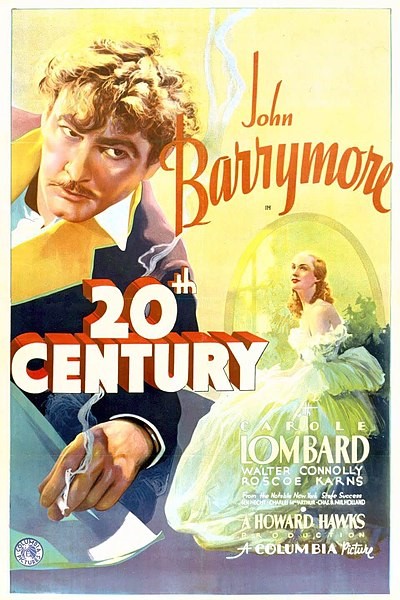
Twentieth Century poster created by Columbia Pictures.

I said earlier in this review how Ebert and Siskel were only given a few minutes to talk about the year’s worst films. This made Siskel’s discussion of Gable and Lombard sound vague, as he states “in real life, you can get arrested for playing around with dead bodies. The same should be true for movie-makers who desecrate the memory of great, dead actors”. Because this review affords me more time to elaborate on my opinion, I will now discuss what I didn’t like about Gable and Lombard. At the beginning of the movie, Clark is told Carole was in a plane crash, but her whereabouts are unknown. The very next scene shows Carole riding in an ambulance, alive and appearing uninjured. That scene took place years before the plane crash happened. With no on-screen text acknowledging the story’s time and place, it was sometimes difficult to figure out the story’s timeline. I liked James’ and Jill’s portrayal of Clark and Carole. However, I found their on-screen chemistry inconsistent. When their story began, Carole and Clark went from enemies to lovers. For the rest of the story, they continuously broke up then got back together. I recognize Gable and Lombard is based on a real-life relationship. But because of the back-and-forth nature of that relationship, I couldn’t stay fully invested in the relationship of Clark and Carole.

Comparing with the Critics banner created by me, Sally Silverscreen. TV show title cards created by WTTW National Productions, WTTW, Public Broadcasting Service (PBS), Lifetime Television, Tribune Entertainment, Buena Vista Television, and Disney-ABC Domestic Television

Looking back on Gable and Lombard, I believe Siskel’s, and even Roger Ebert’s, thoughts on the film were a tad harsh. I wouldn’t call it a “dog” or “lousy”, as the movie does have its merits. But I do believe the marketing is a bit misleading. The quotes on Gable and Lombard’s poster are “It was the wildest, wackiest love affair Hollywood ever knew” and “They had more than love – they had fun”. In the ‘Best Films of 1976’ episode of Opening Soon…at a Theater Near You, Carole dumped salad on Clark’s head, one of the more humorous scenes from the film. While there were comedic moments sprinkled throughout the story, the movie’s marketing presents the false idea it is solely a comedy. Seen from the lens of the Breen Code, Gable and Lombard presents a character study of how a portion of the Breen Code era affected the professional and personal lives of the Hollywood landscape. With the story emphasizing Carole and Clark’s relationship, they navigate complicated decisions, as well as honesty about feelings and emotions. The balance of comedy and tragedy adds a sense of maturity to the overall story. At worst, the movie prioritizes style over substance. as most of the budget seems to be put toward the set design. But, at best, Gable and Lombard is just ok.

This review was brought to you by

Sally Silverscreen

Take 3: China Seas Review

Last month, I had planned on participating in the Star/Genre Of The Month Blogathon, with January’s star being Doris Day. However, multiple projects throughout the month had filled up my schedule, preventing me from joining the event. To make up for it, I decided to participate in the blogathon this month, where the featured star is Clark Gable! As the only film of Clark’s I’ve seen up until this point has been Gone with the Wind, I was excited to explore his filmography! When I was choosing which film to write about, I also signed up for the We Heart Pirates Week Blogathon. To meet the requirements for both events, I have selected the 1935 film China Seas! Since Gone with the Wind is considered a romantic drama, it will be interesting to see Clark in a movie from a different genre!

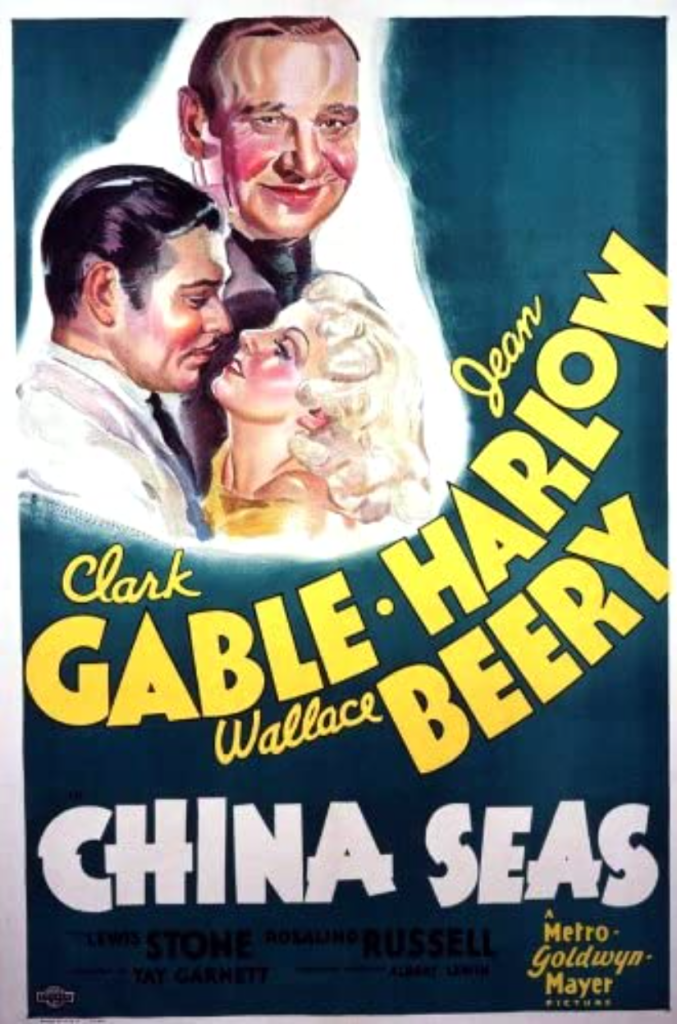
China Seas poster created by Metro-Goldwyn-Mayer.

Things I liked about the film:

The acting: Like I said in the introduction, the only film of Clark Gable’s I’ve seen is Gone with the Wind. Therefore, I didn’t know what to expect from his performance in China Seas. Even though this film was released four years before Gone with the Wind, Clark’s portrayal of Captain Alan Gaskell didn’t feel like a copy of Rhett Butler. For this particular role, Clark adopted the qualities of a natural born leader. Two of them were the strength and perseverance during times of conflict. When Alan is being tortured by the pirates, he never succumbed to the pain or surrendered to the enemy. He stood his ground instead, protecting his ship, as well as the guests and crew aboard it. I was pleasantly surprised to see Jean Harlow and Rosalind Russell in this film! Since I’ve seen very few projects from both of their filmographies, I was excited to see what they had to offer, talent-wise, in China Seas. What I liked about Jean’s performance was how versatile it was. Throughout the film, she used many different expressions as her character, Dolly, is boarding Alan’s ship. A fancy dinner in the ship’s dining room is a good example. At the beginning of that dinner, Dolly is in a pleasant mood, smiling and laughing at a friend’s joke. As the event goes on, she becomes bitter by Sybil’s presence. Speaking of Sybil, Rosalind’s performance was much different from her portrayal of Mother Superior from The Trouble with Angels and Where Angels Go, Trouble Follows. In China Seas, Sybil was more reserved than the other female characters. However, she had a gentler persona, which also helped her stand out. It was nice to see one of Rosalind’s earlier films, as this movie was released three decades before The Trouble with Angels.

The costume design: Some of the costumes in this movie were simply gorgeous! The dresses from the female characters definitely stole the show! At the dinner I mentioned earlier in my review, Jean wore a simple white dress that was slightly off the shoulder. The only applique was a metal paisley brooch, which added an element of pop to the dress. Later in the movie, Jean wears a satin gown. Similar to the aforementioned white dress, the satin gown was also given an element of pop. This time, the straps on the dress were covered with jewels. My favorite costume in China Seas was the pirate captain’s, as his was one of the most beautiful costumes I’ve ever seen in a pirate film! While it is simple, like Jean’s fancy dresses, it is the fine details that help it stand out! Paired with a silk blouse, the jacket is coated with an intricate design. The sleeves and boarders of the jacket are covered in fancy ribbon.

The pirate subplot: When I found out there would be pirates in China Seas, I was excited to see Clark Gable fight against them. The subplot involving the pirates was the best part of the overall story! It contained a mystery that unfolded as the movie progressed, featuring surprises and twists I didn’t see coming. There was also exciting action, which keep me invested. I was actually surprised by the amount of violence in China Seas because it was released in the Breen Code Era, where violence in films were kept at a minimum. However, it wasn’t graphic and over the top. This particular subplot also brought out each character’s true colors. I won’t reveal the movie for anyone, but I will say it was an interesting approach to providing character development!

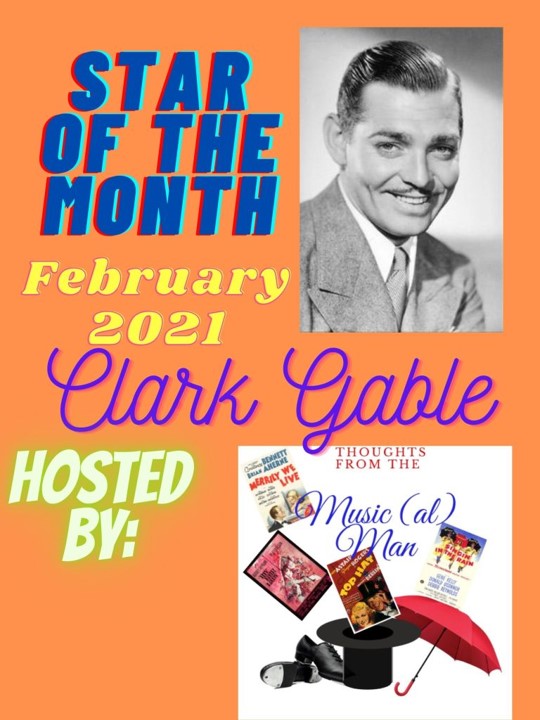
Star of the Month (Clark Gable) blogathon banner created by Neil from Thoughts From The Music(al) Man

What I didn’t like about the film:

A limited presence of the pirates: While I did like the conflict involving the pirates, they weren’t in the story for a long period of time. This part of the film was introduced fifty-eight minutes into this hour and twenty-seven-minute movie, with it lasting for about thirty minutes. I was honestly disappointed by this because I expected the pirates’ conflict to be the main story of China Seas. The captain of the pirate crew was one of the more interesting characters the movie had to offer, as he chose to become a pirate despite coming from a wealthy, noble family. However, the limited presence of the pirates prevented this character from receiving a lot of character development or screen time. Everything I said makes China Seas light on “action” and “adventure”.

A dull first half: As I just mentioned, China Seas is light on “action” and “adventure”. Even though those two things can be found in this movie, the story as a whole leans more into the drama genre. In the first half of the film, the script focuses on Dolly’s jealously toward Sybil. While this encouraged Jean to use a variety of emotions in her performance, I wasn’t interested in this part of the story. Other conflicts taking place in the movie’s first half includes whether Sybil’s pearls are real and Dolly trying to win back Alan’s love. These kinds of conflicts made China Seas feel like it was “Rich People Problems: The Movie”, revolving around problems that seemed stereotypical of wealthier individuals. Throughout the film’s first half, I kept asking myself, “When are the pirates going to get here”?

Confusing areas of the story: There were some areas of China Seas’ story that I found confusing. I’ll provide two examples for this part of the review. When Sybil is outside on the ship’s deck one evening, she is joined by one of Alan’s colleagues. Shortly after, the two can be seen kissing one another. Several scenes later, Sybil is spending time with Alan and expressing romantic interest in him. If she was romantically interested in Alan, why was she kissing another man? My second example is about the ending. While I won’t spoil it for any of my readers, I felt it didn’t fit within the overall story. The ending tried to wrap everything up in a nice little package. But with the events that led up to that ending, that part of the story became more confusing than it should have been. I know this film was released during the Breen Code Era, where happy endings were usually favored. However, the ending of China Seas was, in my opinion, not earned.

We Heart Pirates Week blogathon banner created by Hamlette from Hamlette’s Soliloquy

My overall impression:

While it was interesting to see Clark Gable in a different role and genre from what I’ve seen before, I found China Seas to be just ok. Were there aspects of the film I liked? Sure. The pirate captain’s costume was beautiful and I did like the acting performances. But I was disappointed by the limited amount of screen-time the pirates received. Before watching China Seas, I had expected the main plot to revolve around Clark Gable’s character dealing with the pirates. However, the most exciting parts of the story took place toward the end of the film, making the movie’s second half stronger than the first. Having a major part of the story focus on Dolly’s jealousy toward Sybil and obsession with Alan didn’t work for me. It came across as petty and immature. I do plan on seeing more of Rosalind’s, Clark’s, and Jean’s films in the future. But I hope the next movie is stronger than this one.

Overall score: 6 out of 10

Have you seen any of Clark Gable’s films? What is your favorite pirate movie? Please tell me in the comment section!

Have fun at the movies!

Sally Silverscreen