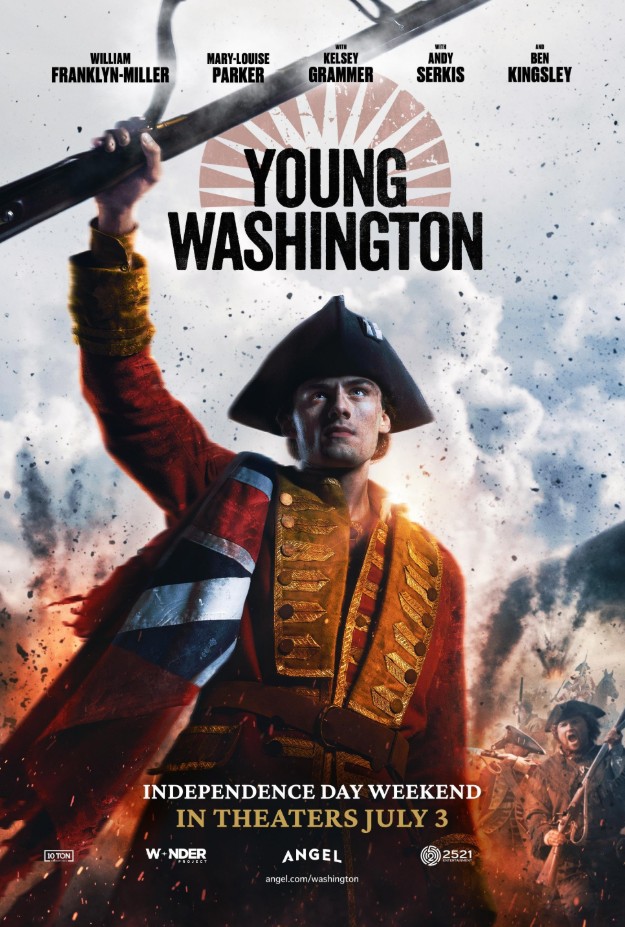
2026 marks the 250th birthday of the United States of America’s founding. Because of this major milestone, MovieRob selected July’s Genre Grandeur theme as “Red, White and Blue Movies”. This means a chosen film has to deal “with The American Revolution, American Patriotism or related to the 4th itself”. For my selection, Young Washington, I had planned to publish my review on July 4th. But because of my schedule at the time, I didn’t get the chance to see the 2026 picture as soon as I had hoped. Now that I’ve seen the movie, I can finally post my review for MovieRob’s Genre Grandeur Blogathon! As I already mentioned in this introduction, a chosen film for the event had to deal “with The American Revolution”. When George Washington appears in entertainment media revolving around this period in history, the story itself focuses on what led up to the signing of The Declaration of Independence. In Young Washington, however, the story explores the events that shaped George into the leader history remembers him as today. Reflecting on The American Revolution related pieces of entertainment media I’ve seen, heard, or read, Young Washington’s approach to this specific time period seems to have addressed a creative void.
Things I liked about the film:
Incorporation of the story’s natural landscape: IMDB lists Ireland as Young Washington’s primary filming location. Yet the story is set in Virginia. Since the majority of the movie takes place outdoors, the forest landscape of America’s tenth state was given center-stage through long and medium shots. Clear blue waters, rolling green hills, and what appears to be pine trees literally and figuratively represent the “calm before the storm”, as the Ohio Territories are at the center of a major conflict. This same landscape was also shown at different times of the day as well as in different climates. On a few occasions, snow covered the forest floor and trees. Paired with a gray-blue sky, this landscape visually presented a peaceful environment, despite the uncertainty this type of terrain brings. The incorporation of Young Washington’s natural landscape added natural beauty to the film. This creative decision also reminded me of Europe’s natural landscape receiving importance in I Am David, showing a side of the United States of America that could be easily taken for granted.
The acting: As I just mentioned in this review, the Ohio Territories are at the center of a major conflict in Young Washington. The reason is because the French desire to claim the land as their own. In order to convince the French to leave, George is tasked with persuading a French military officer named Joseph Jumonville. In a scene where George negotiates with Joseph, Joseph, at first, appears very jovial. His huge smile, jolly demeanor, and laughter gives George (and the audience) the impression things will go George’s way. But as soon as George addresses the French residing on the Ohio Territories, Joseph’s attitude immediately changes. His intense stare and sharp tone of voice lets George (as well as the audience) know he means business. Joseph’s change in attitude causes a shift in the scene’s atmosphere, raising the stakes of the situation. Despite having a limited presence in Young Washington, Joseph became such a memorable part of the movie! That’s because the actor who portrayed Joseph, Clement Toyon, gave a performance that was captivating due to his flawless transition between attitudes. With that said, I wish Joseph made a few more appearances in the film.
While George and a surveyor named Christopher are surveying the Ohio Territories, they cross paths with Half-King Tanacharison. Similar to Joseph Jumonville, Half-King Tanacharison appears in Young Washington for a limited period of time. Also similar to Clement Toyon’s portrayal of Joseph, Half-King Tanacharison was so memorable because of Ryan Begay’s performance! Whenever he showed up in the story, Half-King Tanacharison carried himself with a strong confidence, his demeanor letting others know how he should be taken seriously. At the same time, Half-King Tanacharison carried a gentleness which emphasized how he was a leader who sought fairness. These combined characteristics in demeanor allowed Ryan’s performance to contain a commanding presence. Because we’re on the subject of leaders, I must talk about William Franklyn-Miller’s portrayal of George Washington! Like I said about Liev Schreiber’s portrayal of Orson Welles in RKO 281 and Tom Hulce’s portrayal of Amadeus in Amadeus, William brought humanity back to George’s name by finding the heart of the “genius” and putting some genuine emotion behind it. What I also liked about William’s performance is how it possessed a strong sense of realism. This element didn’t show an actor portraying a historical figure, but, instead, a young man becoming the leader he was destined to be. Working in William’s favor as well is his understanding how to utilize emotion and when to increase or decrease the intensity of those emotions.
Historical accuracy: Filmmakers have the ability to create the illusion of immersion. This illusion makes the audience feel immersed in a movie’s world, giving them a reason to stay invested in the story. One way to achieve the illusion of immersion is through historical accuracy. When a film’s creative team adopts that element of storytelling, research and attention to detail must be prioritized in order to effectively bring the chosen time period back to life. While watching Young Washington, the historical accuracy could be seen as well as felt! One of my favorite examples is when George attends a party at the Belvoir plantation. Every room within the plantation is lit by candles. Throughout scenes taking place at the plantation, the lighting was consistently dim. Looking back on the movies I’ve seen (and even reviewed) relying on historical accuracy, I never thought about how a film’s lighting could affect a film’s historical accuracy, let alone illusion of immersion. The example I brought up of the dim lighting in Young Washington allows the audience to grasp how different lighting options were in the 1700s.
The dialogue: An underrated film-making element is the quality of a script’s dialogue. If the dialogue among a movie’s characters is good, it can become a memorable component of the movie itself. As I watched Young Washington, there was dialogue that stood out to me because of how good it was! When George applies for the British Army, he is ultimately rejected due to his social status. To prove his worth, George presents his collection of quotes he wrote down while being tutored by his half-brother, Lawrence. But George is told how an imitation of great men doesn’t make him one. This quote not only encourages George to forge his own path in life, it also foreshadows George’s future. Earlier in the story, Lawrence teaches George how to play chess. During the lesson, Lawrence says how a pawn can take a king. This quote was, once again, clever foreshadowing, as George’s role in the American Revolution helped the Thirteen Colonies break away from a king ruled government to form the United States of America. The two examples of dialogue I presented in this review show how much thought and effort went into the screenwriting as well as how the dialogue was delivered!

What I didn’t like about the film:
Inconsistent incorporation of subtitles: Earlier in this review, I brought up how George and Christopher cross paths with Half-King Tanacharison while surveying the Ohio Territories. Christopher and Half-King Tanacharison share a conversation, despite never meeting before. Half-King Tanacharison and Christopher’s conversation is not in English, yet no subtitles appear on the screen during their conversation. But any other time characters speak to one another in a language that isn’t English, subtitles are present on the screen. This inconsistency became noticeable to me by the third non-English conversation characters shared in Young Washington.
A missing “And then what happened” segment: In movies based on true stories, there is sometimes a segment toward the end of the movie explaining what happened to the story’s key individuals after the events presented in the movie. But Young Washington lacked this kind of segment. Toward the end of the 2026 film, on-screen text reveals a few of the events leading up to the signing of the Declaration of Independence. However, what happened to key people from Young Washington, like Sally Cary, David Frisk, and even Robert Dinwiddie, was not brought up. This creative decision left me disappointed, as I wanted to know more about the people in the story.
Some underutilized talent: Before watching Young Washington, I knew Kelsey Grammer starred in the movie. From what I remember, he was heavily featured in the movie’s marketing. At the end of the film, Kelsey himself delivered a message on the film’s importance. Yet he appeared in Young Washington in two scenes as Lord Fairfax. One of my family members almost forgot Kelsey was cast in the movie due to his very limited screen-time. While I understand why Kelsey starred in the film for a short period of time, this was one example where, to me, talent was underutilized.

My overall impression:
The best way I can describe Young Washington is a “hero’s journey” woven into a history lesson. Throughout the 2026 movie, the audience sees George experience both trials and triumphs. What the audience of Young Washington also sees is solid acting performances, immersive historical accuracy, and a beautiful forest landscape. They can hear dialogue that is well written and delivered, as well as good messages and themes. Another strength of Young Washington is the ebb and flow between action-heavy, suspenseful scenes and quieter, slower-paced scenes. This ebb and flow maintained the story’s intrigue, keeping me invested in what was happening on screen. There are flaws within the 2026 picture, like inconsistent incorporation of subtitles and some underutilized talent. But, in my opinion, there’s a lot Young Washington got right when it comes to film-making. Now that we’re at the halfway point of 2026, I can honestly say I’ve seen more movies, so far, I liked than didn’t. Young Washington is one of those films belonging to the first category of movies I liked!
Overall score: 8 out of 10
Have you seen Young Washington? Is there a movie set around the American Revolution you like? Please tell me in the comment section!
Have fun at the movies!
Sally Silverscreen