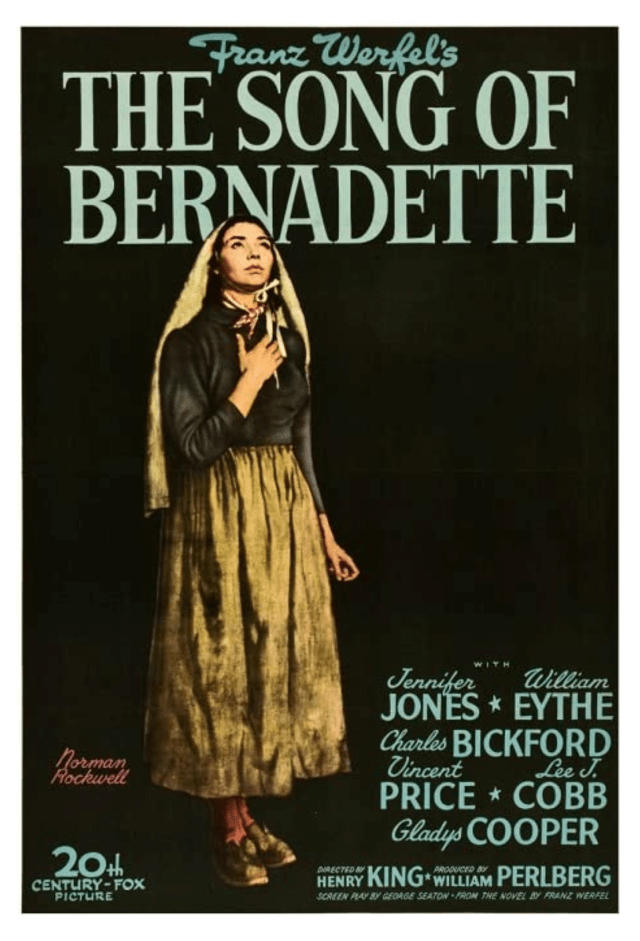
Shock and sadness. That’s how I felt when I discovered the passing of Patricia, from Caftan Woman, on Twitter. Upon hearing the announcement of the Caftan Woman Blogathon, I wanted to participate as a way to pay my respects to a fellow blogger. Over the years, Patricia has recommended several films for future reviews. So, it was only fitting for me to choose one of her suggestions for the event. Since the blogathon is commemorating a loss, I felt The Song of Bernadette was the most appropriate choice out of the recommendations on my Pinterest board. This also compliments other religious/faith-based films I’ve reviewed in the past, such as Ben-Hur and The Carpenter’s Miracle. With all that said, let’s start this review of The Song of Bernadette.
Things I liked about the film:
The acting: One of my favorite movies is Portrait of Jennie. Jennifer Jones’ consistent and captivating performance is one of the reasons why I love that film so much. In The Song of Bernadette, Jennifer’s portrayal of the titular character reminded me of her portrayal of Jennie. This is because she has a talent for pulling off an innocent demeanor without coming across as childish or immature. Throughout the film, Bernadette claims she is dumb. Yet, when asked what a sinner is, she tells the local reverend a sinner “is someone who loves sin”. The reverend even comments how Bernadette chose to say “loves sin” instead of “commits sin”. Personality wise, Jennifer brought a gentleness to her character. When speaking with one of Lourdes’ members of police, the policeman gets details of Bernadette’s story wrong. In a polite manner, Bernadette corrects him, pointing out the policeman’s errors in a soft-spoken voice. This innocence and gentleness allowed Bernadette to be taken seriously by the audience.
On 18 Cinema Lane, I have reviewed several of Vincent Price’s films. In most of these movies, Vincent portrays a character that can exude a sense of fear for the audience. But in The Song of Bernadette, his role of Vital Dutour was very different from his other roles. One reason is how Vincent is a part of an ensemble instead of a main focus in the story. Another reason is how Vital’s actions and choices were not chosen to cause fear. Despite all of this, Vincent carries his character with elegance and arrogance. In an effort to get to the bottom of Bernadette’s “visions”, Vital questions her story in his office. He speaks to Bernadette with a stern voice and presents a no-nonsense attitude. By interacting with her in this way, Vital is attempting in enforce his authority, thinking he will get his way. But because of Bernadette’s strength in her faith and her innocent demeanor, she is able to stand up to Vital. With that, both Jennifer Jones and Vincent Price are able to, acting-wise, go toe-to-toe with each other!
The set design: The Song of Bernadette takes place in the French countryside of 1858. But according to IMDB, the movie was filmed in California. Despite this, the set didn’t look like a set. Instead, it looked like a small French town from the 1850s! The architecture of Lourdes’ buildings was simple. Materials such as stone cover these structures. A traditional roof shingle design is displayed on top of these buildings. Like any well-researched production, the attention to detail was not overlooked! Vital’s office boasts two impressive things: a large desk and fireplace. The desk is a big piece of furniture that is coated in darker wood. Small, gold detailing can be found on the side of the desk. The fireplace is a massive marble structure, with etched detailing just below the mantle. Attention to detail and thorough research made this on-screen world an immersive environment!
Correlations with Biblical stories: When I reviewed the 1959 film, Ben-Hur, I talked about how certain Biblical events were incorporated into the overall story. With The Song of Bernadette, I could pick out moments that felt like unintentional correlations with some stories from the Bible. Toward the beginning of the film, Bernadette’s father is hired to dispose dirty rags from hospital patients. Shortly after being hired, Bernadette’s father can be seen pulling the wagon filled with dirty rags up a hill. This scene reminded me of the Crucifixion story, when Jesus is carrying the cross. The scene can also serve as a reminder how everyone has their own cross to bear, literally or figuratively. After Bernadette sees her first “vison”, Bernadette’s neighbors offer Bernadette’s family extra food they had acquired. The neighbors’ multiplying of food is reminiscent of the story where Jesus multiplied two fish and five loaves. Because this scene takes place after the first “vision”, I saw it as a miracle similar to the aforementioned Biblical story.
Using little to no dialogue: In two scenes, the movie’s creative team did a great job using little to no dialogue! One of them was the aforementioned scene where Bernadette’s father climbed up the hill. Orchestral music replaces any dialogue, which captures the emotions of Bernadette’s father. A long shot showcases the journey, elaborating how small Bernadette’s father is compared to the hill. This scene visually explained how difficult his life is. Another scene that used no dialogue is when Bernadette experiences her first “vision”. Not only is orchestral and choir music incorporated, the creative team uses a spotlight to accentuate Jennifer’s facial expressions. At one point in this scene, wind blew unexpectedly, signaling something was about to happen. Both scenes were able to say so much while saying so little!

What I didn’t like about the film:
The under-utilization of Antoine and his mother: In The Song of Bernadette, the titular character appears to be friends with a man named Antoine. Antoine also appears to be close with his mother. These two characters were only shown in a handful of scenes. Even when they were included in the story, their significance in the overall plot was weaker. The under-utilization of Antoine and his mother was disappointing, as I felt they could have offered more to the story. But since this movie was based on a book I haven’t read, I’m not sure if the limited presence of these characters is close to the source material.
A few ignored details: Toward the beginning of the movie, a friend of Bernadette’s explains to their teacher how Bernadette has asthma. This diagnosis is brought up on a few occasions by Bernadette’s family throughout the movie. But, for the most part, this detail was ignored and had little significance in the story. There were times when Vital Dutour was seen wiping his nose with a handkerchief. At one point in the story, he claims it’s “influenza”. However, it isn’t clearly explained what he’s medically dealing with. As I already said, The Song of Bernadette is based on a book I haven’t read. But if the creative team knew they weren’t going to utilize these details, it makes me wonder why they would include them in the movie?

My overall impression:
Incorporating faith into film can be a tricky task. On the one hand, you don’t want to run the risk of alienating those who aren’t religious. At the same time, you want to acknowledge the beliefs of those who choose to include religion in their lives. The Song of Bernadette finds a way to achieve “the best of both worlds”! Bernadette’s story is shown as a procession, a good exploration of how religious phenomena can affect a small town. The film doesn’t seem to take sides when it comes to the actual topic. Yes, some people make fun of Bernadette because of her “visions”. But there’s no antagonist or villain in the movie. Lourdes’ mayor and his friends don’t believe Bernadette. However, none of the men are religious, approaching the situation from a legal and literal perspective. Even the town’s reverend isn’t quick to assume the “visions” are religious. Out of all the movies I’ve seen this year, so far, I’d say The Song of Bernadette is the strongest one! If you are interested in checking this film out, I think Easter would be an appropriate time to see it. Personally, I wish I had seen it sooner, especially since I can no longer thank Patricia for the recommendation.
Overall score: 8.2-8.3 out of 10
Rest in Peace Patricia
Sally Silverscreen