Take 3: Cut, Color, Murder Review

The last time I reviewed a Hallmark Movies & Mysteries film was last August, when I wrote about Poisoned in Paradise: A Martha’s Vineyard Mystery. To make up for that, I thought it made sense to review one of the network’s newest titles. As of February 2022, Hallmark Movies & Mysteries only has two new mystery releases; Cut, Color, Murder and Aurora Teagarden Mysteries: Haunted by Murder. Like the title of this review says, I’ll be writing about Cut, Color, Murder! For years, I’ve been waiting for Hallmark to create a movie that revolved around pageants. Sure, I received Signed, Sealed, Delivered: The Impossible Dream back in 2015. But the pageant in that movie played such a minor role in the overall story. I’ve also heard some of the network’s series have been cancelled, such as Picture Perfect Mysteries, Hailey Dean Mysteries, and Matchmaker Mysteries. So, the idea of a new series is exciting! But is Cut, Color, Murder worthy of the crown? Let’s solve this mystery by starting this review!

Cut, Color, Murder poster created by Crown Media Family Networks and Hallmark Movies & Mysteries

Things I liked about the film:

The chemistry among the cast: In most of my movie reviews, I talk about specific acting performances. But this time, I’ll be writing about the chemistry among the cast in Cut, Color, Murder! Within Hallmark Movies & Mysteries’ movie series, the chemistry and camaraderie between the characters has been a consistent component. This is especially true when it comes to the network’s newest mystery film! At the beginning of the movie, the protagonist’s sister, Chelsea, is concerned about an upcoming college tuition payment. After the protagonist, Ali, suggests working on pedicures at the salon in order to make extra money, Chelsea sarcastically responds to her sister by saying, “I’ve seen some of those women’s feet. I’d rather drop out”. The interaction I just described came across as realistic, like a conversation two siblings might typically have. This is because Julie Gonzalo’s and Grace Beedie’s acting talents complimented one another. At a restaurant called ‘The Jackson’, Ali and Chelsea have lunch with their mom and some of Ali’s co-workers. Their conversation during this meal revolves around Chelsea possibly joining the Miss Golden Peak Pageant. In this scene, each character is presented with their own unique personality. Ali’s co-workers play a specific role at the salon, as each one volunteers to help Chelsea on pageant day. The way these characters interacted with one another feels like a family, with each member giving Chelsea their love and support. Interactions like this one feel genuine and believable because of the cast’s acting strength!

The banter: A component that can make or break a film is the banter among the characters. With Cut, Color, Murder, the banter was one of the strongest aspects of the overall production! While at the aforementioned restaurant, ‘The Jackson’, Ali meets Golden Peak’s newest detective, Kyle Crawford. During their initial interaction, Ali makes educated analyzes about Kyle’s background based on her observations about him. The way these analyzes were delivered was sharp and precise, showcasing the strength of Julie’s acting abilities and the screen-writing. Kyle takes Ali’s words in stride, as Ryan McPartlin, the actor who portrays Kyle, remains consistent in his performance. At the salon, Ali talks with Golden Peak’s resident officer, Fred Wright, about new develops in the film’s murder mystery. As they exchange details with one another, their banter sounds like an exciting game of ping-pong! Both Julie and Fred Henderson, the actor who portrays Fred Wright, are quick with their line delivery, with each actor effectively meeting with other at their level. The screen-writing also helps with the strength of Ali and Fred’s banter!

How the subject of death was handled: When a mystery story revolves around a murder, death is going to be one of the story’s overarching themes. In the case of Cut, Color, Murder, I’m referring to how the movie’s creative team handled the subject of a deceased spouse, which was unrelated to the movie’s main mystery. During the film, Ali reveals how she lost her husband, Dan, in the line of duty. Whenever this subject was brought up, it was spoken by the characters with a serious tone in their voices. But it was also brought up with a sense of reverence and respect. At two points in Cut, Color, Murder, Ali visits Dan’s gravesite. She has conversations with him as if Dan was sitting right next to her. Ali does try to move forward from Dan’s passing, as his death took place two years prior. Ali decides to move forward on her own terms and she doesn’t receive any negativity for visiting Dan’s gravesite. With the strong acting performances and screen-writing, Ali’s gravesite visits and the characters’ reactions to Ali’s grief felt realistic. The inclusion of Dan’s passing also emphasized how death can impact a community and the people within it.

Princess tiara image created by Freepik at freepik.com. <a href=’https://www.freepik.com/free-vector/ornamental-princess-crowns_1109199.htm’>Designed by Freepik</a>. <a href=”https://www.freepik.com/free-photos-vectors/gold”>Gold vector created by Freepik</a>. Image found at freepik.com.

What I didn’t like about the film:

A limited insight on pageantry: When I discovered Cut, Color, Murder would take place during a pageant, I was excited to see the world of pageants shown through a Hallmark lens. While I did receive some insight into this particular industry, I was left desiring more. It was interesting to see how local businesses and aspiring professionals were affected by a pageant. But other aspects related to this subject felt surface level, such as squabbling pageant mothers. The majority of the story focused on the mystery itself. Because Ali’s sister was the one entering the Miss Golden Peak Pageant, the pageantry in this story felt like a subplot. Looking back on this film, it makes me wish the story had been set in the pageant world, instead of being a bystander to it.

An unclear setting: The majority of Hallmark Movies & Mysteries’ movie series take place in a small town. While this is true for Cut, Color, Murder, I was unsure where this story took place. For about half the movie, I was confused over the story’s location. When I first saw the salon Ali works at, I thought the story took place in New York City. Because Fred Wright consistently wore a cowboy hat, I then thought Ali’s town was situated in Texas. Before realizing the owner of ‘The Jackson’ shared the restaurant’s name, I also thought the town was in Jackson Hole, Wyoming. At the film’s half-way point, I learned Ali, her family, and her co-workers lived in Idaho. Despite receiving this knowledge, the setting didn’t feel like Idaho. In fact, it looked and felt like any other small town from any other Hallmark production.

Few interactions with Ali and Kyle: A lot of mystery films from Hallmark Movies & Mysteries feature a male and female protagonist who eventually form a romantic relationship. In the case of Cut, Color, Murder, these protagonists are Kyle Crawford and Ali Bowden. Since it’s unknown at this time if this movie will lead to a series, it’s unclear if Kyle and Ali will come together as a couple. But compared to other Hallmark Movies & Mysteries projects, these characters didn’t spend much time together. Their limited interactions mostly took place in a professional context, whether at the police station or while crossing paths interrogating suspects. Unprofessionally, Ali and Kyle stayed in their own worlds and focused on their own careers. I liked the on-screen chemistry between Julie Gonzalo and Ryan McPartlin. Because of their short amount of time together on-screen, however, I don’t know how this chemistry is going to work in a long-term series.

Image of hair and makeup station created by freepik at freepik.com. Woman photo created by freepik – www.freepik.com

My overall impression:

As the saying goes, “put your best foot forward”. This can apply to any movie, television, or book series. From what I remember, most of the series from Hallmark Movies & Mysteries have not only put their “best foot forward”, but have also presented a collection of films I enjoyed watching. Like I said in my review, it’s unknown at this time if Cut, Color, Murder will lead to a series. But if it is, the movie certainly was a strong start to a potential one! This film gave the audience a variety of suspects, providing many possible directions to the final outcome. Sometimes, clues were discovered through the characters’ dialogue, which showcased the unique inclusion of some of these clues. Cut, Color, Murder displayed other strong qualities, such as the banter and chemistry among the cast. The work of salon employees hasn’t often been featured in Hallmark films. Depending on who you ask, this work can also be seen as important. But as I said in my review, I wish the story had been set in the pageant world. While watching Cut, Color, Murder, I kept thinking how different this story/potential series would be if it had been from Chelsea’s perspective. Come to think of it, Chelsea’s perspective would have made the story a little more interesting. But what will also be interesting, though, is what will happen if this story receives a second chapter.

Overall score: 7.5 out of 10

Have you seen Cut, Color, Murder? Would you like to see this movie become a series? Please let me know in the comment section below!

Have fun at the movies!

Sally Silverscreen
Buzzwordathon 2022: Review of ‘Wish You Well’ by David Baldacci

Another month means another Buzzwordathon review! For February, the theme is ‘Pronouns & Possessive Pronouns’. Because one of the eligible words is ‘you’, my selection is Wish You Well by David Baldacci! Prior to participating in Buzzwordathon, I have read The Christmas Train, which I loved. I also enjoyed its respective film adaptation from Hallmark Hall of Fame. So, when I purchased Wish You Well at a garage sale back in 2019, I thought I might like it. But, in all honesty, I found the book just ok. One of the reasons is about 80% of the book is a “slice of life” story, a type of story I, personally, don’t find as interesting as other stories. Since some parts of the “slice of life” story revolve around farm life, there were times when Wish You Well felt repetitive. Another way the overall story felt repetitive was when the protagonist, Lou, runs away anytime something bad happens. Lou is named after her great-grandmother, Louisa. Because of how similar these names are, it was sometimes difficult to tell which character David was referring to. A few coincidences that seemed too convenient also hurt this book’s case, such as how a restaurant in the small town of Dickens just so happened to be named after the state Lou and her brother, Oz, are from. Wish You Well’s page count is 399. For a story of this nature, I thought this page count made the book longer than necessary.

Here is a screenshot of my copy of Wish You Well. Screenshot taken by me, Sally Silverscreen.

 David’s writing style in Wish You Well is lyrical, to the point where it almost feels flowery. So, if you’re not paying attention to the text, you might find yourself confused by what is happening in the story. Fortunately, I never found this to be a problem, as the story itself is straight forward. David uses the chosen writing style in his favor, putting that effort toward his book’s world building and character development! The way locations are described help the reader picture them in their mind. One example is when David writes about a train station as being “a glorified pine-studded lean-to”. Through his writing, David is able to create characters that are unique to one another. With the descriptive details he chooses, a character like Louisa, for example, sounds as if David is talking about a real-life individual. There are tense moments sprinkled into the story, which held my interest. A court case that takes place toward the end of the book was a tense part of the story that held higher stakes. Because I had never read Wish You Well before, I was curious of the court case’s outcome.

Sunny autumn landscape picture created by Kotkoa at freepik.com. <a href=’https://www.freepik.com/free-photo/autumn-forest_1436222.htm’>Designed by Kotkoa</a>. <a href=”https://www.freepik.com/free-photos-vectors/background”>Background image created by Kotkoa – Freepik.com</a>. Image found at freepik.com.

In the afterword material from my copy of the book, David explained how learning about his family’s history was his inspiration for Wish You Well. From the sounds of that, it seems like his intentions were good and his heart was in the right place. But I wish David had written a memoir about his family’s history and his journey through learning about that history, instead of penning a fictional version of it. While reading Wish You Well, I could see how the book inspired a non-profit organization of the same name; the Wish You Well Foundation. However, as I stated earlier, I thought this book was just ok. In the future, I do plan to seek out more of David’s literary work, especially his mysteries/thrillers, as I haven’t read any of those yet. Hopefully, the next book of David’s I read, as well as March’s Buzzwordathon pick, is stronger than Wish You Well.

Overall score: 3 out of 5 stars

Have fun during Buzzwordathon!

Sally Silverscreen

Disclaimer: Wish You Well contains some content that some readers may find offensive. This content is the following:

  • One character who uses racial slurs on more than one occasion*
  • The use of the word “hobos”*
  • A chapter focusing on a woman giving birth
  • At least one mention of an animal passing away
  • At least one mention of a child passing away
  • A child smoking on a few occasions
  • The use of swear words on some occasions
  • References to child abuse
  • References to a car accident

(* — This is in relation to the book’s time period, 1940)

Take 3: Fiddler on the Roof Review

As I write this review, Rebecca, from Taking Up Room, is hosting the John Williams Blogathon! When signing up for this event, I knew John’s high-profile projects were going to be some of the most popular selections among fellow participants. Therefore, I decided to go off the beaten path by choosing a title that wasn’t associated with a franchise. As I scrolled through John’s filmography on IMDB, I discovered he conducted the music in the 1971 musical, Fiddler on the Roof. With this newfound knowledge, I chose that film to review for Rebecca’s blogathon! Prior to this event, I had seen about half of this film. I have also reviewed very few films revolving around Jewish stories. In fact, the only movies including Jewish stories and/or characters I have written about so far is Holiday Date and The Lost Child. But will I enjoy Fiddler on the Roof like I enjoyed the 2019 Hallmark Channel film or will I think it is just fine like the 2000 Hallmark Hall of Fame production? As a composer starts his or her cue for their orchestra, it’s time for this review to begin!

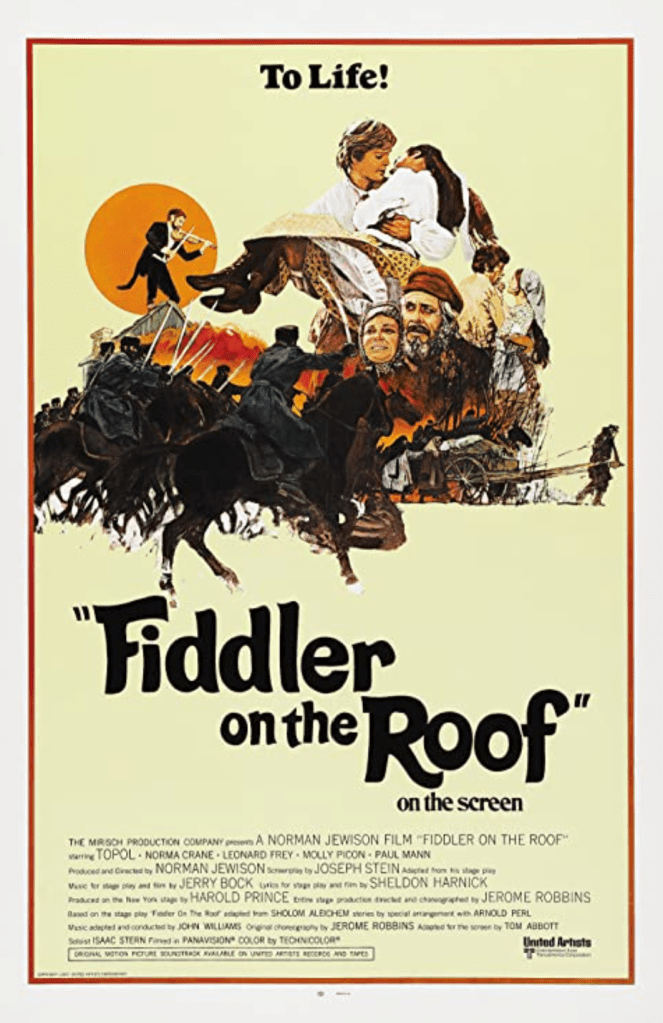
Fiddler on the Roof poster created by
The Mirisch Production Company and United Artists

Things I liked about the film:

The acting: Fiddler on the Roof is a film with an ensemble cast. Despite its large size, the film’s cast was, as a whole, solid! But within this ensemble, there were some performances that really stood out to me. The most notable one came from Topol! Throughout the movie, Topol presented a versatile portrayal of his character, Tevye. This versatility allowed Tevye to be seen as a realistic individual who is trying to make sense of the changes taking place in his world. At several points in the story, Tevye speaks with God and contemplates his faith. Tevye’s emotions matched whatever dilemma he faced. When one of his daughters comes to him with serious news, Tevye is angry and frustrated. As he receives the aforementioned news, Tevye questions how far he’s willing to go for his faith, talking through the situation while genuine emotion finds a place in his voice, facial expressions, and body language. Moments like the one I described show a sincerity that gave Tevye the opportunity to be Fiddler on the Roof’s “every man”!

Motel is a tailor from Tevye’s village. Portrayed by Leonard Frey, Motel wants to marry Tevye’s oldest daughter, but lacks the confidence to approach Tevye with this proposal. Through a consistent performance, the audience can watch Motel grow from a timid tailor to a man who genuinely believes in himself and his abilities. Having Tzeitel as Motel’s inspiration certainly helped his case. Tzeitel is Tevye’s oldest daughter, who is portrayed by Rosalind Harris. She worries about who she will end up marrying in the near future. Despite this, Rosalind gave a performance that was well-rounded and enjoyable to watch! When Motel tells Tevye about his marriage plans, the confidence he once lacked steadily grows within his voice. His facial expressions become stronger with each statement toward Tevye, finding the words Motel had suppressed for too long. Meanwhile, Tzeitel appropriately reacts to this discussion, expressions of worry and joy being displayed on her face. This scene shows how the acting abilities of both Leonard and Rosalind work well together!

The musical numbers: When thinking about music composed by John Williams, pieces of music that make any scene feel grand and larger-than-life come to mind. The music in Fiddler on the Roof certainly accomplished this, as John’s contributions to the film elaborate on a scene’s large scale! One of these songs is “Tradition”, which can be heard at the beginning of the movie. This song highlights how the traditions of the Jewish community of Anatevka affected every member, with each role and its significance explained through the song’s lyrics. Bold, orchestral melodies accompany these lyrics, as an excited greeting to the film’s incoming audience. Looking beyond the music, the musical numbers themselves were well-choreographed and fit within the context of the story! A musical number I really enjoyed seeing was “Tevye’s Dream”! In this scene, Tevye is recounting a dream he had regarding Tzeitel’s marriage prospects. Tevye and his wife, Golde, find themselves in a graveyard that boasts a gray hue. Headstones of decreased villagers surround the graveyard, with these decreased villagers appearing as the scene progresses. Though the musical number itself is very fantastical compared to the film’s other numbers, its uniqueness in presentation allows “Tevye’s Dream” to stand out and be memorable!

The incorporation of Jewish faith/culture: As I previously mentioned, Anatevka is a small village that hosts a Jewish community. Throughout Fiddler on the Roof, aspects of the Jewish faith/culture are incorporated not only into the film’s story, but into the songs and musical numbers as well. When talking about these musical numbers in the previous paragraph, I brought up the song, “Tradition”, and how it highlights some of the traditions among the villagers in Anatevka. At the beginning of the film, Tevye explains directly to the audience how he and other members of the community wear a special garment related to prayer. During a wedding ceremony, the bride and groom are lifted on chairs by wedding guests. This action is part of a dance called the Horah, which is typically performed at Jewish special occasions, such as weddings. The Horah was seamlessly woven into a larger musical number called “Wedding Celebration”, which also featured a group of bottle dancers. The incorporation of Jewish faith/culture gave the movie its own unique identity. It also provides an introduction to Jewish customs and traditions.

The John Williams Blogathon banner created by Rebecca, from Taking Up Room

What I didn’t like about the film:

No answers about The Fiddler: I have mentioned before how a film’s title can serve as a promise to its respective audience. The title can also let the audience know what to expect. This 1971 film is called Fiddler on the Roof. Yet the audience never learns more about the titular character, as he only appears in a handful of scenes. While watching this movie, I noticed how the Fiddler wore bright clothes compared to the villagers and even those from imperial Russia. Because of this, it caused me to speculate what role the Fiddler had within the overall story. Was he a spirit meant to guide Tevye through life or simply a peculiar individual? These are just two of the questions I’ll probably never get answers to.

An inconsistent conflict: When I learned this movie took place during imperial Russia, I expected the overarching conflict to revolve around the fall of the Romanov family. However, the overarching conflict was about how the government wanted the villagers to evacuate from Anatevka, for reasons the script never shared. This conflict complimented the film’s theme of change. But the story focused on this conflict in the film’s second half, with the conflict having a limited presence in its first half. I know this creative decision was meant to emphasize the tonal change within the story. I just wish it had a more consistent presence in the movie.

A limited inclusion of a broken fourth wall: At the beginning of Fiddler on the Roof, Tevye talks directly to the audience about his village, the people who live there, and the titular Fiddler. Because broken fourth walls are not common in musicals, I was looking forward to seeing the story told from Tevye’s perspective and watching the movie presented in a creative way. But for the rest of the film, Tevye didn’t break the fourth wall. I found this as such a missed opportunity, because, as I already said, broken fourth walls are not often found in musicals. While Fiddler on the Roof is a unique musical, Tevye consistently breaking the fourth wall could have added more uniqueness.

Hanukkah mehorah image created by Freepik at freepik.com. <a href=’https://www.freepik.com/free-photo/mehorah-with-flaming-candles_3299423.htm’>Designed by Freepik</a>. <a href=”https://www.freepik.com/free-photos-vectors/background”>Background image created by Freepik</a>. Image found at freepik.com.

My overall impression:

Fiddler on the Roof is a little over three hours. Therefore, you need to set aside time if you’re interested in watching this film. Despite the longer run-time, Fiddler on the Roof is a good movie! Almost every year, I come across that one musical that pleasantly stood out and captivated me. While it’s way too early to say whether this 1971 title will end up as one of the best movies I saw this year, it definitely captivated me, as I found it enjoyable! John Williams’ musical contributions provided some of the fabric of the story’s cinematic quilt, accompanied by well-choreographed and entertaining numbers. The ensemble cast binds these pieces of fabric with a strong thread, holding each scene together with solid acting performances. Incorporations of the Jewish faith/culture help the overall production gain a unique identity, asking questions and discussing topics that wouldn’t typically be found in a musical. Combining all these elements together, Fiddler on the Roof is a special project not just in the world of cinema, but also among musicals! With that, I’d say John Williams is a special composer. To those who don’t pay attention to the musical aspect of a given film, one might wonder how John is different from any other composer. But when you look at his body of cinematic work and the scores associated with those works, maybe that is more than enough to set him apart.

Overall score: 7.9 out of 10

Have you seen Fiddler on the Roof? Which John Williams composed film do you enjoy watching? Please tell me in the comment section!

Have fun at the movies!

Sally Silverscreen

Take 3: Hallmark Hall of Fame’s The Lost Child Review + 395 Follower Thank You

To all 395 followers, thank you for helping make 18 Cinema Lane the success it is today! With a new blog follower milestone comes a new blog follower dedication review! I recently read Black Star, Bright Dawn by Scott O’Dell. After reading that book, I realized how rarely I review films revolving around Native American stories. The last one I reviewed was Luna: Spirit of the Whale, with that review published two years ago. To make up for that, I decided to select Hallmark Hall of Fame’s The Lost Child to write about and discuss! It also has been several months since I reviewed a Hallmark Hall of Fame production, with my review of Saint Maybe published last September. Within Hallmark’s library of films, those containing Native American stories are far and few between. These handful of movies have ranged in quality, with Dear Prudence being the best one, in my opinion. So, where does The Lost Child rank? The only way to find out is to keep reading!

Since I had The Lost Child recorded on my DVR, I took a screenshot of the film’s poster with my phone. Screenshot taken by me, Sally Silverscreen

Things I liked about the film:

The acting: Mercedes Ruehl and Jamey Sheridan are no strangers to the world of Hallmark entertainment, as both actors have appeared in at least one Hallmark film besides The Lost Child. Back in 2013, Mercedes starred in Banner 4th of July, a film I haven’t seen. A movie I have seen is 2008’s Dear Prudence, which starred Jamey Sheridan. I don’t believe Mercedes and Jamey appeared in a movie together prior to The Lost Child. Despite this, they had really nice on-screen chemistry! Their characters, Rebecca and Jack, seemed like kindred spirits. The acting abilities of Jamey and Mercedes are part of the reason why this is the case! When Rebecca first meets Jack at a bar, the audience can tell how in sync these two characters are. Jack and Rebecca appear to enjoy each other’s company, with the body language and facial expressions of each actor showing how their characters feel. Mercedes and Jamey not only had good chemistry with each other, they had good chemistry with the other cast members as well! Even though they weren’t on screen together, the scene where Grace, portrayed by Irene Bedard, calls Rebecca is one of the strongest scenes in The Lost Child. Throughout their phone conversation, genuine emotions were shared between both women. The strength of Mercedes’ and Irene’s acting abilities elevated the scene itself, as their conversation revolves around a very emotional subject. A combination of facial expressions, tone of voice, and use of emotionality worked in the favor of each actress, as the scene felt believable!

The scenery: The Lost Child was filmed in Superior, Arizona, according to IMDB. This is because the majority of the story takes place on a Navajo reservation. At several moments in the movie, the film’s creative team took advantage of The Grand Canyon State’s beauty by incorporating the natural landscape within establishing shots or weaving them into the story. A woman named Aunt Mary gives Rebecca a tour of the reservation. During this tour, Aunt Mary takes Rebecca to the spot where Rebecca’s biological parents got married. It’s easy to see why they chose to get married in that spot, as a piece of canyon rock dominates the space. Set against a clear, blue sky, this rock contrasts beautifully with the sky’s hue, as well as the green of nearby cactus. Before Rebecca meets Aunt Mary, she watches the sun rise. The sky gives off hues of orange and yellow, which help the audience focus on this part of natural majesty. Scenes like the two I mentioned are examples of the creative team taking initiative to show how beautiful Arizona can be!

An introduction to Native American culture: As I previously stated, the majority of The Lost Child takes place on a Navajo reservation. Because of this, Rebecca and her family spend time interacting with other members of the Navajo community. Through these interactions, Rebecca’s family, as well as the audience, learn about some aspects of the Navajo culture. When she’s trying to learn how to weave, Aunt Mary tells Rebecca to make a break in her blanket design, in order to prevent losing her spirit in her work. This simple piece of advice teaches Rebecca and the viewers how blankets created by Navajo members carry a special meaning with each design. One evening, Rebecca’s biological family gather around a fire and dance around that fire together. When Rebecca arrives, she asks what her family is celebrating. Her cousin shares how there doesn’t need to be a celebration to have a good time. The Lost Child is not the “end all, be all” when it comes to Navajo culture. However, if one is interested in learning more, this movie provides a good starting point!

Illustrated image of Arizona desert created by pikisuperstar at freepik.com. Background vector created by pikisuperstar – www.freepik.com

What I didn’t like about the film:

A not so compelling conflict: In The Lost Child, Rebecca not only learns she is a Navajo woman, her biological family having been looking for her as well. However, this conflict is resolved within the first thirty minutes of the movie. To make up for the short resolution, the rest of the story focuses on Rebecca and her family acclimating to reservation life. Without spoiling the movie, I can see why Rebecca would make the choices she did. But I didn’t find this overarching conflict to be as compelling as Rebecca’s search for her family. Part of this has to do with how I’m not a fan of “slice of life” stories. The Lost Child is based on a book I haven’t read. Therefore, I’m not sure which parts are straight from the source material and which are creative liberties.

A missing twin brother: When Rebecca is around the age of thirteen, she accidently finds out she has a twin brother. Years later, she posts notices on the internet, in an attempt to find him. These posts are what lead Rebecca to Grace, one of her sisters. But when Rebecca meets her biological family, she abandons the search for her brother. Throughout the story, this twin is brought up in passing. His whereabouts or his name are never mentioned. Like I previously stated, this movie is based on a pre-existing book. Despite that fact, I was frustrated by this huge loose end.

Too many story ideas: I know there is only so much story you can tell in two hours, the run-time for The Lost Child. Therefore, you need enough story material to not only satisfy that run-time, but also hold the audience’s attention. In the case of this movie, there are too many ideas found within the story. Some of these ideas could have warranted its own film. One of them revolves around Rebecca’s daughter, Caroline, being bullied at her new school. Because of how many story ideas were in this film, some of those ideas get lost in the shuffle. A good example is Rebecca’s youngest daughter being diagnosed with a food sensitivity. Looking back on The Lost Child, it felt like the creative team tried to tackle so much in a short amount of time.

White horse image created by Gabor Palla at freeimages.com. “FreeImages.com/Gabor Palla.”

My overall impression:

The Lost Child is the forty-seventh Hallmark Hall of Fame movie I’ve seen in my life. At this point, I know what I like and expect to see in a film of this nature. Personally, I thought the 2000 production was just fine. But it didn’t leave a strong impression on me like other Hall of Fame titles have. I wish the story had focused more on Rebecca’s search for her family, as I found that more interesting than her reservation life. However, I recognize that the film is based on pre-existing material. As I said in the introduction, Hallmark movies revolving around Native American stories are far and few between. This can also be said for the coverage of these films on 18 Cinema Lane. When I do chance upon a movie containing Native American stories, I approach them in the hope they are good. For The Lost Child, it was about as enjoyable as Luna: Spirit of the Whale was, a movie I reviewed back in 2020. A good thing I can say about the Hallmark Hall of Fame project is how it does introduce the audience to the Navajo culture. Having beautiful scenery and containing strong acting performances also help its case. I happen to have other Hall of Fame titles on my DVR. The question is, which one will I review next?

Overall score: 7 out of 10

Do you watch Hallmark Hall of Fame movies? Are there any you’d like to see me review? Let me know in the comment section!

Have fun at the movies!

Sally Silverscreen
Waiting to Board: The Travel Gone Wrong Blogathon!

As I start this blogathon announcement, I’d like to thank Gill, from Realweegiemidget Reviews, and Rebecca, from Taking Up Room. If they hadn’t chosen Red Corner for me to review for their Odd Or Even Blogathon, I wouldn’t have found an inspiration for this year’s event! While looking back on the 1997 movie, I thought about all the movies or television show episodes where a trip doesn’t go according to plan. Realizing how many I could think of off the top of my head, my blogathon theme was born! Like past events, The Travel Gone Wrong Blogathon invites participants to get creative by reviewing, analyzing, or discussing a movie, tv show episode, piece of music, stage play, book, artwork, or any other entertainment media relating to this year’s theme! If you’re interested in taking a (figurative) trip from April 29th to May 2nd, keep reading as I share my blogathon’s official rules!

Pink travel backpack image created by Pikisuperstar at freepik.com. <a href=”https://www.freepik.com/free-photos-vectors/watercolor”>Watercolor vector created by Pikisuperstar – Freepik.com</a>. <a href=’https://www.freepik.com/free-vector/travel-lettering-with-watercolor-pink-backpack_2686676.htm’>Designed by Freepik</a>. Image found at freepik.com.

The Travel Gone Wrong Blogathon’s Official Rules

  1. Please be respectful toward other participants and the subject(s) you’re writing about.
  2. Please let me know in advance if you plan on publishing your post(s) earlier or later than the allotted time-frame (April 29th to May 2nd).
  3. Only new posts will be eligible for this year’s event.
  4. Because this year’s theme is so broad, I am not allowing duplicate entries.
  5. There is a three-entry limit for each participant.
  6. All entries must be original work.
  7. No travels are too big or small. Your entry can revolve around trips as extensive as week or month long excursions or as simple as a trip to the grocery store.
  8. Domestic (within the United States), international, or galactic travel is eligible for your entry/entries.
  9. Entries will be placed in one of two categories; hilariously wrong or horrifyingly wrong. Hilariously wrong means the results of a trip gone wrong are supposed to make you laugh. Some examples are the Walt Disney World episode of The Middle, A Very Merry Mix-Up, and Home Alone 1 and/or 2. Horrifyingly wrong means the results of a trip gone wrong are supposed to horrify you. Examples include Red Corner, the Touched by An Angel episode, ‘The Spirit of Liberty Moon’, and Taken.
  10. If you’re interested in participating, please share your idea(s) in the comment section below.
  11. Pick one of the four banners and let others know about The Travel Gone Wrong Blogathon, so they can join in on the fun!

Hilariously Wrong

Rebecca from Taking Up Room — Review of Andy Hardy Meets Debutante (1940)

Hamlette from Hamlette’s Soliloquy — Review of French Kiss (1995)

Gill from Realweegiemidget Reviews — Review of Our Ladies (2019)

J-Dub from Dubsism — Review of Planes, Trains, and Automobiles (1987)

Ruth from Silver Screenings — Review of Mr. Hobbs Takes a Vacation (1962)

Classic Movie Muse from The Classic Movie Muse — Review of The Great Race (1965)

Crystal from In The Good Old Days Of Classic Hollywood — Review of The Long, Long Trailer (1954)

Created by Sally Silverscreen at Adobe Creative Cloud Express

Horrifyingly Wrong

Evaschon98 from Classics and Craziness — Review of Flightplan (2005)

J-Dub from Dubsism — Review of Airport (1970)

Debbie from Moon In Gemini — Review of Train to Busan (2016)

Eric from Diary of A Movie Maniac — Review of The Lost Weekend (1945)

Created by Sally Silverscreen at Adobe Creative Cloud Express

Have fun at the blogathon!

Sally Silverscreen

Take 3: Harvey (1950) Review

This month’s Genre Grandeur is one I have been anticipating! That’s because of the film I selected for the event! January’s theme is ‘Comedies that feature characters who are either Stoners or Drunk’. After doing some research on the internet, I discovered the 1950 movie, Harvey, would be eligible! Harvey is a film I have been wanting to see for several years. Led by the beloved James “Jimmy” Stewart, so many good things have been said about this film. I was also interested in seeing Harvey because of its release date. Recently, I read an editorial by Jillian Atchley titled ‘It’s A Wonderful Life, James Stewart, and George Bailey’. In the article, Jillian explains there are two kinds of James Stewart films; pre-war and post-war. The post-war films, such as It’s A Wonderful Life, contain depth. I’d also add the post-war films feature higher stakes. Since Harvey was released four years after It’s A Wonderful Life, I was curious to see how deep this story would go. I also wanted to see how James would approach a character who is friends with an imaginary rabbit.

Harvey (1950) poster created by Universal Pictures

Things I liked about the film:

The acting: I have seen some of James Stewart’s movies prior to watching Harvey. What I’ve noticed about his roles in films like The Philadelphia Story, Mr. Smith Goes to Washington, It’s A Wonderful Life, and Rear Window is how there is a certain amount of charm included in his character’s personality. While portraying Elwood P. Dowd, James’ on-screen personality was different from what I’d seen before. In Harvey, Elwood is more laid-back. He also has a gentler persona, not having a care in the world. But there was one point in the movie where Elwood became somewhat philosophical. When asked by Dr. Lyman Sanderson and Miss Kelly how he first met Harvey, Elwood gives a thorough answer that is thoughtful and reminiscent. His answers to Lyman’s and Kelly’s questions not only captivate them, but the audience as well. This conversation shows there is more to Elwood when you look past the drinking and fascination with Harvey.

There were other performances in Harvey I enjoyed seeing. One of them came from Josephine Hull. Portraying Elwood’s sister, Veta, Josephine’s performance reminded me, to an extent, of Frances Bavier’s portrayal of Aunt Bee Taylor from The Andy Griffith Show. Let me explain myself; like Aunt Bee, Veta has her concerns and worries. You can hear the tension in her voice and see the fear in her eyes, illustrating how much Veta had on her plate. But, like Aunt Bee, Veta had her heart in the right place. All she wanted was for her brother to be a functioning and contributing member of society. Even if her actions weren’t always agreeable, Veta put her brother’s needs before her own. Because of her performance’s consistency, Josephine became an actress I looked forward to seeing on screen!

The set design: When I thought of Harvey, impressive set design was not what came to mind. So, when I first saw the set design in this movie, I was pleasantly surprised! A great location is the Dowd family home, which I wish was given more screen-time. While the house boasts a classic Victorian exterior, its interior was shown the most. In the house’s foyer, the stone staircase immediately caught my eye. Bearing a carved design, this staircase felt like it belonged in a castle! Another part of the home that features carved designs are the door frames. Marble fireplaces and stained-glass windows added exquisite details that highlighted the elegance and charm of the house! Another location I loved was Charlie’s! From some character’s descriptions, the bar sounded like a cheap or sleazy place. But when its interior was shown, it actually looked kind of cozy! The wood paneled walls were covered in framed photos. As a viewer, this gave me the impression the establishment is proud of their history. The booth Elwood sits at also gives off a cozy feel! The dark wood, tall backed seats surround a smaller, dark wood table. Above this seating arrangement was a small Tiffany style ceiling light.

Collection of white rabbit images created by freepik at freepik.com Hand drawn vector created by freepik – www.freepik.com

What I didn’t like about the film:

Lack of comedy: According to IMDB, Harvey is partially classified as a comedy. As I’ve said before, comedy is a subjective genre. But personally, I didn’t find this movie very funny. In fact, I only chuckled once during this hour and forty-four-minute film. I could see the jokes the screenwriters were trying to deliver. Unfortunately, none of these jokes stuck the landing. On IMDB, Harvey is also partially classified as a drama. While watching this movie, it felt like the creative team involved leaned too much into the drama genre. There’s typically nothing wrong with having comedic and dramatic elements in a singular story. In the case of Harvey, the balance between these two elements was not there.

Medical negligence: In real life or fiction, members of the medical profession are human. They are not only capable of helping others, but also capable of making mistakes. However, there is a very fine line between making mistakes and committing medical negligence. In an effort to help Elwood, Veta takes him to a mental hospital called Chumley’s Rest. But due to a registration mix-up, Veta gets admitted into the hospital instead. The idea of mistaken identity and being forced to do something against your will sounds terrifying. Paired with the fact this situation is supposed to be played for laughs makes it worse. Because of this and because of how avoidable the situation was, it didn’t sit well with me.

No explanations for Harvey: As the title suggests, a portion of this story revolves around Elwood’s friendship with Harvey, a 6 foot 3 ½ inch, invisible white rabbit. Throughout the movie, I was waiting for an explanation of what Harvey was. I even waited to see if Harvey would show up on screen. Sadly, none of these things happened. Even though suggestions about Harvey’s purpose were given, no definitive answers were presented. Was Harvey truly an imaginary friend? Was he a mythical creature only Elwood could see? Was Harvey used as a tactic by Elwood to test people’s trust? As I continue to write this review, I still don’t know what Harvey is.

Decisions being flip-flopped: There’s nothing wrong with showing a character changing their mind about something. After all, that prevents them from being static. If a character is going to change their mind on something, you need to show the process of that viewpoint being changed. In the case of Harvey, that process was, sometimes, omitted. When visiting the Dowd family home in search of Elwood, Marvin Wilson, an employee from Chumley’s Rest, takes a romantic fancy to Myrtle Mae, Elwood’s niece. During Marvin’s visit, Myrtle expresses no interest in his romantic advances. But when they meet up again, later in the film, Myrtle suddenly wants to pursue a relationship with Marvin. Her change of opinion feels abrupt, with no lead-up to that decision. The omission of decision transitions sometimes left me frustrated.

Heartbeat image created by Freepik at freepik.com. <a href=’https://www.freepik.com/free-vector/medical-logo_763775.htm’>Designed by Freepik</a>. <a href=”https://www.freepik.com/free-photos-vectors/logo”>Logo vector created by Freepik</a>. Image found at freepik.com.

My overall impression:

“What is the point of this movie”? I’m not asking this to be disrespectful or mean-spirited. I’m asking this because I’m genuinely curious to figure out what that point is. Sometimes, a film’s purpose or intended message is either obvious or easier to figure out. But with Harvey, I don’t know what the creative team was trying to say. Was this movie meant to be a cinematic PSA about how those with mental health related issues should be treated with dignity and respect? Is the film supposed to be an exploration of how some adults lose their sense of imagination the older they become? How am I expected to care about the filmmakers’ message when I don’t have a clear idea what it is? Besides being confusing, Harvey was, for me, disappointing. Because of James Stewart’s involvement in this project and because of the inclusion of a 6 foot 3 ½ inch, invisible white rabbit, I thought the movie was going to be whimsical and charming, with a sense of ‘magical realism’. Unfortunately, the 1950 film was none of those things. The lack of comedy and medical negligence did not help either. In all my years of watching movies, I never thought I’d see a James Stewart film I didn’t like. But, as of January 23rd, 2022, here I am.

Overall score: 5 out of 10

Have you seen Harvey? Which film from James Stewart’s filmography would you recommend I review next? Let me know in the comment section!

Have fun at the movies!

Sally Silverscreen

If you’re interested in reading Jillian’s editorial, here is the link:

Take 3: Red Corner Review

The theme of Gill’s, from Realweegiemidget Reviews, and Rebecca’s, from Taking Up Room, blogathon is one of the most creative! In The Odd Or Even Blogathon, a participant had to pick two movies; one released in a year ending in an odd number and one released in a year ending in an even number. The moderators then chose a movie for the participant out of those two options. One of my two options was the 1997 movie, Red Corner, which is the film I’m reviewing for the event. This isn’t the first time I’ve mentioned Red Corner. Last October, I reviewed the Touched by An Angel episode, ‘The Spirit of Liberty Moon’, in honor of Bai Ling’s birthday. While talking about that episode’s story, I mentioned how the episode was very reminiscent of the film due to topics discussed within the script. After watching ‘The Spirit of Liberty Moon’, I wondered how similar it was to Red Corner. Similar to the Touched by An Angel episode, curiosity got the best of me, which led to this review.

Red Corner poster created by Metro-Goldwyn-Mayer and Avnet/Kerner Productions

Things I liked about the film:

The acting: The cast of Red Corner was strong! But because the majority of the story revolves around Bai Ling’s and Richard Gere’s characters, I’ll focus on their performances in this review. The profession of a lawyer is typically presented in entertainment media as being serious. Therefore, when an actor or actress is cast as a lawyer, there aren’t many opportunities for them to be expressive in that role. Despite this, Bai found a way to bring expressive emotion to her portrayal of Shen Yuelin! Even when this emotion was displayed in a simple fashion, such as Shen looking at another character in a certain way, it was more than enough to prevent this character from becoming dull or forgettable. In my review of the Touched by An Angel episode, ‘The Spirit of Liberty Moon’, I talked about Bai’s strong sense of emotionality. While talking about this strength, I said it allowed Bai’s performance to contain depth. Once again, she uses her sense of emotionality to her advantage in Red Corner! But this time, Bai uses it to bring humanity to her character, allowing the audience to see Shen as more than just a lawyer. One example shows Shen and Jack visiting the nightclub where Jack first met the murder victim. During this scene, Jack recalls some of the events that led up to the crime. When he brings up something funny said by the murder victim, Shen giggles at the English translation of the murder victim’s comment.

Prior to watching and reviewing Red Corner, I had seen two of Richard Gere’s films; Pretty Woman and Hachi: A Dog’s Tale. What makes Richard’s role in Red Corner different from those in the two aforementioned films is how his character, Jack Moore, faced higher stakes. This gave me, as a viewer, an opportunity to see Richard work with different material. In Red Corner, he was very expressive in the lead role. Richard used a variety of emotions to show how a person in Jack’s situation might feel. While trying to obtain phone records, Shen explains to Jack how these records are unavailable. This causes Jack to feel frustrated. As his conversation with Shen continues, Jack becomes more agitated over the powerlessness of their situation. Tension grows between both characters because of the agitation.

The mystery: A large portion of Red Corner focuses on finding the truth behind a murder. This mystery is drawn out throughout the story, letting the audience see it unfold as the film goes on. While reflecting on this movie, I came to an interesting realization. When it comes to seeing “amateur” detectives in entertainment media, lawyers solving mysteries are not as common. Sure, there are series like Matlock, Perry Mason, and Darrow & Darrow. But these are the only lawyer led mystery stories I can think of off the top of my head. Having Shen play an integral role in Red Corner’s mystery was a good creative choice! This is one of the reasons why I enjoyed seeing the film’s mystery play out! The way Shen gathered clues and made discoveries was interesting to watch. Her professional interactions with Jack added to my enjoyment of the mystery. I was intrigued from start to finish, curious to see what happens!

The mise-en-scène: Good mise-en-scène seamlessly blends into a movie and effortlessly weaves within the story. Great mise-en-scène elevates a given scene to help it stand out for all the right reasons! When it comes to this part of Red Corner, I will talk about two scenes. The first one takes place at a fashion show, where Jack and a Chinese businessman named Dan attend. During the show, Jack and Dan are having a conversation, which is captured in a medium shot. When Dan is speaking to Jack, he is covered in a red light. Jack is also covered in this red light, but a faint blue light is shining on his head as well. Without spoiling the movie, I will say this was a good visual to foreshadow what is about to come. The second scene takes place at the prison. Jack and a group of soldiers are walking up a concrete staircase. This short journey is shown in a long to medium shot. The scene uses a limited amount of lighting, which sets a tense and suspenseful tone. Similar to the first scene I described, all of the elements in the second scene come together to indicate what is about to happen.

The Odd Or Even Blogathon banner created by Gill, from Realweegiemidget Reviews, and Rebecca, from Taking Up Room

What I didn’t like about the film:

Some held-back punches: As I said in my introduction, I saw the Touched by An Angel episode, ‘The Spirit of Liberty Moon’ If you read my review for that episode, you’d know I described it as being “emotionally intense” due to the nature of the story and the subject matter involved. Because Red Corner shares similar topics with the Touched by An Angel episode, I was expecting the film to be more emotionally intense, especially since it has an R rating. The brutality of the Chinese jail system and the strictness of the Chinese government are shown in this movie. However, the brutality I expected to frequently see was shown in glimpses. Meanwhile, the strictness was either confined to Jack’s court case or mentioned in passing. I understand there’s only so much you can include in an R rated film. But it seems like more emphasis was placed on figuring out “whodunit”.

Some characters talking over each other: Because Chinese is spoken by several characters, English translations are provided either through on-screen text or an official translator within the court and jail system. More often than not, I was able to understand what these characters were saying. But there were times when I had difficulty doing so. This is because some characters talked over one another. One good example is when Jack is first taken to jail. At the prison, a general is explaining to Jack, in Chinese, why he was arrested. An attending soldier provides necessary English translations to Jack and the audience. However, the soldier spoke at the same time as the general. I had to rewind the movie in order to catch what the soldier had said.

Some things left unexplained: Like I said earlier in my review, I liked seeing how the mystery in Red Corner played out! For the most part, I was able to follow along with the events happening on screen. But there were a few times where I wish explanations were given. During the murder investigation, Shen acquires a crucial piece of evidence that could impact Jack’s trial. But along the way, this piece goes missing. When Jack’s final trial arrives, Shen presents the aforementioned piece of evidence. This left me confused as to how she re-obtained it. While this is heavily implied, it isn’t thoroughly explained. As a viewer, I appreciate how the mystery’s information wasn’t spoon-fed. However, I think some of the connections within the mystery could have been stronger.

Courtroom image created by Macrovector at freepik.com. <a href=”https://www.freepik.com/free-photos-vectors/isometric”>Isometric vector created by macrovector – http://www.freepik.com</a>. Image found at freepik.com.

My overall impression:

Before watching Red Corner, I had come across a few reviews about the film. In those reviews, the general consensus was how the movie was predictable. While I respectfully disagree with this statement, I will say Red Corner left me wanting a little bit more. I was expecting the 1997 film to be ‘The Spirit of Liberty Moon’ times ten. As I said in this review, I thought Red Corner was going to be more brutal and emotionally intense. There was emotion to be found in this movie, with some brutality along the way. But I didn’t have the same reaction after watching this film like I did with the Touched by An Angel episode. Maybe I shouldn’t have set my expectations on the higher side. Just because two projects happen to share similar subjects and ideas doesn’t mean they will be executed in similar fashions. What I can say about Red Corner is it is an interesting and insightful picture that has something important to say. It is also somewhat educational, especially when it comes to international relations and law. If you are interested in seeing this movie, I’d recommend watching it as a companion piece to The Spirit of Liberty Moon. But if I were you, I would watch Red Corner first.

Overall score: 7.1 out of 10

Have you seen Red Corner? If so, what are your thoughts on the film? Please let me know in the comment section!

Have fun at the movies!

Sally Silverscreen

Buzzwordathon 2022: Review of ‘How to Write Good’ by Ryan Higa

Earlier this month, I announced I was participating in this year’s Buzzwordathon. In that announcement, I said I would write reviews for the books I read during this readathon, as a way to stay motivated throughout the year. Because I just finished reading my pick for January, it’s time for the first review of Buzzwordathon! This month’s theme is ‘Who, What, When, Where, Why, or How’, meaning my choice had to have one of these words in the title. With that said, I chose How to Write Good by Ryan Higa!

Here is a screenshot of my copy of How to Write Good. Screenshot taken by me, Sally Silverscreen.

In this book, the Youtuber explains how to write a book by using parts of his life to elaborate these steps. As an avid reader and someone who has an interest in writing, I already knew what these steps were. However, it was interesting to read them from the perspective of a non-professional writer. The parts of his life that Ryan shares are those that were brought up in his ‘Draw My Life’ video from this Youtube channel. In How to Write Good, these parts are explained in further detail, which allows the reader to gain insight into Ryan’s thought process and sense of humor. Speaking of humor, the comedy that Ryan became well-known for on the internet does appear in this book. One area where his humor is present is the consistent comic strips. How to Write Good features comic strips of Ryan and his ghostwriter, Sarah, who appears in these strips as a literal ghost. This play on the word ‘ghostwriter’ shows the cleverness that can be found in Ryan’s Youtube videos!

Here is a screenshot of one of How to Write Good‘s comic strips, to illustrate the point I make in the next paragraph. Screenshot taken by me, Sally Silverscreen.

As I already said, How to Write Good contains comic strips revolving around Ryan and Sarah. Even though these illustrations are good, I wish they were more colorful. The comic strips in this book are coated in a predominantly blue hue, with pops of red every now and then. Because a Youtuber co-wrote How to Write Good, I was expecting the book to be filled with mixed-media. Along with the text, I imagined Ryan’s words paired with photos, illustrations, and links to his videos. Unfortunately, there were only two photos within the 224 pages. The only video that is referenced in this book is the aforementioned ‘Draw My Life’ video. Despite these flaws, I did enjoy reading How to Write Good! It was informative and insightful, while being entertaining along the way. If you’re a fan of Ryan’s comedy or want to learn about writing from a different perspective, then this is the book for you!

Overall score: 4 out of 5 stars

Have fun during Buzzwordathon!

Sally Silverscreen

Disclaimer: How to Write Good contains a few slurs and the topic of suicidal thoughts. However, these subjects are brought up in relation to the bullying Ryan experienced in his childhood and middle school years.

I Will Always Love You: ‘The Bodyguard’ at 30

When I think of the word “umpteenth” paired in the same sentence as film, I think of a movie that you love so much, you don’t mind watching it over and over again. A movie that deserves your undivided attention whenever it appears on television. A title that never fails to make you smile every time you hear it. For me, that film is none other than 1992’s The Bodyguard! If you were to ask me what my top ten favorite movies of all time are, The Bodyguard would be placed somewhere on that list. When I received my first Sunshine Blogger Award, I talked about how I loved this film’s soundtrack. So, for a blogathon that revolves around movies viewed for the “umpteenth” time, I found the perfect opportunity to write about The Bodyguard. But because it is turning thirty this year, simply reviewing this movie wasn’t going to do. Therefore, I decided to write an editorial explaining why I love the film so much! Without further ado, let me tell you why The Bodyguard still holds up thirty years later!

The Bodyguard poster created by Tig Productions, Kasdan Pictures, and Warner Bros. Pictures

The Acting

We can’t talk about The Bodyguard without also talking about Whitney Houston. From what I’ve heard over the years, Whitney had little to no acting experience prior to working on the 1992 film. But her portrayal of Rachel Marron does not reflect what she didn’t have. Instead, Whitney did a fantastic job presenting Rachel as a complex character! Miss Marron is a singer and actress who is constantly presenting herself as a lovable starlet who can do no wrong. Behind the scenes, she is a mother and sister who craves control over her life and career. Whitney’s emotions and expressions weave through the story and adapt to each situation. A great example is the scene before Rachel’s concert. While backstage at the Mayan Club, Rachel receives a disturbing note. When she addresses this to Frank and her friends, Bill and Sy, Rachel discovers the delivery of these notes has occurred more than once. In this scene, she goes from being excited about her concert to expressing genuine concern and fear over the note to being upset by not knowing the severity of the situation sooner. Whitney delivers each line and expression in a realistic way, highlighting how multi-layered Rachel is as an individual!

Recording studio image created by Senivpetro at freepik.com. Music photo created by senivpetro – www.freepik.com

I’ve always thought Kevin Costner should have portrayed James Bond at least once in his career. Now I know it’s an unspoken rule that James Bond has to be portrayed by someone from England/Europe. But before you write off my opinion as being silly, just hear me out. In The Bodyguard, Kevin is cast as Frank Farmer, a former Secret Service agent. While watching this film for the “umpteenth” time, I can point out some similarities Frank shares with the legendary 007. For starters, Frank has a signature drink, which is orange juice. He also has the look, with Frank sporting a suit and bow-tie at the Academy Awards. Frank possesses the poise, skill, and experience to successfully do his job. He can even turn on the charm when he wants to, as Rachel successfully tears down his defense mechanism of keeping his distance from others. But the most important part of my argument is that Kevin has the talent! What works in Kevin’s favor is his ability to consistently carry a collected and serious composure. While this is expected for a character like Frank, Kevin is given moments where genuine emotions are expressed. When Frank and Rachel go on a date to a restaurant, they talk about a woman from Frank’s past. As Rachel makes a joking remark about how she thinks the relationship ended, Frank remains silent, giving Rachel the impression the subject is no laughing matter. A few seconds later, Frank begins chuckling, revealing how he pulled a trick on Rachel. This scene shows that even though Frank is strong and can hold his own is his profession, he is still a man of feelings and fears.

Ski lodge during winter-time image created by Freepik at freepik.com. <a href=’https://www.freepik.com/free-vector/ski-station-background_3423830.htm’>Designed by Freepik</a>. <a href=”https://www.freepik.com/free-photos-vectors/background”>Background vector created by Freepik</a>. Image found at freepik.com.

Whitney and Kevin give great acting performances individually. However, it’s their on-screen chemistry that helps make their interactions memorable! From the moment Rachel and Frank first meet, you can feel the sparklers sizzling. Their banter bounces off each other like an exciting game of ping-pong. At first glance, you wouldn’t think Rachel and Frank would get along. This is because their personalities are the opposite of one another. But when they share private, intimate moments, Rachel and Frank are kindred spirits, understanding each other in a way that can’t be easily explained. The strong on-chemistry is not limited to the interactions between Whitney and Kevin. The interactions they share with the other actors in the film feel believable as well. One good example are the times when Frank interacts with Rachel’s son, Fletcher, portrayed by DeVaughn Nixon. Because of Fletcher’s desire to learn more about his mother’s bodyguard, the audience receives wisdom from Frank, along with clarity about why he is who he is. Fletcher’s curiosity of Frank is innocent and full of wonder, which presents the perfect counterpart to the dangerous and harsh reality of Frank’s career. These conversations between sweet and adorable Fletcher and tough and no-nonsense Frank kind of remind me of the conversations of Sarah and Eric from The Crow. The moments with Frank and Fletcher also allow the audience to take a break from the action and suspense The Bodyguard contains.

Sailing on the sea image created by Michele L at freeimages.com. “FreeImages.com/Michele L.”

The Soundtrack

While we’re talking about Whitney Houston, let’s discuss the soundtrack. In my first Sunshine Blogger Award post, I said Whitney’s songs are such a timeless addition to any playlist. In the case of The Bodyguard soundtrack, these songs perfectly showcase the vocal range Whitney is known for! Delivering half of the soundtrack’s songs, Whitney flawlessly masters three different genres. The tracks ‘Run to You’, ‘I Have Nothing’, and the classic ‘I Will Always Love You’ are presented as emotional ballads that amplify the scenes they’re featured in. Meanwhile, ‘I’m Every Woman’ and ‘Queen of the Night’ are sassy and energetic pop tunes that are somewhat reminiscent of the “get up and dance” feel of ‘I Wanna Dance With Somebody’. ‘Jesus Loves Me’ gives Whitney an opportunity to contribute to the world of gospel music by presenting a heartfelt, powerful melody. These six songs not only compliment Whitney’s singing abilities, but they also add to the album’s musical diversity.

The Bodyguard soundtrack boasts a total of twelve songs. Each track is a good representation of its respective genre. As I already mentioned, ‘I’m Every Woman’ and ‘Queen of the Night’ are sassy and energetic pop tunes. However, those are not the only pop songs featured on the album. Lisa Stansfield’s ‘Someday (I’m Coming Back)’ is a pop song that revolves around a finished relationship. Pop influences can also be heard in the rock song ‘What’s So Funny ‘Bout Peace, Love and Understanding’, sung by Curtis Stigers. ‘It’s Gonna Be a Lovely Day’, performed by S.O.U.L. S.Y.S.T.E.M., is a laid-back hip-hop track that is as straight forward as its title suggests. Another laid-back tune is ‘Even If My Heart Would Break’, an R&B song that features the vocals of Aaron Neville and the saxophone sounds of Kenny G. Alan Silvestri delivers on a theatrical score that carries a somber and serious tune. Finishing the soundtrack is Joe Cocker’s ‘Trust In Me’, which adds some country flavor to this strong album.

Since I own a copy of The Bodyguard soundtrack, I thought it would make sense to post a picture of it in this editorial. Screenshot taken by me, Sally Silverscreen.

The Kitchen Scene

In almost any action movie, there is that one scene audience members talk about long after the movie ends. It usually involves a lot of action, showing characters in an exciting battle of good versus evil. But there is a scene in The Bodyguard that, I feel, is the best scene from any action film. In what I call “the kitchen scene”, Tony, one of Rachel’s bodyguards, is upset over a miscommunication caused by Frank. In a fit of rage, Tony decides to take his frustrations out on Kevin Costner’s character. But he quickly realizes he made a big mistake. Throughout this scene, Kevin’s fight choreography is fast and filled with adrenaline. But he executes the clean choreography with precision and focus while maintaining a cool, collected composure.  Even though the kitchen is a smaller space, different parts of the kitchen are utilized. From Frank pinning Tony to the floor with a chair to Tony being thrown across the kitchen counter, the actors see the limited space given as a challenge instead of a hindrance. The best part of this scene is how there is no music or dialogue. This forces the audience to give their undivided attention to what is happening on-screen. While “the kitchen scene” is shorter in time length, it’s delivery is affective!

Vintage style kitchen image created by karlyukav at freepik.com Light photo created by karlyukav – www.freepik.com

Blending Several Genres

The Bodyguard consists of four genres: action, mystery, drama, and romance. On paper, it seems like there would be an overwhelming amount of content in this one story. In reality, however, these genres end up complimenting and working with each other instead of competing or clashing with one another. The 1992 film revolves around Rachel’s dilemma, which involves her life being threatened by an unknown perpetrator. While this mystery takes place throughout the movie, the audience is given enough clues, suspects, and possible motives to keep them invested in the mystery solving process. Action is sprinkled into the story to raise the stakes and keep viewers on the edge of their seat. As I mentioned earlier, the moments with Frank and Fletcher allow the audience to take a break from the action and suspense The Bodyguard contains. The drama among the Marron family and the romantic moments between Rachel and Frank are also placed in the story to give the audience time to breathe after scenes focusing on the mystery and action. In these moments, the audience learns more about the characters, as well as their motivations for making certain choices. The cycle of these four genres moves like an ocean’s wave, in ebbs and flows.

Magnifying glass image created by Freepik at freepik.com. <a href=’https://www.freepik.com/free-vector/magnifying-glass-with-fingerprint-in-flat-style_2034684.htm’>Designed by Freepik</a>. <a href=”https://www.freepik.com/free-photos-vectors/flat”>Flat vector created by Freepik</a>. Image found at freepik.com.

Its Timeless Story

In the world of cinema, there are two types of film: those that are products of their time and those that stand the test of time. I can only speak for myself, but I feel The Bodyguard belongs in the latter category! Like I said in my previous point, this film consists of four genres. Instead of these genres coming together to create a convoluted narrative, the story ends up not being difficult to understand and follow. Even if you have seen The Bodyguard before, like I have, the script provides an intriguing plot, hilarious one-liners, and dialogue that is well-written, with these aspects of the film making your two hours of viewing worthwhile. Speaking of the plot, it is not defined by the time of its release. The assassination attempt against Ronald Reagan is mentioned on a few occasions. However, this is done to provide context to Frank’s part of the story. The romance between Rachel and Frank is based on the classic trope of opposites attracting. But the quality of the acting performances and on-screen chemistry make this concept work. While the film does contain heavier moments, they’re not too unbearable. This allows the movie to have a higher re-watchability rate.

The Umpteenth Blogathon banner created by CineMaven from Essays from the Couch.

While on a dinner and movie date, Rachel asks Frank how many times he has seen Yojimbo, a Japanese film from the early ‘60s. Frank responds by saying he has seen it a total of 62 times. While I’m not sure how many times I’ve seen The Bodyguard in my life, I found this quote to be such a coincidence, as I’m writing about the film for the Umpteenth Blogathon! Whether you choose to watch this movie for the first time or plan on re-visiting it, The Bodyguard is a movie that, in my opinion, still holds up. It is not only an exciting action flick paired with an intriguing mystery, but there are moments in this story that can make you think. While talking with Fletcher, Frank tells him that when someone is afraid, that means they care about something. Frank’s quote not only provides an interesting perspective on fear itself, but it also highlights the intent of my editorial. Why do we celebrate the birthday of a loved one? Why do we commemorate a holiday or important historical event? Why did I write about a film that was released thirty years ago? It’s because we care about those people, events, or films. Watching a movie for the “umpteenth” time is like spending time with a good friend. You may know every line by heart and how the story plays out, but the time well spent will always be cherished.

Have fun at the movies!

Sally Silverscreen

If you’d like to check out the other entries in the Umpteenth Blogathon, you can visit this link:

FOR THE UMPTEENTH TIME BLOGATHON

Word on the Street: ‘To Catch A Thief’ Remake and Film about Beanie Babies on the way

When I write a Word on the Street story, I sometimes talk about stories that were covered on the Youtube channel, Clownfish TV. I not only like Kneon and Geeky Sparkle’s commentary, but I also learn about subjects I never would have known about before. So, when I watched one of their newer videos, I figured it would be an interesting topic to discuss on 18 Cinema Lane! In the video, ‘Elizabeth Banks Doing a BEANIE BABIES Movie?!’, my initial assumption was the movie being similar in execution to the 2014 hit, The Lego Movie. But as I watched the video, I learned the film would revolve around the popularity of Beanie Babies in the ‘90s. While analyzing an article from The Hollywood Reporter, Kneon and Geeky share how actors Elizabeth Banks and Zach Galifianakis are going to headline a film based on The Great Beanie Baby Bubble: Mass Delusion and the Dark Side of Cute, a book written by Zac Bissonnette.  According to the original article, the movie will focus on the production and consumption of the classic stuffed animals, including “a celebration of the women who helped power Ty Warner’s success”.

Tiger stuffed animal image created by alesia17 at freeimages.com. “FreeImages.com/alesia17.”

While watching Kneon and Geeky’s video, ‘Elizabeth Banks Doing a BEANIE BABIES Movie?!’, they brought up a documentary titled Beanie Mania. In this documentary, the rise and fall of Beanie Babies are explored. From “a lot of drama” to “the one woman even has a rap song she wrote” (referring to a rap song dedicated to the Beanie Babies), Beanie Mania presents the perspectives of those heavily affected by the iconic toy. As I watched Kneon and Geeky’s video and listened to their commentary, I couldn’t help but feel Elizabeth and Zach’s project was a re-hash of the HBO Max documentary. When speculating which direction the film was headed, Geeky says “I think their take on it’s going to be very similar, cause I think the one guy that wrote the book they’re basing it on was in the documentary”. With this and everything else said, it makes me wonder what is the point of Elizabeth and Zach’s movie? What can they offer to the conversation that Beanie Mania didn’t? Personally, I’d like to see a documentary about Tickle Me Elmo, the coveted toy that dominated 1996.

Preschool classroom image created by Vectorpocket at freepik.com. <a href=”https://www.freepik.com/free-photos-vectors/background”>Background vector created by vectorpocket – http://www.freepik.com</a>. Image found at freepik.com.

Speaking of re-hashed ideas, this next story I found in Kneon and Geeky’s video, as it was an advertised article on Deadline’s website. According to the aforementioned site, Justin Kroll writes about a “remake of the classic thriller To Catch a Thief” in the pre-production stages. The Paramount Pictures project has recruited Gal Gadot to star in the film and produce it. Eileen Jones will pen the script, with Jaron Varsano and Neal Moritz also producing the movie. Similar to what I said about the Beanie Baby film, I wonder what the point of this remake is? I know you can ask that about any cinematic production. But what can this creative team bring to the table that Alfred Hitchcock and his team hasn’t already? Personally, I think the remake seems unnecessary.

Image of vintage movie camera created by Macrovector at freepik.com. <a href=”https://www.freepik.com/free-photos-vectors/background”>Background vector created by macrovector – http://www.freepik.com</a>. Image found at freepik.com.

What are your thoughts on these movie news stories? Are you anticipating any of the projects mentioned in this article? Let me know in the comment section!

Have fun at the movies!

Sally Silverscreen
Sources to articles referenced in this article:

https://www.hollywoodreporter.com/movies/movie-news/zach-galifianakis-elizabeth-banks-starring-in-apple-film-the-beanie-bubble-1235073361/

deadline.com/2022/01/eileen-jones-paramounts-to-catch-a-thief-reboot-gal-gadot-1234908113/