Take 3: The Karate Kid (1984) Review (Olympic Dreams Double Feature Part 1)

For my first two blogathons, I wrote editorials as my contribution for the event. These articles were ‘Phantom of the Megaplex’ at 20: A Reflection on the Movie-Going Experience and Roger Ebert’s Movie Yearbooks: How Relevant are They Anyway? This time around, I wanted to do something different. Therefore, I chose to write a double feature review! Because this year’s blogathon is Olympic themed, I selected The Karate Kid and The Karate Kid Part II. In 1984, the Summer Olympics were held in Los Angeles. The Karate Kid not only takes place in California, but it was also released in 1984. Years ago, I had seen about half of this movie. As I said in my review for It’s a Mad, Mad, Mad, Mad, World, I am willing to give films a second chance if I haven’t finished them or haven’t watched them in several years. It’s been a long while since I have seen The Karate Kid, so I thought my blogathon would provide a good excuse to revisit it.
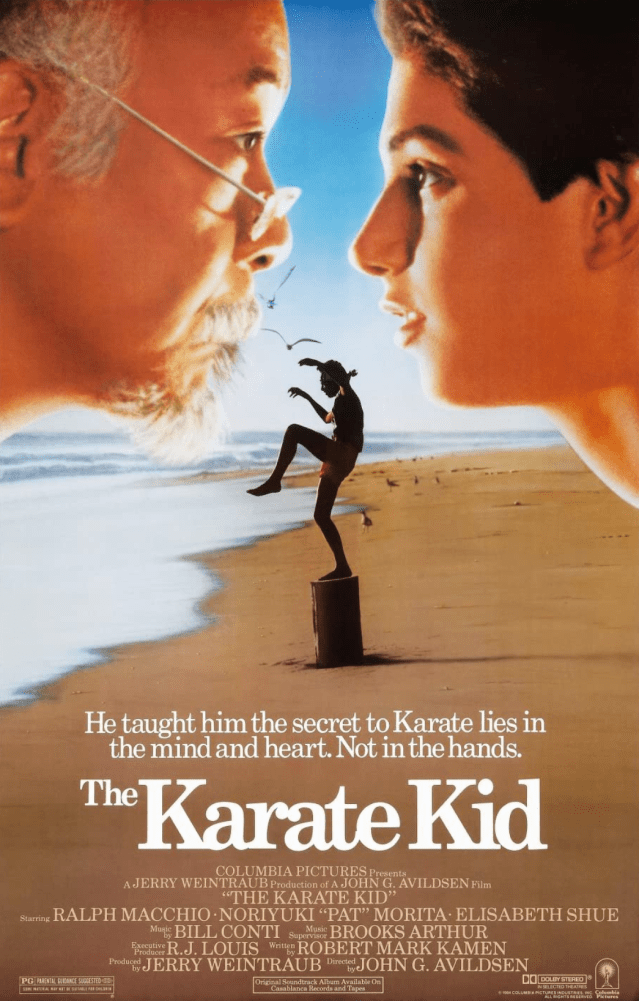
The Karate Kid (1984) poster created by Delphi II Productions, Jerry Weintraub Productions, and Columbia Pictures

Things I liked about the film:

The interactions among the characters: In stories that heavily rely on the relationships between various characters, how well-acted those characters are and the quality of their interactions will make or break that story. With The Karate Kid, these interactions served as one of the strongest parts of the film! That is because all of them felt natural and believable. When Daniel and Ali go to Golf N’ Stuff for the first time, you can see these characters are genuinely having a good time. They acted the way you’d expect a typical teenager would; smiling while racing each other at the go-kart track, laughing as their bumper boat crashed into another boat, and critiquing their pictures from the photobooth. Because of Ralph Macchio and Elisabeth Shue’s performance, as well as the script, their relationship came across as realistic. When it comes to Daniel’s relationship with Mr. Miyagi, we are given the opportunity to witness healthy mentor/student interactions. If one were given instructions, but not the reason behind those instructions, it can be easy to get frustrated. This happens after Daniel receives a series of instructions from Mr. Miyagi. But when Daniel discovers the reason why he has been following these instructions, you start to see him gain an understanding and appreciation for what Mr. Miyagi has taught him. Similar to what I said before about Daniel and Ali’s relationship, this period of learning and discovery contains a lot of realism. It shows that, with the right support and guidance, we can learn things such as how to think for ourselves.

The cinematography: The Karate Kid is a movie that has better cinematography than most of the film fan community gives it credit for. To prove my point, I will bring up one of the film’s earliest scenes as an example. At the beginning of the movie, Daniel and his mom are driving through Arizona. This particular scene starts with a medium shot, placing primary emphasis on Daniel’s mom’s car. As their journey down this road plays out, the camera pulls away from the car and delivers a long shot of a section of the Grand Canyon. Characters’ interactions are also captured well on film! At a Halloween party, Daniel is dressed up as a shower. When Ali wants to talk to Daniel, she goes behind the costume’s curtain. Their conversation is shown in a close-up shot, which allows the audience to feel like they are that small space with Ali and Daniel. I really liked how the karate tournament was filmed! It involved a combination of medium and close-up shots, allowing the audience to witness the action. The camera was also steady, which made the scenes appear clear.

The music: Music is an important component of any movie. A song or instrumental piece can elevate the mood within a scene or highlight a scene’s intended point. The scene where Daniel attends his first day of school serves as a great example. In the background, “Cruel Summer” by Bananarama can be heard. Having this song play during this scene makes sense for several reasons. Daniel’s story starts in September, which is technically summer until September 21st or as late as September 24th. Daniel is also having a difficult time adjusting to his new home, believing the move to be a “cruel” gesture on his mother’s part. The music itself is light with a higher tempo, as the sunny California environment pairs nicely with the tune. The struggles Daniel is experiencing are heavily emphasized, with the help of Bananarama’s “Cruel Summer”.
Created by me, Sally Silverscreen, on Adobe Spark.

What I didn’t like about the film:

The on again/off again nature of Daniel and Ali’s relationship: I liked seeing Daniel and Ali together and I thought Ralph and Elisabeth had good on-screen chemistry. However, I didn’t like the on again/off again nature of their relationship. I know that every relationship, whether platonic or romantic, has their issues to deal with. I also understand that a relationship where both parties are younger are going to handle those issues differently than a relationship where both parties are older. With Ali and Daniel, they became frustrated over their issues too easily. This causes them to enter and exit their relationship too quickly. While I was glad to see Daniel and Ali work things out, I wish they were less hasty about their relationship by talking things through.

A limited presence of karate fight sequences: The Karate Kid is not an action movie, but a coming-of-age story where one develops a better understanding of karate. Even though I knew that before watching this film, I feel the presence of karate fight sequences was limited. We see about three fight sequences toward the beginning of the film, with the majority of them taking place during the tournament. The rest of the story focuses on Mr. Miyagi teaching Daniel the foundations of karate. In the middle of the movie, I think there should have been one or two fight sequences. For example, instead of simply showing Mr. Miyagi breaking the loiters’ glass bottles at the beach, a karate fight sequence had taken place. That way, the excitement that comes from these sequences would be consistent throughout the movie.

Small details that don’t make sense: While watching The Karate Kid, I noticed some small details that, to me, didn’t make sense. In one scene, Mr. Miyagi tells Daniel that karate is about what is in your mind and heart, not about what belt you have. If that is the case, why do belt ranks exist in the first place? Why work toward earning another belt when what’s in your mind and heart are more important? At the tournament, the people running the event acted like they weren’t familiar with Mr. Miyagi’s “dojo”. Yet, on the scoreboard, there is a pre-made logo next to Daniel’s name. How was this logo able to be made if no one organizing the tournament had heard of Mr. Miyagi’s “dojo”?

Martial arts image created by Freepik at freepik.com. <a href=”https://www.freepik.com/free-photos-vectors/red”>Red vector created by freepik – http://www.freepik.com</a>. Image found at freepik.com. 

My overall impression:

The Karate Kid is a film that is considered a “classic” for good reason. It not only features exciting karate fight sequences, but it also uses one-liners well and has a strong script. But, in my opinion, the reason why the 1984 picture has earned this title is because it’s the type of movie that sticks with you. “Wax on, Wax off” is one of the most quotable lines in film history. Whenever I hear that line, I think about how there’s a reason for everything. I also remember how Daniel had to learn the meaning of “Wax on, Wax off” for himself instead of Mr. Miyagi telling him what it means. The Karate Kid is also a movie that has the ability to make you think. Whether or not this was intentional, you can’t help but reflect on the things that Mr. Miyagi says. You also can’t help but think about how those things can apply to real life. It’s been amazing exploring the world of ‘80s cinema. I’ve found some hidden gems, revisited some classics, and stumbled upon some stinkers. With The Karate Kid, I’d say it is definitely a keeper! I hope you stick around, because I’ll be reviewing this story’s second chapter!

Overall score: 8.2 out of 10

Have you seen The Karate Kid? Are you looking forward to my review of The Karate Kid Part II? Let me know in the comment section!

Have fun at the movies!

Sally Silverscreen
Take 3: To Catch a Spy Review (Hallmark Mysteries Double Feature Part 2)

Now, the moment you’ve been waiting for; the second part of my Hallmark Mysteries Double Feature! I recently saw the latest mystery film from the network: To Catch a Spy. This picture’s location made the film seem interesting. When I think of movies taking place outside of North America, I can’t think of many that feature Malta as a prominent backdrop. In fact, this is the first Hallmark project to take place and be filmed in Malta! But “destination” movies from Hallmark have been met with mixed results. One of the best films I saw in 2019 was Rome in Love. To me, it captured almost everything this location had to offer. However, not every “destination” film can be as good as Rome in Love. How will To Catch a Spy compare? Keep reading my review if you want to find out!

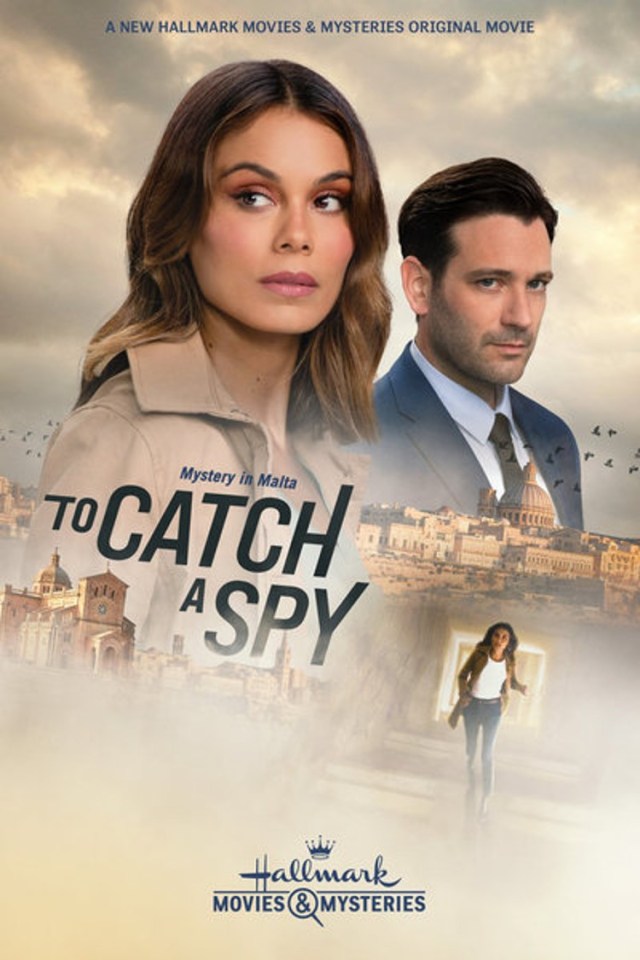
To Catch a Spy poster created by Crown Media Family Networks and Hallmark Movies & Mysteries

Things I liked about the film:

Standout performances: Within the movie, I saw standout performances from some of the actors and actresses. One of the film’s leads, Colin Donnell, gave one of those performances! His portrayal of Agent Aaron Maxwell came across as natural and believable. It reminded me of Stephen Huszar’s performance in the Ruby Herring series. His interactions with Nathalie Kelley’s character, Chloe, showcase this realism well. In the supporting cast, Joe Azzopardi portrayed a hotel employee named Isaac. His best scene was when Isaac’s true identity was revealed. Joe carried his character with suave confidence. This made Isaac so captivating to watch. Another captivating performance came from Becky Camilleri, who portrayed a maid named Rianne. What made her character so memorable was how expressive she was throughout the film! When Chloe is trying to check out of her hotel room, she runs into the hotel’s manager. After their interaction, Rianne walks into the room, appearing genuinely confused. Becky’s expressions helped her stand out among the cast!

Interior design: There were two rooms in To Catch a Spy that boasted fantastic interior design! The first was a sitting room inside Malta’s U.S. Embassy building. Beige and white wallpaper surrounded the interior, with white marble covering the floor. Providing pops of color were a dark wood table and chair set and a green potted plant. These elements came together to create a space that was both classy and elegant. The second space was a local church. When the interior of this location was first introduced, a painted mural on the church’s curved ceiling greeted the audience. Along the walls and pillars, gold was abundantly featured. This large venue could easily rival the Sistine Chapel. Because of everything I just said, I wish this church was shown in more than one scene.

Footage of Malta: According to IMDB, To Catch a Spy not only takes place in Malta, but the movie was filmed there as well. The creative team behind the project definitely took advantage of the country’s picturesque scenery by including it in establishing shots and in the background of some scenes. When Chloe goes on her hotel room’s balcony for the first time, she meets a beautiful view of the clear blue ocean and a city skyline. Because of the buildings’ sandy hue, the skyline ended up complimenting the ocean! In one scene, Aaron and Chloe are walking through a park. This location shared the same sandy stone as the buildings from Malta’s city skyline. It also paired well with a green, grassy field. The peaceful nature of the park certainly made this space inviting to the viewer!

Travel suitcase image created by Freepik at freepik.com. <a href=’https://www.freepik.com/free-vector/water-color-travel-bag-background_1177013.htm’>Designed by Freepik</a>. <a href=”https://www.freepik.com/free-photos-vectors/background”>Background vector created by Freepik</a>. Image found at freepik.com.

What I didn’t like about the film:

A disjointed story: There are three plots within To Catch a Spy. They are the travel writing plot, the murder mystery plot, and the international FBI plot. While these plots are interesting on their own, they ended up having a very loose connection. This caused the story as a whole to feel disjointed. Chloe’s occupation and Aaron’s role in the FBI prevented them from interacting with each other like other mystery film protagonists. In fact, Chloe’s skills as a travel writer weren’t really utilized when it came to being an amateur detective. Personally, I think the movie’s creative team should have chosen one or two of these plots and stuck with them.

Things that don’t make sense: Certain things happened in To Catch a Spy that, to me, didn’t make sense. Both examples I will give involve Chloe. After having a scary experience in the city, Chloe tells Aaron she doesn’t want the FBI badge anymore, indicating she doesn’t want any involvement in the case. A scene later, she eagerly attempts to follow a lead related to that case. The fact Chloe changed her mind so quickly was both confusing and jarring. Earlier in the film, one of Chloe’s friends goes missing. She enters her friend’s hotel room in order to discover what happened. Chloe finds two potential clues on the floor and picks them up with her bare hands. This is the same character who not only reads mystery novels in her spare time, but can also guess the guilty culprit early on. Because of this, wouldn’t Chloe know not to leave fingerprints on potential evidence?

Wasted potential for an overarching series storyline: In more recent series from Hallmark Movies & Mysteries, a storyline that is carried from film to film is included in the script. A perfect example is in the Martha’s Vineyard Mystery series, where Jeff is trying to figure out who shot him prior to the events of the series. In To Catch a Spy, the FBI was attempting to catch a criminal named Zypher. While watching the movie, I thought this would be the perfect overarching storyline if this film became a series. However, due to what happens in the movie, this idea did not become a reality. I was disappointed because of how the creative team wasted a potential storyline in their first film. Not every movie is meant to start a series. But if To Catch a Spy leads to a series, it makes me wonder what overarching storyline they could create?

Evening view of Malta skyline image created by bearfotos at freepik.com. Travel photo created by bearfotos – www.freepik.com

My overall impression:

Like any type of movie, Hallmark’s “destination” pictures are hit or miss. There have been some I liked, such as Rome in Love and Pearl in Paradise. But other titles featuring an exciting location have disappointed, like Christmas at Dollywood. With To Catch a Spy, it reminded me more of Christmas at Dollywood than Rome in Love. Sure, we got to see Malta in its picturesque beauty. However, as Dory said in an episode of the Hallmarkies Podcast, “The scenery can’t save you”. Unlike the protagonists in Rome in Love, we never get to see any of the characters experiencing the country’s culture or learning from the people of Malta. When Chloe’s co-worker, Sara, is asking Rianne about the history of Malta, the audience doesn’t get to hear what Rianne has to say. Plus, one of the film’s biggest flaws was its disjointed story. There is potential for this movie to start a new series. But if that is Hallmark’s plan, I don’t know how they’re going to, realistically, make it happen. As I said in my review, To Catch a Spy was filmed in Malta. Traveling to various countries in order to film on-location is going to get expensive. I guess we’re just going to have to wait and see.

Overall score: 7 out of 10

Have you seen To Catch a Spy? Do you want to see this story become its own series? Let me know in the comment section!

Have fun at the movies!

Sally Silverscreen

Take 3: Aurora Teagarden Mysteries: Til Death Do Us Part Review (Hallmark Mysteries Double Feature Part 1)

Because I haven’t reviewed a Hallmark Movies & Mysteries film since January, I thought writing about the newest Aurora Teagarden movie was a good idea! I also watched the latest mystery film, To Catch a Spy. Therefore, I decided to make my reviews a double feature! First though, we need to talk about Aurora Teagarden Mysteries: Til Death Do Us Part! While weddings have been shown in Hallmark’s mystery films, this is the first time one of the protagonists has gotten married within their respective series. Having Aurora finally walk down the aisle makes sense, especially since the Aurora Teagarden series has been on the air the longest. However, it’s still nice to see Aurora and her fiancé, Nick, reach this milestone in the lives. Speaking of miles and stones, let’s hop, skip, and jump through this review of Aurora Teagarden Mysteries: Til Death Do Us Part!

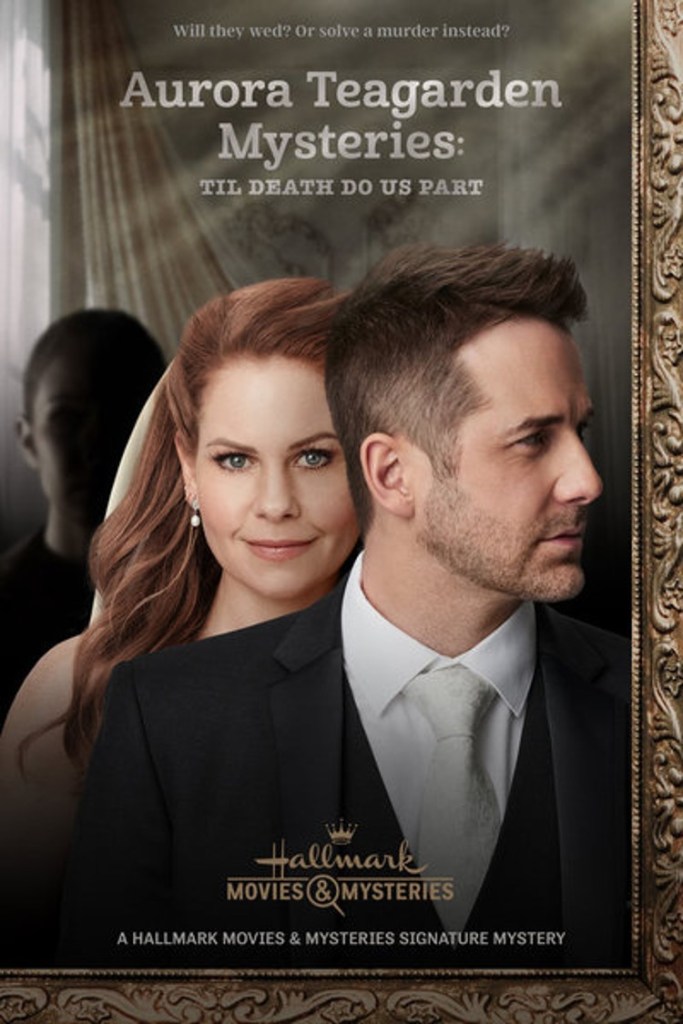
Aurora Teagarden Mysteries: Til Death Do Us Part poster created by Crown Media Family Networks and Hallmark Movies & Mysteries

Things I liked about the film:

Omitting the “planning-a-wedding-in-an-unrealistic-time-period” cliché: Anyone who has read my list of The Top 10 Worst Cliches from Hallmark Movies would know I am not a fan of the “planning-a-wedding-in-an-unrealistic-time-period” cliché. Because this is the first time Aurora and Nick have gotten married, let alone planned a wedding, it would have been easy for the series’ creative team to include this cliché in the script. Instead, part of the story revolved around Aurora and Nick finalizing wedding plans days before their big celebration. I like how the creative team took a different approach when it came to the subject of weddings. It also helps that the wedding itself didn’t dominate the story, like in some wedding movies. Showing a wedding’s planning process in a realistic fashion is quite refreshing. At one point in the film, Nick and Aurora seriously consider postponing their wedding, a conversation that felt mature and considerate. It was nice to see soon-to-be newlyweds take the planning process seriously instead of a) relying on the “power of love” to make everything fall into place or b) become so attached to a physical location, that they do anything it takes just to get married there.

A cold case mystery: Hallmark’s mystery series have sometimes featured cold cases. But these types of cases are not featured as often as cases that take place in an immediate time frame. This is especially true when it comes to the Aurora Teagarden series. The mystery in Aurora Teagarden Mysteries: Til Death Do Us Part first took place over twenty years ago. Not only that, but it also relied on dialogue as clues more than physical objects. This kind of story-telling is rarely seen in Hallmark mystery films. It gives the audience a reason to stay invested in the movie, as it forces them to pay attention to what the characters are saying and doing. I also applaud Aurora Teagarden’s creative team for choosing a different kind of mystery for this story. It keeps the overall series fresh and exciting!

Aurora’s wardrobe: An underrated strength in the Aurora Teagarden series is Aurora’s wardrobe! The outfits found in this film not only appeared stylish and modest, but they also complimented Candace Cameron Bure. In a scene where Nick brings Aurora donuts for breakfast, Aurora’s outfit consisted of a simple green skirt and a gray sweater with a green, yellow, and purple plaid pattern. When a piece of clothing features a pattern, you should pair it with a plain colored piece. This is the reason why Aurora’s outfit worked. Another memorable outfit was the one Aurora wore to her rehearsal dinner. The pink, short-sleeved dress was complimented by simple gold and silver jewelry. When Aurora went outside, she wore a navy-blue coat that boasted a light and dark pink plaid pattern. Because the coat featured the same color of pink as the dress, both pieces paired well together!

Wedding couple image created by Freepik at freepik.com. <a href=’https://www.freepik.com/free-vector/hand-drawn-wedding-invitation-with-happy-couple_1259848.htm’>Designed by Freepik</a>. <a href=”https://www.freepik.com/free-photos-vectors/wedding”>Wedding vector created by Freepik</a>. Image found at freepik.com.

What I didn’t like about the film:

A limited amount of humor: In Hallmark’s mystery series, including the Aurora Teagarden series, a certain amount of humor is incorporated into each story. This element prevents the film from becoming too dark. But Aurora Teagarden Mysteries: Til Death Do Us Part didn’t feature as much humor as other movies in the series. One reason for this was the absence of Miranda Frigon, who has portrayed Lynn since the series’ beginning. Her dry humor and criticism of Aurora’s involvement in each case has served as comic relief. Without Lynn, a percentage of the series’ humor is gone. Even though, there were two scenes that made me laugh out loud, this movie was one of the more serious stories in the series.

The mystery’s weak connection to the wedding: While I did like the film’s cold case mystery and how the wedding didn’t dominate the story, the mystery itself didn’t connect to the wedding. As I mentioned in this review, the mystery took place over twenty years ago. But as I watched the movie, I felt it could have been placed in its own story. I found myself wondering, “Do we really need a wedding to break up the darkness of this case”? If the series’ creative team really wanted Nick and Aurora’s wedding to remain an important part of the story, the mystery could have been something along the lines of a cold case being connected to the wedding reception venue or a florist being kidnapped.

The dynamic of Charles and Aida’s relationship: Aurora’s father, Charles, attends Aurora and Nick’s wedding. Because Charles and Aida, Aurora’s mother, divorced when Aurora was in college, this is the first time Aurora’s parents have interacted in years. If this had happened in real life, there would be a certain amount of awkwardness and discomfort between both parties. But for Aida and Charles, it seemed like they picked up where they left off. I can see the film’s creative team wanted to showcase cordial, co-parenting exes, similar to the Hallmark Channel movie, Love to the Rescue. What made that concept work in the 2019 film is how Nikki DeLoach’s character and her ex were currently raising a school-aged child. Therefore, both parents needed to co-parent. In the newest Aurora Teagarden chapter, Aurora is an adult. At this point in Aurora’s life, Aida and Charles no longer need to co-parent, let alone be on the same page when it comes to their daughter.

Magnifying glass and fingerprint image created by Alvaro_Cabrera at freepik.com. <a href=’https://www.freepik.com/free-vector/loupe-over-a-fingerprint_853908.htm’>Designed by alvaro_cabrera</a>. <a href=”https://www.freepik.com/free-photos-vectors/glass”>Glass vector created by Alvaro_cabrera – Freepik.com</a>. Image found at freepik.com.

My overall impression:

The Aurora Teagarden series is Hallmark Movies & Mysteries’ longest running series. Since 2015, fans have watched Aurora solve multiple murders, navigate her love life, and lead the Real Murders Club. With Aurora Teagarden Mysteries: Til Death Do Us Part, Aurora, as well as Nick, reach a new chapter in their lives. At the same time, our favorite librarian does what she does best: solve a mystery. This new film contains elements that serve as the series’ strengths; such as showing a type of mystery that isn’t always featured on the network and utilizing different ways to present clues. However, the film is one of the more serious titles in the series. Miranda Frigon’s absence was seen and felt. Because some of the series’ humor comes from her character, most of Aurora Teagarden’s comedy was not there. While Marilu Henner and Andrew Airlie, who portray Aida and Charles Teagarden, have good on-chemistry, I didn’t think the dynamic of their characters’ relationship was well executed. For this flaw, the fault lies in the screenwriting. I’m looking forward to the next installment in the series, Aurora Teagarden Mysteries: Honeymoon, Honeymurder! Since Hallmark hasn’t created any programs about a honeymoon before, it’ll be interesting to see how the overall story will play out.

Overall score: 7.5-7.6 out of 10

Have you seen Aurora Teagarden Mysteries: Til Death Do Us Part? Are you looking forward to Aurora Teagarden Mysteries: Honeymoon, Honeymurder? Let me know in the comment section below!

Have fun at the wedding!

Sally Silverscreen

Take 3: Royal Wedding Review (Ginger Rogers and Fred Astaire Double Feature Part 2)

As I said in my review of Teenage Rebel, I haven’t seen many films from Fred Astaire’s filmography. In fact, the only two movies of Fred’s I’ve seen so far are The Sky’s the Limit and Funny Face. When I joined Crystal and Michaela’s blogathon, I knew which Fred Astaire picture I wanted to write about. Last month, I was recommended the 1951 film, Royal Wedding, by Heidi from Along the Brandywine. She suggested this film because of its use of split screens. Since I don’t have many Fred Astaire titles on my movie recommendation board on Pinterest, this was my first choice for this double feature! It is interesting that Royal Wedding is the last movie I’m reviewing in 2020. Musicals from the Breen Code era are usually seen as happy, up-beat productions. This is a contrast to the type of year 2020 ended up becoming.

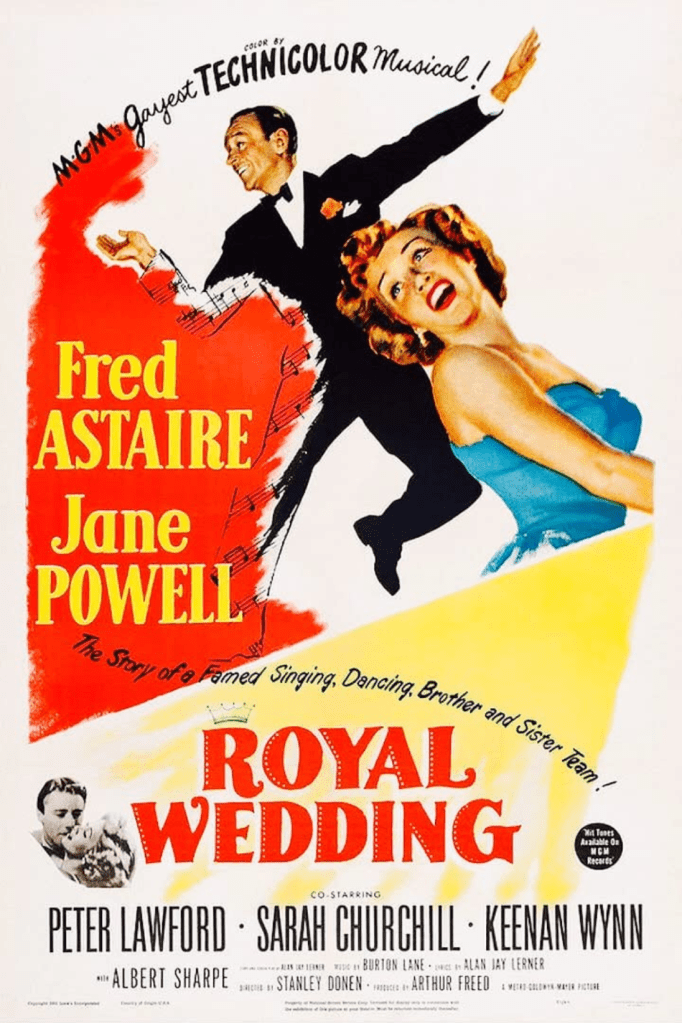
Royal Wedding poster created by Metro-Goldwyn-Mayer.

Things I liked about the film:

The acting: A similarity I’ve noticed among Fred Astaire’s roles in The Sky’s the Limit, Funny Face, and Royal Wedding is how confident he comes across in each film! Speaking specifically about Royal Wedding, his character, Tom Bowen, had the showmanship you’d expect from a stage performer. Even though he was performing a duet in the movie’s opening number, “Ev’ry Night At Seven”, he had a stage presence that demanded the audience’s attention. This is because he had complete control over his part of the performance as well as experience leading other musicals. Fred also appeared comfortable as one of the leads in this film. Jane Powell’s on-screen personality in Royal Wedding was very sweet! Her character, Ellen Bowen, was also flirty without overdoing it. What worked in Jane’s favor was how she was able to keep up with Fred in their musical duets as well as hold her own in her solos. It definitely showed how strong of a performer she is! Because I’m not familiar with Sarah Churchill as an actress, I wasn’t sure how a Fred Astaire and Sarah Churchill on-screen pairing would work when I first saw them together. But as the film went on, I realized they had better on-screen chemistry than I expected! As an individual performer, Sarah gave her character, Anne, a sophisticated independence that never made her seem snobby or self-centered. In one scene, as she’s recalling to Tom how she came to be a dancer, Anne is so sure of herself when she talks about it. In scenes like this, you can tell that Anne has a healthy amount of self-confidence, partly because of Sarah’s captivating performance!

The musical numbers: When I watch musicals from the Breen Code era, I can’t help but notice the creativity that comes from some of the musical numbers! One example is Fred’s solo, “Sunday Jumps”. On paper, the idea of Fred dancing with a hatrack and exercise equipment might sound silly to some audience members. But because of the choreography and Fred’s dancing talents, that idea becomes a thoroughly entertaining one! Another solo of Fred’s, “You’re All the World to Me”, also showcases creativity well. In this musical number, Tom Bowen can be seen literally dancing on the walls and ceiling, as to visually represent what his heart is feeling for Anne. The number itself is also ahead of its time, as this particular idea wasn’t common in films from this era. I loved how a bright color palette was used in “I Left My Hat in Haiti”! It provided the musical number with an energy and personality that nicely contrasted the toned-down atmosphere of London. The musical number also did a good job at utilizing its ensemble.

The dialogue: Because of the Breen Code, screenwriters had to think and write cleverly when it came to expressing ideas that wouldn’t be allowed on film. That mentality can certainly be found in Royal Wedding’s script! After their performance, “Ev’ry Night At Seven”, Ellen complains about the theater’s lack of air conditioning due to the theater manager wanting to save money. Frustrated by that decision, Tom tells his sister how the theater manager will need a fan for one specific place. Subtle references like this one respect the audience’s intelligence and gave the screenwriters a chance to think outside the box when it comes to language. There were also memorable quotes within the script. During Anne and Tom’s conversation, Anne told him that dancing made her happy. She also said that she wanted to dance when she was happy.

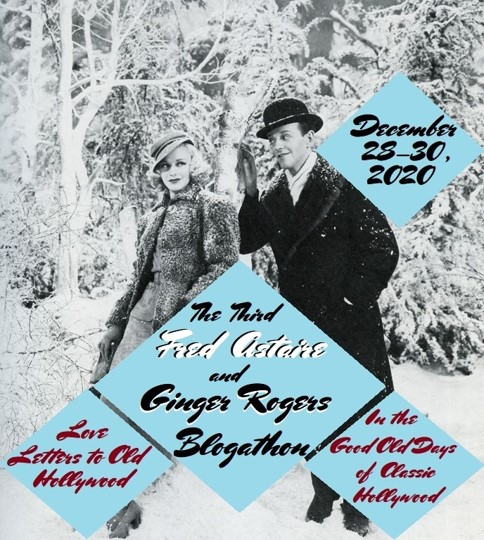
The Third Fred Astaire and Ginger Rogers Blogathon banner created by Crystal from In the Good Old Days of Classic Hollywood and Michaela from Love Letters to Old Hollywood.

What I didn’t like about the film:

No major conflicts: In Anchors Aweigh, Clarence “Brooklyn” Doolittle and Joseph “Joe” Brady help their new friend, Susan, get an audition with a well-known composer at a movie studio. This served as the main conflict for the film. With Royal Wedding, there was no main conflict to be found. Instead, the story focuses on the two relationships between Ellen and John and Tom and Anne. Even when sub-conflicts were introduced in the movie, they are resolved rather quickly. Having one overarching conflict would have added some intrigue to this story.

Too many boyfriends: At the beginning of the movie, Ellen is shown having multiple boyfriends. This was to highlight the point of Ellen having difficulty ending these relationships. When Ellen’s boyfriends are interacting with one another, I had trouble keeping track of who was who. I understand this creative decision was made on purpose, to emphasize the aforementioned point. But this gave the audience unnecessary confusion.

The titular royal wedding as an afterthought: When a film is titled Royal Wedding, most audience members would expect the wedding itself to play a significant role within the plot. Because the story focuses on the relationships of Tom and Anne and Ellen and John, the royal wedding is treated as an afterthought. Sure, the characters casually bring it up from time to time. But there is little to no excitement in London just days before such a historic event. When a pre-wedding parade is passing by Tom and Ellen’s hotel suite, the scene places more emphasis on John and Ellen’s conversation, preventing the parade from being shown on-screen. The day of the wedding appears in the last twenty minutes of the film, but even that part of the story is overshadowed by the previously mentioned relationships.

Princess tiara image created by Freepik at freepik.com. <a href=’https://www.freepik.com/free-vector/ornamental-princess-crowns_1109199.htm’>Designed by Freepik</a>. <a href=”https://www.freepik.com/free-photos-vectors/gold”>Gold vector created by Freepik</a>. Image found at freepik.com.

My overall impression:

Royal Wedding is the type of movie where the acting performances and musical numbers make up for the weaker story. While the plot isn’t bad, it could have benefited from having a major conflict. If the creative team behind this movie wanted their story to be more interesting, it would have contained a mistaken identity. Ellen Bowen would switch places with the princess and fall in love with the prince, while the princess is mistaken for Ellen and eventually forms a romantic relationship with Tom. With this conflict, the wedding itself would have a greater presence in the whole story. It would also create a series of hilarious hijinks. Personally, I’d recommend Anchors Aweigh over Royal Wedding. The former has a stronger story and, in my opinion, is a more enjoyable film overall.

Overall score: 6.2 out of 10

What are your thoughts on Royal Wedding? Which movie is your favorite out of the ones I’ve reviewed this year? Please tell me in the comment section!

Have fun at the movies!

Sally Silverscreen

Take 3: Teenage Rebel Review (Ginger Rogers and Fred Astaire Double Feature Part 1)

I haven’t seen many films from Ginger Rogers’ and Fred Astaire’s filmography. Despite this, I joined the third Fred Astaire and Ginger Rogers Blogathon, in the hopes of expanding my cinematic horizons! Because I figured other participants would cover Ginger’s musicals, I chose one of her movies that wasn’t a part of the musical genre. As the title says, I’ll be reviewing Teenage Rebel! The aftermath of a divorce/custody battle is rarely explored in film. This is what made me take notice of this particular title. What I also thought was interesting was how this story discussed the subject of divorce during a time when the concept was not as talked about as it is today. While I have reviewed the 1939 movie, In Name Only, that film revolved around the divorce itself and what led up to it. Now, let us begin part one of my Ginger Rogers and Fred Astaire Double Feature!

Teenage Rebel poster created by 20th Century Fox.

Things I liked about the film:

The acting: Ginger Rogers is an actress from what would be considered the “Golden Era” of Hollywood. This particular period in time is often depicted with a sense of glamour. Because of this, Ginger carried herself in Teenage Rebel with that same sense of glamour I just brought up. Not only that, her emotionality really shined through in her role as Nancy Fallon! Some of her best scenes featured her interacting with Dorothy/Dodie. Both actresses go toe-to-toe with each other, acting-wise, and make their characters feel believable and genuine. Out of context, Dorothy/Dodie could be written off as a spoiled brat. But Betty Lou Keim’s performance, plus the aftermath of the divorce, makes the audience feel bad for Dorothy/Dodie. While Betty’s portrayal is consistent, she is given enough flexibility to add emotion. This highlights the idea that Dorothy/Dodie is simply human, with thoughts and feelings that need to be expressed. Warren Berlinger portrays Dick, one of the Fallon’s next-door neighbors. What I liked about his performance is how animated it is. This animation livened Warren’s portrayal without coming across as over-the-top. Instead, it gave him a wide range of emotions to work with. His conversation with his family about his long distance girlfriend is a perfect example of this.

The use of symbolism: One night, as a literal storm is brewing in the neighborhood, Nancy finds Dorothy/Dodie sitting outside by herself. The wind outside is strong and doesn’t have any plans to calm down. During their conversation, the sound of cracking lightening can be heard in the background. When Dorothy/Dodie and Nancy return to the house, rain starts to fall. These elements represented the personal turmoil taking place between mother and daughter.

The messages and themes: In films where younger characters are the center of the story, there is always a place for meaningful messages and themes. This is certainly the case for Teenage Rebel. One of the notable themes of this movie is having compassion for others. No matter how closed-off Dorothy/Dodie was, Nancy never gave up on her daughter. Even though Nancy does express feelings of frustration and stress, she always tried her best to make Dorothy/Dodie feel welcome and loved. Even Dick and his sister, Jane, show compassion for Dorothy/Dodie. They invite her to teenage functions like dances and a local car race. Because of the time they spend with her, Dorothy/Dodie allows herself to open her heart to others. The reason why Dorothy/Dodie distances herself from people is because she has lost her trust in them due to the divorce. As the story progresses, Dorothy/Dodie changes her life around. In one scene, Nancy gives her daughter a lecture about how she needs to stop living in isolation.  That speech and the overall message of opening your heart comes across in this story as genuine.

The Third Fred Astaire and Ginger Rogers Blogathon banner created by Crystal from In the Good Old Days of Classic Hollywood and Michaela from Love Letters to Old Hollywood.

What I didn’t like about the film:

A very misleading title: This film is called Teenage Rebel. Paired with the quotes on the movie’s poster, the film is advertised as a cautionary tale about teenagers going “over the edge”. However, none of the teens in this story rebel or misbehave. Even when there is a car race, the event itself appears to be well organized and legal. While Dorothy/Dodie has a bad attitude and runs away from home, she does these things to 1.) put on a brave face to protect her true feelings and 2.) find some alone time to get away from the tension between her and her mother. The title and marketing built this movie up to be something it wasn’t.

The character of Larry: Larry Fallon, portrayed by Rusty Swope, is Nancy and Jay’s son. He had some funny lines in this movie, such as when he said “a man” after Dorothy/Dodie asks him what he wants to be when he grows up. However, after a while, Larry kind of overstays his welcome. I don’t fault Rusty for this, as there was only so much he could do for an actor of his age. This specific flaw is the result of the screenwriting. Larry doesn’t have much to do in the overall story. In fact, he has little to no significance within the main plot. Prior to watching Teenage Rebel, I was expecting to see an interesting dynamic between half-siblings who didn’t grow up together. But, in reality, Dorothy/Dodie and Larry only interacted once. Either Rusty needed more material to work with or the character should have been written out of the movie completely.

An abrupt transformation: When Dorothy/Dodie is introduced in the film, she carries herself with a chip on her shoulder. It gets to the point where she and her mother have an emotionally fueled, tension filled conversation. As I mentioned earlier, Dorothy/Dodie’s attitude was caused by an ugly divorce with an even uglier custody battle. After the aforementioned conversation between Dorothy/Dodie and Nancy, Dorothy/Dodie runs away, where Dick finds her and takes her to a local soda shop. When she returns home, she acts nice toward her mother, like their previous conversation never happened. Similar to what I said about Larry, this flaw was the result of the screenwriting. This change in character should have been a consistent progression throughout the film as a whole.

Breaking heart image created by Kjpargeter at freepik.com. <a href=’https://www.freepik.com/free-vector/broken-heart-valentine-background_1041991.htm’>Designed by Freepik</a>. <a href=”https://www.freepik.com/free-photos-vectors/background”>Background vector created by Kjpargeter – Freepik.com</a>. Image found at freepik.com.

My overall impression:

Teenage Rebel is an ok film. However, its dishonest title and poster doesn’t help its case. In a time when teen centered films were on the rise, the studio wanted to capitalize on that. While a significant part of this story focused on a teenage perspective, it was marketed as something different than what it honestly was. Instead of selling the movie as a meaningful drama exploring the aftermath of divorce, they decided to make the film sound like it was about misbehaving youngsters, despite never being found in the story. Even though it seems like the creative team had their hearts in the right place, I was not a fan of how the story was more “slice of life” than I had wanted. I don’t find these types of stories intriguing, but I appreciate Teenage Rebel’s incorporation of its messages and themes. If you want to watch a teen movie with similar ideas, I’d recommend The Boy Who Could Fly. Not only does it emphasize showing compassion to others, but it’s a much stronger film.

Overall score: 6.3 out of 10

Have you seen Ginger Rogers’ movies? Which film about divorce would you recommend? Tell me in the comment section!

Have fun at the movies!

Sally Silverscreen
Take 3: Amazing Grace and Chuck Review (Atticus and Boo Double Feature Part 2)

As I stated in my review of The Terry Fox Story, I chose to review two movies for the Atticus and Boo Blogathon; one from Gregory Peck’s filmography and one from Robert Duvall’s filmography. Both films were released in the ‘80s and they both have something to do with athletics. In the second part of this double feature, I’ll be writing about the 1987 movie, Amazing Grace and Chuck! This is a movie I had not heard about until this year. However, I found the concept of an athlete giving up their sport because of their views on nuclear weapons interesting. I also thought it would be interesting to see Gregory Peck portray a fictional President. As you may know, I enjoy finding movies that are “hidden gems”. Because Amazing Grace and Chuck is an ‘80s film that has, more often than not, flown under the radar, I took advantage of the opportunity to talk about it on 18 Cinema Lane!

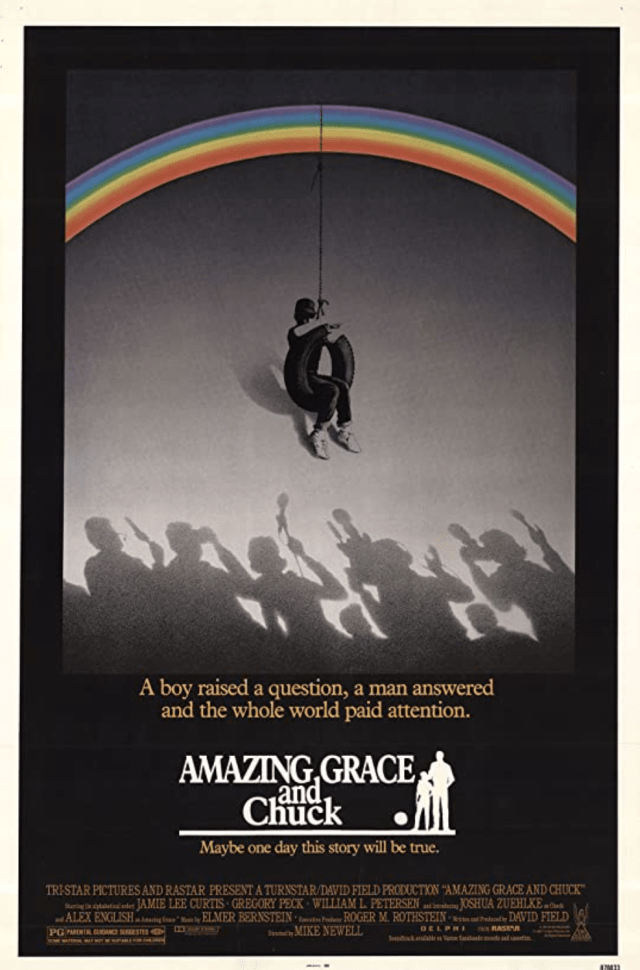
Amazing Grace and Chuck poster created by TriStar Pictures.

Things I liked about the film:

The acting: Like my review of The Terry Fox Story, I will talk about Gregory Peck’s performance first. I liked seeing his portrayal of the President, even though he was in the film for a short amount of time. The same professionalism Gregory brought to his role in To Kill a Mockingbird could be seen in Amazing Grace and Chuck! Not only that, but he also carried himself in a classy manner. Another stand-out performance came from Joshua Zuehlke! In this movie, he did a good job showing what a child would likely experience when dealing with such a complicated topic. One of his best scenes was when Chuck’s father is telling his son about how their family’s lives have changed because of Chuck’s decision to walk away from baseball. While Joshua doesn’t say anything in this scene, his facial expressions of sadness and concern tell the audience everything they need to know. Over the course of the story, Chuck develops a friendship with a basketball athlete named Amazing Grace. This friendship shows that each cast member had good on-screen chemistry with one another and how good of an actor Alex English was in this movie! What made Amazing Grace a memorable character was Alex’s charisma. With a bright smile and an easy-going demeanor, Alex gave Amazing Grace a great on-screen personality that helped him be likable!

The scenery: A pleasant surprise in Amazing Grace and Chuck was the scenery! Most of the story takes place in Livingston, Montana. According to IMDB, parts of the movie were filmed in Livingston and Bozeman. The natural landscapes of the Treasure State take center stage when scenes take place outdoors. Mountains and hills proudly stand tall in the background. In a sweeping overhead shot, a color scheme of green and yellow with a splash of purple could be found in the foliage below. Before a nuclear weapon was shown on screen for the first time, a field represented the calm before the storm. Parts of this movie was also filmed in Boston, Massachusetts. In this particular location, there was some photogenic areas! One great example is when Lynn Taylor, Amazing Grace’s manager, is sitting on the side of a river. This spot presented a visual contrast to its city roots, promoting tranquility among the hustle and bustle of Boston.

An educational approach: When a real-life, debatable topic is featured in a film, both sides of the issue are presented. It can be interesting to see the various perspectives of any subject. But when a movie’s creative team makes this decision, they assume their audience is already educated on the film’s topic. In Amazing Grace and Chuck, the subject of nuclear weapons was introduced as Chuck and his classmates go on a field trip to see a missile. During the trip, facts were delivered to the children and the audience. However, it never felt like the tour guide was talking down to anyone. What it did instead was address the issue and show why it was important. When Chuck quits baseball, it simply shows someone expressing their beliefs. This presentational style is one that I don’t often see in films of this nature.

The Atticus and Boo Blogathon banner created by Rebecca from Taking Up Room.

What I didn’t like about the film:

More telling than showing: Throughout the film, characters told one another how bad things were getting. However, the audience never got to see these things happening. In one scene, the President tells Chuck how there was a protest at a soccer game. He also tells Chuck there is an ice cream stand dedicated to him. The events are not shown on screen, so the audience is forced to take the characters’ word for it. If the audience were given the opportunity to see these events, it would have shown the magnitude of Chuck’s choice to quit baseball.

A whole lot of nothing: The story of Amazing Grace and Chuck revolves around two athletes who choose to quit their beloved sports until all nuclear weapons are dismantled. While this overarching conflict does get resolved, it doesn’t happen until the last ten to fifteen minutes of the movie. For the majority of the film, it seems like the characters are waiting for something for happen instead of actually trying to make things happen. The audience can see other athletes who have joined the cause making international calls. But this was one scene in an hour and fifty-four-minute movie. In fact, it feels like more emphasis was placed on Amazing Grace’s attempts to renovate a run-down barn than on the film’s overarching conflict.

Things happening too quickly: There are several times when things happened too quickly in Amazing Grace and Chuck. At one point in the story, Amazing Grace and Chuck are kidnapped by two football athletes. The moment itself happened suddenly with no forewarning or build-up. When it’s revealed these football athletes support Chuck’s cause, it is implied they personally know Amazing Grace. However, it is never explained how these athletes know the basketball star. Because of the lack of explanations, moments appear too quickly in the story with little to no context.

Military plane image created by Brgfx at freepik.com. <a href=”https://www.freepik.com/free-photos-vectors/background”>Background vector created by brgfx – http://www.freepik.com</a>. Image found at freepik.com.

My overall impression:

While watching Amazing Grace and Chuck, I could tell the film’s creative team had their hearts in the right place. At the same time, it seemed like their minds thought the film would make a bigger statement than it did. As I said in the introduction, this is a movie I hadn’t heard of until this year. It also doesn’t help when the characters seem like they aren’t doing much to find a resolution to their conflict. Something that worked against this story’s favor was featuring a complicated topic that does not have an easy answer. Watching characters build their way toward a solution can be engaging to see. Throughout the movie, I felt like I was watching two separate movies that were loosely woven together. Chuck’s story and Amazing Grace’s story could have existed in their own universes; one about a child trying to make a difference in the world and the other about a superstar athlete choosing to remind himself of what is really important in life. There are two kinds of films from the past; those that stand the test of time and those that are a product of their time. Amazing Grace and Chuck, in this case, leans more toward the latter.

Overall score: 6 — 6.1 out of 10

What are your thoughts on this double feature? If you have seen Amazing Grace and Chuck or The Terry Fox Story, which film is your favorite? Please tell me in the comment section!

Have fun at the movies!

Sally Silverscreen

Take 3: The Terry Fox Story Review (Atticus and Boo Double Feature Part 1)

Back in April, I reviewed To Kill a Mockingbird for Silver Screen Classics’ Classic Literature On Film Blogathon. I also read the book earlier this year. When I discovered Rebecca from Taking Up Room was hosting the Atticus and Boo Blogathon, I just had to participate, as it was too good of a coincidence to pass up! Because this blogathon celebrates Gregory Peck and Robert Duvall, I decided to review one film from each of their filmographies. However, I purposefully chose two films that were not only released in the ‘80s, but also had something to do with athletics. For this double feature, I’ll start by reviewing the 1983 movie, The Terry Fox Story. I have to admit I like finding made-for-TV movies from years past. This specific film is an HBO presentation that I watched on Youtube. I will also admit that I knew very little about the true story that inspired the film. So, I was looking forward to being educated on Terry Fox’s story!

The Terry Fox Story poster created by HBO Premiere Films, HBO, and ITC.

Things I liked about the film:

The acting: I will talk about Robert Duvall’s performance first, as he is one of the reasons why I reviewed this film. In The Terry Fox Story, Robert portrays Bill Vigars, a member of the Cancer Society from Toronto. He doesn’t show up until fifty-nine minutes into the movie, but Robert is given more screen time than he had in To Kill A Mockingbird. With a performance that comes across as natural, Robert made his character feel like a real-life person. One is his best scenes was when Bill gives a pep talk to Terry about ignoring the press. It shows this particular character is trying to look out for Terry’s best interests. Speaking of Terry, Eric Fryer is one of the strongest members in this cast! No matter what scene he appeared in, his performance felt realistic. He displayed the frustrations a patient with cancer might experience, such as when Terry wants to quit his treatments and leave the hospital. There were even times when his character was emotionally guarded, protecting himself from experiencing more pain in his life. Terry stopping people from touching his hair is a good example of this. Despite all the on-screen hardships, Eric brought joy to his role, which helped create happier moments that felt earned. Rika Noda was a part of these happier moments, showing Terry how he can open his heart and allow his personal barriers to be broken down. Portrayed by Rosalind Chao, Rika was an endearing character who, more often than not, brought out the best in Terry. While she gave a good performance individually, Rosalind also had good on-screen chemistry with Eric Fryer. This made me invested in their on-screen relationship and want to see it succeed!

The scenery: Since this movie revolves around Terry’s marathon across Canada, the country’s landscapes serve as photogenic backdrops! When Terry starts his marathon in Newfoundland, he stands on the shores of Cape Spear. With the waves crashing against the rocky shores, this location created a powerful image of a warrior preparing for battle. This waterfront area was also appealing to look at. During his marathon, Terry runs past a city skyline. Behind that skyline was a beautiful sunset. Its pale orange hues illuminated the scene, bringing forth a peaceful picture. A variety of surroundings were featured throughout the marathon. This showed a good representation of the living environments that can be found in an individual country like Canada.

Showing heart-breaking and heart-warming moments: In my review of Nicholas Nickleby, I said one of the strengths of the movie was how there was a balance of despair and joy within the story. The Terry Fox Story had a similar strength, showing both the heart-breaking and heart-warming moments of Terry’s journey. While receiving treatments at the hospital, Terry meets another cancer patient named Bob. Several scenes later, Terry crosses paths with Bob again. This time, the treatments have taken their toll on Bob, making him appear unrecognizable. It was just one example of the ugliness cancer carries, showing the audience a more realistic depiction of the disease. My favorite scene in this film is when Terry’s family and friends are waiting for him to cross the finish line at the seventeen-mile marathon. It was such a heart-warming moment, it made me tear up. This is because it did a good job at displaying what happens when someone believes in another person. It was also a happy occasion that perfectly contrasted the scene’s dark and rainy background!

The Atticus and Boo Blogathon banner created by Rebecca from Taking Up Room.

What I didn’t like about the film:

A rushed beginning: I’m aware there’s only so much story that can be told in an hour and thirty-six minutes. However, the first thirty-eight minutesof The Terry Fox Story was rushed. Important events that led up to the marathon were shown in short segments. It felt like these moments were bullet points within a timeline. It also seemed like the film’s creative team tried to squeeze as much of Terry’s story into the script as they realistically could. Only focusing on some of the events would have benefitted the overall project, as the movie’s flow would be even and certain parts of the story could be fleshed out more.

Terry’s bad attitude: After watching The Terry Fox Story, I read Terry’s family was not a fan of the film “for depicting him as ill-tempered”. In the movie, I saw the character of Terry giving some of the people around him a bad attitude. Toward the beginning of the marathon, Terry complains to his friend, Doug, over the smallest of things. He even calls his friend hurtful names. In the few moments when this happened, it made me briefly question why I was rooting for this character. I know this creative decision was chosen to show how humans can be flawed and have their bad days. Eventually, Terry learns from his errors and apologizes to Doug. But when a movie presents a character they want me to root for and, for any reason, that character makes me wonder why I’m rooting for them, that is not a good thing.

Unresolved or under-resolved story points: There were a few story points in The Terry Fox Story that were either unresolved or under-resolved. As I mentioned earlier, Bob and Terry shared two scenes together. The second of these two scenes left an unresolved conclusion, as Bob is never seen again for the rest of the film. The story never explains if Bob beat his cancer diagnosis or if he passed away. Before the marathon, Rika and Terry’s relationship was traveling rocky waters. It wasn’t until the one hour and fifteen-minute mark when Rika’s voice-over could be heard, indicating her and Terry’s issues were resolved. While it was nice to receive this resolution, it could have been received a lot sooner in the story.

Canada postage stamp image created by Ibrandify at freepik.com <a href=’https://www.freepik.com/free-vector/canadian-flag-stamp-template_836872.htm’>Designed by Freepik</a> <a href=”https://www.freepik.com/free-photos-vectors/template”>Template vector created by Ibrandify – Freepik.com</a> Image found at freepik.com

My overall impression:

Before watching The Terry Fox Story, I only knew the bare minimum of Terry Fox’s story. Now, I feel like I’ve been educated on one of the most important pieces of Canadian history! While there are flaws within the project, the 1983 film did a good job showcasing the human spirit on film. Heart breaking and warming moments influence how people view their world, with the movie effectively showing that. The story also reminds the audience that humans are not invincible, as they all have their own limits. Terry Fox and his marathon teaches us what we are capable of when we believe in ourselves and others. As the character of Terry said in The Terry Fox Story, “it’s about reaching out to people and having them touch you back”. Another good lesson this film teaches is how, sometimes, our best is more than enough. Terry’s single act of attempting to run across Canada helped start a conversation we’re still having decades later. Awareness for various cancers are being raised year after year and multiple organizations have joined the fight against this horrible disease. Even though there’s still more work to do done, I’d like to think Terry’s dream is closer to coming true.

Overall score: 8.1 out of 10

Have you heard of Terry Fox’s story? Which “based on a true story” movie would you like to see me write about? Let me know in the comment section below!

Have fun at the movies!

Sally Silverscreen

Here’s the link to the quote I referenced in this review:

https://en.wikipedia.org/wiki/The_Terry_Fox_Story

Take 3: The Boy Who Could Fly Review (PB & J Double Feature Part 2)

Welcome to the second part of my PB & J Double Feature! This review may contain spoilers and here are the links to the double feature’s introduction and the first part:

My PB & J Double Feature’s Introduction

Take 3: The Last Full Measure Review (PB & J Double Feature Part 1)

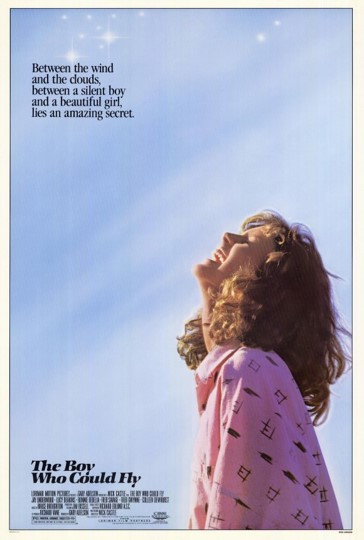
The Boy Who Could Fly poster created by Lorimar Motion Pictures and 20th Century Fox. Image found at https://www.imdb.com/title/tt0090768/?ref_=nv_sr_srsg_0.

1. What is the purpose of Girl Scout fun patches? What is the significance of the PB & J patch that you talked about in the introduction?

I already explained this in my review for The Last Full Measure, so you can read that post if you want to learn more about Girl Scout fun patches and the PB & J patch.

2. How did you come across The Boy Who Could Fly?

I came across the poster for The Boy Who Could Fly while visiting Pinterest. After making this discovery, I read the film’s synopsis. I was curious to see how the subject of Autism would be discussed in a movie set in and released during the ‘80s. The possible meaning behind the title is also what sparked my interest.

3. You elaborated in the introduction how a PB & J sandwich represents a collection of ideas. Can any of these ideas be found in The Boy Who Could Fly?

One of these ideas that can be found in The Boy Who Could Fly relates to building connections. In this film, the audience learns that Mrs. Sherman, Milly and Eric’s teacher, has become one of Eric’s biggest advocates. It was her decision to place him in her class so he can interact with the other students. She also reveals to Milly that she protested against sending Eric to an institution so he could live in an environment that was familiar to him. Because of Mrs. Sherman’s encouragement and after she volunteered to be his gym class partner, Milly chooses to stay by Eric’s side and be his friend. Even when she experiences frustration and considers throwing in the towel, Milly perseveres in helping Eric be the best version of himself that he can be. It’s because of these connections that Eric is able to grow as a person and inspire the people around him.

As I mentioned in answer number one, the PB & J patch is earned by making peanut butter and jelly sandwiches. This activity is usually performed when feeding people in need. Volunteers who choose to serve others in this fashion build connections with other volunteers, as well as with the organizers of this activity. These connections help build a community of life-minded individuals who share a common goal. They may even form connections with the people they are serving.

4. Are there other patches you can think of that would complement The Boy Who Could Fly?

A patch related to Autism seems like an appropriate choice. It could be earned in a variety of ways, from participating in an Autism Walk to meeting members of a local Autism council. One of the major themes in The Boy Who Could Fly is believing in yourself. There is one patch from Mad About Fun Patches that would perfectly fit with this theme. On the website, there is a Dumbo themed patch that says “Believe You Can Fly & Soar”. In The Boy Who Could Fly, Milly reads a Dumbo picture book to Eric. She does this to help Eric communicate and connect with others by using a topic he loves: flight.

5. Is there anything about The Boy Who Could Fly that you liked or didn’t like?

I was surprised by how well this movie aged, especially when it comes to the subject of Autism. While there is language in the film that wouldn’t be used today, the way Eric is treated and viewed by the other characters is positive. A great example is the formation of Milly and Eric’s friendship. The movie presents the possibility of people with Autism successfully creating and maintaining meaningful relationships. This helps dispel stereotypes that could leave a negative impact for those on the Spectrum. While watching The Boy Who Could Fly, I noticed how the audio of the actors was on the quieter side. I had to turn up the volume on my television just to hear what the characters were saying.

Paper airplane image created by Freepik at freepik.com. <a href=’https://www.freepik.com/free-vector/paper-plane-in-cartoon-style_766478.htm’>Designed by Freepik</a>. <a href=”https://www.freepik.com/free-photos-vectors/paper”>Paper vector created by Freepik</a>. Image found at freepik.com. 

6. Did you develop any thoughts and/or questions while watching this film?

A thought I developed during my viewing of The Boy Who Could Fly is how some moments felt ahead of their time. In answer number four, I mentioned how Milly uses Eric’s favorite subject to help him communicate and connect with other people. I read a story several years ago about a woman whose autistic son loved bees, so she based his entire homeschool curricular around that subject. She did this in order to help him enjoy his lessons. The idea of helping someone with Autism based on their personal preferences and accommodations is a practice commonly known today than it might have been in the mid to late ‘80s. After suffering a minor concussion and experiencing a life-like dream, Milly has a conversation with a psychologist from the hospital. The interaction itself normalizes the use of therapy, with the psychologist hearing Milly’s side of the story without any judgement or criticism. Seeking therapy for those with mental health related situations is encouraged and accepted today that it could have been four decades ago.

7. As stated in answer number one, fun patches are earned by either completing an activity or reaching a goal. What goal or activity could correlate with this movie?

Similar to The Last Full Measure, most scouts would not be able to see The Boy Who Could Fly. This is due to language and a scene involving minors consuming alcohol. But, like The Last Full Measure, troops can participate in activities that relate to the movie. As I mentioned in answer number four, a Dumbo themed patch would correlate perfectly with The Boy Who Could Fly. Younger scouts can watch Dumbo and discuss the importance of self-esteem. Meanwhile, older scouts can learn about different forms of flight and discovering how their unique talents can play a vital role in their community.

8. Fun patches are about learning new skills or lessons. Are there any lessons one can learn from this film?

Like I said in answer number four, a major theme in The Boy Who Could Fly is believing in yourself. There are several occasions where characters are facing difficult situations in their lives. Instead of giving up, they persevere and discover a resolution to their conflict. In scouting, troops can face many obstacles. It could be as simple as last-minute changes to pre-set plans. Challenges may be bigger, causing troop leaders to search for an answer in a longer period of time. Despite this happening, it’s important for troop members to learn how to believe in themselves, especially since this lesson is a valuable one in preparation for the real world.

9. Sometimes, patches are created to tie in with a popular movie or IP (intellectual property). If given the opportunity to create a new patch, how would a patch for this movie look? What activity or goal would need to be met?

Because Eric likes creating paper planes, a patch that looks like a paper plane would definitely be a good choice. Maybe a quote from the movie could be featured on the patch. As for the activity, it would have something to do with flight. Making paper planes is a good place to start. Inviting a pilot to a meeting or talking about air travel are also good suggestions.

10. After watching this film, is there anything you can take away from your movie viewing experience?

The Boy Who Could Fly is, so far, the best movie I’ve seen this year! The messages and themes within this story are just as relevant today as they were back in the ‘80s. While I wasn’t expecting Eric to literally fly, it was a creative choice that worked in this narrative. The movie was an emotional rollercoaster and I was invested from start to finish. I’m grateful to have stumbled across this film on Pinterest.

Image of peanut butter and jelly sandwiches created by Katinka Kober at freeimages.com. Photo by Katinka Kober from FreeImages

Have fun at the movies!

Sally Silverscreen
Take 3: The Last Full Measure Review (PB & J Double Feature Part 1)

Welcome to the first part of my PB & J Double Feature! This review will contain spoilers and here is the link to the double feature’s introduction:

My PB & J Double Feature’s Introduction

The Last Full Measure poster created by BCL Finance Group, Boss Collaboration, Foresight Unlimited, Lightbox Pictures, Provocator, SSS Entertainment, SC Films Thailand Co, and Roadside Attractions. Image found at en.wikipedia.org/wiki/File:The_Last_Full_Measure_2019_poster.jpg

1. What is the purpose of Girl Scout fun patches? What is the significance of the PB & J patch that you talked about in the introduction?

Girl Scout Fun Patches are created to commemorate experiences where scouts either spend quality time with their troop or learn a new lesson/skill. They can also be earned by completing an activity or reaching a goal. One example is a Lock-In patch, given to a troop or a collection of troops after they spend the night at a local attraction, such as a zoo. The PB & J patch from my introduction is meant to recognize scout members who participate in the creation of peanut butter and jelly sandwiches. Some soup kitchens, food banks, or homeless shelters will serve these sandwiches to their patrons, with volunteers pitching in to help make the sandwiches and serve them. This experience can teach scouts about playing a vital role in their community and assisting those in need.

2. How did you come across The Last Full Measure?

I learned about The Last Full Measure when I stumbled across several production/behind-the-scenes photos for the movie on Pinterest. I’ve enjoyed watching Sebastian Stan’s portrayal of Bucky Barnes in the Marvel Cinematic Universe, so I was excited to hear he had been given a lead role in this picture. When I read the movie’s synopsis, it sounded like a story that was full of intrigue. I had heard this movie was supposed to be released in October of 2019. For reasons that are unknown to me, the film was pushed back to January of 2020. I was honestly surprised how little attention this project received. It got a small amount of marketing and was in theaters for about less than a month. I’ve also noticed how few movie bloggers have reviewed the film.

3. You elaborated in the introduction how a PB & J sandwich represents a collection of ideas. Can any of these ideas be found in The Last Full Measure?

Absolutely! When reflecting on the story of William H. Pitsenbarger, there are several ideas that come to mind. One of them is how one person can affect the lives of others. Throughout the film, the stories from veterans who fought alongside William are told to Scott Huffman, an employee from the Pentagon tasked with William’s Medal of Honor case. As the movie unfolds, the audience learns how William and his actions impacted the lives of the veterans, as well as William’s parents and Scott’s family. This point is highlighted at William’s Medal of Honor ceremony, where everyone is asked to stand up if they are either a veteran, a family member or spouse of a veteran, or had their life touched by a veteran.

When we think of a PB & J sandwich, it is a singular object that has one purpose: to feed the person that sandwich was created for. When giving the subject more thought, we realize the sandwich itself affects more than the person eating it. There are people who work in the companies creating the peanut butter and jelly. Farmers and agriculturalists grow the wheat to make the bread, as well as the peanuts and fruit to create the peanut butter and jelly. Someone or a group of people make the sandwich, making it whole or cutting it up into separate pieces. If the recipient is given more than one sandwich or has multiple pieces, they can give it to another person. A PB & J sandwich creates an interconnected web where each person plays a role.

4. Are there other patches you can think of that would complement The Last Full Measure?

The most obvious choice would have something to do with veterans. Whether that recognizes sending Valentines to veterans or hosting an Honor Flight, a patch of this nature reminds scouts of a veteran’s importance. Another good choice would be related to history. Events surrounding the Vietnam War are discussed in The Last Full Measure. Age appropriate lessons about a particular war-time era can teach scouts about the event itself and how moments from the past can be applied to the present.

5. Is there anything about The Last Full Measure that you liked or didn’t like?

One element that caught me by surprise was how good the scenery was! When Scott travels to Vietnam to speak with one of the veterans, he is taken to the spot where the battle took place. The place was transformed into a butterfly sanctuary. It was calming and serene to watch, as blue butterflies flew against bright green foliage. The cinematography captured this location well, as soft light radiated within the space. As for what I didn’t like about this film, I found Scott’s part of the story to be the weakest aspect of the narrative. This part wasn’t bad and Sebastian did a good job with the acting material he was given. But I found the veterans’ stories to be much more compelling than what Scott’s story had to offer.

Here is a screenshot I took of the patch from Mad About Fun Patches. I also provided credit to the people who created the patch. Screenshot taken by me, Sally Silverscreen.

6. Did you develop any thoughts and/or questions while watching this film?

I didn’t develop any questions, but two thoughts did come to mind. When William’s parents are remembering their son’s life, they reflect on small details, like the smell of fresh cut grass on his shoes after he mowed the lawn. This reminded me of when Eric Draven, from The Crow, said that “Nothing is trivial”. When we lose a loved one, little things that may seem insignificant to others are the pieces we use to hold on to that person. On Thanksgiving, William’s parents share with Scott and his wife how they try to keep their son’s memory alive. This reminded me of what Sarah said at the end of The Crow about continuing to love someone after they are gone.

7. As stated in answer number one, fun patches are earned by either completing an activity or reaching a goal. What goal or activity could correlate with this movie?

Because The Last Full Measure is rated R, most scouts would not be able to see the film. However, there are activities that troops can participate in that correlates with the movie. Like I mentioned in answer number four, a troop or multiple troops can organize an Honor Flight. This is a plane ride/trip meant to recognize the military contributions of veterans. Younger scouts can make signs and cheer for the veterans as they arrive at the airport. Older scouts can assist their leaders in the event’s organization, showing them how to build connections in their community and organizational skills.

8. Fun patches are about learning new skills or lessons. Are there any lessons one can learn from this film?

A major overarching lesson that can be found in The Last Full Measure is how our actions and choices can affect the people around us. During the Vietnam War, William’s choice to sacrifice his life for his fellow soldiers greatly affected those soldiers in that battle. It also affected those same soldiers, William’s parents, and even Scott’s family years after the event occurred. This lesson reminds viewers to put a great amount of thought into the things we do before we act on them.

9. Sometimes, patches are created to tie in with a popular movie or IP (intellectual property). If given the opportunity to create a new patch, how would a patch for this movie look? What activity or goal would need to be met?

A patch bearing a picture of William H. Pitsenbarger would be an appropriate choice. Another good choice would be an image of the Medal of Honor with William’s name surrounding it. Any activity involving the recognition of veterans would make sense. It could be a grand gesture, such as the aforementioned Honor Flight or decorating a float for a veteran who is a Grand Marshal at a local parade. The act could be smaller in scale, like raking leaves for a veteran during the autumn season or delivering meals for a veteran who may be home-bound. The patch’s goal would strive to help scouts learn about a veteran’s importance and appreciate their inclusion in society.

10. After watching this film, is there anything you can take away from your movie viewing experience?

While I found The Last Full Measure to be a fine, well-made film, I think the story itself would have benefited more in a documentary format. I said in answer number five how the veterans’ stories were the most compelling part of the overall narrative. If this story were presented in a documentary, it would have given the veterans themselves a chance to share their experiences, especially since The Last Full Measure was based on a true story. In my last double feature, I reviewed the film Over the Edge. I stated in that review how the film was based on true events. This is one of the reasons why I felt that story should have been told through a documentary.

Children holding American flags during a sunset image created by rawpixel.com at freepik.com. <a href=”https://www.freepik.com/free-photos-vectors/people”>People photo created by rawpixel.com – http://www.freepik.com</a>. Image found at freepik.com.

Have fun at the movies!

Sally Silverscreen
My PB & J Double Feature’s Introduction

When I published my review of Never a Dull Moment, it became my 400th post! As I’ve stated before, I create a special double feature any time I publish 100 posts. Because this accomplishment was recently achieved, I thought July would be the best time to host this double feature. Over the next two weeks, I will post these reviews as well as the conclusion. Keep reading if you want to learn more about the films I’ll write about and the double feature’s overarching theme!

Image of peanut butter and jelly sandwiches created by Katinka Kober at freeimages.com. Photo by Katinka Kober from FreeImages

You’re probably wondering what a PB & J (Peanut Butter and Jelly) sandwich has to with film? It’s more about how the idea behind the sandwich relates to cinema. I love browsing through pictures of scout related patches and learning about their meanings. One day, I stumbled across this website called Mad About Fun Patches. While visiting the site, there was one patch that caught my eye. This patch is named “Spread the Love, PB & J 2020”. Based on the description, the patch was created to promote the idea of making sandwiches for those in need. The more I thought about this, the more I realized how many ideas can be associated with a PB & J sandwich, which are:

  • Putting the needs of others before one’s self
  • Feeding the hungry
  • Helping one’s community
  • Sharing
  • Building connections
  • Teamwork
  • Brightening someone’s day
  • One person, object, or event affecting the lives of others

When I reflected on these ideas, I discovered two movies that share the concept of one person affecting multiple lives. These films are The Last Full Measure and The Boy Who Could Fly! I’ve heard of both movies, but they seem to be underrated. Within each review, I will be answering the following question:

Can the ideas associated with a PB & J sandwich be found in a given film?

Like my Youth-Led Double Feature from January, I will not be including pre-movie thought and/or questions.

Here is a screenshot I took of the patch from Mad About Fun Patches. I also provided credit to the people who created the patch. Screenshot taken by me, Sally Silverscreen.

Have fun at the movies!

Sally Silverscreen

Here is the link to the website I mentioned in this post if you want to check out their other patches:

https://madaboutfunpatches.com/