2020 was a year that threw a huge wrench into a lot of movie-goers’ plans. As theaters shut their doors and new releases continuously changed dates, there were movie related content creators that had to either adapt as best they could or completely change their formula. Fortunately for 18 Cinema Lane, the impact of this year’s Coronavirus didn’t change the type of content published on the site. As with the previous two years, I saw more good movies than bad. This is honestly the first year where I had difficulty creating my top ten best movies list because of the quantity of enjoyable films that left a memorable impression on me. Since I published my worst movies of the year list first last year, I’ll post my best movies of the year list first this time around. As usual, I will begin the list with my honorable mentions and then move on to the official top ten list. Now let’s get this list started!
Crossword Mysteries: Abracadaver, Where There’s a Will, Generation Gap, A Beautiful Place to Die: A Martha’s Vineyard Mystery, Sweet Surrender, Picture Perfect Mysteries: Dead Over Diamonds, Riddled with Deceit: A Martha’s Vineyard Mystery, Mystery 101: An Education in Murder, To Kill a Mockingbird, Ruby Herring Mysteries: Prediction Murder, House of the Long Shadows, Up in the Air, The Crow, Mystery Woman: Game Time, Fashionably Yours, Finding Forrester, Cyrano de Bergerac (1990), Expecting a Miracle, Time Share, Little Lord Fauntleroy (1936), The Wife of Monte Cristo, Cry Wolf, Mystery Woman: Mystery Weekend, Perry Mason Returns, Perry Mason and the Notorious Nun, Perry Mason: The Case of the Shooting Star, The Terry Fox Story, Follow Your Heart, House of Wax, Funny Face, and The Christmas Bow
10. Nicholas Nickleby (2002)
Looking back on the four film adaptations of Charles Dickens’ work I’ve reviewed, I realize how lucky I am to come across those I enjoyed. Despite having never read Nicholas Nickleby, this production was both understandable and engaging! With the 2002 version of this story, its balance of joy and despair is a staple of the world-famous author’s I recognize from his other stories like Oliver Twist. As I said in my review of Nicholas Nickleby, it can be easy to forget the beauty this world can offer, especially during a year like 2020. I don’t often come across a movie that is so good, it makes me want to seek out its original source material. For this film, however, I just found an exception!
This is an interesting entry from the Breen Code era. It’s a darker musical that is dark in nature for the sake of providing thought-provoking commentary. Like I said in my review, The Unfinished Dance does a good job exploring what happens when truth disappears from the world. All of the musical numbers in this film have a strong reason for being in the story, as opposed to typical musicals where the numbers feel more spontaneous than planned. Even though dance is emphasized more than the story, the quality of the routines themselves make this film worth a watch! The movie is a hidden gem that I wish more people knew about.
I’m glad I was given an opportunity to re-watch this film, as it was just as enjoyable as when I first saw it! The story moves away from the aesthetic that most Christmas movies adopt. Instead, it relies on the messages and themes associated with the Christmas holiday. This creative decision is a breath of fresh air, bringing a different kind of narrative that isn’t often found during that time of year. If You Believe is a film that does what it sets out to do. It also helps that it has stood the test of time.
This is the kind of Hallmark Hall of Fame movie I wish was made more often, one where unique concepts are explored and celebrated. Instead of following a plot, the story revolves around a debate. The subject matter was not only handled with reverence, but each perspective was shown in a respectful light. I’m not a fan of this film’s ending, but I respect Hallmark’s decision to include it in the script, as it respects the audience’s intelligence. Sweet Nothing in My Ear is a title from this collection that can be used as an introduction to Hallmark Hall of Fame!
6. From Up on Poppy Hill
Studio Ghibli has a reputation for giving it their all when it comes to making movies. Besides their signature animation style, they also take the time to create fantastic worlds and memorable characters. While From Up on Poppy Hill doesn’t contain any of the magical elements that can sometimes be found in Studio Ghibli’s stories, the project doesn’t feel out of place in their collection. The plot is a simple one, but the inclusion of interesting characters and world-building is what makes it work. It also contains a great message about history that fits into the script very well.
Batman: Mask of the Phantasm is more than just a story about Batman. It’s a chance for audience members to see a side of this superhero that doesn’t often get presented in the world of film. The movie is a good example of how impressive 2-D animation can be. Even though the world has moved on to the wonders of 3-D and computer graphics, there will always be a place for older styles of animation. Despite having seen only a handful of Batman films, I can honestly say Batman: Mask of the Phantasm is one of the better options! The story itself is just as interesting as the world of Gotham City.
Grace & Glorie contains Hallmark’s favorite cliché of featuring a woman from a big city moving to a small town. But what sets this story apart is how that cliché is not the main focus of the film. Instead, the plot revolves around the friendship of Grace and Gloria. Because the titular characters were portrayed by two strong actresses, it made the dynamic between Grace and Gloria interesting to watch. Similar to From Up on Poppy Hill, this Hallmark Hall of Fame title has a simpler plot that works in its favor. Grace & Glorie is a type of story that is rarely seen on Hallmark Channel or Hallmark Movies & Mysteries. The movie is also an underrated gem that I wish more Hallmark fans were aware of.
3. Matinee
With the way the theatrical landscape was affected in 2020, it kind of feels weird that a film like Matinee would appear on a best movies of the year list for 2020. But instead of making me miss the cinema or feel jealous of the characters as they get to see a movie in a theater, this particular 1993 title reminded me of what I love about film. Because I have a special place in my heart for Phantom of the Megaplex, Matinee showed me that there is more than one story that could show people how movies can be fun. One of the messages of this narrative is that film can provide a much-needed break from the troubles of the real world. With the way 2020 turned out, Matinee seemed to come at the right place and time.
Every year, there is that one movie that catches me by surprise because of how good it is. The Boy Who Could Fly was definitely that film in 2020! I was pleasantly surprised by how well the overall story has aged. Given the subject material and the time it was released in, I can certainly say that my expectations were subverted. While The Boy Who Could Fly would be considered a “teen movie”, it doesn’t follow a lot of the patterns that most of these types of stories would contain. The themes of showing compassion for others, dealing with grief, and understanding people’s differences are given center stage.
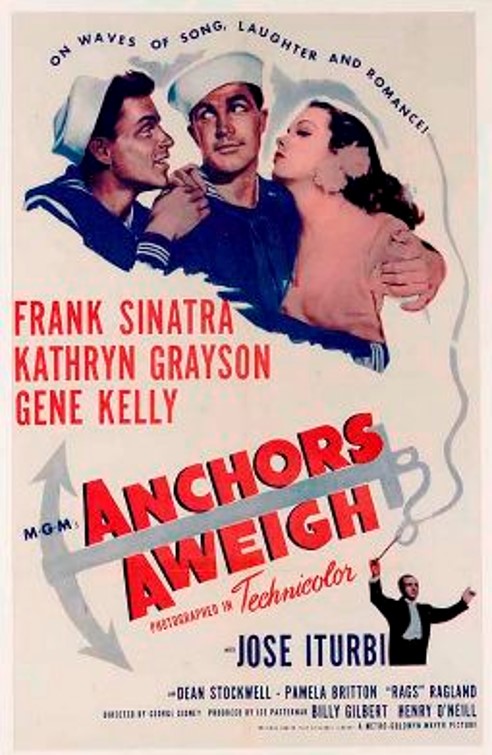
Who knew a Frank Sinatra movie would become the best one I saw in 2020? When I look back on this film, I remember how much fun I had watching it! As I said in my review, I spent most of my time smiling and laughing, which shows how the film’s joyful nature can certainly help anyone improve their mood. Anchors Aweigh is a strong movie on so many different levels. The acting, story, and musical numbers alone showcase how much thought and effort went into the overall production. If I were to introduce someone to the Breen Code era or musicals in general, this is the film I’d show them. Anchors Aweigh was certainly a bright spot in a year like 2020.
Anyone who knows me would know that one of my favorite movies is the Disney Channel film, Phantom of the Megaplex. In fact, this movie has had a great influence on my life, as it showed me that the world of film and the movie-going experience could be fun. Because its milestone 20th birthday was on November 10th, I decided to use my entry for my blogathon, A Blogathon to be Thankful For, to celebrate this special occasion. A lot has changed since 2000, especially the movie-going experience. With that said, this editorial will highlight how different a trip to the theater is now compared to its depiction in Phantom of the Megaplex. The actual birthday itself looked very different than expected, due to the months-long Coronavirus pandemic. For the sake of this editorial, I will be discussing today’s theater-going experience as if 2020 were a typical year. Also, all of the photos are screenshots I took, unless stated otherwise.
In Phantom of the Megaplex, Karen, the younger sister of the film’s protagonist, Pete, plans on arriving at the theater at 7:30 in order to catch a 7:50 showing of a movie called ‘University of Death’. When she and her younger brother, Brian, get to the theater, they are stuck waiting in a long line. This is the result of Movie Mason, a patron of the theater, spending more time persuading guests to see better films than taking their tickets. Fortunately, Karen isn’t late to her film. But, when she meets her friend outside the auditorium’s door, Karen and her friend briefly discuss the idea of their other friend saving seats for them. The example I just described shows how movie-goers in 2000 used to arrive much earlier than their movie’s run-time to not only purchase a ticket, but to also claim their seat of choice. In addition, movie-goers arrived early to the theater to avoid any unexpected hiccups like the one I mentioned. Twenty years later, it’s still encouraged to show up early to the theater so you’re not late to your film. However, buying tickets and choosing seats are not an issue like they were before. Thanks to the internet, movie-goers can purchase their tickets on their local theater’s website or from a third-party site like Fandango or Atom Tickets. Movie-goers are given an opportunity to reserve their seats as well. Had the story of Phantom of the Megaplex taken place now, all Karen and Brian would have to do is show an employee their pre-paid, printed out ticket and avoid a line like the one Movie Mason created.
The line on the left gives viewers an idea of how long Karen and Brian’s line was. They could have been walking up the stairs on the right with their pre-paid, printed out ticket if this movie was released in 2020.
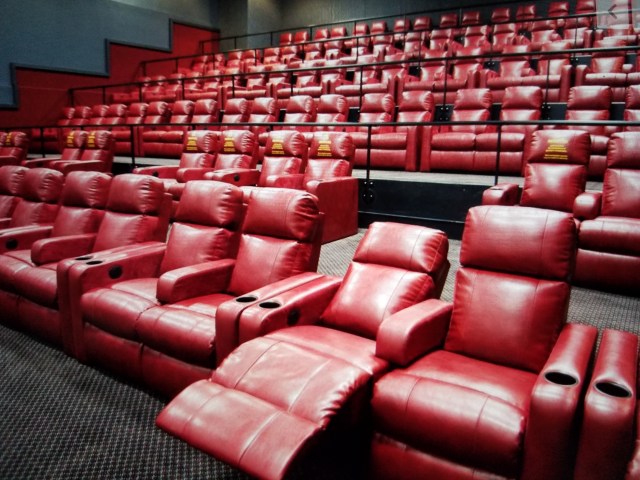
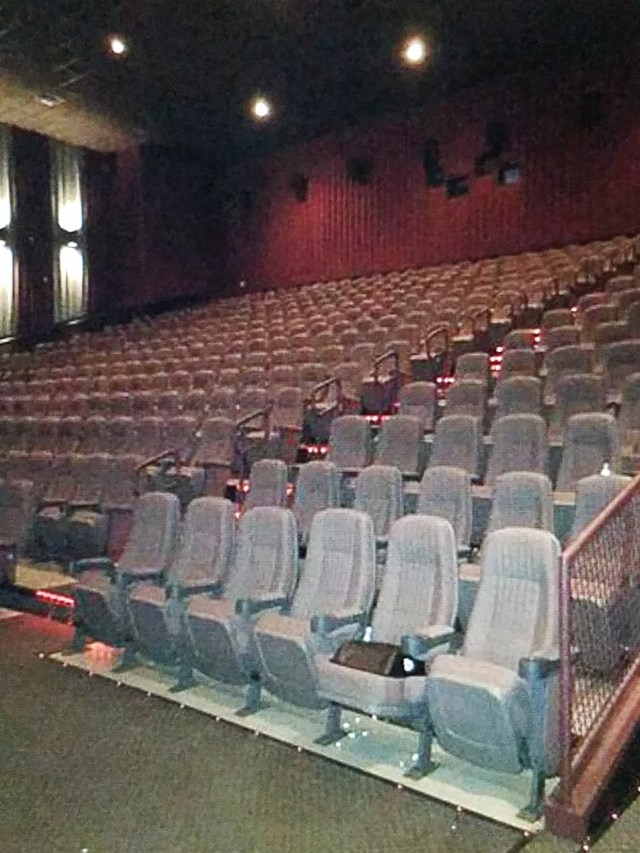
Several scenes in Phantom of the Megaplex show the auditoriums inside the theater. All of the chairs featured are covered in a red material with a folding seat. Theater-goers in 2000 would have this style of chair as their only option. But since then, more cinemas have adopted recliners. There are even theaters that have chosen other forms of seating, such as couches and lounge chairs. However, if you would like to sit in a theater chair from twenty years ago, there is one theater chain that has put these chairs to good use. Two Emagine theaters in Minnesota offer “retro seating”. According to the theater’s website, these are “retro auditoriums that don’t feature recliners, but have throwback seats with throwback prices”.
The Cotton Hills Megaplex is filled with red covered chairs with folding seats like the ones pictured above.
Because Phantom of the Megaplex is a family friendly film, bars would not be found at the cinema. However, theaters have added bars to their facilities within the past two decades. One example is AMC Theaters’ MacGuffins Bar. AMC’s official website states “the term “macguffin,” coined by Alfred Hitchcock, refers to a plot device that propels a movie forward”. The website, Run Pee (a site that informs audience members of the best times to take bathroom breaks during a movie), shares that MacGuffins Bar sometimes correlates drinks with the movies shown at the theater. One example is “a dino-themed bevvie when Jurassic World 2 was showing”.
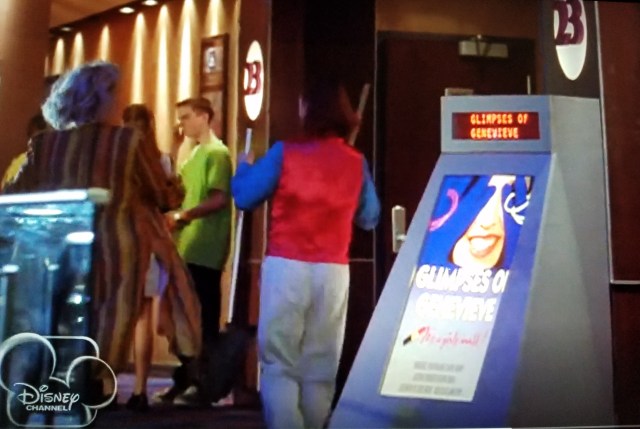
Throughout the Cotton Hills Megaplex, the theater where Phantom of the Megaplex takes place, a movie’s poster is located in front of the auditorium the movie will be playing. In a scene where the “Phantom” causes mischief, a poster for a movie titled ‘Glimpses of Genevieve’ is located right next to the theater’s twenty third auditorium. The film’s title is also electronically shown above the poster. Personally, I have never seen this particular set-up at any theater I’ve attended. Also, theaters today will either not have any indicator (besides the ticket itself) of what movie is playing in the auditorium or the film’s title will be electronically shown above the auditorium’s door. The poster itself will be located in another area of the theater, such as near the main entrance.
This image shows the poster for ‘Glimpses of Genevieve’ sitting right in front of Cotton Hills Megaplex’s twenty third auditorium.
My screenshot features an entrance to a cinema’s auditorium showing 2020’s Tenet. At this specific cinema, the film’s title is above the door.
Cinema Sitter
One of the characters in Phantom of the Megaplex is a “cinema sitter”, an elderly woman who walks around the premises and makes sure the theater’s patrons are on their best behavior. Her role is similar to that of a hall monitor, reprimanding guests who wander the halls of the Cotton Hills Megaplex. This is another concept that I have never seen or heard of at any theater I’ve attended. I’m also not aware of “cinema sitters” being an official component of movie theaters prior to the release of Phantom of the Megaplex. The only thing closest to a “cinema sitter” in real life is Harkins Theatres’ PlayCenter. This space, located in select Harkins Theatres, is dedicated to looking after children while their parents are seeing a movie. The PlayCenter itself would be compared to a typical day care center, a place where children can be occupied while their parents are away. According to the official Harkins Theatres website, “PlayCenter staff members are trained professionals who work exclusively in the PlayCenter. They are background checked and fingerprinted.”
Karen is trying to find Brian with the help of this cinema sitter. The cinema sitter takes her job so seriously, that her title is labeled on the back of her smock.
A row of payphones can be occasionally seen throughout Phantom of the Megaplex. From Pete calling his mom to one of Pete’s co-workers, Lacy, putting a phone back in the payphone holder, these payphones are used to scare Julie, Pete’s mom, and George, Julie’s boyfriend, into going to the cinema to check on Julie’s children. While I’m not denying the existence of payphones in movie theaters, I personally don’t remember seeing payphones in the cinema. Since the film’s release, cellphones, particularly the smart phone variety, have become more common in society. This modern advancement has ultimately led payphones to become more obsolete.
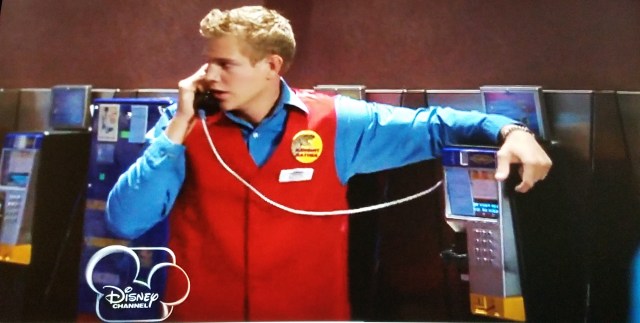
The row of payphones behind Pete are a reminder of how communication devices have changed.
Can you spot the payphone in this theater lobby?
The Projection Booth
The projection booth in Phantom of the Megaplex is operated by Merle, the head projectionist at the Cotton Hills Megaplex. When Pete and Brian ask Merle to resolve one of the “Phantom’s” shenanigans, Merle inspects the projector equipment to show Pete and Brian what likely happened. He even pulls a piece of film strip, proving that the movie itself had not been tampered with. In 2000, movie theaters were not utilizing digital cinema like they are today. Instead of using a digitized film reel or hard drives and internet links, theaters used film reels with strips of film. The closest thing to “state of the art” film projection cinemas had in 2000 was IMAX. Today, theaters are developing their own versions of this projecting concept. One example is Cinemark XD, found at Cinemark Theatres. According to the official website, Cinemark XD uses a “state-of-the-art projector capable of 35 trillion colors”.
In this scene, Merle pulls at a piece of film strip to show how it is perfectly intact.
In an effort to figure out the “Phantom’s” next scheme, Brian visits a movie spoiler website to discover the plot of an upcoming movie called “Midnight Mayhem”. The idea of spoilers has not changed in twenty years. However, the reveal of movie details has expanded beyond websites devoted to the concept. Spoilers can be found everywhere. Social media platforms have been avoided when big blockbusters are released. Warnings for spoilers can be featured toward the beginning of film reviews. Causal word of mouth may slip a major plot point into the conversation. With recent technological progress and the ability to connect with people from across the globe, it has actually become harder to prevent surprises in movies from being spoiled.
While today’s spoilers may be found on the internet, they’re not limited to exclusive websites, like the one pictured above, anymore.
Conclusion
Change is inevitable, especially when it comes to the movie-going experience. Through the lens of film, we are given an opportunity to glimpse the past, even if it is only for a few hours. Phantom of the Megaplex captures how the cinema operated in the beginning of the millennium. It serves as a time capsule for those who remember that specific place in time. The movie is also a reminder of how far cinematic technology and the cinema itself has come. As of November 2020, it is unclear to determine what the landscape of movie theaters will look like by the time Phantom of the Megaplex turns twenty-five. While technology in film has made tremendous strides, there is still a lot that can be done. But will there be a facility to showcase these discoveries? There is no straightforward answer that can be given right now. However, we can still celebrate a movie’s milestone birthday through home entertainment and the internet. Like Movie Mason once said, “tell my theater that even when I’m not here, its magic is never far from my heart”.
Created by me, Sally Silverscreen, on Adobe Spark.
For A Shroud of Thoughts’ 7th Annual Rule, Britannia Blogathon, I decided to choose a film that was already located on my DVR. Since last February, I have had a recording of the 2002 adaptation of Nicholas Nickleby. Because this story takes place in 19th century England and because this blogathon celebrates British cinema, reviewing the movie seemed like a perfect choice! Nicholas Nickleby is not the first adaptation based on a Charles Dickens novel I’ve written about. Within these two years, I have reviewed Oliver!, Oliver & Company, and The Death of Poor Joe. To tell you the truth, I didn’t even know Nicholas Nickleby was based on a book by Charles Dickens until I saw the film’s opening credits. This film selection is a blessing in disguise. It not only gives me an opportunity to watch more movies from my DVR, but it also allows me to expand my cinematic horizons!
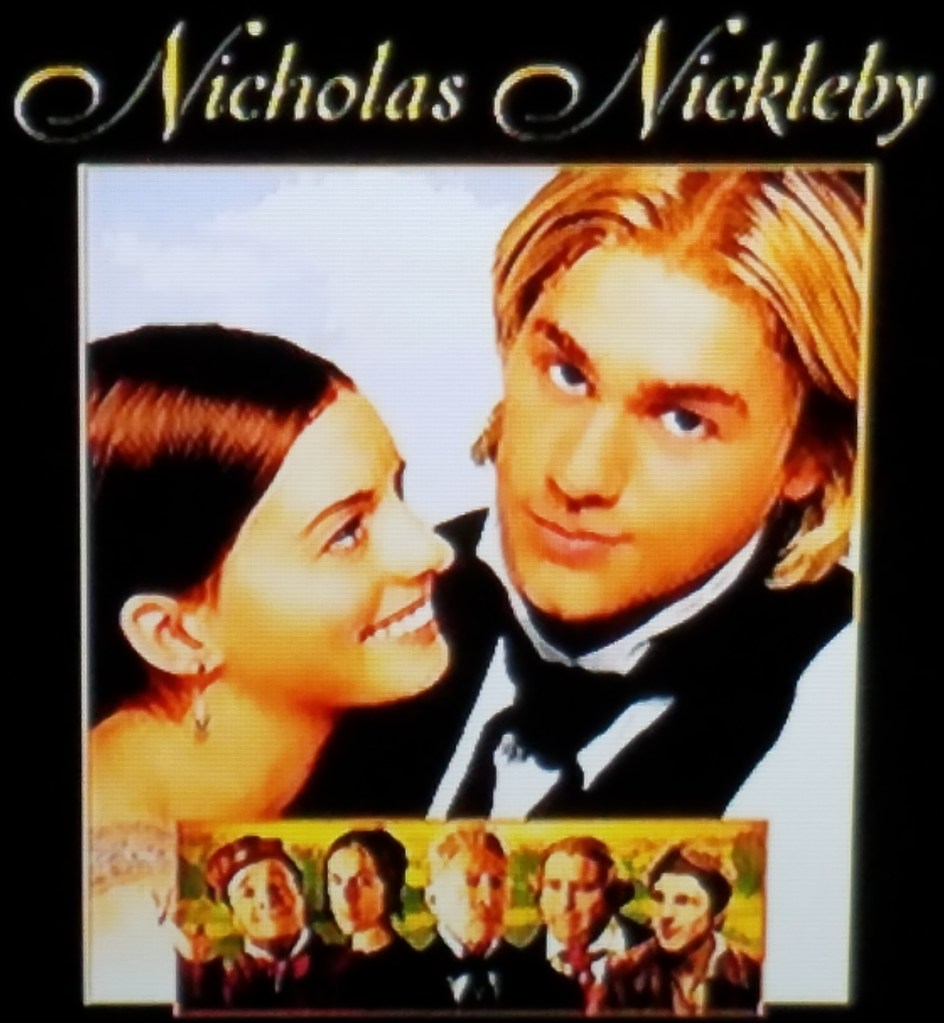
This is a screenshot I took with my phone of the movie’s poster that was displayed on my television. Screenshot taken by me, Sally Silverscreen.
Things I liked about the film:
The acting: Nicholas and Smike have one of the most beautiful friendships I’ve ever seen put on film! This is the result of good screen-writing and good acting! Charlie Hunnam and Jamie Bell put emotion and heart into their individual roles. Together, they display strong on-screen camaraderie. A great example is when Nicholas is trying to read a story to Smike at Dotheboys Hall. Nicholas Nickleby contained an ensemble cast. Each actor and actress worked well with one another, as the performances complimented and highlighted every talent shown on screen. From Anne Hathaway’s use of various emotions to Christopher Plummer’s consistency, all the interactions brought out the best in each cast member!
The dialogue: As I just mentioned, Nicholas and Smike’s friendship was partly the result of good screen-writing. The movie’s screen-writing is also what caused the dialogue to be so memorable! Every piece of conversation reflected this film’s time period. However, the dialogue sounded eloquent without being pretentious. It was also easy to understand, allowing the audience to make sense of what the characters are saying. In one scene, Nicholas is helping Smike escape his kidnapping. The way he told Smike to hurry out of his current location contained urgency and importance. Conversations like the one I just referenced were a consistent and present component of this film!
A balance of despair and joy: I haven’t read Nicholas Nickleby, but I have read Oliver Twist. From what I remember, Charles Dickens found a way to balance the ideas of despair and joy. This balance can be found in the 2002 film! In the movie’s darker moments, despair could be seen and felt. It showed how ugliness presented itself in Nicholas’ world. But there was not so much of this ugliness and despair to make the audience feel depressed. Moments of joy and happiness served to counteract the darker moments. When joyous scenes occurred, they felt earned by the characters. At the same time, they didn’t make it seem like the rest of the film couldn’t be taken seriously. Instead, the incorporation of joy showed how there was beauty in the world, especially if Nicholas searched for it.
Lots of content in a limited time-frame: Having read two of Charles Dickens’ books, I know there is a lot of content in his stories. While watching Nicholas Nickleby, I could see there was a significant amount of content. The movie is two hours and twelve minutes. But because each plot point was seen as important, the run-time was bogged down by the large number of storylines. This caused the film to feel longer than its run-time. It makes me wonder if this particular narrative would have benefitted from a mini-series format?
Some unsmooth scene transitions: There were a few scene transitions in Nicholas Nickleby that weren’t given smooth transitions. When the story shows Kate’s, Nicholas’ sister’s, perspective, the chapter comes and ends more abruptly than other scenes. It almost feels like the plot temporarily shifts the protagonist role from Nicholas to Kate. Even though Kate plays an important role in Nicholas’ life, she is a supporting character, while her brother is the main character.
Nicholas Nickleby is the fourth adaptation of one of Charles Dickens’ works I’ve reviewed on 18 Cinema Lane. Out of these four, the best one is still the 1968 musical Oliver! Because I have read its source material, I know there was some content that was cut from the movie, likely for reasons relating to the run-time. Unlike Oliver!, Nicholas Nickleby contained a lot of content that effected its run-time. However, the story was understandable and the screen-writing was strong! Even though there were a few unsmooth scene transitions in Nicholas Nickleby, it never became a common occurrence. What was common was great acting performances, well-written dialogue, and relatable messages! Nicholas Nickleby does a good job at showing how there is both darkness and goodness in our world. In a year like 2020, where it seems like there is one conflict after another, it can be easy to forget the beauty this world can offer. Because of his bad and good experiences, Nicholas Nickleby always perseveres and never takes anything for granted. This is what we can learn from Nicholas’ story, whether or not Charles Dickens intended to teach his readers.
Overall score: 8.2 out of 10
Have you seen any adaptations from Charles Dickens’ work? Are there any British films you enjoy watching? Share your thoughts in the comment section!
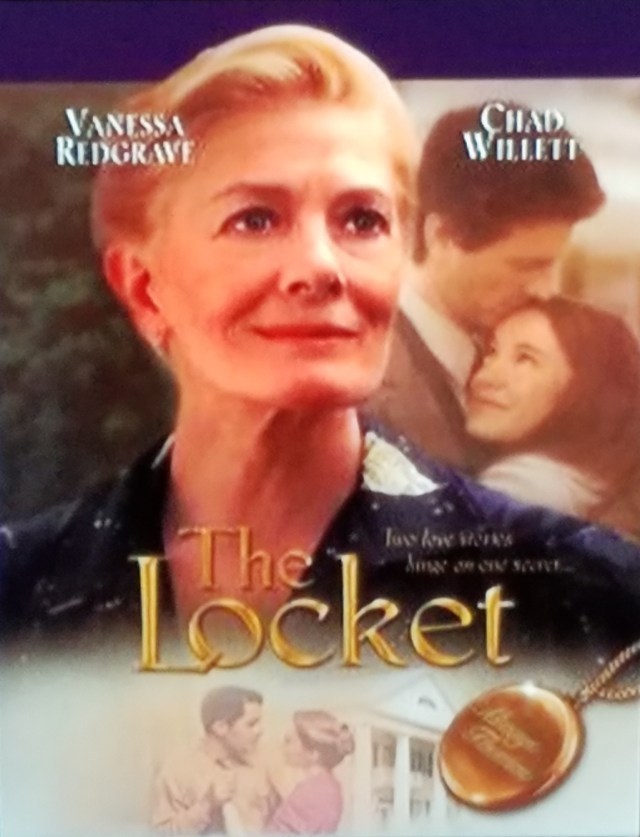
At the end of last month, 18 Cinema Lane received 225 followers! Because of my participation in the Esther Williams Blogathon and the 4th Alfred Hitchcock Blogathon, I postponed this blog follower dedication review to this week. In that time, my blog also received 230 followers! Originally, this review was going to serve as an entry for the A Month Without the Code Blogathon. But because of everything I just said, I decided this post was only going to be a blog follower dedication review. I haven’t talked about a Hallmark movie in two months, with Nature of Love being the latest one. So, I chose Hallmark Hall of Fame’s The Locket for this review. This is a movie I’ve wanted to watch for a few years. One of the reasons was Marguerite Moreau’s involvement in the film. After watching Queen of the Damned, I discovered she had starred in this Hallmark project from 2002. WhenHallmark Drama aired it recently, I knew I had to record it on my DVR!
Because I watched this movie through a television recording, I took a screenshot of the poster with my phone. Screenshot taken by me, Sally Silverscreen.
Things I liked about the film:
The acting: BecauseMarguerite Moreau is one of the reasons why I watched this film, I’ll talk about her performance first. Even though I haven’t watched many of her movies, I’ve noticed how her portrayals feel believable with what her character is experiencing. This is certainly the case for her performance in The Locket! Faye, Marguerite’s character, always appeared natural in her responses to various situations. It allowed me to stay invested in her part of the story. Another aspect to Marguerite’s performance is how her transitions between emotions were flawless! One good example takes place after Faye and Michael deliver Christmas gifts. Toward the beginning of this interaction, Faye is happy to spend time with her boyfriend. As she notices his demeanor, Faye’s face changes to showing an expression of concern. Speaking of Michael, I need to talk about Chad Willett’s performance. Throughout The Locket, Chad used a wide range of emotions. In a scene where Michael visits someone from his past, he appears angry and can be seen crying. Another scene, when Michael is telling Faye about his scholarship, shows him displaying happiness on his face. This part of Chad’s performance made the overall portrayal seem dynamic! I can’t review this movie without discussing Vanessa Redgrave’s performance. What I liked about it was how honest it came across. This component added depth to Vanessa’s portrayal. A good example is her character’s, Esther’s, first encounter with Michael. When he’s changing her bedsheets, Esther compliments Michael for not telling her she’s still beautiful. This is because she thinks that statement is silly.
Whitewood Nursing Home: A significant part of this story takes place at a nursing home called Whitewood. Despite this location serving a medical purpose, it didn’t feel like a medical facility. In fact, it looked and felt like a bed and breakfast! The interior design consistently ran throughout the home. Furniture helped make the rooms seem cozy, with armchairs in the bedrooms and main living room adding to this aesthetic. Detailed and flowery wallpaper displayed soft, pastel colors. This caused the overall location to have a calming effect. Fireplaces made of brick and wood completed the interior design of the rooms, making the home feel inviting. The exterior design of Whitewood is a large white wood structure, hence the name of the facility. These factors gave the impression of the home carrying a sense of importance. Because it is important to take care of the older members of a community, this appearance of the nursing home is fitting.
The on-screen chemistry: As I mentioned earlier in this review, Michael and Faye are in a dating relationship. Anytime they interacted with each other, I could tell Chad and Marguerite had strong on-screen chemistry! This caused their characters to feel like they truly cared about one another. Faye’s first visit to Whitewood is a good example of this. When Faye meets up with Michael, I could see her investment in what is happening in Michael’s life. This investment can also be seen when Michael learns about Faye’s acceptance into medical school. Non-romantic relationships also had good on-screen chemistry! Michael’s friendship with Esther came across like they got along well. It also effectively showed how they tried to understand each other. The scene where Esther explains the locket’s importance to Michael serves as one example.
I couldn’t review this film without featuring a picture of a locket. Screenshot taken by me, Sally Silverscreen.
What I didn’t like about the film:
The under-utilization of Marguerite Moreau: Marguerite is not only the third billed actor in this movie, she is also the main supporting actress. Despite this, she was kind of under-utilized in The Locket. While she was given enough material to make her performance memorable, her on-screen presence was not as consistent as I expected. Most of her appearances can be found in the film’s first half, with her character barely appearing in the second half of the movie. This makes me wonder if Marguerite was working on Queen of the Damned around the same time she was working on The Locket?
The locket is an afterthought: Before watching this film, I had expected the locket itself to affect the lives of the people surrounding it. Because the movie is called The Locket, I thought this artifact would have a large influence over the story. Sadly, this piece of jewelry ends up being an afterthought. Most of the film revolves around Michael and his hardships. When an explanation of the locket’s importance is finally given, happening about forty-five minutes into the movie, it takes place during one dialogue and video heavy scene. What would have made this artifact emotionally affective is if flashbacks from Esther’s life or from around the time Esther received the locket would have been sprinkled throughout the story.
Scenes that feel rushed: There were some scenes in The Locket that, to me, felt rushed. In one scene, Michael is at the VA Hospital, picking up a prescription for a patient at Whitewood. The very next scene shows Michael sharing some good news to Esther. Scenes like the one at the VA Hospital made it seem like the film’s creative team wanted to get certain parts of the story done and over with just to get to the next point. What also doesn’t help is how these scenes didn’t have effective transitions. It caused scenes like the one with Michael and Esther to feel too sudden.
Before I talk about my overall impression, I’d like to thank all of my followers who helped my blog reach this milestone! Your investment in 18 Cinema Lane plays a role in its overall success! Now, time to discuss my final thoughts on The Locket! As glad as I am to have finally seen this movie, I recognize there are Hallmark Hall of Fame titles with similar ideas that are stronger than this one. Two examples are the 1998 film, Grace & Glorie,and 2011’s The Lost Valentine. One thing that The Locket was missing was an emphasis on the locket itself. Instead of having a story where this piece of jewelry impacts the lives surrounding it, the audience received a narrative where the locket is treated as an afterthought. I know there were three Hallmark Hall of Fame movies released in 2002. But, for whatever reason, there were times when The Locket felt rushed. Despite these flaws, the movie did have its strengths. The acting was definitely a high-light of this project, especially Marguerite Moreau’s performance! For me, she stole the show and even outshined the other actors involved! I just wish her on-screen presence would have been more consistent.
Overall score: 7.2 out of 10
Is there a Hallmark Hall of Fame movie that you enjoying? Would you like to recommend a Hallmark Hall of Fame film for me to review? Please let me know in the comment section!
This editorial was written before Valentine’s Day.
Ah, Valentine’s Day. A day when the general theme of love is celebrated. The colors of red and pink are a signature staple whenever February 14th comes around. Hearts are the official shape of the holiday, sometimes filled with candy. This special day is usually known as a happy occasion, a time we can set aside to show the people around us how much we truly care about them. Movie fans sometimes take part in Valentine’s Day festivities by talking about their favorite cinematic couples, sharing their opinions on why they think these relationships are romantic and using a selection of movie quotes and scenes to prove their point. However, we movie fans know that not every cinematic relationship is a healthy one. Some of them are down-right toxic. In this editorial, I will be talking about a cinematic relationship that I, personally, feel is very problematic. By looking at the title, you might already know which on-screen couple I will be talking about. Last October, when I reviewed Queen of the Damned, I mentioned that, to me, Lestat and Akasha’s relationship was one of the most problematic relationships I’ve ever seen in a movie. However, I was only able to briefly explain why I feel this way. Because of my involvement in the Ultimate 2000s blogathon, I now have a chance to explain, in detail, why this particular cinematic relationship is not a healthy one. Before I begin this editorial, I would just like to say that I am only creating this post out of pure honesty and based on my opinion. I am in no way creating this post to be mean-spirited or be negative toward anyone’s cinematic preferences/opinions. In this editorial, I will specifically be referencing the characters and story from the Queen of the Damned film. I will be bringing up specific scenes and quotes in order to prove my point. Now, let’s talk about why Lestat and Akasha’s relationship is problematic by looking at five key areas: lack of consent, lack of communication, a power imbalance, intentional harm toward a significant other, and a not-so-loving significant other.
One of the most important components to any romantic relationship is consent. Asking someone’s permission and making sure that both members of a relationship are comfortable before putting themselves and each other in any situation is usually seen as a sign of how much the other person cares for the one they love. Unfortunately, Lestat and Akasha’s relationship is lacking in this department. In my Queen of the Damned review, I mentioned that Akasha is the one who controlled the relationship, using the analogy of Akasha driving a car and Lestat being stuck in the passenger seat. This is not only true, but it’s also important to keep this truth in mind when discussing these five key areas of Lestat and Akasha’s problematic relationship. The first instance of Akasha not asking for Lestat’s consent happens at his concert. During a performance at his concert, a group of vampires climb up on stage and try to hurt Lestat. Marius tries to fight off these vampires in order to protect Lestat, but eventually he and Lestat are surrounded by even more vampires. While Akasha shows up, in the middle of the concert, and defeats these vampires, she ends up taking advantage of the situation. Akasha crashes through the stage (as if the concert were her own, making a showstopping entrance in the process), takes Lestat against his will, and leaves. We, the audience, never see her ask Lestat if he wants to go anywhere with her or if he even wants to leave his concert. In fact, we never see Akasha make an effort to contact Lestat and make plans with him ahead of time. While Akasha took away Lestat’s chance to choose whether or not he wanted to leave, this is not the last time Akasha refused to ask for his consent.
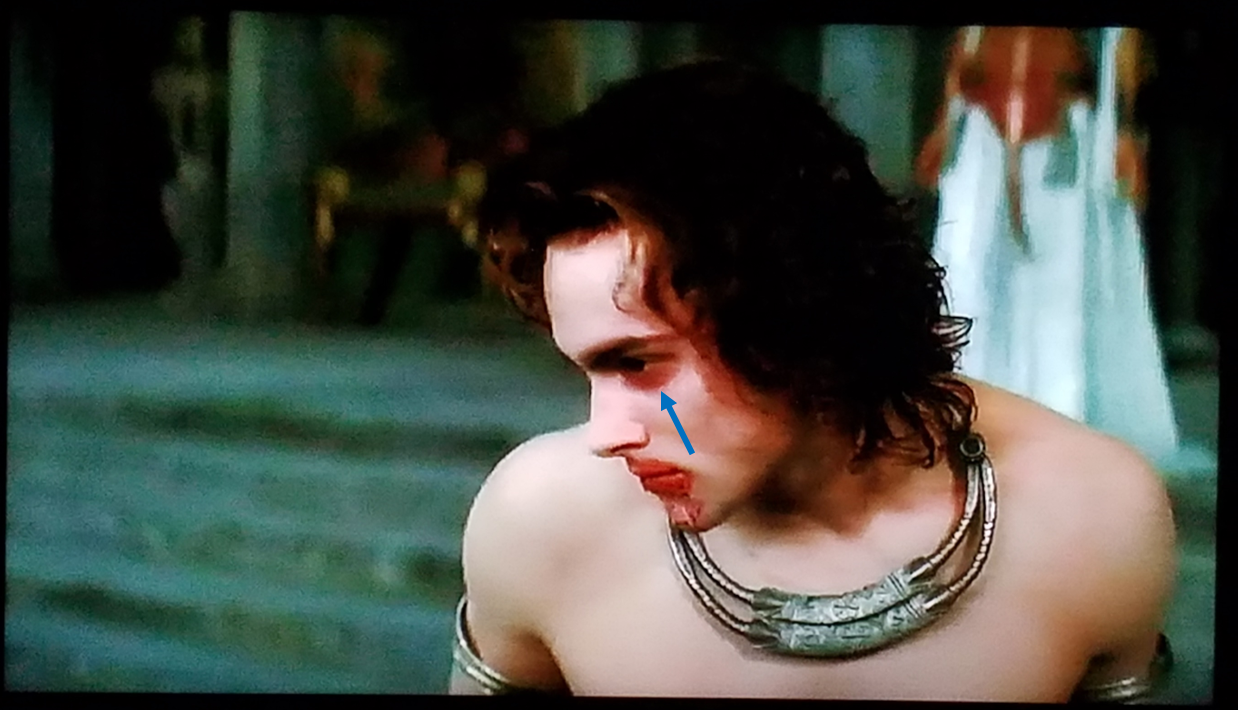
After Akasha and Lestat leave his concert, they arrive at her house. During their conversation, Akasha briefly mentions her deceased husband. When Lestat asks Akasha about her late husband’s whereabouts, she tells him, “He’s no more. Now you are my consort”. Here, Akasha is not only forcing Lestat to be her new husband, but also forcing Lestat into a marriage that he has very little interest in being a part of. Once again, Akasha chose not to ask Lestat if he was ok with being in a relationship with her or if he wanted to be married to her at all. She refuses to give him a choice or a chance to voice his concerns. After this conversation, Lestat and Akasha have an intimate moment with each other in a tub filled with water and red rose petals. We, the audience, don’t see Akasha asking Lestat if he’s comfortable with the situation or if he even wants to be in the situation. During this scene, it appears, at times, that Lestat is comfortable sharing this intimate moment with Akasha. However, there are a few times when Lestat appears as if he’s slipping out of consciousness. While body language can be helpful in figuring out what someone wants or needs, body language only tells a part of the story. It seems as if Akasha only relied on a select portion of Lestat’s body language in order to receive the message she wanted to hear. Whenever Lestat appears to be slipping out of consciousness, Akasha never addresses Lestat’s reaction or asks him if anything is wrong. She just acts like nothing out of the ordinary is happening.
If you focus on Lestat’s eye in the picture (highlighted by the blue arrow), it appears that it is very close to closing. His eye also shows that Lestat is not focusing on the situation that he is a part of. Screenshot taken by me, Sally Silverscreen.
Lack of Communication
A necessary component that is interwoven with consent is communication. In a romantic relationship, words are needed to share feelings, address concerns, and build/strengthen a bond. As I mentioned before, Akasha is the one controlling her relationship with Lestat. Therefore, she is controlling their conversation. During their first conversation at her house, Akasha is talking at Lestat and not to him, leaving very little room for Lestat to contribute to their conversation. In fact, half of this conversation is about Akasha. For example, when she tells Lestat about things she has observed about him, she says “You live your life in the open, like I did”. After she tells Lestat that he is now her husband, Akasha tells him “That’s why I kept you safe. Alive”. It seems like Akasha always finds a way to insert herself into the conversation. She doesn’t want to bother with Lestat’s perspective on anything. It is clear that Akasha is not interested in participating in an equally balanced conversation between her and Lestat.
It’s also important to observe how Akasha talks about Lestat. She mostly refers to him as “my love” or “my king”. However, she only addresses Lestat by his name on less than three occasions. Based on this observation, it appears that Akasha wants to highlight her connection to Lestat, almost as if she holds a sort of ownership over him. During the film’s climax, when Lestat is drinking some of her blood, Akasha tells the other vampires in her presence “You see how he obeys me”. In that sentence alone, Akasha not only refuses to address Lestat by his name, but it also seems like Akasha does not see Lestat as an equal sigfinicant other to her, but instead something she feels she can control.
In a healthy relationship, both members should be equal to one another. Any type of power should be shared amongst each other and a balanced amount of control should be given to each member of that relationship. Unfortunately, this is not the case for Lestat and Akasha’s relationship. Because Akasha is a queen and one of the first vampires ever created, according to Queen of the Damned, Akasha feels she has the right to do, say, act, and treat others whatever and however she wants. This is why Akasha is the one controlling her relationship with Lestat, because she feels she is the most important and powerful vampire in that particular cinematic world. In the morning, after Akasha takes Lestat to her house, she tells him “This is but a taste of what we shall share, my love. My king. Behold our kingdom”. However, Akasha purposefully leaves him out of the process of building their “kingdom”. Lestat wakes up all alone and, later, finds several dead mortals at the pool and on the beach. He has no idea where Akasha is until she shows up minutes later. During this conversation, Lestat appears to be unhappy with what Akasha is telling him, even looking disgusted when Akasha talks about the dead mortals on her property. In their relationship, Lestat and Akasha never make any decisions together, don’t discuss any matters of importance, or comtemplate Lestat’s new “title”. It honestly feels as if Lestat and Akasha aren’t on the same page, let alone the same book.
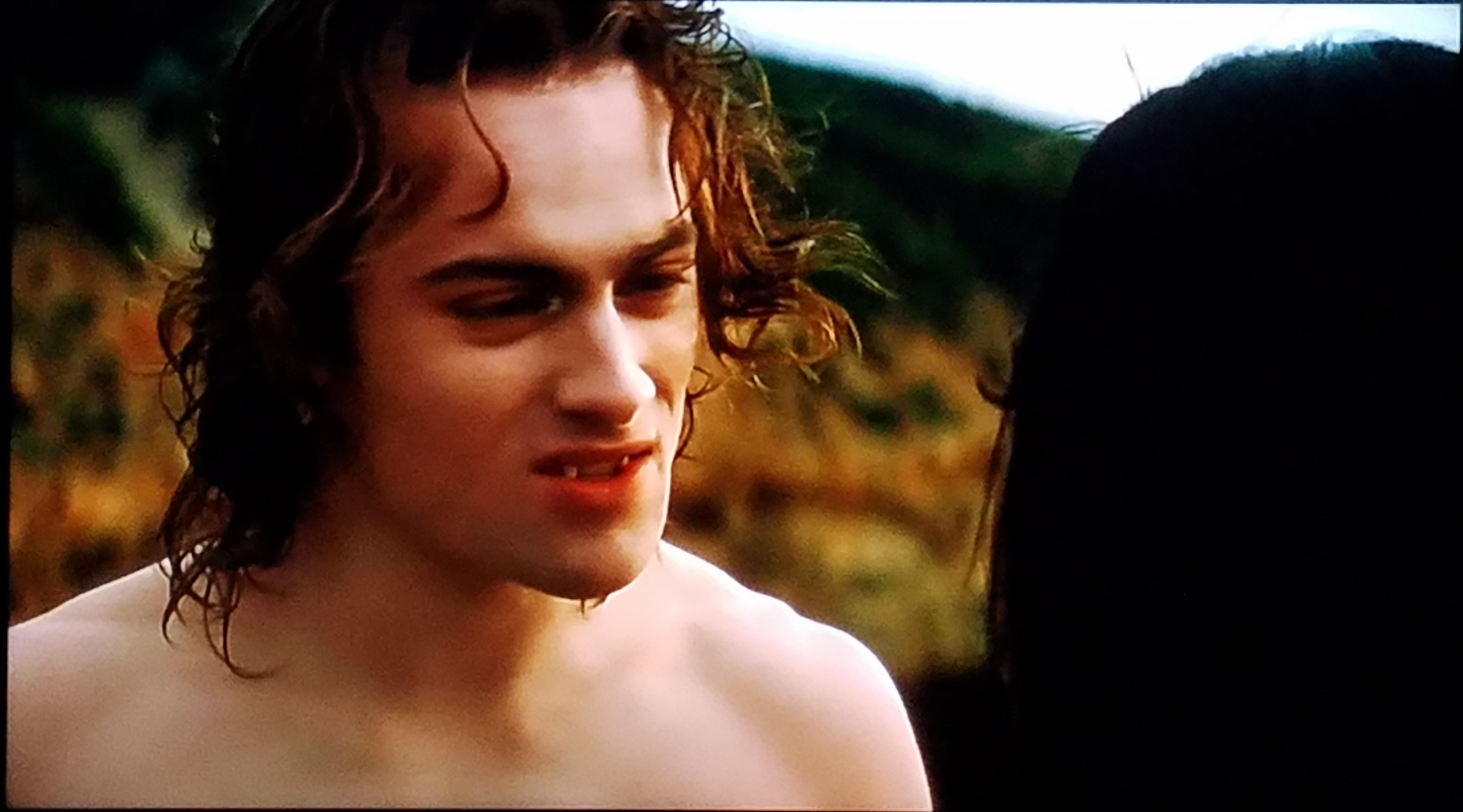
Because of Akasha’s title and her amount of control in their relationship, it appears to be negatively affecting Lestat as a person. Earlier in the film, Lestat is interacting with two female fans. When one of the fans tries to physically take adventage of him, Lestat pushes her hands away and tells her “Don’t do that”. Since there was no power imbalance present in this interaction, Lestat appeared comfortable addressing this fan’s error in not asking for his consent. In his relationship with Akasha, Lestat says very little to her. In the two conversations they had at her house, Lestat only asks short questions. At Marahet’s house, during the film’s climax, Lestat mostly stays silent, more often than not speaking when someone is addressing him. During their intimate moment in the rose petal filled tub, Lestat doesn’t say a word to Akasha, even when she bites his chest. Based on his reaction, it seems like Lestat was negatively affected by her actions. But he doesn’t speak up about these actions to Akasha. It’s hard to tell if he is remaining quiet out of fear or to play along with Akasha’s plan in order to defeat her. Throughout their relationship, the audience doesn’t receive any voice-overs from Lestat like in previous scenes within this film.
In this photo, Lestat is clearly not pleased with what Akasha has said and done regarding the dead mortals on her property. Unfortunately, Akasha doesn’t seem to want to address Lestat’s feelings about the situation. Screenshot taken by me, Sally Silverscreen.
Intentional Harm toward a Significant Other
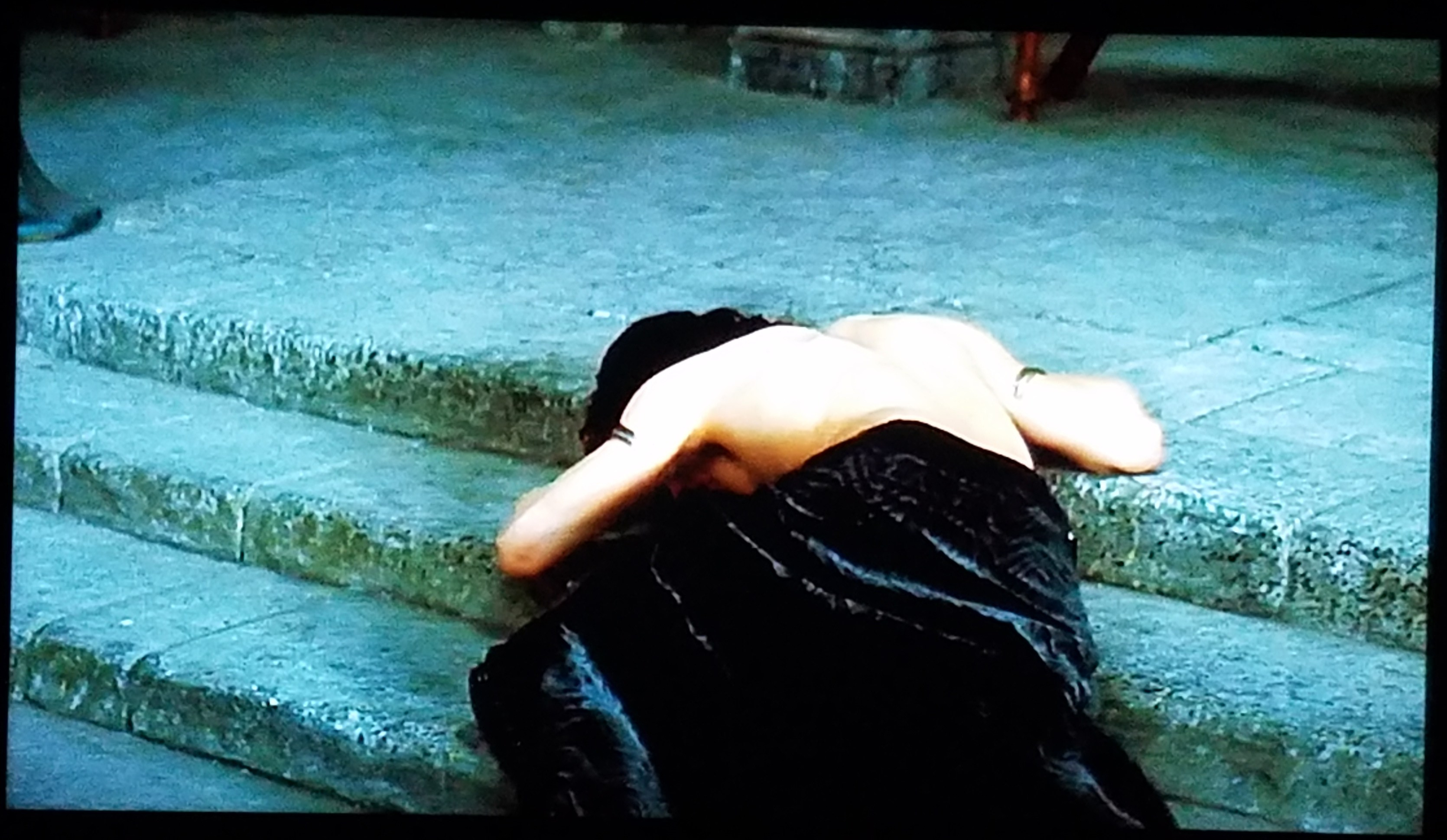
When we think of a typical, healthy relationship, we think of significant others who treat each other with kindness and respect. Images of loving actions, such as hugging and snuggling on the couch, sometimes come to mind. In Lestat and Akasha’s relationship, we never see them perform loving actions toward each other, such as hugging. Even though they have an intimate moment on two separate occasions, both of them involving a lot of kissing, that is the closest thing to a loving action we see throughout their relationship. During Lestat and Akasha’s intimate moment in the rose petal filled tub, Akasha decides to bite Lestat’s chest. This causes him to flinch in pain and have a bloody wound on his chest. Akasha, however, does not seem to care that she has physically hurt her “husband”. Instead, she continues to kiss Lestat as if nothing ever happened. Lestat also never mentions this incident to Akasha or anyone else. The next day, at Maharet’s house, Lestat drinks some of Akasha’s blood. When Akasha is trying to make Lestat stop, she physically pushes him to the point of, practically, throwing him. This causes Lestat to fall on cement stairs. Fortunately, Lestat does not appear to receive any injuries from this incident. As for Lestat, the only thing closest to a harmful action toward Akasha happens on two occasions; a) When Lestat is drinking her blood, but in this situation, he is pretending not to stop in order to provide a distraction so the other vampires can have a chance to defeat Akasha and b) When Lestat drinks Akasha’s blood again, but this time, to protect himself and the others at Maharet’s house from Akasha’s dangerous and villainous ways.
If you look inside the blue circle in the picture, Akasha’s act of biting Lestat’s chest caused him to be wounded. Even though it’s a little difficult to see, you can still tell that Lestat’s wound looks like it needs some sort of medical care. Screenshot taken by me, Sally Silverscreen.
As you can see in the photo, those stairs look like they are made of rough cement. Though Lestat didn’t receive any injuries from falling on these stairs, he could have gotten painful scrapes and bruises. Screenshot taken by me, Sally Silverscreen.
A not-so-loving significant other
For any romantic relationship, there needs to be a significant amount of love between those two people. A true love where both individuals love that person for who they are as well each other’s characters is an important ingredient. In Lestat and Akasha’s relationship, however, it never feels like they truly love each other. Because Lestat was forced into the relationship by Akasha, it doesn’t seem like he is invested in the relationship. Meanwhile, Akasha claims to love Lestat, but her reasons for loving him make one wonder if her intentions are self-centered. Earlier in Queen in the Damned, Akasha visits a vampire bar. When she arrives, she sees Lestat on television. When a patron at the bar asks if she likes Lestat, Akasha replies by saying “He reminds me of someone”. Days later, when Akasha forcibly takes Lestat to her house, she tells Lestat “Now you are my consort. That’s why I kept you safe. Alive”. As Lestat asks her if she really did save him at his concert, Akasha asks him “You thought it was all you” and then says “The ego of a king as well”. Based on what Akasha has said, it seems like she loves Lestat because he reminds her of her deceased husband. Though she never directly tells Lestat or anybody this, it is left to be assumed by the audience.
During their relationship, Akasha doesn’t really make an effort to get to know Lestat. In fact, she assumes she knows enough about him in order for their relationship to work. In their first conversation at her house, she tells him “all your wishes are come true”. When Lestat asks Akasha to specify what wishes she’s referring to, she tells him “For a companion. To share eternity”. Prior to this interaction, Lestat never mentioned anything about wanting or needing a companion. In fact, when Marius visits Lestat in Los Angeles, he tells Marius “I only have myself. You taught me that”. Also, during Akasha and Lestat’s first conversation at her house, she tells him “You’re bold, like your music” and “I know you, Lestat. I know that you crave to have the world at your feet”. Two things happen because of Akasha’s assumptions. The first thing is Akasha is basing her knowledge of Lestat on the image he’s presented as a musical performer. She’s only listened to a few of his songs, seen him on television once, and interrupted his concert. The musical side of Lestat is only a small part of him, so Akasha does not have as much information about him as she thinks she does. The second thing is Akasha assumes she knows what Lestat wants. Throughout the film, Lestat has said that he wants to walk in the light and not hide in the shadows. But, because Akasha does not take the time to ask Lestat what he wants, she gives him a royal title that he did not want or ask for. In Lestat’s case, he knows enough about Akasha to know what kind of a person she is. All of his knowledge of her comes from Marius, after Lestat stumbled across Akasha’s statue-esque being in Marius’ house. While in Los Angeles, Marius shares with Lestat that not only has his music woken Akasha up, but that she also killed her husband and took his blood and powers.
As I’ve said before, Akasha is the one controlling this relationship. This causes her to feel like she can do and say whatever her vampire heart desires. Despite the fact that she is the film’s villain, she doesn’t seem to have any trace of kindness or empathy toward others. At Maharet’s house, during the film’s climax, Akasha asks Lestat if he loves her. When Lestat says “Yes”, Akasha says “Then prove it” and orders him to kill Jesse, a woman that Lestat not only knows quite well, but also would rather be in a romantic relationship with. If two people love each other, they do not need to prove anything to the other person. Their actions and choices should speak for themselves. By Akasha forcing Lestat to prove his “love” for her by hurting someone else shows that Akasha doesn’t really think that highly of Lestat or anybody that he personally knows. If their relationship was healthy, Lestat’s love for his significant other would be enough proof that he cares about that person. It seems no matter what Lestat does or says, it will never be good enough for Akasha.
If you look at Lestat’s eye (highlighted by the blue arrow), you can see that he looks sad about being forced to hurt Jesse. It also seems like he is sad about the way he is treated by Akasha. Screenshot taken by me, Sally Silverscreen.
While Lestat and Akasha’s relationship is very problematic, it fortunately does not last long. Lestat and the other vampires at Maheret’s house are able to successfully defeat Akasha. This allows Lestat to escape this toxic relationship and enter a healthy, romantic relationship with Jesse. When I’ve read reviews for Queen of the Damned, no one had brought up Lestat and Akasha’s horrible, but short-lived relationship. It also doesn’t help that this film’s marketing campaign paints their relationship in a very different light. On the film’s poster, Lestat and Akasha are the only two people featured in the image. In the trailer, not only are Lestat and Akasha the only two characters who are prominently featured, but the movie’s footage and the voice-overs are set up in a way that makes it seem like Lestat chose to be in a relationship with Akasha and had contemplated turning to the dark side. As my editorial and the film itself shows, this is far from the truth. Even though movie fans would, probably, rather talk about the cinematic relationships worth rooting for, it’s important to take the time to talk about the not-so-healthy relationships in film. When observing these choices and behaviors, we movie fans and people in general can learn how not to treat others as well as leading a better example in our own real-life relationships, whether or not they’re romantic. It will not only make for a better Valentine’s Day, but also for better and many years to come.



















 18 Cinema Lane