The Top 10 Worst Movies I Saw in 2022

My worst movies list of 2022 is different from that of the previous year. This time, I’ll be talking about more films that were “so bad they were bad”, as only three of these movies were disappointments. The Dishonorable Mentions portion of the list has also returned! Though I did see more good movies than bad, I couldn’t avoid coming across a “stinker” every now and then. I like to think I’ll, one day, see less than ten films for my annual worst list. But someday has not come this year, as the title of this article suggests. As I’ve stated in past lists, I did not write my list to be mean-spirited or negative. It’s just a way to express my own, honest opinion. Since some of these films have been reviewed on my blog, I will provide links to those reviews.

Dishonorable Mentions

Signed, Sealed, Delivered: The Vows We Have Made, A Place for Annie, Swim Instructor Nightmare, Nikki & Nora: Sister Sleuths, The Corsican Brothers (1985), and Donnie Brasco (I only watched forty minutes of the film before turning it off)

<a href=”http://<a href=’https://www.freepik.com/vectors/new-year’>New year vector created by freepik – http://www.freepik.com</a>&quot; data-type=”URL” data-id=”<a href=’https://www.freepik.com/vectors/new-year’>New year vector created by freepik – http://www.freepik.com2022 Changing numbers image created by Freepik at freepik.com

10. The New Adventures of Heidi

In 2022, I was hoping to finally find my coveted “so bad, it’s good” movie. Sadly, The New Adventures of Heidi was not it. As I said in my review, this film is “spectacularly average”. The more I think about the 1978 made-for-tv movie, the less justifiable reasons I can think of for the project’s existence. Yes, The New Adventures of Heidi was intended as a “modern” re-telling of Johanna Spyri’s story. But the movie didn’t feel unique enough, despite all the changes. Every year I’ve participated in the So Bad It’s Good Blogathon, there has been a pattern between movies that turned out ok and movies that were just disappointing. Hopefully, in 2023, I can break this pattern.

Take 3: The New Adventures of Heidi Review

9. Love in Wolf Creek

When I first read the synopsis for Love in Wolf Creek, I was excited at the idea of a “cozier” story filled with adventure and excitement. The 2022 television film seemed better on paper than in practice. For a movie titled Love in Wolf Creek, there was very little romance in the story. The writing was weaker than I hoped, filled with scenarios that were too unrealistic for my liking. This project was too ambitious for INSP, the network who created the film. It was so disappointing, I didn’t bother watching its sequel, Christmas in Wolf Creek.

8. Harvey (1950)

I think the 1972 Hallmark Hall of Fame adaptation of Harvey is better than its 1950 predecessor. While I’m aware how controversial my opinion is, the 1972 film had more success executing its intended points. A mistake the 1950 movie makes is trying to be a comedy and a drama. This decision led the comedy to not only be underutilized, but also showcased medical negligence in a way that didn’t sit well with me. “Magical realism” was lacking in the 1950 film. This took away any opportunity for the story to be charming and whimsical. When I reviewed Harvey back in January, it was the most disappointing movie I saw in 2022. Now, eleven months later, the 1950 picture still holds that title.

Take 3: Harvey (1950) Review

7. Journey

The 1995 Hallmark Hall of Fame presentation made the same mistake Durango did: not giving the audience a reason to care about the characters and their story. In the case of Journey, the creative team failed to provide explanations for the characters’ choices. At the beginning of the film, the protagonist’s mother, Min, abandons her family, claiming she hates her parents. But the script never explains why she made this decision. Even when there are cut-away scenes featuring Min, she isn’t doing anything significant. How am I expected to care about Min’s choice affecting her family when I don’t even know why she left in the first place?

6. My Mom Made Me Do It

According to a synopsis I read for this 2022 Lifetime film, the protagonist, Jade, turns to stealing in order to help her mom pay the bills. Both the title and synopsis turned out to be a lie because 1) Jade’s decisions were made on her own and 2) Jade never steals anything. What she does instead is crash wealthy people’s parties and photographs their belongings. Other issues contained in this movie are weak lead performances and characters who make one dumb choice after another. I will admit there was at least one effective plot twist. But I wish it had taken place in a better film.
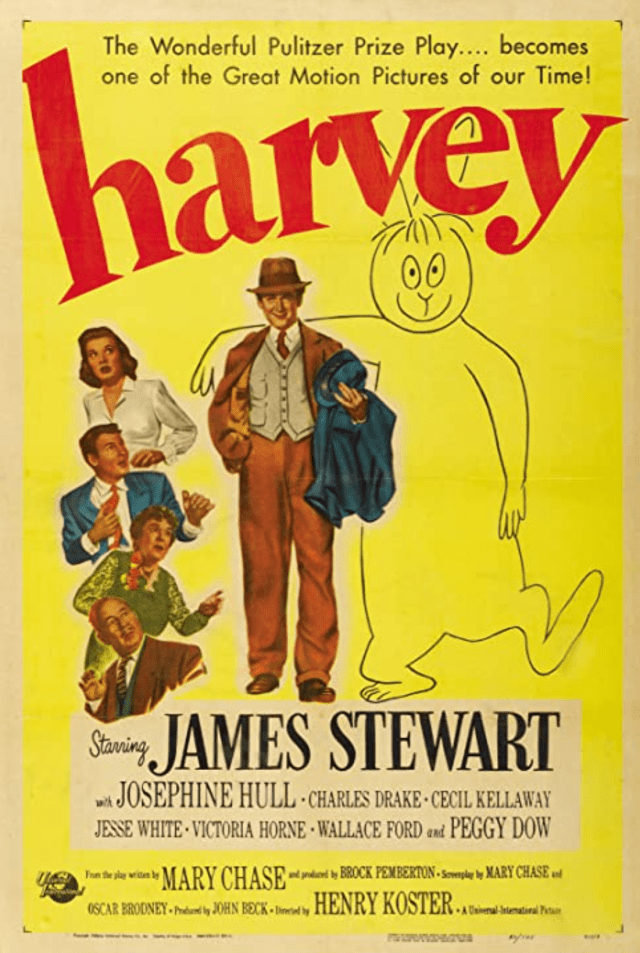
Harvey (1950) poster created by Universal Pictures

5. The Sundowners (1960)

For a little while, I thought The Sundowners was going to be the worst movie I saw this year. Even though I was proven wrong, the 1960 film has still remained in my top five. Like I said in my review, one of the worst things you can do as a film-maker is waste your audience’s time. The story felt longer than necessary, which made the movie two hours and thirteen minutes not well spent. One of my biggest issues with The Sundowners was its “bait and switch” ending. While I won’t go into detail about the ending, as I don’t want to spoil the film, I will say it was cruel for both the characters and the audience.

Take 3: The Sundowners (1960) Review

4. The North Avenue Irregulars

This movie attempts to answer the question; “Wouldn’t it be funny if a group of women came together to solve a mystery”? By the time The North Avenue Irregulars was released in 1979, that question made the film dated on arrival, as there were several television programs from the ‘70s featuring at least one female character solving mysteries or fighting crime. The movie’s creative team told too many types of stories, yet failed at all of them. One minute, the film felt like a precursor to the Mitford series, revolving around a preacher trying to live his best life. The next minute, the film turns into a gangster heist picture, paired with car chases that were longer than necessary. Honestly, I wish this movie was a Scooby Doo-esque story about the film’s fictional band, Strawberry Shortcake. Maybe then the movie would seem more timeless.

3. Lake Effects

For the first time in 18 Cinema Lane history, all the movies in my worst list’s top three are Hallmark productions. Accepting the bronze is the 2012 film, Lake Effects. This movie has so many Hallmark movie clichés, you could create a bingo game around them. You could also create a bingo game around the many storylines found in this script. Lake Effects is a production that relies on style over substance. While Smith Mountain Lake, Virginia was captured well on film, there’s only so much the movie’s creative team could do with the weak script at their disposal. In my review from August, I stated how the movie seemed forgotten over the years. Its poor quality makes it not worth remembering.

Take 3: Lake Effects Review

2. A Boyfriend for Christmas

In 2019 and 2020, a Hallmark Christmas movie ended up in the top three of my annual worst movies list. History is kind of repeating itself with A Boyfriend for Christmas in second place. Like Lake Effects, the 2004 film contained a weak script. But in A Boyfriend for Christmas, I only liked two minor parts of the story. The lack of Christmas magic made my movie viewing experience unenjoyable. It was one of those stories that became worse the longer I watched it. I know this movie is one of the most beloved titles in Hallmark’s cinematic library. Honestly, though, I found it over-rated.

Take 3: A Boyfriend for Christmas Review

1. Francesca Quinn, PI

Remember when I said one of the worst things a film-maker can do is waste their audience’s time? Well, another worst thing a film-maker can do is disrespect their audience’s intelligence. As I watched Francesca Quinn, PI, I was given the impression the film’s creative team didn’t want me to solve the mystery alongside the protagonist. That’s because Francesca explained things that didn’t need explaining. Despite Francesca being a professional private investigator, she constantly made decisions an amateur detective would likely make. Her lack of personality didn’t help either. According to IMDB, Francesca Quinn, PI could replace the Mystery 101 series. The reason is “the main characters’ relationship and the crime at the end of Deadly History are the same as the main characters’ relationship and crime in Francesca Quinn, PI”. If this is the case, the Mystery 101 fans, including myself, deserve so much better.
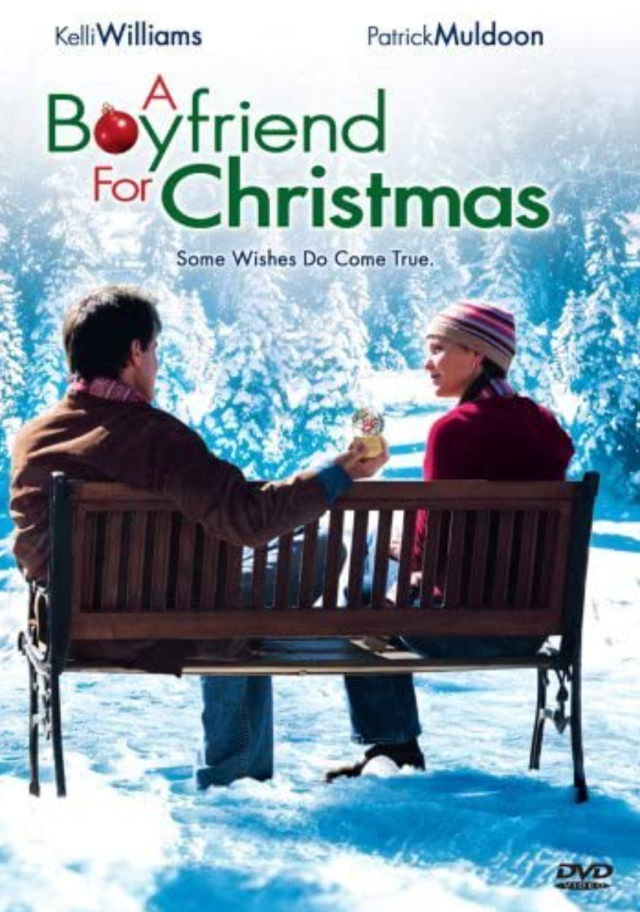
A Boyfriend for Christmas poster created by Hallmark Entertainment,  MAT IV,  Alpine Medien Productions, Larry Levinson Productions, Gaiam Entertainment, and Hallmark Channel 

Have fun in 2023.

Sally Silverscreen
Take 3: Hallmark Hall of Fame’s O Pioneers! Review

When I participated in the Legends of Western Cinema Week last year, I reviewed the Hallmark Hall of Fame film, Durango. Unfortunately, the movie was weaker than I hoped. While thinking about what to write about for 2022’s event, I remembered how I had never seen O Pioneers! Therefore, I thought the Legends of Western Cinema Week was the perfect time to finally see the film! In the 1990s, Hallmark Hall of Fame had a history of adapting stories from the western genre. After the premiere of Sarah, Plain and Tall, the story’s sequels were released; Skylark in 1993 and Sarah, Plain and Tall: Winter’s End in 1999. Outside of this trilogy, Hallmark Hall of Fame created O Pioneers! (in 1992), Rose Hill (in 1997), and Durango (in 1999). While looking back on this history, one has to wonder if this was done in an effort to capitalize on Sarah, Plain and Tall’s success? Whatever the reason, these films provide more than one perspective of westerns. Now, with that introduction out of the way, let’s review O Pioneers!

O Pioneers! poster created by Craig Anderson Productions, Hallmark Hall of Fame Productions, Lorimar Television, and Prairie Films

Things I liked about the film:

The acting: I’ve seen a small handful of Heather Graham’s projects from her filmography. Based on what I’ve seen, she seems to receive one of two types of roles: a “damsel in distress” or the “ditzy” girl next door. But in O Pioneers!, Heather’s role was different. Portraying Alexandra Bergson in her younger years, she not only displayed a motherly persona, she also showcased a quieter strength. After trying to find more fertile farm land, Alexandra comes up with a plan to purchase the surrounding farm land near her family’s home. When she discusses this plan with her brothers, Alexandra explains it in a sure, yet calm way. Even when her brothers doubted her enthusiasm, she consistently maintained her composure, never letting uncertainty get in her way. Through her performance, Heather does a good job at foreshadowing who her character would become!

The majority of O Pioneers! revolves around Alexandra after her family’s farm is established and successful. Because this part of the story takes place fifteen years later, Alexandra is portrayed by Jessica Lange. Throughout the film, Alexandra experiences a variety of situations. This allowed Jessica to utilize different facial expressions, body languages, and emotions. As she reads a letter from her brother, Emil, a warm smile lights up Alexandra’s face. She appears to be sitting in a comfortable position, a friendly demeanor plain to see. Two scenes later, as Alexandra is sharing bad news with Emil, a sullen look is seen on her face. Her tone of voice is serious, as she’s trying to break this news as honestly, but gently as possible. The strength of Jessica’s acting abilities helped her performance appear believable!

One of the most important people in Alexandra’s life is Emil. Portrayed by Reed Diamond, Emil had a personality that was pleasant. Reed adapts to each situation in Emil’s life as well, similar to Jessica’s performance. In the aforementioned scene where Emil receives bad news, a concerned look is shown on his face. He also listens intently to what Alexandra had to say. Emil’s bottom lip quivers, as shock quickly morphs into sadness. The scene ends with Alexandra consoling her brother as he crumbles into tears.

Historical accuracy: O Pioneers! takes place between the late 1880s and early 1900s. Keeping this in mind, it’s important to note how the production looked and felt like the viewer was transported back to that time! In one scene, a man named Frank is walking around the interior of his house. On the wall in the kitchen, a telephone can be seen. The style of this phone is similar to those featured in programs like When Calls the Heart. Another timely piece of technology was the kerosene lamp hanging from the ceiling. This lamp was found in the dining room of Alexandra’s house. Three more kerosene lamps are located in Alexandra’s posh sitting room. Even though these props are smaller components of the movie, it shows how detail oriented this film’s creative team was!

Reed Diamond and Anne Heche’s on-screen chemistry: Anne Heche portrays Marie, a friend of Emil’s since childhood. Most of Emil and Marie’s interactions take place after they grew up, when they are able to live their own lives. During these encounters, I found their on-screen chemistry very sweet! Marie carried herself with a sense of whimsy, almost like she’s a “child at heart”. Meanwhile, Emil is more headstrong, choosing to ground himself in reality. Instead of clashing, these differences worked in Anne and Reed’s favor. The opposites attracting created a balance between their characters. During Marie and Emil’s interactions, they seemed to share an understanding with each other. Their shared history provided that layer of understanding, as well as Anne’s and Reed’s performance.

Legends of Western Cinema Week banner created by Heidi from Along the Brandywine, Olivia from Meanwhile, in Rivendell, and Hamlette from Hamlette’s Soliloquy.

What I didn’t like about the film:

An episodic story: The story of O Pioneers! revolves around Alexandra’s attempts at creating a successful farm with the land she inherited. But instead of those attempts providing an overarching conflict, the movie is filled with smaller conflicts that are resolved in a shorter amount of time. Ivar is a man Alexandra and her family have known for many years. He claims to have powers from God, which causes him to receive some negative attention. At one point, Ivar is threatened of being sent to an asylum. But in the very next scene, Alexandra simply talks to her brothers about what she’ll do if something happens. After that, the issue is unceremoniously resolved.

Too many characters: O Pioneers! is based on a book I haven’t read yet. Despite this, I could clearly see how large of a cast this production contained. Stories with a larger number of characters can be hit or miss. In the case of O Pioneers!, it didn’t work. Because of how many characters were in this story, some of them didn’t receive the amount of attention I feel they deserved. One of these characters was Amedee, a friend of Emil. A European baseball player, Amedee was such a charismatic character I wanted to learn more about. But with all the other characters trying to compete for attention, he only appeared in two scenes.

Some loose ends: Despite the movie having an hour and thirty-seven-minute run-time, there didn’t seem to be enough time to tie up some loose ends in the story. A good example is when one of the characters gets in trouble with the law. Alexandra visits this character in jail and claims she will help them. However, this issue is never resolved. That’s because this conflict takes place within the last eighteen minutes of the movie. It made me wonder why the creative team would include this part of the script when there was no intention to find a resolution to that conflict?

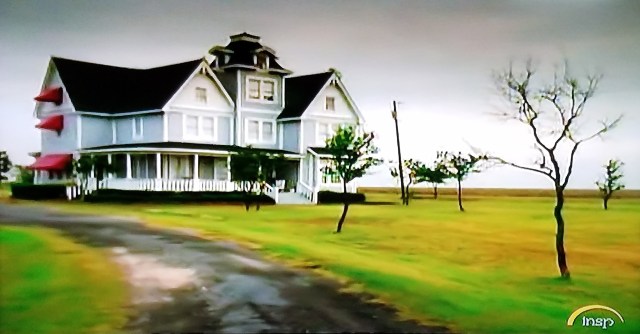
I know this is a screenshot of Wilma’s house from the Walker, Texas Ranger episode ‘The Lynching’. But Alexandra’s house in O Pioneers! reminded me of Wilma’s house, especially that wrap-around porch! Screenshot taken by me, Sally Silverscreen.

My overall impression:

There are some movies where the style is executed better than its substance. O Pioneers! is one of those films. As I said in my review, the project looked and felt like the story’s respective time period. The acting as a whole was good as well. But when it comes to the script, it could have been stronger. A major flaw is the movie’s run-time, which was an hour and thirty-seven minutes. This was not enough time to address the story points and characters within the narrative. Personally, I think O Pioneers! should have been adapted into a multi-part mini-series or a television show. With more time, the creative team would have been able to explore more stories and give some underrated characters more attention. Having an episodic narrative for a mini-series or television show would also make sense, as each story would be more condensed than a film’s plot. Like I mentioned in my review, I haven’t read this movie’s source material. Therefore, I don’t know if it’s better or worse than the 1992 Hallmark Hall of Fame production.

Overall score: 6 out of 10

Have you seen or read O Pioneers!? Is there a book-to-film adaptation you like? Please tell me in the comment section!

Have fun at the movies!

Sally Silverscreen

Take 3: The Sundowners (1960) Review

Here at 18 Cinema Lane, I try to go out of my way to watch, and review, as many film recommendations as possible. In fact, I have a board on Pinterest dedicated to these recommendations. Two years ago, when I reviewed Marriage on the Rocks, Maddy, from Maddy Loves Her Classic Films, suggested I check out the 1960 picture, The Sundowners. Shortly after Debbie, from Moon in Gemini, invited me to her Foreign Western Blogathon, I finally found an opportunity to write about the movie! The Sundowners fits two of the four blogathon categories: ‘directed by foreign directors’ and ‘shot in a foreign country’. According to IMDB, the film’s director, Fred Zinnemann, is from Austria-Hungary. The movie was also filmed in Australia, where the story takes place. Foreign westerns are not a new concept on 18 Cinema Lane. Neither are Australian films. Within the four years of my movie blogging journey, I reviewed Another Man, Another Chance, Interrupted Melody, and Hallmark Hall of Fame’s Durango. If you’re interested, I’ll provide the links to these reviews toward the beginning of this article.

Take 3: Another Man, Another Chance Review

Take 3: Interrupted Melody Review

Take 3: Hallmark Hall of Fame’s Durango Review

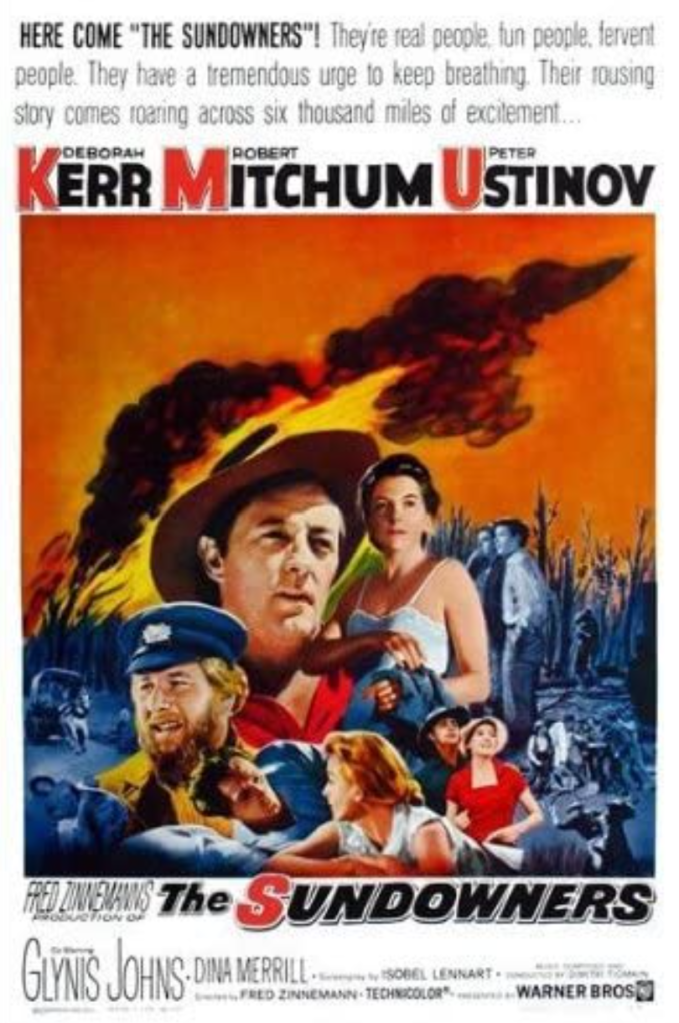
The Sundowners (1960) poster created by Warner Bros.

Things I liked about the film:

The cinematography: Like I said in the introduction, The Sundowners was filmed in Australia. The movie’s creative team took advantage of the country’s natural surroundings through cinematography! One long shot showcased Australia’s farmlands. What made this shot beautiful were the rays of sunlight showering over the green landscape, offering a light only nature could provide. The cinematography also did a good job putting things into perspective. During a forest fire, Ida is driving her family’s wagon away from the forest. While this maneuver is taking place, the camera is situated inside the back of the wagon. It looks out toward the road, giving the audience the illusion they are riding in the wagon with Ida.

Higher stakes: When I reviewed Hallmark Hall of Fame’s Durango last year, I talked about low stakes being one of the film’s biggest flaws. In The Sundowners, higher stakes were featured in a few scenes! A notable example is the forest fire I previously mentioned. While the Carmody family is herding sheep, a nearby forest fire breaks out. This leads all the characters to be in danger. The scene chronicled the entire process of the fire, starting from the detection of smoke and ending in the fire’s aftermath. Cut-away shots of scared wildlife are spliced into the story, emphasizing the other lives in harm’s way. Dramatic music can be heard in the background, elevating the sense of urgency. With all these elements combined, this scene was the perfect example of the higher stakes I expect from a western film!

The historical accuracy: With any “period film”, the historical accuracy can make or break that production. In the case of The Sundowners, the story takes place in the 1920s. From the looks of it, the 1960 project appears historical accurate! The forms of transportation are one indicator. While the Carmody family is working on the sheep farm, the employees sometimes rode in antique trucks with open beds. At least one motorcycle is featured in the story, revealing exposed gears and a model very different from the motorcycles of today. A covered wagon is the preferred vehicle of the Carmody family, with Paddy and Sean riding horses on a few occasions. This aspect of the film’s historical accuracy reminded me of a production like The Grapes of Wrath.

The Foreign Western Blogathon banner created by Debbie from Moon in Gemini

What I didn’t like about the film:

A “slice of life” story: Westerns, like any genre, contain a wide range of narratives. If given the choice, I’d rather watch a western with, at least, one conflict instead of a story that’s more “slice of life”. Unfortunately, the majority of The Sundowners is a “slice of life” story. The script primarily focuses on the daily operations of sheep farming. At first, this topic was interesting. But as the film carried on, the elements of sheep farming became repetitive. Had this movie contained one or two major conflicts, I might have found this story more intriguing.

Lack of Irish accents: According to Wikipedia, the Carmody family is Irish, a fact Sean tells Rupert early in the film. Michael Anderson Jr., Robert Mitchum, and Deborah Kerr must have missed that detail in the script, as none of them could successfully carry an Irish accent. Throughout The Sundowners, Deborah sounded like she was speaking in a British accent. Meanwhile, Robert and Michael sounded Australian. I don’t think Robert, Deborah, and Michael are bad actors. In fact, pulling off any accent can be a difficult skill to master. However, their lack of Irish accents was, for me, jarring.

The run-time: The Sundowners contains a straight-forward story about a family searching for employment in order to afford a place of their own. With that said, I found it unnecessary for the film’s run-time to be two hours and thirteen minutes. Some scenes felt drawn out in an attempt to satisfy this run-time, the shearing contest Paddy enters being one example. That scene lasts about five minutes, even though it could have only featured the most exciting parts of the contest. If scenes like that one had been cut shorter, the movie could have had a run-time of about an hour and thirty minutes.

A “bait and switch” ending: In my review of 1961’s The Pit and the Pendulum, I incorporated spoilers to explain my thoughts on a specific portion of the movie. Similarly, I will be including spoilers in this part of my review. If you haven’t seen The Sundowners, please skip this part and continue reading where it states “My overall impression”.

As I stated earlier in this review, The Sundowners contains a straight-forward story. I also stated how the movie is two hours and thirteen minutes. Within that run-time, the Carmody family receives the funds to afford a farm that was featured toward the beginning of the film. All seems to be going well until the last ten minutes in the story. While in a drunken state, Paddy makes several I-O-Us, losing the family’s finances in the process. In an attempt to earn back some of those funds, the family enters their race-horse, Sundowner, in an upcoming horse race. Not only does Sundowner and Sean win the race, Paddy also wins a bet. Even though they have enough money to make a down payment on the aforementioned farm, Ida changes her mind, saying Paddy can keep the race horse instead. This statement contradicts Ida’s goal throughout the movie; getting a place to put down roots. Moments later, an announcement declares Sundowner is disqualified from the race due to a pass interference. This means the Carmody family lost all the money they just won. The movie ends exactly how it begins; with the family on the road looking for employment and a place to stay. If I had known the story would end this way, I wouldn’t have become invested in the Carmody family’s ordeal.

Horse with saddle photo created by Topntp26 at freepik.com. <a href=’https://www.freepik.com/free-photo/stallion-black-equine-race-sky_1104246.htm’>Designed by Freepik</a>. <a href=”https://www.freepik.com/free-photos-vectors/background”>Background image created by Topntp26 – Freepik.com</a>. Image found at freepik.com.

My overall impression:

When it comes to film-making, one of the worst things you can do is waste the audience’s time. The way I feel about The Sundowners is similar to how I felt about The Birds; like I truly wasted two hours and thirteen minutes. I understand circumstances in western films aren’t always fair. Heck, life itself is sometimes unfair. But what is also not fair is giving your characters and audience hope for two hours, then taking that hope away in the film’s last ten minutes. With the way The Sundowners turned out for me, it almost seemed like history repeated itself. As I mentioned in this review, I wrote about Hallmark Hall of Fame’s Durango last year. That 1999 presentation was a foreign western I didn’t like. Both Durango and The Sundowners have one thing in common. Even though there were things about each film I liked, they contained a weak script. A script is the foundation of any cinematic production. If it isn’t strong, there’s only so much you can do to remedy the issue. Before I end this review, I want to make it clear that I have nothing against foreign westerns or Australian cinema. I’m confident there are stellar Australian and foreign western pictures I haven’t seen yet. Unfortunately, The Sundowners isn’t one of them.

Overall score: 4.7 out of 10

Have you watched any foreign westerns? If so, which ones would you recommend? Let me know in the comment section!

Have fun at the movies!

Sally Silverscreen

Take 3: Let Him Go Review + 380, 385, and 390 Follower Thank You

During my recent mini hiatus, I was thinking about what movie to choose for the long-awaited Blog Follower Dedication Review. While I do have several movies on my DVR, I wanted to choose one that was different from those I have recently reviewed. So, when I saw the 2020 title, Let Him Go, I knew it was the right choice. Like I have stated in the past, the western genre is one that isn’t often covered on my blog. In fact, the last western film I wrote about was the 1999 Hallmark Hall of Fame production, Durango. With this current review, it’ll provide more content related to this specific genre. What makes Let Him Go unique from the other westerns I’ve talked about is how the story takes places later in the 20th century, as the story is set in the early ‘60s. Since I haven’t seen many “modern” westerns, I was curious to see how this type of story would be presented in a different lens. So, without further ado, let’s get this Blog Follower Dedication Review started!

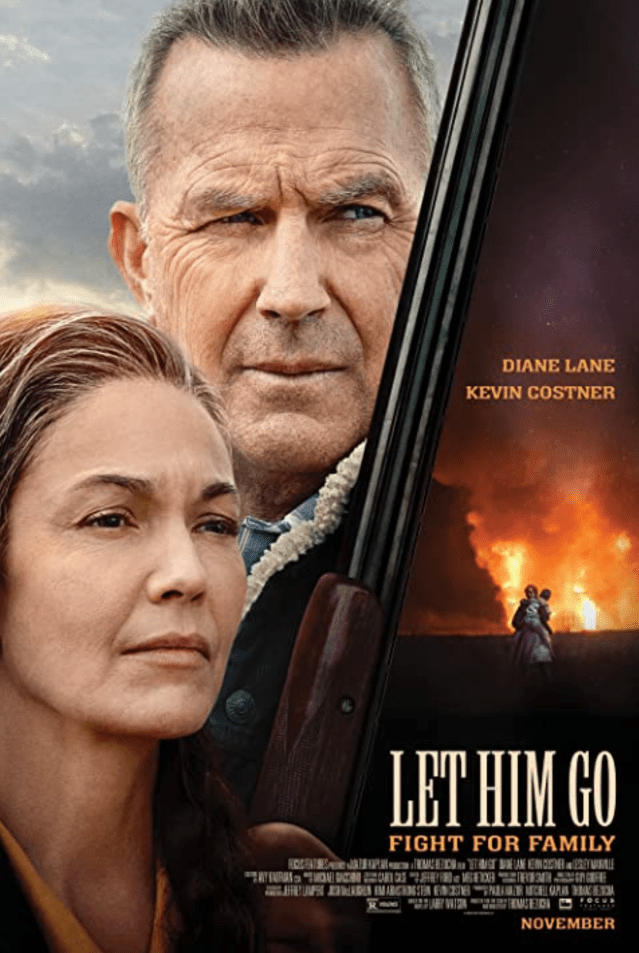
Let Him Go poster created by
The Mazur Kaplan Company, Focus Features, and Universal Pictures

Things I liked about the film:

The acting: While the cast of Let Him Go was strong, there were two actors who gave stand-out performances. The first one came from Lesley Manville. Portraying the Weboy family matriarch, Blanche, her character reminded me of the mob bosses from gangster movies of yesteryear. Lesley carried her character with her own distinct style and personality, which is reminiscent of the aforementioned mob bosses I brought up.  Blanche’s attitude escalates over the course of the movie, becoming viler and more brutal. Even though I wasn’t a fan of Blanche, Lesley’s performance stole the show! The second performance was Booboo Stewart’s! His character, Peter, was my favorite in this film. Booboo’s portrayal consistently appeared genuine, which showed the strength of his acting abilities and the screenwriting. Peter’s presence also brought a sense of peace that was rarely found in this story. I, honestly, wish he was given more appearances in the movie.

The scenery: This movie takes place in Montana and North Dakota. But it was actually filmed in Alberta, Canada. No matter where Let Him Go was filmed, the scenery was beautiful to look at! At the beginning of George and Margaret’s road trip, large mountains dominated the background. That piece of earth was so majestic, I would guess photos and videos do not do those mountains justice. Surrounding these mountains were clear blue skies and grassy hills. All the natural elements came together to create a landscape that brought a sense of peace. I just wish more scenes had taken place outdoors.

The topics discussed: Like I mentioned in the introduction, Let Him Go is set in the early ‘60s. What should also be noted is how two of the film’s overarching topics are child abuse and domestic violence. Even though these subjects are met with a sense of urgency and seriousness today, it was interesting to see how they were viewed over fifty years ago. The attitude surrounding these topics, in the film, carried an “it’s none of my business” energy. This brought a sense of historical realism to the overall story. In Let Him Go, Peter says he was sent to an “Indian school” when he was younger, referring to the residential schools where Native American children were forced to attend. When it comes to entertainment media, these types of educational institutions are not often brought up. So, even though this particular subject was briefly brought up, it was an interesting to see the movie’s creative team include that topic at all.

Sheriff badge image created by Freepik at freepik.com. <a href=’https://www.freepik.com/free-vector/brown-cowboy-label-set_1543252.htm’>Designed by Freepik</a>. <a href=”https://www.freepik.com/free-photos-vectors/vintage”>Vintage vector created by Freepik</a>. Image found at freepik.com.

What I didn’t like about the film:

A misleading trailer: Before watching Let Him Go, I saw its respective trailer, in an effort to determine if the film was worth seeing. In that trailer, the movie came across as an intense thriller. But when I actually saw the film, it was mostly a drama with thrilling elements. This reminds me of when I saw the 2015 movie, Forsaken. Because of the talent involved and the story’s western genre label, I expected more action in that movie. Instead, the script emphasized the drama in the protagonist’s life. Similarly, most of the action in Let Him Go took place during the climax. The story also revolved around the drama among the Blackledge family. With all that said, I found this film’s trailer misleading.

An unclear time period: As I’ve already said, the story is set in the early ‘60s. In fact, the majority of the film takes place in 1963. However, everything looked and felt like it came straight from the ‘50s. From the Blackledge’s kitchen to the cars in their Montana town, the set design and costumes appeared authentic for that period in time. Toward the beginning of the movie, I wasn’t sure if the story was set in the ‘50s or if the Blackledge family just liked a vintage style. When I saw a headstone bearing the death date of 1961, the time placement of the story became clear to me. The 1960s has a very distinct aesthetic, so I was disappointed it was absent from this film.

The Weboy brothers’ lack of distinctiveness: When the Weboy family is first introduced, the audience meets Blanche and her sons. Before this happens, one of the sons, Donnie, marries the Blackledge’s daughter-in-law, Lorna. Because of that event, Donnie is a memorable character. But his brothers appeared and acted very similar to one another. It got to the point where I had difficulty telling these characters apart. Not only is the screenwriting to blame for this, but I think there shouldn’t have been that many members of the Weboy family.

Horse with saddle photo created by Topntp26 at freepik.com. <a href=’https://www.freepik.com/free-photo/stallion-black-equine-race-sky_1104246.htm’>Designed by Freepik</a>. <a href=”https://www.freepik.com/free-photos-vectors/background”>Background image created by Topntp26 – Freepik.com</a>. Image found at freepik.com.

My overall impression:

It feels good writing posts after taking some time away from my blog! I honestly did not mean for the hiatus to last two weeks. But I was working on some projects that weren’t blog related. Since I came back at the beginning of December, I can’t wait to check out some seasonal flicks! Now, back to this Blog Follower Dedication Review. Personally, I thought it was just ok. While I am glad I checked out another western, it wasn’t the product advertised. Plus, the film didn’t look or feel like the ‘60s. Despite these major flaws, there are aspects of the movie I did like. The topics discussed in the story provided historical realism, allowing the audience to glimpse how they were viewed back then. I also thought the acting was strong. As I wrap up this review, I want to take the time to thank all of my blog’s followers. Looking back on these three years, I still can’t believe how far I’ve come as a blogger.

Overall score: 6.5 out of 10

Have you seen any westerns lately? If so, would it be worth recommending? Let me know in the comment section!

Have fun in the movies!

Sally Silverscreen

Take 3: Hallmark Hall of Fame’s Durango Review

Last year was the first time I participated in Legends of Western Cinema Week! For that event, I reviewed some episodes of Walker, Texas Ranger and the movie, Forsaken. This year, I decided to review the 1999 Hallmark Hall of Fame film, Durango! One day, Hallmark Drama was airing several older titles from the Hallmark Hall of Fame collection, with Durango being one of them. Since I try to watch as many Hallmark Hall of Fame movies as realistically possible, I made sure to record this film on my DVR. This is not only my first time watching it, but this particular title was only sold on VHS. Hallmark has a history of selling some of their Hallmark Hall of Fame films for home entertainment. As I said in my review of the 1987 movie, Foxfire, some of them have been sold on DVD for $20 apiece. But there were some titles that were only given a VHS release. I don’t know what the original price of these VHS tapes were. But if the DVDs were $20, it makes me assume the VHS tapes might have been sold for a similar price. Would Durango be worth the price if it was re-sold on DVD? Keep reading my review if you want to find that answer out!

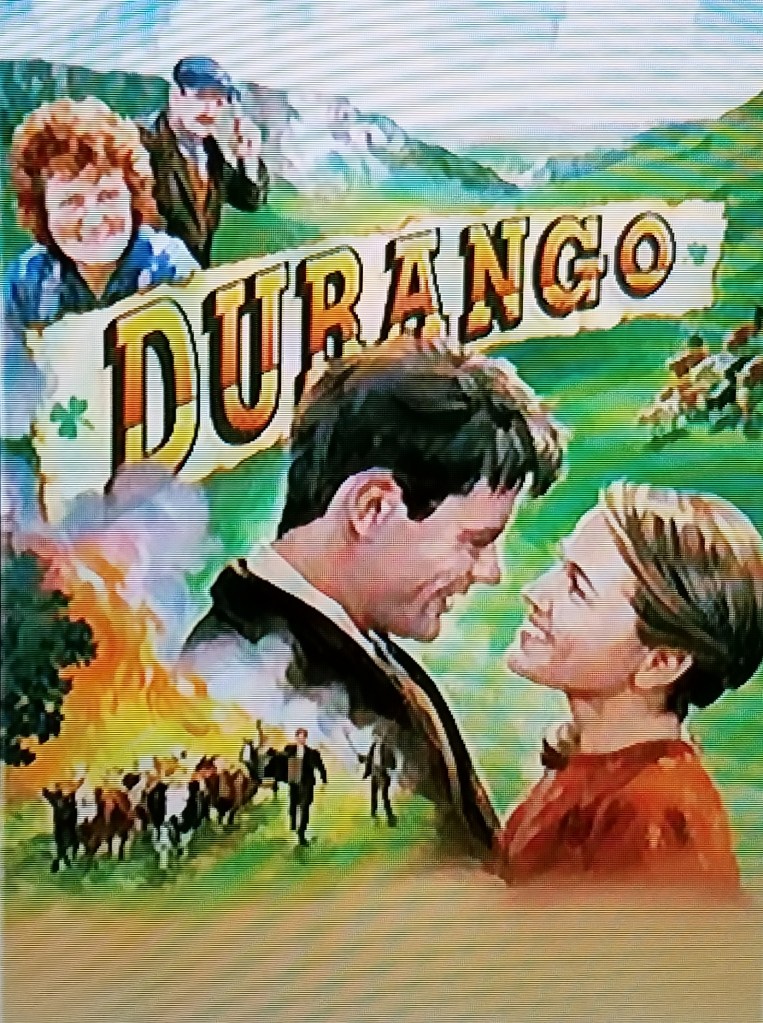
I really like the poster design for Durango, as it is reminiscent of posters from older western films. Screenshot taken by me, Sally Silverscreen.

Things I liked about the film:

Patrick Bergin’s performance: In Durango, Patrick Bergin portrayed Fergus Mullaney, the father of the protagonist’s girlfriend, Annie. Out of the whole cast, Patrick is the one that, for me, stole the show! Whenever his character came on screen, he delivered his performance with a strong sense of emotion. Toward the beginning of the movie, Fergus is giving a threat to the movie’s protagonist. During this scene, he truly came across as intimidating. The look in Fergus’ eyes was fiery, revealing the anger within him. His tone of voice was loud and stern, indicating he is not someone to be messed with. I wish Patrick had more appearances in this movie, so he could have had more opportunities to show off his acting talents!

The scenery: Within my review of Chasing Leprechauns, I discussed how the film looked drab. This was because that film’s creative team didn’t take advantage of Ireland’s natural landscape. That was not the case for Durango, as the majority of the movie took place outdoors and there was a lot of greenery to be found! When the Mullaney family was taking a ride through the countryside, the rolling hills of Ireland were showcased in front of a clear blue sky. On the path, a small stone bridge was seen over a river. This river was surrounded by grassy, green fields. That type of landscape was consistently shown throughout the movie. However, it featured Ireland’s natural beauty, which could encourage someone to visit the country!

The music: In films like those from Hallmark Hall of Fame, orchestral tunes are commonly heard in the background. While that is the case for Durango, the music worked with what was happening on screen. During the protagonist’s journey, grand, sweeping orchestral music could be heard as cattle were traveling through the vast fields of Ireland. Because the scenery is so captivating, having this type of music playing makes sense, as the music represents the viewers’ awe for such a beautiful place. When Annie’s brothers were fighting in public, Mark, the film’s protagonist, tells Fergus what is going on. Even though orchestral music can still be heard, the music is reflective of one’s fear when facing an intimidating man like Fergus. Just like any component of a film, music can make or break a production. The music in Durango definitely worked!

Legends of Western Cinema Week banner created by Heidi from Along the Brandywine and Hamlette from Hamlette’s Soliloquy.

What I didn’t like the film:

Low stakes: A common staple in the western genre is including high stakes in the story. In the movie I reviewed last year, Forsaken, the future of the town was at stake. The fear of the unknown could be felt among the characters, with their dialogue and interactions elaborating this point. The major conflict in Durango was the transportation of cattle from one town to another in an effort to receive a fair price for them. But the stakes associated with this conflict were low, causing me not to feel like any of the characters or their cattle were in danger. This is because, nine times of ten, the characters’ plans work out perfectly. Come to think of it, these plans worked out too perfectly by the standards of the western genre. When a higher stake is introduced in the story, it doesn’t appear until the film’s last nineteen minutes. This stake feels like it was included simply for the script to shoehorn a subtle David and Goliath reference. What is frustrating about that creative decision is the movie’s creative team had the entire project to give us the aforementioned reference. Heck, Durango itself should have been a David and Goliath story.

Fergus Mullaney’s desire to protect his daughter: In a story where a young woman falls in love, it’s common for her father to be concerned for her well-being. This is no different for Durango, as Fergus Mullaney only wants to protect his youngest daughter, Annie. The way he went about protecting her is the issue, as it came across as possessive and bit over the top. Whenever Annie’s boyfriend, Mark, is expressing his love for her or seen interacting with her, Fergus becomes angry. It gets to the point where he threatens to physically harm Mark. If Durango were a comedy and Annie were a teenage girl going on her first date, maybe Fergus’ behavior would be justifiable. But because both Annie and Mark are adults and because this movie is more dramatic in tone, Fergus’ behavior felt out of place.

Matt Keeslar’s performance: I’m not really familiar with Matt Keeslar’s filmography. However, I wasn’t impressed with his portrayal of the protagonist, Mark Doran. He wasn’t as strong of a performer as other actors from Hallmark Hall of Fame productions. For most of the movie, Matt carried a “resting face”, making his face appear static. I could tell he was trying with the material he was given, as there were times where he expressed genuine emotion. But these emotions were, in my opinion, not delivered consistently. With everything I just said and the fact that Matt and Nancy St. Alban, the actress who portrayed Annie, didn’t have strong on-screen chemistry, I was not invested in Matt’s performance.

Irish heart image created by Freepik at freepik.com. <a href=”https://www.freepik.com/free-photos-vectors/label”>Label vector created by freepik – http://www.freepik.com</a>. Image found at freepik.com.

My overall impression:

In my introduction, I mentioned how Durango was only sold on VHS. After watching the film, I now have an understanding of why this could be the case. Durango is one of the few Hallmark Hall of Fame movies I would consider a dud. With a weak lead performance and many low stakes, I found it difficult to stay invested in the characters and overall story. I also think the way Fergus tried to protect his daughter, Annie, felt out of place in this particular film. According to IMDB, Durango is “the first western set in Ireland”, so the fact this movie was not good is disappointing. On paper, an Irish western is an interesting idea that could have worked with a strong creative team. Unfortunately, Durango had a weak execution. I’m glad Hallmark Drama chose to air this movie, as I can honestly say it is not worth purchasing a copy. Personally, I think Irish cinema, the western genre, and Hallmark Hall of Fame deserve better.

Overall score: 4.7 out of 10

Have you seen Durango? Are there any Hallmark Hall of Fame movies you’d like to see re-released on DVD? Please let me know in the comment section!

Have fun at the movies!

Sally Silverscreen

Take 3: Another Man, Another Chance Review

When it comes to blog events taking place on or around Valentine’s Day, romantic stories or favorite couples are usually the chosen topic. But for Pure Entertainment Preservation Society’s Unhappy Valentines Blogathon, there was an interesting twist placed on their event. For this blogathon, the theme was love stories that were “unhappily ever after”. After reading the requirements, I knew exactly which film I wanted to write about! For about a year, I have had the 1977 movie Another Man, Another Chance on my DVR. In this film, a man and woman who have each lost their spouses fall in love with one another. For some people, Valentine’s Day may not be a happy time. This can be the case for a variety of reasons. Whenever I’ve reviewed a Valentine’s Day themed film in honor of this holiday, the tone of those stories were lighthearted. So, it was nice to be given the opportunity to select a change of pace!

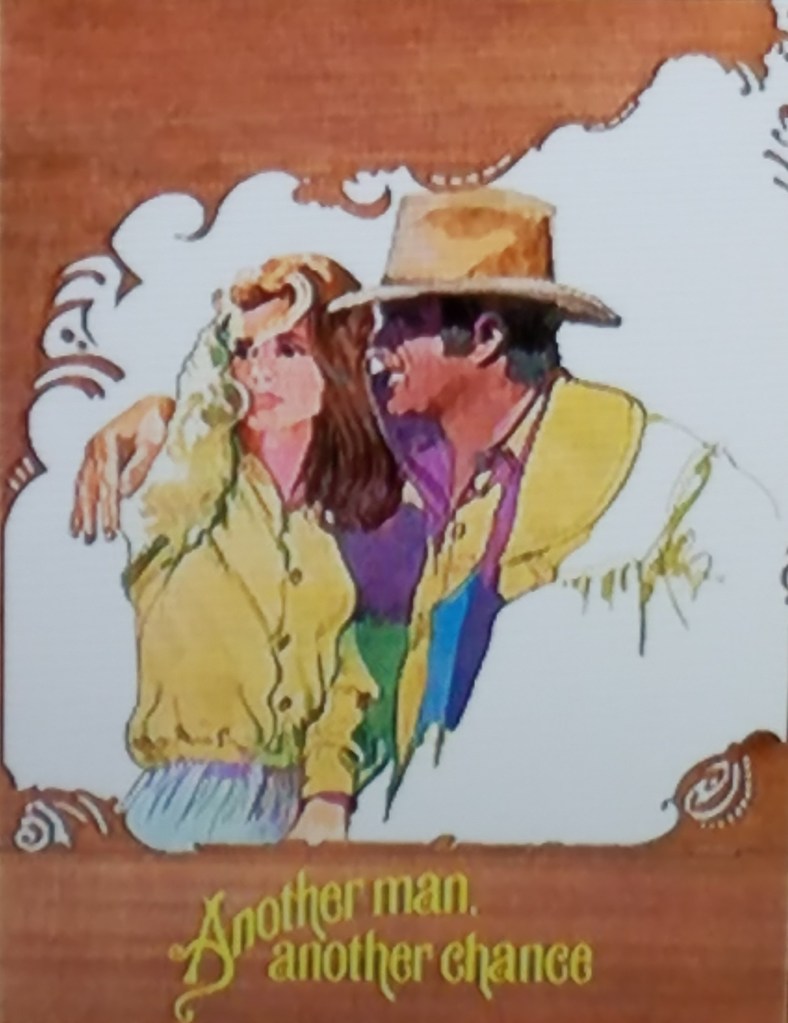
Because the poster for Another Man, Another Chance was featured on my television, I decided to take a screenshot of it with my phone. Screenshot taken by me, Sally Silverscreen.

Things I liked about the film:

The acting: This isn’t the first western of James Caan’s I’ve seen. Prior to reviewing Another Man, Another Chance, I have seen JL Family Ranch and JL Family Ranch: The Wedding Gift (with the latter film receiving a review on this blog). In those films, James’ character was more reserved, his character, Tap, learning from his mistakes and defending his family. With his character in Another Man, Another Chance, David, he appeared surer of himself. However, he wasn’t afraid to express emotions. When he was looking for his wife, David expresses genuine concern throughout his search. As he discovers his wife has died, his eyes tear up as he physically turns away from the sight of his wife’s dead body. Within the movie, the relationship of Francis and Jeanne stole the show! Portrayed by Francis Huster and Geneviève Bujold, both actors had good on-screen chemistry, giving the impression their characters truly loved each other. Geneviève brought a gentleness to her role that is sometimes seen in female protagonists in westerns. This presented a contrast to the harsh environment Jeanne experienced in France and the United States. Francis had a way with words and thought outside the box. When Francis invites Jeanne to come to the United States with him, she reminds him how he barely knows her. Without skipping a beat, Francis tells her how he barely knows America. In order to earn extra money for his family, Francis tries to apply for a part time job at a newspaper by offering to be the Gazette’s photographer. These two examples show the intelligence and wisdom Francis was able to bring to his character!

Showcasing photography: It was interesting to see what the art and business of photography was like in the 1800s! Not only did the equipment look different, but the techniques were different as well. When a customer visits the studio, Jeanne makes him sit in a special chair. This chair features a vertical metal bar with a smaller, curved metal piece at the top. It helped customers sit up straight and keep their head in place as they had their picture taken. While in France, Francis says he can only take pictures for a certain amount of time and on certain days due to needing sunlight. His solution to this problem is moving to the United States and settling in the West, where he feels there will be more natural light.

An immigrant’s perspective: When it comes to stories in the western genre, most of them revolve around characters that were either born or raised in the United States. By devoting a large piece of the story to Francis and Jeanne, the audience is able to see a perspective that is rarely explored in this area of cinema. It also allowed the audience to witness these characters’ contributions to their environment. As I mentioned in this review, Francis tries to apply for a part time job at a newspaper by offering to be the Gazette’s photographer. In the 1800s, photographs were not included in newspapers. However, the editor in chief of the Gazette solved this dilemma by agreeing to create stencils of Francis’ photos and adding them to the paper. If it weren’t for Francis’ talent and profession, the Gazette would never have been ahead of their time!

The Unhappy Valentines Blogathon banner created by the Brannan sisters from Pure Entertainment Preservation Society.

What I didn’t like about the film:

Limited time spent with Jeanne and David’s relationship: One of the biggest plot points (and one of the reasons why I watched this film) is Jeanne and David learning to fall in love again. However, they don’t officially meet until an hour and twenty-eight minutes into the movie. Most of the film revolves around David’s and Jeanne’s life prior to their relationship. I know that context and build-up are important to any story. But for Another Man, Another Chance, there was too much build-up to Jeanne and David’s romance.

The run-time: Another Man, Another Chance is a two hour and sixteen-minute film. Personally, I think this run-time was unnecessary. Several scenes lasted longer than they needed to because of the creative team’s desire to satisfy this length in time. One example is when Francis and Jeanne open their photography studio. The scene itself is somewhere between two to five minutes. Because there are no major conflicts or significant moments happening, that scene could have reduced to either a few seconds or a minute. The film’s run-time might have been an hour and twenty or thirty minutes if scenes like that one had been shorter.

Too many unanswered questions: In the story of Another Man, Another Chance, there is a lot going on within the overall plot. This resulted in many questions remaining unanswered. At the beginning of the film, a wealthy woman named Alice is interested in opening a boarding school in France. She shares how she is unable to have children of her own and mentions her sympathy toward the French people. Later in the movie, Alice ends up starting a partial boarding school in her neighborhood. What caused her to change her mind about that boarding school in France? Where did her sympathy for the French people go? These questions were ignored throughout the story.

Small, western town image created by Freepik at freepik.com. <a href=”https://www.freepik.com/free-photos-vectors/background”>Background vector created by freepik – http://www.freepik.com</a>. Image found at freepik.com.

My overall impression:

Every so often, I come across a film that, intentionally or not, made a significant contribution to the world of film. In the case of Another Man, Another Chance, this was done by telling a type of story that isn’t often seen in westerns. The creativity found in this movie is something I can appreciate. It should also be noted how this is one of the few bilingual westerns. But, to me, the overall project could have been much stronger. Another Man, Another Chance did not need to be over two hours. While watching the film, I noticed several scenes that could have easily been cut shorter. It also doesn’t help that Jeanne and David’s relationship was not featured in the story as much as the synopsis advertised. Even though this blogathon highlights romance gone wrong, I feel there are better stories of this nature to watch on Valentine’s Day. My personal choice is the PixL film, Same Time Next Week. Similar to Another Man, Another Chance, the protagonists learn to fall in love again. But in the 2017 film, the overall story is a lot stronger.

Overall score: 6.1 out of 10

Have you watched a western on Valentine’s Day? If so, which one was it? Tell me in the comment section!

Have fun on Valentine’s Day!

Sally Silverscreen

Take 3: The Sea of Grass Review

When I participated in last year’s Spencer Tracy & Katharine Hepburn Blogathon, I reviewed It’s a Mad, Mad, Mad, Mad, World and One Christmas. The first movie was not my cup of tea, but I found the second movie to be just ok. This time around, I decided to write about one movie starring both Spencer and Katharine. As I’ve mentioned before, I don’t watch films from the Western genre often. This is the reason why I chose to review The Sea of Grass. Looking back on the movies I’ve seen from Spencer and Katharine’s filmographies, this is the first time I’ve seen one of their titles where both actors were the leads. Spencer and Katharine are talented actors individually, so it was interesting to see them acting alongside one another!

The Sea of Grass poster created by Metro-Goldwyn-Mayer and Loew’s Inc.

Things I liked about the film:

The acting: In The Sea of Grass, Katharine Hepburn portrays Lutie Cameron, a St. Louis native who moves to the country in order to marry Colonel Jim Brewton. Toward the beginning of the film, Lutie comes across as naïve, as she is a romantic at heart. As she stays in the country, Lutie gains a sense of maturity and grows as a person. Throughout her character’s journey, Katharine was able to show this transition in her acting performance by adopting a variety of emotions. The “sea of grass” this film is named after is Colonel Jim Brewton’s favorite spot. While talking about it with Lutie, Jim describes the fields like a convincing salesman. His face contains a look of longing; reflecting on the past, present, and future of his prized field of grass. The way he talks about it shows how much he cares for this patch of earth. The facial expressions and tone of voice Spencer adopts persuade the audience of this location’s importance. Spencer’s expressions and vocal inflections also reveal the cracks in Jim’s foundation as the story continues. Brice Chamberlain, a local lawyer, is portrayed by Melvyn Douglas. Whenever his character interacted with Lutie, Melvyn was able to, talent-wise, go toe-to-toe with Katharine. He delivered thought-out remarks with a serious calm that one might expect from a respected lawyer. A professional composure was also present in Melvyn’s performance. Because his on-screen personality was different from Katharine’s, it created an interesting dynamic.

The scenery: The majority of The Sea of Grass takes place in the country. Because of this, the natural landscape of this environment is shown in several scenes! When characters travel through the desert, huge mountainous rocks illustrate just how small humans are compared to the large scope of nature. Long and medium shots are used to emphasis this idea. Even the “sea of grass” is featured in a few scenes, its beauty captured well on screen! Sweeping shots showed the vast size of this field. As the wind blew, the movements of the grass looked like the rippling of water. All of these components came together to create a calming space!

Katharine’s wardrobe: Throughout the movie, Katharine showcased an impressive wardrobe that complimented her well! This is because all of her outfits were simple, but elegant. When Lutie and Jim are sharing their first dinner after their wedding, she wears a white long-sleeved dress with a small set of flowers in the front of the dress’s top. Later in the movie, Katharine wears a black-and-white, over-the shoulder dress. This outfit was paired nicely with a dainty black choker and ponytail hair-do. What’s also worth pointing out is how Katharine’s wardrobe in The Sea of Grass appeared historically accurate with the film’s time period.

The Third Spencer Tracy & Katharine Hepburn Blogathon created by Crystal from In the Good Old Days of Classic Hollywood and Michaela from Love Letters to Old Hollywood.

What I didn’t like about the film:

More emphasis on telling: At the beginning of the movie, several people in Salt Fork inform Lutie about how awful of a person Jim is. He is, apparently, such a bad person, some compare him to a tyrant. While the audience can hear Jim say harmful things, they never get to see him do harmful actions. This creative decision gives the viewers only part of a bigger picture when it comes to Jim Brewton. Whenever the subject of people using the “sea of grass” is brought up, Jim is very specific about how the land should be used. If someone objects to these ideas, Jim tells others what he’s going to do instead of carrying out the deed.

No major conflict: Since the film is called The Sea of Grass, you’d think most of the story would revolve around the “sea of grass” itself. Instead, the film prioritizes the personal events of the characters. Stories that are character driven can work. But when you have an interesting conflict like how to utilize a field of grass, the character’s stories don’t seem as interesting. While the triumphs and tragedies of Lutie and company are highlighted, the “sea of grass” is relegated to a subplot.

Times moves too fast: In a movie where time progresses, there is usually some indicator that a jump in time has occurred. This is done through on-screen text or a voice-over. The Sea of Grass, unfortunately, doesn’t utilize any techniques to inform their audience that time has moved forward, causing changes to appear abruptly. A perfect example are the lives of Sara Beth and Brock. In one scene, Sara Beth is shown as a little girl, while Brock is a toddler. The very next scene shows Sara Beth and Brock as older children, appearing to be ten and eight.

Small, western town image created by Freepik at freepik.com. <a href=”https://www.freepik.com/free-photos-vectors/background”>Background vector created by freepik – http://www.freepik.com</a>. Image found at freepik.com.

My overall impression:

When I chose to review The Sea of Grass, I wanted to expand my Western genre horizons. This decision taught me that Western tragedies do exist. Despite seeing a handful of Westerns, the movie was quite different from other films I’ve seen in this genre. Even though I knew that this movie was about a rocky relationship, it was sadder than I expected. The Sea of Grass is a fine film with strong components, like the acting and scenery. However, it does have its flaws that shouldn’t be ignored. While the “sea of grass” is shown on screen, it isn’t as significant as the title would suggest. In fact, this location feels more like a glorified backdrop. I will say that Katharine Hepburn and Spencer Tracy do work well together as actors. As the years go by, I would like to see more of their films where they both star as the leads.

Overall score: 7.3 out of 10

Do you like watching Western films? Are there any Westerns you’d like to see me review? Let me know in the comment section below!

Have fun at the movies!

Sally Silverscreen

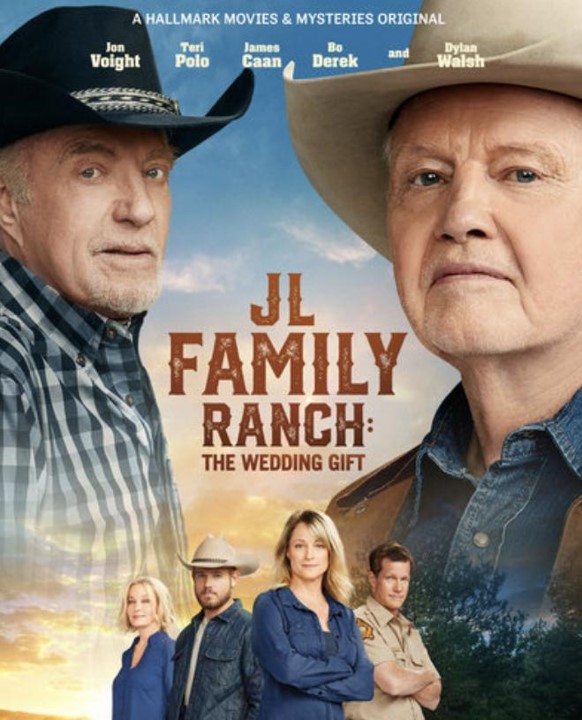
Take 3: JL Family Ranch: The Wedding Gift Review

It’s been four months since I last reviewed a Hallmark Movies & Mysteries film. To fix this, I chose to write about the newest sequel, JL Family Ranch: The Wedding Gift! I saw the first movie when it premiered four years ago, which I thought was just ok. Therefore, I was not asking Hallmark to grant this title a second chapter. Despite not being a fan of JL Family Ranch, I wanted to watch the sequel with an open mind. Providing Hallmark Movies & Mysteries related content was also my intent. Earlier this month, in a Word on the Street story, I talked about JL Family Ranch: The Wedding Gift’s trailer. In that article, I said the trailer made the movie feel like it took a tonal shift from the first movie. But unless I watched the movie for myself, I wouldn’t know how this shift would affect my movie-viewing experience.

JL Family Ranch: The Wedding Gift poster created by Crown Media Family Networks and Hallmark Movies & Mysteries.

Things I liked about the film:

The acting: Most of the cast members from JL Family Ranch appeared in the sequel. This worked in the cast’s favor, as they knew what to expect from each other, talent-wise! Teri Polo had good on-screen chemistry with her co-stars, especially those that appeared in the first movie. She also gave her character, Rebecca Landsburg, a stoic persona. This creative choice allowed the audience to see how having so much on her plate really affected her. When James Caan’s character, Tap Peterson, appeared in the film, a sense of defeat could be seen and felt. This was caused by events that take place within Tap’s subplot. In a scene where he goes to the bank to ask for a large sum of money, facial expressions and body language effectively show what is going on in Tap’s mind. New faces in this cast also found their way to shine! Judson Mills is one example, portraying a new character named Caleb Peterson. Though he was only in select scenes, his performance still left a memorable impression on me. One scene showed Caleb on his phone, talking about an important matter. As the scene plays out, Caleb goes from looking concerned to being on the verge of tears.

The scenery: The scenery in JL Family Ranch: The Wedding Gift effectively reflected the characters’ rural lifestyle, presenting a stylized version of a ranch family. Sweeping establishing shots captured the green pastures surrounding the family’s bed and breakfast. Picturesque fields were shown in scenes where characters ride their horses. When Rebecca and her fiancé, Henry, are having a private picnic, they are sitting next to a river. The clear blue of the water paired with the surrounding grass nicely. These locations promoted the ideas of the calm and tranquility a rural setting can offer!

Tap Peterson’s house: There have been some gorgeous houses to grace the backgrounds of Hallmark’s productions. Tap Peterson’s house in JL Family Ranch: The Wedding Gift is one of them! Its white exterior boasts a traditional colonial style, complete with a manicured front yard. The interior design within the house displayed a well-to-do setting fit for the prominent rancher Tap is. In one room, the rich wood on the walls complimented a cream armchair with a red pattern. Another room contained white walls showcasing blue and green glass plates. Each design choice was elegant and classy, creating a timeless look in each room presented on screen!

Horse with saddle photo created by Topntp26 at freepik.com. <a href=’https://www.freepik.com/free-photo/stallion-black-equine-race-sky_1104246.htm’>Designed by Freepik</a>. <a href=”https://www.freepik.com/free-photos-vectors/background”>Background image created by Topntp26 – Freepik.com</a>. Image found at freepik.com.

What I didn’t like about the film:

Poor audio: While I haven’t seen Follow Me to Daisy Hills or Falling for Look Lodge, I have heard there are audio problems within these movies. It seems like poor audio has become commonplace in Hallmark’s productions lately, as JL Family Ranch: The Wedding Gift contained the same flaw. All of the characters sounded muffled whenever they spoke, especially when scenes took place outdoors. Because of this, it was difficult at times to understand what was being said. I’m not sure if music or microphone related issues are what caused the movie’s audio to be poor. What I am sure about is this problem was consistent throughout the film.

Too many cliches: I know Hallmark loves their cliches like Santa loves milk and cookies. But JL Family Ranch: The Wedding Gift incorporated too many cliches that have been featured in many other Hallmark films. Four of these cliches were discussed in my list of the top ten worst cliches from Hallmark movies: the “we’re not together” cliché, the “it’s not what you think” cliché, the “protagonist’s ex showing up unannounced” cliché, and the “planning a wedding in an unrealistic time period” cliché. JL Family Ranch: The Wedding Gift also showcased cliches that I’ve never talked about on my blog before, such as the “save the (insert establishment here)” cliché and the “owner of a bed & breakfast trying to impress a travel critic/writer” cliché. If Hallmark knew they were going to use any of these clichés in this movie, they should have put a new twist on them. One idea is to have the travel critic/writer be one of the character’s exes. This way, it creates a compelling conflict of interest dynamic.

Convenient resolutions: On multiple occasions, situations in JL Family Ranch: The Wedding Gift were resolved too conveniently. One example can be found toward the beginning of the film. After a surprise wedding proposal, two travel writers that had come to the bed and breakfast a day early decide to leave sooner than expected. When John tells them there will be an engagement brunch that same morning and when the writers discover all the food of the brunch are “farm to table”, the writers’ impression of the bed and breakfast quickly begins to change. The circumstances that caused these writers to change their perspective were placed at a convenient time in the story.  But because of how everything in that situation happened so quickly, it made the resolution seem like it was met too conveniently.

First wedding dance image created by Teksomolika at freepik.com. <a href=’https://www.freepik.com/free-photo/newlyweds-dancing-at-their-wedding_983404.htm’>Designed by Freepik</a>. <a href=”https://www.freepik.com/free-photos-vectors/wedding”>Wedding image created by Teksomolika – Freepik.com</a>. Image found at freepik.com.

My overall impression:

In 2018, I named Marrying Mr. Darcy the tenth worst movie I saw that year. My reason was how the film could have been better than its predecessor, but ended up being a disappointment. JL Family Ranch: The Wedding Gift made me feel the same way. The 2020 sequel was a disappointingly average film that never reached its full potential. Instead of receiving an exciting new chapter, the story was drowned in clichés and convenient resolutions. It also didn’t help that the project’s audio was poor. While there are things about this movie I liked, such as the talented cast and Tap Peterson’s house, the script itself didn’t hold up its end of the bargain. When it comes to movies, a story is what makes or breaks that project. In the case of JL Family Ranch: The Wedding Gift, the narrative didn’t do it a lot of favors. As a matter of fact, the movie itself is proof why its predecessor did not need a second part.

Overall score: 5.6 out of 10

Did you watch JL Family Ranch: The Wedding Gift? If so, what are your thoughts on it? Tell me in the comment section below!

Have fun at the movies!

Sally Silverscreen

The Legends of Western Cinema Week Tag 2020

For the Legends of Western Cinema Week, Hamlette and Heidi created a special tag for participants to engage in. Because the event revolves around westerns, the questions are western themed as well. Out of all the blogathons I have participated in, this is the first one that has a tag associated with it. It’s also the third tag I have posted on 18 Cinema Lane. However, the other two tags correlated with National Reading Month. The western genre is not one that I regularly watch, so my answers may seem like a stretch. However, I have tried my best to provide an honest perspective on this particular area of film.

Legends of Western Cinema Week banner created by Hamlette from Hamlette’s Soliloquy and Heidi from Along the Brandywine. Image found at https://hamlette.blogspot.com/2020/07/announcing-legends-of-western-cinema.html.
  1. What’s the last western you watched?

That would be the 2015 film, Forsaken. I recently reviewed the movie for this event, so I’ll include the link in my post.

Take 3: Forsaken (2015) Review (A Month Without the Code #3)

2. A western of any stripe (happy or tragic) where you were highly satisfied by the ending?

INSP does not often create their own movies, so it’s nice to check out their efforts when they do release a new project. One of their stronger pictures is The Legend of 5 Mile Cave, which premiered last year. The overall story was solid and everything wrapped up nicely in the end. It had a mystery element that kept me invested from start to finish.

3. The funniest western you’ve seen?

I haven’t seen this movie in quite some time, but I do have fond memories of The Three Amigos! The scene with the singing horses and the talking turtle makes me smile every time I think about it.

4. What similar elements/themes show up in your favorite westerns?

When I think about the western genre, a sense of mystery is something that comes to mind. What I mean by this is there’s always that mystery of how the overarching conflict is going to get resolved. Most westerns also contain a journey, where the characters travel over a certain period of time. This creates the feeling of the audience going on an adventure with the characters.

5. Scariest villain/antagonist in a western?

For this question, I’ll give two answers. My first one is Dr. McQueen from my favorite Little House on the Prairie episode, ‘The Wild Boy’ Part 1 and 2. Not only does this villain think it’s acceptable to mistreat a child, he also represents a type of villain that I find to be the scariest. Dr. McQueen thinks in his mind he can justify his choices, even though he is clearly in the wrong. My second choice is Connie’s husband, Brad, from the Walker, Texas Ranger episode ‘The Juggernaut’. He also thinks he can justify his actions, as well as being the type of villain someone could cross paths with in real-life.

Horse with saddle photo created by Topntp26 at freepik.com. <a href=’https://www.freepik.com/free-photo/stallion-black-equine-race-sky_1104246.htm’>Designed by Freepik</a>. <a href=”https://www.freepik.com/free-photos-vectors/background”>Background image created by Topntp26 – Freepik.com</a>. Image found at freepik.com.

6. Favorite romance in a western?

I’ll choose Rosemary and Lee Coulter from When Calls the Heart! When it comes to their relationship, they bring out the best in each other. They have also come a long way since they were first introduced in the story. It does help that Pascale Hutton and Kavan Smith have great on-screen chemistry. Both Rosemary and Lee are the glue that keeps that show together, as they are two of the best things to happen to When Calls the Heart.

7. Three of your favorite westerns?

Here are three westerns I would recommend:

  • The Legend of 5 Mile Cave – One of the stronger films from INSP. The mystery element allows the audience to stay invested in the story.
  • When Calls The Heart: The Christmas Wishing Tree – The best movie out of When Calls the Heart’s collection of films. It took a tried-and-true idea from other Hallmark projects and gave it a new twist.
  • Cowgirls ‘N Angels – Even though this is a modern western, it was one of the best movies I saw in 2018. The acting was solid and the story was endearing.

8. Favorite actress who made 1 or more westerns?

A movie that I enjoy is Portrait of Jennie! Jennifer Jones’ performance is one of the reasons why I like that film. After doing from research on thegreatwesternmovies.com, I discovered that Jennifer starred in the 1946 movie, Duel in the Sun. I have not seen this movie, so I’ll try to find time to check it out!

9. Favorite western hero/sidekick pairing?

Charles Ingalls and Isaiah Edwards from Little House on the Prairie will be my choice for this question. While they’re not western heroes in the traditional sense, they are heroes in their own right. This is because they try to do the right thing and make Walnut Grove a better place.

10. Share one (or several!) of your favorite quotes from a western.

A quote I like comes from the Walker, Texas Ranger episode ‘The Covenant’. Walker tells his students “These belts don’t come easy. You have to earn them” after they graduate to a green belt. This quote highlights how one should expect to work hard if they truly want something.

White horse image created by Gabor Palla at freeimages.com. “FreeImages.com/Gabor Palla.”

What are your thoughts on this tag? Which westerns do you enjoy watching? Share your thoughts in the comment section!

Have fun at the movies!

Sally Silverscreen

Take 3: Forsaken (2015) Review (A Month Without the Code #3)

When I reviewed The Crow back in May, I said in the comment section that I wanted to see Michael Wincott cast in a western, as I thought it would be a perfect casting choice. As the months have gone by, I discovered that Michael had starred in the 2015 western film, Forsaken! The Legends of Western Cinema Week is what reminded me of this wish. As a blogger of my word, I chose to review Forsaken as one of my two entries for this event! The western genre is one that isn’t often covered on my blog. While I do re-cap When Calls the Heart, this is an exception to the rule. The last western I reviewed was Little House: Bless All the Dear Children back in July, with the review before that being last year’s When Calls the Heart: Home for Christmas. I figured the Legends of Western Cinema Week served as a good excuse to revisit the western genre for the first time in about a month!

Forsaken (2015) poster created by Momentum Pictures, Mind’s Eye Entertainment, Panacea Entertainment, Rollercoaster Films, and Moving Pictures Media. Image found at en.wikipedia.org/wiki/File:Forsaken_Poster.jpg

Things I liked about the film:

The acting: When I reviewed Caesar and Cleopatra last September, I said in the comment section how Vivien Leigh’s portrayal of Cleopatra felt like Scarlett O’Hara was playing dress-up. This is because I thought the film’s creative team was attempting to take advantage of the popularity and success of Gone with the Wind. As Michael Wincott’s character, Gentleman Dave Turner, was first introduced with the film’s villains, I wondered if this portrayal was going to be a western genre version of Top Dollar from The Crow. Instead, Michael’s performance and the screenwriting presented a character that was his own person with his own story! A consistent aspect of Michael’s portrayal of Dave was the calmness he displayed. Even in the direst of situations, he always appeared to have control of his emotions. When I think of Kiefer Sutherland, I think of his portrayal of Jack Bauer from 24. Spending so much time on a show with a mix of drama and action seems to have paid off for Kiefer, as he was able to display a wide range of emotions! In one scene, Keifer’s character, John Henry, is recalling a fateful decision from his past. As he reflects over the lives of the people he hurt, his demeanor slowly transitions from remorse to sorrowfully sobbing. I’ve seen very few projects from Donald Sutherland’s filmography. However, I did think his portrayal of Reverend Samuel was strong! In a scene where his character is having an argument with John Henry about faith, Donald’s character quickly goes from calm and collected to yelling with anger. His emotionality definitely added to his overall performance!

The scenery: According to IMDB, Forsaken was filmed in Alberta, Canada. This particular landscape was captured very well throughout the film! Distant mountains paired with a blue sky were shown in establishing shots. These natural elements provided a great contrast to the lush, green fields also found in the movie. Forests were a part of the story as well, with sunlight giving this space a natural glow. The overall setting of Forsaken was picturesque and calming, which is different from the rough terrain that is a staple of westerns. This kind of scenery reminded me of shows like Little House of the Prairie and When Calls the Heart!

The on-screen chemistry:  In Forsaken, John Henry reconnects with his former love interest, Mary Alice, who was portrayed by Demi Moore. Keifer and Demi had good on-screen chemistry, as their characters appeared to truly care about each other! Through these performances, John Henry and Mary Alice’s interactions came across as bittersweet. This drove the point home that the romantic nature of their relationship was left in the past. There was also good on-screen chemistry among the other actors! During the film, the tension between John Henry and Reverend Samuel could be felt. It helps that Keifer and Donald had the emotional intensity to deliver performances that a story like this requires.

Legends of Western Cinema Week banner created by Hamlette from Hamlette’s Soliloquy and Heidi from Along the Brandywine. Image found at https://hamlette.blogspot.com/2020/07/announcing-legends-of-western-cinema.html.

What I didn’t like about the film:

The under-utilization of Michael Wincott: As I said in my introduction, the reason I chose to watch Forsaken is because I wanted to see Michael Wincott in a western. While I got what I wanted, I felt his talents were under-utilized. In this hour and thirty-minute film, Michael appeared in about five scenes. His character’s significance in the story was also not made clear. Gentleman Dave Turner can be seen spending his time with the movie’s villains. However, he claims to be John Henry’s friend and doesn’t condone the actions of his villainous cohorts. I found this part of the film frustrating because Michael and his character had a purpose for being in this movie, but I couldn’t figure out what that purpose was.

More emphasis on drama: When it comes to the western genre, a certain amount of action is to be expected. Not all westerns utilize action to its fullest extent, but enough action is incorporated into most westerns to keep the story interesting. In Forsaken, the majority of the plot focused on the drama between John Henry and Reverend Samuel’s strained relationship. This part of the story wasn’t bad, but it did overshadow the action. Throughout the film, there were moments where action could be seen. Most of the action took place in the climax, which happened during the last twenty minutes of the movie. This creative decision caused the action to be used sparingly.

An overshadowed conflict: The overarching conflict in Forsaken is how a group of villains are trying to take over a small town. To me, this was the most compelling part of the plot. Because the story placed more emphasis on the estranged relationship of John Henry and his father, the conflict wasn’t given as much attention as I expected. This conflict was addressed in the film from time to time. However, it didn’t feel like its placement was consistent. While the conflict does get revolved, it doesn’t happen until the film’s last twenty minutes.

A Month Without the Code Blogathon banner created by Tiffany and Rebekah Brannan from Pure Entertainment Preservation Society. Image found at https://pureentertainmentpreservationsociety.wordpress.com/2020/07/27/announcing-amonthwithoutthecode2020/.

My overall impression:

On 18 Cinema Lane, it seems like 2020 is the year when wishes come true. First, it was Words on Bathroom Walls receiving a distributor and a release date. Next, it was seeing and reviewing the film, The Wife of Monte Cristo. Now, it’s watching Michael Wincott in a western! As I said in my review, I got what I wanted. However, I feel there was more to be desired from Forsaken as a whole. The conflict involving the villains’ attempts to take over the town was the most compelling part of the movie. Unfortunately, it was overshadowed by the drama between John Henry and his father. Even though westerns do contain a certain amount of drama, the appeal of this genre is the action/adventure aspect of the world and its characters. This gives the audience the feeling of going on a journey with spirited men and women of the Wild West. Despite this movie being rated R, Forsaken could certainly be transformed into a Breen Code era film! The only two offenses I was able to find were the swearing and the amount of on-screen blood. While violence is expected for a western story, this aspect, along with the language, would need to meet Breen Code standards before production began.

Overall score: 6.1 out of 10

Have you see Forsaken? Are there any western films you’d like to see me review? Share your thoughts in the comment section!

Have fun at the movies!

Sally Silverscreen