Comparing with the Critics – Best of 1985 – Mad Max Beyond Thunderdome

This review is from my series, Comparing with the Critics. If you’d like to learn more about the series, click on the link below.

Introducing my new series, Comparing with the Critics!

In my Comparing with the Critics review of Amadeus, I mentioned the Falco song, “Rock Me Amadeus”, being one of the reasons why I was intrigued to review the movie. I actually have a similar experience with Mad Max Beyond Thunderdome. Every time I think of this film, I think of the Tina Turner song, “We Don’t Need Another Hero (Thunderdome)”. This is an ironic coincidence, as “We Don’t Need Another Hero (Thunderdome)” and “Rock Me Amadeus” were released in 1985. Another ironic coincidence is how, for the Comparing with the Critics series, I, once again, selected an ‘80s film both Roger Ebert and Gene Siskel liked. Though Mad Max Beyond Thunderdome only appeared on Roger’s list of the top ten best films of 1985, each critic gave the movie a thumbs-up when they reviewed it on an episode of At The Movies. Before this Comparing with the Critics review, I had never seen any of the Mad Max movies, let alone Mad Max Beyond Thunderdome. Therefore, I couldn’t agree or disagree when Roger stated that Mad Max Beyond Thunderdome was “the best of the Road Warrior movies” or when Gene declared it was “a great, violent, fun picture”. Now that I have seen the film, I can honestly say I don’t agree with Gene’s and Roger’s praise. It’s not that Mad Max Beyond Thunderdome is a bad movie, I just didn’t like or love it as much as the critics did.
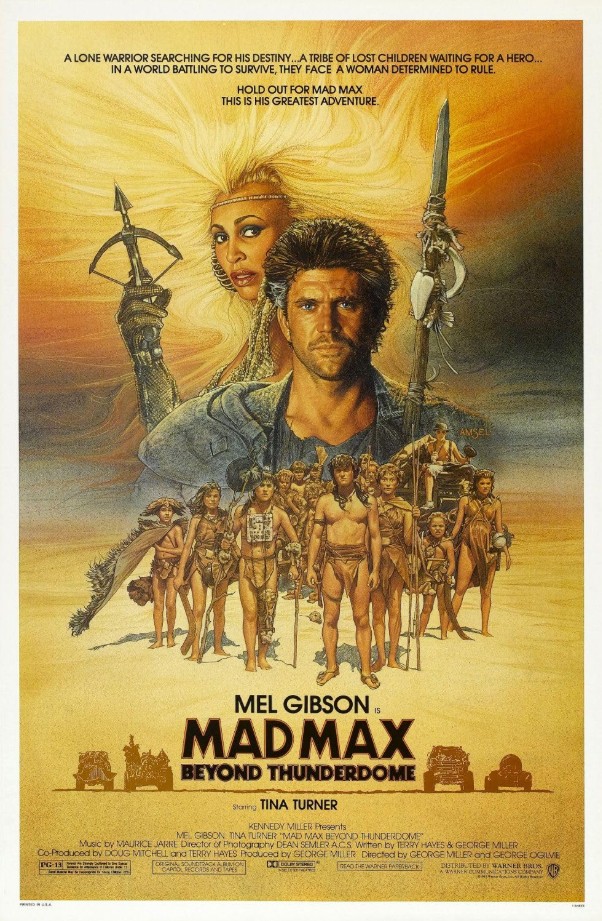
Mad Max Beyond Thunderdome poster created by Kennedy Miller Productions and Warner Bros.

While sharing his opinion on Mad Max Beyond Thunderdome in an episode of At The Movies, Gene complements the directors, George Miller and George Ogilvie, as both of them “successfully creates a complete alien world on film”. To add to Gene’s statement, Roger commented how the film’s “world is as rich as Casablanca or as rich as Oz”. I admit one of the strengths of Mad Max Beyond Thunderdome was its set design, as the movie’s creative team presented an atmosphere that felt immersive! One of the conflicts in the story is Max battling in a duel against a character named Blaster, in order to retrieve his stolen items. They fight within the titular Thunderdome, a circular caged structure built out of steel-like material. What adds to the scene’s immersion is the medium and close-up shots captured within the Thunderdome. The combination of these creative choices helps the audience feel like they are right in the middle of the excitement! Even the sign advertising the Thunderdome is a blend of color, light, and dirt. This specific prop captures the thrill of the dueling action while also consistently displays the film’s aesthetic.

Image by Freepik

As I said in this review’s introduction, Mad Max Beyond Thunderdome ended up on Roger’s list of the top ten best films of 1985. One of his reasons was how he “was overwhelmed by the wealth of new ideas they came up with in the third picture”. Specifically speaking about Max and Blaster’s aforementioned duel, Roger explains how this scene presents two new ideas; “a new place to put the audience, which is over the top of the dome, and a new way to fight by putting the people on elastic bands so they have a three or a four dimensional, if you will, fight instead of regular punching it out”. Adding to Roger’s explanation, both Max and Blaster were given more freedom to move around the Thunderdome because of their elastic harnesses. While there was fist-fighting in the duel, flips and large jumps were incorporated in the fight choreography. Blaster and Max were presented with a variety of weapons, which added to the duel’s unpredictability. It also shows how the duel itself was a battle of strategy. This scene is definitely one of the most memorable from Mad Max Beyond Thunderdome!
Back to 1985 Blogathon banner created by Quiggy from The Midnite Drive-In and Hamlette from Hamlette’s Soliloquy

While Gene and Roger sang the praises of Mad Max Beyond Thunderdome, I was disappointed they ignored Tina Turner’s portrayal of Aunty Entity. Personally, I think Tina is a better actress than some people give her credit for. Her performance in this film proves that. A great example is when Master confronts Aunty Entity about the true leadership of Bartertown. Before this confrontation, Aunty Entity is confident in her ability to rule over this little community. Master calls her out by questioning who’s in charge. Aunty’s confidence gradually turns into anger. She develops a stern look on her face, the anger itself filling her eyes. There’s even a point where Aunty’s bottled-up anger causes her to shake. This scene shows how Tina’s performance was able to say so much while utilizing very little dialogue.

Illustrated image of Arizona desert created by pikisuperstar at freepik.com. Background vector created by pikisuperstar – www.freepik.com

Like I brought up in my review’s introduction, I didn’t like or love Mad Max Beyond Thunderdome as much as Roger and Gene did. A reason for my opinion is how the script left several questions unanswered. When Max meets the children of the Planet Erf tribe, the children believe he is Captain Walker. They describe Captain Walker as a plane pilot who will lead them to a better land. Because Jedediah was introduced in Mad Max Beyond Thunderdome as a man who could successfully fly a plane, I thought he could be Captain Walker, connecting him to the Planet Erf tribe’s part of the story. But this wasn’t the case, leaving questions about Captain Walker’s whereabouts. I was also not a fan of the creative team’s decision to prioritize telling over showing. A good example is when Blaster is about to be defeated in his and Max’s duel. Master begs Max not to kill Blaster, as he has a lot of respect for Blaster. However, this respect isn’t shown leading up to that scene. The only interactions with Master and Blaster are Master simply using Blaster as a means of transportation. Had the respect and camaraderie between Blaster and Master been better displayed, the duel itself and even its aftermath would have carried more emotional weight.
Comparing with the Critics banner created by me, Sally Silverscreen. TV show title cards created by WTTW National Productions, WTTW, Public Broadcasting Service (PBS), Lifetime Television, Tribune Entertainment, Buena Vista Television, and Disney-ABC Domestic Television

When Roger Ebert placed Mad Max Beyond Thunderdome on his list of the top ten best films of 1985, he called it “a great looking, high styled thriller”. Gene Siskel even claimed that “kids are gonna want toys out of this film” and “people are gonna dress like out of this film”. I can only speak for myself, but I wouldn’t go out of my way to seek out merchandise related to this movie or even revisit this movie. That’s because I thought Mad Max Beyond Thunderdome was just a fine, well-made picture. I couldn’t become fully invested in this story because of the collection of unanswered questions, which left me confused. I did not like the creative team’s decision to emphasize telling over showing as well. But the movie does have its merits. The world-building was one of the strongest aspects of the production, as the directors helped create an on-screen world that felt immersive. I not only liked the acting, I also believe the Thunderdome duel was one of the film’s most memorable scenes. So, this is yet another review where I didn’t agree with the critics. Now, if you’ll excuse me, I’ve got to go sing along to Tina Turner’s song, “We Don’t Need Another Hero (Thunderdome)”!

This review was brought to you by

Sally Silverscreen
Take 3: Jack and the Beanstalk (1952) Review

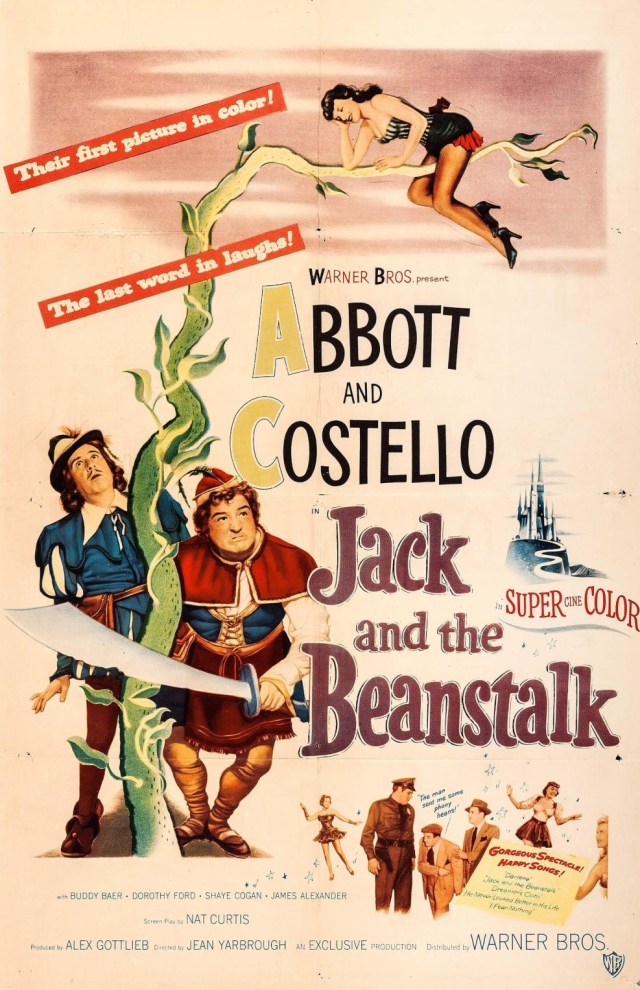
I need to make a confession: in the seven years 18 Cinema Lane has been around, I’ve never reviewed any of Abbott and Costello’s films. (insert shocked gasp here) But at 18 Cinema Lane, I am willing to expand my cinematic horizons. This is one of the reasons why I selected 1952’s Jack and the Beanstalk for the Once Upon A Time Blogathon. Another reason is how I don’t often get the opportunity to write about fantasy films. In fact, the last fantasy movie I reviewed was Cancel Christmas last December. When I came across the poster for Jack and the Beanstalk, I was surprised to read the tagline “Their first picture in color”! Abbott and Costello are household names in the world of comedy. Plus, this adaptation of the fairy tale was released thirteen years after The Wizard of Oz. So, is the movie worthy of such a historic milestone? Adventure through this review of Jack and the Beanstalk to find out!

Jack and the Beanstalk (1952) poster created by Exclusive Productions Inc., Legend Films, and Warner Bros.

Things I liked about the film:

The dialogue: Sometimes, a movie’s comedy will be woven into the dialogue. Words spoken between characters can not only be hilarious, but also clever and witty, especially if the screenwriting is strong. Dialogue was one of the best qualities of Jack and the Beanstalk! One example is from the beginning of the film. Arthur arrives at Eloise’s house to pick her up for play rehearsal. Her younger brother, Donald, answers the door, even setting up a trap that causes Arthur to fall. When Arthur asks Donald where Eloise is, Donald replies in a matter-of-fact manner, “putting on her lipstick so you can kiss off”. What makes this line so memorable is how it fits the character of Donald, who is portrayed as a precocious child. Another example happens during the ‘Jack and the Beanstalk’ story. Jack is heartbroken when his mother suggests they sell the family cow. After Jack’s mother urges him to take the cow to the market, Jack tells her, “Yes mother. You can depend on me. Whatever they bid, I’ll bid higher”. This is a line that is genuinely funny, as Jack says it with good intentions.

The use of color film: During the opening credits of Jack and the Beanstalk, it’s revealed parts of the film are presented in Super Cine Color. These parts are the ‘Jack and the Beanstalk’ story itself, while the “modern” parts of the movie are shown in black-and-white film. I actually liked this creative decision! It emphasized the magic and whimsy of the fairy tale. The use of color film also allowed the vibrant hues of the costume and set design to be visible. Overall, this production of Jack and the Beanstalk felt pleasantly reminiscent of 1939’s The Wizard of Oz!

Working as a pair: Bud Abbott and Lou Costello (also known as Abbott and Costello) have been acknowledged as one of the most beloved comedic duos in film history. So, I was curious how they would work together in Jack and the Beanstalk, since the heroic adventure typically involves only one character. Lou portrays Jack and Bud portrays Mr. Dinkelpuss (a local butcher). Even though both characters travel up the titular beanstalk, they each have their own motives. Mr. Dinkelpuss and Jack help each other escape The Giant’s castle as well. Through the acting performances and the screenwriting, this version of Jack and the Beanstalk feels like Jack was always meant to travel with a buddy.

Once Upon a Time Blogathon: Fairy Tales, Legends, & Myths banner created by Annette from Hometowns to Hollywood

What I didn’t like about the film:

Musical padding: The 1952 adaptation of Jack and the Beanstalk is a musical, with five musical numbers incorporated into the production. These numbers were very well choreographed and sounded good musically. However, they felt like padding, making the movie seem longer than its one hour and twenty-three-minute run-time. A few of the musical numbers feel drawn out, such as the almost three-minute dance between Jack and Polly. Had some of these numbers been trimmed down, the overall run-time could have been under an hour and twenty minutes.

Forgotten details: Within Jack and the Beanstalk’s script, there were a few forgotten details. Jack’s cow, Henry, presents two examples. When Henry is first brought up in the movie, Jack refers to the cow as female. He even puts makeup on her to stress this fact. But before Jack says goodbye to Henry at Mr. Dinkelpuss’ shop, Jack tells the cow to “be a good boy”. Later in the movie, Jack climbs the beanstalk. One of his intentions is to rescue Henry from the clutches of The Giant. When Jack and his friends finally escape The Giant’s castle, however, Polly is the one who ends up saving Henry.

Patrick the Harp: In The Giant’s castle resides a harp named Patrick. Not only does music play every time he talks, he’s also very critical of Polly. Personally, I was not a fan of Patrick. He spoke with a thick accent, which sometimes made it difficult to understand what he was saying. His role in the story was quite minimal, offering little to the plot. If Patrick had been written out of Jack and the Beanstalk, not much would change.

Fairytale castle image created by Freepik at freepik.com. <a href=’https://www.freepik.com/free-vector/fairy-tale-castle_837803.htm’>Designed by Freepik</a>. <a href=”https://www.freepik.com/free-photos-vectors/design”>Design vector created by Freepik</a>. Image found at freepik.com.

My overall impression:

As I mentioned in the introduction of my review, Abbott and Costello are household names in the world of comedy. However, there is a reason why they achieved this honor. Using Jack and the Beanstalk to explain my point, Costello and Abbott work together as a team. Even in a fairy tale where a team dynamic doesn’t exist, they find a way, through acting and screenwriting, to create a story where they can both shine. The dialogue was one of the strongest aspects of the 1952 adaptation, as it was hilariously clever. It also helps that the dialogue was written and delivered well. Even the use of color film enhanced the whimsical charm one would expect from a fairy tale. While Jack and the Beanstalk does have its flaws, it is, indeed, a pleasant presentation! Now, if you’ll excuse me, I need to figure out who really is on first.

Overall score: 7.4 out of 10

Have you seen 1952’s Jack and the Beanstalk? What other fairy tales would you have liked to see Abott and Costello star in? Tell me in the comment below!

Have fun at the movies!

Sally Silverscreen

That’s a Wrap for my Second Chance Christmas Double Feature

Now we’ve come to the end of another double feature, as both chosen titles, Young at Heart and An Old Fashioned Christmas, have been watched and reviewed! In the introduction, I brought up the following question:

Did these two movies deserve a second chance?

For my answer, I’ll say Young at Heart was more deserving of a second chance than An Old Fashioned Christmas. With Young at Heart, I not only received an opportunity to check out more projects from Frank Sinatra’s and Alan Hale Jr.’s filmography, I was also given an official introduction to Doris Day’s movies. I found a good excuse to see more musicals, as well as films from the 1950s. Overall, I enjoyed Young at Heart more than Hallmark’s 2010 presentation. As someone who loves An Old Fashioned Thanksgiving, the sequel left a lot to be desired. Despite being titled An Old Fashioned Christmas, the film didn’t feel like a Christmas film. Instead of prioritizing the messages and themes of the holiday, the script primarily focused on stories that could have taken place any time of year. It also doesn’t help how so much of the story revolves around a love triangle. Looking back on An Old Fashioned Christmas, it makes me wonder if the sequel’s poorer quality, as well as becoming forgotten by time and Hallmark themselves, is the reason why I’ve, more often than not, seen DVD copies of the movie included in Christmas movie box sets?

Christmas themed movie tickets image created by Kraphix at freepik.com. <a href=’https://www.freepik.com/free-vector/movie-tickets-christmas_971544.htm’>Designed by Kraphix</a>. <a href=”https://www.freepik.com/free-photos-vectors/christmas”>Christmas vector created by Kraphix – Freepik.com</a>. Image found at freepik.com.

Have fun at the movies!

Sally Silverscreen

Take 3: Young at Heart Review (Second Chance Christmas Double Feature Part 1)

Thank you for joining me for the first part of my Second Chance Christmas Double Feature! Similar to last year’s review of I Am David, my review of Young at Heart is spoiler-free. If you’re curious about why I chose Young at Heart for this double feature, you can check out the introduction in the link below.

Coming Soon to a Blog Near You; The Second Chance Christmas Double Feature!

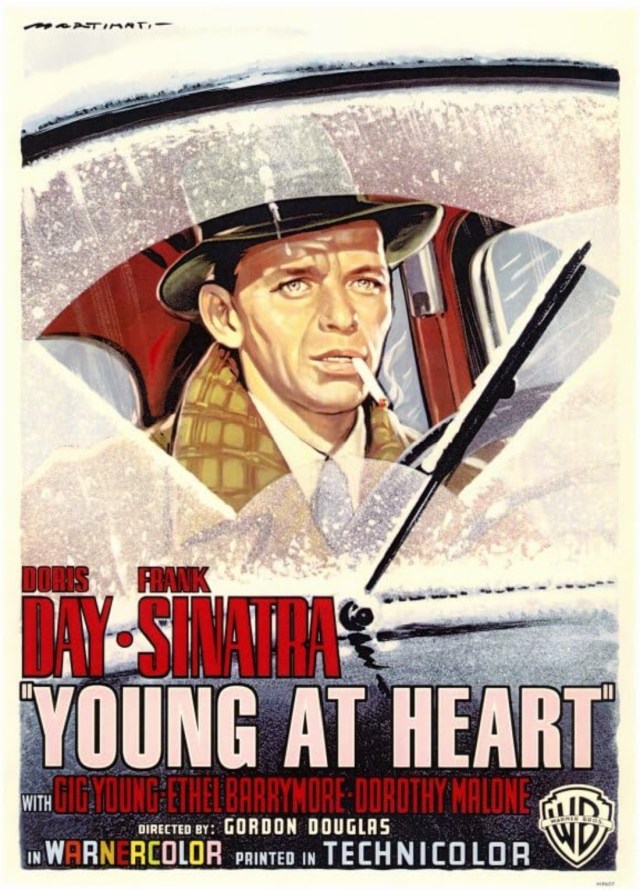
Young at Heart poster created by Arwin Productions and Warner Bros.

1. How were you introduced to Young at Heart and why was it selected for this double feature?

I was introduced to Young at Heart back in January of 2020, through a recommendation from Maddy (of the blog, Maddy Loves Her Classic Films). Several months later, I received another recommendation for Young at Heart. This time, the suggestion came from Moviecriticqueen (of the blog, Movies Meet Their Match). For five years, this movie has stayed on my movie recommendation board on Pinterest. But I have tried to find the right opportunity to write about the film. When I participated in the Sixth Annual Barrymore Trilogy Blogathon, I was originally going to review two movies; Young at Heart and Twentieth Century. Due to technical difficulties, I only had time to write about one film, which I selected the 1934 title. In 2021, I wanted to participate in the Star/Genre Of The Month Blogathon, as January’s featured star was Doris Day. But a busy schedule prevented me from joining the event.

2. You discovered Young at Heart was a Christmas movie after you learned more about the film on IMDB. What else have you discovered about the 1954 picture?

While watching Young at Heart, I discovered Alan Hale Jr. portrayed a character named Bob. Those familiar with their television history would recognize Alan from his starring role (‘Skipper’) on Gilligan’s Island. I will admit the only projects from his filmography I’ve seen are Gilligan’s Island and The North Avenue Irregulars. Even though I’m more familiar with Alan’s appearances on Gilligan’s Island, it was a pleasant surprise to see him star in a different medium!

3. Is the theme of “second chances” incorporated in Young at Heart’s story? If so, how?

Yes, specifically in Barney’s part of the story! When he’s introduced in Young at Heart, Barney (portrayed by Frank Sinatra) is a very pessimistic man. He feels no matter what he does, he will never find success. Throughout the film, one of the few people who believes in Barney is Doris Day’s character, Laurie. During their initial meeting, Laurie tells Barney how anyone can control their own fate. She also encourages him to complete one of his songs. By befriending Barney, Laurie gave him a second chance to prove how valuable he is. Without spoiling the movie, Laurie and Barney’s friendship pays off!

4. Was there anything about Young at Heart you liked or didn’t like?

One of the best aspects of Young at Heart was the dialogue! The writing and delivery were so sharp and witty, it made interactions between the characters interesting! When Barney first arrives at the Tuttle family’s house, he meets Aunt Jessie. During their conversation, Barney nonchalantly asks Aunt Jessie what kind of aunt she is. With a stern tone in her voice, Aunt Jessie promptly tells him her name came first and the curtains came later. This simple exchange between Aunt Jessie and Barney shows some of their character development, as well as the dynamic these characters share.

As I answered for question number three, Barney is a very pessimistic man who believes he can’t find success. I recognize how overcoming insecurities and doubts takes time. But, in Young at Heart, Barney spends most of the movie being pessimistic. He doesn’t change his perspective until the end of the film. This creative choice made Barney a static character. I wish his transformation had gradually taken place over the course of the story.

Adorable Christmas card image created by Rawpixel.com at freepik.com. <a href=’https://www.freepik.com/free-vector/christmas-greeting-card-vector_2824854.htm’>Designed by Rawpixel.com</a>. <a href=”https://www.freepik.com/free-photos-vectors/christmas”>Christmas vector created by Rawpixel.com – Freepik.com</a>. Image found at freepik.com.

5. On 18 Cinema Lane, you’ve covered plenty of Christmas films. How is Young at Heart similar to or different from other Christmas pictures written about on your blog?

It is true that Christmas has a place in Young at Heart. However, the story spans over the course of several months. This means only a portion of the movie is set during Christmas. So, if I had to compare Young at Heart to any of the Christmas films I’ve reviewed, it would be Meet Me in St. Louis. The 1944 movie not only takes place over a year, there is one scene set during Christmas.

6. Did you develop any thoughts and/or questions while watching this film?

As I was watching Young at Heart, I found moments of irony when it came to Barney. When Barney first meets Laurie, he talks about serving in the military during World War II. This reminded me of how Frank’s character, Clarence “Brooklyn” Doolittle, was in the Navy in Anchors Aweigh. During his conversation with Laurie, Barney says he’s never created a hit song. Throughout Frank’s career, he had several hit songs to his name. One notable example is “New York, New York”, which has become the unofficial theme song for New Year’s in Times Square. Any time Barney performed at a restaurant, the patrons didn’t pay him any attention. I’d like to think if Frank had shown up at any restaurant, most of the patrons would have stopped what they were doing to focus on Frank.

7. How would the story of Young at Heart change if it revolved around another holiday?

Like I answered for question number five, Young at Heart spans over the course of several months, with Christmas playing a role in only a portion of the movie. Therefore, I don’t think the story would change much had another holiday served as the primary focus.

8. Did Young at Heart deserve a second chance? If so, why?

I do believe Young at Heart deserved a second chance! By finally checking this movie out, it gave me an opportunity to see more projects from Frank Sinatra’s and Alan Hale Jr.’s filmography. Young at Heart also became my introduction to Doris Day’s films, as I had never seen any of her movies before 2025.

9. After watching Young at Heart, is there anything you can take away from your movie viewing experience?

Young at Heart and The Chalk Garden share one thing in common; a character-driven story that works because of the strength of the cast. But a major difference between these films is how Young at Heart’s script is more “slice of life”. There were conflicts woven into the story. However, these conflicts were either abandoned or resolved at the very end of the movie. I wish Young at Heart had put a little more emphasis on problem-solving among the characters. Another thing The Chalk Garden and Young at Heart have in common is the dialogue, as it was well-written and delivered in both films. There was, clearly, thought and effort put into this film-making component, which made interactions between characters interesting. While I found The Chalk Garden good, Young at Heart was, in my opinion, just fine. The 1954 production could be used as an introduction to Doris Day’s filmography.

Group of puppies image created by Rawpixel.com at freepik.com. <a href=”https://www.freepik.com/free-photos-vectors/background”>Background photo created by rawpixel.com – http://www.freepik.com</a>. Image found at freepik.com.

Have fun at the movies!

Sally Silverscreen
Take 3: Dial M for Murder Review

For this movie review, I chose to write about the 1954 film, Dial M for Murder, for two reasons. The first is how I selected this specific title for The 6th Wonderful Grace Kelly Blogathon, as Grace Kelly stars in the film. The second reason is how, prior to this review, I had never seen Dial M for Murder. Grace and Alfred are no strangers to 18 Cinema Lane. As of mid-November, 2024, I have reviewed two of Grace’s films; High Society (which I thought was fine) and To Catch a Thief (which I found just ok). Meanwhile, four of Alfred Hitchcock’s movies have been covered on my blog. Out of those titles, Strangers on a Train is, in my opinion, still the best one. But how does Dial M for Murder compare to any of Alfred’s films featured on 18 Cinema Lane? Find out by reading my review!

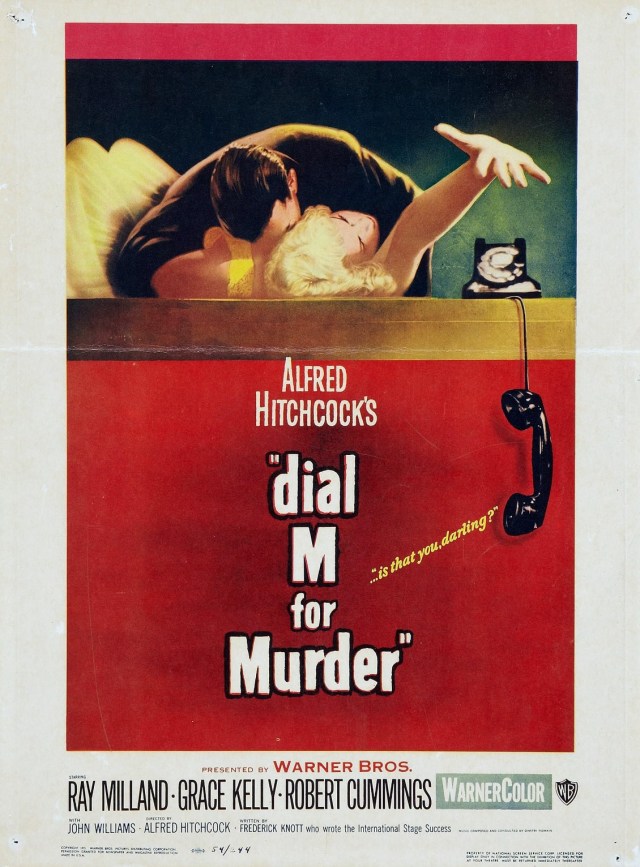
Dial M for Murder poster created by Warner Bros.

Things I liked about the film:

The acting: Since Grace Kelly is the reason why I chose to review Dial M for Murder, I will talk about her performance first. Out of her movies I’ve seen, I’ve noticed how her character portrayals have appeared at ease. Her performance in Dial M for Murder is no different, as her adopted mannerisms and reactions came across as realistic! While sharing a conversation with Mark (portrayed by Robert Cummings), Grace’s character, Margot, seems comfortable in his presence. She effortlessly moves around her apartment and, at times, stands close to him. But when she talks with Mark about how her husband, Tony, has changed, Margot appears to stare into the distance. The combination of her aforementioned stare and frown indicates how Tony’s behavior has troubled her. It also shows the audience how effective Grace’s acting talents are!

As I just said in this review, Robert Cummings portrays Mark, a close friend of Margot. Though they shared only a few scenes together, Grace and Robert displayed nice on-screen chemistry! The strength of Robert’s and Grace’s acting abilities helped their characters appear to truly get along with each other. While I liked Robert’s performance in Dial M for Murder, I was also impressed with Ray Milland’s performance! Similar to Grace’s portrayal of Margot, Ray’s portrayal of Tony showcases how adaptable his acting skills are. For example, Tony looks annoyed while at a restaurant with Mark. From the tone in his voice to constantly checking his watch, Tony clearly appears impatient. A few scenes later, as he’s on the phone with Margot, his demeanor quickly changes to concern due to what he hears over the phone. Throughout his performance, Ray effortlessly brought his character to life!

The use of lighting: Over the course of his career, Alfred Hitchcock has received the title of “Master of Suspense”. One reason why he was given this title is because of how he utilizes lighting to stir up a mood, present visually interesting concepts, or add suspense. In one scene, someone enters Margot and Tony’s apartment. This moment takes place at night, so the only light comes from the fireplace in the living room. An orange glow only providing light to certain areas of the room creates a suspenseful environment, giving the intruder places to hide. I brought up earlier in this review how Mark and Margot shared a conversation. Their conversation takes place in Tony and Margot’s apartment. Right before Tony returns home, Margot’s and Mark’s shadow departs from each other, keeping the closeness of their relationship a secret.

The use of color: Dial M for Murder’s opening credits reveal how the film’s creative team used “WarnerColor” in their project. I’m glad this movie was presented in color because it gave the creative team opportunities to utilize this visual technique to their advantage! Sometimes, the color red was incorporated into a character’s wardrobe. This ranged from Margot wearing a red dress at the beginning of the movie to Tony sporting deep red suspenders. One of the pieces of décor in Margot and Tony’s apartment were dark green curtains. In these examples, color was chosen to draw the audience’s attention to a person, object, or location in the room.

The 6th Wonderful Grace Kelly Blogathon banner created by Virginie from The Wonderful World of Cinema and Emily from The Flapper Dame

What I didn’t like about the film:

Exposition heavy: At the beginning of the movie, Margot shares with Mark how she recently lost her purse. She also tells him when her purse was returned, a letter Mark wrote her was missing. But shortly after Margot made this confession, an exposition heavy scene revealed the letter’s whereabouts, as well as who the story’s perpetrator was. Because this information was revealed so early in the movie, it took away a lot of the story’s suspense. So much exposition given within the film’s first ten minutes may also overwhelm the audience, possibly missing important information if they don’t actively pay attention to the dialogue.

A mystery that isn’t interactive: While talking about Dial M for Murder’s exposition heavy story, I said the perpetrator was revealed so early in the movie. This creative choice takes away the audience’s opportunity to solve the mystery of whodunit alongside the characters. What Dial M for Murder became was a story of how the perpetrator would get caught, similar to programs like Columbo and Diagnosis Murder. That creative decision forces the audience to simply watch the characters solve the story’s mystery. With everything I said, the mystery in Dial M for Murder wasn’t interactive.

A less intimidating antagonist: In some of Alfred Hitchcock’s movies, the antagonist is an intimidating person for a variety of reasons. Their intimidation can add suspense and intensity to a given film’s story. I will not spoil Dial M for Murder. However, I can honestly say I did not find the movie’s antagonist intimidating. Throughout the story, the antagonist kept making dumb decisions, which distracted from their attempts to be an intimidating character. It also didn’t help how the exposition heaviness of the film’s first ten minutes took away a lot of the story’s suspense. If anything, the antagonist in Dial M for Murder was annoying.

Colorful image of key created by orchidart at freepik.com. Flower vector created by orchidart – www.freepik.com

My overall impression:

As of the publication of this review, I have seen eight of Alfred Hitchcock’s films. While I was disappointed by The 39 Steps, I ended up liking Strangers on a Train. When it comes to Dial M for Murder, though, the movie lies somewhere in the middle. Grace Kelly’s performance was, once again, one of the best parts of the production! Her portrayal of Margot was so strong, her reactions and expressions appeared realistic! The use of lighting and color gave Alfred and his creative team ways to present visually creative ideas. But what held Dial M for Murder back from being a more intriguing project is how the first ten minutes of the story was exposition heavy, with this decision impacting the film’s suspense. The mystery not being interactive also takes away some of Dial M for Murder’s intrigue. Alfred’s film felt reminiscent of shows like Columbo and Diagnosis Murder, where the audience simply waits for the perpetrator to get caught. Personally, I prefer mystery stories where I’m left guessing whodunit.

Overall score: 6-6.1 out of 10

Have you seen Dial M for Murder? Which movie of Alfred Hitchcock’s would you like to see me review next? Tell me in the comment section!

Have fun at the movies!

Sally Silverscreen

Take 3: In Country (1989) Review

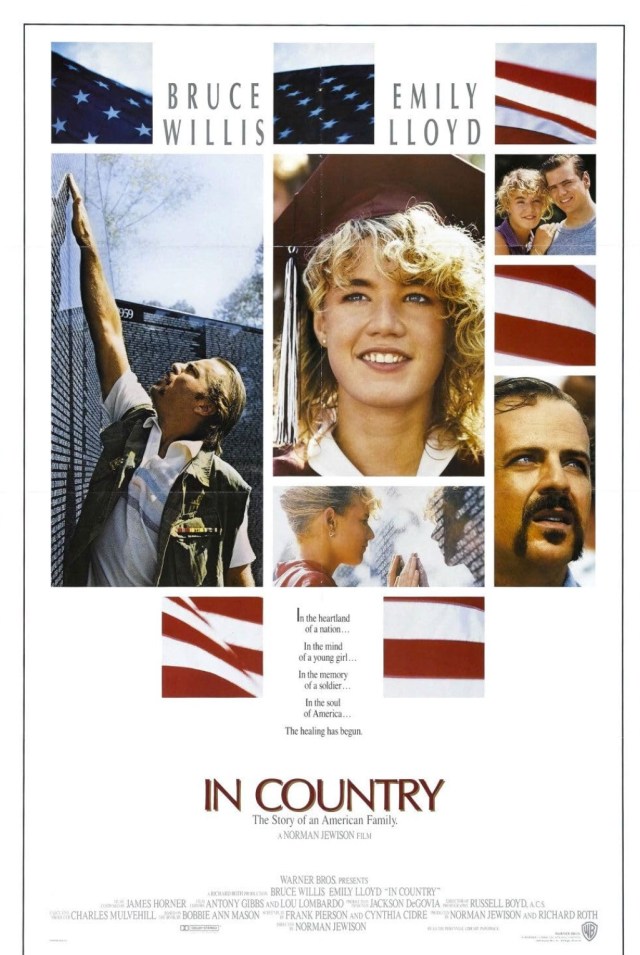
One of the best parts about participating in blogathons is being introduced to movies that may be new to you. This is my experience with the 1989 film, In Country! For Taking Up Room’s Norman Jewison Blogathon, I wanted to choose a movie that was more underrated. While searching through Norman’s IMDB filmography, I came across the aforementioned ‘80s title. The synopsis reminded me of My Girl 2, where Vada is attempting to learn more about her mother. What sets In Country apart from the 1994 sequel is how the 1989 movie explores the aftermath of the Vietnam War by having the protagonist search for answers about her father. In 2024, I have reviewed four other films from the 1980s, so far. Similar to titles like Amadeus and Hallmark Hall of Fame’s Pack of Lies, In Country incorporates historical elements into the story. But will the 1989 movie be a pleasant surprise like Amadeus or a disappointment like Pack of Lies? Keep reading my review to find out!

In Country (1989) poster created by Warner Bros. and Yorktown Productions

Things I liked about the film:

The acting: In any story, especially one that features a young protagonist, the main character’s likability can determine if the story is worth investing time in. I can only speak for myself, but I liked Samantha “Sam” Hughes’ personality! Though naïve at times, Sam was like a bright ray of sunshine, caring about the people in her life and trying to make her world a better place. What made Sam a likeable character was how genuine her emotions were. After finding a box of her father’s belongings in her mother’s room, Sam leaves a voice message on the phone explaining to her mother how upset she is by her mother’s silence about her father. When she hangs up the phone, the sad look in her eyes and the slight frown perfectly show how hurt Sam feels about her mother’s choices. This is just one example of Emily Lloyd bringing that genuineness to life, allowing her performance to be memorable!

Prior to watching and reviewing In Country, I had seen some of Bruce Willis’ films. His portrayal of Emmett Smith is different from some of his other roles, as he had to rely on emotion instead of action to carry his character through the story. A thunderstorm is causing chaos outside Emmett’s home one evening. Because of his time serving in the Vietnam War, he flinches whenever thunder strikes due to the flashbacks he is experiencing. At the same time, Emmett carries irritation in his voice because he wants the storm to stop and he wants to avoid Sam’s questions. Similar to what I said about Emily Lloyd’s performance, Bruce’s performance felt genuine. Beneath the tough exterior Emmett consistently displayed, he was a man who was trying to live a civilian life as best as he knew how.

Honesty about war and its impact on veterans: Like I just mentioned in this review, Emmett experiences flashbacks one stormy evening due to his time serving in the Vietnam War. These flashbacks not only cause Emmett to flinch every time thunder strikes, they also cause him to go outside, climb up a tree, and yell for someone to show their face. Throughout this scene, Sam asks Emmett questions about what is happening. Unfortunately for Sam, these questions are left unanswered. When Emmett goes outside, Sam calls for Emmett to come back in the house. As Emmett’s mind and heart are beyond the borders of his Kentucky home, Sam feels powerless, unsure of how to help Emmett. The scene I just wrote about is one example of the film’s honesty when discussing war and its impact on veterans. The candid way these subjects were talked about in the movie shows how the movie’s creative team understood the subjects’ significance.

The mise-en-scène: I’ve explained before that mise-en-scène is how a scene is presented in a movie. Mise-en-scène was utilized in several scenes’ favor in In Country. Toward the beginning of the film, a group of U.S. soldiers are wading through the swamps of Vietnam. This moment is presented as a long shot with the view appearing as if the camera is hiding behind the swamp’s foliage. How this scene is showcased to the audience emphasizes the soldiers’ need to stay unseen. Sam, Emmett, and Mamaw travel to Washington D.C. to visit the Vietnam Veterans Memorial. While walking past the monument, a close-up shot captured Mamaw as the names on the monument were gliding past her face. The visuals symbolized how the Vietnam veterans have touched the lives of not just their loved ones, but those in their communities as well.

The Norman Jewison Blogathon created by Rebecca from Taking Up Room

What I didn’t like about the film:

Sam’s attraction for Tom: While trying to learn more about her father, Sam turns to a veteran named Tom. At the Vietnam veterans’ dance, Sam invites Tom to share a slow-dance with her, where they get a little too close for comfort. After the dance, Sam spends the night at Tom’s house and has sex with him. Up until the slow-dance at the veterans’ dance, Sam never expressed any romantic interest in Tom. Plus, she just graduated from high school and Tom appears old enough to be her father. Not only was this part of the story random, its inclusion in the film was unnecessary, especially since it has no impact on the plot.

The “slice of life” parts of the story: As I’ve been saying in this review, Sam wants to learn more about her father who served and died in the Vietnam War. This part of the story, as well as the parts exploring the veterans’ perspective, was interesting. But those parts made up half the movie. The other half revolved around subplots that were more “slice of life”. When the story turned to the “slice of life” events, I found myself wishing the movie would go back to Sam learning more about her father or Emmett interacting with the other veterans. In fact, I think the movie should have primarily focused on those aforementioned parts of the story.

On-the-nose songs: The inclusion of songs in a movie can make or break a given scene. Sometimes, a song can be so on-the-nose, it doesn’t leave the intended emotional impact. This happened on more than one occasion in In Country. The opening lines of the Bruce Springsteen song, “I’m On Fire” are “Hey, little girl, is your daddy home? Did he go away and leave you all alone?”. This song can be heard on two occasions after Sam decides to learn more about her father, pointing out what the audience already knows. Earlier in this review, I brought up how Sam invites Tom to share a slow-dance with her, where they get a little too close for comfort. The song they dance to is Hank Williams Jr.’s “Ain’t Misbehavin’”, which narrates what’s happening on screen and foreshadows what’s about to come. That song paired with the events that unfold created a scene that left me uncomfortable.

Children holding American flags during a sunset image created by rawpixel.com at freepik.com. <a href=”https://www.freepik.com/free-photos-vectors/people”>People photo created by rawpixel.com – http://www.freepik.com</a>. Image found at freepik.com.

My overall impression:

When I watch a movie, I sometimes imagine how the story would turn out if it was presented in a different way. One recent example is how Hallmark Hall of Fame’s Brush with Fate would have, in my opinion, benefitted by being presented as a multi-part mini-series. I feel similarly about 1989’s In Country. For the most part, the creative team behind the movie appeared to have their hearts in the right place. The honesty about war and its impact on veterans was included in the story in such a candid way, it showed the movie’s creative team understanding the significance of the subjects woven into the script. But this aforementioned honesty, as well as Sam’s search for answers about her father, should have been the film’s primary focus. Therefore, I wish this story had been a road-trip movie, where Sam, Emmett, and Mamaw go to visit the Vietnam Veterans Memorial in Washington D.C., with Sam learning about her father and important life lessons along the way.

Overall score: 6.1 out of 10

Have you seen 1989’s In Country? What’s your favorite film from 1989? Tell me in the comment section!

Have fun at the movies!

Sally Silverscreen

Take 3: You’ve Got Mail Review

Every so often, I try to review a movie that has been recommended by one of my readers or a fellow blogger. It’s a wonderful opportunity when I can write about a recommended film for a blogging event. This is what happened when I joined the Everything Is Copy Blogathon! When I learned Rebecca’s, from Taking Up Room’s, event centered around the Ephron family, I realized no one had chosen You’ve Got Mail as their blogathon entry. Since the movie was recommended by Janis from Momshie Diaries, I found the perfect excuse to finally see the film in its entirety! You’ve Got Mail is far from the first romantic comedy (rom-com) I’ve talked about on 18 Cinema Lane. Several Hallmark Channel films have received their own review, ranging from terrible to the best I’ve ever seen. So, where does You’ve Got Mail rank among those Hallmark titles? Log in to this review to find out!

You’ve Got Mail poster created by Warner Bros.

Things I liked about the film:

Tom and Meg’s on-screen chemistry: An ingredient to a successful rom-com is casting an actor and actress who share strong on-screen chemistry. This ingredient creates an on-screen relationship that feels believable. In You’ve Got Mail, Tom Hanks and Meg Ryan portray Joe Fox and Kathleen Kelly; two literary business owners who have different perspectives on the world of bookselling. Yet, whenever they’re together, Kathleen and Joe share a spark between them, learning over time how they have more in common than they initially believed. The on-screen chemistry between Meg and Tom makes it feel like their characters have known each other for many years. It also helps how Tom and Meg brought a strong sense of likability to their characters. Even though Joe was a businessman who felt there was a time and a place for “big box stores”, his personality was more jovial than some of the businessmen who appear in a typical Hallmark Channel rom-com. Meanwhile, Kathleen’s personality was fun and fancy-free, trying to find a silver lining during autumn in New York City.

The set design: One of the conflicts in You’ve Got Mail was a bigger, chain bookstore affecting the business of a smaller, locally owned book shop. The interior design of the bigger bookstore was meant to imply how impersonal that store’s shopping experience was. But I actually liked the interior design of both stores! At the smaller book shop, the pale yellow walls paired nicely with warm wood shelves. With string lights circling near the store’s ceiling, the space itself felt cozy and quaint. At the bigger bookstore, white supporting columns, dark gray granite countertops, and shiny silver railings boasted a modern space that looked and felt heavenly. Quirky décor, such as a large, spinning silver globe and a replica of the Statue of Liberty reading a book prevented the store from being dull. Even the bookstore’s bakery section was promoted as a hip gathering space, a curved countertop with tall stools providing an area for readers to come together and enjoy each other’s company. Both spaces looked inviting and appeared photogenic!

The dialogue: The strength of dialogue can create or break a script. While the dialogue can be elevated through delivery, its believability and memorability lie in the writing talent. Within You’ve Got Mail, there was dialogue that I thought was cleverly written! One example was when Kathleen and Joe met each other at a restaurant. Using advice from her anonymous pen pal, Kathleen shared what was on her mind with Joe. Frustrated by Joe’s inability to see how his bookstore prevented other bookstores from thriving, Kathleen told Joe his brain was replaced by a cash register and his heart was taken over by the bottom line. While her statement was meant to be insulting, Kathleen’s quote was an eloquent way of illustrating how she saw Joe. Her quote also stressed how her love of literature helped her choose words that made her opinion sound mature and intelligent.

The Everything Is Copy Blogathon banner created by Rebecca from Taking Up Room

What I didn’t like about the film:

Forgettable secondary characters: In a rom-com, the main male and female character are not the only characters who can make a story work. A collection of secondary characters who interact with the protagonists can add humor, wit, and even thoughtful insight to the film. The story of You’ve Got Mail revolved so heavily around Kathleen and Joe, all of the movie’s secondary characters seemed like an afterthought. This group of actors and actresses did a good job with the material they were given. But the characters they portrayed weren’t as 3-dimensional as Joe and Kathleen. Some rom-coms will give at least one secondary character a subplot. However, no subplots were given to the secondary characters in You’ve Got Mail. Even when there was the possibility for a secondary character to receive their own piece of the story, this opportunity didn’t lead anywhere. It felt like You’ve Got Mail was the world according to Joe and Kathleen, where every other character was simply given permission to exist in it.

The protagonists’ love interests: I have seen some Hallmark rom-coms where the main male and female characters are already in a romantic relationship, only for these characters to end their previously established relationships in order to fall in love with each other. This trope is not limited to Hallmark’s films, as it appeared in You’ve Got Mail. At the beginning of the movie, the story established Kathleen is living with her boyfriend, Frank. Meanwhile, Joe is considering proposing to his girlfriend, Patricia. Because You’ve Got Mail is a rom-com, there is a greater likelihood Kathleen and Joe will fall in love. I’ve also mentioned in this review how, in my opinion, Tom and Meg had strong on-screen chemistry. Therefore, Joe and Kathleen’s previously established relationships feel pointless.

The run-time: You’ve Got Mail has a run-time of one hundred and twenty minutes. This is almost the same run-time as a typical Hallmark movie. Like I mentioned in this review, none of the story’s secondary characters were given a subplot, as the film revolved heavily around Joe and Kathleen. You’ve Got Mail’s plot includes anonymous pen pals desiring to connect in the real world. With the story being so simple and easier to follow, the movie’s run-time feels excessive. Some scenes are drawn out to likely satisfy the film’s run-time. In my opinion, You’ve Got Mail should have shown the anonymous pen pals meeting sooner. That way, they could not only help each other with their professional dilemmas, but the story itself could have become a contemporary retelling of Pride and Prejudice.

Envelope with hearts image created by Freepik at freepik.com. <a href=’https://www.freepik.com/free-photo/hearts-and-pink-envelope-for-mothers-day_1950691.htm’>Designed by Freepik</a>. <a href=”https://www.freepik.com/free-photos-vectors/love”>Love image created by Freepik</a>. Image found at freepik.com.

My overall impression:

Before and after the release of You’ve Got Mail, rom-coms have found their place in the world of film. Like any genre, there’s a variety of titles, some good and some bad. For me, You’ve Got Mail falls somewhere in the middle. The main romance was well written, directed, and acted. This combination allowed the protagonists to form a relationship that felt believable and charming. While the dialogue and set design certainly helped this picture, it wasn’t enough to outweigh the film’s flaws. From none of the secondary characters receiving their own subplot to the run-time, these things held the movie back from being a stronger story. With the film titled, You’ve Got Mail, and with the anonymous pen pals exchanging emails and instant messages, I’m surprised none of the story’s bookstores brought up the possibility of selling their merchandise online. In fact, I’m shocked the internet wasn’t a bigger topic/theme in this movie! I would say that was a missed opportunity. But with the film itself being just fine, I guess I don’t have much to complain about.

Overall score: 7.2 out of 10

Have you seen You’ve Got Mail? What’s your favorite rom-com? Tell me in the comment section below!

Have fun at the movies!

Sally Silverscreen

Take 3: Space Jam (1996) Review

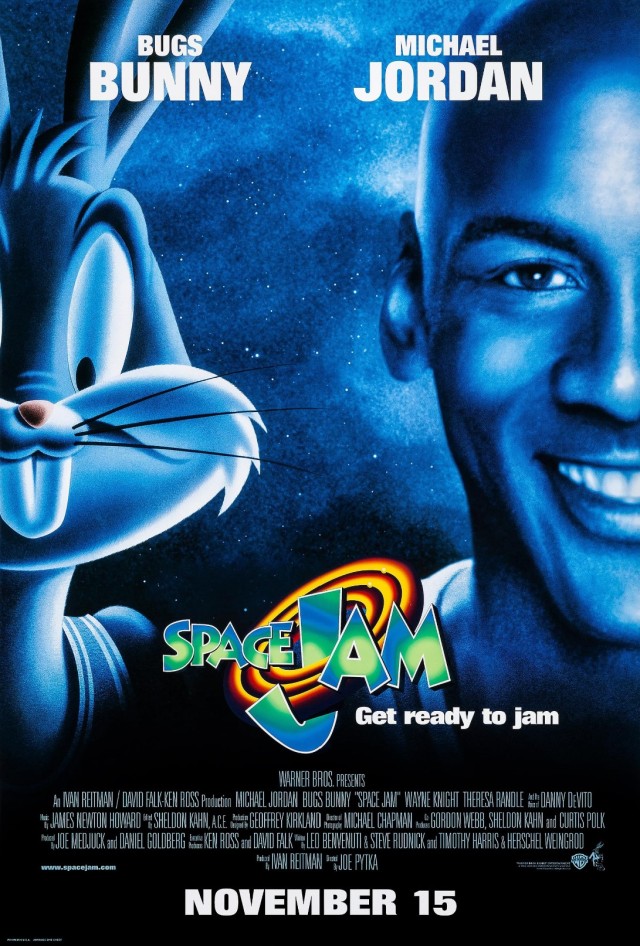
Some of my readers will know Michael Jordan as the reason why they cared about the Chicago Bulls. Other readers are familiar with Michael because of the infamous meme where Michael says in a calm and friendly way, “Stop it. Get some help”. Then there are my readers who are fans of Michael because of his appearance in the 1996 movie, Space Jam. Michael’s involvement in this film is one of the reasons why I’m reviewing it, as “movies where a star is playing themselves” is June’s theme for Genre Grandeur. Another reason why I chose to write about Space Jam is how I don’t often receive the opportunity to talk about animated films on 18 Cinema Lane. While I am familiar with this movie and what it’s about, I had never seen it in its entirety before. Now that I have checked out Space Jam, I can now give an honest opinion about it. So, sit back in your courtside seats, as this review is about to begin!

Space Jam (1996) poster created by Warner Bros. Family Entertainment, Northern Lights Entertainment, Courtside Seats Productions, and Warner Bros.

Things I like about the film:

The animation: In the 1990s, a trend in animation was the adoption of bright colors. Whether it was the Disney Renaissance or the first creatures in the world of Pokémon, bold hues and color schemes dominated both big and small screens. Space Jam follows this trend in various ways. One great example is the locations in the film’s animated world. There is a shot in the movie of the gym where Michael and the Looney Tunes train for their upcoming basketball game. The gym itself boasts a bright coral exterior, with the building set against a blue sky and a green, grassy lawn. The film’s colors emphasize the fun and energetic nature of it’s animated landscape. They also provide pops of color that make animated characters and their world interesting to look at.

Before the release of Space Jam, the Looney Tunes were an animated collection with their distinct histories, stories, and even voice acting performances. When bringing these characters into one overarching story, it could have been difficult to adapt them from one medium to another. Yet, every Looney Tunes character featured in the movie looked, sounded, and acted consistently with their pre-established shows. This crucial creative decision allowed the story to maintain a strong sense of continuity. It also gave audience members of all ages an opportunity to enjoy watching the Looney Tunes and their antics.

The messages and themes: At the beginning of Space Jam, Michael Jordan decides to take a break from the world of basketball to pursue a baseball career. According to the movie’s introduction, baseball is a sport Michael cared about. Yet, joining Major League Baseball (MLB) was a new direction in Michael’s career. His baseball endeavors aren’t as fruitful as his basketball endeavors. Yet, there are people surrounding Michael who are supportive of his decision. What this part of the story showed me was how one shouldn’t be afraid to try new things. Even when someone has a forte and has achieved their full potential, it could be beneficial to expand their horizons. That message can be a valuable lesson for younger viewers and a message older viewers can appreciate!

The humor: Animation and humor typically go hand in hand. Space Jam is no exception, as there were moments within this story I found genuinely funny. One way humor was incorporated into the film was through the dialogue. After Bugs Bunny and Daffy Duck retrieve Michael’s basketball attire, Daffy said they should name their team ‘The Ducks’. Bugs then responds by asking “Why would a Mickey Mouse corporation name their team ‘The Ducks’”? This question was meant to poke fun at Disney’s program, The Mighty Ducks. What added to the humor of this conversation was how the dialogue fit the personality of these characters.

What I didn’t like about the film:

Parts of the story that don’t make sense: In Space Jam, several basketball athletes have mysteriously lost their athletic abilities. This causes concern amongst the league’s other basketball teams. It gets to the point where the basketball season ends early. Here’s where the story doesn’t make sense: the film shows the National Basketball Association’s (NBA’s) season taking place at the same time as the Major League Baseball’s (MLB’s) season. A typical MLB season will take place between April to October, while the NBA runs their season from about fall to early summer. The only time these leagues’ schedules overlap is when the NBA Finals happen. With all that said, the basketball season in Space Jam would almost be over, with the Finals on the horizon. Yet, none of the characters bring up the Finals. This is just one example where the story doesn’t make sense.

A disjointed story: As I just mentioned, some basketball athletes have mysteriously lost their athletic abilities in Space Jam. Meanwhile, the Looney Tunes recruit Michael Jordan to compete in a basketball game in space. Because Michael spends most of the movie in the animated world, his story and the story of the basketball athletes feel like two separate stories, with a very loose connection to one another. When the film goes back and forth between the stories, the transitions are abrupt, with little segue provided. These creative decisions led Space Jam to feel disjointed.

The underutilization of Lola Bunny: Lola Bunny has found a place for herself in the world of Looney Tunes. From what I remember, she was prominently featured in Space Jam’s marketing. Yet in the movie, prior to the basketball game itself, Lola appears in only two scenes. Her first appearance took place forty minutes into an hour and twenty-seven-minute film. I’m unsure when Lola made her debut in the Looney Tunes universe. But if Space Jam was meant to be her introduction, I was disappointed by how unceremonious it was.

Collection of white rabbit images created by freepik at freepik.com Hand drawn vector created by freepik – www.freepik.com

My overall impression:

There are two categories for films that are products of their time; those that are dated on arrival and those that serve as a visual time capsule for when the movie was released. Space Jam belongs in the latter category, presenting a slice of the ‘90s through a combination of animation, athletics, and intergalactic silliness. Speaking of the animation, I was surprised by how the character designs, background designs, and blend with live-action mostly aged well. Though innovative at the time, this blend serves as an example of the creativity ‘90s animation has to offer. It was also interesting to see Michael Jordan’s career incorporated into the story, showing the audience how anyone, even the most celebrated of athletes, can try new things. Space Jam is, in my opinion, a fine film. Even though I won’t reflect on this movie as fondly as other films, I am glad I finally saw it in its entirety.

Overall score: 7.1 out of 10

Have you watched Space Jam? Which animated film from the 1990s do you like? Tell me in the comment section below!

Have fun at the movies!

Sally Silverscreen

Take 3: Sesame Street Presents: Follow That Bird Review (The Great Muppet Guest Star Caper Double Feature Part 2)

Welcome to part two of The Great Muppet Guest Star Caper Double Feature! Like my review of The Great Muppet Caper, this review of Sesame Street Presents: Follow That Bird will be spoiler-free. I will also be referring to the movie as ‘Follow That Bird’ instead of its full title. If you would like to know why I selected this movie, I will provide the link to this double feature’s introduction. The link to my review of The Great Muppet Caper will be provided as well.

The Great Muppet Guest Star Caper Double Feature is On Its Way!

Take 3: The Great Muppet Caper Review (The Great Muppet Guest Star Caper Double Feature Part 1)

Sesame Street Presents: Follow That Bird poster created by Warner Bros. and Children’s Television Workshop

1. Were you familiar with Follow That Bird before The Great Muppet Guest Star Caper Blogathon?

Similar to The Great Muppet Caper, I was familiar with Follow That Bird before participating in the blogathon. I own a copy of the film’s soundtrack, so I knew what the story was about. When it comes to the movie itself, I’d only seen pieces of it.

2. Who was the featured guest star in Follow That Bird?

Sesame Street’s Big Bird was a guest on The Muppet Show. As I said in my review of The Great Muppet Caper, The Muppets and Sesame Street were created by Jim Henson. Keeping this fact in mind, I’ve always seen the characters from each intellectual property (IP) as being extended members of the same family. So, when it comes to The Muppet Show, I was surprised Big Bird was considered a “guest”.

3. How would Follow That Bird’s story change if a different Sesame Street character was the main character?

Like The Muppets, Sesame Street has a large cast of characters. Whether that character is a human or a muppet, each one has their own unique personality, set of likes and dislikes, and talents to offer. With that said, this would be a completely different movie if the story revolved around a different Sesame Street character. Grover is one example, as an important part of his character is his desire to become a superhero. If Grover were the main character of a Sesame Street movie, his story would likely be a “superhero’s tale”, where the protagonist fights crime and saves the day with superpowers.

4. Did you develop any thoughts and/or questions while watching this film?

While watching Follow That Bird, I found some parts of the story confusing. As some of the characters watch a news report on a television at Mr. Hooper’s store, Chevy Chase makes a cameo appearance as a newscaster. During the weather report, he quotes the theme song to Mister Rogers’ Neighborhood. Out of all the references Chevy could make in a Sesame Street movie, why that one? Wouldn’t it make more sense for Fred Rogers to appear in the film and quote the theme song of his own show? Another example is when several characters spot Big Bird in a parade. These characters can clearly see their feathered friend, but their path is blocked due to the parade taking place. How come none of the characters considered getting out of their car and following Big Bird through the parade on foot? It’s decisions like this one that, for me, didn’t make sense.

Similar to The Great Muppet Caper, I was surprised by which characters were included in the movie and how much screen-time they received. Toward the end of Follow That Bird, Elmo makes such a brief cameo appearance, he doesn’t even have any lines. On one hand, Elmo was introduced on Sesame Street in 1980. By the time Follow That Bird was released in theaters, he had been on the show for about five years. On the other hand, at the time of Follow That Bird’s premiere, Elmo was not as popular as he would later become. Despite these facts, I was kind of surprised by Elmo’s limited appearance.

5. Follow That Bird was the first Sesame Street movie ever created. Why do you think it took the show’s creative team that long to make a film?

I have two answers why this decision was likely made. A lot of the cast members from the Sesame Street show worked on Follow That Bird. This includes cast members who worked on Muppet related projects, such as The Great Muppet Caper and The Muppet Show. Like I said in my review of The Great Muppet Caper, my guess is Sesame Street’s creative team wanted to prevent creative burn-out and spreading their talent too thin.

At the time Follow That Bird was released, Sesame Street had been on the air for sixteen years. During that time, the show’s creative team worked very hard to cultivate a program that was creatively and educationally consistent. Like any television show, Sesame Street’s audience grew over time. When it comes to creating a movie, I would guess Warner Brothers, the studio who distributed Follow That Bird, and Children’s Television Workshop, Sesame Street’s production company, wanted to wait until they felt they could make a satisfying profit on the film.

The Great Muppet Guest Star Caper banner created by Rebecca from Taking Up Room and Gill from Realweegiemidget Reviews

6. Is there anything about Follow That Bird you liked or didn’t like?

As I said in answer number four, I was surprised by which characters were included in the movie and how much screen-time they received. But I also found it interesting how these characters were utilized in the story. On Sesame Street, Oscar the Grouch, more often than not, stays in his trash can and maintains a negative disposition. These factors cause Oscar to appear on the show in certain situations, such as interacting with The Wicked Witch of the West from The Wizard of Oz. While he still had a negative disposition in Follow That Bird, Oscar explored the world beyond his trash can. That’s because he was one of the assigned drivers searching for Big Bird. In Follow That Bird, Oscar was a lot more humorous than I expected. My favorite line of his was spoken during the road trip preparations. Oscar exclaims how he loves a good goose chase. Then, he randomly says, “Let’s get lost”. Giving Oscar more humorous lines and allowing him to join the road trip gave this character an opportunity to be utilized more than he has on the show!

In my review of The Great Muppet Caper, I mentioned the characters’ knowledge of being in a movie as one of the story’s overarching jokes. This was one of the highlights of the 1981 film, as the dialogue relating to the joke was cleverly written and successfully delivered. Two of the characters in Follow That Bird, Oscar the Grouch and Count von Count, acknowledged the film’s audience was watching their movie. But other than “The Grouch Anthem” and the end credits, this knowledge was not consistently brought up in the script. That is just one example of a creative element that wasn’t fully utilized in the 1985 movie.

7. Could a new Sesame Street movie work in 2023?

Since its debut in 1969, Sesame Street has become a global phenomenon. The success of the show has encouraged countries outside of the United States to create their own version of Sesame Street. In the thirty-eight years since Follow That Bird’s premiere, the cinematic landscape has become more globalized. If Sesame Street’s creative team wanted to make another movie, an important question they would have to answer is which characters will be included in the story. Would it exclusively focus on the characters from Sesame Street or would it also feature characters from one of the international shows? If you wanted to create a movie in 1985, you had three distribution options: releasing the film in theaters, premiering the movie on television, or putting the production directly on video cassette. With the invention of streaming services, studios and production companies are now given the option to forgo the process of theatrical releases, as well as selling a movie on physical media. The distribution of a Sesame Street film is another important question the show’s creative team would have to address.

8. What does Sesame Street mean to you?

To me, Sesame Street represents the idea of timelessness. The show has found its place in the pop cultural landscape and stayed there for over fifty years. In that timeframe, the world and Sesame Street itself has seen so many changes. But despite all of that, some elements of the program have remained the same. Each episode has been given an official letter and number. Follow That Bird even adopted this component from the show, with ‘W’ and ‘B’ being the movie’s letters, representing the studio that distributed the film, Warner Brothers. That simple creative decision has taught children the alphabet and how to count. This knowledge lays the educational foundation so children can master other skills, such as constructing sentences and mathematical equations. The simplicity and consistency of including letters and numbers into Sesame Street is a reminder of the timeless nature of these lessons.

9. After watching Follow That Bird, is there anything you can take away from your movie viewing experience?

According to Muppet Wiki, Sesame Street created three television specials in the 1980s focusing on Big Bird traveling around the world; Big Bird in China, Big Bird in Australia, and Big Bird in Japan. With Follow That Bird being released in 1985 and with the story about Big Bird traveling outside of Sesame Street, it makes me wonder if the movie was meant to correlate with the aforementioned television specials? Speaking of the movie, I thought it was a fine, pleasant, cute enough production. But compared to The Great Muppet Caper, Follow That Bird could have been stronger. There were several creative elements within the movie that weren’t consistently utilized. “The Grouch Anthem” and the end credits being the only two instances of the characters acknowledging the audience is watching their movie is just one example I mentioned in my review. As I also mentioned in my review, some creative decisions didn’t make sense, such as Chevy Chase quoting the theme song of Mister Rogers’ Neighborhood. However, this wasn’t a bad first attempt at making a movie. In fact, there are aspects of the project that worked in the movie’s favor, like the musical numbers! I feel Follow That Bird is one of those films that younger children would enjoy more than an older audience member would.

Image of Colorado road created by welcomia at freepik.com. <a href=”https://www.freepik.com/free-photos-vectors/mountain”>Mountain photo created by welcomia – http://www.freepik.com</a>. Image found at freepik.com.

Have fun at the blogathon!

Sally Silverscreen

Take 3: The Sundowners (1960) Review

Here at 18 Cinema Lane, I try to go out of my way to watch, and review, as many film recommendations as possible. In fact, I have a board on Pinterest dedicated to these recommendations. Two years ago, when I reviewed Marriage on the Rocks, Maddy, from Maddy Loves Her Classic Films, suggested I check out the 1960 picture, The Sundowners. Shortly after Debbie, from Moon in Gemini, invited me to her Foreign Western Blogathon, I finally found an opportunity to write about the movie! The Sundowners fits two of the four blogathon categories: ‘directed by foreign directors’ and ‘shot in a foreign country’. According to IMDB, the film’s director, Fred Zinnemann, is from Austria-Hungary. The movie was also filmed in Australia, where the story takes place. Foreign westerns are not a new concept on 18 Cinema Lane. Neither are Australian films. Within the four years of my movie blogging journey, I reviewed Another Man, Another Chance, Interrupted Melody, and Hallmark Hall of Fame’s Durango. If you’re interested, I’ll provide the links to these reviews toward the beginning of this article.

Take 3: Another Man, Another Chance Review

Take 3: Interrupted Melody Review

Take 3: Hallmark Hall of Fame’s Durango Review

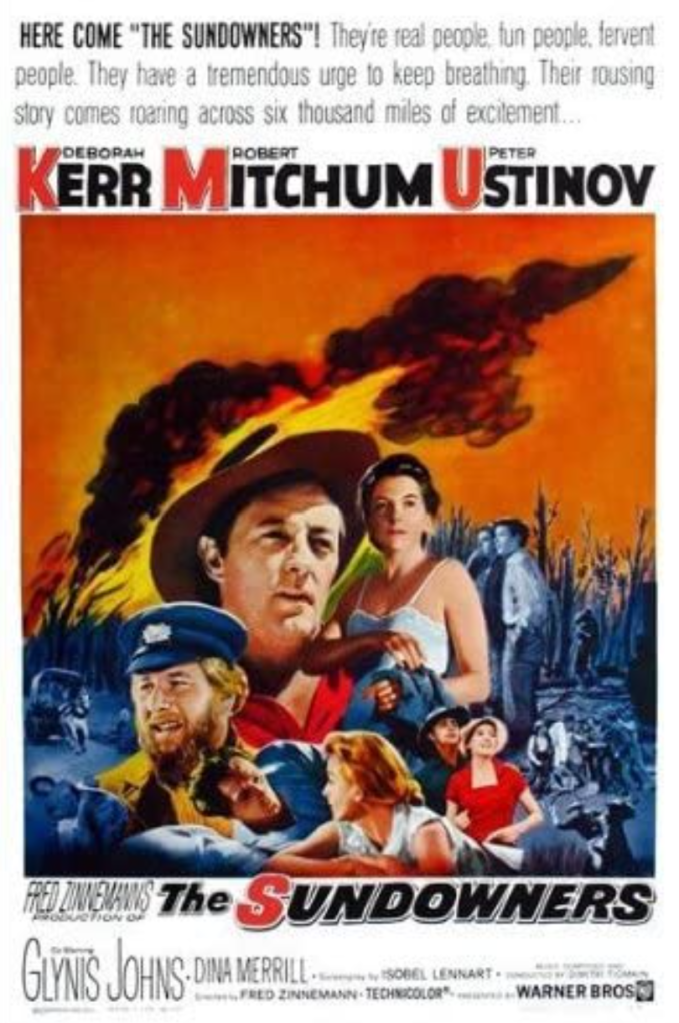
The Sundowners (1960) poster created by Warner Bros.

Things I liked about the film:

The cinematography: Like I said in the introduction, The Sundowners was filmed in Australia. The movie’s creative team took advantage of the country’s natural surroundings through cinematography! One long shot showcased Australia’s farmlands. What made this shot beautiful were the rays of sunlight showering over the green landscape, offering a light only nature could provide. The cinematography also did a good job putting things into perspective. During a forest fire, Ida is driving her family’s wagon away from the forest. While this maneuver is taking place, the camera is situated inside the back of the wagon. It looks out toward the road, giving the audience the illusion they are riding in the wagon with Ida.

Higher stakes: When I reviewed Hallmark Hall of Fame’s Durango last year, I talked about low stakes being one of the film’s biggest flaws. In The Sundowners, higher stakes were featured in a few scenes! A notable example is the forest fire I previously mentioned. While the Carmody family is herding sheep, a nearby forest fire breaks out. This leads all the characters to be in danger. The scene chronicled the entire process of the fire, starting from the detection of smoke and ending in the fire’s aftermath. Cut-away shots of scared wildlife are spliced into the story, emphasizing the other lives in harm’s way. Dramatic music can be heard in the background, elevating the sense of urgency. With all these elements combined, this scene was the perfect example of the higher stakes I expect from a western film!

The historical accuracy: With any “period film”, the historical accuracy can make or break that production. In the case of The Sundowners, the story takes place in the 1920s. From the looks of it, the 1960 project appears historical accurate! The forms of transportation are one indicator. While the Carmody family is working on the sheep farm, the employees sometimes rode in antique trucks with open beds. At least one motorcycle is featured in the story, revealing exposed gears and a model very different from the motorcycles of today. A covered wagon is the preferred vehicle of the Carmody family, with Paddy and Sean riding horses on a few occasions. This aspect of the film’s historical accuracy reminded me of a production like The Grapes of Wrath.

The Foreign Western Blogathon banner created by Debbie from Moon in Gemini

What I didn’t like about the film:

A “slice of life” story: Westerns, like any genre, contain a wide range of narratives. If given the choice, I’d rather watch a western with, at least, one conflict instead of a story that’s more “slice of life”. Unfortunately, the majority of The Sundowners is a “slice of life” story. The script primarily focuses on the daily operations of sheep farming. At first, this topic was interesting. But as the film carried on, the elements of sheep farming became repetitive. Had this movie contained one or two major conflicts, I might have found this story more intriguing.

Lack of Irish accents: According to Wikipedia, the Carmody family is Irish, a fact Sean tells Rupert early in the film. Michael Anderson Jr., Robert Mitchum, and Deborah Kerr must have missed that detail in the script, as none of them could successfully carry an Irish accent. Throughout The Sundowners, Deborah sounded like she was speaking in a British accent. Meanwhile, Robert and Michael sounded Australian. I don’t think Robert, Deborah, and Michael are bad actors. In fact, pulling off any accent can be a difficult skill to master. However, their lack of Irish accents was, for me, jarring.

The run-time: The Sundowners contains a straight-forward story about a family searching for employment in order to afford a place of their own. With that said, I found it unnecessary for the film’s run-time to be two hours and thirteen minutes. Some scenes felt drawn out in an attempt to satisfy this run-time, the shearing contest Paddy enters being one example. That scene lasts about five minutes, even though it could have only featured the most exciting parts of the contest. If scenes like that one had been cut shorter, the movie could have had a run-time of about an hour and thirty minutes.

A “bait and switch” ending: In my review of 1961’s The Pit and the Pendulum, I incorporated spoilers to explain my thoughts on a specific portion of the movie. Similarly, I will be including spoilers in this part of my review. If you haven’t seen The Sundowners, please skip this part and continue reading where it states “My overall impression”.

As I stated earlier in this review, The Sundowners contains a straight-forward story. I also stated how the movie is two hours and thirteen minutes. Within that run-time, the Carmody family receives the funds to afford a farm that was featured toward the beginning of the film. All seems to be going well until the last ten minutes in the story. While in a drunken state, Paddy makes several I-O-Us, losing the family’s finances in the process. In an attempt to earn back some of those funds, the family enters their race-horse, Sundowner, in an upcoming horse race. Not only does Sundowner and Sean win the race, Paddy also wins a bet. Even though they have enough money to make a down payment on the aforementioned farm, Ida changes her mind, saying Paddy can keep the race horse instead. This statement contradicts Ida’s goal throughout the movie; getting a place to put down roots. Moments later, an announcement declares Sundowner is disqualified from the race due to a pass interference. This means the Carmody family lost all the money they just won. The movie ends exactly how it begins; with the family on the road looking for employment and a place to stay. If I had known the story would end this way, I wouldn’t have become invested in the Carmody family’s ordeal.

Horse with saddle photo created by Topntp26 at freepik.com. <a href=’https://www.freepik.com/free-photo/stallion-black-equine-race-sky_1104246.htm’>Designed by Freepik</a>. <a href=”https://www.freepik.com/free-photos-vectors/background”>Background image created by Topntp26 – Freepik.com</a>. Image found at freepik.com.

My overall impression:

When it comes to film-making, one of the worst things you can do is waste the audience’s time. The way I feel about The Sundowners is similar to how I felt about The Birds; like I truly wasted two hours and thirteen minutes. I understand circumstances in western films aren’t always fair. Heck, life itself is sometimes unfair. But what is also not fair is giving your characters and audience hope for two hours, then taking that hope away in the film’s last ten minutes. With the way The Sundowners turned out for me, it almost seemed like history repeated itself. As I mentioned in this review, I wrote about Hallmark Hall of Fame’s Durango last year. That 1999 presentation was a foreign western I didn’t like. Both Durango and The Sundowners have one thing in common. Even though there were things about each film I liked, they contained a weak script. A script is the foundation of any cinematic production. If it isn’t strong, there’s only so much you can do to remedy the issue. Before I end this review, I want to make it clear that I have nothing against foreign westerns or Australian cinema. I’m confident there are stellar Australian and foreign western pictures I haven’t seen yet. Unfortunately, The Sundowners isn’t one of them.

Overall score: 4.7 out of 10

Have you watched any foreign westerns? If so, which ones would you recommend? Let me know in the comment section!

Have fun at the movies!

Sally Silverscreen