Take 3: In Country (1989) Review

One of the best parts about participating in blogathons is being introduced to movies that may be new to you. This is my experience with the 1989 film, In Country! For Taking Up Room’s Norman Jewison Blogathon, I wanted to choose a movie that was more underrated. While searching through Norman’s IMDB filmography, I came across the aforementioned ‘80s title. The synopsis reminded me of My Girl 2, where Vada is attempting to learn more about her mother. What sets In Country apart from the 1994 sequel is how the 1989 movie explores the aftermath of the Vietnam War by having the protagonist search for answers about her father. In 2024, I have reviewed four other films from the 1980s, so far. Similar to titles like Amadeus and Hallmark Hall of Fame’s Pack of Lies, In Country incorporates historical elements into the story. But will the 1989 movie be a pleasant surprise like Amadeus or a disappointment like Pack of Lies? Keep reading my review to find out!

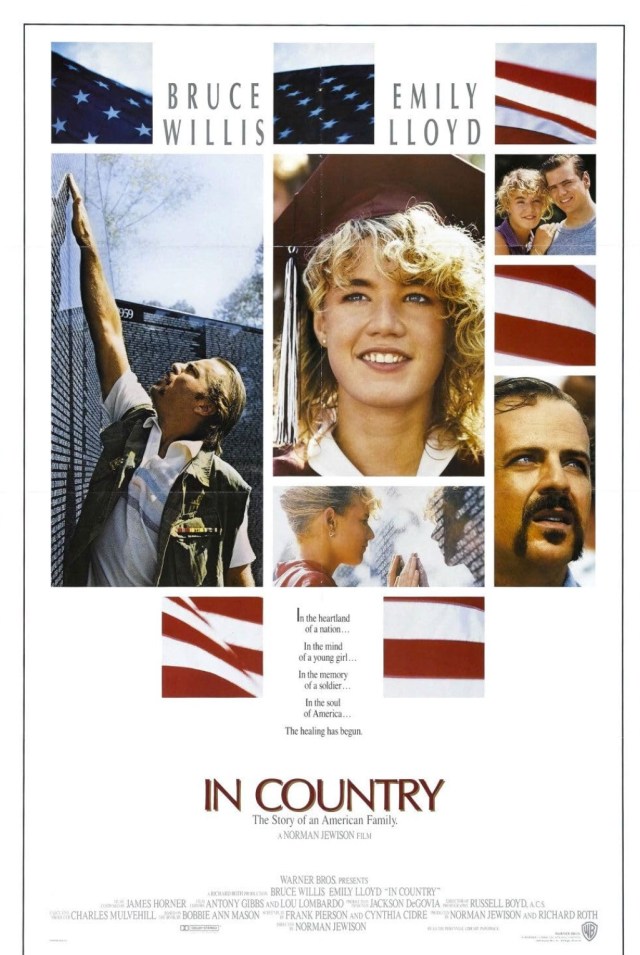
In Country (1989) poster created by Warner Bros. and Yorktown Productions

Things I liked about the film:

The acting: In any story, especially one that features a young protagonist, the main character’s likability can determine if the story is worth investing time in. I can only speak for myself, but I liked Samantha “Sam” Hughes’ personality! Though naïve at times, Sam was like a bright ray of sunshine, caring about the people in her life and trying to make her world a better place. What made Sam a likeable character was how genuine her emotions were. After finding a box of her father’s belongings in her mother’s room, Sam leaves a voice message on the phone explaining to her mother how upset she is by her mother’s silence about her father. When she hangs up the phone, the sad look in her eyes and the slight frown perfectly show how hurt Sam feels about her mother’s choices. This is just one example of Emily Lloyd bringing that genuineness to life, allowing her performance to be memorable!

Prior to watching and reviewing In Country, I had seen some of Bruce Willis’ films. His portrayal of Emmett Smith is different from some of his other roles, as he had to rely on emotion instead of action to carry his character through the story. A thunderstorm is causing chaos outside Emmett’s home one evening. Because of his time serving in the Vietnam War, he flinches whenever thunder strikes due to the flashbacks he is experiencing. At the same time, Emmett carries irritation in his voice because he wants the storm to stop and he wants to avoid Sam’s questions. Similar to what I said about Emily Lloyd’s performance, Bruce’s performance felt genuine. Beneath the tough exterior Emmett consistently displayed, he was a man who was trying to live a civilian life as best as he knew how.

Honesty about war and its impact on veterans: Like I just mentioned in this review, Emmett experiences flashbacks one stormy evening due to his time serving in the Vietnam War. These flashbacks not only cause Emmett to flinch every time thunder strikes, they also cause him to go outside, climb up a tree, and yell for someone to show their face. Throughout this scene, Sam asks Emmett questions about what is happening. Unfortunately for Sam, these questions are left unanswered. When Emmett goes outside, Sam calls for Emmett to come back in the house. As Emmett’s mind and heart are beyond the borders of his Kentucky home, Sam feels powerless, unsure of how to help Emmett. The scene I just wrote about is one example of the film’s honesty when discussing war and its impact on veterans. The candid way these subjects were talked about in the movie shows how the movie’s creative team understood the subjects’ significance.

The mise-en-scène: I’ve explained before that mise-en-scène is how a scene is presented in a movie. Mise-en-scène was utilized in several scenes’ favor in In Country. Toward the beginning of the film, a group of U.S. soldiers are wading through the swamps of Vietnam. This moment is presented as a long shot with the view appearing as if the camera is hiding behind the swamp’s foliage. How this scene is showcased to the audience emphasizes the soldiers’ need to stay unseen. Sam, Emmett, and Mamaw travel to Washington D.C. to visit the Vietnam Veterans Memorial. While walking past the monument, a close-up shot captured Mamaw as the names on the monument were gliding past her face. The visuals symbolized how the Vietnam veterans have touched the lives of not just their loved ones, but those in their communities as well.

The Norman Jewison Blogathon created by Rebecca from Taking Up Room

What I didn’t like about the film:

Sam’s attraction for Tom: While trying to learn more about her father, Sam turns to a veteran named Tom. At the Vietnam veterans’ dance, Sam invites Tom to share a slow-dance with her, where they get a little too close for comfort. After the dance, Sam spends the night at Tom’s house and has sex with him. Up until the slow-dance at the veterans’ dance, Sam never expressed any romantic interest in Tom. Plus, she just graduated from high school and Tom appears old enough to be her father. Not only was this part of the story random, its inclusion in the film was unnecessary, especially since it has no impact on the plot.

The “slice of life” parts of the story: As I’ve been saying in this review, Sam wants to learn more about her father who served and died in the Vietnam War. This part of the story, as well as the parts exploring the veterans’ perspective, was interesting. But those parts made up half the movie. The other half revolved around subplots that were more “slice of life”. When the story turned to the “slice of life” events, I found myself wishing the movie would go back to Sam learning more about her father or Emmett interacting with the other veterans. In fact, I think the movie should have primarily focused on those aforementioned parts of the story.

On-the-nose songs: The inclusion of songs in a movie can make or break a given scene. Sometimes, a song can be so on-the-nose, it doesn’t leave the intended emotional impact. This happened on more than one occasion in In Country. The opening lines of the Bruce Springsteen song, “I’m On Fire” are “Hey, little girl, is your daddy home? Did he go away and leave you all alone?”. This song can be heard on two occasions after Sam decides to learn more about her father, pointing out what the audience already knows. Earlier in this review, I brought up how Sam invites Tom to share a slow-dance with her, where they get a little too close for comfort. The song they dance to is Hank Williams Jr.’s “Ain’t Misbehavin’”, which narrates what’s happening on screen and foreshadows what’s about to come. That song paired with the events that unfold created a scene that left me uncomfortable.

Children holding American flags during a sunset image created by rawpixel.com at freepik.com. <a href=”https://www.freepik.com/free-photos-vectors/people”>People photo created by rawpixel.com – http://www.freepik.com</a>. Image found at freepik.com.

My overall impression:

When I watch a movie, I sometimes imagine how the story would turn out if it was presented in a different way. One recent example is how Hallmark Hall of Fame’s Brush with Fate would have, in my opinion, benefitted by being presented as a multi-part mini-series. I feel similarly about 1989’s In Country. For the most part, the creative team behind the movie appeared to have their hearts in the right place. The honesty about war and its impact on veterans was included in the story in such a candid way, it showed the movie’s creative team understanding the significance of the subjects woven into the script. But this aforementioned honesty, as well as Sam’s search for answers about her father, should have been the film’s primary focus. Therefore, I wish this story had been a road-trip movie, where Sam, Emmett, and Mamaw go to visit the Vietnam Veterans Memorial in Washington D.C., with Sam learning about her father and important life lessons along the way.

Overall score: 6.1 out of 10

Have you seen 1989’s In Country? What’s your favorite film from 1989? Tell me in the comment section!

Have fun at the movies!

Sally Silverscreen

Take 3: You’ve Got Mail Review

Every so often, I try to review a movie that has been recommended by one of my readers or a fellow blogger. It’s a wonderful opportunity when I can write about a recommended film for a blogging event. This is what happened when I joined the Everything Is Copy Blogathon! When I learned Rebecca’s, from Taking Up Room’s, event centered around the Ephron family, I realized no one had chosen You’ve Got Mail as their blogathon entry. Since the movie was recommended by Janis from Momshie Diaries, I found the perfect excuse to finally see the film in its entirety! You’ve Got Mail is far from the first romantic comedy (rom-com) I’ve talked about on 18 Cinema Lane. Several Hallmark Channel films have received their own review, ranging from terrible to the best I’ve ever seen. So, where does You’ve Got Mail rank among those Hallmark titles? Log in to this review to find out!

You’ve Got Mail poster created by Warner Bros.

Things I liked about the film:

Tom and Meg’s on-screen chemistry: An ingredient to a successful rom-com is casting an actor and actress who share strong on-screen chemistry. This ingredient creates an on-screen relationship that feels believable. In You’ve Got Mail, Tom Hanks and Meg Ryan portray Joe Fox and Kathleen Kelly; two literary business owners who have different perspectives on the world of bookselling. Yet, whenever they’re together, Kathleen and Joe share a spark between them, learning over time how they have more in common than they initially believed. The on-screen chemistry between Meg and Tom makes it feel like their characters have known each other for many years. It also helps how Tom and Meg brought a strong sense of likability to their characters. Even though Joe was a businessman who felt there was a time and a place for “big box stores”, his personality was more jovial than some of the businessmen who appear in a typical Hallmark Channel rom-com. Meanwhile, Kathleen’s personality was fun and fancy-free, trying to find a silver lining during autumn in New York City.

The set design: One of the conflicts in You’ve Got Mail was a bigger, chain bookstore affecting the business of a smaller, locally owned book shop. The interior design of the bigger bookstore was meant to imply how impersonal that store’s shopping experience was. But I actually liked the interior design of both stores! At the smaller book shop, the pale yellow walls paired nicely with warm wood shelves. With string lights circling near the store’s ceiling, the space itself felt cozy and quaint. At the bigger bookstore, white supporting columns, dark gray granite countertops, and shiny silver railings boasted a modern space that looked and felt heavenly. Quirky décor, such as a large, spinning silver globe and a replica of the Statue of Liberty reading a book prevented the store from being dull. Even the bookstore’s bakery section was promoted as a hip gathering space, a curved countertop with tall stools providing an area for readers to come together and enjoy each other’s company. Both spaces looked inviting and appeared photogenic!

The dialogue: The strength of dialogue can create or break a script. While the dialogue can be elevated through delivery, its believability and memorability lie in the writing talent. Within You’ve Got Mail, there was dialogue that I thought was cleverly written! One example was when Kathleen and Joe met each other at a restaurant. Using advice from her anonymous pen pal, Kathleen shared what was on her mind with Joe. Frustrated by Joe’s inability to see how his bookstore prevented other bookstores from thriving, Kathleen told Joe his brain was replaced by a cash register and his heart was taken over by the bottom line. While her statement was meant to be insulting, Kathleen’s quote was an eloquent way of illustrating how she saw Joe. Her quote also stressed how her love of literature helped her choose words that made her opinion sound mature and intelligent.

The Everything Is Copy Blogathon banner created by Rebecca from Taking Up Room

What I didn’t like about the film:

Forgettable secondary characters: In a rom-com, the main male and female character are not the only characters who can make a story work. A collection of secondary characters who interact with the protagonists can add humor, wit, and even thoughtful insight to the film. The story of You’ve Got Mail revolved so heavily around Kathleen and Joe, all of the movie’s secondary characters seemed like an afterthought. This group of actors and actresses did a good job with the material they were given. But the characters they portrayed weren’t as 3-dimensional as Joe and Kathleen. Some rom-coms will give at least one secondary character a subplot. However, no subplots were given to the secondary characters in You’ve Got Mail. Even when there was the possibility for a secondary character to receive their own piece of the story, this opportunity didn’t lead anywhere. It felt like You’ve Got Mail was the world according to Joe and Kathleen, where every other character was simply given permission to exist in it.

The protagonists’ love interests: I have seen some Hallmark rom-coms where the main male and female characters are already in a romantic relationship, only for these characters to end their previously established relationships in order to fall in love with each other. This trope is not limited to Hallmark’s films, as it appeared in You’ve Got Mail. At the beginning of the movie, the story established Kathleen is living with her boyfriend, Frank. Meanwhile, Joe is considering proposing to his girlfriend, Patricia. Because You’ve Got Mail is a rom-com, there is a greater likelihood Kathleen and Joe will fall in love. I’ve also mentioned in this review how, in my opinion, Tom and Meg had strong on-screen chemistry. Therefore, Joe and Kathleen’s previously established relationships feel pointless.

The run-time: You’ve Got Mail has a run-time of one hundred and twenty minutes. This is almost the same run-time as a typical Hallmark movie. Like I mentioned in this review, none of the story’s secondary characters were given a subplot, as the film revolved heavily around Joe and Kathleen. You’ve Got Mail’s plot includes anonymous pen pals desiring to connect in the real world. With the story being so simple and easier to follow, the movie’s run-time feels excessive. Some scenes are drawn out to likely satisfy the film’s run-time. In my opinion, You’ve Got Mail should have shown the anonymous pen pals meeting sooner. That way, they could not only help each other with their professional dilemmas, but the story itself could have become a contemporary retelling of Pride and Prejudice.

Envelope with hearts image created by Freepik at freepik.com. <a href=’https://www.freepik.com/free-photo/hearts-and-pink-envelope-for-mothers-day_1950691.htm’>Designed by Freepik</a>. <a href=”https://www.freepik.com/free-photos-vectors/love”>Love image created by Freepik</a>. Image found at freepik.com.

My overall impression:

Before and after the release of You’ve Got Mail, rom-coms have found their place in the world of film. Like any genre, there’s a variety of titles, some good and some bad. For me, You’ve Got Mail falls somewhere in the middle. The main romance was well written, directed, and acted. This combination allowed the protagonists to form a relationship that felt believable and charming. While the dialogue and set design certainly helped this picture, it wasn’t enough to outweigh the film’s flaws. From none of the secondary characters receiving their own subplot to the run-time, these things held the movie back from being a stronger story. With the film titled, You’ve Got Mail, and with the anonymous pen pals exchanging emails and instant messages, I’m surprised none of the story’s bookstores brought up the possibility of selling their merchandise online. In fact, I’m shocked the internet wasn’t a bigger topic/theme in this movie! I would say that was a missed opportunity. But with the film itself being just fine, I guess I don’t have much to complain about.

Overall score: 7.2 out of 10

Have you seen You’ve Got Mail? What’s your favorite rom-com? Tell me in the comment section below!

Have fun at the movies!

Sally Silverscreen
Take 3: Space Jam (1996) Review

Some of my readers will know Michael Jordan as the reason why they cared about the Chicago Bulls. Other readers are familiar with Michael because of the infamous meme where Michael says in a calm and friendly way, “Stop it. Get some help”. Then there are my readers who are fans of Michael because of his appearance in the 1996 movie, Space Jam. Michael’s involvement in this film is one of the reasons why I’m reviewing it, as “movies where a star is playing themselves” is June’s theme for Genre Grandeur. Another reason why I chose to write about Space Jam is how I don’t often receive the opportunity to talk about animated films on 18 Cinema Lane. While I am familiar with this movie and what it’s about, I had never seen it in its entirety before. Now that I have checked out Space Jam, I can now give an honest opinion about it. So, sit back in your courtside seats, as this review is about to begin!

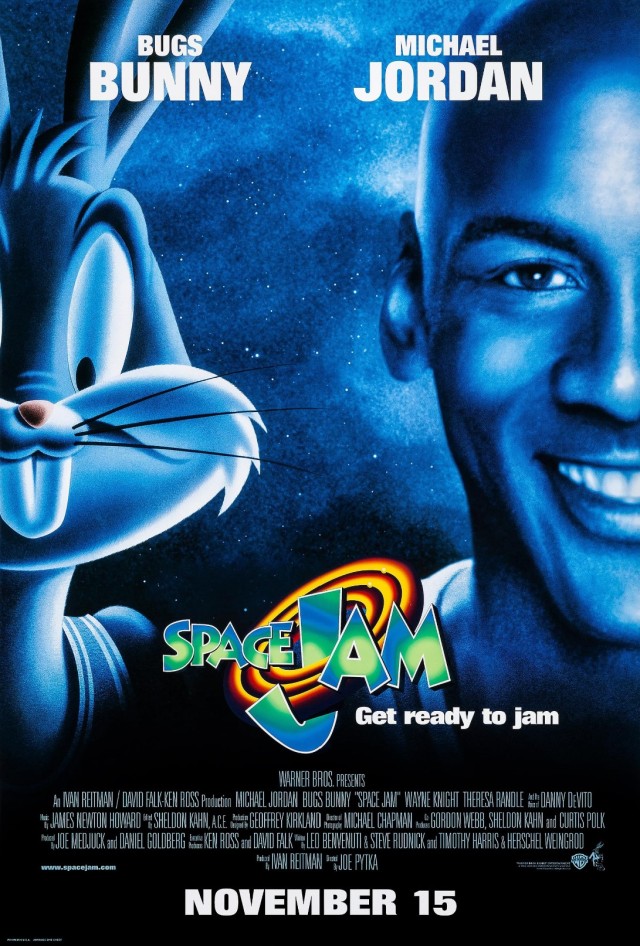
Space Jam (1996) poster created by Warner Bros. Family Entertainment, Northern Lights Entertainment, Courtside Seats Productions, and Warner Bros.

Things I like about the film:

The animation: In the 1990s, a trend in animation was the adoption of bright colors. Whether it was the Disney Renaissance or the first creatures in the world of Pokémon, bold hues and color schemes dominated both big and small screens. Space Jam follows this trend in various ways. One great example is the locations in the film’s animated world. There is a shot in the movie of the gym where Michael and the Looney Tunes train for their upcoming basketball game. The gym itself boasts a bright coral exterior, with the building set against a blue sky and a green, grassy lawn. The film’s colors emphasize the fun and energetic nature of it’s animated landscape. They also provide pops of color that make animated characters and their world interesting to look at.

Before the release of Space Jam, the Looney Tunes were an animated collection with their distinct histories, stories, and even voice acting performances. When bringing these characters into one overarching story, it could have been difficult to adapt them from one medium to another. Yet, every Looney Tunes character featured in the movie looked, sounded, and acted consistently with their pre-established shows. This crucial creative decision allowed the story to maintain a strong sense of continuity. It also gave audience members of all ages an opportunity to enjoy watching the Looney Tunes and their antics.

The messages and themes: At the beginning of Space Jam, Michael Jordan decides to take a break from the world of basketball to pursue a baseball career. According to the movie’s introduction, baseball is a sport Michael cared about. Yet, joining Major League Baseball (MLB) was a new direction in Michael’s career. His baseball endeavors aren’t as fruitful as his basketball endeavors. Yet, there are people surrounding Michael who are supportive of his decision. What this part of the story showed me was how one shouldn’t be afraid to try new things. Even when someone has a forte and has achieved their full potential, it could be beneficial to expand their horizons. That message can be a valuable lesson for younger viewers and a message older viewers can appreciate!

The humor: Animation and humor typically go hand in hand. Space Jam is no exception, as there were moments within this story I found genuinely funny. One way humor was incorporated into the film was through the dialogue. After Bugs Bunny and Daffy Duck retrieve Michael’s basketball attire, Daffy said they should name their team ‘The Ducks’. Bugs then responds by asking “Why would a Mickey Mouse corporation name their team ‘The Ducks’”? This question was meant to poke fun at Disney’s program, The Mighty Ducks. What added to the humor of this conversation was how the dialogue fit the personality of these characters.

What I didn’t like about the film:

Parts of the story that don’t make sense: In Space Jam, several basketball athletes have mysteriously lost their athletic abilities. This causes concern amongst the league’s other basketball teams. It gets to the point where the basketball season ends early. Here’s where the story doesn’t make sense: the film shows the National Basketball Association’s (NBA’s) season taking place at the same time as the Major League Baseball’s (MLB’s) season. A typical MLB season will take place between April to October, while the NBA runs their season from about fall to early summer. The only time these leagues’ schedules overlap is when the NBA Finals happen. With all that said, the basketball season in Space Jam would almost be over, with the Finals on the horizon. Yet, none of the characters bring up the Finals. This is just one example where the story doesn’t make sense.

A disjointed story: As I just mentioned, some basketball athletes have mysteriously lost their athletic abilities in Space Jam. Meanwhile, the Looney Tunes recruit Michael Jordan to compete in a basketball game in space. Because Michael spends most of the movie in the animated world, his story and the story of the basketball athletes feel like two separate stories, with a very loose connection to one another. When the film goes back and forth between the stories, the transitions are abrupt, with little segue provided. These creative decisions led Space Jam to feel disjointed.

The underutilization of Lola Bunny: Lola Bunny has found a place for herself in the world of Looney Tunes. From what I remember, she was prominently featured in Space Jam’s marketing. Yet in the movie, prior to the basketball game itself, Lola appears in only two scenes. Her first appearance took place forty minutes into an hour and twenty-seven-minute film. I’m unsure when Lola made her debut in the Looney Tunes universe. But if Space Jam was meant to be her introduction, I was disappointed by how unceremonious it was.

Collection of white rabbit images created by freepik at freepik.com Hand drawn vector created by freepik – www.freepik.com

My overall impression:

There are two categories for films that are products of their time; those that are dated on arrival and those that serve as a visual time capsule for when the movie was released. Space Jam belongs in the latter category, presenting a slice of the ‘90s through a combination of animation, athletics, and intergalactic silliness. Speaking of the animation, I was surprised by how the character designs, background designs, and blend with live-action mostly aged well. Though innovative at the time, this blend serves as an example of the creativity ‘90s animation has to offer. It was also interesting to see Michael Jordan’s career incorporated into the story, showing the audience how anyone, even the most celebrated of athletes, can try new things. Space Jam is, in my opinion, a fine film. Even though I won’t reflect on this movie as fondly as other films, I am glad I finally saw it in its entirety.

Overall score: 7.1 out of 10

Have you watched Space Jam? Which animated film from the 1990s do you like? Tell me in the comment section below!

Have fun at the movies!

Sally Silverscreen

Take 3: Sesame Street Presents: Follow That Bird Review (The Great Muppet Guest Star Caper Double Feature Part 2)

Welcome to part two of The Great Muppet Guest Star Caper Double Feature! Like my review of The Great Muppet Caper, this review of Sesame Street Presents: Follow That Bird will be spoiler-free. I will also be referring to the movie as ‘Follow That Bird’ instead of its full title. If you would like to know why I selected this movie, I will provide the link to this double feature’s introduction. The link to my review of The Great Muppet Caper will be provided as well.

The Great Muppet Guest Star Caper Double Feature is On Its Way!

Take 3: The Great Muppet Caper Review (The Great Muppet Guest Star Caper Double Feature Part 1)

Sesame Street Presents: Follow That Bird poster created by Warner Bros. and Children’s Television Workshop

1. Were you familiar with Follow That Bird before The Great Muppet Guest Star Caper Blogathon?

Similar to The Great Muppet Caper, I was familiar with Follow That Bird before participating in the blogathon. I own a copy of the film’s soundtrack, so I knew what the story was about. When it comes to the movie itself, I’d only seen pieces of it.

2. Who was the featured guest star in Follow That Bird?

Sesame Street’s Big Bird was a guest on The Muppet Show. As I said in my review of The Great Muppet Caper, The Muppets and Sesame Street were created by Jim Henson. Keeping this fact in mind, I’ve always seen the characters from each intellectual property (IP) as being extended members of the same family. So, when it comes to The Muppet Show, I was surprised Big Bird was considered a “guest”.

3. How would Follow That Bird’s story change if a different Sesame Street character was the main character?

Like The Muppets, Sesame Street has a large cast of characters. Whether that character is a human or a muppet, each one has their own unique personality, set of likes and dislikes, and talents to offer. With that said, this would be a completely different movie if the story revolved around a different Sesame Street character. Grover is one example, as an important part of his character is his desire to become a superhero. If Grover were the main character of a Sesame Street movie, his story would likely be a “superhero’s tale”, where the protagonist fights crime and saves the day with superpowers.

4. Did you develop any thoughts and/or questions while watching this film?

While watching Follow That Bird, I found some parts of the story confusing. As some of the characters watch a news report on a television at Mr. Hooper’s store, Chevy Chase makes a cameo appearance as a newscaster. During the weather report, he quotes the theme song to Mister Rogers’ Neighborhood. Out of all the references Chevy could make in a Sesame Street movie, why that one? Wouldn’t it make more sense for Fred Rogers to appear in the film and quote the theme song of his own show? Another example is when several characters spot Big Bird in a parade. These characters can clearly see their feathered friend, but their path is blocked due to the parade taking place. How come none of the characters considered getting out of their car and following Big Bird through the parade on foot? It’s decisions like this one that, for me, didn’t make sense.

Similar to The Great Muppet Caper, I was surprised by which characters were included in the movie and how much screen-time they received. Toward the end of Follow That Bird, Elmo makes such a brief cameo appearance, he doesn’t even have any lines. On one hand, Elmo was introduced on Sesame Street in 1980. By the time Follow That Bird was released in theaters, he had been on the show for about five years. On the other hand, at the time of Follow That Bird’s premiere, Elmo was not as popular as he would later become. Despite these facts, I was kind of surprised by Elmo’s limited appearance.

5. Follow That Bird was the first Sesame Street movie ever created. Why do you think it took the show’s creative team that long to make a film?

I have two answers why this decision was likely made. A lot of the cast members from the Sesame Street show worked on Follow That Bird. This includes cast members who worked on Muppet related projects, such as The Great Muppet Caper and The Muppet Show. Like I said in my review of The Great Muppet Caper, my guess is Sesame Street’s creative team wanted to prevent creative burn-out and spreading their talent too thin.

At the time Follow That Bird was released, Sesame Street had been on the air for sixteen years. During that time, the show’s creative team worked very hard to cultivate a program that was creatively and educationally consistent. Like any television show, Sesame Street’s audience grew over time. When it comes to creating a movie, I would guess Warner Brothers, the studio who distributed Follow That Bird, and Children’s Television Workshop, Sesame Street’s production company, wanted to wait until they felt they could make a satisfying profit on the film.

The Great Muppet Guest Star Caper banner created by Rebecca from Taking Up Room and Gill from Realweegiemidget Reviews

6. Is there anything about Follow That Bird you liked or didn’t like?

As I said in answer number four, I was surprised by which characters were included in the movie and how much screen-time they received. But I also found it interesting how these characters were utilized in the story. On Sesame Street, Oscar the Grouch, more often than not, stays in his trash can and maintains a negative disposition. These factors cause Oscar to appear on the show in certain situations, such as interacting with The Wicked Witch of the West from The Wizard of Oz. While he still had a negative disposition in Follow That Bird, Oscar explored the world beyond his trash can. That’s because he was one of the assigned drivers searching for Big Bird. In Follow That Bird, Oscar was a lot more humorous than I expected. My favorite line of his was spoken during the road trip preparations. Oscar exclaims how he loves a good goose chase. Then, he randomly says, “Let’s get lost”. Giving Oscar more humorous lines and allowing him to join the road trip gave this character an opportunity to be utilized more than he has on the show!

In my review of The Great Muppet Caper, I mentioned the characters’ knowledge of being in a movie as one of the story’s overarching jokes. This was one of the highlights of the 1981 film, as the dialogue relating to the joke was cleverly written and successfully delivered. Two of the characters in Follow That Bird, Oscar the Grouch and Count von Count, acknowledged the film’s audience was watching their movie. But other than “The Grouch Anthem” and the end credits, this knowledge was not consistently brought up in the script. That is just one example of a creative element that wasn’t fully utilized in the 1985 movie.

7. Could a new Sesame Street movie work in 2023?

Since its debut in 1969, Sesame Street has become a global phenomenon. The success of the show has encouraged countries outside of the United States to create their own version of Sesame Street. In the thirty-eight years since Follow That Bird’s premiere, the cinematic landscape has become more globalized. If Sesame Street’s creative team wanted to make another movie, an important question they would have to answer is which characters will be included in the story. Would it exclusively focus on the characters from Sesame Street or would it also feature characters from one of the international shows? If you wanted to create a movie in 1985, you had three distribution options: releasing the film in theaters, premiering the movie on television, or putting the production directly on video cassette. With the invention of streaming services, studios and production companies are now given the option to forgo the process of theatrical releases, as well as selling a movie on physical media. The distribution of a Sesame Street film is another important question the show’s creative team would have to address.

8. What does Sesame Street mean to you?

To me, Sesame Street represents the idea of timelessness. The show has found its place in the pop cultural landscape and stayed there for over fifty years. In that timeframe, the world and Sesame Street itself has seen so many changes. But despite all of that, some elements of the program have remained the same. Each episode has been given an official letter and number. Follow That Bird even adopted this component from the show, with ‘W’ and ‘B’ being the movie’s letters, representing the studio that distributed the film, Warner Brothers. That simple creative decision has taught children the alphabet and how to count. This knowledge lays the educational foundation so children can master other skills, such as constructing sentences and mathematical equations. The simplicity and consistency of including letters and numbers into Sesame Street is a reminder of the timeless nature of these lessons.

9. After watching Follow That Bird, is there anything you can take away from your movie viewing experience?

According to Muppet Wiki, Sesame Street created three television specials in the 1980s focusing on Big Bird traveling around the world; Big Bird in China, Big Bird in Australia, and Big Bird in Japan. With Follow That Bird being released in 1985 and with the story about Big Bird traveling outside of Sesame Street, it makes me wonder if the movie was meant to correlate with the aforementioned television specials? Speaking of the movie, I thought it was a fine, pleasant, cute enough production. But compared to The Great Muppet Caper, Follow That Bird could have been stronger. There were several creative elements within the movie that weren’t consistently utilized. “The Grouch Anthem” and the end credits being the only two instances of the characters acknowledging the audience is watching their movie is just one example I mentioned in my review. As I also mentioned in my review, some creative decisions didn’t make sense, such as Chevy Chase quoting the theme song of Mister Rogers’ Neighborhood. However, this wasn’t a bad first attempt at making a movie. In fact, there are aspects of the project that worked in the movie’s favor, like the musical numbers! I feel Follow That Bird is one of those films that younger children would enjoy more than an older audience member would.

Image of Colorado road created by welcomia at freepik.com. <a href=”https://www.freepik.com/free-photos-vectors/mountain”>Mountain photo created by welcomia – http://www.freepik.com</a>. Image found at freepik.com.

Have fun at the blogathon!

Sally Silverscreen

Take 3: The Sundowners (1960) Review

Here at 18 Cinema Lane, I try to go out of my way to watch, and review, as many film recommendations as possible. In fact, I have a board on Pinterest dedicated to these recommendations. Two years ago, when I reviewed Marriage on the Rocks, Maddy, from Maddy Loves Her Classic Films, suggested I check out the 1960 picture, The Sundowners. Shortly after Debbie, from Moon in Gemini, invited me to her Foreign Western Blogathon, I finally found an opportunity to write about the movie! The Sundowners fits two of the four blogathon categories: ‘directed by foreign directors’ and ‘shot in a foreign country’. According to IMDB, the film’s director, Fred Zinnemann, is from Austria-Hungary. The movie was also filmed in Australia, where the story takes place. Foreign westerns are not a new concept on 18 Cinema Lane. Neither are Australian films. Within the four years of my movie blogging journey, I reviewed Another Man, Another Chance, Interrupted Melody, and Hallmark Hall of Fame’s Durango. If you’re interested, I’ll provide the links to these reviews toward the beginning of this article.

Take 3: Another Man, Another Chance Review

Take 3: Interrupted Melody Review

Take 3: Hallmark Hall of Fame’s Durango Review

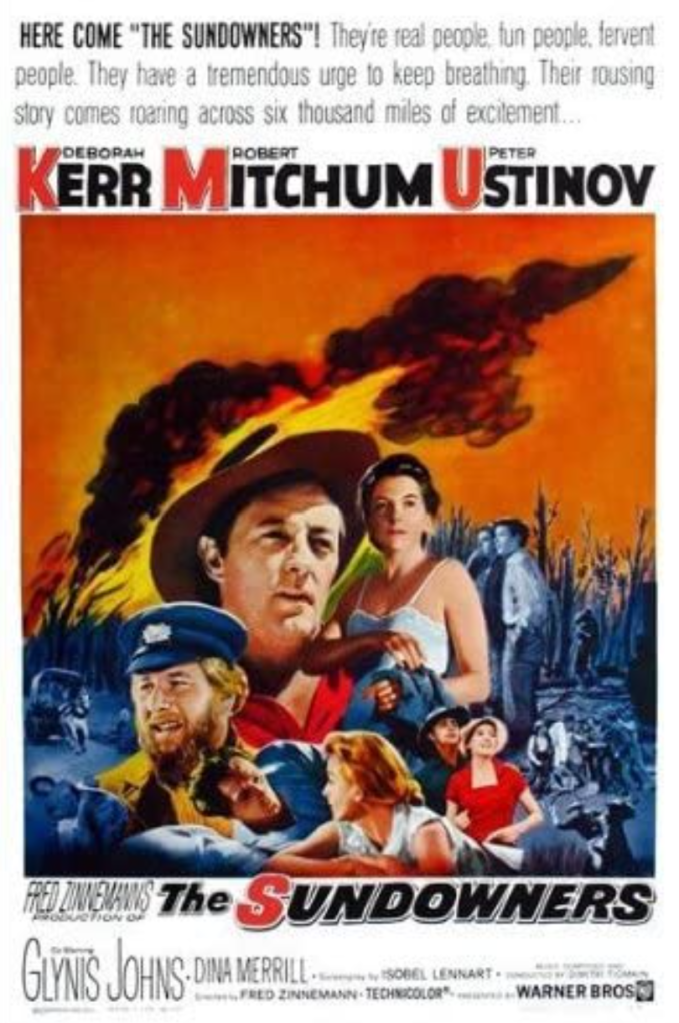
The Sundowners (1960) poster created by Warner Bros.

Things I liked about the film:

The cinematography: Like I said in the introduction, The Sundowners was filmed in Australia. The movie’s creative team took advantage of the country’s natural surroundings through cinematography! One long shot showcased Australia’s farmlands. What made this shot beautiful were the rays of sunlight showering over the green landscape, offering a light only nature could provide. The cinematography also did a good job putting things into perspective. During a forest fire, Ida is driving her family’s wagon away from the forest. While this maneuver is taking place, the camera is situated inside the back of the wagon. It looks out toward the road, giving the audience the illusion they are riding in the wagon with Ida.

Higher stakes: When I reviewed Hallmark Hall of Fame’s Durango last year, I talked about low stakes being one of the film’s biggest flaws. In The Sundowners, higher stakes were featured in a few scenes! A notable example is the forest fire I previously mentioned. While the Carmody family is herding sheep, a nearby forest fire breaks out. This leads all the characters to be in danger. The scene chronicled the entire process of the fire, starting from the detection of smoke and ending in the fire’s aftermath. Cut-away shots of scared wildlife are spliced into the story, emphasizing the other lives in harm’s way. Dramatic music can be heard in the background, elevating the sense of urgency. With all these elements combined, this scene was the perfect example of the higher stakes I expect from a western film!

The historical accuracy: With any “period film”, the historical accuracy can make or break that production. In the case of The Sundowners, the story takes place in the 1920s. From the looks of it, the 1960 project appears historical accurate! The forms of transportation are one indicator. While the Carmody family is working on the sheep farm, the employees sometimes rode in antique trucks with open beds. At least one motorcycle is featured in the story, revealing exposed gears and a model very different from the motorcycles of today. A covered wagon is the preferred vehicle of the Carmody family, with Paddy and Sean riding horses on a few occasions. This aspect of the film’s historical accuracy reminded me of a production like The Grapes of Wrath.

The Foreign Western Blogathon banner created by Debbie from Moon in Gemini

What I didn’t like about the film:

A “slice of life” story: Westerns, like any genre, contain a wide range of narratives. If given the choice, I’d rather watch a western with, at least, one conflict instead of a story that’s more “slice of life”. Unfortunately, the majority of The Sundowners is a “slice of life” story. The script primarily focuses on the daily operations of sheep farming. At first, this topic was interesting. But as the film carried on, the elements of sheep farming became repetitive. Had this movie contained one or two major conflicts, I might have found this story more intriguing.

Lack of Irish accents: According to Wikipedia, the Carmody family is Irish, a fact Sean tells Rupert early in the film. Michael Anderson Jr., Robert Mitchum, and Deborah Kerr must have missed that detail in the script, as none of them could successfully carry an Irish accent. Throughout The Sundowners, Deborah sounded like she was speaking in a British accent. Meanwhile, Robert and Michael sounded Australian. I don’t think Robert, Deborah, and Michael are bad actors. In fact, pulling off any accent can be a difficult skill to master. However, their lack of Irish accents was, for me, jarring.

The run-time: The Sundowners contains a straight-forward story about a family searching for employment in order to afford a place of their own. With that said, I found it unnecessary for the film’s run-time to be two hours and thirteen minutes. Some scenes felt drawn out in an attempt to satisfy this run-time, the shearing contest Paddy enters being one example. That scene lasts about five minutes, even though it could have only featured the most exciting parts of the contest. If scenes like that one had been cut shorter, the movie could have had a run-time of about an hour and thirty minutes.

A “bait and switch” ending: In my review of 1961’s The Pit and the Pendulum, I incorporated spoilers to explain my thoughts on a specific portion of the movie. Similarly, I will be including spoilers in this part of my review. If you haven’t seen The Sundowners, please skip this part and continue reading where it states “My overall impression”.

As I stated earlier in this review, The Sundowners contains a straight-forward story. I also stated how the movie is two hours and thirteen minutes. Within that run-time, the Carmody family receives the funds to afford a farm that was featured toward the beginning of the film. All seems to be going well until the last ten minutes in the story. While in a drunken state, Paddy makes several I-O-Us, losing the family’s finances in the process. In an attempt to earn back some of those funds, the family enters their race-horse, Sundowner, in an upcoming horse race. Not only does Sundowner and Sean win the race, Paddy also wins a bet. Even though they have enough money to make a down payment on the aforementioned farm, Ida changes her mind, saying Paddy can keep the race horse instead. This statement contradicts Ida’s goal throughout the movie; getting a place to put down roots. Moments later, an announcement declares Sundowner is disqualified from the race due to a pass interference. This means the Carmody family lost all the money they just won. The movie ends exactly how it begins; with the family on the road looking for employment and a place to stay. If I had known the story would end this way, I wouldn’t have become invested in the Carmody family’s ordeal.

Horse with saddle photo created by Topntp26 at freepik.com. <a href=’https://www.freepik.com/free-photo/stallion-black-equine-race-sky_1104246.htm’>Designed by Freepik</a>. <a href=”https://www.freepik.com/free-photos-vectors/background”>Background image created by Topntp26 – Freepik.com</a>. Image found at freepik.com.

My overall impression:

When it comes to film-making, one of the worst things you can do is waste the audience’s time. The way I feel about The Sundowners is similar to how I felt about The Birds; like I truly wasted two hours and thirteen minutes. I understand circumstances in western films aren’t always fair. Heck, life itself is sometimes unfair. But what is also not fair is giving your characters and audience hope for two hours, then taking that hope away in the film’s last ten minutes. With the way The Sundowners turned out for me, it almost seemed like history repeated itself. As I mentioned in this review, I wrote about Hallmark Hall of Fame’s Durango last year. That 1999 presentation was a foreign western I didn’t like. Both Durango and The Sundowners have one thing in common. Even though there were things about each film I liked, they contained a weak script. A script is the foundation of any cinematic production. If it isn’t strong, there’s only so much you can do to remedy the issue. Before I end this review, I want to make it clear that I have nothing against foreign westerns or Australian cinema. I’m confident there are stellar Australian and foreign western pictures I haven’t seen yet. Unfortunately, The Sundowners isn’t one of them.

Overall score: 4.7 out of 10

Have you watched any foreign westerns? If so, which ones would you recommend? Let me know in the comment section!

Have fun at the movies!

Sally Silverscreen

Take 3: Kingdom of Heaven Review

This is my second year participating in the Rule, Britannia Blogathon. In 2020, I reviewed the 2002 adaptation of Nicholas Nickleby, a movie I ended up liking so much, I now want to read the source material. For the 8th annual event, I chose to write about another film from the 2000s; 2005’s Kingdom of Heaven. This is a movie I have heard about, but never got around to seeing. Until this blogathon, it had sat on my DVR for three years. Since the movie stars Orlando Bloom, a British actor, the Rule, Britannia Blogathon seemed like the perfect opportunity to finally check the film out. One of the few things I knew about this movie was that it had something to do with the Crusades. This is a time period I know very little about. However, this didn’t stop me from giving the film a fair chance. What did I think of this 2005 title? Keep reading if you want to find out!

Kingdom of Heaven poster created by Scott Free Productions, Inside Track, Studio Babelsberg Motion Pictures GmbH, 20th Century Fox, and  Warner Bros. Pictures

Things I liked about the film:

The acting: As I said in the introduction, Orlando Bloom’s involvement in this project is one of the reasons why I chose to review Kingdom of Heaven. Prior to watching the film, I had seen the Pirates of the Caribbean trilogy, where Orlando consistently portrayed Will Turner. While the character of Balian is similar to Will, each role is distinct. To an extent, Orlando’s performance in Kingdom of Heaven reminded me of Vincent Perez’s portrayal of Yanko from Swept from the Sea. While Balian is a masculine character, he also displayed a gentle charm. A good example is when Balian arrives in Jerusalem. He gives his prize horse to the servant of his opponent. When the servant asks why Balian would make this decision, Balian replies how he doesn’t want the horse to suffer.

In Kingdom of Heaven, Eva Green portrayed a queen named Sibylla. Despite appearing in the movie for a limited amount of time, I did enjoy watching her performance! I noticed how fluid Eva’s emotions were. This allowed her to adapt to any situation her character faced. It also helps that she was able to excel, acting wise, alongside her co-stars. Another character I wish appeared in the film more was King Baldwin IV. Portrayed by Edward Norton, this character was a leper. Therefore, he was completely covered and wore a mask. Edward’s use of body movement and expressive eyes make up for the lack of facial expressions. His approach to his role made King Baldwin IV a compelling character to watch!

The scenery: “Sword and sandal” movies are known for featuring breath-taking scenery. Kingdom of Heaven also brings beautiful scenery to the table, showcasing desert, oceanic, and forest landscapes. Toward the beginning of the movie, Balian resided in the French countryside. This area was surrounded by deep green forestry, the ground and trees lightly covered in snow. As Balian travels to Messina, the city is met with a clear, blue ocean. The hue of the water beautifully complimented the warm sandstone of the nearby buildings. While Jerusalem is in the middle of a desert, palm trees brought a pop of color to the environment. These plants helped make Jerusalem appear as an oasis.

The historical accuracy: I’m not familiar with this particular period in history. But based on the limited information I do know, the movie appeared to be historically accurate. Throughout the film, knight’s armor could be seen. Helmets, swords, and other related gear adopted an older style. Some of the swords boasted jewels, with Balian’s sword displaying a giant ruby. Even the attack towers from one of the film’s battles looked as if it came directly from the time of the Crusades. As I’ve said about other period films, details like the ones I mentioned show how much the creative team cared about the presentation of their project!

The 8th Annual Rule, Britannia Blogathon banner created by Terence from A Shroud of Thoughts.

What I didn’t like about film:

Sibylla’s unclear motives: During Balian’s time in Jerusalem, Sibylla becomes romantically interested in him. But she’s already married, a fact that Balian himself is aware of. Balian’s reason for going to Jerusalem was to seek forgiveness for his and his deceased wife’s sins. After meeting Sibylla, he, more often than not, doesn’t object to Sibylla’s romantic interest for him. I was left confused on what her motives were for wanting to be with Balian. At times, I wondered if Sibylla’s situation was similar to Rose’s from Titanic, simply stuck in a loveless relationship and desperately looking for a way out. Other times, I thought Sibylla was attempting to seduce Balian toward sin. I wish these motives were clarified in the script.

A limited incorporation of religion/faith: Because Kingdom of Heaven takes place around the time of the Crusades, I was expecting religion/faith to be one of the cornerstones of this story. While the topic is included in the film, its incorporation is very limited. Before watching this movie, I thought the story was going to be similar to 1959’s Ben-Hur, with the protagonist trying to live his life as a man of the people and of faith. But we never get to see Balian’s internal struggle with these responsibilities. Instead, the audience sees Balian resolve smaller non-religious conflicts which lead to a much bigger conflict. Even though people can be seen praying, there is more to religion/faith than prayer. The script relied more on who would rule Jerusalem than how religion/faith played a role within that world.

A more episodic story: When it comes to “sword and sandal” movies, there is usually an overarching conflict the characters work to resolve over the course of the story. But in Kingdom of Heaven, most of the story is episodic. As I said earlier, Balian wants to go to Jerusalem to seek forgiveness for his and his deceased wife’s sins. Once he has achieved his goal, he moves on to another conflict that is resolved within a short amount of time. This is how the story plays out for about the first half of the movie. There is a major conflict that receives a lot of attention in the film’s second half. However, it feels more like a climax than an event the characters are working towards.

White horse image created by Gabor Palla at freeimages.com. “FreeImages.com/Gabor Palla.”

My overall impression:

Two years ago, I reviewed 1959’s Ben-Hur, a classic “sword and sandal” film. Despite seeing it for the first time, I was over the moon by the strength of the movie’s quality. With Kingdom of Heaven, I didn’t feel the same way. Yes, the 2005 title is a fine, well-made production. But there were times I was confused as I followed along with the story. Like I mentioned in my review, Sibylla’s motives for being romantically interested in Balian were not made clear. However, this is one example of my confusion. Even though this movie was released over ten years ago, I won’t spoil it for anyone who hasn’t seen it. But I will say that something happens toward the end of the film that left me wondering if everything the characters worked for was worth it. As someone who knows very little about the Crusades, I was hoping to use my movie viewing experience as a learning opportunity. While I did learn some information, I feel there’s far more I need to discover. I’ve heard there is a director’s cut of Kingdom of Heaven. If this information is true, maybe I’ll check it out and see which version I like more.

Overall score: 7.2 out of 10

Have you seen Kingdom of Heaven? What is your favorite “sword and sandal” film? Tell me in the comment section!

Have fun at the movies!

Sally Silverscreen
Twentieth Century vs. Queen of the Damned at the Against the Crowd Blogathon

I’ve been participating in blogathons for three years. For most of those events, a variety of content was welcome, highlighting the broad nature of a chosen theme. The Against the Crowd Blogathon is a different type of event for me, as editorial style articles are preferred. I discovered this blogathon on the blog, Realweegiemidget Reviews, as Gill included it in a list of upcoming events. When I looked at past entries, I knew I could bring something new to the table. This blogathon asks their participants to share two movies; a movie you love that everyone hates and a movie everyone loves that you hate. For my entry, I chose to talk about two films I have reviewed before. While I will bring up points I brought up in my reviews, the purpose of this post is to explain why I like or don’t like a movie. This article is not meant to be disrespectful or mean-spirited. Everything I say will be solely based on my opinion.

Against the Crowd Blogathon 2021 banner created by Dell from Dell on Movies

A Film Everyone Loves, But You Hate

Twentieth Century poster created by Columbia Pictures.
Twentieth Century Rotten Tomatos score created by Rotten Tomatos

Remember on Seinfeld, when Elaine was the odd one out for not liking The English Patient? Well, the way she feels about that movie is the way I feel about Twentieth Century. Receiving a “fresh” critic score of 86% and a 7.4 out of 10 on IMDB, this film is considered beloved among cinephiles. Even legendary critic Leonard Maltin likes Twentieth Century. In his 1989 edition of TV Movies & Video Guide, Leonard not only gave the movie four out of four stars, but also called it a “super screwball comedy”. But the genre classification of this particular title is one of the reasons why I found this movie so bad, it was appalling.

When I reviewed Twentieth Century last November, I pointed out how the movie was labeled a “romantic comedy”. As someone who has watched my fair share of Hallmark Channel productions, I know the typical components of the “rom-com” genre. With the 1934 title, it doesn’t feel like a “rom-com”. That is because it is missing one key ingredient: likable characters. All of the characters are horrible to varying degrees. But the worst one is Oscar. He is so selfish, from “firing” his friends on multiple occasions to trying to break up an established relationship. Oscar is also abusive toward his girlfriend, Lilly. Throughout their relationship, Oscar is possessive and controlling. He goes so far as to physically hurt Lilly, even using his mortality as a manipulation tactic to keep her with him. To me, none of that screams “romantic” or “funny”. It is actually downright despicable. By placing Twentieth Century in the “rom-com” genre, the awfulness of the characters and their situations are completely undermined.

Take 3: Twentieth Century Review

The Top 10 Worst Movies I Saw in 2020

A Film You Love, But Everyone Hates

Queen of the Damned poster created by Warner Bros. Pictures. Image found at https://www.warnerbros.com/queen-damned

Isn’t it ironic how, for this blogathon, I chose two movies that feature a predominant abusive relationship? While I wouldn’t go so far as to say I love Queen of the Damned, I do enjoy it for what it is. In fact, I wrote two editorials related to the film, with one of them becoming my most popular editorial I’ve ever written. That article is about how unhealthy Lestat and Akasha’s relationship is. Unlike Twentieth Century, the characters surrounding this relationship realize how terrible it is. Akasha, who I explained in my editorial as the reason for the relationship’s problematic nature, also faces accountability for her behaviors and choices.

In my review of The Karate Kid Part II, I talked about how the sequel didn’t feel like a carbon copy of the first film. Despite having only seen the Interview with the Vampire trailer, I can tell Queen of the Damned’s creative team tried to give their project its own identity. As I said in my review, the 2002 project focuses on the new-school/modern gothic style. It also presents Lestat as a more likable protagonist. I did like how voice-overs from both Jesse and Lestat could be heard throughout the story. Like I said in my review, they provided depth to the script. To me, this movie is better than its soundtrack, an opinion that I’m sure is very unpopular. I also like Lestat and Jesse’s relationship.

Take 3: Queen of the Damned Review (Halloween Double Feature Part 2)

Toxic Valentine: Why Lestat and Akasha’s relationship is very problematic in Queen of the Damned (2002)

What is the Net Worth of the Characters from the ‘Queen of the Damned’ film?

Have fun at the movies!

Sally Silverscreen

Word on the Street: Willy Wonka to Receive a Prequel + Hallmark’s ‘One Winter Wedding’ will Finally Go into Production

As I said in a Word on the Street post last September, it hasn’t been easy finding movie news stories to write about these days. So, when I stumbled across this story on Twitter, I thought it would make a perfect topic for the first Word on the Street article of 2021! According to Aaron Couch from The Hollywood Reporter, Warner Bros. is creating a new film titled Wonka. The movie “hails from Paddington director Paul King and Harry Potter producer David Heyman”. Aaron also says of the script that “Simon Rich wrote the original draft, with Simon Farnaby and King penning the current draft”. As of January 2021, the film is scheduled for a March 17th, 2023 release. It is also about Willy Wonka’s life before his beloved candy factory came into the picture.

While everyone involved with this project is busy creating their next cinematic project, they are forgetting one major detail. Back in the 2005 film, Charlie and the Chocolate Factory, Willy Wonka’s backstory was revealed. Through a series of flashbacks, the audience learns that Willy created his candy factory in spite of his strict father, who forbade the chocolatier from eating sweets when he was younger. Because of this, it makes Wonka seem like it is using rehashed material and trying to pass it off as new. What would have been more interesting is a movie about Ronald Dahl and how he created one of his most iconic stories.

Bakery image created by Freepik at freepik.com. <a href=”https://www.freepik.com/free-photos-vectors/pattern”>Pattern photo created by freepik – http://www.freepik.com</a>. Image found at freepik.com.

Back in 2019, I mentioned that Taylor Cole announced a third film in Hallmark’s One Winter series; One Winter Wedding. However, the reality of the project seemed distant at the time. This was because two of the series’ stars, Jack Turner and Taylor Cole, were working on separate film projects. Now, two years after Taylor made the aforementioned announcement, One Winter Wedding is finally going into production! On the website for UBCP/ACTRA (Union of British Columbia Performers/Alliance of Canadian Cinema, Television and Radio Artists), the movie will start filming on February 1st and end on February 20th. With this production schedule, I predict One Winter Wedding will either be a Christmas film or a 2022 ‘New Year New Movies’ presentation.

Ski lodge during winter-time image created by Freepik at freepik.com. <a href=’https://www.freepik.com/free-vector/ski-station-background_3423830.htm’>Designed by Freepik</a>. <a href=”https://www.freepik.com/free-photos-vectors/background”>Background vector created by Freepik</a>. Image found at freepik.com.

What are your thoughts on these movie news stories? Do you plan on seeing any of the films I mentioned? Let me know in the comment section!

Have fun at the movies!

Sally Silverscreen

Here are the links to the articles I referenced in my post:

https://www.ubcpactra.ca/whats-shooting/ (click on the words “Current Film and TV Production List”)

Take 3: To Grandmother’s House We Go Review

For the last Genre Grandeur of 2020, the theme is ‘Alternative Christmas Movies’. Whenever I think of this term, films where the story doesn’t rely on typical Christmas elements always comes to mind. After watching and reviewing If You Believe, I remembered another ‘90s Christmas movie I hadn’t seen in years: To Grandmother’s House We Go. However, when I thought about this film, it didn’t seem to focus on the Christmas holiday like other titles, such as those found on either of Hallmark’s networks. Sure, both Mary-Kate and Ashley Olsen are wearing Santa hats on the movie’s poster. You can also see Christmas lights behind the Olsen twins in the aforementioned image. But the story itself is not one that is exclusive to the Christmas movie genre. In fact, the idea of siblings running away to another family member’s house can be found in a plot from any time of year. Even the title, To Grandmother’s House We Go, doesn’t contain any Christmas references. Now that this introduction is almost over, I’ll take another trip down memory lane by reviewing this film from 1992!

To Grandmother’s House We Go poster created by Jeff Franklin Productions, Green/Epstein Productions, Lorimar Television, and Warner Bros. Television.

Things I liked about the film:

The acting: The appeal of any Olsen twins production is watching Mary-Kate and Ashley’s characters go on adventures that most of the audience will never experience. Though it has been years since I’ve seen any of their movies, I remember Mary-Kate and Ashley giving their characters a sense of likability, no matter the situation. This is what happened in To Grandmother’s House We Go, as Julie and Sarah were a delight to watch as the story progressed! Despite their young ages, Mary-Kate and Ashley had good comedic delivery. A good example of this is when Julie and Sarah give a street musician chicken drumsticks, using the edible item as a tip instead of money. It should also be noted that Mary-Kate and Ashley’s characters came across as genuine throughout the story. In a scene where they overhear their mother, Rhonda, telling her friend her daughters are a handful, the looks on the twins’ faces display feelings of sadness and betrayal that immediately makes the audience feel bad for Julie and Sarah. It also helped that Mary-Kate and Ashley worked alongside actors who can, acting wise, stand on their own! One of them is Cynthia Geary, who portrays Rhonda. When Julie and Sarah are missing, genuine concern can be seen on Rhonda’s face. Because the twins’ journey lasts the majority of the movie, it allows Cynthia’s performance to contain a good amount of consistency.

The inclusion of western movie scenes: Eddie is a delivery man who frequently visits the convenience store Rhonda works at. When something happens in Eddie’s part of the story, scenes from various western movies are shown to visualize how Eddie views his life. Usually, these scenes mirror what Eddie is doing in the “real world”. An example is when Eddie is taking a short cut to the convenience store, as a scene of Roy Rogers riding off the beaten path is presented while Eddie is driving his truck. The reason why these western scenes were included in the film is because Eddie loves westerns and dreams of owning his own ranch. What I liked about this element is how it provided a unique way to present a character’s perspective that isn’t usually seen in Christmas films. In movies of this nature, dream sequences or flashback scenes are given to a character when the story needs to share their point of view.

The messages and themes: A common component in family-friendly movies is the messages and themes that can be found in the overall story. This is especially the case for productions involving the Olsen twins. In To Grandmother’s House We Go, Julie and Sarah overhear their mother say her daughters are a handful and that she’d like a vacation. This causes the twins to run away to their grandmother’s house, in an attempt to help their mother. When all is said and done, the overarching lesson is how our words can, for better or worse, affect the actions of others. Doing the right thing is a theme that can also be found in To Grandmother’s House We Go. Harvey, one of the bandits in the film, helps his wife, Shirley, steal Christmas presents in order to sell them for money. As Harvey and Shirley spend more time with Julie and Sarah, Harvey starts to wonder what his life would be like if he wasn’t a criminal. While I won’t spoil the movie for anyone, Harvey does take the film’s aforementioned theme to heart.

Christmas Tree with boxes image created by Freepik at freepik.com. <a href=’https://www.freepik.com/free-vector/christmas-tree-out-of-gift-boxes_1448089.htm’>Designed by Freepik</a>. <a href=”https://www.freepik.com/free-photos-vectors/background”>Background vector created by Freepik</a>. Image found at freepik.com

What I didn’t like about the film:

Rhonda and Eddie’s inconsistent relationship: At the beginning of the film, Eddie wants to go on a date with Rhonda. No matter how many times he flirts with Rhonda, she politely declines, as she’s only interested in being his acquaintance. After Eddie finds out Rhonda is a single parent, he gives up pursuing her as a potential significant other. For the rest of the movie, Rhonda and Eddie go back and forth between liking and disliking one another. Their disagreements are resolved rather quickly and they get along for a short amount of time as well. While Cynthia and J. Eddie Peck work well together as actors, the inconsistency of their on-screen relationship prevented me from becoming fully invested in it.

The lottery subplot: Throughout the movie, Eddie is convinced he will win the lottery. He frequently purchases lottery tickets, hoping to win the jackpot so he can afford his dream ranch. This wasn’t a bad subplot, as it effectively connected to the main plot. However, with the majority of the plot revolving around Julie and Sarah’s journey, as well as Rhonda and Eddie’s search for the twins, the lottery subplot felt like it was included to provide an extra conflict. To Grandmother’s House We Go has enough going on to satisfy the run-time, so this specific part of the story didn’t necessarily need to be there.

A drawn-out story: Even though the main plot of To Grandmother’s House We Go is straight forward, there are plenty of twists and turns to keep the plot going. But some parts of the story do cause the overall project to feel drawn-out. In an attempt to raise $10,000 for a kidnapping reward, Rhonda and Eddie plan on selling other people’s Christmas gifts, with the intention of buying those gifts back after the twins have been returned. The entire process of their plan is shown in the movie, lasting for several scenes. This part of Rhonda and Eddie’s subplot could have limited to one or two scenes, as to help tell the story in a shorter amount of time.

Christmas snowman image created by Freepik at freepik.com  <a href=”https://www.freepik.com/free-photos-vectors/christmas-tree”>Christmas tree vector created by Freepik</a> <a href=’https://www.freepik.com/free-vector/set-of-pretty-christmas-tags_1337932.htm’>Designed by Freepik</a> Image created by freepik.com

My overall impression:

Calling To Grandmother’s House We Go an ‘alternative Christmas movie’ is tricky. On the one hand, there are scenes in the movie that rely on typical Christmas elements more than others. One of them is when Julie and Sarah are building a tiny snowman in front of their apartment building. But, as I said in the introduction, the story itself could be found outside of the Christmas season. For the sake of this review, I’ll call this film a “partial alternative Christmas movie”. As for the movie itself, To Grandmother’s House We Go is a fine, harmless, family-friendly title. Similar to what I said about The Strange Monster of Strawberry Cove, the 1992 picture will be more appealing for a younger audience, as the main story revolves around young children going on an adventure. Personally, I have no desire to re-watch it. Despite this, I am glad I was able to revisit the film.

Overall score: 7 out of 10

Do you remember watching any of the Olsen twins’ movies? If so, which one was your favorite? Let me know in the comment section below!

Have fun on Christmas!

Sally Silverscreen

Take 3: House of Wax (1953) Review

For KN Winiarski’s 1st Annual Spooky Classic Movie Blogathon, I chose to write about a film that was recommended to me by one of my fellow bloggers. As the title states, I will be reviewing the 1953 film, House of Wax, which was suggested by Patricia from Caftan Woman. This is a movie I’ve heard of, but had never seen. Since the film was released between 1920 and 1960 (one of the blogathon’s requirements), it gave me a good excuse to check it out! Even though I have seen and reviewed three of Vincent Price’s movies, only one of them was released during the Breen Code era. Because House of Wax premiered in the early ‘50s, it allowed me to view more of his films from that time period. Based on the synopsis, House of Wax is considered a “revenge film”. It made me curious to see how this type of story would work within the Breen Code era. I was also interested in comparing House of Wax to a project like The Crow, which I reviewed back in May.

House of Wax poster created by Warner Bros.

The acting: House of Wax is the fourth film of Vincent Price’s I’ve seen. While I enjoyed his acting performances in The Whales of August, House of the Long Shadows, and Shock, I really liked his performance in the 1953 film! When his character, Henry, is talking about his wax figures, the passion he has for his craft can be seen on his face and in his eyes. Vincent makes the audience feel bad for Henry when these figures and the museum burn to the ground. As time moves forward, Henry evolves into a man of sophistication. Through the power of his acting talents, Vincent makes this transition feel believable. Prior to watching House of Wax, I was not familiar with Phyllis Kirk as an actress. However, I really liked her portrayal of Sue Allen! The emotional intensity Phyllis brought to her role is what made her performance stand out! When she is chased through the city by a murderous criminal, the audience can see and feel the fear Sue is experiencing. This helped raise the intensity of that scene. After she reaches the safety of a neighbor’s house, she immediately bursts into tears. Sue’s emotions show just how emotionally exhausted she is from constantly looking over her shoulder.

The wax figures: Because this film is called House of Wax, a showcase of various wax figures is to be expected. What was unexpected for me was the overall quality of these wax figures! All of them were so well-crafted, they looked like real-life individuals. In fact, there were times when I was waiting for at least one of them to start moving on their own. Throughout the film, facts about the people these figures were representing and the artistic process were shared within the dialogue. One example is when Henry is explaining how he created his Marie Antoinette figure. He tells a potential investor that Marie’s eyes are glass and were inserted through a hallow part of the head before it was attached to the neck. I found this part of the story fascinating! I also wish there was a documentary about this particular art form.

The historical accuracy: House of Wax takes place during the early 1900s, with the time period influencing every aspect of the film. What works in this movie’s favor is how the visuals looked and felt like the time period the film’s creative team was striving for! As Henry’s wax museum is burning, a fire truck appears to put the fire out. A noteworthy point is the model of the truck resembled one from the early 1900s. Another way the time period was reflected was through the set design! The exterior of the House of Wax museum looked like a movie palace from decades past, commanding the attention of passers-by. The beige and red marble alcove leading to the museum reminded me of an outdoor market, with the museum itself selling a form of entertainment to potential customers. These design choices made the overall film feel immersive!

Scared audience image created by Katemangostar at freepik.com. <a href=’https://www.freepik.com/free-photo/terrified-friends-watching-horror-movie-in-cinema_1027311.htm’>Designed by Freepik</a>. <a href=”https://www.freepik.com/free-photos-vectors/people”>People image created by Katemangostar – Freepik.com</a>. Image found at freepik.com.

What I didn’t like about the film:

The 3D effects: One of House of Wax’s claims to fame is featuring one of the earliest forms of 3D in cinematic history. Any poster of the film and the movie’s opening credits boast this detail enthusiastically. However, the 3D in this movie stayed in 1953. In the scene where Henry opens his House of Wax museum, a spokesperson uses paddle-balls to get patrons’ attention. During his routine, the spokesperson breaks the fourth wall and tells a man in the audience that he is trying to hit his popcorn bag with one of the paddle-balls. When the paddle-ball moved toward the audience, the moment itself looked like it was filmed in 2D. The 3D in House of Wax comes across as an outdated gimmick that felt awkward and out of place.

A protagonist I can’t root for: More often than not, “revenge films” feature a protagonist who represents the opposite of the horrors committed against them. Eric Draven from The Crow is a perfect example. While he kills the villains who have wronged him and his fiancé, Shelly, Eric is fighting fire with fire when his city’s justice system is ineffective. He also chooses to keep his moral compass intact by helping those who are innocent. I won’t spoil House of Wax for those who haven’t seen it yet. But all I’ll say is that as time goes on, Henry throws away his moral compass and takes his mission too far. Because of this, I couldn’t bring myself to root for this character.

Scares that aren’t consistent: There are several moments in House of Wax that are truly unsettling to watch. Seeing Henry’s wax figures burning is just one of them. However, I expected the film to be much scarier than it was. The most terrifying moments happened toward the beginning and end of the movie. Everything in-between felt like a juggling act of darker and lighter moments. Right after Henry’s wax museum burns down, a happy dance party is shown. This feels like a major tonal shift from the ominous tone that was set up in the film’s opening scene.

1st Annual Spooky Classic Movie Blogathon banner created by Kristen from KN Winiarski Writes.

My overall impression:

As a movie, House of Wax is good! It is a horror title that relies more on tone and atmosphere. But as a “revenge story”, I feel a film like The Crow does a better job at expressing that type of narrative. One major difference is how the character of Henry is not worth rooting for, as he abandons his moral compass within the course of the film. I found this to be a surprising choice for a Breen Code era film. While it doesn’t overpower the movie, the 3D aspect of the project did not work. It was obvious that 2D filmed moments were waiting for the 3D effect to kick in. Sadly, the 3D failed to show up. I would say House of Wax is an interesting choice for Halloween viewing, as it utilizes wax figures to provide elements of horror. It eliminates the use of blood/gore and has the ability to put the audience on edge.  

Overall score: 7.5 out of 10

Have you seen House of Wax? Which film of Vincent Price’s is your favorite? Share your thoughts in the comment section!

Have fun at the movies!

Sally Silverscreen