Take 3: Gods and Generals Review

Out of the movies from Robert Duvall’s filmography, I’ve written about To Kill a Mockingbird (which I liked), The Terry Fox Story (which I also liked), and Network (which I wasn’t a fan of). While looking through his filmography for Taking Up Room’s Robert Duvall Tribute Blogathon, I discovered he starred in the 2003 movie, Gods and Generals. I hadn’t seen this film prior to the event. But because of its association with the Movieguide Awards, I had heard of it before. At the 2004 Movieguide Awards, Stephen Lang won an acting award called the ‘Grace Award for Movies’ for his portrayal of General Stonewall Jackson. Gods and Generals also won the ‘Faith & Freedom Award for Movies’ at the 2004 Movieguide Awards. I wasn’t able to find any information about the other nominees for those aforementioned categories. Therefore, I cannot comment on who should or should not have won. But, through my review, I want to determine if, in my opinion, Gods and Generals deserved to be nominated. Selecting the 2003 film also gave me an excuse to review another title of Robert’s.
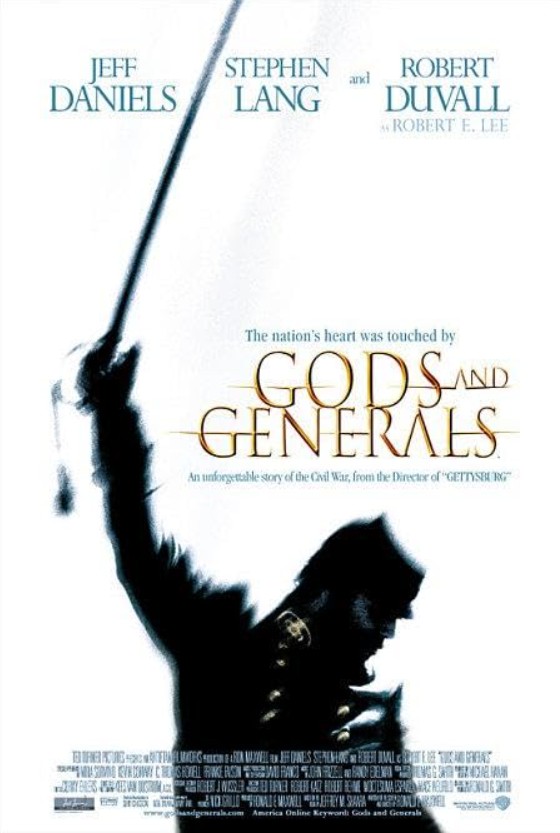
Gods and Generals poster created by Ted Turner Pictures, Antietam Filmworks, Esparza / Katz Productions, Rehme Productions, Mace Neufeld Productions, and Warner Bros.

Things I liked about the film:

The acting: Since Robert Duvall is the reason why I’m reviewing Gods and Generals, I’ll talk about his acting performance first. In the 2003 movie, Robert portrays General Robert E. Lee. Throughout the movie, I noticed the consistent calmness he brought to his performance. At the beginning of Gods and Generals, General Robert E. Lee turns down an invitation. The tone of voice he adopts is very articulate and matter of fact. There’s a gentleness in his eyes that shows he holds no ill-feelings or disrespect toward receiving the invitation in the first place. Robert’s approach to portraying General Robert E. Lee appeared to have genuine thought and effort put into it. Meanwhile, I liked Jeff Daniels’ portrayal of Lieutenant Colonel Joshua Lawrence Chamberlain! Jeff brought a tenderness that made Lieutenant Colonel Joshua Lawrence Chamberlain interesting to watch. One of the most captivating scenes in Gods and Generals is when Lieutenant Colonel Joshua Lawrence Chamberlain and his wife, Fanny, discuss his upcoming departure to the United States Army. Their interaction is very bittersweet, yet tender. Their gentle tone of voice holds the love they share for each other. Both Fanny (portrayed by Mira Sorvino) and Lieutenant Colonel Joshua Lawrence Chamberlain carry sadness on their faces, especially in their eyes, unsure what their future will hold. Jeff’s and Mira’s acting abilities effectively sold the believability of Lieutenant Colonel Joshua Lawrence Chamberlain and Fanny’s relationship!

I brought up in this review’s introduction how, at the 2004 Movieguide Awards, Stephen Lang won an acting award called the ‘Grace Award for Movies’ for his portrayal of General Stonewall Jackson. Now that I’ve seen his performance for myself, I can, honestly, say his nomination was well deserved! Stephen brought versatility to his portrayal of General Stonewall Jackson, allowing his performance to be well-rounded. Because of Stephen’s acting talents, scenes he (as General Stonewall Jackson) appeared in were emotionally effective. A great example is when General Stonewall Jackson and his wife, Anna, read the Bible together before he leaves for the Battle of Manassas. The gentle, yet loving tone of voice from both General Stonewall Jackson and Anna (portrayed by Kali Rocha) showed how seriously they took their relationship. The look in their eyes was that of longing, longing for more time together as well as longing to be loved by each other. Anna and General Stonewall Jackson’s interaction in that scene showcased a moment of tenderness, reflection, and true love. This was achieved because of the strength of Stephen’s and Kali’s acting abilities!

Historical accuracy: What can ultimately make or break a historical movie is its historical accuracy. If the creative team behind a historical film effectively executes that production’s historical accuracy, the film in question can present the illusion of immersion. This illusion was achieved in Gods and Generals! From the set design to the costume design and even the finest of details, everything looked and felt like the Civil War era. I was impressed how simple items, like a doll or a piano, appeared to have come straight out of that time-period. Other elements, like the dialect, helped bring authenticity to the production. Looking back on Gods and Generals, the creative team’s research into the Civil War era is very evident!

How long shots were utilized: Long shots can be incorporated into a film for a variety of reasons. In “sword & sandal” films, long shots capture the scope of larger set designs. Films featuring armies, teams, or crowds will showcase the size of those groups through long shots. In Gods and Generals, however, long shots were utilized to present establishing shots (shots that establish a story’s location). One example is when Fredericksburg, Virginia is introduced in the story. The long shot used captured an aerial view of the town. Through this perspective, hues of black, white, green, blue, brown, and even purple appeared to nicely blend together. How the town was shown on screen looked like a watercolor painting! Presenting places like Fredericksburg, Virginia with a long shot helped add visually appealing images to Gods and Generals.

The Robert Duvall Tribute Blogathon banner created by Rebecca from Taking Up Room

What I didn’t like about the film:

The run-time: IMDB lists Gods and Generals’s run-time as a little over three-and-a-half-hours. After seeing the movie, however, I felt like I spent three and a half years watching it. I recognize depicting a historical event through film takes time, whether it be battles or certain individuals interacting with one another. For a historical story like Gods and Generals, there are a lot of moving parts involved. But some scenes in the 2003 film were either drawn out too long or seemed unnecessary. One example is a scene where a soldier (who also happened to be a background character) explained to his fellow soldiers what they should do with his belongings if he dies on the battlefield. Personally, I think Gods and Generals should have been presented as a mini-series. Therefore, the story’s key individuals and events would have received their due diligence.

A dialogue-heavy film: In any movie, including historical pictures, dialogue plays an important role in storytelling. Through dialogue, ideas are expressed, emotions are shared, and characters give pieces of their heart to each other and the audience. But if a movie is dialogue-heavy, it forces the audience to actively pay attention to what they’re watching or else they’ll miss important context. Gods and Generals is a dialogue-heavy film, featuring long stretches of time where characters engage in conversations with one another. What also works against Gods and Generals is its little over three-and-a-half-hour run-time I already brought up in this review. While there were battles and action-heavy scenes throughout the movie, they were far and few between compared to the dialogue-heavy scenes. Having an ebb and flow of action and dialogue-heavy scenes would have maintained a steadier pace.

Underutilizing Robert Duvall and Jeff Daniels: Robert Duvall’s involvement in Gods and Generals is the reason why I wanted to review the film. As I mentioned earlier in this review, I liked Jeff Daniels’ portrayal of Lieutenant Colonel Joshua Lawrence Chamberlain. But compared to Stephen Lang and his portrayal of General Stonewall Jackson, it seemed like the acting talents of Jeff and Robert were utilized sparingly. In fact, it got to the point where the movie became ‘The General Stonewall Jackson Show’, with everyone else simply participating in it. Listing Robert, Stephen, and Jeff as Gods and Generals’s top-billed actors feels a bit misleading because of Jeff’s and Robert’s underutilization. This decision also does Robert’s and Jeff’s acting talents a disservice.

Horse with saddle photo created by Topntp26 at freepik.com. <a href=’https://www.freepik.com/free-photo/stallion-black-equine-race-sky_1104246.htm’>Designed by Freepik</a>. <a href=”https://www.freepik.com/free-photos-vectors/background”>Background image created by Topntp26 – Freepik.com</a>. Image found at freepik.com.

My overall impression:

The way I feel about Gods and Generals is similar to how I feel about the 1994 film, Scarlett. Both projects were competently made, each respective creative team clearly knowing what they were doing. The acting and historical accuracy were the strengths of each movie. But the screenwriting causes Scarlett and Gods and Generals to be a mixed bag. The 2003 film having a run-time of a little over three-and-a-half-hours is, in my opinion, excessive. Not only is Gods and Generals a dialogue-heavy movie, I also felt Robert Duvall’s and Jeff Daniels’ acting talents were underutilized. But what I will say is, for me, Stephen Lang stole the show! His performance was so solid, his Movieguide Awards nomination was well deserved. I’d honestly recommend just watching his scenes because the versatility Stephen brought to his portrayal of General Stonewall Jackson made his performance worth watching the film.

Overall score: 6 out of 10

Have you seen Gods and Generals? Which movie from Robert Duvall’s filmography would you like to see me review next? Let me know in the comment section below!

Have fun at the movies!

Sally Silverscreen

Take 3: The Terry Fox Story Review (Atticus and Boo Double Feature Part 1)

Back in April, I reviewed To Kill a Mockingbird for Silver Screen Classics’ Classic Literature On Film Blogathon. I also read the book earlier this year. When I discovered Rebecca from Taking Up Room was hosting the Atticus and Boo Blogathon, I just had to participate, as it was too good of a coincidence to pass up! Because this blogathon celebrates Gregory Peck and Robert Duvall, I decided to review one film from each of their filmographies. However, I purposefully chose two films that were not only released in the ‘80s, but also had something to do with athletics. For this double feature, I’ll start by reviewing the 1983 movie, The Terry Fox Story. I have to admit I like finding made-for-TV movies from years past. This specific film is an HBO presentation that I watched on Youtube. I will also admit that I knew very little about the true story that inspired the film. So, I was looking forward to being educated on Terry Fox’s story!

The Terry Fox Story poster created by HBO Premiere Films, HBO, and ITC.

Things I liked about the film:

The acting: I will talk about Robert Duvall’s performance first, as he is one of the reasons why I reviewed this film. In The Terry Fox Story, Robert portrays Bill Vigars, a member of the Cancer Society from Toronto. He doesn’t show up until fifty-nine minutes into the movie, but Robert is given more screen time than he had in To Kill A Mockingbird. With a performance that comes across as natural, Robert made his character feel like a real-life person. One is his best scenes was when Bill gives a pep talk to Terry about ignoring the press. It shows this particular character is trying to look out for Terry’s best interests. Speaking of Terry, Eric Fryer is one of the strongest members in this cast! No matter what scene he appeared in, his performance felt realistic. He displayed the frustrations a patient with cancer might experience, such as when Terry wants to quit his treatments and leave the hospital. There were even times when his character was emotionally guarded, protecting himself from experiencing more pain in his life. Terry stopping people from touching his hair is a good example of this. Despite all the on-screen hardships, Eric brought joy to his role, which helped create happier moments that felt earned. Rika Noda was a part of these happier moments, showing Terry how he can open his heart and allow his personal barriers to be broken down. Portrayed by Rosalind Chao, Rika was an endearing character who, more often than not, brought out the best in Terry. While she gave a good performance individually, Rosalind also had good on-screen chemistry with Eric Fryer. This made me invested in their on-screen relationship and want to see it succeed!

The scenery: Since this movie revolves around Terry’s marathon across Canada, the country’s landscapes serve as photogenic backdrops! When Terry starts his marathon in Newfoundland, he stands on the shores of Cape Spear. With the waves crashing against the rocky shores, this location created a powerful image of a warrior preparing for battle. This waterfront area was also appealing to look at. During his marathon, Terry runs past a city skyline. Behind that skyline was a beautiful sunset. Its pale orange hues illuminated the scene, bringing forth a peaceful picture. A variety of surroundings were featured throughout the marathon. This showed a good representation of the living environments that can be found in an individual country like Canada.

Showing heart-breaking and heart-warming moments: In my review of Nicholas Nickleby, I said one of the strengths of the movie was how there was a balance of despair and joy within the story. The Terry Fox Story had a similar strength, showing both the heart-breaking and heart-warming moments of Terry’s journey. While receiving treatments at the hospital, Terry meets another cancer patient named Bob. Several scenes later, Terry crosses paths with Bob again. This time, the treatments have taken their toll on Bob, making him appear unrecognizable. It was just one example of the ugliness cancer carries, showing the audience a more realistic depiction of the disease. My favorite scene in this film is when Terry’s family and friends are waiting for him to cross the finish line at the seventeen-mile marathon. It was such a heart-warming moment, it made me tear up. This is because it did a good job at displaying what happens when someone believes in another person. It was also a happy occasion that perfectly contrasted the scene’s dark and rainy background!

The Atticus and Boo Blogathon banner created by Rebecca from Taking Up Room.

What I didn’t like about the film:

A rushed beginning: I’m aware there’s only so much story that can be told in an hour and thirty-six minutes. However, the first thirty-eight minutesof The Terry Fox Story was rushed. Important events that led up to the marathon were shown in short segments. It felt like these moments were bullet points within a timeline. It also seemed like the film’s creative team tried to squeeze as much of Terry’s story into the script as they realistically could. Only focusing on some of the events would have benefitted the overall project, as the movie’s flow would be even and certain parts of the story could be fleshed out more.

Terry’s bad attitude: After watching The Terry Fox Story, I read Terry’s family was not a fan of the film “for depicting him as ill-tempered”. In the movie, I saw the character of Terry giving some of the people around him a bad attitude. Toward the beginning of the marathon, Terry complains to his friend, Doug, over the smallest of things. He even calls his friend hurtful names. In the few moments when this happened, it made me briefly question why I was rooting for this character. I know this creative decision was chosen to show how humans can be flawed and have their bad days. Eventually, Terry learns from his errors and apologizes to Doug. But when a movie presents a character they want me to root for and, for any reason, that character makes me wonder why I’m rooting for them, that is not a good thing.

Unresolved or under-resolved story points: There were a few story points in The Terry Fox Story that were either unresolved or under-resolved. As I mentioned earlier, Bob and Terry shared two scenes together. The second of these two scenes left an unresolved conclusion, as Bob is never seen again for the rest of the film. The story never explains if Bob beat his cancer diagnosis or if he passed away. Before the marathon, Rika and Terry’s relationship was traveling rocky waters. It wasn’t until the one hour and fifteen-minute mark when Rika’s voice-over could be heard, indicating her and Terry’s issues were resolved. While it was nice to receive this resolution, it could have been received a lot sooner in the story.

Canada postage stamp image created by Ibrandify at freepik.com <a href=’https://www.freepik.com/free-vector/canadian-flag-stamp-template_836872.htm’>Designed by Freepik</a> <a href=”https://www.freepik.com/free-photos-vectors/template”>Template vector created by Ibrandify – Freepik.com</a> Image found at freepik.com

My overall impression:

Before watching The Terry Fox Story, I only knew the bare minimum of Terry Fox’s story. Now, I feel like I’ve been educated on one of the most important pieces of Canadian history! While there are flaws within the project, the 1983 film did a good job showcasing the human spirit on film. Heart breaking and warming moments influence how people view their world, with the movie effectively showing that. The story also reminds the audience that humans are not invincible, as they all have their own limits. Terry Fox and his marathon teaches us what we are capable of when we believe in ourselves and others. As the character of Terry said in The Terry Fox Story, “it’s about reaching out to people and having them touch you back”. Another good lesson this film teaches is how, sometimes, our best is more than enough. Terry’s single act of attempting to run across Canada helped start a conversation we’re still having decades later. Awareness for various cancers are being raised year after year and multiple organizations have joined the fight against this horrible disease. Even though there’s still more work to do done, I’d like to think Terry’s dream is closer to coming true.

Overall score: 8.1 out of 10

Have you heard of Terry Fox’s story? Which “based on a true story” movie would you like to see me write about? Let me know in the comment section below!

Have fun at the movies!

Sally Silverscreen
Here’s the link to the quote I referenced in this review:

https://en.wikipedia.org/wiki/The_Terry_Fox_Story