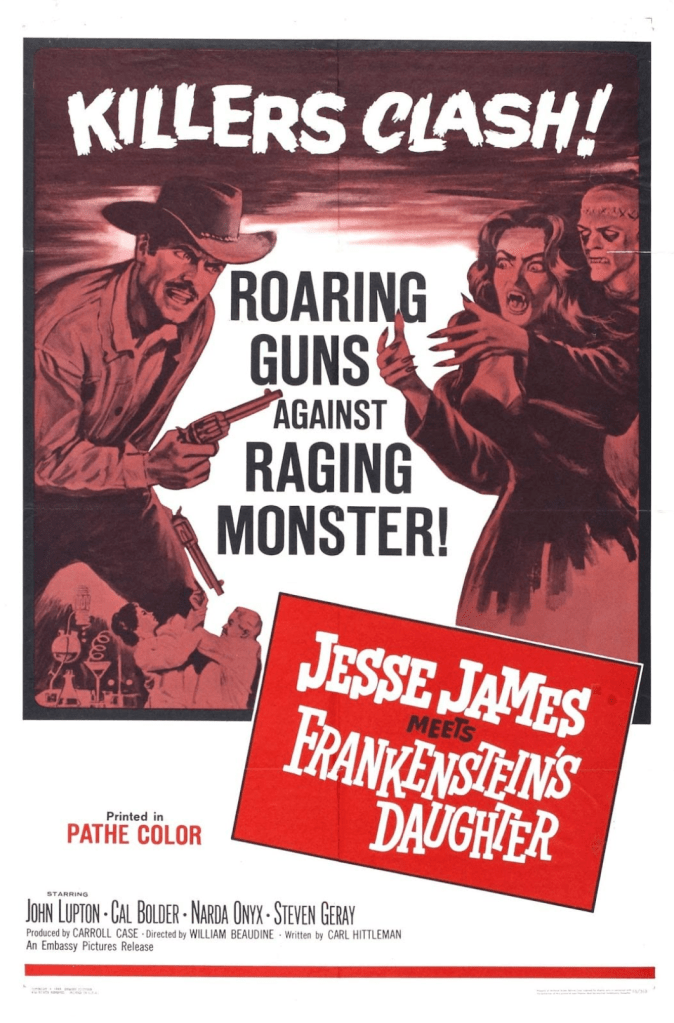
My quest to find my “so bad it’s good” movie has, at this point, turned into a saga. During my time participating in the So Bad It’s Good Blogathon from Taking Up Room, I have selected a film I thought would earn the coveted title, only to have that film fall short of my expectations. But I haven’t given up, as I still believe my “so bad it’s good” film is out there somewhere. When I reviewed Sea Change, I said the movie sounded so “bonkers”, I had to check it out for myself. I had a similar experience when I discovered the 1966 film, Jesse James Meets Frankenstein’s Daughter. Based on that title alone, the movie sounded “bonkers”, a well-known criminal from the “wild, wild west” crossing paths with someone from the story of Frankenstein. I hadn’t seen a film where the western and horror genres combined, so I was curious to see how this story would turn out. I was also curious to see if Jesse James Meets Frankenstein’s Daughter would finally be my “so bad it’s good” movie.
Maria’s house: Within this movie’s dialogue, Maria explains how her house formerly belonged to a missionary. Though the space is more reflective of Maria’s taste in design, I was impressed with the set! Despite only three rooms being shown on screen, my favorite room was the sitting room! The walls and massive fireplace were covered in a light-colored sandstone. A large medallion with carved images sits over the fireplace, boasting a darker metal hue. Red armchairs and curtains nicely complimented the sandstone. These details added elements of elegance and European flair to the desert!
The inclusion of science: In stories from the western genre, science isn’t often found in the script. In fact, the only times I’ve seen science included in western stories are during school lessons or whenever a medical situation takes place. Maria is a scientist from Austria, who just so happens to be related to the same Frankenstein from Mary Shelley’s novel. She is driven to make her experiment work, using an artificial brain that was passed down through her family. Despite the film’s science being poorly written, I appreciate this story adopting a more unique identity. I also appreciate the creativity this movie’s creative team attempted.
Poorly written science: As I previously stated in this review, the science in Jesse James Meets Frankenstein’s Daughter is poorly written. It honestly made the characters sound like they didn’t know what they were talking about. While performing one of her experiments, Maria explains to her brother why they moved to the United States. She says there are more “electrical storms” in the United States than there are in Austria. What Maria failed to remember is how thunderstorms can take place anywhere, as clouds can congregate to create the effects of a typical storm, such as lightening. This made Maria’s trip seem kind of pointless.
A misleading title: I mentioned in this review’s introduction how the title of Jesse James Meets Frankenstein’s Daughter sparked my curiosity, as it made the movie sound “bonkers”. Personally, I thought the film would feature Jesse James in his younger years interacting with the daughter of Frankenstein’s monster. However, the title turned out to be a lie. Maria is Victor Frankenstein’s granddaughter. When Jesse meets Maria, forty minutes into the movie, nothing happens after their initial meeting. They don’t fall in love or form some sort of alliance. If given an honest title, this film would be called “Jesse James Meets Juanita”.
Delayed reactions: Though not a common flaw, there were a few times where actors presented delayed reactions. When Juanita’s family first meets Jesse and his friend, Hank, both men are running from the law. Hank has a very noticeable injury, which is getting worse by the minute. But it takes Juanita about five to ten seconds to acknowledge Hank’s injury. I’m not faulting the actors, as they tried their best with the material given. I will fault the screenwriting, as there could have been a stronger sense of urgency written into the script.
Lack of horror: In this review’s introduction, I said I was curious to see a movie combine the western and horror genres. But when I watched the film, the western genre was emphasized. To me, it felt like the movie’s creative team wanted to take their western story seriously, instead of finding a balance between the horror and western genres. When the horror elements were utilized, it seemed like they were used to tell a rehashed version of Mary Shelley’s story. Even though I appreciate the creativity attempted, I wish the delivery was stronger.
For five years, I have been searching for my “so bad it’s good” movie. Throughout this search, I have found films that were either ok or disappointing. With Jesse James Meets Frankenstein’s Daughter, there were a few times I found myself giggling. But I wouldn’t say this movie is “so bad it’s good”. To be honest, this film was built on a gimmick. Though that could work with the right creative talent, Jesse James Meets Frankenstein’s Daughter didn’t have a strong delivery. It felt like the movie’s creative team wanted to take their project seriously. This made the film feel more like a generic western. The inclusion of the horror genre added some creativity to the movie. Unfortunately, the horror elements were not utilized well. With this review for the So Bad It’s Good Blogathon, it feels like I took a step in the right direction! Hopefully, those steps will lead me to my “so bad it’s good” movie!
Overall score: 4.9-5 out of 10
Have you seen or heard of Jesse James Meets Frankenstein’s Daughter? Would you like to see more westerns combine other genres? Please let me know in the comment section!
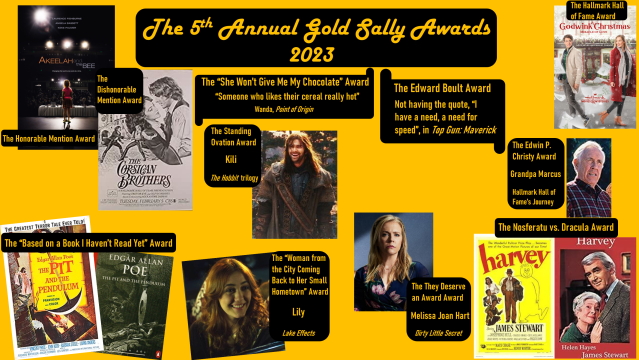
With 18 Cinema Lane’s 5th anniversary in February, the annual Gold Sally Awards is here to mark this occasion! As I mentioned last month, this year’s awards will be presented differently. Each category was created by me, based on topics I’ve brought up on my blog. The award recipients relate to movies I saw in 2022, with some of those movies covered on 18 Cinema Lane. For each category, I will explain the significance of them and why I chose that recipient. So, without any delay, let the Gold Sally Awards begin!
5th Annual Gold Sally Awards Winners created by me, Sally Silverscreen.
The Edwin P. Christy Award
(Most Annoying Character in Film)
Grandpa Marcus from Hallmark Hall of Fame’s Journey
When I saw I Dream of Jeanie two years ago, I was introduced to the character of Edwin P. Christy. In my review of the 1952 movie, I said I found Edwin annoying. This is because he used every opportunity to put the spotlight on himself. He does this so often, I said in my list of the top ten worst movies of 2021 that I Dream of Jeanie’s honest title would be “The Edwin P. Christy Show”. In 2022, I met another annoying character named Marcus, from Hallmark Hall of Fame’s Journey.
Having a hobby can be a good thing. But in Marcus’ case, his hobby for photography turns into an obsession. This obsession causes Marcus’ family to either hide their faces or run away from him whenever he wants to take their picture. Marcus also takes pictures of people without their permission. It even gets to the point where Marcus makes his grandson, who appears to be eight to ten years old, drive a car so Marcus can take photos. His grandchildren jokingly remark how their grandpa will photograph their car accident if something should happen to them, their remark not sitting well with me at all. In Journey, Marcus’ hobby is related to one of the movie’s themes; memories are irreplaceable. The delivery of this theme, though, was an annoying one.
The “She Won’t Give Me My Chocolate” Award
(Best Quote from a Movie)
“Someone who likes their cereal really hot” – Wanda, Point of Origin
The Valley of Light is a Hallmark Hall of Fame movie I like. I’ve mentioned in my tier rank list of every Hallmark Hall of Fame movie I saw that “She won’t give me my chocolate” is one of my favorite quotes from this collection of films. When I watched Point of Origin last June, I heard a quote that was so funny, it caught me off guard! In one scene, John’s daughter asks John, the film’s protagonist, what a serial arsonist is, after hearing the term on the news. Without missing a beat, Wanda, John’s wife, answers the young girl’s question by explaining it is “someone who likes their cereal really hot”. I was not expecting Wanda to provide this kind of answer, let alone any answer at all. Its unexpectedness is why I found this quote hilarious!
The Edward Boult Award
(Missed Opportunity in Cinema)
Not Having the Quote, “I have a need, a need for speed”, in Top Gun: Maverick
Back in 2019, I watched Edward, My Son for the first time. In my review of that film, I talked about how Edward’s lack of on-screen appearances was a missed opportunity. Not only did this creative decision prevent the audience from getting to know and connect with Edward as a character, it also denied an actor from receiving the “standing ovation” he deserved. Out of the films I saw in 2022, there were a few times where I felt an opportunity was missed. But not having the quote, “I have a need, a need for speed”, in Top Gun: Maverick was, in my opinion, the biggest missed opportunity of the year. The aforementioned quote is not only the most well-known quote from Top Gun: Maverick’s predecessor, it’s one of the most famous quotes in movie history. Like I said in my review of the 2022 blockbuster, the film did a good job respecting Top Gun. However, I still think “I have a need, a need for speed” should have been referenced somewhere in the movie.
The They Deserve an Award Award
(An Actor or Actress Who Deserves Recognition)
Melissa Joan Hart (for her performance in Dirty Little Secret)
A quote I have always tried to incorporate into 18 Cinema Lane is Auggie’s quote from Wonder: “Everyone in the world should get a standing ovation at least once in their life because we all overcometh the world.” This is why I go out of my way to talk about movies, people, or movie related topics that may be overlooked. Dirty Little Secret is a Lifetime movie that premiered last year. In this film, Melissa portrays Joanna, a woman who is secretly a hoarder. As I have said in the past, Lifetime has a history of creating PSA/ “after school special”/cautionary tale type of movies. Unlike the majority of those projects, Dirty Little Secret revolves around a story, which happens to address the serious issue of hoarding. Through her performance, Melissa was able to successfully bring forth the humanity of her character. With a strong sense of emotionality and an array of expressions and body language, Joanna became a character the audience could be empathetic towards. Personally, I think Melissa should have, at least, been nominated for an award, as her performance in Dirty Little Secret was one of the best from 2022!
The “Woman from the City Coming Back to Her Small Hometown” Award
(Most Extreme Use of a Cliché)
Lily from Lake Effects
If you’ve read my list of the top ten worst cliches from Hallmark movies, you’d know the “woman from the city coming back to her small hometown” cliché is my least favorite. It’s been used so many times, it makes a story more predictable. There are two cliches from Hallmark productions I’ve never talked about on 18 Cinema Lane: the “younger sibling is free-spirited” cliché and the “artist = free-spirit” cliché. While these cliches have made several appearances in Hallmark projects, including When Calls the Heart, their presence hasn’t been as frequent as other cliches. But these two cliches were fully embodied by Lily, one of the characters in the 2012 film, Lake Effects. From her colorful wardrobe to her dream of studying art in Paris, Lilly adopted every component of the two aforementioned cliches you can think of. The combination of these elements created a character I couldn’t take seriously. In fact, you could make a bingo game revolving around the various ways the “younger sibling is free-spirited” cliché and the “artist = free-spirit” cliché are incorporated into Lilly’s story.
The Standing Ovation Award
(Character Most Deserving of Receiving Their Full Potential)
Kili from The Hobbit trilogy
When I talked about The They Deserve an Award Award, I brought up Auggie’s quote from Wonder. Last November, I created a list of characters who didn’t receive their full potential. With both of that said, I decided to create an award category where I recognize a character that I feel should receive the full potential they deserve. In my tag post, My take on The “Flaming Hot…5 Reasons Why” Tag, I brought up Kili from The Hobbit trilogy. Since I saw all three movies for the first time last year, Kili would be eligible for this award. In that aforementioned tag post, I claimed how Kili was, in my opinion, the MVP of Middle-Earth. This is because there are several attributes that make him a likable character, such as his humbleness toward his royal title. Throughout the trilogy, I was rooting for Kili to achieve his full potential, which I feel could have been possible. But, without spoiling this story, his potential was ultimately denied. I do plan on writing at least one editorial about Kili, so stay tuned!
The Honorable and Dishonorable Mention Award
(Best and Worst Movie from the Honorable and Dishonorable Mention Category)
Best – Akeelah and the Bee, Worst – Hallmark Hall of Fame’s The Corsican Brothers
Whenever I publish my best and worst movies of the year lists, I receive few opportunities to talk about the movies in my Honorable and Dishonorable Mention categories. In fact, the only times I talk about these movies are when I get the opportunity to review them on my blog. Therefore, I created an award category to recognize these films. Akeelah and the Bee was such a pleasant surprise for me! It was a feel-good story that felt sincere in the messages and delivery. There were even interesting twists that I did not see coming. Without spoiling the movie, the script did a good job at avoiding a cliché when it comes to competitions in movies. I’m glad I checked out Akeelah and the Bee, as the film was time well spent!
Last October, I reviewed Hallmark Hall of Fame’s The Corsican Brothers for the Devilishly Delightful Donald Pleasence Blogathon. After seeing some adaptations of Alexandre Dumas’ stories, I thought I knew what to expect from the 1985 made-for-tv movie. But the longer I watched The Corsican Brothers, the more disappointed I became. This story was not the exciting tale with adventure and intrigue I was hoping for. Instead, it was a confusing film with little to no use of urgency. As of the publication of this award post, I still have not read this movie’s source material. Therefore, I don’t know which parts of the production are creative liberties.
The Nosferatu vs. Dracula Award
(Two Movies That Feel Like You’re Watching the Same One)
Harvey (1950) and Hallmark Hall of Fame’s Harvey (1972)
For a Blog Follower Dedication Review, I wrote about 1931’s Dracula. Because I had seen Nosferatu prior to watching Dracula, the 1931 film felt like a re-tread of its predecessor. I even told my readers if they had seen Nosferatu, they’d already seen Dracula. Last year, I reviewed two versions of Harvey; the 1950 movie and the Hallmark Hall of Fame adaptation from 1972. Though I liked the Hallmark Hall of Fame movie more than its predecessor, I didn’t like how it was a copy of the 1950 film. The movie’s sets even looked almost exactly like they did in the 1950 production. If you’ve never seen any version of this story, I’d recommend only seeing 1972’s adaptation of Harvey.
The Hallmark Hall of Fame Award
(Movie That Feels Like It Belongs in the Hallmark Hall of Fame Collection)
A Godwink Christmas: Miracle of Love
I have sometimes found a movie that feels like it should have been included in the Hallmark Hall of Fame collection. So, when I find out a story isn’t associated with this series, it surprises me, whether it’s because the movie is based on a true story or the story itself covers a topic found within Hallmark Hall of Fame. That leads me to bring up A Godwink Christmas: Miracle of Love! Like other films in the Godwink series, the 2021 film is also based on a true story. Subjects related to faith, which usually aren’t found in a typical Hallmark Channel or Hallmark Movies & Mysteries production, are included within this particular story as well. In my opinion, the overall quality of A Godwink Christmas: Miracle of Love felt reminiscent of Hallmark Hall of Fame movies I like, such as The Valley of Light and A Dog Named Christmas. I’m honestly surprised SQuire Rushnell’s stories weren’t included in the Hallmark Hall of Fame collection back when Hallmark utilized that banner.
The “Based on a Book I Haven’t Read Yet” Award
(Movie Based on Source Material I Have Not Yet Read)
The Pit and the Pendulum
I feel like, more often than not, I find myself saying that a movie I review is based on source material I haven’t read. This prevents me from judging the film as an adaptation. It’s been years since I’ve read anything by Edgar Allan Poe. I even mentioned this fact in my review of the 1961 adaptation. Fortunately, The Pit and the Pendulum is a book I plan on reading for the upcoming Eurovisionathon readathon. Because of that, I selected The Pit and the Pendulum for this specific award!
My approach to February’s Genre Grandeur is similar to my approach for last month’s blogathon. As the theme this time around is ‘movies that take place or feature Italian settings’, I could have selected one of several Hallmark productions where Italy serves as the story’s backdrop. Instead, I overlooked the realm of Hallmark for a movie that happened to be on my DVR; 1985’s A Room with a View! When I discovered the film’s protagonist, Lucy, travels to Florence, Italy, I knew it would the perfect selection for this month’s Genre Grandeur. Because my choices for 2023’s blogathon have, so far, featured a female protagonist traveling abroad (A Room with a View and Black Narcissus), I saw this is as a very interesting coincidence. In my review of Black Narcissus, I thought the 1947 film was just ok, as the movie emphasized style over substance. Did I feel the same way about A Room with a View? Take a trip through this review to find out!
A Room with a Viewposter created by Merchant Ivory Productions, Goldcrest Films, FilmFour International, Curzon Film Distributors, and Metro-Goldwyn-Mayer
Things I liked about the film:
Interactions between characters: A Room with a View is an ensemble film, with the actors and actresses coming from all walks of life and journeys in their careers. The characters reflect this idea, as they travel to Italy for various reasons. Because of everything I just said, it was interesting to see each interaction between the characters unfold. One of the funniest scenes was shared between Charlotte, portrayed by Maggie Smith, and Eleanor, portrayed by Judi Dench. Eleanor is a writer, a woman who adopts a more romantic view of the world. Meanwhile, Charlotte is more of a realist, someone who views the world through a practical lens. As they explore Florence, Eleanor encourages Charlotte to breath in the scent of the city, in an attempt to make the most of their traveling experience. Instead, Charlotte puts a handkerchief over her nose, as she and Eleanor just walked past a group of smokers. Due to the screenwriting, as well as Judi’s and Maggie’s performance, this scene elaborates my aforementioned points!
The scenery: As I stated in the introduction, I chose to review A Room with a View because of Lucy’s trip to Florence. Therefore, my discussions about the movie’s scenery will focus on the Italian background. Toward the beginning of the film, Lucy visits a cathedral. In the interior of this massive structure, the main hall is surrounded in light gray stone. Symmetrical stone columns with matching hue and carved designs burst from the cathedral’s high ceiling. Filled with giant statues, a sprinkling of candles, and artwork within the cathedral’s alcoves, the large scale of this space was captured well through various camera angles!
During Lucy’s trip, she and several tourists visit Florence’s countryside. While enjoying their picnic, the characters sit on rolling green hills, coated in varying shades of green. Trees proudly stood among the guests, joining their event from a distance. A few red-orange poppies poked out of the sea of grass, providing the landscape with a pop of bright color. Wrapped up in a clear, sunny sky, Florence’s countryside looked postcard perfect!
Lucy’s wardrobe: Since this was my first time watching A Room with a View, I had no expectations when it came to Lucy’s wardrobe. But as the story progressed, I found myself adoring Lucy’s attire, as it was classy and elegant! An excellent example is what Lucy decided to wear to her piano recital. Lucy wore a cream-colored gown with puffed lace sleeves. The scooped neckline was surrounded by embroidered flowers. Sparkles covered the bodice of the dress, providing just enough twinkle. Paired with a jeweled belt, Lucy’s gown was simply beautiful!
Italian countryside image created by Bill Silvermintz at freeimages.com. “FreeImages.com/Bill Silvermintz.” Photo by <a href=”/photographer/edudflog-58908″>Bill Silvermintz</a> from <a href=”https://freeimages.com/”>FreeImages</a>.
What I didn’t like about the film:
The drawn-out story: A Room with a View’s primary focus was Lucy’s growing attraction for George, who she met on her trip to Florence. But alongside that part of the story were situations involving the other characters from this ensemble. These situations were competing against one another for the audience’s attention. One situation happened after Lucy came home to England. She tries to recruit some of the trip’s guests to stay in a local cottage. Her fiancé, Cecil, recruits guests to the cottage, who just so happen to be George and his father. However, the emphasis on the cottage’s status is one of the reasons why Lucy’s attraction for George isn’t resolved until the last forty minutes of the movie. Because of these things and the film’s two hour run-time, the story itself felt drawn out.
Lack of on-screen chemistry: Helena Bonham Carter and Julian Sands, the actors who portrayed Lucy and George, did a good job with the material they were given. But when their characters were interacting together, I didn’t feel a strong sense of on-screen chemistry. A reason why is because of how infrequently George and Lucy crossed paths. Within the film’s first forty minutes, Lucy and George spend time together in about two or three scenes. Shortly after those first forty minutes, Lucy becomes engaged to Cecil, a character who a) was never brought up during the Florence trip and b)didn’t appear on screen until forty minutes into the film. Even after the engagement, George and Lucy’s time together isn’t consistent. This resulted in the missed opportunity to watch this relationship grow over time.
The title cards and on-screen text: At various moments in A Room with a View, title cards announced when a character was about to do something. On-screen text would sometimes replace these title cards. One example takes place when Lucy and several tourists travel to Florence’s countryside. Before their excursion, white text appeared on the screen, explaining what they were about to do. I was not a fan of this creative decision because these title cards and on-screen text told the audience what they could see or figure out for themselves. This creative decision was also not consistently featured in the movie.
When it comes to A Room with a View’s style, this movie excels! It’s a pretty looking film, as the scenery, set design, and even Lucy’s wardrobe made the production pleasant to the eye. But when it comes to the substance, the film falls short. I didn’t find the story compelling, which is caused by the story itself being drawn out. I also did not sense strong on-screen chemistry between Helena Bonham Carter and Julian Sands. The more historical fiction/period drama media I consume, I find myself, more often than not, gravitating toward stories whose casts are smaller. This creative decision prevents the stories from competing for attention, as there are less characters to keep track of. Because A Room with a View contained an ensemble cast, there were so many ideas brought up and so few time to address it all. As the saying goes “time flies when you’re having fun”.
Overall score: 6.1 out of 10
Have you seen A Room with a View? Do you prefer movies with bigger or smaller casts? Please tell me in the comment section below!
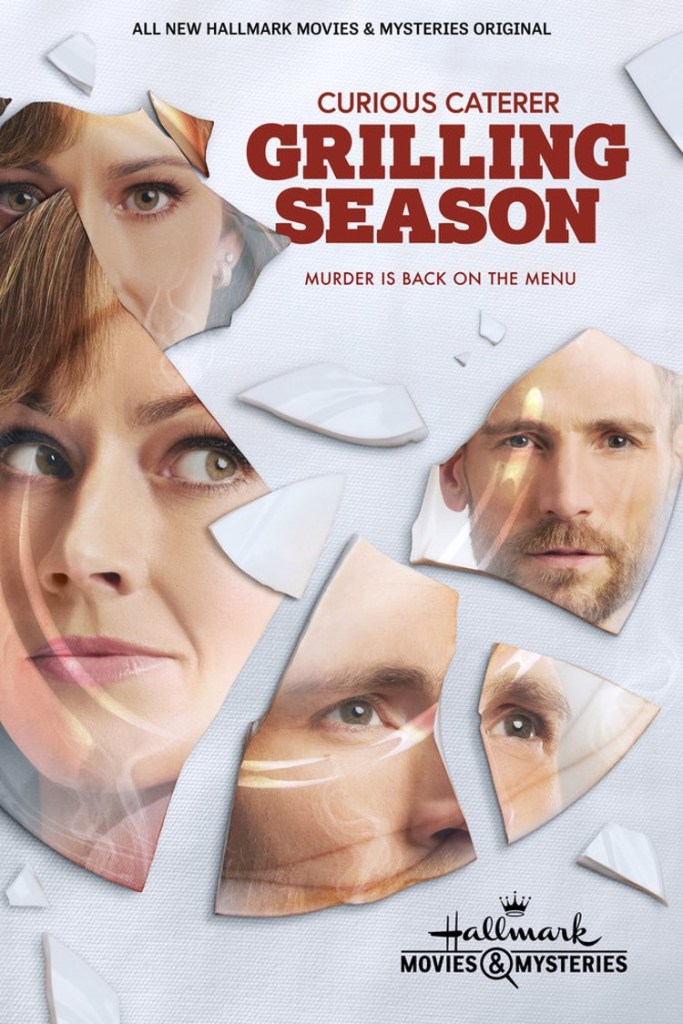
It’s been a little while since I last reviewed a Hallmark film. In fact, this is my first Hallmark movie review of 2023. Since 18 Cinema Lane recently received 455 followers, I thought this would the perfect opportunity to write about a Hallmark production. Besides, “absence makes the heart grow fonder”. Last year, I reviewed Curious Caterer: Dying for Chocolate (as a Blog Follower Dedication Review). Even though I thought it was just fine, the movie had potential to start a new series. Out of the newer mystery films to premiere on Hallmark Movies & Mysteries this decade, so far, Curious Caterer is one of only two to receive a sequel. I will admit when I first read the synopsis for Curious Caterer: Grilling Season, it sounded like a repeat of the first film. It also didn’t help how the trailer revealed very little information about the movie. However, as a thank you to every one of 18 Cinema Lane’s followers, I’m serving up this review of Hallmark Movies & Mysteries’ latest mystery title!
The acting: When I reviewed Curious Caterer: Dying for Chocolate last year, I complimented Nikki Deloach, Andrew W. Walker, and even Kendall Cross on their solid performances. Nikki and Andrew returned to this second chapter with equally strong portrayals of their respective characters! Throughout the film, I was impressed by the strength of the cast as a whole. Every interaction appeared so natural, I was immersed in the story! A great example is when Goldy and her friend, Marla, are unknowingly delivering evidence to Detective Tom’s office. In this scene, Goldy and Marla explain how they conveniently crossed paths with Mason, Tom’s detective partner, in the parking lot. Displaying genuine confusion on their faces, Marla and Goldy bring some of the murder victim’s paperwork, in an attempt to simply help in any way they can. Not wanting Goldy to be involved in official detective work, Tom tells both women how they are interfering with an investigation. During this interaction, Tom carries a stern tone in his voice and a frustrated look in his eyes, displeased with civilians interrupting his work. Meanwhile, Mason displays an easy-going, yet professional persona, trying his best to do his job right. This blend of personalities, emotions, and expressions created a scene that was not only well acted, but was hilarious as well!
The humor: Limited amount of humor was one of the flaws of Curious Caterer: Dying for Chocolate. This prevented the audience from receiving a break from the story’s heavy murder mystery plot. In Curious Caterer: Grilling Season, however, more humor was incorporated in the script. Like other mystery series on Hallmark’s second network, the humor felt like it belonged in the world of Curious Caterer. While Goldy and Marla are creating a mystery board, Detective Tom arrives at Goldy’s back door. Because this back door contains a see-through window, Tom can see exactly what Marla and Goldy are doing. When they see that Tom has arrived, Goldy and Marla try their best to cover the board up, as they know Tom would disapprove. With a irritated look on his face, he points to the door knob, demanding Goldy open the door. To me, this was one of the funniest scenes in the movie, as the intended ideas were expressed with very little dialogue!
Marla’s involvement in the mystery: In most mystery series from Hallmark Movies & Mysteries, the protagonist’s best friend either has a small role in the mystery or isn’t involved at all. Curious Caterer: Grilling Season gave Marla, Goldy’s friend and co-worker, a greater opportunity to participate in the mystery. During the creation of the mystery board, Marla was thinking up suspects and speculating on their motives. Meanwhile, Goldy was providing insight into other possible theories. Marla also shares information with Goldy about two possible suspects. Creative decisions like this one allow the Curious Caterer series to try new things and stand out from the network’s other mystery titles!
Providing far-reaching or no explanations: At the beginning of the movie, Goldy is catering the birthday party of her friend, Susie. Tom is one of the party’s guests, who appears to personally know the hostess. Within the dialogue, though, Tom’s relationship with Susie was never explained. In some mystery stories, explanations for clue discoveries and motive reveals can be so far-reaching, most audience members would have never figured it out on their own. Without spoiling the story, far-reaching explanations were found on a few occasions in Curious Caterer: Grilling Season. For me, this made the mystery less interactive. I also think this could frustrate some viewers.
The under-utilization of Olive: Last year, when I reviewed Curious Caterer: Dying for Chocolate, I talked about how the audience didn’t receive the opportunity to get to know Goldy’s daughter, Olive. This is because she was featured in a handful of “don’t blink or you’ll miss her” moments. In Curious Caterer: Grilling Season, the audience learned a little more about Olive, such as her participation on a softball team. But similar to the first film, her appearances in the story were limited. This was disappointing, as I was hoping Olive would receive a greater role in the story. Perhaps she could have helped Goldy solve a mystery, with both mother and daughter looking for information related to a case.
No close-up shots of the food: As I talked about the cinematography in Curious Caterer: Dying for Chocolate, I shared my thoughts on the close-up shots of some appetizers Goldy served. Those shots gave the audience an idea of the kind of catering service Goldy provides. At Susie’s birthday party in Curious Caterer: Grilling Season, however, there were no close-up shots of the food. Even Susie’s birthday cake was not featured on screen. Catering plays such a vital role in Goldy’s story, as that is her business. So not featuring a few close-up shots of the food not only feels like a missed opportunity, it takes away some of this series’ identity.
As I stated in the introduction, Curious Caterer is one of only two newer mystery titles to receive a sequel on Hallmark Movies & Mysteries. Like I also stated, I had my concerns about the sequel feeling like a repeat of its predecessor. Even though both films share some similarities, I found Curious Caterer: Grilling Season to be a stronger movie than the first chapter! There were times when the sequel improved upon the flaws made in last year’s title, such as incorporating more humor. A sense of consistency was found in the second movie, as the acting was just as strong as it was in the first film. But Curious Caterer: Grilling Season proves this series still has room to grow. The series has so many ideas for future stories! Since Nikki and Andrew have starred in their fair share of Christmas movies, maybe a Christmas mystery is possible? Or a mystery relating to Olive’s softball team is on the horizon, either focusing on the theft of a trophy or a coach is framed for poor sportsmanship? As of the publication of this review, there have been no announcements for upcoming Curious Caterer films. But as the saying goes, “the sky’s the limit”.
Overall score: 7.4-7.5 out of 10
Have you seen Curious Caterer: Grilling Season? Would you like to see this series continue? Let me know in the comment section!
For my first Word on the Street story of 2023, I wanted to talk about a piece of movie news that revolves around a topic I don’t often talk about: movie theatres. When I came across a video from Clownfish TV’s Youtube channel discussing AMC Theatres’ recently announced business model, I felt it was worth bringing up on 18 Cinema Lane. In the video, ‘Desperate AMC Theatres to Charge More for GOOD Seats?!’, Kneon and Geeky Sparkles address the theatre chain’s newest decision to have separate pricing for seats, based on where they’re located in the auditorium. Quoting an article from comicbook.com, Geeky Sparkles and Kneon break down the three tiers that will determine a seat’s price-tag. This article lists these tiers as “Value Sightline” (“seats in the front row of the auditorium, as well as select ADA seats in each auditorium”), “Standard Sightline” (“seats that are the most common in auditoriums and are available for the traditional cost of a ticket”), and “Preferred Sightline” (“seats in the middle of the auditorium and are priced at a premium to standard sightline seats”). Kneon and Geeky Sparkles speculate AMC Theatres is adopting this business plan to encourage more movie-goers to sign up for their AMC Stubs A-List program. Despite the theatre chain “hemorrhaging money right and left”, Kneon believes “other theatres are probably gonna adopt this”.
As someone who talks about movie news from time to time, I’m thankful to have discovered some great topics on Clownfish TV’s Youtube Channel. However, I respectfully disagree with Kneon’s view of the influence AMC Theatres’ latest decision will have on other theatres. When this Word on the Street story is published, the economy AMC Theatres exists in is not strong. Almost every day, there are articles chronicling the closure of multiple retail shops. With that in mind, movie-goers may, more often than not, view the theatre experience as a luxury. To save money on this pastime, audience members could either seek out a theatre that doesn’t charge extra for seats or wait to rent a theatrical movie and watch it at home. I believe AMC Theatres’ tier pricing for their seats will hurt their company more than help. I wouldn’t be surprised if, within this year, there are articles reporting on AMC Theatres closing several cinemas.
What are your thoughts on this piece of movie news? Is your theatre affected by AMC Theatres newest business model? Let me know in the comment section!
Have fun at the movies!
Sally Silverscreen
If you’re interested in reading the comicbook.com article that was referenced in the Clownfish TV video and my post, here’s the link:
Now that The Great Muppet Guest Star Caper Blogathon has concluded and I reviewed both films, it’s time to share my overall thoughts! First, I’d like to thank Gill, from Realweegiemidget Reviews, and Rebecca, from Taking Up Room, for hosting this event! A Muppets themed blogathon was not only a creative idea, it also gave me an excuse to check out Muppet related films. Out of the two movies I reviewed, The Great Muppet Caper and Follow That Bird, one clearly stood out more than the other. That would be 1981’s The Great Muppet Caper! I had such a great experience watching this movie! It felt reminiscent of productions like Anchors Aweigh and Singin in the Rain, where the interactions between the characters and the musical numbers prevented the simpler story from being weak or predictable. Follow That Bird, on the other hand, was a fine, first attempt at creating a film. However, there were several story-telling elements within the project that weren’t utilized to their fullest extent. Some creative decisions were confusing as well. Now that another successful double feature has been completed, I wonder what will be the theme of my next double feature?
Welcome to part two of The Great Muppet Guest Star Caper Double Feature! Like my review of The Great Muppet Caper, this review of Sesame Street Presents: Follow That Bird will be spoiler-free. I will also be referring to the movie as ‘Follow That Bird’ instead of its full title. If you would like to know why I selected this movie, I will provide the link to this double feature’s introduction. The link to my review of The Great Muppet Caper will be provided as well.
1. Were you familiar with Follow That Bird before The Great Muppet Guest Star Caper Blogathon?
Similar to The Great Muppet Caper, I was familiar with Follow That Bird before participating in the blogathon. I own a copy of the film’s soundtrack, so I knew what the story was about. When it comes to the movie itself, I’d only seen pieces of it.
2. Who was the featured guest star in Follow That Bird?
Sesame Street’s Big Bird was a guest on The Muppet Show. As I said in my review of The Great Muppet Caper, The Muppets and Sesame Street were created by Jim Henson. Keeping this fact in mind, I’ve always seen the characters from each intellectual property (IP) as being extended members of the same family. So, when it comes to The Muppet Show, I was surprised Big Bird was considered a “guest”.
3. How would Follow That Bird’s story change if a different Sesame Street character was the main character?
Like The Muppets, Sesame Streethas a large cast of characters. Whether that character is a human or a muppet, each one has their own unique personality, set of likes and dislikes, and talents to offer. With that said, this would be a completely different movie if the story revolved around a different Sesame Street character. Grover is one example, as an important part of his character is his desire to become a superhero. If Grover were the main character of a Sesame Street movie, his story would likely be a “superhero’s tale”, where the protagonist fights crime and saves the day with superpowers.
4. Did you develop any thoughts and/or questions while watching this film?
While watching Follow That Bird, I found some parts of the story confusing. As some of the characters watch a news report on a television at Mr. Hooper’s store, Chevy Chase makes a cameo appearance as a newscaster. During the weather report, he quotes the theme song to Mister Rogers’ Neighborhood. Out of all the references Chevy could make in a Sesame Street movie, why that one? Wouldn’t it make more sense for Fred Rogers to appear in the film and quote the theme song of his own show? Another example is when several characters spot Big Bird in a parade. These characters can clearly see their feathered friend, but their path is blocked due to the parade taking place. How come none of the characters considered getting out of their car and following Big Bird through the parade on foot? It’s decisions like this one that, for me, didn’t make sense.
Similar to The Great Muppet Caper, I was surprised by which characters were included in the movie and how much screen-time they received. Toward the end of Follow That Bird, Elmo makes such a brief cameo appearance, he doesn’t even have any lines. On one hand, Elmo was introduced on Sesame Street in 1980. By the time Follow That Bird was released in theaters, he had been on the show for about five years. On the other hand, at the time of Follow That Bird’s premiere, Elmo was not as popular as he would later become. Despite these facts, I was kind of surprised by Elmo’s limited appearance.
5. Follow That Bird was the first Sesame Street movie ever created. Why do you think it took the show’s creative team that long to make a film?
I have two answers why this decision was likely made. A lot of the cast members from the Sesame Street show worked on Follow That Bird. This includes cast members who worked on Muppet related projects, such as The Great Muppet Caper and The Muppet Show. Like I said in my review of The Great Muppet Caper, my guess is Sesame Street’s creative team wanted to prevent creative burn-out and spreading their talent too thin.
At the time Follow That Bird was released, Sesame Street had been on the air for sixteen years. During that time, the show’s creative team worked very hard to cultivate a program that was creatively and educationally consistent. Like any television show, Sesame Street’s audience grew over time. When it comes to creating a movie, I would guess Warner Brothers, the studio who distributed Follow That Bird, and Children’s Television Workshop, Sesame Street’s production company, wanted to wait until they felt they could make a satisfying profit on the film.
6. Is there anything about Follow That Bird you liked or didn’t like?
As I said in answer number four, I was surprised by which characters were included in the movie and how much screen-time they received. But I also found it interesting how these characters were utilized in the story. On Sesame Street, Oscar the Grouch, more often than not, stays in his trash can and maintains a negative disposition. These factors cause Oscar to appear on the show in certain situations, such as interacting with The Wicked Witch of the West from The Wizard of Oz. While he still had a negative disposition in Follow That Bird, Oscar explored the world beyond his trash can. That’s because he was one of the assigned drivers searching for Big Bird. In Follow That Bird, Oscar was a lot more humorous than I expected. My favorite line of his was spoken during the road trip preparations. Oscar exclaims how he loves a good goose chase. Then, he randomly says, “Let’s get lost”. Giving Oscar more humorous lines and allowing him to join the road trip gave this character an opportunity to be utilized more than he has on the show!
In my review of The Great Muppet Caper, I mentioned the characters’ knowledge of being in a movie as one of the story’s overarching jokes. This was one of the highlights of the 1981 film, as the dialogue relating to the joke was cleverly written and successfully delivered. Two of the characters in Follow That Bird, Oscar the Grouch and Count von Count, acknowledged the film’s audience was watching their movie. But other than “The Grouch Anthem” and the end credits, this knowledge was not consistently brought up in the script. That is just one example of a creative element that wasn’t fully utilized in the 1985 movie.
7. Could a new Sesame Street movie work in 2023?
Since its debut in 1969, Sesame Streethas become a global phenomenon. The success of the show has encouraged countries outside of the United States to create their own version of Sesame Street. In the thirty-eight years since Follow That Bird’s premiere, the cinematic landscape has become more globalized. If Sesame Street’s creative team wanted to make another movie, an important question they would have to answer is which characters will be included in the story. Would it exclusively focus on the characters from Sesame Street or would it also feature characters from one of the international shows? If you wanted to create a movie in 1985, you had three distribution options: releasing the film in theaters, premiering the movie on television, or putting the production directly on video cassette. With the invention of streaming services, studios and production companies are now given the option to forgo the process of theatrical releases, as well as selling a movie on physical media. The distribution of a Sesame Street film is another important question the show’s creative team would have to address.
8. What does Sesame Street mean to you?
To me, Sesame Street represents the idea of timelessness. The show has found its place in the pop cultural landscape and stayed there for over fifty years. In that timeframe, the world and Sesame Street itself has seen so many changes. But despite all of that, some elements of the program have remained the same. Each episode has been given an official letter and number. Follow That Bird even adopted this component from the show, with ‘W’ and ‘B’ being the movie’s letters, representing the studio that distributed the film, Warner Brothers. That simple creative decision has taught children the alphabet and how to count. This knowledge lays the educational foundation so children can master other skills, such as constructing sentences and mathematical equations. The simplicity and consistency of including letters and numbers into Sesame Street is a reminder of the timeless nature of these lessons.
9. After watching Follow That Bird, is there anything you can take away from your movie viewing experience?
According to Muppet Wiki, Sesame Street created three television specials in the 1980s focusing on Big Bird traveling around the world; Big Bird in China, Big Bird in Australia, and Big Bird in Japan. With Follow That Bird being released in 1985 and with the story about Big Bird traveling outside of Sesame Street, it makes me wonder if the movie was meant to correlate with the aforementioned television specials? Speaking of the movie, I thought it was a fine, pleasant, cute enough production. But compared to The Great Muppet Caper, Follow That Bird could have been stronger. There were several creative elements within the movie that weren’t consistently utilized. “The Grouch Anthem” and the end credits being the only two instances of the characters acknowledging the audience is watching their movie is just one example I mentioned in my review. As I also mentioned in my review, some creative decisions didn’t make sense, such as Chevy Chase quoting the theme song of Mister Rogers’ Neighborhood. However, this wasn’t a bad first attempt at making a movie. In fact, there are aspects of the project that worked in the movie’s favor, like the musical numbers! I feel Follow That Bird is one of those films that younger children would enjoy more than an older audience member would.
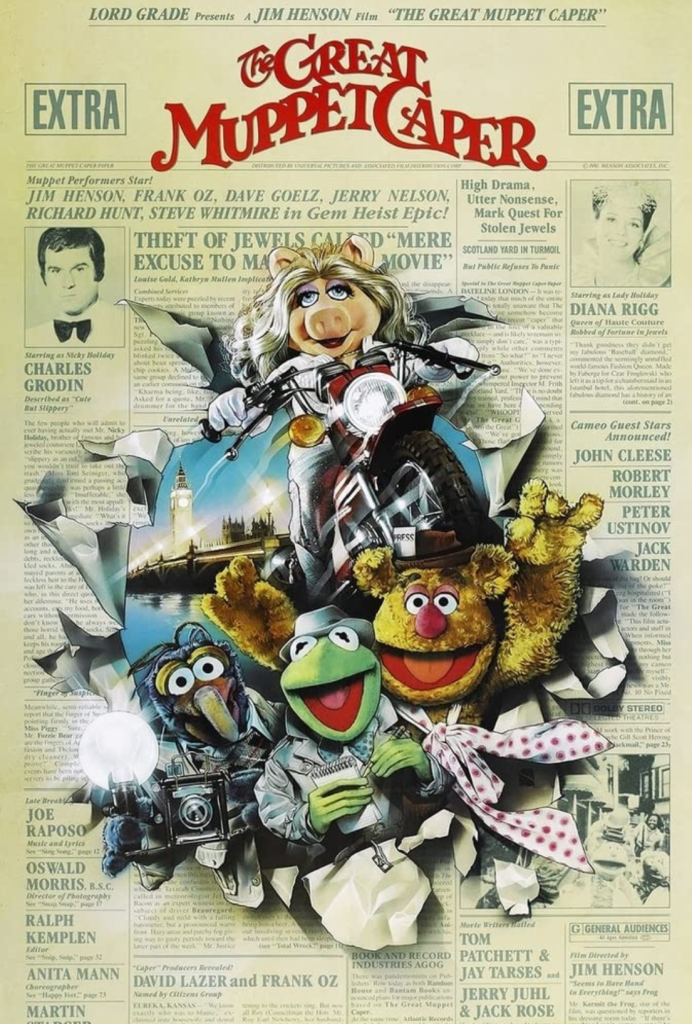
Welcome to part one of The Great Muppet Guest Star Caper Double Feature! Unlike past double feature reviews, my review of The Great Muppet Caper is spoiler-free. If you’re wondering why I chose this movie for the blogathon, you can check out this double feature’s introduction at the link below.
The Great Muppet Caperposter created by ITC Entertainment, Henson Associates, and Universal Pictures
1. Were you familiar with The Great Muppet Caper before The Great Muppet Guest Star Caper Blogathon?
I had heard of The Great Muppet Caper prior to being invited to the blogathon. One reason why I’m familiar with the 1981 film is Christine Elizabeth Nelson’s cameo. Christine is the daughter of Jerry Nelson, who was not only a member of The Muppets cast, he also worked on The Great Muppet Caper. Christine’s mother, Jacquie Gordon, wrote a book about her, titled Give Me One Wish: A True Story of Courage and Love, which chronicled Christine’s young life with a Cystic Fibrosis diagnosis. When I sought out her cameo, before seeing The Great Muppet Caper, I admit I was confused why Christine referred to Kermit as a bear. But as I watched the movie, I realized her line was part of a running joke where Kermit and Fozzie Bear are mistaken for twins, as they wear similar looking hats.
2. Who was the featured guest star in The Great Muppet Caper?
That would be John Cleese! He portrayed a character named Neville, a wealthy British resident. John and Joan Sanderson were featured in the scene where Miss Piggy breaks into a high-end home in an attempt to portray her boss, Lady Holiday.
3. If Neville was portrayed by a different actor, how would his role in The Great Muppet Caper change?
The Great Muppet Caper is similar to It’s a Mad, Mad, Mad, Mad, World in that the majority of the cast is given smaller roles, which results in a shorter amount of time on-screen. This surprised me, as I expected John to have more appearances in the movie. While John did a good job with the limited material given, I don’t think the role of Neville would change no matter who portrayed him. This is because The Muppets were the stars of the show, which is expected for this particular title.
4. Did you develop any thoughts and/or questions while watching this film?
In the film’s opening number, “Hey A Movie!”, a city landscape served as the number’s backdrop. From what I could tell, the city didn’t look like the background on Sesame Street. I was surprised by this creative decision, as both The Muppets and Sesame Street were created by Jim Henson. Because of this fact, I expected more cross-overs between the two intellectual properties (IPs). But the only Sesame Street reference I could find in The Great Muppet Caper was a cameo appearance from Oscar the Grouch. Personally, I think having Sesame Street serve as the backdrop for “Hey A Movie!” would have been a nice nod to that show. With both Sesame Street and The Muppets containing their own large cast of characters and their own specific stories, it makes sense why The Great Muppet Caper featured little acknowledgement of Sesame Street.
The inclusion and exclusion of certain Muppet characters also surprised me. Looking back on The Great Muppet Caper, I remember Pepe the King Prawn was nowhere to be found. In my recollections of The Muppets, Pepe and The Great Gonzo have been good friends. So, I was a bit confused why Pepe wasn’t featured in the story. After doing some research about the character, I learned he joined The Muppets family in 1996, a decade after The Great Muppet Caper premiered. Had Pepe starred in this movie, he likely would have worked with Lady Holiday’s fashion label.
5. The Great Muppet Caper was not only the second Muppet movie created, it was also released at the end of The Muppet Show’s run. Why do you think the creative team behind the Muppets chose to make and premiere this film toward the end of the show’s lifespan?
If you want to create a movie, especially a good one, there is a lot of time, dedication, creative energy, and resources needed to make that a reality. This can also be said for the creation of a television show. Many cast members from The Muppet Show also worked on The Great Muppet Caper. Had both of these programs been created around the same time, this creative team would have run the risk of their talent being spread too thin as well as creative burn-out.
6. Is there anything about The Great Muppet Caper you liked or didn’t like?
One of the overarching jokes in this story was the characters’ knowledge of being in a movie. The way this knowledge was written and delivered felt like the film’s creative team was winking at the audience. One example is when Lady Holiday, portrayed by Diana Rigg, tells Miss Piggy about her brother, Nicky, and why she doesn’t like him. After Miss Piggy asks Lady Holiday why she’s telling her this information, Lady Holiday responds, in a nonchalant and matter-of-fact way, that what she said is exposition and it needs to go somewhere. I liked this part of the story because of how it was cleverly incorporated into the script. The quality of the screen-writing made this overarching joke feel like it fit within the movie’s world.
The plot of The Great Muppet Caper revolves around Kermit, Fozzie Bear, and The Great Gonzo solving the mystery of stolen jewels. As someone who seeks out media from the mystery genre, I was intrigued by the idea of a mystery story starring The Muppets. But when I watched the movie, I quickly learned the musical numbers were given more emphasis than the mystery. Because I enjoyed watching and hearing these numbers, I didn’t mind this creative decision too much. However, I still wish the mystery itself was given a little more focus.
7. Could a new Muppets movie work in 2023?
In the short term, I believe a new Muppet movie could work, purely based on nostalgia. The Muppets is an IP (intellectual property) many people are fond of, so the movie itself might have a huge draw on opening weekend. But for long term success, meaning memorability, merchandising, and home entertainment sales, the story needs to be able to stand the test of time. To achieve that, the script has to be timeless and straight-forward.
8. What does The Muppet Show mean to you?
When I think of The Muppet Show, the word “tradition” comes to mind. It’s one of those shows the family can watch together, sitting around the television every weekend and enjoying the program, as well as each other’s company. With the large cast of characters, a variety of guest stars, and plenty of musical numbers, there seems to be something for everyone. Sadly, I can’t think of many shows today like The Muppet Show, a show that brings families together.
9. After watching The Great Muppet Caper, is there anything you can take away from your movie viewing experience?
When it comes to movies, especially musicals, sometimes the simplest, most straight-forward stories are the ones that work the best. As I reflect on The Great Muppet Caper, I am reminded of Singin in the Rain and Anchors Aweigh. These three films containstories that are easier to follow. But the strength of the talent, pleasant musical numbers, and execution of the final product worked in the story’s favor, making each title so enjoyable to watch! Seeing The Great Muppet Caper was such a fun experience! I found myself laughing and smiling during the film, as it exuded so much joy. That joy will carry in my heart long after the end credits roll. Then again, how can you not feel joy when The Muppets come around?
Last December, when I published my review of the 1981 made-for-TV movie, When the Circus Came to Town, it was my 700th post! For those who are not familiar with my annual double features, I commemorate the accomplishment of publishing 100 articles by hosting a special double feature, written in an interview style. In the past, my double features sought to answer a pre-selected question or see whether a prediction was correct. This time around, I will not include a pre-determined prediction or question. That’s because this double feature will correlate with The Great Muppet Guest Star Caper Blogathon! When I was invited by Gill (from Realweegiemidget Reviews) to join the event, I was told duplicates were not allowed. Keeping this in mind, I was surprised none of the Muppet movies had been chosen. I was also surprised to discover Big Bird (of Sesame Street fame) had been a guest star on The Muppet Show. With all of that said, I will be reviewing The Great Muppet Caper and Follow That Bird for the 700th double feature!
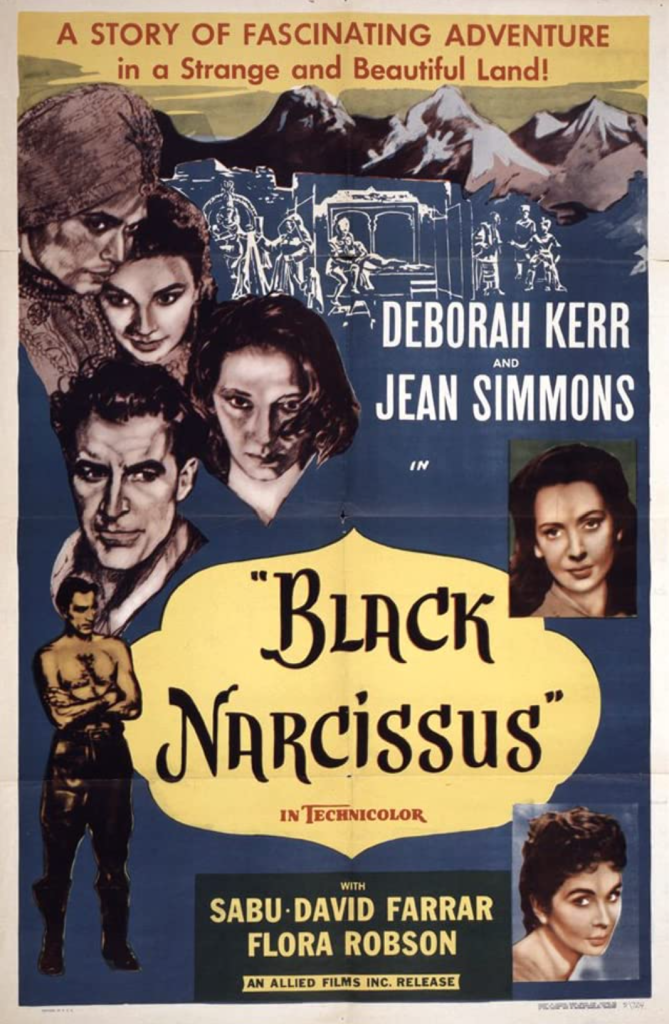
For the first Genre Grandeur of 2023, the theme is ‘Movies that take place in Cold weather situations (snow, ice, hail, etc.)’. While I could have selected a Hallmark title, I decided to pick another film instead. As I looked through my recommendations board on Pinterest, I remembered the 1947 movie, Black Narcissus. Suggested by Maddy from Maddy Loves Her Classic Films, this story takes place in the Himalayas, a mountainous region known for colder temperatures and snowy landscapes. Prior to watching Black Narcissus, I had heard this movie was controversial at the time of its release. All I knew about the film was its synopsis and the fact it premiered within the Breen Code era. Is Black Narcissus worth the trek up the mountain? Keep reading my review to find out!
Black Narcissus(1947) poster created by The Archers and General Film Distributors
Things I liked about the film:
The dialogue: In my review of When the Circus Came to Town, I mentioned how the dialogue was surprisingly profound. This was also the case in Black Narcissus, where the dialogue was sometimes profound, even thought-provoking. After Christmas Eve service, the Young General congratulates Sister Clodagh on the birth of Jesus. This statement brings up an excellent point about Christmas. When there is a new baby in a family, the family will be congratulated on their new arrival. So, congratulating Jesus’ birth makes sense, especially given the religious context of the holiday. After Sister Clodagh tells the Young General how the sisters don’t speak of God in a casual sense, Mr. Dean replies how God should be as common as bread. Even though Mr. Dean made this statement while drunk, he did make an interesting point. From the way I interpreted it, it seems like Mr. Dean thinks Christians should live their everyday lives with God present in it.
The set design and scenery: Off the top of my head, I can’t think of many movies taking place in the Himalayas. Therefore, I was excited to see this locale through a cinematic lens. The Himalayas did not disappoint, as the landscape looked so photogenic, it honestly appeared as a piece of art! One example is a shot of the mountains, where the snow caps dissolved in an ombre palette of white to light blue, transforming to a deep blue. Not only were the exterior shots appealing to the eye, the interior shots were interesting to look at as well! My favorite room in the palace was the “blue room”. In this room, the walls are covered in a mural primarily boasting hues of blue, periwinkle, and purple. Pops of green can be found on the mural, presenting the illusion the room has been submerged into the sea. Complimenting the space is a blue, circular chair with yellow, flowered stitching and a crystal chandelier.
The Young General’s wardrobe: Even though the Young General appeared in the film for a limited period of time, I absolutely loved his wardrobe! In fact, his wardrobe stole the show! My favorite outfit was the one he wore during the Christmas service. While attending the service, the Young General’s attire was white with gold details. Because winters in the Himalayas are colder, his outfit was beautifully paired with a fur coat covered in a leopard pattern and puffy white sleeves. Adding a light gold turban, the Young General’s attire was impeccably designed by Hein Heckroth!
Few introductions to Himalayan culture: In 1956’s The King and I, Anna, as well as the audience, are introduced to Siamese culture through her interactions with various characters. One notable example is Tuptim’s interpretation of Uncle Tom’s Cabin, where her perspective on the text provides an insight into her cultural background. Before watching Black Narcissus, I was hoping to learn more about the people of the Himalayas. Unfortunately, the film’s creative team didn’t take the time to show Himalayan customs, traditions, and beliefs. Yes, the Young General is interested in learning more about Christianity and there is a spiritual leader who makes a handful of appearances in the movie. But these parts of the story were not explored to a satisfying extent.
Little to no explanations: Kanchi is a seventeen-year-old young lady who arrives at the convent. Mr. Dean explains to Sister Clodagh how Kanchi is a “troublemaker” who isn’t wanted by anyone. Was Kanchi truly a “troublemaker” or is she simply misunderstood? Why does it seem like no one wants her around? Why was Kanchi given little to no dialogue in the story? Is she non-verbal or was she so traumatized by something from her past, that she chooses not to speak? This is just one example of how little to no explanations were found in the film. That creative decision didn’t allow the audience to get to know Kanchi and understand the reason behind her choices. Because of how common explanations were omitted, I was confused by the end of the movie.
Relying on a premise instead of a plot: When I reviewed When the Circus Came to Town last December, I talked about how the made-for-tv movie relied more on a premise (the story’s hook) than a plot (what keeps the audience invested in the story). Black Narcissus contains the same flaw. Prior to seeing this film, I thought the first half of the story would show the sisters’ journey up the mountain, with the story’s second half chronicling the creation of the convent. The movie completely omits the journey, going straight to the convent’s creation. For the majority of the story, the sisters are shown going through the motions of keeping their convent afloat. While the sisters’ deal with their own personal issues, there was no overarching conflict that needed to be resolved.
Objectively speaking, Black Narcissus is a competently made film. In fact, I could tell the creative team behind the project cared about what they were making. But subjectively, this is one of the most confusing movies I’ve ever seen. That is because so many parts of the story were given little to no explanations. I didn’t know the 1947 film was based on a novel until I saw the film’s opening credits, so maybe this is a case where the source material does a better job than the adaptation when it comes to explaining things? Black Narcissus is a film that emphasizes style over substance. While there was appealing scenery, set design, and costume designs, the story was missing an overarching conflict. Missed opportunities to learn more about Himalayan culture were in this story as well. With everything I said, I can’t give a strong recommendation for Black Narcissus. Instead, I would suggest checking out movies like 1956’s The King and I and The Nun’s Story.
Overall score: 6 out of 10
Have you seen Black Narcissus? Which movies featuring cold weather situations are your favorites? Please tell me in the comment section!












 18 Cinema Lane