Take 3: Saving the Titanic Review

When it comes to the Titanic, the sinking of the “unsinkable” ship and the tragedy that followed are the two most emphasized parts of the watercraft’s history. During the one hundred and thirteen years since the infamous disaster, multiple survivors (either real or fictional) have shared their stories through various forms of media. However, I have observed how the majority of these recollections have been from the perspectives of the passengers. While the passengers’ point of view is important, it seems like the media rarely captures the perspective of Titanic’s employees. This is the reason I chose to review Saving the Titanic for The Titanic In Pop Culture Blogathon. Whenever I participate in a blogathon, I will sometimes review a made-for-TV film. This decision is made because television movies are rarely included in blogging events. I also try to write about a subject that presents a blogathon’s theme in a more unique way. As I already mentioned, Saving the Titanic addresses a point of view that seems less frequent. So, without further delay, let’s begin my review of the 2012 TV production.
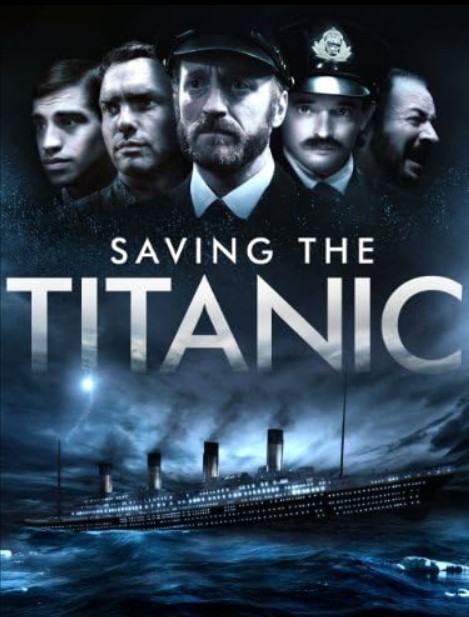
Saving the Titanic poster created by Gebrueder Beetz Filmproduktion, Tile Films, and Public Broadcasting Service (PBS)

Things I liked about the film:

How the lower budget was utilized: Made-for-TV movies have historically received lower budgets. According to IMDB, the estimated budget for Saving the Titanic was €1,600,000 (or $1.8 million). Despite the limited funds, the creative team behind the 2012 television production saw this aspect as a challenge instead of a hinderance. The story revolves around the Titanic’s electricians, engineers, and “firemen” (those who feed fire to the ship’s boilers). Because their roles take place below deck, there’s only a few locations where the employees either reside or work. This allowed the movie’s creative team to recycle sets, featuring a handful of locations in multiple scenes. Medium and close-up shots of the employees and the ship’s machinery not only encourage the audience to focus on how the Titanic operated, they also show how frugal the creative team was with the space they were given. Because of the clever ways the budget was utilized in Saving the Titanic, it was easy to forget how low the budget was.

Use of mixed media: If I had to classify Saving the Titanic, I would call it a “docudrama”. While the majority of the film is a dramatization of the events surrounding the Titanic, the movie features mixed media, which is sometimes found in documentaries. From time to time, blueprints of the Titanic would appear onscreen as a voice-over explained the significance of each featured area. Real-life photographs emphasized how actual lives were impacted by every aspect of the ship. Even the Titanic’s first distress call was typed out on screen, giving the audience an idea of what nautical communication looked like in the 1910s. The inclusion of mixed media created an enriching viewing experience. That element highlights how the Titanic is as multi-faceted as the stories surrounding it.

Learning something new: Over the years, I’ve learned a lot about the Titanic. From discovering the ship did, indeed, have a swimming pool to what the last dinner was served in first class, I thought I knew a satisfying amount of information. But by watching Saving the Titanic, I learned even more about the titular ship, partly due to the perspective of the employees. The fourth funnel on the ship was fake. However, this design choice was a blessing in disguise for one of Titanic’s crew members. A greaser named Alfred White refuses to climb to the top of the fourth funnel due to his fear of heights. Later in the movie, he is ordered by Joseph Bell to report everything happening above deck. This order helps Alfred overcome his fear and accomplish his task, as he had to climb up the same funnel he refused to climb before. Had it not been for Alfred’s part of the story, I might have never known only three of Titanic’s funnels were functional.
The Titanic In Pop Culture Blogathon banner created by Rebecca from Taking Up Room

What I didn’t like about the film:

No explanation for surviving crew members: Toward the beginning of Saving the Titanic, a small group of Titanic’s surviving crew members are at the White Star Line Office. Two of those crew members are featured throughout the film, Alfred White and Frederick Barrett. On screen text revealed the movie was “based on testimonies from surviving crew of RMS Titanic”. So, I was curious about what happened to Frederick and Alfred after they arrived in New York. Unfortunately, the film doesn’t address this information. Instead, the end of the film acknowledged the deceased crew members, such as Joseph Bell. Even though recognizing the crew members who perished is important, I wish the crew members who survived were recognized as well.

Thick accents: When I reviewed Crimes of Fashion: Killer Clutch last year, I pointed out how difficult it was to understand characters who spoke with thick French accents.  Saving the Titanic has a similar issue. A voice-over explains how the majority of Titanic’s employees came from Southampton. This means the ship’s crew members spoke to one another with English accents in varying degrees of thickness. For employees with thick accents, I, once again, found it difficult to understand what they were saying. While this wasn’t a consistent issue, it was enough for me to point it out.

Frederick Barrett’s “plot twist”: For this part of my review, I will spoil Saving the Titanic. If you have not seen this movie and are planning on watching it, skip ahead to the part of my review titled “My overall impression”.

Throughout his time on the Titanic, Frederick Barrett is very secretive about his past. When he is asked about his life before boarding the famous ship, his answers are vague. In a tense moment while the Titanic is sinking, Frederick explains to Joseph Bell how his wife cheated on him. He wanted to kill his wife and her lover, but chose to join the Titanic’s crew instead. As I mentioned earlier in this review, Saving the Titanic was “based on testimonies from surviving crew of RMS Titanic”. Therefore, the crew members featured in the film were actual people. The way the aforementioned part of Frederick’s story was presented felt like the movie’s creative team wanted to include a plot twist in a real-life story. Not only was this delivery unnecessary, I, personally, think there were better ways to write facts about Frederick’s life into the script.
Since I’m reviewing a movie about the Titanic and its history, I thought including a picture of That Fatal Night: The Titanic Diary of Dorothy Wilton was appropriate. Screenshot taken by me, Sally Silverscreen.

My overall impression:

At the beginning of Saving the Titanic, Frederick Barrett is being interviewed about the Titanic disaster. Members of White Star Line tell Frederick they want to reassure the public of White Star Line’s nautical quality by bringing up heroes who helped rescue lives on that infamous April night. But, later in the film, Frederick calls out White Star Line’s members for trying to find heroes to fit the company’s narrative. He also refers to himself as a survivor, not a hero. The story of the Titanic is wrapped in tragedy, fear, and cruel irony. So much emphasis is placed on these aspects of the Titanic’s history, it may be easy to forget there were, indeed, people boarding the ship who were heroes in someone else’s eyes. Whether they are known or not, these people guided someone toward a lifeboat, fetched a life vest for a passenger who might not have received one, or simply tried to ease a frightened crew member’s anxiety. Saving the Titanic brings up some of those names and allows their stories to be told. Like I mentioned in my review’s introduction, the 2012 television presentation addresses a point of view that seems less frequent, which is Titanic’s employees in this case. Though the movie is flawed, I am thankful a production like this exists. It not only teaches viewers about the Titanic from a different perspective, it also shares a side of the story that seems rarely covered in media.

Overall score: 7.1 out of 10

Have you seen Saving the Titanic? Are there aspects of the Titanic’s story you’d like to hear more from? Please tell me in the comment section.

Have fun at the movies.

Sally Silverscreen
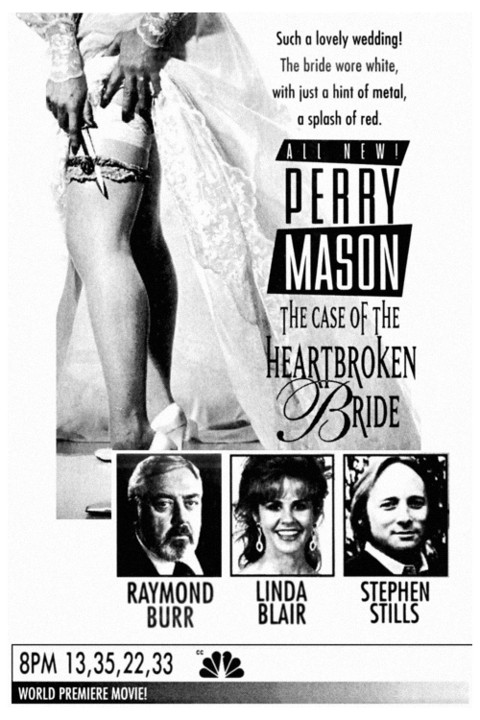
Take 3: Perry Mason: The Case of the Heartbroken Bride Review

As I looked at the blogathon schedule for the rest of 2025, I discovered how few events were announced. This includes my upcoming blogathon, The Food & Film Blogathon. Despite the limited amount of blogathons, I wanted to provide more blogathon related content to my readers. So, I have decided to participate in Genre Grandeur! I have written reviews for this year-long blogathon before. However, the last time I participated in Genre Grandeur was October 2023, when I reviewed Christmas at Castle Hart. With July’s theme being “Movies Featuring Weddings”, I knew there were a lot of options at my disposal. But I wanted to talk about a movie that was more off the beaten path. When I learned there was a Perry Mason film revolving around a wedding, I knew I found the perfect title! Some of the movies from the Perry Mason TV film series have been covered on 18 Cinema Lane. These pictures have received likable reviews, as I have enjoyed them to varying degrees. How will this film, Perry Mason: The Case of the Heartbroken Bride, compare to those other entries? Keep reading my review to solve this mystery!

Perry Mason: The Case of the Heartbroken Bride poster created by Fred Silverman Company, Viacom Productions, Dean Hargrove Productions, National Broadcasting Company, and Viacom

Things I liked about the film:

Stand-out performances: In a mystery film, there is sometimes that one actor or collection of actors whose performance shines the brightest. That kind of performance came from Merle Kennedy, Brian McNamara, and Heather McAdam in Perry Mason: The Case of the Heartbroken Bride! The film’s titular bride is a pop star named Kaitlynn Parrish. From her style to her songs and even her dance moves, everything about Kaitlynn’s celebrity persona feels very Madonna-esque. But throughout the movie and also at the wedding, Kaitlynn’s personality is quite different. Heather McAdam portrays her character as a sweet, down-to-earth woman who hasn’t let fame and fortune get to her head. Instead of becoming a self-centered “bridezilla”, Kaitlynn shows concern for her dad’s legal situation. When Kaitlynn’s dad receives a phone call from a commissioner, the smile she had on her face as she walks into the room immediately melts into a look of worry. As she talks to her dad about the commissioner’s call, Kaitlynn’s tone of voice is filled with concern and there’s even a sad look in her eyes. She also suggests asking Perry Mason for help. Kaitlynn eventually goes back to appearing happy when her dad is in a better mood. Scenes like the one I described present a good example of how, sometimes, an entertainer’s real-life persona is quite different from what they present in the spotlight.

Brian McNamara portrays Sam Wald, a groomsman in Kaitlynn Parrish’s wedding. Merle Kennedy stars in the movie as Suzy Richards, a fan of Kaitlynn’s. What both Merle and Brian have in common is how their performance was charismatic! It also helps how their ability to adapt from scene to scene was effortless! Because of how strong Brian’s and Merle’s performance was, it allowed Sam and Suzy to be more intriguing. These elements made me look forward to seeing the characters appear on screen. I honestly wish Merle and Brian were given more material to work with in this movie.

The wardrobe: The Perry Mason TV movies are “contemporary” mysteries grounded in reality. This means the characters’ wardrobe not only runs the risk of appearing mundane, it also runs the risk of becoming overlooked. In Perry Mason: The Case of the Heartbroken Bride, however, some of the female characters’ wardrobe stood out to me. One of my favorite outfits appeared toward the beginning of the film. When Suzy is first introduced in the movie, she wears a red suede jacket with matching shiny red Doc Martin boots. Her outfit also includes a white shirt, black shorts, and black knee-high socks. My favorite piece was a black, cross-body purse with a silver buckle and silver corners. From what I could see, the purse looked like a mini trunk. The outfit I described was not only a great contrast from the other characters’ wardrobe, it also wonderfully represented Suzy’s personality! These results helped outfits like Suzy’s be memorable!

The set design: When I reviewed Perry Mason Returns and Perry Mason: The Case of the Lost Love, I talked about the set design as one of the strengths of both films. The exterior and interior of the highlighted spaces effectively visualized how well-off the characters are. Kaitlynn and her fiancé, Gary’s, wedding in Perry Mason: The Case of the Heartbroken Bride takes place in a large mansion. This mansion appears built out of warm-stone brick with cream borders around the windows and main door. To the left of the mansion is a multi-paneled cylinder, making the building look like a castle. With manicured foliage in front of the mansion, one might mistake the structure as a dream out of a fairytale! Later in the film, the office of a music producer named Jake Lubin is shown on screen. This space has a high ceiling, large windows, and a massive indoor balcony. Metal support pillars and frosted glass railings give the office a modern industrial style. Platinum and gold framed records represent Jake’s success as well as compliment the cream, silver, and gold color palette. Once again, the set design of Perry Mason: The Case of the Heartbroken Bride provided visual clues for the characters’ social status.

Wedding couple with cameras image created by Freepik at freepik.com. <a href=’https://www.freepik.com/free-vector/original-cards-for-wedding-photography_913021.htm’>Designed by Freepik</a>. <a href=”https://www.freepik.com/free-photos-vectors/logo”>Logo vector created by Freepik</a>. Image found at freepik.com.

What I didn’t like about the film:

Lack of urgency: The Perry Mason television film series doesn’t rely on suspense or adrenaline. But the mysteries provide intrigue to keep the viewers invested in what’s happening on screen. The mysteries also provide characters with a sense of urgency, as they race against the clock to solve the case. However, Perry Mason: The Case of the Heartbroken Bride lacks that sense of urgency. Perry, Della, and even Ken meanderingly take their time building a legal case and questioning suspects. These characters act as if they don’t have a deadline or limited time frame to work with. This lack of urgency sometimes made the movie boring, as well as sucked the energy out of the story.

Things that don’t make sense: Ken Malansky suspects he’s being followed. Yet he doesn’t lock his car doors when he leaves his car to follow a lead at a music club. As Ken questions the music club’s owner, someone plants a recording device inside Ken’s car phone. When Ken eventually drives away from the music club, the car that was following him can clearly be seen through the front window of Ken’s car. That’s because the car following Ken was parked a few feet away from Ken’s vehicle. Decisions like Ken leaving his car doors open and ignoring the suspicious car created parts of the story that didn’t make sense.

Missed creative opportunities: My reviews for the Perry Mason TV movies have addressed the creativity each story had to offer. These creative choices helped give the movies a unique identity that was memorable. But Perry Mason: The Case of the Heartbroken Bride was a lackluster film because of the creative opportunities that were missed. Gary, Kaitlynn’s fiancé, has a sister named Hannah. After her music career failed, Hannah decided to pursue a legal career. She even tells Perry how she will soon take the bar exam. This career shift could have provided a subplot where Hannah either assists Perry in solving the case or where the script explores the concept of a celebrity taking their career in a different direction. Sadly, Hannah’s new career plan has little to no bearing over the story of Perry Mason: The Case of the Heartbroken Bride.

Courtroom image created by Macrovector at freepik.com. <a href=”https://www.freepik.com/free-photos-vectors/isometric”>Isometric vector created by macrovector – http://www.freepik.com</a>. Image found at freepik.com.

My overall impression:

As I mentioned in my review of Perry Mason: The Case of the Heartbroken Bride, some of the female characters’ wardrobe stood out to me. There were outfits I really liked, with Suzy’s aforementioned introductory attire being one of them. But similar to what I said in the past about a film’s scenery, this movie’s wardrobe couldn’t save the film. Out of the titles from the Perry Mason TV movie series I’ve seen and even reviewed, Perry Mason: The Case of the Heartbroken Bride was an under-cooked and uninspired entry. While there were stand-out acting performances, they weren’t truly given a chance to shine. That’s because the actors’ respective characters did not have consistent enough appearances in the story. The movie featured so many creative opportunities that were missed, not allowing the story to be memorable or unique. It also doesn’t help that the picture lacked a sense of urgency. With any movie series boasting over ten titles, there’s going to be at least one “bad day at the office”. Perry Mason: The Case of the Heartbroken Bride was one of those days for the fictional detective.

Overall score: 5 out of 10

Have you seen Perry Mason: The Case of the Heartbroken Bride? Are there any films from the Perry Mason television movie series you’d like to see me review? Let me know in the comment section below!

Have fun at the movies!

Sally Silverscreen

Take 3: The Dark Crystal Review + 510 Follower Thank You

For this Blog Follower Dedication Review, I wanted to write about an animated film. That’s because the last animated movie I reviewed was hoops&yoyo’s Haunted Halloween last October. As I was looking for the right title to choose, I realized I don’t often talk about animated films involving puppetry. Therefore, my Blog Follower Dedication Review will highlight 1982’s The Dark Crystal! On 18 Cinema Lane, the only projects of Jim Henson’s I’ve reviewed were 1981’s The Great Muppet Caper and 1985’s Follow That Bird. Choosing to write about The Dark Crystal has now become ironic, as all three of these movies were released in the 1980s. While I thought Follow That Bird was Sesame Street’s fine first attempt at making a movie, The Great Muppet Caper was a fun, joyful experience. Where will The Dark Crystal rank among these two pictures? Journey through this review to find out!

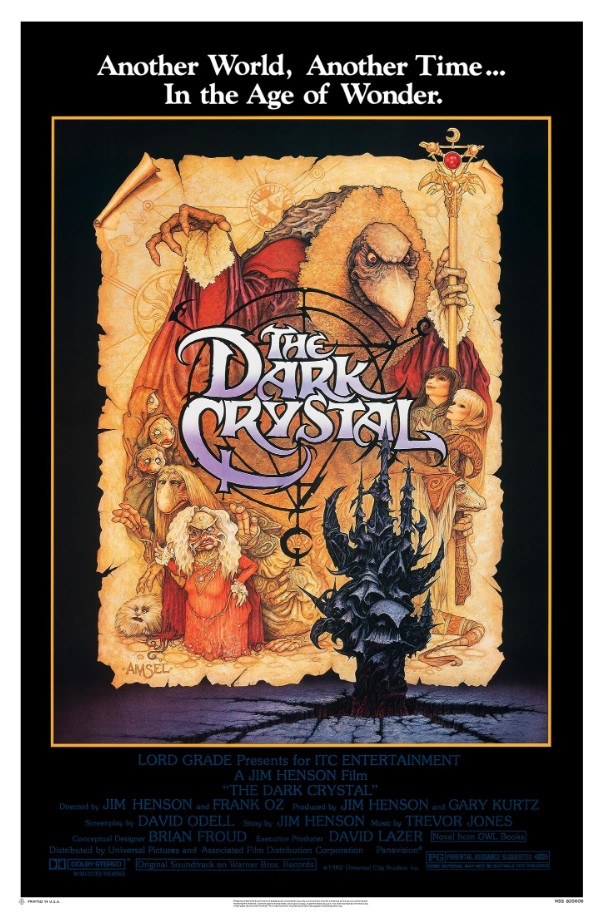
The Dark Crystal poster created by Incorporated Television Company (ITC), Henson Associates (HA), Henson Organisation, The Jim Henson Company, Associated Film Distribution (AFD), and Universal Pictures

Things I liked about the film:

The puppetry: Jim Henson has set the bar high when it comes to the art of puppetry! Through his work with The Muppets and on Sesame Street, Jim created characters that were fascinating to watch and were adoringly memorable. In The Dark Crystal, his craftmanship, direction, and artistic vision contribute to the quality his style of puppetry is known for. The way characters move provide just one example. Jen, the movie’s protagonist, goes on a quest to fulfill a prophecy by finding a crystal shard. This quest shows Jen walking, climbing, riding, and even jumping. The execution of these movements were so well-done, there were times I forgot I was watching a puppet. How Jen was able to blink and move his head was also impressive!

The scenery/set design: Films in the fantasy genre, like The Dark Crystal, have a reputation for presenting imaginative, fantastical worlds. Good movies in this particular genre will make these respective worlds immersive through an emphasis on attention to detail. I can honestly say the creative team behind The Dark Crystal truly cared about how the world surrounding the characters was showcased. An excellent example is when Kira and Jen meet for the first time. The location itself is a tropical oasis; complete with green plants, soft earth on the ground, and even a small body of water.  It feels like an actual jungle because of the realistic appearance of the materials. More often than not, the tropical space is peaceful, which gives the audience a break from the tension of the film’s conflict. The tonal and visual pairing of the jungle helps the audience stay invested in the story.

Use of practical effects: In the 21st century, CGI (computer generated imagery) has become the go-to tool of film-making. The popularity and accessibility of CGI has caused a debate over whether this film-making tool is over-used. So, watching a film like The Dark Crystal in 2025 is refreshing, as the 1982 production utilizes practical effects. In one scene, the Skeksis Emperor dies. Instead of the Skeksis Emperor simply laying unconscious, the body literally crumbles like rocks being broken down. Another scene shows Jen and Kira rowing on a lake. The foliage surrounding the lake appeared life-like, as did the body of water itself. This is because the film’s creative team incorporated actual water and other related props to make the scene feel as realistic as possible.

Colorful galaxy image created by Freepik at freepik.com. <a href=’https://www.freepik.com/free-vector/lovely-hand-drawn-galaxy-background_2943080.htm’>Designed by Freepik</a>. <a href=”https://www.freepik.com/free-photos-vectors/background”>Background vector created by Freepik</a>. Image found at freepik.com.

What I didn’t like about the film:

An underutilized character: When the Skeksis General becomes the next Emperor, he shuns the Chamberlain from the Skeksis kingdom. The Chamberlain then tries to find ways to get back into the Emperor’s good graces. Despite these attempts, the Chamberlain was underutilized in The Dark Crystal. He appeared in only a handful of scenes and his role in the film’s plot was minimal as well. I was hoping the Chamberlain’s rejection would express the ideas of standing against group mentality and changing a person’s way of thinking. Sadly, these ideas were not incorporated into the Chamberlain’s story.

Scenes that became padding: The run-time of The Dark Crystal is an hour and thirty-three minutes. However, the movie’s run-time seemed longer because some scenes became padding. One example shows a group of Skeksis eating dinner. This scene features a medium shot of each dinner guest eating their meal, making the scene feel drawn out. If The Dark Crystal’s run-time had been less than an hour and thirty-three minutes, scenes like the Skeksis’ dinner would be trimmed.

A confusing resolution: For this part of my review, I will spoil The Dark Crystal. If you haven’t seen this movie and are planning on watching it, skip to the part of my review titled ‘My overall impression’.

A voice-over at the beginning of The Dark Crystal explains how the Skeksis and Mystics were at odds with each other after the titular crystal broke. The upcoming Great Conjunction will determine who will rule the land, with Jen’s quest to find a crystal shard playing a role in this decision. The way this conflict was explained made me believe the overall story was a battle of good versus evil. But when Jen reunites the crystal shard with the titular crystal, the resolution became confusing. As the Skeksis kingdom falls apart and the Skeksis themselves are running around in fear, the Mystics arrive and surround the titular crystal. The Mystics and Skeksis then merge to become one ghost-like being. The reunion between these groups was never explained throughout the movie. Maybe a scene explaining why this particular resolution was reached was left on the cutting-room floor?

Image by Freepik

My overall impression:

When it comes to quality, the art of puppetry is a spectrum. On the higher end of this spectrum has always been the work of Jim Henson. The Dark Crystal provides a strong example for why that statement is true. The puppets’ artistry and execution were truly impressive, with their movements making me sometimes forget I was even watching puppets at all. Set design and scenery from the 1982 production looked like the film’s creative team truly cared about how the story’s world was presented. I also liked how practical effects were used, which brought a sense of realism to certain moments! Even though The Dark Crystal had its strengths, it had its flaws too. From a confusing resolution to an underutilized character, the film wasn’t perfect. But it was a fine, interesting presentation, definitely one of Jim Henson’s more ambitious projects. Before I conclude this review, I’d like to thank my blog’s followers for their support of 18 Cinema Lane! These articles always encourage me to expand my cinematic horizons!

Overall score: 7 out of 10

Have you seen The Dark Crystal? Which Jim Henson presentation would you like to see in a future Blog Follower Dedication Review? Please tell me in the comment section!

Have fun at the movies!

Sally Silverscreen
Take 3: Speak Easily Review

When I participated in the 10th Annual Buster Keaton Blogathon last year, I reviewed Buster’s episode of The Twilight Zone; “Once Upon a Time”. In that review, I stated how his episode would be a good place to start if one were introduced to the show, partly due to the story’s light-hearted nature. For this year’s event, hosted by Lea from Silent-ology, I wanted to check out one of Buster’s films. After taking a trip to his IMDB filmography, I selected the 1932 picture, Speak Easily! One of the reasons why I chose this movie for the blogathon was the story itself. According to the Internet Movie Data Base, “a timid professor inherits a large sum of money and decides to fund a terrible musical”. Another reason for choosing Speak Easily is how Buster starred in a “talking picture” (movies with sound). Because he’s known as a silent screen legend, I was curious to see how he’d perform in a film with audible dialogue. So, with all that said, let’s begin this review of the 1932 presentation!

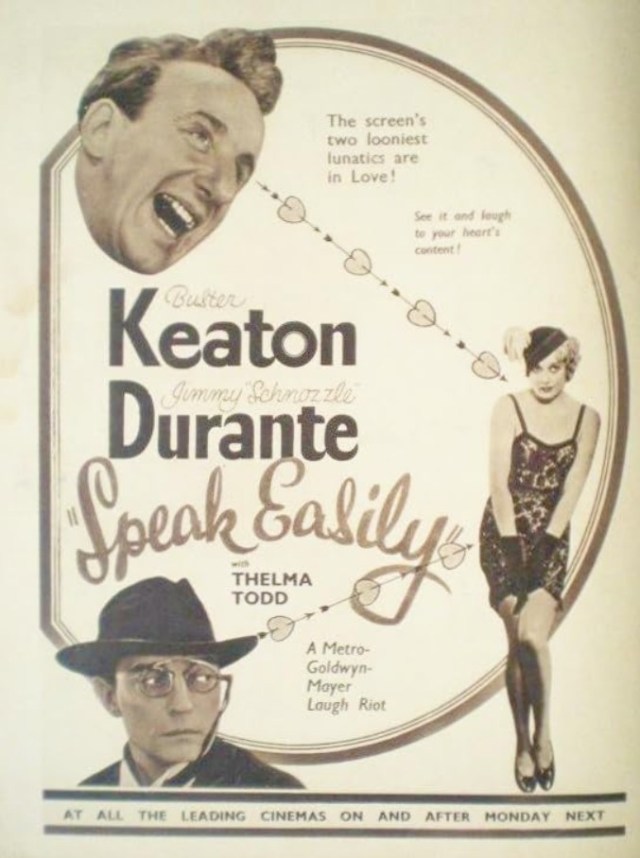
Speak Easily poster created by Metro-Goldwyn-Mayer

Things I liked about the film:

The acting: As I mentioned in the introduction, Buster Keaton is known as a silent screen legend. His forte was “slapstick” comedy, which worked in the format of silent films. With Speak Easily, Buster had to incorporate both physical movement and dialogue in order to help tell the story. Honestly, I think he did a good job with the provided material! In the 1932 production, Buster portrays Professor Post, an intelligent yet isolated man. This allowed Buster to adopt eloquent words, a sense of awkwardness, and responses that are too literal. Add his signature “slapstick” comedy for good measure and you have a character that was charming in his own right! Along the way, Professor Post becomes friends with a theater performer named James Dodge. Portrayed by Jimmy Durante, James had a big personality, brighter than all the lights of Broadway. This vibrancy was consistent throughout the movie, a strength of Jimmy’s performance! Ruth Selwyn and Thelma Todd join the cast as Pansy Peets and Eleanor Espere. Both actresses did a good job making their characters feel distinct from each other. During Speak Easily, Ruth displayed a gentle persona and was more soft spoken. Meanwhile, Eleanor adopted a flirtatious personality.

The dialogue: Prior to reviewing Speak Easily, I have seen a few of Buster’s “talking pictures”. However, his roles in these movies were smaller, meaning he was given fewer lines to work with. Though Buster received more opportunities to incorporate dialogue in Speak Easily, I was more impressed with the dialogue itself. Throughout the film, I caught on to how well-written the dialogue was. One good example can be heard toward the beginning of the film. Professor Post doesn’t go to a local event at his college because he claims he wasn’t invited. His colleague, Jenkins, thinks this is an excuse for Professor Post to stay in his comfort zone. During a visit to Professor Post’s office, Jenkins tells Professor Post, “if you only go out and find life, you’ll enjoy living it”. This line serves as a friendly yet firm reminder how life is too short to miss out on.

The messages and themes: Like I said earlier in this review, Professor Post is an intelligent yet isolated man. After he receives a large sum of money, Professor Post chooses to travel to New York and, eventually, funds a musical. As the story progresses, he tries to form connections with his peers. Eventually, Professor Post successfully finds friends by staying true to himself. The trials and triumphs of forming relationships, whether romantic or platonic, is a relatable subject. What’s also relatable is having a genuine persona/personality and doing the right thing. The incorporation of these messages and themes was one of the things I liked about Speak Easily!

The 11th Buster Keaton Blogathon banner created by Lea from Silent-ology

What I didn’t like about the film:

A drawn-out film: Speak Easily has a run-time of an hour and twenty-one minutes. However, the movie’s run-time felt longer. This is because parts of the story were drawn-out. As Professor Post boards a train, there’s a running joke about how he forgot his trunk. The joke then transforms into a couple forgetting their baby. That entire joke lasts for about four minutes. Had the joke just focused on Professor Post forgetting his trunk, maybe some of Speak Easily’s run-time could have trimmed.

An overshadowed musical: I’ve mentioned twice in this review how Professor Post funds a musical after receiving a large sum of money. This concept made me curious how Professor Post’s involvement would influence the musical. While the musical was featured in the movie, you have to wait over fifty minutes into an hour and twenty-one minute story just to see the musical come to life. Preparations for the musical were shown, but only in two scenes. The majority of the story focuses on Professor Post’s relationships with the other characters. That focus causes the musical to be over-shadowed.

Limited amount of “slapstick” comedy: I said earlier in my review how “slapstick” comedy was Buster’s forte. This part of his career has been incorporated into his “talking picture” projects, such as The Twilight Zone episode; “Once Upon a Time” and Speak Easily. But in the 1932 production, Buster’s “slapstick” comedy was used sparingly. That creative decision was the result of the film’s run-time, as Buster’s silent films were, more often than not, shorter. The limited amount of “slapstick” comedy felt like the movie was missing something. I wish Speak Easily’s creative team had capitalized on Buster’s forte a bit more.

String of musical notes image created by Freepik at freepik.com. <a href=’https://www.freepik.com/free-vector/pentagram-vector_710290.htm’>Designed by Freepik</a> <a href=”https://www.freepik.com/free-photos-vectors/background”>Background vector created by Freepik</a>. Image found at freepik.com. 

My overall impression:

In Speak Easily, Professor Post sees working on a musical as trying something new. By moving out of his comfort zone, he was able to make new friends, find success, and travel beyond the walls of his office. By starring in this film, Buster Keaton was, in a way, trying new things. This time, he had to rely on more than just physical movement and “slapstick” comedy to carry the story. Even though I liked Buster’s performance in the 1932 presentation, the project itself was, in my opinion, just ok. I was pleasantly surprised by how well-written the dialogue was! The acting, as well as the messages and themes, were Speak Easily’s other strengths. But there were aspects of the movie I didn’t like, from the drawn-out nature of the film to the musical becoming overshadowed. By reviewing this project, I found an excuse to write about a pre-Breen Code era title. Since the only pre-Breen Code era movies I’ve reviewed this year, so far, were The Garage and 1925’s Phantom of the Opera, Speak Easily will easily fill that void!

Overall score: 6-6.1 out of 10

Have you seen Speak Easily? Which “talking picture” from Buster Keaton’s filmography would you like to see me review? Let me know in the comment section!

Have fun at the movies!

Sally Silverscreen

Take 3: Jack and the Beanstalk (1952) Review

I need to make a confession: in the seven years 18 Cinema Lane has been around, I’ve never reviewed any of Abbott and Costello’s films. (insert shocked gasp here) But at 18 Cinema Lane, I am willing to expand my cinematic horizons. This is one of the reasons why I selected 1952’s Jack and the Beanstalk for the Once Upon A Time Blogathon. Another reason is how I don’t often get the opportunity to write about fantasy films. In fact, the last fantasy movie I reviewed was Cancel Christmas last December. When I came across the poster for Jack and the Beanstalk, I was surprised to read the tagline “Their first picture in color”! Abbott and Costello are household names in the world of comedy. Plus, this adaptation of the fairy tale was released thirteen years after The Wizard of Oz. So, is the movie worthy of such a historic milestone? Adventure through this review of Jack and the Beanstalk to find out!

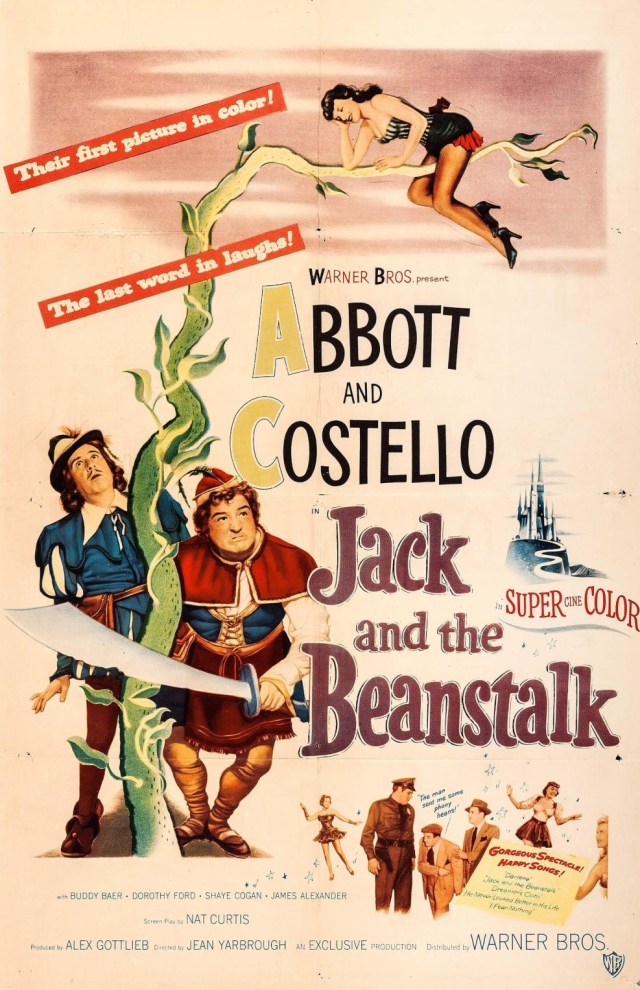
Jack and the Beanstalk (1952) poster created by Exclusive Productions Inc., Legend Films, and Warner Bros.

Things I liked about the film:

The dialogue: Sometimes, a movie’s comedy will be woven into the dialogue. Words spoken between characters can not only be hilarious, but also clever and witty, especially if the screenwriting is strong. Dialogue was one of the best qualities of Jack and the Beanstalk! One example is from the beginning of the film. Arthur arrives at Eloise’s house to pick her up for play rehearsal. Her younger brother, Donald, answers the door, even setting up a trap that causes Arthur to fall. When Arthur asks Donald where Eloise is, Donald replies in a matter-of-fact manner, “putting on her lipstick so you can kiss off”. What makes this line so memorable is how it fits the character of Donald, who is portrayed as a precocious child. Another example happens during the ‘Jack and the Beanstalk’ story. Jack is heartbroken when his mother suggests they sell the family cow. After Jack’s mother urges him to take the cow to the market, Jack tells her, “Yes mother. You can depend on me. Whatever they bid, I’ll bid higher”. This is a line that is genuinely funny, as Jack says it with good intentions.

The use of color film: During the opening credits of Jack and the Beanstalk, it’s revealed parts of the film are presented in Super Cine Color. These parts are the ‘Jack and the Beanstalk’ story itself, while the “modern” parts of the movie are shown in black-and-white film. I actually liked this creative decision! It emphasized the magic and whimsy of the fairy tale. The use of color film also allowed the vibrant hues of the costume and set design to be visible. Overall, this production of Jack and the Beanstalk felt pleasantly reminiscent of 1939’s The Wizard of Oz!

Working as a pair: Bud Abbott and Lou Costello (also known as Abbott and Costello) have been acknowledged as one of the most beloved comedic duos in film history. So, I was curious how they would work together in Jack and the Beanstalk, since the heroic adventure typically involves only one character. Lou portrays Jack and Bud portrays Mr. Dinkelpuss (a local butcher). Even though both characters travel up the titular beanstalk, they each have their own motives. Mr. Dinkelpuss and Jack help each other escape The Giant’s castle as well. Through the acting performances and the screenwriting, this version of Jack and the Beanstalk feels like Jack was always meant to travel with a buddy.

Once Upon a Time Blogathon: Fairy Tales, Legends, & Myths banner created by Annette from Hometowns to Hollywood

What I didn’t like about the film:

Musical padding: The 1952 adaptation of Jack and the Beanstalk is a musical, with five musical numbers incorporated into the production. These numbers were very well choreographed and sounded good musically. However, they felt like padding, making the movie seem longer than its one hour and twenty-three-minute run-time. A few of the musical numbers feel drawn out, such as the almost three-minute dance between Jack and Polly. Had some of these numbers been trimmed down, the overall run-time could have been under an hour and twenty minutes.

Forgotten details: Within Jack and the Beanstalk’s script, there were a few forgotten details. Jack’s cow, Henry, presents two examples. When Henry is first brought up in the movie, Jack refers to the cow as female. He even puts makeup on her to stress this fact. But before Jack says goodbye to Henry at Mr. Dinkelpuss’ shop, Jack tells the cow to “be a good boy”. Later in the movie, Jack climbs the beanstalk. One of his intentions is to rescue Henry from the clutches of The Giant. When Jack and his friends finally escape The Giant’s castle, however, Polly is the one who ends up saving Henry.

Patrick the Harp: In The Giant’s castle resides a harp named Patrick. Not only does music play every time he talks, he’s also very critical of Polly. Personally, I was not a fan of Patrick. He spoke with a thick accent, which sometimes made it difficult to understand what he was saying. His role in the story was quite minimal, offering little to the plot. If Patrick had been written out of Jack and the Beanstalk, not much would change.

Fairytale castle image created by Freepik at freepik.com. <a href=’https://www.freepik.com/free-vector/fairy-tale-castle_837803.htm’>Designed by Freepik</a>. <a href=”https://www.freepik.com/free-photos-vectors/design”>Design vector created by Freepik</a>. Image found at freepik.com.

My overall impression:

As I mentioned in the introduction of my review, Abbott and Costello are household names in the world of comedy. However, there is a reason why they achieved this honor. Using Jack and the Beanstalk to explain my point, Costello and Abbott work together as a team. Even in a fairy tale where a team dynamic doesn’t exist, they find a way, through acting and screenwriting, to create a story where they can both shine. The dialogue was one of the strongest aspects of the 1952 adaptation, as it was hilariously clever. It also helps that the dialogue was written and delivered well. Even the use of color film enhanced the whimsical charm one would expect from a fairy tale. While Jack and the Beanstalk does have its flaws, it is, indeed, a pleasant presentation! Now, if you’ll excuse me, I need to figure out who really is on first.

Overall score: 7.4 out of 10

Have you seen 1952’s Jack and the Beanstalk? What other fairy tales would you have liked to see Abott and Costello star in? Tell me in the comment below!

Have fun at the movies!

Sally Silverscreen

Take 3: A Little Romance (1979) Review

Back in 2022, I wrote a list of the top ten movies I’d love to review. One of the films on that list was 1979’s A Little Romance. Since publishing that article three years ago, I haven’t gotten around to reviewing the movie. But Gill’s (from Realweegiemidget Reviews) and Barry’s (from Cinematic Catharsis) blogathon, Adventure-A-Thon, finally gave me an opportunity to check A Little Romance out! When it comes to “adventure” in cinema, that term can have different meanings depending on who you ask. For me, an “adventure” movie is when the story’s characters go on a journey to achieve something. In the case of A Little Romance, the protagonists, Daniel and Lauren, travel to Italy to prove the legitimacy of a legend. The 1979 film is not the only picture I’ve reviewed this year involving Italian travel. I wrote about Roman Holiday back in January. In my opinion, the movie was just ok, as I wanted to like it more than I did. Was A Little Romance ok like Roman Holiday? Let’s start the adventure of this review!

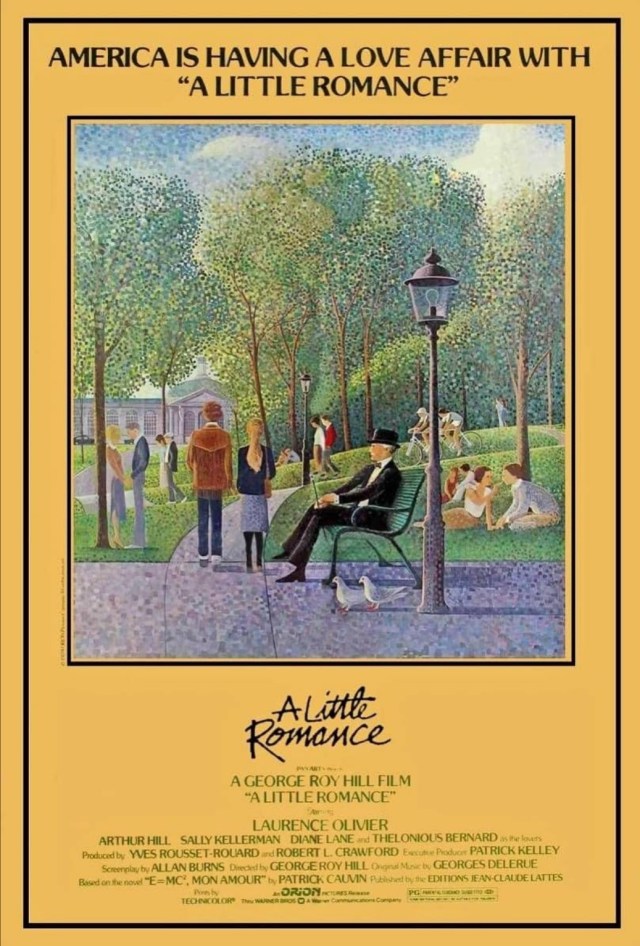
A Little Romance (1979) poster created by Orion Pictures, Pan Arts, Trinacra Films, and Warner Bros.

Things I liked about the film:

The acting: When it comes to teenagers in movies, it can be easy for a creative team to present those characters stereotypically. If written or directed to adopt certain behaviors and attitudes, teenage characters could even come across as caricatures. Fortunately, this was not the case in A Little Romance! Though there are only four teenage characters in the movie, their interactions didn’t feel scripted, making the characters themselves seem realistic. One example shows Lauren (portrayed by Diane Lane) and her friend, Natalie (portrayed by Ashby Semple), looking at sculptures during a class trip. As they observe the sculptures, Lauren nonchalantly tells tall tales about her time spent with Daniel. Natalie naively believes Lauren, her eyes becoming wide and her tone of voice revealing how shocked she is. Lauren, with a casual smile on her face and a giggle in her voice, then shares with Natalie how her tall tales were fabricated. This exchange between the two friends illustrates how teenagers can sometimes tease and joke with each other.

In this review’s introduction, I mentioned how the protagonists, Daniel and Lauren, travel to Italy to prove the legitimacy of a legend. Their journey was enjoyable to watch because of how strong Diane Lane and Thelonious Bernard’s on-screen chemistry was! Every time Lauren and Daniel interacted with one another, they always looked like they got along so well. There was a sweetness to their relationship that was wholesome and charming. It also helps how both Daniel and Lauren had likable personalities that complimented each other. While Thelonious and Diane deserve credit for their performances, credit should also be given to the screenwriting.

An appreciation for film: Before watching A Little Romance, I knew what the basic premise was about. But when I finally saw the 1979 picture, I was pleasantly surprised by the appreciation for film woven into the script! As soon as the movie starts, the audience sees Daniel watching a collection of films in a local cinema. As the story progresses, he sometimes quotes the movies he sees and even wants Lauren to call him “Boggie”, as he believes Humphrey Bogart and Lauren Bacall were meant to be together. Daniel’s decisions and perspectives are also influenced by the world of film. When Daniel receives rude comments about his relationship with Lauren from a movie director named George de Marco, Daniel punches George. Not only does Daniel strongly dislike George’s films, Daniel believes George’s comments cheapen the meaning of love he’s learned from movies.

The dialogue: In some of the movies I’ve reviewed this year, one of the strengths was the dialogue. The way it was written and delivered allowed this film-making component to be memorable for the right reasons. The dialogue was also a strength in A Little Romance! Through the screenwriting, the audience can tell how much thought was put into this aspect of the 1979 production. While Lauren talks about her family, Daniel asks her why she calls her stepfather ‘Richard’. Lauren replies by saying “It’s easier to lose a Richard than a dad”. From that one quote, Lauren is able to express how her mother’s multiple marriages have affected the family dynamic. In order to make enough money for their trip to Italy, Daniel and Lauren plan to bet on race horses. They want to figure out the betting odds to increase their chances of choosing a winning horse. When Lauren suggests using a computer to get these numbers, Daniel says “I am not a computer”. This simple quote stresses how humans, as well as betting odds, don’t always provide the correct answers.

The Adventure-A-Thon banner created by Gill from Realweegiemidget Reviews and Barry from Cinematic Catharsis

What I didn’t like about the film:

The adventure’s prolonged delay: Like I said in this introduction, Daniel and Lauren travel to Italy to prove the legitimacy of a legend. But their Italian journey doesn’t begin until a little over an hour into an hour and fifty-minute story. That’s because the first half of the movie is devoted to setting up the motives for the journey and building up to the trip itself. It’s important for any creative team to set up their movie’s premise and provide build up to significant parts of the presentation. For A Little Romance, however, that set up/build up took a little too long.

Lack of subtitles: About half of A Little Romance takes place in France. This means some scenes feature characters speaking in French to one another. But when the story presented French dialogue, subtitles did not appear on screen. For viewers who are not fluent in French, they may feel like the creative team is withholding context from them. Even though clues such as body language can help the audience assume what is happening in the story, I still wish subtitles had been included in A Little Romance.

An absence of Daniel’s father: At the beginning of A Little Romance, the audience is introduced to Daniel and his father, Michel. According to Daniel, Michel is a taxi driver who watches horse races from time to time. Throughout the movie, however, Michel’s appearances are so far and few between, I almost forgot he was in the movie. Meanwhile, Lauren’s parents, Richard and Kay, are consistently involved in the story. I recognize A Little Romance revolves around Daniel and Lauren’s relationship and adventure. But I still think Michel should have received a larger role in the film. Perhaps his involvement in the story could have related to one of the movie’s central themes.

Colorful travel suitcase image created by Pikisuperstar at freepik.com. <a href=’https://www.freepik.com/free-vector/beautiful-illustration-of-travel_2686674.htm’>Designed by Freepik</a>. <a href=”https://www.freepik.com/free-photos-vectors/watercolor”>Watercolor vector created by Pikisuperstar – Freepik.com</a>. Image found at freepik.com.

My overall impression:

When I first brought up A Little Romance in 2022, I said the story seemed like a light-hearted version of Rich Kids. While there is some truth to this statement, my initial claim now seems a bit too simplistic. Both Rich Kids and A Little Romance revolve around adolescent characters relying on themselves and each other to navigate the world around them. But unlike Rich Kids, there’s a hopeful optimism in A Little Romance! Because the story emphasizes Daniel and Lauren’s Italian journey, the audience witnesses Lauren and Daniel’s relationship grow throughout the story. The acting performances and screenwriting allow these characters to share meaningful and heart-felt moments together. Strong messages and themes are sprinkled into the script, from the importance of being your authentic self to having the courage to achieve dreams. Though it took a little over an hour for the journey to begin, A Little Romance is a delightful, pleasant film! A significant point the film makes is how adventure can come in different forms. The 1979 picture can also cause viewers to think about what it truly means to be a “legend”.

Overall score: 7.3 out of 10

Have you seen A Little Romance? What does the term “adventure movie” mean to you? Let me know in the comment section!

Have fun at the movies!

Sally Silverscreen
Take 3: Signed, Sealed, Delivered: To the Moon and Back Review

Lately, I’ve been reading books for the Eurovisionathon readathon as well as conducting research for my upcoming Sally Solves a Mystery article. But I wasn’t going to miss the opportunity to review Signed, Sealed, Delivered: To the Moon and Back! Leading up to the premiere of Hallmark’s newest presentation, I was going to write a Word on the Street story sharing my thoughts on the film’s trailer. This did not happen because Hallmark gave the movie almost nonexistent marketing. On Hallmark Channel’s website, there were no promotional photos, trailer, or official poster presented for Signed, Sealed, Delivered: To the Moon and Back. Only three images on IMDB (Internet Movie Data Base) make up any promotional campaign this film received. Even on social media, the only people I saw talking about the film were POstables (fans of the Signed, Sealed, Delivered series). Despite this minimalistic marketing approach, I was looking forward to Signed, Sealed, Delivered: To the Moon and Back. That’s because I was curious to see who would portray the rock star character and how that character would impact the mystery.

Signed, Sealed, Delivered: To the Moon and Back promotional image created by Moon Water Productions, Muse Entertainment Enterprises, and Hallmark Channel

Things I liked about the film:

Correcting the predecessor’s mistakes: When I reviewed Signed, Sealed, Delivered: A Tale of Three Letters last year, one of my criticisms was Shane and Oliver’s relationship problems. In my review, I said the couple’s woes got to the point where they didn’t seem compatible like in previous films. It looks like Signed, Sealed, Delivered‘s creative team took this criticism seriously, as Oliver and Shane appeared more compatible in Signed, Sealed, Delivered: To the Moon and Back! Throughout the movie, the couple are shown genuinely supporting and loving one another, making their moments together feel reminiscent of past installments. Even when Oliver is facing a bit of an identity crisis, Shane never gives up on her husband. She cheers Oliver on from the (figurative) sidelines and lets Oliver deal with his situation on his own terms. Because Signed, Sealed, Delivered’s creative team placed more emphasis on the loving interactions between Shane and Oliver, they fixed a mistake from the previous chapter!

A humble celebrity: In some Hallmark productions, the story will include a public figure (either a celebrity or royalty) who needs to learn humility by the end of the movie. But in Signed, Sealed, Delivered: To the Moon and Back, that celebrity was already humble. Nate Holloway is the rock star I mentioned in this review’s introduction. When the POstables turn to Nate for help with their letter-related mystery, he is reluctant to give away any information. This is because he’s protecting a close friend who chooses privacy over fame. Though he eventually shares his friend’s identity with Oliver and Shane, Nate reveals how his friend has written all his hit songs. However, Nate also shares how he sets aside money for his friend, showing acknowledgement and appreciation for his musical success. Through the screenwriting and William Wilder’s performance, Nate Holloway was such a pleasant surprise in Signed, Sealed, Delivered: To the Moon and Back!

A mystery within a mystery: The mystery of Signed, Sealed, Delivered: To the Moon and Back involves the POstables tracking down the sender of a mysterious letter. Not only do the POstables turn to Nate for help, they go on a multi-state road trip in order to solve the mystery. While the story continues, however, another mystery emerges from the initial, previously stated one. This second mystery isn’t revealed until about the film’s half-way point. I liked this creative decision of presenting a mystery within a mystery! The way Signed, Sealed, Delivered’s creative team incorporated these mysteries into their script allows the audience to stay invested in the movie, as well as maintain intrigue!

Music and stage image created by Topntp26 at freepik.com. <a href=’https://www.freepik.com/free-photo/music-sign_1179519.htm’>Designed by Topntp26</a>. <a href=”https://www.freepik.com/free-photos-vectors/vintage”>Vintage image created by Topntp26 – Freepik.com</a>. Image found at freepik.com.

What I didn’t like about the film:

Forced humor: Back in February, when I reviewed Reality Bites: A Hannah Swensen Mystery, I talked about how the film’s humor felt forced. In that review, I said Delores’ antics and gimmicks came across as too over-the-top and silly. I also said Delores’ interactions with other characters felt like they belonged in a sit-com. The creative team behind Signed, Sealed, Delivered: To the Moon and Back made this same mistake; presenting humor that feels forced. One example is when Oliver, Shane, Rita, and Norman meet up for brunch. During this gathering, the friends discuss who is having a baby. This discussion quickly turns into miscommunications about who is pregnant and how many babies they are having. The scene itself is drawn out to about a little over a minute, lasting longer than necessary. The conversation sounded very repetitive as well. Norman, Rita, Shane, and Oliver talked in an animated fashion, making their discussion feel over-the-top. What I just described sounded like a scene out of a sit-com. All it was missing was a laugh track.

Far-fetched resolutions: Hallmark’s presentations, more often than not, make their audience suspend a certain amount of disbelief. Sometimes, this suspension of disbelief can be so great, the audience can’t take that movie seriously or believably. This happened on a few occasions in Signed, Sealed, Delivered: To the Moon and Back. At the Dead Letter Office, Norman is trying to figure out the identity of the letter’s sender. A few seconds after analyzing the handwriting, Norman is able to conclude certain aspects of the sender’s identity, such as their age. While I’m aware the Signed, Sealed, Delivered series is a fictionalized version of postal detective work, I found the discovery of Norman’s resolution too far-fetched. I couldn’t take Signed, Sealed, Delivered: To the Moon and Back seriously because of moments like the one I brought up.

An emphasis on Oliver’s subplot: Signed, Sealed, Delivered: To the Moon and Back features a main plot (the mystery with its accompanying mystery that I mentioned earlier in this review) and two subplots. These subplots are the preparations for a fundraising gala and Oliver receiving a box from his biological father. The creative team behind the 2025 film decided to place the most emphasis on Oliver’s subplot. Personally, I found this subplot the least interesting part of the movie. No new information is revealed from this box, especially for viewers who have consistently followed the Signed, Sealed, Delivered series. The box itself and Oliver’s response to it have very little connection to the other plots in the script. Any time Oliver’s subplot came up in the movie, I wanted the story to go back to showing the characters either planning the gala or solving the mystery. The box did not present a strong conflict that needed to be resolved by the end of the story.

Envelope with hearts image created by Freepik at freepik.com. <a href=’https://www.freepik.com/free-photo/hearts-and-pink-envelope-for-mothers-day_1950691.htm’>Designed by Freepik</a>. <a href=”https://www.freepik.com/free-photos-vectors/love”>Love image created by Freepik</a>. Image found at freepik.com.

My overall impression:

While Shane, Rita, Oliver, and Norman discuss the mysterious letter in Signed, Sealed, Delivered: To the Moon and Back, Rita says the letter itself says so much and nothing at all at the same time. Rita’s statement is the best way I can describe this newest chapter in the Signed, Sealed, Delivered series. On the one hand, there are aspects of the film I liked. The movie improved upon some of the predecessor’s flaws, like making Oliver and Shane’s relationship seem more compatible. I also liked how Nate was a humbler celebrity and how the story contained a mystery within a mystery. On the other hand, several creative errors held the film back from becoming a stronger picture. The creative team behind Signed, Sealed, Delivered: To the Moon and Back chose to emphasize Oliver’s subplot, which I found the least interesting part of the story. Far-fetched resolutions and forced humor prevented me from taking the movie seriously. Looking back on the Signed, Sealed, Delivered films from this year and last year, I think the series should have stayed in retirement. These titles lack the cozy charm that made the series stand out from others on Hallmark Mystery. How can we expect more films from Signed, Sealed, Delivered when Hallmark provided very little marketing for this movie?

Overall score: 6 out of 10

Have you seen Signed, Sealed, Delivered: To the Moon and Back? Do you think the Signed, Sealed, Delivered series will continue? Please tell me in the comment section!

Have fun at the movies!

Sally Silverscreen

Take 3: Orca (1977) Review

When I participated in the first ‘Favorite Stars in B movies’ Blogathon two years ago, I reviewed the 1963 film, The Raven. I found Vincent Price’s picture to be a fine, likable one, which left me amazed how a simple story from Edgar Allan Poe could be turned into a feature presentation. For this year’s Third ‘Favorite Stars in B movies’ Blogathon, there were plenty of movies from Vincent Price’s filmography for me to choose from. But this time, I decided to go in a different direction. As I looked back at the history of my blog, I came to realize none of Richard Harris’ films have been covered on 18 Cinema Lane. I also remembered how the 1977 movie, Orca, was recommended to me by Eric Binford (from Diary of a Movie Maniac). With these two facts in mind, I found the perfect title to write about for the Third ‘Favorite Stars in B movies’ Blogathon! When Eric suggested Orca to me, he said the film steals from Jaws. Because I’ve seen the 1975 blockbuster, I imagined Orca to be a knock-off/rip-off of the iconic movie. But is the 1977 picture a copy of Jaws? Let’s dive into this review and find out!

Orca (1977) poster created by Famous Films (II), Dino De Laurentiis, and Paramount Pictures

Things I liked about the film:

Richard Harris’ performance: Because Richard Harris is one of the reasons why I chose to review Orca, I will now take the time to highlight his performance. In the 1977 movie, Richard portrays Captain Nolan, a fisherman who desires catching a whale in order to receive a large sum of money. His versatile acting abilities helped create a multi-layered character, one that is both tragic and complicated. After killing a pregnant whale, Nolan is very remorseful of his actions. One evening, he confides with Rachel Bedford (portrayed by Charlotte Rampling) over how he’d apologize to the dead whale’s mate. During this confession, Nolan adopts a somber look on his face, his eyes on the verge of tears. He even boasts a long frown. Nolan’s tone of voice is serious, sounding like he’s pleading for forgiveness. This one exchange presents a perfect example of Richard using his acting talents to bring his character to life!

An introduction to Orca Whales: Toward the beginning of the movie, Rachel Bedford lectures a group of students (and the film’s audience) about Orca Whales. This lecture is packed with information, from an explanation of the word ‘orca’ in Latin to showing a picture of an Orca fetus. On Captain Nolan’s boat, Annie (portrayed by Bo Derek) shares with Nolan how Orca Whales stay with their mate for life. He even receives a book from Rachel about whales in mythology. While some of the movie’s information may be dated (due to what’s been discovered about Orcas since the film’s release), it does provide an introduction to Orca Whales. Including this information into the script feels like the creative team made an effort to educate their audience.

Tonal variety in music: One of the most iconic pieces of music in film history is the theme from Jaws. John Williams’ score and the image of the titular shark sneaking up on its victims created a perfect, memorable combination. But compared to Orca, this piece of music seems to sensationalize the shark itself, as the suspenseful tune is the only music heard whenever the shark comes around. The first shot of the 1977 picture shows a group of Orcas swimming in their natural habitat. Peaceful, orchestral music plays in the background anytime whales are, simply, gliding from place to place. The only time suspenseful music is heard is when the titular Orca is causing chaos and destruction. This creative choice emphasizes how the whale has been provoked. Tones between different pieces of music show that while Orca Whales can have dangerous behavior, they can also be a great source of fascination.

The Third ‘Favorite Stars in B movies’ Blogathon banner created by Brian from Filmsfrombeyond.com

What I didn’t like about the film:

Inconsistent voice-overs: In Orca, Rachel narrates what is happening in the story. I actually liked this creative decision, especially since she was one of the most educated characters when it came to Orca Whales. What I didn’t like was how Rachel’s voice-overs were inconsistent. In fact, she only narrated about three times throughout the one hour and thirty-two-minute film. Had these voice-overs been more consistent, they could have been used as a bridge between scenes.

The underutilization of Will Sampson: Another reason why I wanted to review Orca is Will Sampson’s involvement in the project. After seeing One Flew Over the Cuckoo’s Nest and The White Buffalo, I was looking forward to watching another movie from Will’s filmography. When I finally checked out Orca, I was disappointed by how Will’s acting talents were underutilized. Not only did he appear in the film for a limited amount of time, he also received very few lines in the script. I, honestly, wish Will’s character, Jacob, had played a larger in the story, especially since he shared great insight about Orca Whales.

Limited character development: The story of Orca primarily revolves around the battle between the titular whale and Nolan. Because of this creative decision, Nolan becomes the only (human) character to receive character development. Other characters are simply known by their profession or an experienced scenario. Rachel is characterized as the scientist who is educated about Orca Whales. Annie is known as the lady who broke her leg. I understand there is only so much story to tell in one hour and thirty-two-minutes. However, I still believe a little more character development should have been included in the script.

Orca Whale image created by Freepik at freepik.com. Label vector created by freepik – www.freepik.com. Image found at freepik.com.

My overall impression:

In the introduction of my review, I said I imagined Orca to be a knock-off/rip-off of Jaws. But now I have seen the 1977 picture, calling it that does the film a disservice. I never got the impression Orca’s creative team was intentionally trying to copy the 1975 blockbuster. Instead, the film serves as a cautionary tale of how one’s actions toward animals and their natural environment have consequences. As I said in my review, including information about Orca Whales into the script feels like the creative team made an effort to educate their audience. This is different from Jaws, where (as far as I remember) education about sharks was far and few between. With that said, I wonder what would have happened if Orca had received anywhere near as much attention as Jaws? On the one hand, society’s perspective and treatment of Orca Whales may have changed much sooner. More knowledge and awareness may have already been reached before the 21st century. But, seeing how much merchandising and commercialism Jaws has produced in a fifty-year timespan, maybe Orca’s intended message would have gotten lost among the shuffle.

Overall score: 6 out of 10

Have you seen Orca? What are some of your favorite films with animals in title roles? Let me know in the comment section!

Have fun at the movies!

Sally Silverscreen

Take 3: An Old Fashioned Christmas Review (Second Chance Christmas Double Feature Part 2)

Thank you for joining me for the second part of my Second Chance Christmas Double Feature! Unlike my review of Hallmark’s Frankenstein, this review of An Old Fashioned Christmas will contain a few spoilers. If you’re curious about why I chose An Old Fashioned Christmas  for this double feature, you can check out the introduction in the link below.

Coming Soon to a Blog Near You; The Second Chance Christmas Double Feature!

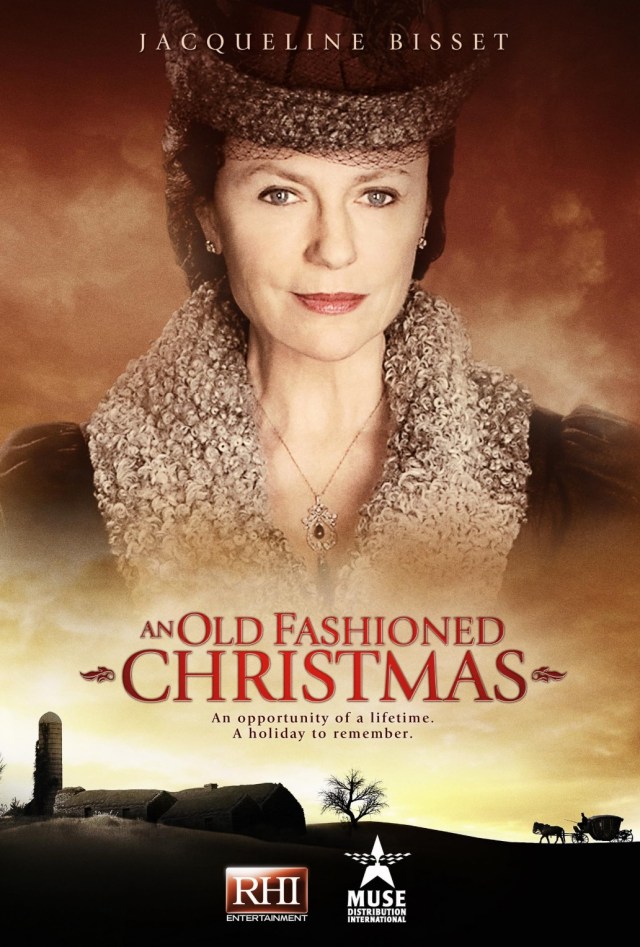
An Old Fashioned Christmas poster created by RHI Entertainment, The Government of Ireland, Parallel Film Productions, MNG Films, Muse Entertainment Enterprises, and Hallmark Channel

1. How were you introduced to An Old Fashioned Christmas and why was it selected for this double feature?

I have declared An Old Fashioned Thanksgiving as one of my favorite Hallmark movies. Years ago, when I discovered the 2008 film received a sequel, I was eager to check that movie out. But as time went on, Hallmark gave the sequel fewer airings during their Christmas line-ups, making it more difficult to watch the film. I’ve always looked for the right time to write about An Old Fashioned Christmas. I even included it on two lists; 2022’s top ten movies I’d love to review and 2023’s top ten Christmas movies I’d love to review. On both lists, I said I found a few DVD copies of the 2010 title. But, more often than not, these DVDs were included in Christmas movie box sets, which, typically, are expensive. Fortunately, An Old Fashioned Christmas was uploaded on Youtube, which is how I watched it.

2. You’ve mentioned An Old Fashioned Thanksgiving being one of your favorite Hallmark movies. Did An Old Fashioned Christmas contain any elements that made you like the 2008 film?

One of the reasons why I love An Old Fashioned Thanksgiving is how immersive the production is! The attention to detail and historical accuracy created the illusion of taking the audience to another time and place. This same strength was found in An Old Fashioned Christmas! One simple, yet effective, example were the props. Anytime Tilly and Isabella shared a meal with the Shannon family, the table was covered with fine china dishes, crystal goblet-style glasses, and even a shiny silver teapot. These specific props reflected the story’s time period, which appears to be the late 1800s. They also symbolized the prestigious family history of the Shannons.

3. Is the theme of “second chances” incorporated in An Old Fashioned Christmas’ story? If so, how?

One of the reasons why Tilly wanted to travel to Ireland was to meet her father’s side of the family. After she gets to know her paternal grandfather and uncle, Tilly writes a letter in the hopes Isabella will make amends with Sean (Tilly’s grandfather). So, in An Old Fashioned Christmas, not only is Tilly given a second chance to connect with her father’s side of the family, Isabella received a second chance to build a bridge between herself and Tilly’s grandfather.

4. Was there anything about An Old Fashioned Christmas you liked or didn’t like?

Similar to Young at Heart, the dialogue was one of the best parts of An Old Fashioned Christmas! Because of the thought and effort put into this film-making aspect, conversations between characters sounded intelligent and eloquent. During breakfast one morning, Lady Shannon asks, “Wouldn’t it be lovely for Americans to have titles”? This question relates to how her son, Cameron, will become an Earl someday. Isabella responds by saying, “Actually, we do. We all share the same title: American”. The way Isabella answered Lady Shannon’s question carried a sense of confidence and grace, simply stating a major difference between her world and the world of the Shannon family. I also thought Isabella’s response to Lady Shannon’s question was pretty clever.

Speaking of Lady Shannon’s son, Cameron, I found him to be the worst character in An Old Fashioned Christmas. He always acted like he had something to prove. Plus, Cameron attempted to get the last word in every argument or conversation. The longer I watched An Old Fashioned Christmas, the more annoying Cameron became. I recognize the film’s creative team was trying to create a male character different from Gad (Tilly’s fiancé). However, this goal can be achieved without making that male character completely unlikable.

Blue sparkly Christmas tree image created by Macrovector at freepik.com. <a href=”https://www.freepik.com/free-photos-vectors/frame”>Frame vector created by Macrovector – Freepik.com</a>. <a href=’https://www.freepik.com/free-vector/merry-christmas-card_2875396.htm’>Designed by Macrovector</a>. Image found at freepik.com.

5. On 18 Cinema Lane, you’ve covered plenty of Christmas films. How is An Old Fashioned Christmas similar to or different from other Christmas pictures written about on your blog?

As I answered for question number three, meeting her father’s side of the family was the reason Tilly wanted to travel to Ireland. Like I also answered for question number four, Isabella responded to Lady Shannon’s question by stating Americans share the same title: American. The story of an American protagonist traveling to Ireland to learn more about her father’s side of the family felt very reminiscent of Christmas at Castle Hart. Another similarity these films share is how a majority of their stories take place in an Irish castle.

6. Did you develop any thoughts and/or questions while watching this film?

What makes An Old Fashioned Thanksgiving such a great movie is how the story embraces the Thanksgiving holiday. The film boasts a Thanksgiving dinner and showcases themed decorations, like a handmade blanket. But the 2008 picture also weaves the messages and themes of the holiday into the story and dialogue, truly making An Old Fashioned Thanksgiving feel like a Thanksgiving movie. An Old Fashioned Christmas definitely looked like a Christmas movie, as decorations and themed activities were sprinkled throughout the film. However, it did not feel like a Christmas picture. That’s because the majority of the story emphasized the love triangle between Tilly, Gad, and Cameron. An Old Fashioned Christmas is a Hallmark presentation where the protagonist says they are going to do something, but spends the majority of the film not doing what they said they were going to do. One of the reasons for Tilly and Isabella’s trip to Ireland was for the Earl of Shannon to mentor Tilly in her writing, in the hopes of getting Tilly’s work published. But throughout the one hour and fifteen-minute movie, Tilly barely accomplishes any writing goals. In fact, the only writing Tilly does is composing letters to her mother.

7. How would the story of An Old Fashioned Christmas change if it revolved around another holiday?

I just mentioned for question number six how the majority of An Old Fashioned Christmas’ story emphasized the love triangle between Tilly, Gad, and Cameron. Other stories, such as the Earl of Shannon mentoring Tilly, didn’t really have anything to do with the Christmas holiday. Therefore, changing the plot of An Old Fashioned Christmas to another time of year wouldn’t make a difference.

8. Did An Old Fashioned Christmas deserve a second chance? If so, why?

Now that I have seen An Old Fashioned Christmas, this is, honestly, a tough question to answer. On the one hand, I received some closure for how the story continues after An Old Fashioned Thanksgiving. I also developed my own, honest opinion about the sequel. But, on the other hand, An Old Fashioned Christmas, kind of, let me down. The Christmas holiday almost seems like an afterthought in the 2010 title. There were underutilized aspects of the story, like Tilly pursuing her writing dreams. So, to answer this question, I’m thankful I received an opportunity to check out An Old Fashioned Christmas. However, I don’t think it was worth the wait.

9. After watching An Old Fashioned Christmas, is there anything you can take away from your movie viewing experience?

If you ignore the fact An Old Fashioned Christmas was created as a sequel to An Old Fashioned Thanksgiving, this is an ok film. The attention to detail and historical accuracy create a visually immersive experience. The dialogue was also well written and delivered. But if you intend to watch An Old Fashioned Christmas as a sequel to An Old Fashioned Thanksgiving, you will be underwhelmed. With Tilly, Gad, and Isabella as the only returning characters, the family dynamic between Tilly’s family and Isabella is absent. Like I said for questions number six and seven, the majority of An Old Fashioned Christmas’ story emphasizes the love triangle between Gad, Tilly, and Cameron. It did not help that Cameron was such an unlikable character. Honestly, this movie will likely be a one-time watch for me. Since I still love An Old Fashioned Thanksgiving, I’ll just stick with the 2008 picture.

Irish heart image created by Freepik at freepik.com. <a href=”https://www.freepik.com/free-photos-vectors/label”>Label vector created by freepik – http://www.freepik.com</a>. Image found at freepik.com.

Have fun at the movies!

Sally Silverscreen

Take 3: Young at Heart Review (Second Chance Christmas Double Feature Part 1)

Thank you for joining me for the first part of my Second Chance Christmas Double Feature! Similar to last year’s review of I Am David, my review of Young at Heart is spoiler-free. If you’re curious about why I chose Young at Heart for this double feature, you can check out the introduction in the link below.

Coming Soon to a Blog Near You; The Second Chance Christmas Double Feature!

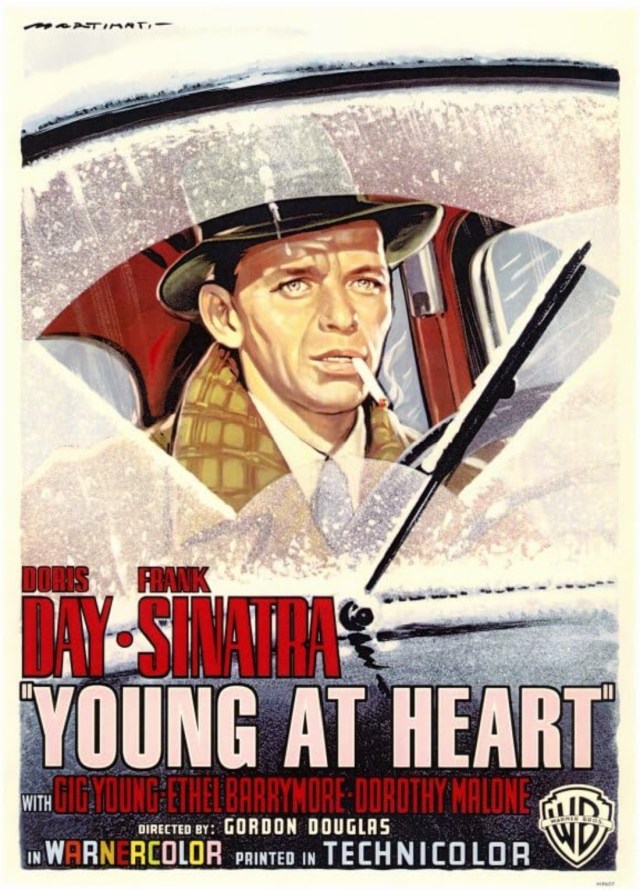
Young at Heart poster created by Arwin Productions and Warner Bros.

1. How were you introduced to Young at Heart and why was it selected for this double feature?

I was introduced to Young at Heart back in January of 2020, through a recommendation from Maddy (of the blog, Maddy Loves Her Classic Films). Several months later, I received another recommendation for Young at Heart. This time, the suggestion came from Moviecriticqueen (of the blog, Movies Meet Their Match). For five years, this movie has stayed on my movie recommendation board on Pinterest. But I have tried to find the right opportunity to write about the film. When I participated in the Sixth Annual Barrymore Trilogy Blogathon, I was originally going to review two movies; Young at Heart and Twentieth Century. Due to technical difficulties, I only had time to write about one film, which I selected the 1934 title. In 2021, I wanted to participate in the Star/Genre Of The Month Blogathon, as January’s featured star was Doris Day. But a busy schedule prevented me from joining the event.

2. You discovered Young at Heart was a Christmas movie after you learned more about the film on IMDB. What else have you discovered about the 1954 picture?

While watching Young at Heart, I discovered Alan Hale Jr. portrayed a character named Bob. Those familiar with their television history would recognize Alan from his starring role (‘Skipper’) on Gilligan’s Island. I will admit the only projects from his filmography I’ve seen are Gilligan’s Island and The North Avenue Irregulars. Even though I’m more familiar with Alan’s appearances on Gilligan’s Island, it was a pleasant surprise to see him star in a different medium!

3. Is the theme of “second chances” incorporated in Young at Heart’s story? If so, how?

Yes, specifically in Barney’s part of the story! When he’s introduced in Young at Heart, Barney (portrayed by Frank Sinatra) is a very pessimistic man. He feels no matter what he does, he will never find success. Throughout the film, one of the few people who believes in Barney is Doris Day’s character, Laurie. During their initial meeting, Laurie tells Barney how anyone can control their own fate. She also encourages him to complete one of his songs. By befriending Barney, Laurie gave him a second chance to prove how valuable he is. Without spoiling the movie, Laurie and Barney’s friendship pays off!

4. Was there anything about Young at Heart you liked or didn’t like?

One of the best aspects of Young at Heart was the dialogue! The writing and delivery were so sharp and witty, it made interactions between the characters interesting! When Barney first arrives at the Tuttle family’s house, he meets Aunt Jessie. During their conversation, Barney nonchalantly asks Aunt Jessie what kind of aunt she is. With a stern tone in her voice, Aunt Jessie promptly tells him her name came first and the curtains came later. This simple exchange between Aunt Jessie and Barney shows some of their character development, as well as the dynamic these characters share.

As I answered for question number three, Barney is a very pessimistic man who believes he can’t find success. I recognize how overcoming insecurities and doubts takes time. But, in Young at Heart, Barney spends most of the movie being pessimistic. He doesn’t change his perspective until the end of the film. This creative choice made Barney a static character. I wish his transformation had gradually taken place over the course of the story.

Adorable Christmas card image created by Rawpixel.com at freepik.com. <a href=’https://www.freepik.com/free-vector/christmas-greeting-card-vector_2824854.htm’>Designed by Rawpixel.com</a>. <a href=”https://www.freepik.com/free-photos-vectors/christmas”>Christmas vector created by Rawpixel.com – Freepik.com</a>. Image found at freepik.com.

5. On 18 Cinema Lane, you’ve covered plenty of Christmas films. How is Young at Heart similar to or different from other Christmas pictures written about on your blog?

It is true that Christmas has a place in Young at Heart. However, the story spans over the course of several months. This means only a portion of the movie is set during Christmas. So, if I had to compare Young at Heart to any of the Christmas films I’ve reviewed, it would be Meet Me in St. Louis. The 1944 movie not only takes place over a year, there is one scene set during Christmas.

6. Did you develop any thoughts and/or questions while watching this film?

As I was watching Young at Heart, I found moments of irony when it came to Barney. When Barney first meets Laurie, he talks about serving in the military during World War II. This reminded me of how Frank’s character, Clarence “Brooklyn” Doolittle, was in the Navy in Anchors Aweigh. During his conversation with Laurie, Barney says he’s never created a hit song. Throughout Frank’s career, he had several hit songs to his name. One notable example is “New York, New York”, which has become the unofficial theme song for New Year’s in Times Square. Any time Barney performed at a restaurant, the patrons didn’t pay him any attention. I’d like to think if Frank had shown up at any restaurant, most of the patrons would have stopped what they were doing to focus on Frank.

7. How would the story of Young at Heart change if it revolved around another holiday?

Like I answered for question number five, Young at Heart spans over the course of several months, with Christmas playing a role in only a portion of the movie. Therefore, I don’t think the story would change much had another holiday served as the primary focus.

8. Did Young at Heart deserve a second chance? If so, why?

I do believe Young at Heart deserved a second chance! By finally checking this movie out, it gave me an opportunity to see more projects from Frank Sinatra’s and Alan Hale Jr.’s filmography. Young at Heart also became my introduction to Doris Day’s films, as I had never seen any of her movies before 2025.

9. After watching Young at Heart, is there anything you can take away from your movie viewing experience?

Young at Heart and The Chalk Garden share one thing in common; a character-driven story that works because of the strength of the cast. But a major difference between these films is how Young at Heart’s script is more “slice of life”. There were conflicts woven into the story. However, these conflicts were either abandoned or resolved at the very end of the movie. I wish Young at Heart had put a little more emphasis on problem-solving among the characters. Another thing The Chalk Garden and Young at Heart have in common is the dialogue, as it was well-written and delivered in both films. There was, clearly, thought and effort put into this film-making component, which made interactions between characters interesting. While I found The Chalk Garden good, Young at Heart was, in my opinion, just fine. The 1954 production could be used as an introduction to Doris Day’s filmography.

Group of puppies image created by Rawpixel.com at freepik.com. <a href=”https://www.freepik.com/free-photos-vectors/background”>Background photo created by rawpixel.com – http://www.freepik.com</a>. Image found at freepik.com.

Have fun at the movies!

Sally Silverscreen