Well, here we are. The conclusion of this double feature has finally arrived! At the start of this project, my goal was to figure out which adaptation of The Secret Garden was the best one. After reading the book, I watched and analyzed three of the most well-known film versions of this story. Now that we’re at the end of this double feature, it’s time for me to evaluate my results!
I know I’m featuring the photo from the Double Feature Introduction post. But, I figured it would fit appropriately with the context of this post’s topic. Screenshot taken by me, Sally Silverscreen.In the video, “Talking Anne with an E (Spoilers)”, Rachel and Amber, who are also hosts of Hallmarkies Podcast, share their thoughts on Netflix’s adaptation of Anne of Green Gables. During this discussion, Amber was saying how the film or television adaptation of this story is “not the end all, be all of Anne”. What she meant by this was that there is much more to the source material than just the first book, Anne of Green Gables. Other stories and characters from this series are just as important as the content that is considered when it comes to adaptations. Amber’s beliefs can also be applied to my double feature. No matter how many adaptations are made, they should never be a replacement for the source material. Each adaptation has a different creative team associated with it, so the beliefs about which elements are worth including in the movie are going to vary. With that said, I think that both the 1987 Hallmark Hall of Fame presentation and the 1993 version are the best adaptations of The Secret Garden! Both of these films have their fair share of similarities and differences. But I found them to be close enough to the book where I was satisfied. As a film, however, I would prefer the one from 1993 over the Hallmark Hall of Fame movie. While the 1987 production was good, it felt a little too drawn-out. I also think that Kate Maberly did a better job at portraying Mary than Gennie James did. Since I now found the answer to a question that I’ve wanted to find for years, I can honestly say that my mission is finally accomplished.
Have fun at the movies!
Sally Silverscreen
If you want to read the other posts from this double feature, go to these links:
If you want to watch the video that I referenced in this post, type “Talking Anne with an E (Spoilers)” into Youtube’s search bar or visit the Youtube channel, Rachel’s Reviews.
Welcome to my Bonus Double Feature! Just to let you know, there will be spoilers within this post. If you want to read the introduction, here’s the link:
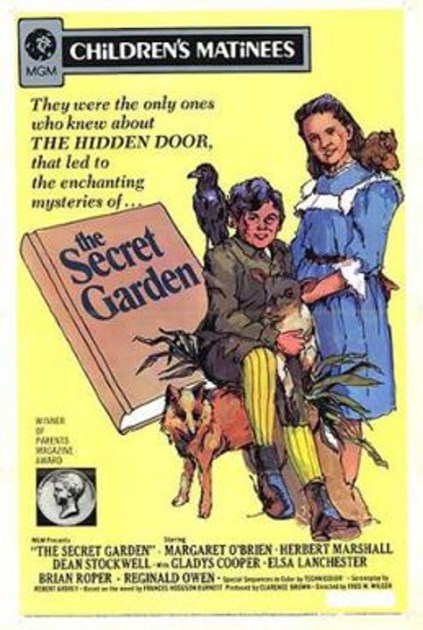
The Secret Garden poster created by Metro-Goldwyn-Mayer and Loew’s Inc. Image found at en.wikipedia.org/wiki/File:The_Secret_Garden_FilmPoster.jpeg
In what way is the adaptation like the book?
1949: There were several similarities to the book in the 1949 adaptation of The Secret Garden. One of them was the incorporation of the wind. In the book, the sounds of Colin’s cries blend with the sounds of the wind. Mary quickly picks out the cries from the wind and notices that something isn’t right. In the movie, this aspect sounded just like how it was described in the book. If one wasn’t paying attention, they would assume that the cries were a part of the wind. The other element was the path to Colin’s room. Mary, in the book, enters different rooms and passageways in order to find the source of the crying. In the movie, when Mary attempts to find out where the crying comes from, she travels through various rooms and hallways, which take her to Colin’s bedroom door. While this trip takes place in a shorter amount of time, the visuals of the different places in the house shows just how intertwined Misselthwaite Manor really is.
1987: More similarities were found in this adaptation than in the 1949 version. The one that I was pleasantly surprised by was Mary’s characteristics. Despite Gennie James’ inability to carry a British accent, she made up for this by embodying the spirit and persona of her character. Through her emotions, actions, and behavior, Gennie brought the likability and unlikability that Mary Lennox is known for. Two examples are when Mary was more upset about losing her doll over her parents and when she became friends with the robin. While we’re on the subject of this friendship, Mary forms a relationship with a robin that is also very fond of Ben Weatherstaff. By befriending the robin, in both the book and movie, Mary’s transformation from self-centered child to selfless individual begins. As for the character transformations, they were developed very well in the source material and the adaptation. Even though the movie was drawn out, it showed that the transformations of characters like Mary, Colin, and Mr. Craven happened over the course of several months. It also showed that these transformations take time and patience.
1993: Similar to the 1987 film, the characteristics of Mary are pretty close to how the character was written in the book. But in this adaptation, the characteristics of almost all the characters seemed like it reflected the book very well. In the 1993 movie, Kate Maberly’s performance was the best portrayal of Mary Lennox! Not only was she able to carry a British accent throughout the entire film, but she also did a really good job at bringing a balance of emotions to her role. During the scene where Martha accidently offends Mary, the angry emotions that Kate brought to her character reminded me of how the character would have behaved in the book. Another good example is when Dickon and Mary are in the secret garden, while they are singing “Mistress Mary Quite Contrary”. Even though she’s happy to be spending time with Dickon, she’s reminded of the painful memories when she arrived in England. Speaking of Dickon, Andrew Knott’s portrayal of this character was the best out of all three adaptations I’ve seen! He did a fantastic job pulling off a Yorkshire accent and brought a sense of likability to his role. The scene where Dickon and Mary meet for the first time is a good example of this.
As I just mentioned, Dickon and Mary sing “Mistress Mary Quite Contrary” in the 1993 movie. This song plays a small role in the book. At the beginning of the story, the song is sung to Mary in a manner of teasing. When the story goes on, she reflects on the song’s meaning and questions her outlook on life. Another aspect of the movie that reflected the book was the interior designs of Misselthwaite Manor. Mary’s and Colin’s room are a great example, as tapestry can be seen on the walls. This is an important detail to mention because tapestry was described in the novel.
Was there anything in the adaptation that was different from the book?
1949: In the 1949 adaptation, there were just as many differences from the book as there were similarities. One notable difference is how emotional Mary Lennox is. In the film, Mary bursts into tears when she finds out that her parents have died. This is not the reaction that Mary has in the book, as she wouldn’t care what happens to her parents because of her poor relationship with them. Speaking of relationships, Mary’s relationship with Ben Weatherstaff is quite different in the film. Mary, as well as Colin and Dickon, don’t like Ben. They not only keep their distance from him, but they also don’t allow him to enter their garden. In the book, however, Ben becomes the children’s ally. He provides them with plenty of information about the secret garden, such as why it’s closed off from the rest of the gardens. The children even invite him into the garden on a few occasions. Finally, how Mary and Dickon meet is also different in the movie. Mary meets Dickon before she’s even aware that a secret garden exists. In the book, Mary meets Dickon after she’s entered the secret garden. She meets him because he’s purchased some flower seeds for her.
1987: While watching this adaptation of The Secret Garden, I noticed fewer differences compared to the 1949 version. Like the 1949 film, the initial meeting of Mary and Dickon happens at a different part of the story. In this movie, Mary meets Dickon before she’s found the secret garden, yet she is aware that it exists. At the beginning and end of the movie, the audience sees that the story is told through the reflections of a grown-up Mary Lennox. Since the book only focused on Mary’s story from when she was a child, this was a creative choice that Hallmark Hall of Fame made. Unlike the book, Mary and Colin are not cousins. I’m not going to reveal the reason for this creative decision because I don’t want to spoil the movie for anyone who hasn’t seen this version. But this choice wasn’t as much of an issue as I thought it could be. Plus, it works within this particular story!
1993: Toward the beginning of the film, Mary loses her parents to an earthquake. This is different from the book, as she loses her parents to sickness. The location of the secret garden’s key is also different from the source material. In the movie, Mary finds this key in her aunt’s jewelry box instead of in the dirt. Another difference I noticed was the characteristics of Mrs. Medlock. This character, in the book, was stern but caring. Mrs. Medlock, in the movie, was much stricter. She’s not only against the idea of Mary and Colin spending time together, but she’s also mean to the other members of the staff. I’m not sure if this creative decision was made to include a conflict or to highlight the acting strengths of Maggie Smith.
Did you find anything in the movie that you felt improved upon the material more than the book?
1949: While the majority of the film is presented in black-and-white, the only scenes that were featured in color were those that took place in the garden. Frances Hodgson Burnett was very descriptive when writing about the garden. But you can only describe so much without giving someone a visual. The way the garden is presented in this adaptation helps bring the text to life.
1987: In a few parts of the film, the element of suspense was incorporated. One good example was when Mary meets Colin for the first time. The build-up to that moment was staged really well, using as little lighting as possible and featuring things like lightening and scary looking statues. Because of these elements coming together, it was better executed in the movie than in the book.
1993: During the 1993 adaptation, a transition happens between winter and spring/summer. This transition isn’t just seen through the exterior background. The cinematography and color of wardrobe are other visuals that indicate the changing seasons. An explanation of how Mary and Colin are related is included in this script. According to this adaptation, Mary’s mother was the twin sister of Colin’s mother. No explanations to how Mary and Colin are related were given in the book. All that’s known is that they’re cousins and Mr. Craven is Mary’s uncle.
This is yet another Hallmark Hall of Fame movie that I purchased. However, I bought it because I wanted to give an honest opinion for this double feature. Screenshot taken by me, Sally Silverscreen.
Is there anything from the book that improved upon the material more than the movie?
1949: In the book, the garden itself is written as if it were its own character. Because of this, the garden creates a ripple effect on the characters and their lives. In the movie, however, the garden is treated like a Macguffin. It’s not featured in the film for very long and the progression of the characters happens pretty quickly. We also don’t see the process of the garden’s revival.
1987: When I was thinking about this Hallmark Hall of Fame presentation, I found it difficult to find anything that the book did better than the movie. This is because the adaptation was pretty close to the source material. It gives people who have read the book, like myself, a reason to find it satisfying.
1993: Even though she plays a really small role in the book, Susan Sowerby, Martha and Dickon’s mom, shares her wisdom and advice throughout the story. These things have a small, but significant influence over the events of the plot. Because Susan was nowhere to be found in this film, this part of the story was eliminated from the script.
Because each adaptation was released in a different decade, do you feel that the movie itself was affected by the time period in which it was released? If so, how?
1949: MGM’s The Wizard of Oz was one of the first movies to experiment with color imaging. Since the movie was a success for the studio, they were more than willing to incorporate color imaging into their future films. The Secret Garden was released ten years after The Wizard of Oz, so it makes sense that they reserved the color imaging for the titular secret garden. What’s interesting is how little color imaging is included in the movie. It’s only seen on three occasions, after the garden has been fully revived.
1987: There’s three key things that I think had an influence on this version of The Secret Garden. The first is the 1949 movie. Because this particular film had an equal amount of similarities and differences, it encouraged the creative team behind the Hallmark Hall of Fame project to make a more faithful adaptation. The second key ingredient was the trend where content in ‘80s children’s/family-friendly entertainment was darker and “creepier”. Since Hallmark Hall of Fame’s The Secret Garden was released in 1987, it provided an alternative for those who wanted to move away from the aforementioned trend. The last thing is the concept of home entertainment and video rental stores. One of the most well-known video rental businesses, Blockbuster, opened its doors in 1985, just two years before Hallmark Hall of Fame’s adaptation was released. Since then, the idea of renting or purchasing films has played a huge role in the world of cinema. I’m not sure when Hallmark starting allowing their movies to be sold for home entertainment. But their version of The Secret Garden has been available on VHS and DVD.
1993: Two important aspects affected the creation of this specific adaptation. The first one is the previous adaptations of The Secret Garden. This particular version of the story was the first theatrical adaptation since the 1949 film. The Hallmark Hall of Fame presentation was close enough to the source material where readers would be satisfied. Taking these films into consideration, the creative team behind the 1993 movie tried to make a movie that felt cinematic and respected the source material. The second thing is the climate that existed in children’s/family-friendly entertainment in the early ‘90s. During this time, the Disney Renaissance was in the early stages. The box office was also receiving films with Don Bluth’s signature animation style. In the live-action department, films like My Girl and Beethoven were released from their respective studios. The early ‘90s provided variety to children’s/family-friendly entertainment. Since this version of The Secret Garden was released in 1993, the film contributed to the aforementioned climate.
If an adaptation of The Secret Garden were made today, how would it be different from the other adaptations?
I think that if The Secret Garden received another adaptation, that film’s creative team would probably try to have the story take place in “modern” times. If this decision were made, the simplistic nature that comes from a historical fiction narrative would be taken away. Another possible change would be the incorporation of an environmental message. This would be unnecessary because the purpose of the secret garden has nothing to do the environment. The garden is included in the story to present the idea of becoming a better person when putting the needs of others before one’s own.
What aspect from the movie or book do you think has stood the test of time?
The messages and themes within this story have been relatable and cherished for many years. As I already mentioned, one idea that can be found in both the source material and any adaptation is how putting the needs of others before one’s own can help someone become a better person. Because the protagonist of this story is a child, the narrative evokes reflection on a time when a person’s life could be care-free. It also reminds the audience of how anything is possible when we set our minds on something.
While I have seen this version of The Secret Garden before, this was my first time watching it as an adaptation. Screenshot taken by me, Sally Silverscreen.Have fun at the movies!
Back in May, my post called “A Bucky Fan’s Response to one of Looper’s Avengers: Endgame related videos” became my 200th published post! Whenever I publish a hundred posts, I coordinate a double feature where I try to answer a thought-provoking question through the viewing of two similar films. But, around the time when I published my aforementioned post, I discovered that I would soon reach the milestone of 100 published reviews. So, I postponed my Double Feature until that milestone was reached. It was achieved in July when I published my review of Christmas Camp! However, that post was published just before I embarked on an out-of-town trip. So, I postponed my Double Feature until after the trip. But August became my busiest month, as I participated in four blogathons. Because of that, the Double Feature had to be pushed back again. Now that I have set aside some time to coordinate my Double Feature, I can finally announce that it will be published this week! Since I’m celebrating two milestones, I will be writing about three films.
I am fully aware of the irony that comes with reading The Secret Garden from the Hallmark Gift Books collection before watching the Hallmark Hall of Fame adaptation. Screenshot taken by me, Sally Silverscreen.If you ask anyone what the best adaptation of The Secret Garden is, most of them will tell you that it’s the Hallmark Hall of Fame version from 1987. For years, I have heard this statement from many people on the internet. In fact, when I asked a search engine which adaptation of The Secret Garden was the best one, the Hallmark Hall of Fame version was the film that came up as the answer. But is this movie really the best adaptation? That’s what I wanted to find out for myself! The most well-known versions of The Secret Garden that I will be watching are the 1949 release, the Hallmark Hall of Fame presentation, and the 1993 project. I read The Secret Garden prior to watching these films, so I could gain a better understanding of how similar or different each adaptation is from the source material. Because I’m going to talk about three versions of the same story, I will ask myself fewer questions than I did for my Halloween Double Feature. I will also not be giving these films any score ratings because I’m judging them as adaptations. There will be no pre-movie thoughts, questions, or predictions this time because I know what the movies are about before I’ve seen them.
For The World War II Blogathon, I wanted to talk about a film that no one else had chosen. With this idea in mind, I figured that if anyone was going to review a Hallmark movie, I knew it was, highly likely, going to be me. More often than not, Hallmark Hall of Fame films have told cinematic stories surrounding World War II. Out of all the Hallmark Hall of Fame movies that would be eligible for this blogathon, In Love and War is one that I hadn’t seen. This particular film is based on a true story, using a memoir by Eric Newby as the basis for the cinematic narrative. Within the past five years, true stories are rarely found in Hallmark Hall of Fame presentations. Since this is the first Hallmark Hall of Fame movie I’ve reviewed that does feature a true story, I knew it would a treat for my readers and followers!
Yes, I purchased a copy of this film so I could write an honest review about it. Screenshot taken by me, Sally Silverscreen.Things I liked about the film:
The acting: More often than not, Hallmark Hall of Fame movies are known for having talented casts. In Love and War is no exception to this tradition! Callum Blue did a really good job portraying Eric Newby. With believability and versatility, his character was awestruck by the beauty within his surroundings, while not being fazed by reality. Callum effectively portrayed a soldier who hadn’t been too hardened by war and tragedy. I also enjoyed seeing Barbora Bobulova’s performance! She portrayed Wanda, the woman who stole Eric’s heart. Barbora had a very pleasant on-screen presence and flawlessly pulled off an Italian accent. She also used a wide range of emotions, making her character seem as realistic as possible. These are just some of the reasons why her performance was very memorable.
The scenery: The Italian countryside is the only location featured in this film. Despite that fact, the movie’s creative team used this environment to their advantage, especially when it came to story-telling. Even though war had cast a shadow on Wanda’s town, it never lost its quaint charm on screen. This picturesque setting showed that restoring peace in the world could be possible. Seeing the fields and farmlands in the film showed a different perspective of this particular country. When the Italian countryside is incorporated into cinematic stories, it seems like it is, more often than not, romanticized. It also makes it feel like this location can never be touched by the harshness of reality. In Love and War’s scenery was pretty to look at, but it also shows that no space is safe from such a catastrophic event.
The on-screen chemistry: Even though Callum and Barbora were not on screen together for very long, they did have good on-screen chemistry. Eric and Wanda’s relationship was very sweet, containing the amount of sentimentality that makes sense for a Hallmark production. Whenever they spent time together, these characters seemed to truly care about one another. Despite coming from two different backgrounds, their love for each other was able to help them find a common ground. Through communication and understanding, Eric and Wanda were able to learn about the other person as well as about themselves. Because Callum and Barbora’s acting performances were good, they were successfully able to bring these elements to their characters.
Italian countryside image created by Bill Silvermintz at freeimages.com. “FreeImages.com/Bill Silvermintz.” Photo by <a href=”/photographer/edudflog-58908″>Bill Silvermintz</a> from <a href=”https://freeimages.com/”>FreeImages</a>.
What I didn’t like about the film:
Low stakes: Throughout the film, Eric becomes a Prisoner of War and tries to escape from the clutches of the Nazis. However, all of the stakes in this movie felt low. When Eric and his team become prisoners, their situation doesn’t appear or feel harsh. Even when Eric did experience a harsh condition, the effects were temporary. The clear and present danger, which were the Nazis, appeared in the film when it was convenient for the plot. It seemed like Eric wasn’t in as much danger as the movie wanted us, the audience, to think.
An imbalance between peace and conflict: Hallmark films are known for containing a good amount of positivity and making their audience feel good about the film they’re watching. But because In Love and War largely focused on the movie’s more peaceful moments, it made the moments involving conflict seem sparse. This flaw contributes to the previous problem that I just talked about: lower stakes. It also doesn’t create a healthy balance between the two ideas. The imbalance between peace and conflict made the “war” part of In Love and War seem like a distant aspect of the story.
No action: Everyone’s story from the time of World War II is going to be different. Since the film’s story is about a member of the military who entered enemy territory, having no action in the film makes it feel like something is missing. Not only were there no battles, but there was no fighting in sight. The only scene that involved any amount of military action was when an enemy plane flew over Eric and his comrades. However, this scene ended up being very brief.
The two most common cinematic stories surrounding World War II involve the American perspective and the Holocaust. While these stories are important, it can feel like other World War II related stories get overshadowed. In Love and War takes a unique approach to this subject, focusing on the British and Italian perspectives. Through these perspectives, interesting ideas get the chance to be expressed. Some examples are standing against group mentality, relying on the kindness of strangers, and changing a person’s way of thinking. As a film about this particular time-period, I liked In Love and War for what it was. At best, this is a decent movie that has its strengths. But, as a Hallmark Hall of Fame production, it didn’t leave as big of an emotional impact as other films from this collection have. I will say that this film is a good introduction to not only Hallmark Hall of Fame, but also to Hallmark movies in general. If someone likes a particular aspect of the movie, they will be able to find other Hallmark films that share similarities.
Overall score: 7 out of 10
What are your thoughts on World War II in film? Which Hallmark Hall of Fame movie do you like? Share your thoughts in the comment section!
Dumbo (2019). Men in Black International. Poms. Dark Phoenix. These are a few examples of movies that have, recently, lost their battles in the Cinematic Colosseum. When a film underperforms or doesn’t reach expectations, people always look for reasons why this happened. It is a way of providing a sense of closure to the situation. Some say that the reason why 2019 has seen more cinematic failures than successes is because of an absence of original and innovative ideas. Others say that the creative teams behind these projects put more emphasis on politics than the story itself. Another reason that has been discussed is having too many remakes, sequels, and franchise continuations competing against each other within a short amount of time. Whatever the reason, I think we can all agree that these films probably failed because, simply, movie-goers just weren’t interested in the overall product. This seems very different from the time-period of 1934 to 1954, when the Breen era not only existed, but also thrived. During this particular stretch of time, it feels like more films were both successful and memorable for the right reasons. Take 1939, for example. Within this year alone, movie-goers were given three films that cemented their place in cinematic history; Gone with the Wind, Mr. Smith Goes to Washington, and The Wizard of Oz. The fact that these very distinct films placed in the Top 10 at that year’s box office proves that during the Breen era, there was something for everyone at the cinema. With the Breen Code absent in today’s cinematic world, an interesting media company that, I feel, has embraced Joseph I. Breen’s way of thinking is Hallmark. The more I’ve thought about the Breen Code and its impact on film, the more I see the similarities within the kinds of movies that Hallmark creates. Even though these films are featured on either television or digital services, it proves that there is hope for the Breen Code to make a comeback.
Before discovering the blog, Pure Entertainment Preservation Society, I had never known about Joseph I. Breen and the Breen Code. In fact, I had always believed that the MPAA (the Motion Picture Association of America) was the “end all, be all” when it came to judging a film’s content. It wasn’t until I watched the video, “Why You Shouldn’t Listen to the MPAA (Podcast Excerpt)” from the Youtube channel, Rachel’s Reviews, that I started to change my views about this particular rating system. In this video, Rachel and her friend, Conrado, talk about why movie-goers should form their own self-censorship than solely rely on the MPAA. When I came across Pure Entertainment Preservation Society last October, while looking for upcoming blogathons to participate in, I was introduced to who Joseph I. Breen was as well as the Breen Code itself. In preparation for this article, I read as much as I could about Joseph and his Code. Tiffany and Rebekah Brannan, the creators of Pure Entertainment Preservation Society, have done a wonderful job at educating their readers and followers about the Breen Code and advocating its return to entertainment. Their articles are very informative and interesting to read. After learning all of this information, I feel that a newer and stronger code for judging a film’s content needs to be put in place. While having the MPAA is better than having nothing at all, its rules and guidelines seem to be more on the relaxed side. In the previously mentioned video, Rachel and Conrado discuss some of the ways that a film receives a particular rating. One example is the use of blood within the film’s context. Rachel brings up the example of The Hunger Games receiving a PG-13 rating due to the absence of blood while “contestants” are dying during the event within the story. She feels that because blood isn’t shown during these moments, the film is “dehumanizing the situation”. Had The Hunger Games been created during a time when something similar to the Breen Code existed, either this film would have never seen the light of day or the “contestants” would have died off-screen.
The movies and shows from Hallmark make up a large percentage of the content on my blog. Sometimes, I review films from Hallmark Channel, Hallmark Movies & Mysteries, and Hallmark Hall of Fame. In some of my Word on the Street posts, I’ve talked about movie news related to upcoming Hallmark projects. I also conduct two re-cap series for When Calls the Heart and Chesapeake Shores. Hallmark has created a reputation as being a family-friendly company in both appearance and content. As I mentioned in the introduction, things within the Breen Code sound like the type of material that Hallmark creates and distributes on their networks. Within the Hallmark entertainment spectrum, there are three television networks that air movies; Hallmark Channel, Hallmark Movies & Mysteries, and Hallmark Drama. Each network has their own unique and consistent tone, while still maintaining the company’s created image. Hallmark Channel features films that primarily contain light-hearted, romance stories. However, the relationships featured in these movies are wholesome. In the Breen Code, it states that “pictures shall not infer that low forms of sex relationship are the accepted or common thing”. Typical Hallmark Channel films do not feature or talk about sex. The only two films that I can think of that either mention sex or imply that a couple was having sex are A Family Thanksgiving and Audrey’s Rain. Hallmark Movies & Mysteries has a darker tone than Hallmark Channel, as the majority of the network’s content is mystery related. The type of mystery that is common in these movies is the murder mystery. However, this aspect of the story is always handled in a very tasteful way. Not only is a small amount of violence shown, but a limited amount of blood is featured on-screen. The Breen Code contains a whole section about featuring murder in film. One of the points in this section says that “methods of crime should not be explicitly presented”. Sometimes, these films show how a victim is murdered. This is included to introduce the mystery and present the seriousness of the situation. Toward the end of the movie, the guilty party reveals how and why they committed the crime. But the guilty party is never “presented in such a way as to throw sympathy with the crime”. Even though Hallmark Drama has only been around for two years, it has been a network where Hallmark’s more dramatic films can be seen. These types of films are either from Hallmark Hall of Fame or from Hallmark Channel and Hallmark Movies & Mysteries that haven’t be aired in recent years. Some of these projects were created before Hallmark embraced the image they have today, even before the Hallmark Channel was introduced back in 2001. One of these films is Ellen Foster, which is a Hallmark Hall of Fame movie that was released in 1997. In this film, there is one scene where Ellen is being physically abused by her father. If this exact same movie were released by Hallmark today, that scene would never have been featured in the film. The subject of child abuse would have only been implied through the use of dialogue and subtle visual references. This suggestion would fit with the Breen Code and Hallmark’s current image, as the Code itself states that “excessive and inhuman acts of cruelty and brutality shall not be presented. This includes all detailed and protracted presentation of physical violence, torture, and abuse”. Despite this aforementioned detail, Hallmark Drama still features content that is family oriented.
The previous paragraph contains some examples of how the Breen Code can be found within Hallmark’s movies. I could provide more examples, but that would mean this article would be longer than it already is. Hallmark’s commitment to providing family friendly content to their audience shows that the Breen Code, or some form of it, can return to the entertainment world. It will most likely happen in a process of events rather than a quick succession. However, this is proof that Joseph I. Breen’s intentions still have a place in our world. In the article, “The Production Code of 1930’s Impact on America” from Pure Entertainment Preservation Society, it was said that “films are merely rated but not censored”. Since this is the case, we, the movie-goers, need to take the initiative to discover a film’s content, understand why a rating was given to a particular film, and form our own choice to view or not view a film. Until the day when Joseph I. Breen’s dream can come true again, this is the only option that movie-goers currently have.
For my two Breening Thursday suggestions, I would like to recommend Wild Oranges and The Trouble with Angels. Wild Oranges is a silent film from 1924 that I reviewed when I received 95 followers on my blog. The Trouble with Angels is one of the films that I reviewed during the Rosalind Russell blogathon earlier this month. It was released in 1966.
Have fun at the movies!
Sally Silverscreen
If you want to check out the references I mentioned in this editorial, you can type “Why You Shouldn’t Listen to the MPAA (Podcast Excerpt)” into Youtube’s search bar or visit Rachel’s Youtube channel, Rachel’s Reviews. You can also visit these links:
Hi everyone! I just want to remind you that tomorrow, May 21st, is the last day to submit your nomination for the Gold Sally Awards’ Hallmark Star of the Year. In my most recent Sunset Over Hope Valley post, I mentioned that I would be out of town during the weekend of May 19th. I’m still out of town, so my next Sunset Over Hope Valley post and the results of the Gold Sally Awards will be published later than expected.
This is it; the final division of the First Annual Gold Sally Awards! When I first introduced the Gold Sally Awards back in January, I provided a brief explanation of what the Hallmark Star of the Year is. Now that the time has come for this division to begin, a more thorough explanation is needed. What makes a Hallmark star a “Hallmark Star”? Sure, it can mean a person that appears in a Hallmark movie. But I feel it has to be something more than that. The Hallmark Star of the Year Award is an attempt to answer this question. There are so many people that make Hallmark what it is. However, some of these people don’t always get the recognition they deserve. As I’ve also mentioned, this division is the most interactive category of the Gold Sally Awards. This is true, as you get to decide who will be crowned the first ever Hallmark Star of the Year! Now I will provide more details as to how you can participate!
In this division, voters are allowed to choose one nominee per person. The people that would be eligible for this award are:
Former and current Hallmark stars
Hallmark Hall of Fame alumni
Members from the business side of Hallmark
Directors, producers, screen-writers, etc. of Hallmark projects
Authors of adapted Hallmark productions
Team members from Home & Family
Animals that have appeared in Hallmark affiliated programs (ex: kittens from the Kitten Bowl)
When deciding on who to nominate, I would kindly encourage you to choose someone who is currently living. The only reason why I suggest this is in the event that your nominee was to visit this blog, I would want them to see how their participation in the Hallmark community has made an impact on Hallmark’s audience/fans.
How do I nominate someone for the Hallmark Star of the Year Award?
It’s a very simply process! All you have to do is write a brief, but thorough explanation for why your chosen nominee is worthy of receiving this title. Here is a template for how to set up your nomination:
Name: (This is pretty self-explanatory)
Connection to Hallmark: (This is where you can say how your nominee is affiliated with Hallmark. If your nominee has worked on more than one Hallmark project, name the most recent project of theirs.)
Nomination: (This is where you get to explain why your nominee should receive the title of Hallmark Star of the Year! For advice on how to create your nomination, consider the letters in the word Star:
S – Has your nominee participated in any community service opportunities? Have they performed a selfless act that you admired?
T – Do you admire your nominee’s talent? Do you believe that your nominee’s talent gets overshadowed or receives the right amount of attention?
A – Has your nominee accomplished something great? Have they earned an achievement that you wish more people knew about?
R – Do you feel that your nominee is under-rated? Do you think that your nominee has received a good amount of recognition?)
Where do I put my vote?
Like the previous voting categories, you can place your vote in the comment section of this post.
How long will this division last?
Voting for the Hallmark Star of the Year Award will begin today, May 11th, and end on May 21st.
I can’t wait to see who you’ve nominated for the Hallmark Star of the Year Award! Happy voting!
Hello everyone! I just wanted to remind you that voting for the Best Ensemble from a Hallmark Channel movie and a Hallmark Movies & Mysteries movie ends tomorrow. The final category of the Gold Sally Awards will begin on the 11th. Happy voting!
Today is the day for the last acting division of the Gold Sally Awards to begin! In these polls, you will determine which is the Best Ensemble from a Hallmark Channel and Hallmark Movies & Mysteries film! Like with the previous polls, you are only allowed to vote once per person. But you are allowed to vote for more than one nominee. Your votes can be placed in the comment section of this post. This round of the Gold Sally Awards will conclude on May 10th. After that day, two casts will receive the title of Best Ensemble from the Gold Sally Awards!
On the weekend of April 27th, Avengers: Endgame was not the only movie that premiered. While I did give a little more priority to Marvel’s latest film, I also wanted to see the new Hallmark Hall of Fame movie, Love Takes Flight. To give both films the attention they deserve, I decided to publish my spoiler-free review of Avengers: Endgame on the 27th and my review of Love Takes Flight today. When I found out about this Hallmark Hall of Fame movie last month, I knew that this was a movie that I had to review. Last year, I reviewed both of Hallmark Hall of Fame’s movies, with those reviews being well-received. However, when I learned more about this year’s film, I started to have doubts about it. It also didn’t help that Love Takes Flight was given one of the worst marketing campaigns in Hallmark movie history. In my opinion, the film’s poster looked worse than the one for The Beach House and Love Takes Flight’s trailer looked like a haphazard and rushed tv spot. However, I still wanted to give this film a chance. Last year, I wasn’t impressed with the marketing for The Beach House. But the movie itself ended up being better than its marketing campaign. Keep reading this review if you want to find out if Love Takes Flight had a similar fate.
The acting: In Love Takes Flight, the acting was the driving force of this story! All of the acting performances felt so believable, that every character appeared as if they were real-life individuals experiencing realistic situations! Even though I had my doubts about Nikki’s incorporation in this cast, she proved me wrong by bringing the emotional versatility that is usually required for Hallmark Hall of Fame projects. In fact, she was one of the strongest actors in this film! Another actor that I was impressed with was Tom Thon. His portrayal of Walter Allen was emotionally effective, as his journey throughout this film seemed very believable. Tom’s acting talents brought some depth to his character’s narrative.
The scenery: Love Takes Flight was filmed in Savannah, Georgia, the third Hallmark Hall of Fame movie in a row to be filmed in the Peach State. The natural landscape of this location was showcased really well throughout the film. The foliage of the trees, flowers, and plants added a serene feeling to the overall atmosphere. This helped the story maintain its sincerity and thoughtfulness, as the natural surroundings brought a sense of peace when it seemed like the characters needed it the most. Walter’s property was absolutely gorgeous, its on-screen presence reminding me of architecture of past Hallmark Hall of Fame films! While the house itself was very cozy and elegant at the same time, the grounds surrounding the house are a scene stealer! The waterfront appeared so peaceful, complimenting some of the emotional moments that took place in that area. The creative team behind this movie made the right decision to choose Savannah as their filming location!
The exploration of grief: In some Hallmark movies, the protagonist or someone that the protagonist knows loses a loved one. However, because movies on Hallmark Channel are primarily light-hearted, the topic of grief is briefly touched upon. Since Hallmark Hall of Fame is historically known for addressing topics that are darker and more serious, the creative team behind this movie used this to their advantage to explore the concept of grief. In Love Takes Flight, Walter was dealing with the loss of his wife. The way this narrative was written made it feel like a story that would have been incorporated into Hallmark Hall of Fame movies from years past. The story of Walter and the protagonist’s daughter, Quinn, forming a friendship was a very thoughtful and interesting way to show how one moves forward from such a saddening situation.
The editing: While watching this movie, I noticed that some scenes felt shorter than others. When these scenes would play out, they ended a little too abruptly. As I wondered why this was happening, I realized that this had to do with the film’s editing. To solve this problem, each scene should have run their course and been at an equal length. That way, every part of the story could have had a chance to be developed.
A little too predictable: When it comes to Hallmark Channel movies, the story is inevitably going to be predictable. However, Hallmark Hall of Fame movies are meant to be separate from the typical Hallmark Channel material. In Love Takes Flight, there were a few plot elements that were more predictable than I’d hoped. Because of this, it blurred that line between Hallmark Channel and Hallmark Hall of Fame. In some of these moments, it made the movie feel like a glorified Hallmark Channel film.
Too many plots: Love Takes Flight had seven plots that played out throughout the story. While some of these plots were well explored, other plots were undeveloped. As I watched this film, I felt that at least two or three of these plots could have cut from the overall narrative. I think that this movie should have had one main plot with two or three subplots. While this main plot is played out, the subplots could be equally developed.
Despite the poor marketing campaign that was given to this movie, Love Takes Flight was a good film! Yes, there were things about the project that could have been better. But, for what it was, I found the movie to be enjoyable. Once again, Hallmark Hall of Fame has had a consistent track record, since 2017, of creating films that are good. While I would like the films to become consistently great, I realize that it’ll take time for this to happen. I have a feeling that this can come to fruition one day. But the most important thing is that Hallmark is making the right steps for this to occur. Just like last year, the next movie for Hallmark Hall of Fame wasn’t advertised during the end credit commercial after the film. But whatever that film is going to be about, I just hope that it can take the Hallmark Hall of Fame to a whole new level.
Overall score: 7.8 out of 10
Have you seen Love Takes Flight? What would you like the next Hallmark Hall of Fame movie to be about? Please let me know in the comment section!

![20190904_161300[1]](https://18cinemalane.com/wp-content/uploads/2019/09/20190904_1613001-e1567629333829.jpg?w=427&h=674)
![20190906_190444[1]](https://18cinemalane.com/wp-content/uploads/2019/09/20190906_1904441-e1567813868962.jpg?w=443)
![20190906_190452[1]](https://18cinemalane.com/wp-content/uploads/2019/09/20190906_1904521-e1567814077703.jpg?w=441&h=597)
![20190904_161300[1]](https://18cinemalane.com/wp-content/uploads/2019/09/20190904_1613001-e1567629333829.jpg?w=406&h=641)
![20190901_174811[1]](https://18cinemalane.com/wp-content/uploads/2019/09/20190901_1748111-e1567388026567.jpg?w=474&h=675)