Take 3: A Quiet Place Review + 445 Follower Thank You

This month, 18 Cinema Lane received 445 followers! Therefore, a Blog Follower Dedication Review is in order! Since October is typically known as the Halloween season, I wanted to select a film that was appropriate for this time of year. But I’m also participating in Genre Grandeur, where the theme this month is ‘Movies Directed by the Main Actor/Actress’. So, as the title of this review says, I have chosen to write about A Quiet Place! Prior to this review, I had heard of the 2018 film. Mixed results are what I have heard; either viewers have loved the movie or they thought the story’s logistics didn’t make sense. I’ve also heard A Quiet Place is a horror film that thinks outside the box. This is another reason why I chose to review this movie, as I don’t often talk about titles from the horror genre.
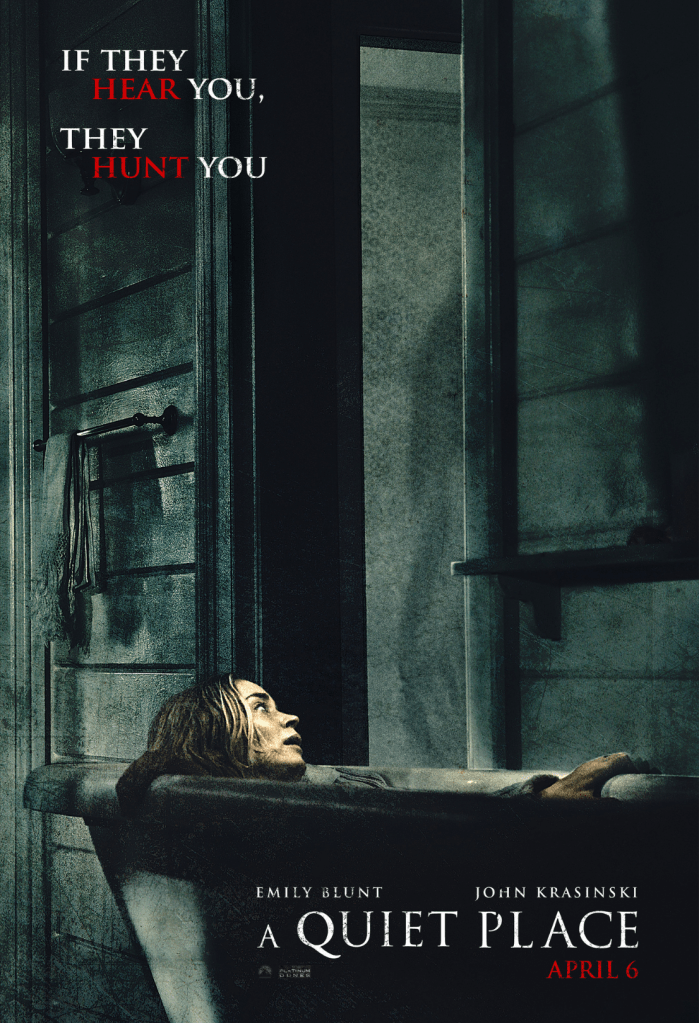
A Quiet Place poster created by Platinum Dunes, Sunday Night Productions, and Paramount Pictures

Things I liked about the film:

The family dynamic: John Krasinski and Emily Blunt are two actors I am familiar with, primarily for their comedic performances. With John, I have seen clips of The Office, while one of Emily’s most notable performances was in The Devil Wears Prada. As I’ve said before on 18 Cinema Lane, I’ve seen more comedic actors successfully transition to dramatic acting. John’s and Emily’s performance definitely stuck the landing, as they were both able to convey a variety of emotions through facial expressions and body language! Portraying John and Emily’s on-screen children were Noah Jupe, Millicent Simmonds, and Cade Woodward. Adding their strong performances, the Abbott family had a really good family dynamic that felt believable and genuine. Toward the beginning of the film, Cade’s character, Beau, really wants a toy space shuttle. However, the toy makes noise, which is a no-no within the Abbott family’s world. Through sign language and facial expressions, John’s character, Lee, explains how Beau can’t have the toy. Beau’s response was a look of pure sadness and confusion on his face. Another memorable scene was when Regan refused a new cochlear implant. Throughout the film, Lee attempts to create a functioning cochlear implant for his daughter. When he gives Regan the implant, Lee is optimistic it will work this time, wide eyes and even a smile conveying this optimism. Regan is not impressed with the new implant, as she’s frustrated at the idea of another implant not working. She not only expresses frustration on her face, she even pushes away her father’s hand.  

The atmosphere: As I mentioned in my point about the family dynamic, noise is a no-no in the Abbott family’s world. That’s because unidentified extraterrestrial creatures have taken over their environment, destroying anyone or anything that makes noise. Right in the very first scene, the audience can see how these creatures have driven people away from a small town. It looks like what most people would call a “ghost town”; cars frozen in the street and leaves slowly blowing through the air. The store where the Abbott family visits appears to be an urban explorer’s dream. Natural light from the store’s windows provides the facility’s only source of light. Products are strewn on the floor, waiting for someone to finally pick them up. Cinematography and inclusion of light help create a film that feels very atmospheric!

Use of sound: Even though the Abbott family try to create as little sound as possible, the film itself was not devoid of sound. At various moments in the story, natural sound could be heard whenever the family traveled from place to place. One notable example is when Noah’s character, Marcus, and Lee walk near a river. Sounds could also be heard through headphones or earbuds. In a scene where Lee and Emily’s character, Evelyn, are slow dancing, Evelyn puts one of her earbuds in Lee’s ear. Not only can the song be heard through the earbud, the song is amplified so the audience can hear it too. It serves as a reminder how sound, even noise, plays a role in our lives.

Sunny autumn landscape picture created by Kotkoa at freepik.com. <a href=’https://www.freepik.com/free-photo/autumn-forest_1436222.htm’>Designed by Kotkoa</a>. <a href=”https://www.freepik.com/free-photos-vectors/background”>Background image created by Kotkoa – Freepik.com</a>. Image found at freepik.com.

What I didn’t like about the film:

A film that doesn’t feel like a horror film: Like I said in my introduction, A Quiet Place is a horror film. Even the poster bears the hallmarks of a typical horror production. But, to me, A Quiet Place didn’t feel like a horror movie. Sure, there were terrifying moments in the story. But, if anything, the film felt like a dystopian/apocalyptic film with sci-fi elements. As I watched A Quiet Place, it reminded me of a more creative version of Signs.

Questions that are left unanswered: While I appreciate the film’s creative team respecting the audience’s intelligence, there were some questions I wish were answered. For instance, why did the Abbott family choose not to wear shoes? During Lee and Marcus’ hike, they cross paths with an elderly couple. Who were they and why did the elderly man want the creatures to capture him? Couldn’t the couple join the Abbott family and seek safety together?

The science’s confusing logic: As Marcus and Lee attempt to catch fish in a river, Lee explains how it’s ok to make small sounds. While big sounds are bad, they can be cancelled out with bigger sounds. With this logic in mind, why aren’t the extraterrestrial creatures congregating near the river? Why would they even bother trying to capture people, animals, and objects that make noise? Statements like Lee’s made the story somewhat confusing.
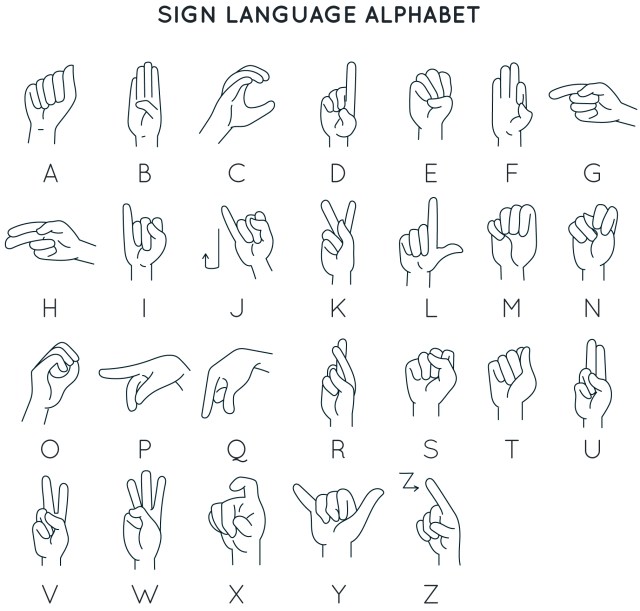
Sign language alphabet image created by Freepik at freepik.com. Hand sign vector created by freepik – www.freepik.com

My overall impression:

Before I share my overall impression of A Quiet Place, I’d like to thank all of 18 Cinema Lane’s followers! You are the reason why I continue to write and publish so many Blog Follower Dedication Reviews! Now, on to my thoughts on A Quiet Place. I will admit this is a fine, ambitious film that is one of the more unique titles of this nature. However, some aspects of the project could have been stronger. Like I said in my review of Night of the Comet, you need to explain the science in your science fiction story, especially in a way that satisfies the audience. While some of the science in A Quiet Place was explained, other parts of the story were confusing. The movie, to me, felt less like a horror movie and more like a dystopian/apocalyptic film with sci-fi elements. This makes the film’s marketing, as well as its horror classification, somewhat misleading. I am aware there is a sequel to A Quiet Place. Because I thought the movie was just fine, I’m not rushing to see the sequel anytime soon.

Overall score: 7 out of 10

Have you seen A Quiet Place? What movie do you like to watch around Halloween? Please tell me in the comment section below!

Have fun at the movies!

Sally Silverscreen
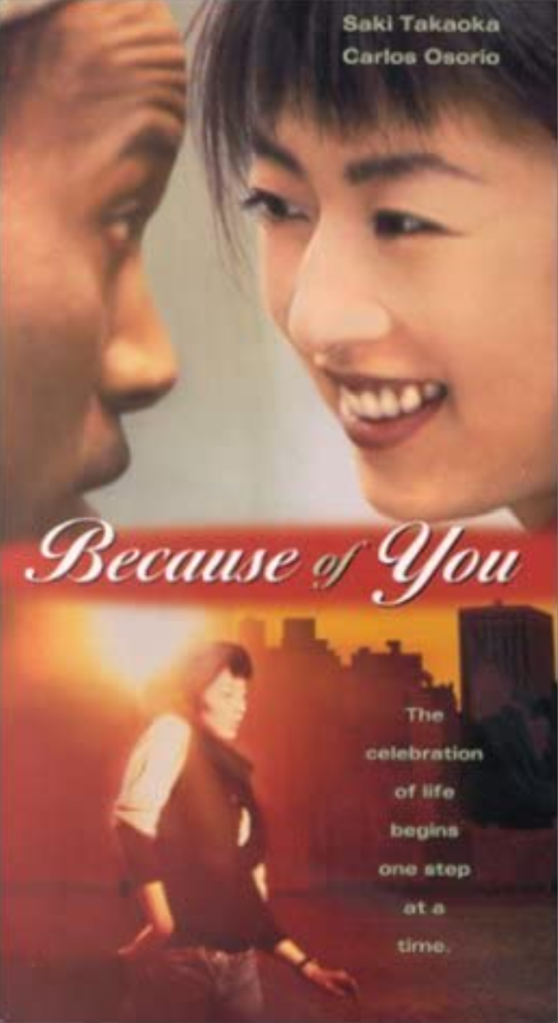
Take 3: Kyoko/Because of You Review

Kyoko/Because of You is a movie I first planned to review back in May. But as I explained in my review of The Pit and the Pendulum, my DVD copy of Kyoko/Because of You didn’t arrive in time for the blogathon I was participating in. Thanks to this month’s Genre Grandeur, I now have an excuse to finally check this movie out! ‘New York Films That Take Place Prior to 9/11’ was selected for September’s Genre Grandeur theme. Not only was Kyoko/Because of You released in 1996, the protagonist takes a trip to New York. When I first came across this movie on IMDB, the synopsis immediately caught my attention. It sounded heartfelt, almost like a Hallmark Hall of Fame production. Since this movie is a lesser-known title, it gave me a chance to try to find a hidden gem!

Kyoko/Because of You poster created by Concorde-New Horizons

Things I liked about the film:

The acting: I’m not familiar with Saki Takaoka’s filmography. Despite this, I thought her portrayal of the titular character was pleasant to watch! From scene to scene, Saki displayed genuine emotion. One great example is when Jose is telling her about a lampshade his mom loved. When the scene begins, Kyoko has a smile on her face, happy to be spending time with her mentor. But as Jose is sharing his story, Kyoko’s face slowly falls, highlighting just how sad his story is. At the end of Jose’s story, Kyoko smiles again and tells him she’ll help find this lampshade, making her response bittersweet.

Kyoko’s mentor, Jose, is portrayed by Carlos Osorio. For the majority of the film, Jose is dealing with the effects of not only AIDS, but also Dementia. Despite these struggles, the humanity of this character shown through, thanks to Carlos’ acting talents. Before Kyoko leaves to purchase a souvenir, Jose asks to keep the van door open, as he wants to feel the breeze. Jose’s face has a wistful look about it, like he is reminiscing on simpler times. When Kyoko returns, Jose is angry at a young man named Angel. He not only yells at Angel, Jose also uses his cane to protect himself.

While in New York, Kyoko meets a limousine driver named Ralph. Portrayed by Scott Whitehurst, Ralph was one of the best characters in this movie! He was so charismatic and such a good friend to Kyoko. During their first interaction, Ralph encourages Kyoko to take a ride in his limousine. Using charm to his advantage, Ralph’s encouragement sounded more like a sales pitch. Despite this, the pleasant demeanor and friendliness of Scott’s body language and facial expressions indicated his good intentions.

Various sides of New York: In any movie taking place in a well-known, beloved location, there are two angles a creative team can take their project: glamourize and glorify it or show the not-so-pretty sides of that location. When it came to New York in Kyoko/Because of You, the presentation of New York seemed balanced. Yes, there is a shot of Radio City Music Hall. But well-known landmarks were not the only places featured in this part of the story. While looking for Jose, Kyoko visits a dance studio and a local bar. While the dance studio visit was brief, the local bar is where Kyoko shows off her dance skills. Since New York is such a large city, it hosts a landscape of multiple restaurants and cultural hubs. The film shows how various communities can make their home in the Big Apple.

The soundtrack: Throughout the film, Latin tunes can be heard in the background. While the tunes themselves were pleasant, I liked how they contained a strong connection to the story. Jose is from Cuba, sharing through a voice-over how dancing plays a huge role in his culture. Both Jose and Kyoko are Latin dancers, with the music emphasizing their shared interest. What’s also good about the music is its consistency, as Latin music was the principal sound for this movie.

New York City skyline with letters image created by Freepik at freepik.com. <a href=’https://www.freepik.com/free-vector/new-york-skyline-typographic-silhouette_719554.htm’>Designed by Freepik</a>. <a href=”https://www.freepik.com/free-photos-vectors/background”>Background vector created by Freepik</a>. Image found at freepik.com.

What I didn’t like about the film:

Dancing has a limited presence: In the synopsis for Kyoko/Because of You, it states Jose taught Kyoko to dance when she was younger. With that in mind, I was expecting dance to be one of the film’s key themes. Sadly, there wasn’t much dancing within the story. In this hour and twenty-five-minute movie, there were two dance solos and three duets. Even though this film wasn’t a musical, I still found this disappointing.

The bait-and-switch: Because Kyoko travels to New York and because the New York City skyline is featured on the film’s poster, I assumed the majority of the story would take place in New York City. Even though the Big Apple is featured in the movie, only about a third of the film is set there. The rest of the movie becomes a road trip story, with some shots of a moving vehicle used as padding. Since I watched this film partly because of its New York City backdrop, this was somewhat misleading.

Drawn out scenes: As I just mentioned, some shots of a moving vehicle were used as padding. They were also used to satisfy the film’s run-time. One example is when Kyoko is driving out of New York. In this shot, she is driving her vehicle on a bridge, which lasts for about thirty seconds. Scenes like that one should have been cut shorter, giving more time to the plot.

Image of ballerina preparing to dance created by Pressfoto at freepik.com. <a href=”https://www.freepik.com/free-photos-vectors/people”>People photo created by pressfoto – http://www.freepik.com</a>. Image found at freepik.com.

My overall impression:

The story of someone reconnecting with their mentor could be heartwarming. While that potential was there for Kyoko/Because of You, it didn’t contain as much heart as I expected. The majority of this story focused on the road trip instead of the bond between Kyoko and Jose. Yes, I know Jose was experiencing Dementia. But it seems like the road trip, from a story-telling perspective, tried to make up for Jose’s disintegrating memory. The acting performances were nice to watch. I also enjoyed the dance routines. However, I wish dance had been a key theme in this movie. New York is such a diverse landscape, especially when it comes to dancing. Therefore, this felt, to me, like a missed opportunity. I’m glad I finally got a chance to review Kyoko/Because of You. But it’s not the hidden gem I thought it could be.

Overall score: 6.1 out of 10

Have you seen Kyoko/Because of You? Which ‘dance films’ do you like? Tell me in the comment section!

Have fun at the movies!

Sally Silverscreen

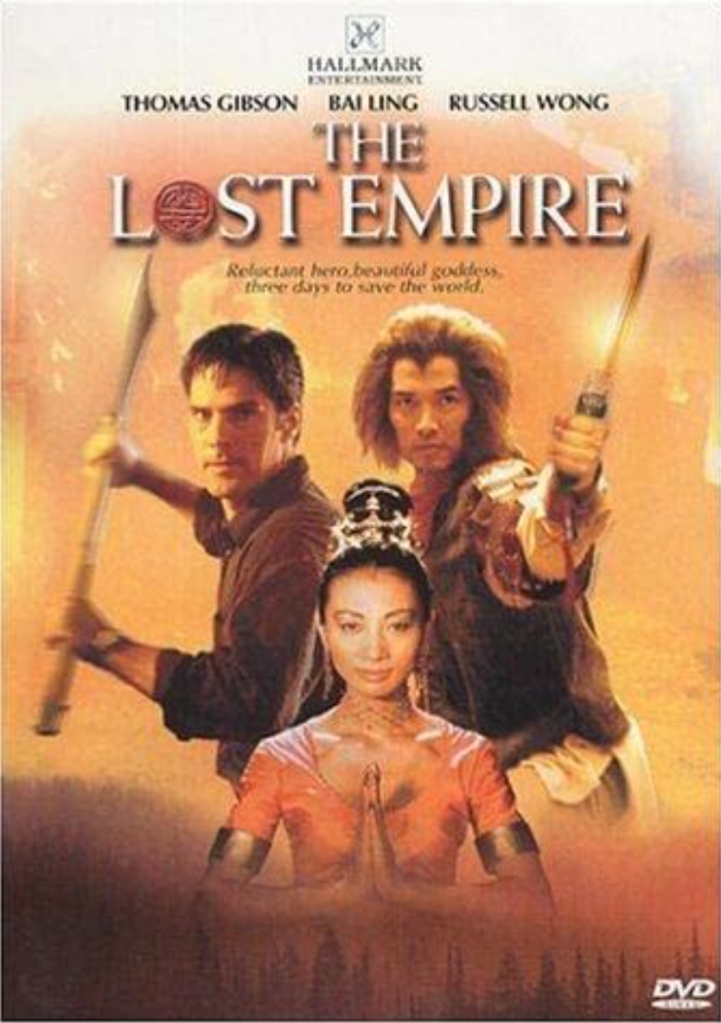
Take 3: The Lost Empire/The Monkey King Review

Last month, I wrote a list of movies I’d love to review someday. One of those films was The Lost Empire/The Monkey King. Originally, I was going to review the 2001 picture for Bai Ling’s birthday, as it is in October. But because July’s theme for Genre Grandeur is ‘Fantasy Movies of the 21st Century’, I found a reason to see this movie three months early! In my aforementioned list, I said the story of The Lost Empire/The Monkey King is based on Chinese folklore. This is very different from the types of films Hallmark creates today, which seem to, mostly, be recycled, predictable material. In fact, the only new Hallmark movies I’ve seen this year, so far, are Cut, Color, Murder, Aurora Teagarden Mysteries: Haunted by Murder, and Curious Caterer: Dying for Chocolate. The Lost Empire/The Monkey King was created during a time when Hallmark wasn’t afraid to take creative risks. But did those risks lead to cinematic rewards? Let’s journey through this review as we find that answer together!

The Lost Empire/The Monkey King poster created by Hallmark Entertainment, RTL, Babelsberg International Film Produktion, Milk & Honey Pictures, National Broadcasting Company (NBC), and Hallmark Home Entertainment

Things I liked about the film:

The acting: When I reviewed Point of Origin last month, I was disappointed by Bai Ling’s limited presence in that film. To me, it seemed like her talents were underutilized. In The Lost Empire/The Monkey King, however, Bai was given more acting material to work with. This allowed her talents to be satisfyingly showcased! I’ve said in the past how Bai Ling has a strong sense of emotionality when it comes to her acting abilities. This was not only incorporated into her portrayal of Kwan Ying, but her on-screen performance was also fluid. A great example is when Kwan and Nicholas “Nick” Orton interact for the first time. While sharing drinks at a local restaurant, Kwan’s demeanor is giggly and somewhat flirty, reflecting her drunken state. She holds hands with Nick as she casually leans across the table. But as soon as Nick asks Kwan why she needed to see him, her mood changes without missing a beat. Kwan becomes very serious, as she sits up in her seat and even looks over her shoulder. This change in Kwan’s demeanor also indicates what’s to follow in the story.

Years ago, I read American Born Chinese by Gene Luen Yang. From what I remember, the Monkey King was portrayed as an older, wiser character who younger characters looked up to. Russell Wong’s portrayal of the Monkey King was much different from what I expected. However, it was enjoyable to watch in The Lost Empire/The Monkey King! The Monkey King in the 2001 film was a humorous character. Russell’s dryer sense of humor and one liners worked in the story’s favor, as it provided a break from the tenser moments in the movie. The humor itself also fit within that movie’s world. When Nick first meets the Monkey King, he is taken aback by his change of scenery. The Monkey King uses that interaction to explain what is happening. Nick asks the Monkey King when the book, The Journey to the West will be destroyed. The Monkey King casually responded by saying, “Midnight. Next Thursday”. What also worked in Russell’s favor was his comedic timing. All of the Monkey King’s humorous moments were delivered at the right place and time. This was not only the result of the screenwriting, but the strength of Russell Wong’s acting abilities as well!

One of the most relatable stories is the “fish out of water” story. In order for this story to work in film, you need an actor or actress who can believably sell this idea to the audience. Thomas Gibson in his portrayal of Nick did just that! The way Thomas expressed emotion appeared more realistic, adding to the believability of his performance. Thomas’ ability to adapt to each situation was strong, allowing the audience to witness Nick grow over the course of the movie. The Lost Empire/The Monkey King is not only a “fish out of water” story, but also a “hero’s journey” story. That means the protagonist makes a significant change in his or her life. Throughout the film, Nick makes a personal transformation, gaining confidence as he encounters each obstacle. The way Nick reacts to these changes adds a sense of relatability to the character.

The set design: Immersive and imaginative worlds are a staple within the fantasy genre. The quality of a project’s set design can successfully present that illusion to the audience. I loved the set design in The Lost Empire/The Monkey King because it was able to pull the aforementioned illusion off! Nick is on a business trip to China. Some scenes showcased a typical Chinese city, with smaller details emphasizing the realism of this location. String lights and red lanterns can be seen overhead, which brings a softer glow in the middle of the evening. Vending booths line the streets, elaborating a greater number in population as extras and background characters walk by. Banners and signs in Chinese indicate how that specific part of the city is popular for business.

As the story progresses, more fantastical worlds are shown on-screen. One of these worlds is Jade City. Massive structures boast an ancient Chinese architecture. The ground beneath the characters’ feet displays a pale green hue, subtly reminding the audience of the city’s name. Bright pink flowered trees nicely contrasted the buildings and landscape, bringing a pop of color to the city. Nearby lanterns and window screens are smaller details that show the craftmanship that went into the film’s set design!

The discussion of literature: The main conflict in The Lost Empire/The Monkey King was the fate of the original copy of The Journey to the West. The villains want the book destroyed, while Nick and his friends are trying to save it. This main conflict led to a discussion of censorship versus preservation. The way the discussion is brought up, verbally and visually, was interesting. What was also interesting was the author of The Journey to the West, Wu Ch’eng En, receiving the opportunity to witness the impact of his literary work. I found this part of the story thought-provoking, as it made me think of authors who didn’t really have the chance to see their stories effect the world. The script’s focus on literature brought a sense of depth to a fantastical and whimsical story!

Traditional Chinese dragon image created by Freepik at freepik.com. <a href=”https://www.freepik.com/free-photos-vectors/design”>Design vector created by freepik – http://www.freepik.com</a>. Image found at freepik.com.

What I didn’t like about the film:

Some of the special effects: When creating a television movie, there’s only so much technological resources at the creative team’s disposal. I’m also aware cinematic technology was not as strong in the early 2000s as it is in the 2020s. Despite these setbacks, the special effects in The Lost Empire/The Monkey King were not a consistent issue. But when they were an issue, it was noticeably rough. While Nick was trying to find a way back to his world, he encounters a tiger in a nearby forest. This tiger appears to have been created through computer technology. Instead of resembling a real-life tiger, it resembled one from a computer game from the time of the movie’s release. The longer the tiger was on screen, the more dated it looked.

Lack of acknowledgment for Pigsy’s mistake: Pigsy is a character that tags along with Nick on his journey. During this journey, Pigsy makes a mistake that negatively impacts his friends and their mission. There were moments where Pigsy appears guilty about his choice. However, the mistake itself was not acknowledged like I hoped it would. Pigsy’s situation does get resolved. But this resolution was glossed over instead of being properly addressed. That was an underutilization of one of the movie’s themes, which was truth.

Mentioning Nick’s ex: On more than one occasion, Nick’s ex-girlfriend is brought up in the story through flashbacks. At a more climatic moment, her inclusion made sense. But, personally, I found it unnecessary for the ex-girlfriend to be brought up more than once. These parts of the story reminded me of a Hallmark movie cliché I’ve talked about in the past: the “protagonist’s ex showing up unannounced” cliché. Nick’s ex-girlfriend is only shown through flashbacks, as I’ve already mentioned. However, I’ve also mentioned how pointless it is to bring up a protagonist’s ex when those characters have no plans to get back together.

Tiger image created by Chevanon at freepik.com.  <a href=’https://www.freepik.com/free-photo/tiger-looking-straight-ahead_999674.htm’>Designed by Freepik</a>. <a href=”https://www.freepik.com/free-photos-vectors/pattern”>Pattern image created by Chevanon – Freepik.com</a>. Image found at freepik.com.

My overall impression:

As I watched The Lost Empire/The Monkey King, I noticed some parallels between this movie and The Wizard of Oz.  In the Hallmark production, the characters travel to Jade City. Meanwhile, in The Wizard of Oz, Dorothy and her friends seek out The Emerald City. But comparing The Lost Empire/The Monkey King to The Wizard of Oz does the 2001 film such a disservice. This is because the Hallmark film holds up on its own! I found this production so imaginative, creative, and one of the more unique pictures I’ve seen this year! It was entertaining, engaging, sometimes thought-provoking, and even somewhat educational. The Lost Empire/The Monkey King makes me wish Hallmark would make more movies like this instead of what they’re currently creating. Like I said in the introduction, the 2001 production was made during a time when Hallmark wasn’t afraid to take creative risks. In more recent years, Hallmark has over-relied on one genre to the point where it seems like they don’t want to try anything new. I, honestly, find this to be a shame, as there are so many more stories Hallmark could tell.

Overall score: 7.9-8 out of 10

Have you seen The Lost Empire/The Monkey King? Are there any older Hallmark films you wish received more recognition? Please tell me in the comment section!

Have fun at the movies!

Sally Silverscreen

Take 3: Flying Colors Review

The theme of February’s Genre Grandeur is “College Themed Films”. While looking for ideas through a general internet search, I came across titles I had either heard of or seen before. But, for this month’s event, I wanted to choose one that was new to me. Toward the bottom of an IMDB list of “college films”, one movie caught my eye. That would be the 2015 Japanese film, Flying Colors! Prior to 2022, I had reviewed two Japanese productions; Howl’s Moving Castle and From Up on Poppy Hill. But anyone who knows anything about film would know Studio Ghibli is not the “end all, be all” when it comes to Japanese cinema. With that said, this will be the first time a live-action Japanese movie has been reviewed on 18 Cinema Lane! Because I don’t watch and/or review international movies often, I had never heard of Flying Colors. According to IMDB, this is a “fact-based tale” that, to me, sounded uplifting and inspirational. Those aforementioned words usually don’t come to mind when the subject of “college films” is brought up. So, before hitting the books and cramming for that upcoming test, take some time to read this review of Flying Colors!

Flying Colors poster created by Toho.

Things I liked about the film:

The acting: Flying Colors revolves around Sayaka, a struggling student who receives the opportunity to improve her grades and apply to one of the top universities in Japan. Since this is a “coming-of-age” story, the project needed an actress who could effectively show the changes and growth happening within Sayaka’s life. Kasumi Arimura did just that, allowing this on-screen growth to appear natural! Specifically referring to the college application process, there are ups and downs along the way. One of those downs is academic burn-out. Sayaka becomes so frustrated by a stand-still in her academic journey, she chooses to take a break. This frustration is met with yelling at the tutor, Tsubota-Sensei, and an angry look on her face. Through Kasumi’s performance, the audience can see this frustration is not directed toward the tutor, but is coming from a place of self-doubt and insecurity. Later, when Sayaka shows up at her mother’s place of employment, she bursts into tears as soon as her mother approaches. This is in response to those earlier feelings of self-doubt and insecurity bubbling to the surface.

Because I brought up Tsubota-Sensei, I’m now going to talk about Atsushi Itô’s performance next! The on-screen camaraderie between Atsushi and Kasumi was strong, which made Sayaka and Tsubota-Sensei’s interactions memorable and enjoyable! In preparation for college entrance exams, Tsubota-Sensei creates a game where Sayaka has to give answers in a short amount of time. During one of these games, Sayaka lost, so she had to remove the false eyelashes she was wearing that day. This game is just one example of how Tsubota-Sensei not only created a lesson/study plan that was tailored to Sayaka’s interests, but also gave her the freedom to evolve as a student and young lady. At a restaurant with an investor, Tsubota-Sensei was given doubt about the effectiveness of his tutoring program. The investor also shares insults about Sayaka. Tsubota-Sensei comes to her and the program’s defense, appearing sure of Sayaka, himself, and the rest of his students. But if you look closely at his eyes, you can see how hurt Tsubota-Sensei is by the investor’s comments. These moments show how Atsushi Itô is a good actor individually and within an ensemble!

The messages and themes: As I said in the introduction, Flying Colors sounded uplifting and inspirational. This statement is true because of the messages and themes found within the story! Before seeking Tsubota-Sensei’s help, Sayaka was a junior in high school, whose grades were suffering. Her father feels she is a hopeless cause and her teacher is confident she won’t graduate high school. Despite all this doubt, Sayaka still puts effort into her academics, realizing there is more to her life than she initially thought. Her story shows the audience how it’s not too late to write a new chapter in their story. Throughout Flying Colors, Sayaka’s father pushes her brother, Ryuta, to become a professional baseball player. This has happened since he was a child, so Ryuta becomes burned out by all the pressure coming his way. The burn-out causes a dispute between him and his father, which ends up upsetting the whole family. Ryuta’s part of the film serves as a cautionary tale of how it isn’t wise to place all your eggs in one basket.

Sayaka’s wardrobe: When I talked about Atsushi Itô’s performance, I said his character, Tsubota-Sensei, allowed Sayaka the freedom to evolve as a student and young lady. One area of evolution is her wardrobe. At the beginning of the film, Sayaka places more emphasis on her looks than her grades. This is reflective in outfits that are colorful and considered “fashionable”. While at a tutoring session, Sayaka wears a yellow sundress covered in small pink and blue flowers. Complimenting the dress is a large, robin’s egg blue, flower necklace and a pair of yellow wedge shoes. As Sayaka grows into a studious, college hopeful, her outfits adopt an appearance that some would say is more “conversative”. Toward the end of the film, she wears a black and white plaid sweater dress, which looks more like a longer coat. Paired with black boots and a light blue scarf, this outfit shows how much Sayaka has matured since her story’s start.

Skyline of Yokohama, Japan image created by Lifeforstock at freepik.com. Travel photo created by lifeforstock – www.freepik.com. Image found at freepik.com.

What I didn’t like about the film:

Confusion over the college applications process: Because Flying Colors takes place in Japan, the college applications process is reflective of the Japanese educational system. While I appreciate the opportunity to learn more about Japan’s college applications process, there were times when I found myself confused. After taking some practice tests, Sayaka is frustrated when she receives a “E” score. But when she receives a “C” score, Sayaka becomes more confident in her academic abilities. Since I’m not familiar with Japan’s educational system, I wasn’t sure what these “E” and “C” scores meant. I also didn’t know the importance of the numbers and symbols on those practice tests. If you are unfamiliar with Japan’s educational system and/or college applications process, you might be as confused as I was.

An unresolved relationship: While attending Tsubota-Sensei’s tutoring sessions, Sayaka meets a male student who is taking the tutoring program for similar reasons. Like Sayaka, this student also changes his appearance over time, to reflect his new-found focus on his academics. As the story progresses, these characters become friendly with one another, with the script implying they might form a relationship. However, their interactions doesn’t really lead anywhere. I know not every on-screen relationship is meant to be romantic. But I wish the script had clarified where Sayaka and this male student stood in their bond.

The run-time: Flying Colors is an hour and fifty-six minutes. Even though it is a “coming-of-age” story, it is also a straight forward narrative. Because of this, I don’t think the movie needed to be almost two hours. Some of the practice testing scenes could have been eliminated, an example of how the run-time can be reduced. A few scenes related to Ryuta’s baseball training could have been cut too. With that said, the film’s run-time might be an hour and twenty-five to thirty minutes. This solution would have allowed the story to get straight to the point sooner.

Library image created by Freepik at freepik.com. <a href=’https://www.freepik.com/free-photo/stack-of-books-on-library-desk_2509490.htm’>Designed by Freepik</a>. <a href=”https://www.freepik.com/free-photos-vectors/school”>School image created by Freepik</a>. Image found at freepik.com.

My overall impression:

How I feel about Flying Colors is similar to how I feel about Red Corner. Both films have something important to say, while presenting strong acting performances and an intriguing story. But they were held back by their flaws. In the case of Flying Colors, the run-time is a bit too long. The college applications process of Japan was also confusing, as I’m not familiar with the components of this process. However, like Red Corner, I would recommend Flying Colors to anyone seeking international films, especially those from Japan! The delivery of the messages and themes feel genuine, making the audience feel good about what they watched. The interactions between the characters appear realistic, giving viewers a reason to stay invested in their journey. While I’m not sure how “fact-based” Flying Colors is, I’m glad I discovered this movie! Thanks to MovieRob and Jason from Agent Palmer, this review might not have existed if it wasn’t for Genre Grandeur.

Overall score: 7.2 out of 10

Do you watch Japanese films? If so, are there any you’d like to recommend to me? Please tell me in the comment section!

Have fun at the movies!

Sally Silverscreen
Take 3: Harvey (1950) Review

This month’s Genre Grandeur is one I have been anticipating! That’s because of the film I selected for the event! January’s theme is ‘Comedies that feature characters who are either Stoners or Drunk’. After doing some research on the internet, I discovered the 1950 movie, Harvey, would be eligible! Harvey is a film I have been wanting to see for several years. Led by the beloved James “Jimmy” Stewart, so many good things have been said about this film. I was also interested in seeing Harvey because of its release date. Recently, I read an editorial by Jillian Atchley titled ‘It’s A Wonderful Life, James Stewart, and George Bailey’. In the article, Jillian explains there are two kinds of James Stewart films; pre-war and post-war. The post-war films, such as It’s A Wonderful Life, contain depth. I’d also add the post-war films feature higher stakes. Since Harvey was released four years after It’s A Wonderful Life, I was curious to see how deep this story would go. I also wanted to see how James would approach a character who is friends with an imaginary rabbit.

Harvey (1950) poster created by Universal Pictures

Things I liked about the film:

The acting: I have seen some of James Stewart’s movies prior to watching Harvey. What I’ve noticed about his roles in films like The Philadelphia Story, Mr. Smith Goes to Washington, It’s A Wonderful Life, and Rear Window is how there is a certain amount of charm included in his character’s personality. While portraying Elwood P. Dowd, James’ on-screen personality was different from what I’d seen before. In Harvey, Elwood is more laid-back. He also has a gentler persona, not having a care in the world. But there was one point in the movie where Elwood became somewhat philosophical. When asked by Dr. Lyman Sanderson and Miss Kelly how he first met Harvey, Elwood gives a thorough answer that is thoughtful and reminiscent. His answers to Lyman’s and Kelly’s questions not only captivate them, but the audience as well. This conversation shows there is more to Elwood when you look past the drinking and fascination with Harvey.

There were other performances in Harvey I enjoyed seeing. One of them came from Josephine Hull. Portraying Elwood’s sister, Veta, Josephine’s performance reminded me, to an extent, of Frances Bavier’s portrayal of Aunt Bee Taylor from The Andy Griffith Show. Let me explain myself; like Aunt Bee, Veta has her concerns and worries. You can hear the tension in her voice and see the fear in her eyes, illustrating how much Veta had on her plate. But, like Aunt Bee, Veta had her heart in the right place. All she wanted was for her brother to be a functioning and contributing member of society. Even if her actions weren’t always agreeable, Veta put her brother’s needs before her own. Because of her performance’s consistency, Josephine became an actress I looked forward to seeing on screen!

The set design: When I thought of Harvey, impressive set design was not what came to mind. So, when I first saw the set design in this movie, I was pleasantly surprised! A great location is the Dowd family home, which I wish was given more screen-time. While the house boasts a classic Victorian exterior, its interior was shown the most. In the house’s foyer, the stone staircase immediately caught my eye. Bearing a carved design, this staircase felt like it belonged in a castle! Another part of the home that features carved designs are the door frames. Marble fireplaces and stained-glass windows added exquisite details that highlighted the elegance and charm of the house! Another location I loved was Charlie’s! From some character’s descriptions, the bar sounded like a cheap or sleazy place. But when its interior was shown, it actually looked kind of cozy! The wood paneled walls were covered in framed photos. As a viewer, this gave me the impression the establishment is proud of their history. The booth Elwood sits at also gives off a cozy feel! The dark wood, tall backed seats surround a smaller, dark wood table. Above this seating arrangement was a small Tiffany style ceiling light.

Collection of white rabbit images created by freepik at freepik.com Hand drawn vector created by freepik – www.freepik.com

What I didn’t like about the film:

Lack of comedy: According to IMDB, Harvey is partially classified as a comedy. As I’ve said before, comedy is a subjective genre. But personally, I didn’t find this movie very funny. In fact, I only chuckled once during this hour and forty-four-minute film. I could see the jokes the screenwriters were trying to deliver. Unfortunately, none of these jokes stuck the landing. On IMDB, Harvey is also partially classified as a drama. While watching this movie, it felt like the creative team involved leaned too much into the drama genre. There’s typically nothing wrong with having comedic and dramatic elements in a singular story. In the case of Harvey, the balance between these two elements was not there.

Medical negligence: In real life or fiction, members of the medical profession are human. They are not only capable of helping others, but also capable of making mistakes. However, there is a very fine line between making mistakes and committing medical negligence. In an effort to help Elwood, Veta takes him to a mental hospital called Chumley’s Rest. But due to a registration mix-up, Veta gets admitted into the hospital instead. The idea of mistaken identity and being forced to do something against your will sounds terrifying. Paired with the fact this situation is supposed to be played for laughs makes it worse. Because of this and because of how avoidable the situation was, it didn’t sit well with me.

No explanations for Harvey: As the title suggests, a portion of this story revolves around Elwood’s friendship with Harvey, a 6 foot 3 ½ inch, invisible white rabbit. Throughout the movie, I was waiting for an explanation of what Harvey was. I even waited to see if Harvey would show up on screen. Sadly, none of these things happened. Even though suggestions about Harvey’s purpose were given, no definitive answers were presented. Was Harvey truly an imaginary friend? Was he a mythical creature only Elwood could see? Was Harvey used as a tactic by Elwood to test people’s trust? As I continue to write this review, I still don’t know what Harvey is.

Decisions being flip-flopped: There’s nothing wrong with showing a character changing their mind about something. After all, that prevents them from being static. If a character is going to change their mind on something, you need to show the process of that viewpoint being changed. In the case of Harvey, that process was, sometimes, omitted. When visiting the Dowd family home in search of Elwood, Marvin Wilson, an employee from Chumley’s Rest, takes a romantic fancy to Myrtle Mae, Elwood’s niece. During Marvin’s visit, Myrtle expresses no interest in his romantic advances. But when they meet up again, later in the film, Myrtle suddenly wants to pursue a relationship with Marvin. Her change of opinion feels abrupt, with no lead-up to that decision. The omission of decision transitions sometimes left me frustrated.

Heartbeat image created by Freepik at freepik.com. <a href=’https://www.freepik.com/free-vector/medical-logo_763775.htm’>Designed by Freepik</a>. <a href=”https://www.freepik.com/free-photos-vectors/logo”>Logo vector created by Freepik</a>. Image found at freepik.com.

My overall impression:

“What is the point of this movie”? I’m not asking this to be disrespectful or mean-spirited. I’m asking this because I’m genuinely curious to figure out what that point is. Sometimes, a film’s purpose or intended message is either obvious or easier to figure out. But with Harvey, I don’t know what the creative team was trying to say. Was this movie meant to be a cinematic PSA about how those with mental health related issues should be treated with dignity and respect? Is the film supposed to be an exploration of how some adults lose their sense of imagination the older they become? How am I expected to care about the filmmakers’ message when I don’t have a clear idea what it is? Besides being confusing, Harvey was, for me, disappointing. Because of James Stewart’s involvement in this project and because of the inclusion of a 6 foot 3 ½ inch, invisible white rabbit, I thought the movie was going to be whimsical and charming, with a sense of ‘magical realism’. Unfortunately, the 1950 film was none of those things. The lack of comedy and medical negligence did not help either. In all my years of watching movies, I never thought I’d see a James Stewart film I didn’t like. But, as of January 23rd, 2022, here I am.

Overall score: 5 out of 10

Have you seen Harvey? Which film from James Stewart’s filmography would you recommend I review next? Let me know in the comment section!

Have fun at the movies!

Sally Silverscreen

If you’re interested in reading Jillian’s editorial, here is the link:

Take 3: The Nutcracker Prince (1990) Review

With 2021 soon coming to a close, this will be my last movie review and my last blogathon entry of the year! Because the Christmas season is upon us, I figured a Christmas flick was the way to go! As was announced by MovieRob, December’s Genre Grandeur theme is Non-Disney Animated Films of the 90’s. While looking for possible titles through a general internet search, I came across The Nutcracker Prince from 1990. Prior to writing this review, I had heard of the film. But I had never seen it. Over the years, it has been said most movie adaptations of The Nutcracker ballet are bad. Since I’ve only seen the Barbie version many years ago, I can’t agree or disagree with this statement. So, for this review of The Nutcracker Prince, I will only be judging the 1990 title.

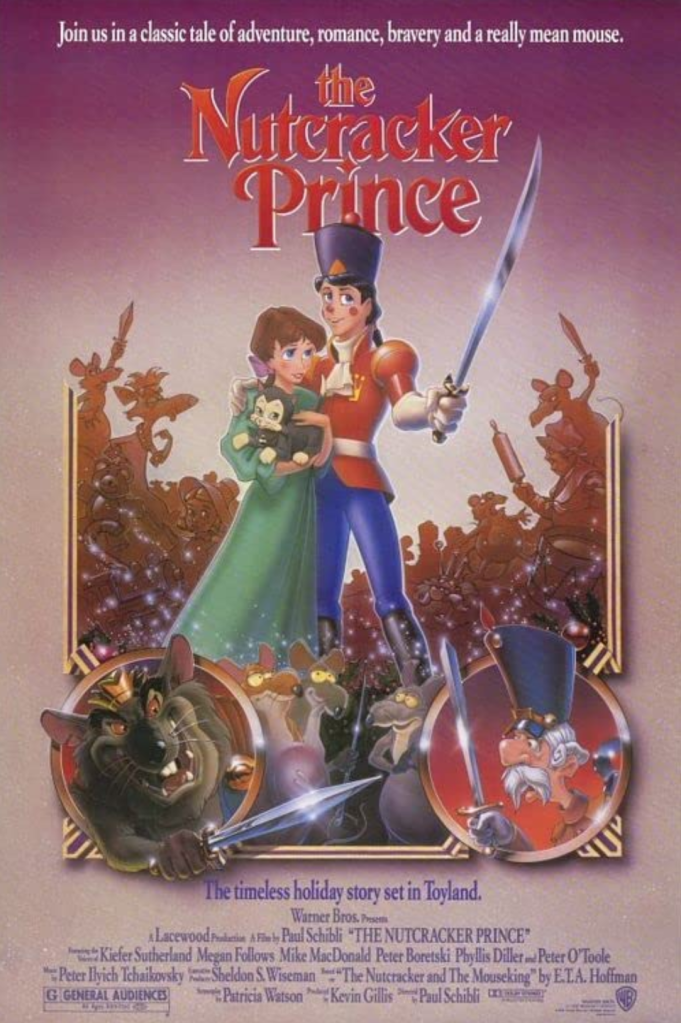
The Nutcracker Prince (1990) poster created by Lacewood Productions, Boulevard Entertainment, Allied Filmmakers, and Cineplex Odeon Films

Things I liked about the film:

Use of color: The Nutcracker ballet is a production that is known for being colorful. Therefore, the use of color in an adaptation of this story can make or break it. The way color was used in The Nutcracker Prince complimented the source material! One good example is the Christmas party at Clara’s family’s house. The primary colors in the background were a faded red and coral. But Clara’s dress boasted a hue of sea foam green. This color selection allowed Clara’s dress to stand out against the background. It also gave Clara as a character definition and focus.

Utilizing the ballet’s musical pieces: Another iconic part of The Nutcracker ballet is its music! From the ‘Dance of the Sugar Plum Fairy’ to ‘Waltz of the Flowers’, these pieces of music have become a staple in not only the soundtrack of Christmas, but also in the world of classical music. What’s interesting about the ballet’s music in The Nutcracker Prince is how it was utilized in different parts of the story from the original show. The ‘Waltz of the Flowers’ can be heard twice in this film. The first time is during Clara’s family’s Christmas party, as the adult attendees are dancing a waltz. The second time is when Clara is dancing with the Nutcracker in the middle of the night. Only this time, she’s singing a song called ‘Save This Dance’, with the music from ‘Waltz of the Flowers’ serving as a background melody. Using these pieces in different contexts show how versatile they are. They elaborate a scene’s specific tone as well.

A backstory for the Nutcracker: In The Nutcracker ballet, the audience watches as the Nutcracker transforms into a human. Since there are no explanations provided for this transformation, the audience is forced to accept what happened at face value. In The Nutcracker Prince, the creative team makes sure to provide their audience with a backstory for the titular character. I can’t get into detail about this part of the story, as I don’t want to spoil the movie. But all I’ll say is there is an explanation given for why this character becomes a nutcracker. I like how this film’s creative team took a part of the ballet and gave it a new story. This shows one example of how they respected the source material while also bringing something new to the table!

Image of ballerina preparing to dance created by Pressfoto at freepik.com. <a href=”https://www.freepik.com/free-photos-vectors/people”>People photo created by pressfoto – http://www.freepik.com</a>. Image found at freepik.com.

What I didn’t like about the film:

No Land of Sweets: What sets The Nutcracker apart from other ballets is the second half of the production, reserved for the Land of Sweets. This is the part of the story where Clara and the Nutcracker visit the aforementioned land where sweet treats are brought to life through dance. The Nutcracker Prince omits the Land of Sweets. Instead, this land is replaced with The Land of the Dolls. From a creative perspective, I understand why the movie’s creative team made this decision, as they didn’t want to copy-and-paste the source material. But, on the other hand, I was disappointed by the lack of the Land of Sweets. That’s because I was curious to see how the ballet’s second half would translate to animation.

The amount of focus on The Mouse King vs. The Nutcracker: Within the ballet’s first half, the Nutcracker fights in a duel with The Mouse King, the villain in the story. Like The Nutcracker Prince, this duel served as a conflict in the ballet. However, it lasted for only one scene. In the movie, the conflict takes up the majority of the plot. Similar to what I said earlier, I understand why the film’s creative team made this decision, as they wanted to provide their story with a solid conflict. But because of that decision, it took away time from exploring The Land of the Dolls and showcasing elements from the Land of Sweets.

Unclear parts of the story: Within The Nutcracker Prince, there were a few parts of the story that I wish were clarified. On Christmas Eve, after Clara receives a doll named Marie, her parents say this is the last doll Clara will get. With little to no context provided, I was unsure if Clara was simply growing up or was about to pass away. At several points in the film, Uncle Drosselmeier mentions his nephew. To prevent spoilers from being revealed, I won’t share too many details about that part of the story. However, when Drosselmeier’s nephew does appear in the film, I was confused of the identity of this character. I’m assuming that information was supposed to be heavily implied. However, if it was related to the plot, it should have been clearly explained.

Merry Christmas banner created by Freepik at freepik.com. <a href=’https://www.freepik.com/free-vector/merry-christmas-decorative-vintage-background_1359013.htm’>Designed by Freepik</a>. <a href=”https://www.freepik.com/free-photos-vectors/background”>Background vector created by Freepik</a>. Image found at freepik.com.

My overall impression:

As I said in my introduction, I’ve heard most movie adaptations of The Nutcracker ballet are bad. The Nutcracker Prince from 1990 has been included in that conversation. But now that I have seen this movie, I can finally give my own honest opinion about it. With that said, I personally thought it was fine. With any adaptation, The Nutcracker Prince is not the “end all, be all”. Sure, there are parts of the story that could have been stronger. But I will give this film credit where it is due. Similar to what I’ve said about remakes, a good adaptation should do two things: respect the source material and bring something new and unique to the table. I can honestly say The Nutcracker Prince does both of those things! The story itself goes in different directions than the ballet. At the same time, the movie’s creative team uses elements of the ballet to their advantage, such as the colorful palette and the musical pieces. So, if you’re a fan of The Nutcracker, animated movies, or lesser-known projects of the ‘90s, then I would suggest adding The Nutcracker Prince to your to-watch list this Christmas season!

Overall score: 7.1 out of 10

Have you seen any film adaptation of The Nutcracker? Are there any animated movies you like watching during the Christmas season? Please tell me in the comment section below!

Have fun at the movies!

Sally Silverscreen

Take 3: Suddenly (1954) Review

Movies that take place over a 24 Hour time frame (not including time loop movies) are the chosen subject for August’s Genre Grandeur. Since this theme is so broad, I needed to do some research before choosing my contribution. While reading through a list on Wikipedia, I came across the 1954 title, Suddenly. I have heard of this movie because it was recommended by Maddy from Maddy Loves Her Classic Films. Last year, I reviewed five of Frank Sinatra’s movies. While most of the movies I’ve seen were either a comedy or musical, Ocean’s Eleven was the only one that was dramatic in tone. This makes Suddenly a unique project in Frank Sinatra’s filmography. Movies from the Film-Noir genre have also been far and few between on my blog. So, I’m hoping this review makes up for that!

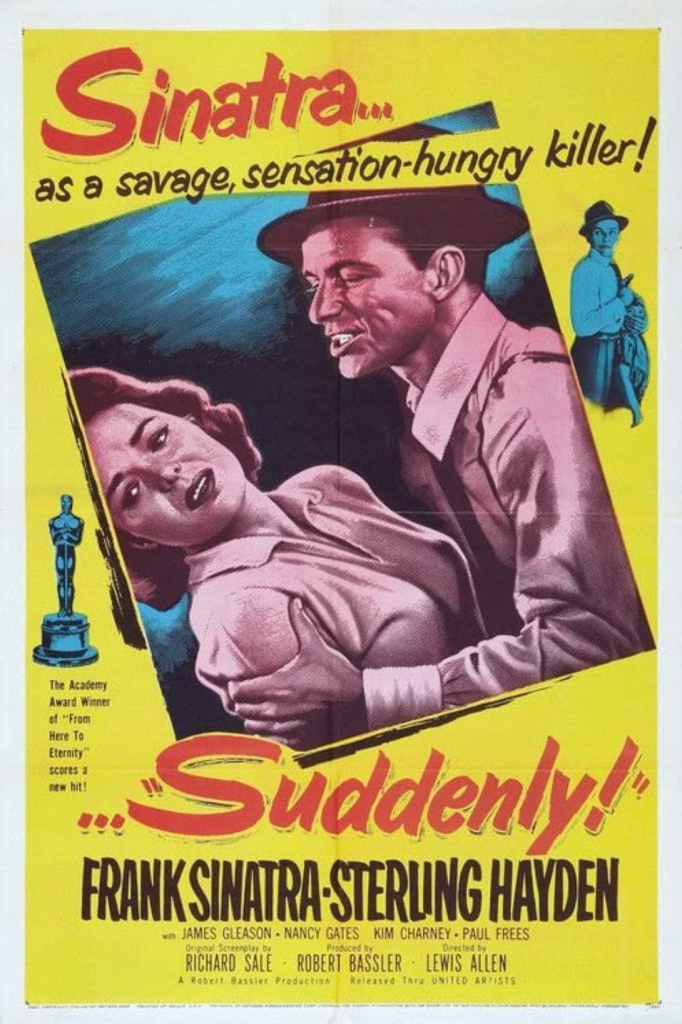
Suddenly (1954) poster created by Libra Productions and United Artists

Things I liked about the film:

The acting: In Frank Sinatra’s movies I’ve seen so far, he was given roles that allow him to achieve likability. This is made possible through a charismatic personality. While Frank’s character in Suddenly, John Baron, carries himself with suave charisma, he is not someone the audience wants to root for. In fact, this part of John’s personality can make viewers uncomfortable. That’s because, as the movie poster says, he is “a savage, sensation-hungry killer”. The darker material is different from what I’ve seen from Frank’s filmography, so far. However, Frank gave a strong performance that really showcased his range as an actor! While he carried his character with the charisma he has portrayed in other films, he was quick to adopt anger. Whenever someone gave him an insult, John immediately grew intense with rage. It not only showed how John had an underlying instability, but also showed how Frank was like a chameleon with expressions and emotions. These elements help create a character that puts the audience on edge.

Despite being the only actress in Suddenly, Nancy Gates’ did a good job portraying her character, Ellen Benson! While watching this film, I couldn’t help but be reminded of Judy Garland’s acting abilities. This is because, like Judy, Nancy brought a gentleness to her role. Throughout the movie, Ellen always put others before herself. She tries to protect her son, Pidge, from a world she feels is too dangerous. That part of Ellen’s story gives Nancy an opportunity to bring genuine emotion to her role. Toward the beginning of the film, Ellen and Sheriff Tod Shaw, portrayed by Sterling Hayden, debate over her overprotective nature. When Tod brings up her deceased husband, Ellen is immediately moved to tears. James Gleason provides a good counterpart to Ellen Benson with his portrayal of her father, Peter Benson. In the film, he has a more easy-going, light-hearted personality. While I wouldn’t say he was the movie’s comic-relief, Peter did prevent the story from being too dark. Peter’s ability to adapt to any situation and his quick thinking give the audience peace of mind, as it shows he has a good head on his shoulders and will know what to do. It also helps that Peter was the glue that kept his family together.

The subject matter: I was not expecting Suddenly to contain the real-life subjects it did. But they provided a good insight into the views, beliefs, and issues within the time period of the movie’s release. Because the movie takes place in and premiered a decade after World War II, the characters discussed the negative impacts of war. John Baron’s part of the story kind of serves as a cautionary tale when it comes to a war’s psychological aftermath. As John’s plan starts to unravel, the Benson family and Tod accuse John of being “un-American”. This reflects the McCarthyism that primarily took place in the ‘50s.  United States history is also included in the story, with presidential assassination attempts brought up within the script. Tod argues these attempts were failures, because the perpetrators were not only caught, but also frowned upon in history. His insight into this particular subject is interesting, especially remembering what would happen a decade after the film’s release.

Film-Noir’s new setting: Whenever I think of the Film-Noir genre, I think of stories that take place either in big cities or shady places with a dark, ominous tone. With Suddenly, the story takes place in a small, suburban town. This type of location usually hosts stories that are light-hearted and matched with a happy ending. Suddenly’s pairing provided a good contradiction. It also expanded Film-Noir’s horizons, showing that movies from this genre can take place anywhere. It was a creative decision that was definitely thought outside the box!

Children holding American flags during a sunset image created by rawpixel.com at freepik.com. <a href=”https://www.freepik.com/free-photos-vectors/people”>People photo created by rawpixel.com – http://www.freepik.com</a>. Image found at freepik.com.

What I didn’t like about the film:

Some weak performances: While I liked the majority of the acting performances in Suddenly, there were a few that were weak. One of those performances came from Sterling Hayden. When his character was involved in police/serious matters, Sterling successfully carried his character with stoic confidence. But when it came to tender-hearted moments, like when Tod is asking Ellen on a date, Sterling appeared stiff and wooden. Another performance that was weak was Kim Charney’s. I know Kim was a young actor when portraying Pidge. However, Kim carried one expression and emotion throughout the movie, causing Pidge to appear one-dimensional. I am aware that performances from young actors or actresses can be hit or miss. But, for me, Kim’s performance was a miss.

Unclear story details: Suddenly is the type of story where the audience figures out what’s going on as the film progresses. However, there are some parts of the story that don’t receive clarification. When John reveals his plan, he says he is being paid to carry it out. But the audience never learns who this anonymous benefactor is or why John is being paid in the first place. When telling Ellen about his past, John says the “experts” removed the feeling out of him. The identities of these “experts” and the reason for removing John’s feelings are never revealed. The omission of these answers feels like the film’s creative team is intentionally withholding information from the audience.

A self-contained story: The film-noir genre typically shows characters doing what they want and going where they please. This reminds me of Cady’s quote from Mean Girls: “The limit does not exist”. But in Suddenly, the majority of the story takes place in the Benson family home, as John is holding the family hostage. That part causes the movie to feel stagnant and limited, which is the opposite of film-noir’s nature. It also doesn’t help when the movie’s conflict is drawn out for most of the story.

Diner image created by Freepik at freepik.com. <a href=’https://www.freepik.com/free-vector/american-vintage-restaurant-hand-drawn_902205.htm’>Designed by Freepik</a>. <a href=”https://www.freepik.com/free-photos-vectors/food”>Food vector created by Freepik</a>. Image found at freepik.com.

My overall impression:

When I think about Tod’s view on presidential assassination attempts, I am reminded of the Touched by An Angel episode, “Beautiful Dreamer”. The majority of the episode’s story revolves around the assassination of President Abraham Lincoln, with John Wilkes Booth believing the act will make people see him as a hero. Instead, he is seen as not only a coward, but also one of the most hated people in history. I find it interesting that two different pieces of media from two different time periods share a similar belief. Suddenly also makes me think of the Hallmark Hall of Fame movie, Foxfire. That’s because the 1954 film felt more like a play than a movie. During my viewing experience, I found myself picturing the Benson family home as a stage, with any event outside of the home taking place off-stage. With the story being self-contained, I honestly feel this production works better in that format. Suddenly provides good insight into parts of the 1950s, with the characters’ dialogue sounding authentic. I also liked seeing Frank Sinatra’s performance, as it shows just how far he can stretch his acting abilities.

Overall score: 6.3 out of 10

Have you seen any of Frank Sinatra’s film? If so, which one is your favorite? Tell me in the comment section!

Have fun at the movies!

Sally Silverscreen

Take 3: The Lion Review

I haven’t participated in MovieRob’s Genre Grandeur since April, when I reviewed the 1966 movie, Born Free. To make up for some of that lost time, I decided to review a film for July’s event. This month, the theme isMovies of the Outdoors”. That means the majority of the film has to take place outdoors or the movie has to significantly feature nature within the story. In a search for ideas, I turned to a book that I’ve had in my possession since last year: Leonard Maltin’s TV Movies & Video Guide 1989 Edition. The pages of this text revealed a title I had never even heard of before. In 1962, 20th Century Fox released a live-action production titled The Lion. Leonard gave this project two out of four stars, saying “Beautiful scenery of Kenya is far better than melodrama about young girl attached to pet lion, with family concerned it is turning her into a savage”. With curiosity getting the better of me, I chose to seek this movie out as my contribution for July’s Genre Grandeur! But will I end up agreeing or disagreeing with Leonard? Keep reading in order to find out!

The Lion poster created by 20th Century Fox.

Things I liked about the film:

William Holden and Capucine’s banter: While The Lion is the fourth film of William Holden’s I have seen, it is also the first film of Capucine’s I have seen. Despite this, I really liked hearing the banter between their characters, Robert and Christine! After Robert arrives at the game reserve’s guest house, Christine reminds him how he is now on a game reserve. In a nonchalant manner, Robert tells her that he won’t bite the animals. In this film, there was a hint of a laid-back persona with William Holden’s character. Even though this was not Robert’s strongest character trait, William pulled it off flawlessly, making his line sound like a piece of natural conversation. Another collection of banter between these characters carried a more serious tone later in the film. When Christine questions Robert’s reason for coming to Africa, he says “I’m here, aren’t I”? In my review of The World of Suzie Wong, I said that William Holden’s performance in that movie was consistent. His and Capucine’s performance in The Lion was consistent as well, each actor delivering their lines with effective execution!

The scenery: The natural landscape of Africa is one of the reasons why I chose to watch this film. Similar to the 1966 movie, Born Free, the African fields served as the principal scenery for The Lion, almost like the landscape itself served as a character in its own right. When Robert’s plane first flies to the game reserve, an establishing shot of a massive mountain is predominantly featured in the background. It was such a beautiful piece of earth, with its white and light blue hues glistening on screen. Like Born Free, the African plains are given multiple opportunities to be featured. But in The Lion, there were other locales that were shown. When Tina, Robert and Christine’s daughter, is on her way to introduce Robert to her pet lion, King, she walks along a winding path. One part of this scene shows Tina and Robert walking past a huge waterfall. While I wish this waterfall had been shown for a longer period of time,  it highlights how there are various types of landscapes within Africa.

Pamela Franklin’s performance: I am not familiar with Pamela Franklin’s filmography. However, she gave a solid performance in The Lion! While watching her portrayal of Tina, I couldn’t help being reminded of Hayley Mills in films such as The Parent Trap. This is because, like Hayley, Pamela carried herself with confidence and a strong sense of self, especially for a young person. These qualities in character paired nicely with Tina’s headstrong personality. Pamela also brought enough emotionality to make her role sympathetic. Whenever she is instructing her per lion, King, on what she wants him to do, you can tell Tina truly cares about him. In one scene, King is leaving with a mate. As Tina is begging him to stay, desperation could be seen and heard in her eyes and voice. Everything I’ve been saying allowed Pamela to still the show!

Image of male lion created by Wirestock at freepik.com. Animals photo created by wirestock – www.freepik.com

What I didn’t like about the film:

Use of the words “wild” and “savage”: In The Lion, there are a few moments where Robert and Christine use the words “wild” or “savage” when referring to Tina’s interest in the local wildlife and African tribe. At one point, Christine fears her daughter will grow up to be “wild”. I know the ‘60s were a different time compared to the 2020s. But that is not the reason why I didn’t like the characters’ use of the words “wild” and “savage”. By them choosing those words to refer to Tina’s interests, they fail to understand the importance of these subjects. Throughout the movie, Christine, Robert, and even John worry about who Tina will grow up to be in the future. Instead, they should have taken the time to get to know her in the present. Since Tina’s passion for wildlife and her appreciation for the local African tribe is common knowledge to everyone in her life, her parents could have chosen to homeschool their daughter. Those aforementioned interests could have served as the basis for various academic subjects, with Tina’s parents guiding and protecting her along the way. Tina’s upbringing in Africa and a strong educational foundation might afford her a good chance to be accepted into a reputable university. If her parents took the initiative to nurture their daughter’s love for animals, maybe she would have become a veterinarian or operate her own wildlife sanctuary. Some people say “sticks and stones may break my bones, but words will never hurt me”. However, Christine and Robert’s words fail to recognize a middle ground where all parties are satisfied.

Poor special effects: As I just said in my previous point, the ‘60s were a different time compared to the 2020s. One way this is made apparent is the quality of the technology used in cinema. Sometimes, actors will be placed in front of a green screen, in an attempt to present the illusion that the actors are in a particular location. A few scenes in The Lion showed some of the characters driving through the fields of Africa, with pre-filmed shots of this landscape shown in the background. But during these on-screen trips, a faint but visible blue glow could be seen outlining the characters. This technological error prevented me from getting fully immersed in these scenes. Toward the end of the movie, rain was shown falling in one scene. But the special effect used looked like small images of raindrops lay on top of the scene’s picture instead like looking like the raindrops were falling in that world. That also ruined the illusion of being in the movie’s space.

A drawn-out conflict: Like I already mentioned before, Tina’s parents worry about her future. The way they talk about this conflict sounded like a dire situation. But throughout the film, there was no sense of urgency to find a resolution. Instead, several scenes focus on a safari trip John leads. While I enjoyed seeing Africa’s scenery, these scenes felt like padding to make up for the main conflict being drawn-out. Another part of the story that received more attention than the main conflict was the customs and politics of the local African tribe. I will admit that this part of the script was interesting. However, it took time away from the main conflict, causing its final outcome to be stalled. Even though Tina’s parents solve their problem, the answer doesn’t feel satisfying because of how long the problem was drawn out.

Illustrated African landscape image created by Macrovector at freepik.com. Background vector created by macrovector – www.freepik.com

My overall impression:

Because this month’s Genre Grandeur theme is Movies of the Outdoors”, I knew The Lion would be the perfect choice for this event. As expected, the scenery in the film presented a pleasant picture to look at. But like I quoted in my review of To Catch a Spy, “The scenery can’t save you”. That is certainly the case for the 1962 movie. The pieces of a good project were there; from the strong acting performances to interesting conflicts. But the overall direction wasn’t focused. Instead of working to find a resolution to the film’s main conflict, the story traveled down side paths. This placed more emphasis on other parts of the plot and caused the overarching narrative to be drawn-out. I was also frustrated by the lack of initiative from Tina’s parents to help their daughter reach her full potential with the resources they already had. While I understand they wanted the best for her, they never took the time to ask Tina what she wished for. Honestly, I’d recommend Born Free over The Lion. The story of the 1966 picture is not only straight forward, but its script is also stronger.

Overall score: 6.2 out of 10

Have you seen The Lion? Which “outdoor movie” would you prefer? Tell me in the comment section below!

Have fun outside!

Sally Silverscreen

Take 3: Born Free Review + 340 and 345 Follower Thank You

Earlier this month, 18 Cinema Lane received 340 and 345 followers! Before I continue, I’d just like to say thank you to each and every person who has chosen to follow my blog. I appreciate you taking the time to read my articles and listen to what I have to say. Speaking of articles, let’s back to the review! For April’s Genre Grandeur, the theme is “travel films”. Because this topic is so broad, it took me a while to figure out which film I would write about. Then I remembered I had the 1966 movie, Born Free, on my DVR. While Joy and George Adamson, the story’s protagonists, do travel within the movie, it is not the central component of the story. I also have participated in Thoughts From The Music(al) Man’s Star/Genre Of The Month Blogathon, with my review of China Seas being my first contribution. April doesn’t have a theme, so I thought Born Free would be the perfect choice for the blogathon! Prior to writing this review, I had heard of, but not seen, the 1966 picture. This is because I was familiar with the movie’s theme when it was featured on the soundtrack for the film, Madagascar. Now, the moment you’ve been waiting for; the start of this review!

Because I recorded this movie on my DVR, I took a screenshot of the movie’s poster from my phone. Screenshot taken by me, Sally Silverscreen.

Things I liked about the film:

How the animals were showcased: While I liked the acting in Born Free, it’s the animals that steal the show! Animals were showcased in a natural way, allowing them to be shown in situations that are more realistic. None of the animals were given voice-overs, giving the audience a chance to witness their authentic expressions. A great example is when Elsa, the lion Joy and George take care of, interacts with a male lion. Throughout the scene, Elsa and the male lion take turns roaring. They also can be seen fighting over food. The way these lions were presented made it look like they were having a conversation. The human characters’ conversations about these animals also gave them a humanistic quality. After Joy and George leave Elsa alone with the aforementioned lion, Joy compares the experience to waiting for a daughter to come home from a date. The cinematography and script gave the animals just as much importance as the human characters!

The scenery: The majority of Born Free takes place outdoors, as the African landscapes serve as the principal scenery for the story. Toward the beginning of the movie, Joy is painting in her front yard. A clear blue sky enveloped a large space of plains. This specific location appeared peaceful as long shots were used to capture it on film. Another impressive location was the beach that Elsa, Joy, and George visit. Once again, a blue sky is visible, soaring over the blue of the ocean and bright beige of the sand. The beach was very photogenic, with long and medium shots helping to showcase that location!

The music: I liked the use of music in Born Free! The pieces of instrumental tunes provided the tone for each scene it was included in. When a suspenseful and tense moment took place, the sound of beating drums could be heard. This sound elaborated on the seriousness of what was happening in that particular scene. One example is when, toward the end of the film, Elsa is fighting with another female lion. For more light-hearted, joyful moments, the movie’s theme played in the background. Some scenes that featured this piece of music revolved around Elsa and her sisters as lion cubs.

Mother lion and her baby cubs image created by wirestock at freepik.com. Animals photo created by wirestock – www.freepik.com

What I didn’t like about the film:

An inconsistent narrative: When a close friend named John suggests Elsa should be placed in a zoo, Joy is completely against the idea. This decision has even resulted in a heated argument between Joy and George. Joy’s decision for wanting Elsa to remain wild is understandable. However, earlier in the film, she doesn’t object to sending Elsa’s two sisters to a zoo. Joy also takes in a baby elephant that Elsa happened to be chasing one day. This specific narrative was inconsistent, which prevented me from getting fully invested in Joy’s side of the story.

The run-time: According to IMDB, Born Free is an hour and thirty-five minutes. But because the story is a simpler one, I don’t think this movie needed that run-time. While watching the film, I noticed how some scenes contained montages. For example, when Joy, George, and Elsa go to the beach, a montage lasting several minutes featured these characters playing on the beach and in the ocean. I feel these montages were placed in the film to satisfy its run-time. Had these montages been shortened, the movie could have had a run-time of an hour or less.

Unnecessary voice-overs: Throughout the film, Joy provides voice-overs to explain what is happening in the story. These voice-overs were beneficial in understanding Elsa’s journey. But there were some scenes where Joy’s voice-overs were not necessary. At the beginning of a scene where Joy, George, and Elsa are at a camp, Joy explains how, one night, she heard the roar of a lion who was eating the livestock of a nearby African village. If the voice-over had not been included in this scene, the on-screen event could have spoken for itself. Having the voice-over only reminded the audience of what they already knew.

Colorful travel suitcase image created by Pikisuperstar at freepik.com. <a href=’https://www.freepik.com/free-vector/beautiful-illustration-of-travel_2686674.htm’>Designed by Freepik</a>. <a href=”https://www.freepik.com/free-photos-vectors/watercolor”>Watercolor vector created by Pikisuperstar – Freepik.com</a>. Image found at freepik.com.

My overall impression:

When you think of “travel films”, a movie where the protagonist takes an extravagant and adventurous trip will likely come to mind. However, traveling can mean different things for various people. In the case of Born Free, Joy and George Adamson travel from England to Africa. Throughout the film, they also travel to town and several African villages. As I mentioned in the introduction, Born Free does not focus on the travels of Joy and George. Instead, it prioritizes the relationship these characters share with Elsa. While I liked the natural portrayals of the animals, these depictions are more suited for an older audience. This is also a simpler story, calling for a shorter run-time than the one it received. Not only were some of Joy’s voice-overs unnecessary, but her stance on keeping Elsa out of a zoo was inconsistent. Despite these flaws, I thought Born Free was a fine film! If you are interested in the subject of animals, I feel this is the movie for you!

Overall score: 7.1-7.2 out of 10

Have you seen any “travel films” lately? Do you have any films to recommend for the next blog follower dedication review? Let me know in the comment section!

Have fun at the movies!

Sally Silverscreen

Take 3: The Abominable Dr. Phibes Review

The Abominable Dr. Phibes was recommended by one of my readers named Michael. When I found out the movie was considered a horror-comedy, I thought it’d be a perfect entry for MovieRob’s Genre Grandeur, as horror-comedies are the theme for February. Then I discovered the film was released in 1971. Because Kim and Drew, from Tranquil Dreams and Drew’s Movie Reviews, are hosting the 6th Annual Ultimate Decades Blogathon, where the subject is movies premiering in years ending in 1, I decided to review The Abominable Dr. Phibes for both blogathons! As of early 2021, this is the fifth film of Vincent Price’s I’ve seen and written about. Most of these movies have either belonged in the horror genre or have been mysterious in nature. With The Abominable Dr. Phibes, this will be a little different, as part of the story is a comedy. Out of the movies of Vincent’s I have seen, none of them have featured a large amount of humor. So, by choosing this film for the aforementioned blogathons, I am given an opportunity to see Vincent work with slightly different material!

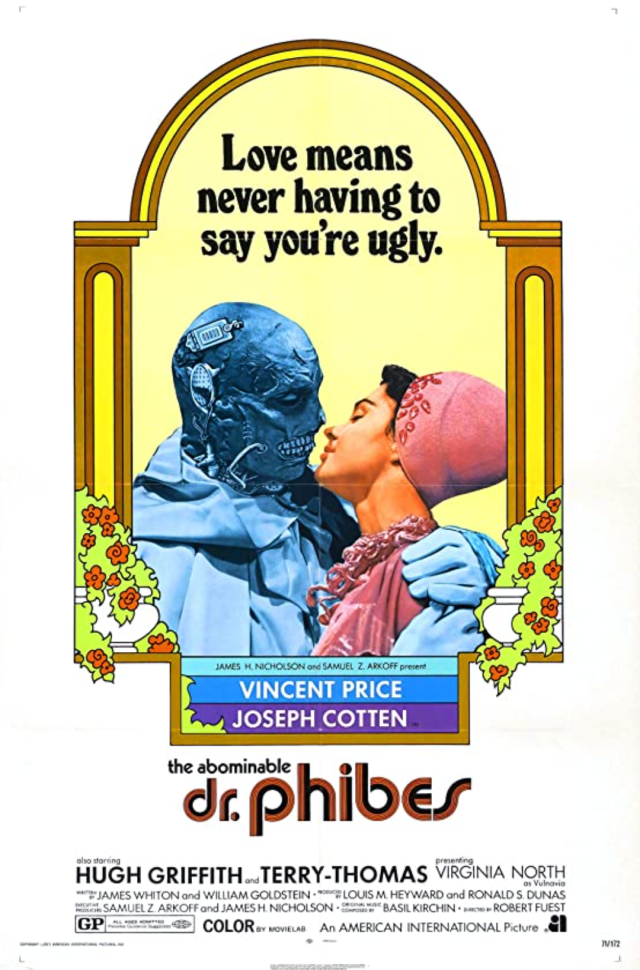
The Abominable Dr. Phibes poster created by American International Pictures.

Things I liked about the film:

The mystery: In horror movies, there is usually a mysterious element that can come in a variety of forms. One of these forms is a mystery. Throughout The Abominable Dr. Phibes, the detectives at Scotland Yard are attempting to figure out why several doctors in their neighborhood are dying of mysterious causes. The way the mystery is presented allows the audience to solve it alongside the characters. This presents the idea of the audience sharing an experience with the detectives in the film. Even though we see what is making these doctors die, it doesn’t take away from the intrigue of the mystery. In fact, it keeps the audience invested in what is about to happen next. Seeing how all the pieces of the story connected was interesting to see. It definitely kept my attention as I watched the film!

The craftmanship: There were several items in this movie that caught my eye due to their quality and artistry. A frog mask is just one example. The head covering mask is covered in three different shades of green, allowing it to shine from many different angles. Gold piping can also be found on the mask, assisting in distinguishing its shape. Jewels add finishing touches as the mask features gold gems around the frog’s eyes and an emerald clasp in the back. Dr. Phibes’ mask also boasts incredible craftsmanship! The eye covering mask is shaped like a bird and is coated in shiny shades of green, bronze, and gold. Both masks were two of the most beautiful I’ve ever seen!

The set design: The Abominable Dr. Phibes features several interesting set designs that are worth noting. Despite Dr. Phibe’s house only being shown at night and only part of its exterior could be seen, it was a magnificent structure! Its Victorian style brightened the night with its white frames and cherry wood doors. The house features a grand white marble staircase paired beautifully with chandeliers and crystal sconces. I wish more scenes had taken place by this staircase, as it is an impressive part of Dr. Phibes’ residence! Other locations in the story also displayed memorable set designs.  Dr. Vesalius’ apartment is a great example. Near the front door is a curved, frosted window. The door itself was covered in a light and dark wood that ending up complimenting the faded yellow walls. This location looked reflective of the late ‘60s to early ‘70s due to its color scheme and furniture selections.

Scared audience image created by Katemangostar at freepik.com. <a href=’https://www.freepik.com/free-photo/terrified-friends-watching-horror-movie-in-cinema_1027311.htm’>Designed by Freepik</a>. <a href=”https://www.freepik.com/free-photos-vectors/people”>People image created by Katemangostar – Freepik.com</a>. Image found at freepik.com.

What I didn’t like about the film:

The underutilization of Vincent Price: As I said in my introduction, this is the fifth film of Vincent Price’s I’ve seen. Therefore, I, as an audience member, know what he is capable of, talent wise. Despite being the top billed actor in The Abominable Dr. Phibes, Vincent wasn’t given much material to work with. He didn’t have any speaking lines in this movie. While there is an explanation given within the story, the only time we hear Vincent’s iconic voice is through recordings. It also doesn’t help that the different ways Dr. Phibes went after his victims overshadows Vincent’s performance. The more I think about it, the more I wonder if the creative team behind this film cast Vincent Price simply to get more people to see the movie?

Weak on comedy: The Abominable Dr. Phibes is classified as a horror-comedy. When I made this discovery, I was expecting the movie to be more like Young Frankenstein. Even though there were a few times I found myself giggling, the film didn’t contain much humor. The Abominable Dr. Phibes relies more on the horror genre. It also contains a mystery within the overall plot, which would make it a horror-mystery. I felt misled after these reveals.

Depiction of demises partially used for shock value: Strictly from a story-telling perspective, it was interesting to see how Dr. Phibes carried out his plan. But when the plan is put into practice, the depiction of his victims’ demises comes across as more gross than scary. Within a segment of the story involving rats, there was a brief shot of a rat chewing on what looks like a bloody bone. I won’t spoil The Abominable Dr. Phibes, in case any of my readers haven’t seen it. But parts of the film like the one I described feels like the movie’s creative team just wanted to shock their audience.

Ultimate Decades Blogathon (1) banner created by Kim and Drew from Tranquil Dreams and Drew’s Movie Reviews.

My overall impression:

When I think of the term “horror-comedy”, Young Frankenstein immediately comes to mind. Even though I haven’t seen this film, I am aware of its premise. Because of my expectations, I was somewhat let down by The Abominable Dr. Phibes. Sure, its mystery was intriguing and kept me invested in the overall story. But as I look back on this movie, I find myself expecting more. Despite its classification as a horror-comedy, it ended up being a horror-mystery, with very little comedy to be found. I was also disappointed to see Vincent Price underutilized in The Abominable Dr. Phibes. While he was given different material to work with, he didn’t have any speaking lines. The way Dr. Phibes’ victims met their demise overshadowed Vincent’s performance. These factors make his portrayal of the titular character feel like a part of an ensemble instead of someone leading a film. This is an interesting movie, but I can think of stories of this nature that are stronger than this one. I still prefer a picture like The Crow over The Abominable Dr. Phibes.

Overall score: 7-7.1 out of 10

Have you seen a horror-comedy? Which film of Vincent Price’s would you recommend? Share your thoughts in the comment section!

Have fun at the movies!

Sally Silverscreen