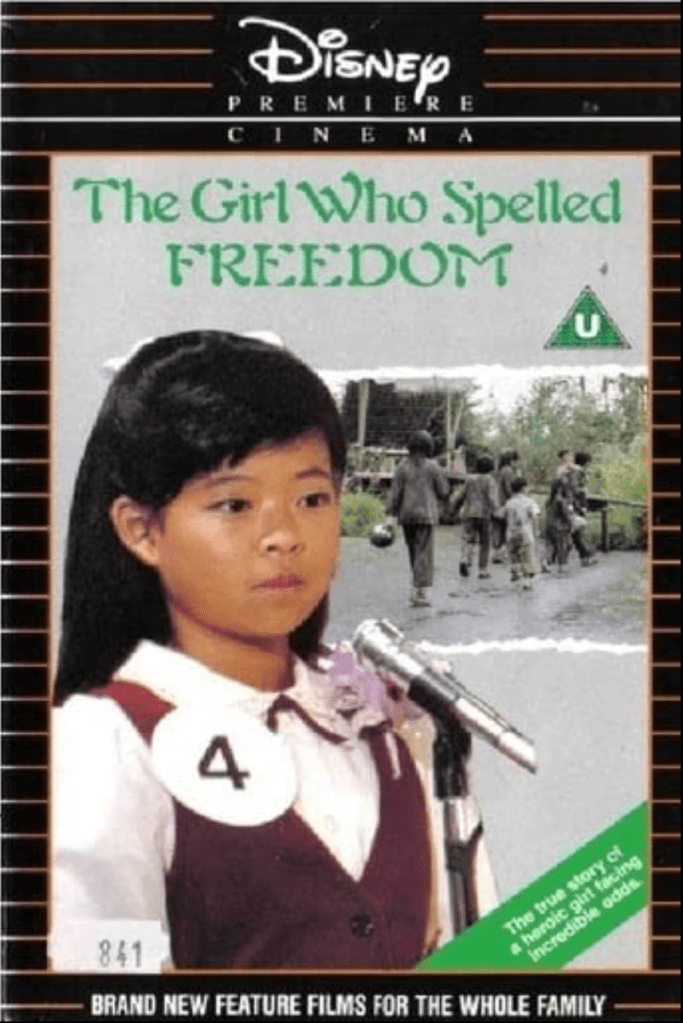
Originally, I was going to publish a double feature review of Wild Hearts Can’t Be Broken and The Girl Who Spelled Freedom for the American Experience on Film Blogathon. However, I have also been working on another big project that required more time than I expected. Therefore, I was only able to watch one movie, which was The Girl Who Spelled Freedom. Don’t worry, though, because I will coordinate a double feature to celebrate the publication of 500 posts! The 1986 made-for-tv movie had been unknown to me until this year. I stumbled across The Girl Who Spelled Freedom when I was looking through an IMDB list about family-friendly films. After reading the synopsis, I was interested in watching the movie! There aren’t many cinematic stories that feature a spelling bee. In fact, the only one I can think of is Akeelah and the Bee from 2006. I also realize that Disney creates fewer “based on a true story” movies now than they did decades ago. Because a Disney project hasn’t been reviewed on my blog since last December, let’s begin talking about The Girl Who Spelled Freedom!
The acting: As I have stated in the past, it takes a very talented young actor or actress to carry a film. For Jade Chinn, she did such a great job with the material she was given! What made her performance so memorable is how she utilized body language, emotions, and facial expressions to illustrate Linn’s limited use of English. However, these techniques helped address what the character was experiencing. When Linn was traveling on a plane for the first time, she curled up on the floor in fear. The way Linn was behaving showed the audience that cultural differences and language barriers can turn something as simple as a plane trip into a terrifying experience. Another stand-out performer was Mary Kay Place, who portrayed Prissy Thrash! One of her best scenes took place toward the beginning of the film. Prissy and her husband, George, were dealing with the news of how many members are in Linn’s family. Prissy is so overwhelmed, she suddenly bursts into tears. This moment alone displays the emotionality Mary was able to bring to her performance! A heartwarming scene was when George was teaching Linn and her sisters how to count. The performances from the actors in this scene, especially from Wayne Rogers, appeared so genuine. It was also nice to see the dynamic between these characters!
The cinematography: I was pleasantly surprised by some of the cinematography in The Girl Who Spelled Freedom! Even though this is a made-for-tv movie from the mid ‘80s, the cinematography looked like it came from a theatrical production. At the beginning of the film, Linn and her family are crossing a river. One shot is presented as if the viewer is in the water, watching the family moving through the river toward safety. When Linn and her family are staying with the Thrash family, they discover one of the sons is missing. As George and Prissy are searching their home, the camera follows them. This gives the idea the audience are looking for this child alongside the characters.
A balance of heartbreaking and heartwarming moments: With films that deal with emotional material, there are bound to be heartbreaking moments. In The Girl Who Spelled Freedom, there were certainly scenes that were sadder in nature. An example is when Prissy takes Linn and some of her siblings to the park. When the children see a giant statue of the Crucifix, they become scared, as they are instantly reminded of the trauma they experienced. Even though Prissy reminds them that the statue isn’t real, the children are still shaken up by the imagery. At the same time, the film contained light-hearted moments that were heartwarming. At the Thrash family home, Linn accidently walks in on Laura, Prissy and George’s daughter, curling her hair. In an effort to prevent Linn from feeling embarrassed, Laura decides to not only curl Linn’s hair, but also curl Linn’s sisters’ hair. The scene itself was very sweet and showed how a little bit of kindness can make a big difference.
Missing context: The Girl Who Spelled Freedom has the same flaw The Crow did: there are areas of the story that needed context. One strong example is Linn giving sentimental value to a ring. At the beginning of the film, Linn can be seen looking for a ring in the mud. When she is escaping from a group of soldiers in Thailand, she gives the ring to one of the soldiers. In the United States, Prissy gives one of her rings to Linn. Later in the film, Linn is upset when she accidently drops the ring down the sink. The significance of this ring is never addressed in the film. Linn herself never explains why the ring is so valuable to her. If context had been provided to this part of the story, the audience could try to understand why the ring is important to Linn.
A limited presence of the spelling bee: Before watching this movie, I knew there would be a spelling bee featured in the overall story. However, I was expecting a build-up to the spelling bee, similar to Akeelah and the Bee. While we get to see a spelling bee in The Girl Who Spelled Freedom, it was only referenced a few times before the actual event began. Most of the story focused on Linn’s adjustment to life in the United States. Even though watching the spelling bee unfold was satisfying, I wish it had received a little more emphasis in the film.
A few characters receiving character development: In films that feature bigger casts, it is not easy providing character development to every character involved. But when only a few characters receive character development, it can be disappointing. This is what happened with The Girl Who Spelled Freedom. The only characters who are given character development are the members of the Thrash family and Linn. With Linn’s family, the audience becomes familiar with them, but doesn’t get the opportunity to get to know them. This can also be said about other characters, such as Henry Turner, who helped the Thrash family bring Linn and her family to the United States.
The American Experience is a tricky thing to sum up, as everyone’s experiences are going to be different. This is especially the case if someone is a refugee or immigrant. The Girl Who Spelled Freedom is a perfect example of how unique the American Experience can be. For most of the film, Linn and her family deal with “culture shock”, coming across things and situations that they feel are “unusual”. But over time, they start to create their own American Experience. Linn enters a local spelling bee in 1983. An activity that is typically seen as fun and harmless was seen by Linn as a fight for survival, a view that was shaped by her past experiences. Therefore, she was partially responsible for creating her own American Experience. For a television film from the mid ‘80s, I’d say this is one of the better presentations! While the film does have its flaws, it did feel like a Hallmark Hall of Fame movie before the collection moved to Hallmark Channel. After the film, there was an interview with the real-life Thrash and Yann families. Because the audience was able to hear their sides of the story, it added to my enjoyment of the overall project! It’s a shame fewer networks have decided to create made-for-TV films. There are so many stories worth telling, so I hope they are able to get told someday.
Overall score: 7.6 out of 10
Have you seen The Girl Who Spelled Freedom? Are there any television films you’d like to see me review? Let me know in the comment section!
Back in January, I announced my 3rd annual blogathon; the Olympic Dreams Blogathon! This event will take place from July 19th to the 23rd. That means if you’re interested in signing up, you still have three months left! In this post, I will provide the link to the original post where the participant list is featured. You can leave your entry ideas in the comment section of either post.
Earlier this month, 18 Cinema Lane received 340 and 345 followers! Before I continue, I’d just like to say thank you to each and every person who has chosen to follow my blog. I appreciate you taking the time to read my articles and listen to what I have to say. Speaking of articles, let’s back to the review! For April’s Genre Grandeur, the theme is “travel films”. Because this topic is so broad, it took me a while to figure out which film I would write about. Then I remembered I had the 1966 movie, Born Free, on my DVR. While Joy and George Adamson, the story’s protagonists, do travel within the movie, it is not the central component of the story. I also have participated in Thoughts From The Music(al) Man’s Star/Genre Of The Month Blogathon, with my review of China Seas being my first contribution. April doesn’t have a theme, so I thought Born Free would be the perfect choice for the blogathon! Prior to writing this review, I had heard of, but not seen, the 1966 picture. This is because I was familiar with the movie’s theme when it was featured on the soundtrack for the film, Madagascar. Now, the moment you’ve been waiting for; the start of this review!
Because I recorded this movie on my DVR, I took a screenshot of the movie’s poster from my phone. Screenshot taken by me, Sally Silverscreen.
Things I liked about the film:
How the animals were showcased: While I liked the acting in Born Free, it’s the animals that steal the show! Animals were showcased in a natural way, allowing them to be shown in situations that are more realistic. None of the animals were given voice-overs, giving the audience a chance to witness their authentic expressions. A great example is when Elsa, the lion Joy and George take care of, interacts with a male lion. Throughout the scene, Elsa and the male lion take turns roaring. They also can be seen fighting over food. The way these lions were presented made it look like they were having a conversation. The human characters’ conversations about these animals also gave them a humanistic quality. After Joy and George leave Elsa alone with the aforementioned lion, Joy compares the experience to waiting for a daughter to come home from a date. The cinematography and script gave the animals just as much importance as the human characters!
The scenery: The majority of Born Free takes place outdoors, as the African landscapes serve as the principal scenery for the story. Toward the beginning of the movie, Joy is painting in her front yard. A clear blue sky enveloped a large space of plains. This specific location appeared peaceful as long shots were used to capture it on film. Another impressive location was the beach that Elsa, Joy, and George visit. Once again, a blue sky is visible, soaring over the blue of the ocean and bright beige of the sand. The beach was very photogenic, with long and medium shots helping to showcase that location!
The music: I liked the use of music in Born Free! The pieces of instrumental tunes provided the tone for each scene it was included in. When a suspenseful and tense moment took place, the sound of beating drums could be heard. This sound elaborated on the seriousness of what was happening in that particular scene. One example is when, toward the end of the film, Elsa is fighting with another female lion. For more light-hearted, joyful moments, the movie’s theme played in the background. Some scenes that featured this piece of music revolved around Elsa and her sisters as lion cubs.
An inconsistent narrative: When a close friend named John suggests Elsa should be placed in a zoo, Joy is completely against the idea. This decision has even resulted in a heated argument between Joy and George. Joy’s decision for wanting Elsa to remain wild is understandable. However, earlier in the film, she doesn’t object to sending Elsa’s two sisters to a zoo. Joy also takes in a baby elephant that Elsa happened to be chasing one day. This specific narrative was inconsistent, which prevented me from getting fully invested in Joy’s side of the story.
The run-time: According to IMDB, Born Free is an hour and thirty-five minutes. But because the story is a simpler one, I don’t think this movie needed that run-time. While watching the film, I noticed how some scenes contained montages. For example, when Joy, George, and Elsa go to the beach, a montage lasting several minutes featured these characters playing on the beach and in the ocean. I feel these montages were placed in the film to satisfy its run-time. Had these montages been shortened, the movie could have had a run-time of an hour or less.
Unnecessary voice-overs: Throughout the film, Joy provides voice-overs to explain what is happening in the story. These voice-overs were beneficial in understanding Elsa’s journey. But there were some scenes where Joy’s voice-overs were not necessary. At the beginning of a scene where Joy, George, and Elsa are at a camp, Joy explains how, one night, she heard the roar of a lion who was eating the livestock of a nearby African village. If the voice-over had not been included in this scene, the on-screen event could have spoken for itself. Having the voice-over only reminded the audience of what they already knew.
When you think of “travel films”, a movie where the protagonist takes an extravagant and adventurous trip will likely come to mind. However, traveling can mean different things for various people. In the case of Born Free, Joy and George Adamson travel from England to Africa. Throughout the film, they also travel to town and several African villages. As I mentioned in the introduction, Born Free does not focus on the travels of Joy and George. Instead, it prioritizes the relationship these characters share with Elsa. While I liked the natural portrayals of the animals, these depictions are more suited for an older audience. This is also a simpler story, calling for a shorter run-time than the one it received. Not only were some of Joy’s voice-overs unnecessary, but her stance on keeping Elsa out of a zoo was inconsistent. Despite these flaws, I thought Born Free was a fine film! If you are interested in the subject of animals, I feel this is the movie for you!
Overall score: 7.1-7.2 out of 10
Have you seen any “travel films” lately? Do you have any films to recommend for the next blog follower dedication review? Let me know in the comment section!
Last year, I participated in the Classic Literature On Film Blogathon. Since I was reading To Kill a Mockingbird at the time, I chose to review the book’s film adaptation. For this year’s event, I selected the 1948 version of The Three Musketeers! Because I’m using my TBR Tin to choose which book to read next, I wasn’t able to read the source material before I saw the movie, as I’m currently reading The Shadowy Horses by Susanna Kearsley. I was recommended this film by Patricia from Caftan Woman. As I try to see as many film suggestions as I can, this became one reason why I selected The Three Musketeers for this blogathon. I have seen the 1993 adaptation of the story. But I can’t give an honest opinion on that film, as I haven’t seen the movie in years. What will my thoughts be on the 1948 adaptation of The Three Musketeers? Keep reading to find out!
The Three Musketeers(1948) poster created by Metro-Goldwyn-Mayer and Loew’s, Inc.
Things I liked about the film:
The acting: Because The Three Musketeers contained an ensemble cast, it’s difficult to choose a favorite performance. However, I will still mention a few of them. For me, Gene Kelly is always going to be known for his performances in musicals. Seeing him work with different acting material was very interesting, as it forced him to utilize his expressions and emotions more. Out of Gene’s films I’ve seen so far, his portrayal of D’Artagnan has become one of my favorites! This performance was so well-rounded, D’Artagnan came across as a mutli-layered character. As Gene had a variety of expressions at his disposal, he was able to adapt to any situation D’Artagnan faced. I am not familiar with Van Heflin as an actor. But I was impressed with his portrayal of fellow Musketeer, Athos! Van’s best scene was when Athos drunkenly tells a story of an aristocrat who was betrayed by a woman from the country he fell in love with. Even though Athos is disoriented by the alcohol, you can tell there is deep emotion in his voice and eyes. Another performance that also became a favorite came from Lana Turner, who portrayed Countess de Winter! Her standout scene was when her character was in prison. The Countess appears disheveled as she begs for her life to end. What made this scene so memorable was the amount of emotion Lana put into her role. She presented a character that was so desperate, she’d be willing to do anything to get out of it.
The costumes: When it comes to scene-stealers, the costumes in The Three Musketeers definitely stole the show! I liked how colorful they were, as bright hues were used on various pieces of apparel. It not only made the characters stand out, but it also helped when telling characters apart from one another. The amount of detail on these costumes was also exquisite! In one scene, the Duke of Buckingham wore a purple shawl. Gold embroidery complimented the shawl’s shade of purple and prevented the piece from becoming plain. At a dinner party, Queen Anne wore a white gown. This gown also contained gold details, which were found on the skirt and bodice. Small jewels near the top of the dress completed Queen Anne’s elegant look!
The set design: If you’re going to create a period film, you have to pay attention to the finer details that go into each set. These details will reflect the effort, research, and care that went into how these sets look. The sets in The Three Musketeers show how much the film’s creative team cared about the presentation of their final product! What I love about the sets in this movie are the fine details that can be found. Carved images are shown in the Duke of Buckingham’s study, covering the fireplace and doorframe in these wooden pictures. They can also be found in other rooms and on other materials, such as on a tin-plated cabinet in a General’s office. My favorite design detail can be found in Queen Anne’s sitting room. As Queen Anne and the Duke of Buckingham are standing near the fireplace, Queen Anne turns a knob found near the top of the fireplace. This action reveals a secret compartment that hides a box of diamonds.
The fight choreography: Any action movie is just as good as its fight choreography. The performative presentation of the fights in The Three Musketeers helped make these fights so memorable! Because of Gene Kelly’s dancing skills, he was able to incorporate leaps into his fight sequences. Watching D’Artagnan leap from place to place gave him a natural superpower that he was able to use to his advantage! Humor can also be found during these fight sequences, which prevented them from being too dark or serious. D’Artagnan’s first duel was against the head of the French police. During this duel, hilarity ensued, from D’Artagnan splashing water in his opponent’s face to pushing his opponent in a pond. This inclusion of humor in the fight choreography allowed the creative team to present these fights in creative and interesting ways!
D’Artagnan’s romantic relationships: After rescuing Constance from a home invasion, D’Artagnan falls in love with her. He not only tells Constance he loves her, but they also share a romantic kiss. While I liked Constance and D’Artagnan’s relationship, I felt it was developed too quickly. Later in the film, Constance is kidnapped. In order to save her, D’Artagnan pretends to fall in love with Countess de Winter. However, after his initial meeting with the Countess, D’Artagnan tells Athos how much he loves her. If D’Artagnan was romantically interested in Constance, why would he even bother having feelings for the Countess? That part of the story was confusing.
A weaker villain: There are two villains in The Three Musketeers; Countess de Winter and Richelieu. But one of them definitely outshined the other. Countess de Winter was the stronger villain. She is a criminal by legal context and the audience can witness her committing several crimes. Richelieu, on the other hand, is not presented in the same way. The audience does see him commit a crime of theft, but it is never explained how this was done. Richelieu was also friends with the King of France, a character that was not written or portrayed as a villain. This made me puzzled as to what Richelieu’s true intentions were, whether he was a villain or simply a man who follows his own rules.
The Musketeers spending little time together: When you think of The Three Musketeers, you think of these heroes fighting alongside each other and saving the day together. As I watched this film, I noticed how they spent more time apart. I was disappointed to discover this because that team dynamic the Musketeers are known for had a limited presence. While this separation did allow the audience to get to know these characters individually, we didn’t really get to see this group of friends grow over time. Though there was a lot of content in this movie, I wish more time was given to show the Musketeers together.
Anchors Aweigh was the best movie I saw in 2020. This was a pleasant surprise, as I never expected one of Gene Kelly’s films to receive this honor. Even though it’s only April, the 1948 adaptation of The Three Musketeers has now become the best movie I’ve seen so far! There is so much effort that was put into this project, which is reflected in many parts. The costumes and set designs were impressive because of the detail that was incorporated into them. Many good acting performances can be found, making it difficult to choose the best one. These actors not only did a good job individually, but they also worked well together as a group! Similar to what I said in my Oliver! review, I might read The Three Musketeers because of how much I enjoyed its film adaptation! For now, my top priority is reading the books that are currently on my TBR shelf.
Overall score: 8 out of 10
Have you read or seen The Three Musketeers? What adaptations of classic literature do you like? Please let me know in the comment section!
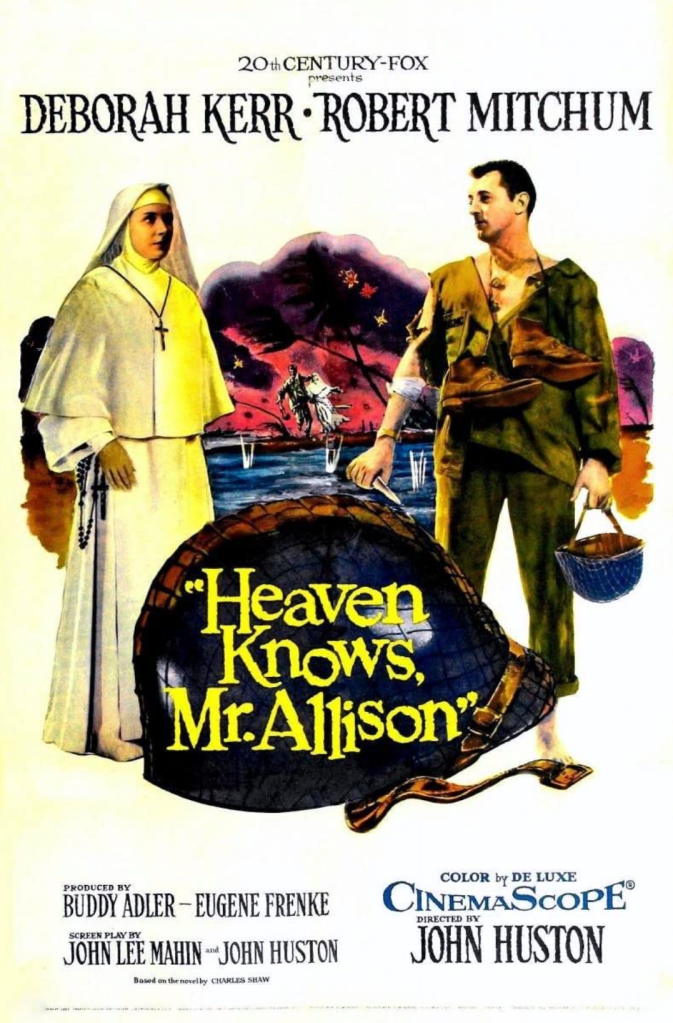
Easter is just around the corner. Because of this, Pure Entertainment Preservation Society is hosting The Faith in Film Blogathon! This event has given me the perfect opportunity to review Heaven Knows, Mr. Allison, which was recommended to me by Maddy from Maddy Loves Her Classic Films. Since the movie features a Nun as one of the main characters, I knew there would be some religious themes within this script. However, I have never seen this film before, so I didn’t know what these themes would be. Choosing Heaven Knows, Mr. Allison also gave me an excuse to watch more movies from Deborah Kerr’s filmography. So, let’s start this review to see where this film ranks!
The acting: Because Robert Mitchum and Deborah Kerrare the only two actors in this movie’s main cast, those are the only two performances I will be discussing in this review. This is the third film of Deborah Kerr’s I’ve seen, with the previous two being Edward, My Son and Marriage on the Rocks. The one consistent part of Deborah’s acting abilities is how she uses emotions and expressions to her advantage. This allows her to make each of her roles seem well-rounded! While Sister Angela, Deborah’s character, and Mr. Allison are fishing, Mr. Allison tries to catch a turtle with a tool he built himself. When Mr. Allison falls into the ocean, Sister Angela appears shocked and horrified, as the situation happened so quickly. Later in the film, Sister Angela and Mr. Allison are discussing their plans if they leave the island. As Mr. Allison is talking about how he has grown closer to Sister Angela, tears can be seen forming in Sister Angela’s eyes. Deborah’s face in that scene said so much more than dialogue could. Robert Mitchum is an actor I’ve heard of, but am not familiar with. Even though I have seen pieces of El Dorado and Scrooged, I don’t remember his performance in those projects. As I watched his portrayal of the titular character, it appeared as a combination of the laid-back personality of Clark Gable and the tough persona of John Wayne. But for Robert, his eyes contained emotion throughout his performance. As Sister Angela falls ill, you can tell Mr. Allison is genuinely concerned for her. Robert’s eyes are what worked in his favor, as they held a sense of sympathy for Sister Angela and longing for her well-being. The first scene of this movie contained no dialogue, as it focused on Mr. Allison’s reaction when he first arrives on the island. Because of this, Robert had to rely on his facial expressions and body language to explain what his character was going through. I found these creative decisions gave the film a good first impression, as it brought some realism to this story!
The scenery: According to IMDB, Heaven Knows, Mr. Allison was filmed in Trinidad and Tobago. Even though the location is not specified in the film, the scenery made the movie very photogenic! There is so much foliage to be seen, from the tall palm trees to the smaller bushes. The ocean boasted a consistent shade of blue, which was definitely appealing to the eye. Sandy beaches and dark brown rocks complete the natural look this space had to offer. Based on appearances alone, this island looked inviting!
The parallels between the religious order and the Marines: Within Mr. Allison and Sister Angela’s conversations, parallels between the Marines and the religious order are brought up. One of the them is discussed while they are building a sail for their raft. Sister Angela addresses the preparations she had to go through in order to become a Nun. She even talks about one mentor within the religious order she wasn’t a fan of. Meanwhile, Mr. Allison shares his basic training before he officially became a Marine. He also brings up a drill Sergeant that he didn’t like. I never thought about these parallels until I saw this film, so I like how this story was somewhat thought-provoking. The parallels between the religious order and the Marines also showed how Sister Angela and Mr. Allison were similar than they first realized.
The Faith in Film Blogathon banner created by the Brannan sisters from Pure Entertainment Preservation Society.
What I didn’t like about the film:
The limited presence of faith: While I did like seeing the parallels between the religious order and the Marines, I was disappointed by how limited faith’s presence was. Before watching Heaven Knows, Mr. Allison, I expected faith to be a cornerstone of this story, similar to films like Ben-Hur. Because the movie takes place during World War II, a correlation with the David and Goliath story would make sense. Seeing one of the characters question their faith or have their faith tested would be appropriate, given their circumstances. But faith in Heaven Knows, Mr. Allison was served in small doses.
A basic conflict: In movies, television shows, or books, I like conflicts that contain more depth. But the conflicts in Heaven Knows, Mr. Allison were more basic than I hoped. In theory, the idea of a Marine and a Nun surviving on an abandoned island sounds interesting. But as the story progresses, the conflict is the same as other films of this nature. Even when Japanese soldiers invade the island, survival is still a major conflict. Because of everything I mentioned, few new ideas were brought to this particular table.
Lack of resolution: At one point in the film, Sister Angela explains to Mr. Allison how some women change their minds when it comes to the religious order. Several scenes later, Mr. Allison tries to dissuade Sister Angela from taking her final vows by telling her he loves her. She even starts to weigh her options when it came to her future. However, we never find out what her final decision was. A brief explanation in the script would be solved this problem. But because this explanation was nowhere to be found, a sense of closure was missing.
Heaven Knows, Mr. Allison is a fine movie. Even though I found it better than Edward, My Son and Marriage on the Rocks, I was expecting more from this third film. I was hoping faith would have a bigger role in the story, especially since Heaven Knows, Mr. Allison was released two years before Ben-Hur. However, as I said in my review, faith was served in small doses. The conflict itself was typical for a movie that involves characters being stranded on an island. Because I like conflicts with more depth, this creative decision was disappointing. But the movie did have its strengths, such as the acting and the thought-provoking parallels. With all this said, this is a film I would still recommend to older viewers just in time for Easter!
Overall score: 7.2 out of 10
Have you seen Robert Mitchum’s or Deborah Kerr’s films? If so, which ones would you recommend? Let me know in the comment section below!
For Terence’s 7th Annual Favourite TV Show Episode Blogathon, I was originally going to write an editorial on an episode from Highway to Heaven. But the more I thought about that decision, the more I realized the shows I’ve reviewed so far have one of two things in common: the shows are darker in tone or they cover heavier, real-world subjects. Because of this, I decided to change things up a bit. I have never watched a full episode of Kids Incorporated, but I have seen two performance videos from the show. Since I liked what I saw, I thought reviewing the show for the blogathon would be a good idea! Its light-hearted, joyous tone is definitely different from the other shows I’ve talked about. This will also be the first time a musical show has been covered on 18 Cinema Lane. Like some of my previous TV show reviews, I have chosen four random episodes. Each episode will be broken down into five categories: what I liked about this episode, what I didn’t like about this episode, the musical numbers, the other factors from this episode, and my overall thoughts. I wasn’t able to find a consistent record of when these episodes premiered, so I will not be listing premiere dates this time. But I will share my final assessment of the show toward the end of my review.
What I like about Kids Incorporated is each character’s preferences and personalities are showcased in subtle ways. Seeing which books the cast were reading is a perfect example of this. Screenshot taken from the Youtube channel, Kids Incorporated.
What I liked about this episode:
When you have a television or movie series that revolves around a group of people, that group needs to consist of actors and/or actresses who have good on-screen camaraderie with one another. With this episode of Kids Incorporated, I immediately took notice of how well these young actors and actresses worked together! The fact this cast also appeared in season two gives the impression they are familiar with each other’s’ talents, which helps make their on-screen relationship convincing. My favorite moment in ‘Peter Pam’ was when Gloria is talking to Stacey about Stacey’s lack of excitement for a new sibling. This conversation came across as sincere and believable, almost like Gloria assumed the role of an older sister looking out for her younger sister. It was a sweet moment that definitely added heart to this story!
What I didn’t like about this episode:
With this episode’s run-time clocking in at a little over twenty-two minutes, there is only so much content that can be included in the project. Because of this, I thought Stacey’s story was rushed. The “Peter Pam” part of the episode was not given the amount of time I expected, with that part of the story taking place in a small handful of scenes. Stacey’s change in perspective from being against the idea of a new sibling to being excited about growing up happens a little too quickly, which causes that resolution to feel unbelievable. I wish more time had been devoted to Stacey’s/the “Peter Pam” story.
The musical numbers:
I actually enjoyed most of the musical numbers in ‘Peter Pam’! They not only sounded good, but the overall presentation was fun to watch! A big surprise was how most of the musical numbers were unrelated to the ‘Peter Pam’ story. Because Kids Incorporated aired on Disney Channel and because this episode retold the story of Peter Pan, I’m shocked the cast didn’t perform a cover of ‘You Can Fly’. Personally, I think that was a missed opportunity.
My favorite musical number was ‘Yo Ho Ho’! It was so whimsical and imaginative, from the colorful costumes to seeing who portrayed which character. Creative changes from the Disney film, like giving Captain Hook’s sidekick more confidence, give the number and story its own voice. The choreography was fantastic, almost like I was watching a Broadway show! All of the dancers were in sync with one another and there was never a dull moment. The weakest musical number was Stacey’s solo, ‘Take Me Home’. She sang slower than the song’s tempo, which caused her to sound like she was singing out of tune. Stacey is a good singer, but ‘Take Me Home’ did not do her singing talents justice.
The other factors from this episode:
While Stacey gave a good acting performance overall, her portrayal of “Peter Pam” was weaker than her portrayal of her “real world” character. Despite this being the first episode of Kids Incorporated I’ve seen, I get the sense that Stacey is a more emotional actress who uses expressions and emotions in subtle ways. Based on her stage presence, Martika is a more dramatic and expressive performer. With that said, I wish a role like “Peter Pam” was given to Martika instead.
My favorite costume from this episode is definitely Stacey’s “Peter Pam” costume! It maintains the iconic look of the Peter Pan character, making the costume recognizable. Subtle sparkles on the pink sleeves and collar add a girly twist. Even though I’m not familiar with Stacey’s character, this costume seemed to compliment her personality. I could see this costume standing the test of time!
In shows like Kids Incorporated, at least one young character will be fascinated by the idea of getting older. Hijinks then ensue, which causes the character to realize growing up is not what it’s cracked up to be. With ‘Peter Pam’, a new take on this kind of story is presented, focusing on a character wanting to stay young. Instead of showing the downsides of staying young, it highlights how growing up in not always a bad thing. The way this message was executed served as one of the stronger points of this episode!
My overall thoughts:
‘Peter Pam’ was a fine episode. I could tell the creative team had their hearts in the right place, especially when it came to the overarching message. However, I wish the majority of the episode and musical numbers had revolved around the “Peter Pam” story. The parallels between Peter Pan and the desire to remain a younger sibling are an interesting concept. But with all of the content that was included in this episode, Stacey’s story was rushed, with the discovery of a resolution happening a little too quickly. I was pleasantly surprised by how well ‘Peter Pam’ has aged! Having a relatable and timeless message certainly helped its case.
Rating: A 3.7 out of 5
I love how colorful these costumes are! They feel consistent with tone of the show! Screenshot taken from the Youtube channel, Kids Incorporated.
Episode Name: I Love You Suzanne
Season 2
Episode 30
Suzanne, wearing a yellow shirt, is dancing with the cast of Kids Incorporated toward the end of the episode. I apologize for the quality of this picture. But I just wanted to say this is one of my favorite moments from this episode! Screenshot taken from the Youtube channel, Tammy Coleman.
What I liked about this episode:
After Ryan is caught off guard by the fact Riley’s cousin, Suzanne, is blind, Riley reminds Ryan that Suzanne is no different from anyone else. He also points out that Suzanne has feelings and interests similar to Ryan’s. When Ryan is telling Renee and Stacey that Suzanne is blind, they act like her disability is no big deal. Even The Kid quickly befriends Suzanne before breaking out in song. The attitudes and beliefs of the characters highlights this episode’s overarching message: our differences bringing us together instead of holding each other apart. It’s a sentiment that is just as important today as it was in 1985.
What I didn’t like about this episode:
Ryan and Suzanne’s first encounter was awkward, as this is the moment when Ryan learns of Suzanne’s disability. I know this moment was intended to be awkward. In fact, I felt embarrassed for both characters. But the fact that it took Ryan a while to realize Suzanne is blind was somewhat unbelievable. He ends up figuring this out when Suzanne says she hasn’t seen the sights in the neighborhood. I guess you could use the excuse of Ryan being so infatuated with Suzanne, that he didn’t notice this detail at first. However, in reality, I feel like Ryan would have caught on a little bit sooner.
The musical numbers:
Unlike ‘Peter Pam’, all of the musical numbers in ‘I Love You Suzanne’ directly correlated with Ryan’s story! It felt like they were effortlessly woven into the episode. Suzanne was included in two of the musical numbers; performing a simple dance and handshake in ‘New Attitude’ and joining the Kids Incorporated cast on stage during ‘I Love You, Suzanne’. This brought home the message I talked about earlier, of our differences bringing us together. Stacey’s solo, ‘Premonition’, was much stronger than ‘Take Me Home’ from ‘Peter Pam’! It showcased her singing talents well and the pace of the song matched with the pace of her voice. The most interesting musical number was Martika’s solo, ‘Too Late for Goodbyes’! Her performance did not take place on stage, but she was edited into the scene through the use of greenscreen technology. Martika appeared in various places, from the wheel of Ryan’s bicycle to reflections in Ryan’s sunglasses. Despite this episode being filmed in the mid-‘80s, the technology holds up pretty well!
The other factors from this episode:
After Ryan leaves the P*lace, The Kid finds Ryan trying to fix his bike. The Kid then asks Ryan if he still plans on going to the movies, with Ryan replying how he is tired of them. Even though ‘I Love You Suzanne’ aired in Kids Incorporated’s second season, that scene felt like it was foreshadowing the season four episode, ‘When Movies Were Movies’. It should also be noted that Rahsaan Patterson and Ryan Lambert star in that 1987 episode.
This episode was funnier than I expected! While I know this show is meant to be light-hearted, I did not expect ‘I Love You Suzanne’ to contain as much humor as it did. The Kid threatening to leave the room if things got too “mushy” was one of the funniest moments. It contained on-point comedic timing and Rahsaan gave a good acting performance. Comedy definitely prevented this episode from becoming too dramatic or serious.
At the beginning of the episode, Riley is performing a magic trick while waiting for Kids Incorporated to start performing. He’s also practicing a magic trick during his shift at the soda shop stand. Riley’s attempts at being a magician fail both times. But it made me want to see a story where Riley creates his own act. Though I haven’t seen a lot of Kids Incorporated episodes, I wonder if a magician ever paid a visit to the P*lace?
My overall thoughts:
I once saw a bumper sticker that read, “Diversity is being invited to the party. Inclusion is being asked to dance”. ‘I Love You Suzanne’ is the embodiment of that bumper sticker. Ryan’s story is a simple one, but it ends up working. This is because the overarching message of togetherness feels organic and believable. Even the way the characters talk about Suzanne comes across as realistic. It also helps how all the musical numbers directly correlated with the story. Each one was equally enjoyable; I honestly can’t choose a favorite. Similar to ‘Peter Pam’, ‘I Love You Suzanne’ has also aged well! Everything about it has stood the test of time.
Rating: A 4.1 out of 5
Here is an image from Martika’s solo, ‘Too Late for Goodbyes’. The special effects are impressive, even by 1980s standards. Screenshot taken from the Youtube channel, Tammy Coleman.
Episode Name: Russian 101
Season 4
Episode 73
This is the final shot of the musical number, ‘That’s America’. I’m sorry if the image isn’t the clearest. But, as you will read in this part of the review, this was my favoritte musical number in this episode. Screenshot taken from the Youtube channel, Tammy Coleman.
What I liked about this episode:
You can tell the character of Ryan has grown up over the course of two seasons! I like how these characters change during their time on the show instead of remaining stagnant. As he expresses interest in a Russian ballerina named Katrina, Ryan takes the time to learn more about her country and culture, as well as ballet. This is very different from “I Love You Suzanne”, where he displays more consideration and respect for his crush this time. ‘Russian 101’ also explores the reality of long-distance relationships, especially when both parties are from different countries. I was not expecting this topic to be addressed, as it is more mature than what you’d usually find in a show like Kids Incorporated. However, it was handled with a sense of honesty.
What I didn’t like about this episode:
When one thinks of the ‘80s from a historical context, the Cold War will come to mind. At the time of ‘Russian 101’s’ release, the Berlin Wall hadn’t fallen yet and some movies and TV show episodes covered this particular conflict in history. But programs like Murder, She Wrote and the original Red Dawn were created for an older audience, people who were aware of what was happening in the world. With Kids Incorporated, I wanted to see how the Cold War was addressed to a younger audience, those who were not as educated on that subject. Unfortunately, the Cold War was glossed over throughout this story. Sure, Russia was mostly referred to as the Soviet Union (a term that is of its time). But the conflict itself was never brought up by any of the characters.
The musical numbers:
Similar to ‘Peter Pam’, I liked most of the musical numbers in ‘Russian 101’! However, my favorite musical number was ‘That’s America’! Not only was it entertaining to listen to, but it was also well choreographed. Some of the dancers were dressed in traditional Russian attire and performed Russian dances. Katrina even participates in the musical number. This highlights a similar message to “I Love You Suzanne”; how our differences can bring us together instead of keeping each other apart. The only minor critique I have is how the Kids Incorporated casts’ costumes should have been red, white, and blue. Also similar to ‘Peter Pam’, the weakest musical number was a solo. But this time, it was Ryan’s solo, ‘I Can Dream About You’. At some points in the song, Ryan sang faster than the music’s tempo. I found this to be, at times, distracting. However, I did like seeing Katrina perform a ballet solo within that musical number.
The other factors from this episode:
Toward the end of ‘Russian 101’, Katrina gives Ryan a record of her favorite Russian band. Even though this was a nice gesture, it brings up the question: if Katrina is temporarily in the United States with a traveling ballet company, how was she able to acquire a Russian record? Did she happen to take one with her on the trip?
During a conversation with the Kids Incorporated members, Renee compares ballet to basketball. While she doesn’t refer to ballet as a sport, she does acknowledge how, like basketball, ballet requires strength and skill. This stance on dance actually sounds ahead of its time. More people would now consider competitive dance a sport, recognizing the athleticism associated with it. Also, ballet was featured in the Sochi Winter Olympics, even though it was only included in the opening ceremonies.
While giving Katrina a tour of his neighborhood, Ryan takes her to the P*lace. He briefly explains the P*lace’s history, expressing his enthusiasm about one of his favorite spots. Because this episode aired in season four, it is to be assumed this history was thoroughly explained in, as least, season one. I liked how this script referenced earlier episodes, as it maintains the show’s overarching continuity!
My overall thoughts:
Out of the three episodes I’ve reviewed so far, I’ve noticed a consistent element. Each episode has aged fairly well, despite premiering four decades ago! I didn’t like how the Cold War was glossed over in ‘Russian 101’. But I do appreciate the episode’s message of our differences bringing us together instead of tearing each other apart. Between ‘Russian 101’ and ‘I Love You Suzanne’, I’d pick “I Love You Suzanne”, as I found that episode to be stronger overall. However, there are aspects of the 1987 episode I liked. One of them was most of the musical numbers. Like the other two episodes, they were fun to watch and were the highlight of the story. ‘Russian 101’ became a nice piece of entertainment that was worth the twenty-one minutes!
Rating: A 3.9 out of 5
Even though ‘I Can Dream About You’ was the weakest musical number in this episode, I did like Katrina’s inclusion in the number. Screenshot taken from the Youtube channel, Tammy Coleman.
Episode Name: When Movies Were Movies
Season 4
Episode 74
Here’s a picture that was featured in the episode, ‘When Movies Were Movies’. It shows how this musical number was meant to look like a movie from the 1920s. Screenshot taken from the Youtube channel, Kids Incorporated.
What I liked about this episode:
When I read the synopsis for this episode, I was expecting a completely different story. In ‘When Movies Were Movies’, I expected the episode to revolve around the cast’s day-off, with the musical numbers taking place at a movie theater. Each musical number would be based on each member’s cinematic preferences. For example, Renee might want to see a romantic movie, so her song would be a slower tune with a romantic tone. However, this episode was about the early history of cinema, as well as Laurel and Hardy’s contributions to the world of film. Since about a third of this episode showed the cast traveling back in time to the 1920s, an imaginary conflict was created in correlation with the story’s discussion on film. I liked the direction this story took because it was a creative subversion of expectations! Because the topic of film is so broad, it was nice to see the show’s team think outside the box!
What I didn’t like about this episode:
Even though Kids Incorporated is somewhat grounded in reality, the locations within the characters’ world are clearly sets in a filming studio. Because of this, I was curious to see what a movie theater would look like in this world. Unfortunately, no movie theater was shown in this episode. In fact, we never see the cast go to the movies. Another thing I didn’t like about this episode was how the cast either didn’t mention a movie’s title or said a fake movie title when suggesting which film they should see. As someone who is interested in ‘80s pop culture, I was looking forward to hearing which films each character would bring up. Like I said before, Kids Incorporated aired on Disney Channel, so I’m surprised no Disney affiliated movies were included in this script.
The musical numbers:
I mentioned earlier how a third of this episode showed the cast traveling back in time to the 1920s. These scenes were presented as a skit where each character is given a role at an imaginary movie studio, trying to figure out what the next big picture will be. Within this skit, two musical numbers directly associated with this part of the story. The first one was Ryan’s solo, ‘Forever (Like Heroes and Fools)’. For a show of this nature, this was a mature number because it brought up feelings and thoughts that might come to mind for people around Ryan’s age or older: failure, self-doubt, and the figurative cost of a dream. The way the overall musical number sounded reminded me of ‘One More Try’ by Timmy T. ‘When Movies Were Movies’ was the second musical number. Even though there was singing and some dancing involved, the number itself was presented as a skit. It was shown in black and white, like a movie from the 1920s. This was the most creative musical number from the four episodes I saw!
I liked all the musical numbers in this episode, but I don’t think Connie, Stacey, and Renee’s number, ‘I’m Still Standing’, fit in its moment of the episode. It should have been a group number placed as the finale. If ‘I’m Still Standing’ had been the last song of ‘When Movies Were Movies’, it would have represented two ideas: the cast finding a solution to their problem in the imaginary world and movies remaining a pastime since the 1920s. ‘The Finer Things’, the musical number that was this episode’s finale, should have been the second number.
The other factors from this episode:
According to a comment from Youtube, Kids Incorporated was filmed at Hal Roach Studio. This particular studio also filmed silent comedies from the 1920s. The decision to take a movie-centric episode and using it to pay tribute to the history of the studio shows the creative team put a lot of thought into this story. It also makes me appreciate the efforts made when it came to this episode.
In ‘Peter Pam’, Stacey portrayed “Peter Pam” while the rest of the cast portrayed either lost children or pirates. While I liked the musical number, ‘Yo Ho Ho’, I feel there are other roles the Kids Incorporated cast could have portrayed. For example, Martika could have portrayed TinkerBell and Renee could have portrayed Wendy. With ‘When Movies Were Movies’, the roles the cast were given in the imaginary world were more diverse. While Ryan portrays the executive leader of a studio, The Kid and Connie are given the roles of directors. Meanwhile, Richie is portraying an actor from the Western genre and Stacey and Renee are portraying glamourous actresses.
Even though there was an overarching message in ‘When Movies Were Movies’, it wasn’t in the center of the story like the previous episodes I saw. This episode primarily focused on the exploration of the early history of cinema. The message came after this history was explained; when it comes to entertainment, sometimes older is better. It’s a message that seems to be relevant today, as I have heard people say they choose to turn toward the older films than the modern ones. In fact, I have found myself doing this on my blog.
My overall thoughts:
‘When Movies Were Movies’ is my favorite episode out of the four I’ve seen! It not only covers a topic I’m interested in, but the concept was executed in such a creative way! I am disappointed a movie theater wasn’t shown on-screen or any real-life movies weren’t brought up. However, the episode has more positives than negatives. The majority of the musical numbers had a strong connection to the story. ‘When Movies Were Movies’ and ‘Forever (Like Heroes and Fools)’ were the only two that correlated with the cast’s trip to the 1920s. These numbers were interesting for various reasons. It gave the cast different material to work with from a musical and acting perspective. ‘When Movies Were Movies’ serves as a good introduction to movies for a younger audience. How entertaining this history lesson is also helps!
Rating: A 4.2 out of 5
It was interesting to see which characters were given which roles, as it gave the cast new material to work with. Screenshot taken from the Youtube channel, Kids Incorporated.
My final assessment:
I was not expecting to like Kids Incorporated as much as I did! Even though there are episodes I liked more than others, I had an enjoyable experience watching this show for the first time! By this point, I’m going to sound like a broken record. But I was surprised by how well the episodes and their messages held up. Each episode’s story was simple yet interesting, with a message that was timeless and relatable. These elements work in Kids Incorporated’s favor, as they help the show live on past its prime. Entertaining musical numbers also make this show as enjoyable as I found it! Most of the songs were likable and the musical numbers were a joy to watch. I liked seeing the creativity in some of these numbers, like ‘Yo Ho Ho’ and ‘When Movies Were Movies’. Witnessing imagination come to life is what stands out when I think about this show. I’m actually considering watching all of Kids Incorporated’s episodes and ranking them. Since I don’t create rank posts often, it would be something different from the content I usually publish.
Have you seen Kids Incorporated? Are there any episodes you’d like to see me review? Share your thoughts in the comment section!
Happy Patrick’s Day to all my readers and followers! For Pure Entertainment Preservation Society’s Luck O the Irish Blogathon, I wanted to choose a Hallmark movie that was either filmed in Ireland or that takes place in Ireland. Since I have seen most of the network’s films that fit this criteria, I selected the 2012 presentation, Chasing Leprechauns. Despite this being my first time seeing the movie, I am familiar with its basic premise. The inclusion of leprechauns helps the film stand out from the tried-and-true rom-coms that frequent Hallmark Channel. I also liked how a relationship wasn’t the central focus of the story. Instead, Chasing Leprechauns revolves around finding a resolution to a conflict. But will these factors equal an enjoyable movie viewing experience? Keep reading to find out if a pot of gold is waiting at the end of this review!
The forestry: There are two scenes in Chasing Leprechauns where Ireland’s forestry was beautifully filmed! When Michael and Sarah, two of the story’s lead characters, go to the leprechaun’s forest for the first time, the grass and moss poke out through the snow. It presents an image of spring forcing itself past the wintery barrier. On the beaten path, green trees can be seen in the background, with an afternoon sunlight being cast over the forest. This particular location appears peaceful and serene. Several scenes later, Sarah and Michael spend some time at an abandoned building. While sitting around a fire, the taupe structure of the building is behind them. Green from a nearby tree peeks out of a window, with a foggy view of a field visible from these windows. The space looks haunting and secluded, which is a pleasant change in scenery for a Hallmark project!
The characters of Evelyn and Sheamus: When Michael goes to Ireland, he stays at a Bed and Breakfast run by a woman named Evelyn. Throughout the film, Evelyn has a cheerful personality. She also dreams of traveling to New York City. Hearing Evelyn share which places she’d like to visit was such a joy. I also liked seeing her positive persona! Sheamus is a frequent patron of the local pub. At first, it can be easy to write him off as a man who just likes his glass of alcohol. But when the audience learns more about him, they see Sheamus carries a lot of wisdom and helpful advice. Evelyn and Sheamus were my favorite characters in Chasing Leprechauns! Not only were they well written, but they were also well acted by their respective actor and actress, Marion O’Dwyer and Terry Byrne. I honestly wish this story had focused more on them!
No leprechauns: As I’ve said before on 18 Cinema Lane, a movie’s title partially serves as a promise to the audience. In the case of Chasing Leprechauns, that promise is featuring at least one leprechaun on screen. Despite what the title claims, there are no leprechauns in this film. Everyone in the small Irish town says there are leprechauns, even dedicating a museum to them. At various moments in the movie, squeaking noises can be heard, implying leprechauns are nearby. But never does a leprechaun show themselves to any of the characters in the story. How am I expected to care about the town’s “leprechaun problem” if the script doesn’t give me a reason to care? How am I to believe the town contains leprechauns when no evidence is provided? Chasing Leprechauns is a textbook example of why you shouldn’t just tell and not show when creating a story.
A drab looking film: Ireland is known for having beautiful landscapes that contain lush greenery and picturesque forestry. Too bad the creative team behind Chasing Leprechauns chose to film their movie in the middle of winter, when all that greenery is buried in snow. I know that snowy landscapes can be beautifully captured on film. However, the movie’s creative team appeared to not take any initiative to do so. This presents one reason why Chasing Leprechauns is such a drab looking film. The movie consistently carried dull shades of black, white, brown, and beige. Even when pops of colors did appear, such as on a scarf, those colors appeared muted. Even though I’ve never been to Ireland, I can honestly say this movie did not make the country look visually appealing.
No sense of urgency: Chasing Leprechauns is a movie where the protagonist says they are going to do something, but spends the majority of the film not doing what they said they were going to do. Though Hallmark doesn’t tell stories like this often, it is one I have grown to dislike. In this movie, Michael, our protagonist, is sent to Ireland in order to get approval for a future building project. Due to the town’s “leprechaun problem”, Michael faces an unexpected dilemma. Throughout the story, Michael spends more time experiencing Ireland than actually doing his job. It gets so bad that Michael’s boss shows up in Ireland to remind him how the trip was supposed to last two days, not two weeks.
A not so bright protagonist: Like I just mentioned, Michael spends two weeks in Ireland instead of the required two days. What is even worse is how it took Michael two weeks to solve his problems. I am aware of how some problems take longer to solve than others. But when Michael has a reputation of being his company’s “fixer”, then that should be embarrassing for him. Even though his job requires him to travel all over the world, he doesn’t take the time to learn about the countries he is visiting. As Michael and Sarah, the inspector, go to the forest where the leprechauns supposedly live, Michael suggests to call a priest and have him perform an exorcism. While Sarah calls him out for his lack of education, Michael reveals how foolish of a protagonist he is.
Chasing Leprechauns wants to have its cake and eat it too. What I mean by this is the film takes itself so seriously, yet they expect their audience to suspend almost all their disbelief. When you have a story where leprechauns are involved, a sense of magic or whimsy is usually found. But Chasing Leprechauns is devoid of those things. One of the film’s biggest mistakes was not showing at least one leprechaun on screen. I haven’t seen Fairy Tale: A True Story in years. But from what I remember, there was enough whimsy and charm to make up for the lack of fairies. If the creative team behind Chasing Leprechauns knew they weren’t going to put any leprechauns in their project, this is the direction they should have chosen. The magic within that world should feel believable, helping to create a whimsical and delightful place. It could be similar to the Good Witch series, where the magic is more figurative than literal. If you’re looking for a Hallmark film set in Ireland, I’d recommend Forever in My Heart from 2019. The story is much stronger than Chasing Leprechauns’ and the film is more grounded in reality, which gives the audience a reason to take it seriously.
Overall score: 4.7 out of 10
Have you seen any Hallmark movies set in or filmed in Ireland? If so, which one did you like? Please tell me in the comment section!
Any time I participate in a blogathon, I try to choose a film or topic that brings something different to the event. This allows my entry to stand out, as well as offer a sense of variety to the blogathon’s subject. When searching Joan Collins’ filmography, for Realweegiemedget Reviews’ Joan Collins Blogathon, I came across the 1983 television movie, Making of a Male Model. What intrigued me to the point of wanting to watch it was how it told a story from a completely different perspective. In films that revolve around modeling or the fashion industry, the story usually focuses on a female protagonist. With Making of a Male Model, a man is entering the modeling world. Out of the films I’ve seen involving modeling, the only one featuring a male model in the starring cast is the Disney movie, Model Behavior. Add the fact I’ve haven’t seen many of Joan’s projects, I am definitely eager to start this review!
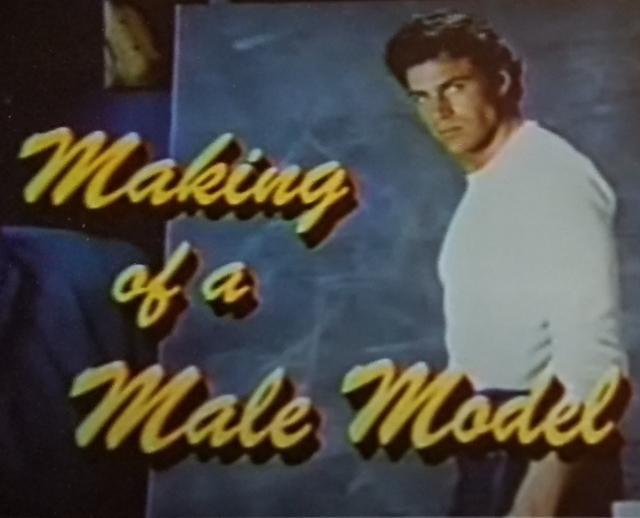
Here is a screenshot I took with my phone of the movie’s opening title. Screenshot taken by me, Sally Silverscreen.
Things I liked about the film:
The acting: Because Joan Collins’ involvement in this movie is one of the reasons why I chose to review this film, I’ll talk about her performance first. In stories where the head of a fashion or modeling firm is one of the main characters, they either have an obvious self-centered personality or they come across as emotionally distant. With Joan’s portrayal of Kay Dillon, she brought something different to a role like this. For most of the film, Kay appeared genuinely kind-hearted and nurturing. The only times Kay sounds self-centered is when she is upset. When Kay and Tyler discuss their plans over lunch is a perfect example, as she explains how she can’t spend much time with him because she had spent ten years building her career. Speaking of Tyler, I enjoyed watching Jon-Erik Hexum’s performance! He did a good job portraying a character in his specific situation. At the beginning of the movie, Tyler is a “fish out of water”, overwhelmed by the modeling world and taken aback by some of the things that take place in that world. As the film progresses, Tyler gains more confidence and his perspective begins to change. I also liked Jeff Conaway’s portrayal of Chuck Lanyard! It was dramatic and emotional without being over-the-top. One of Jeff’s best scenes is when his character is comparing the modeling world to a stage play. That scene proved to me Jeff has the talents for a Broadway show!
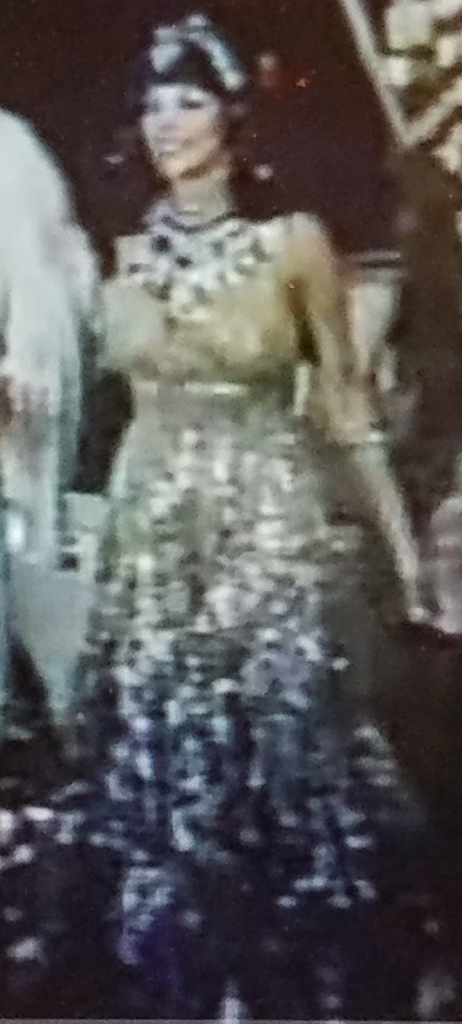
The costume design: In one scene, Tyler and Kay attend a costume party. The costumes were so elaborate and detailed, I honestly thought they were going to the Met Gala! One of the party goers wore a large hat in the shape of eyes. The piece around the blue eyes appeared periwinkle, with the hat portion blending into a pretty purple. Kay’s dress was absolutely gorgeous! It was covered in sparkles, allowing the dress to shine whenever Joan moved. The top of the dress was gold, with the skirt adopting an ombre design of blue and purple. A clear jeweled collar completed the look. During a photo shoot, one of the models was wearing a hat with a bird on it. The bird was covered in purple jewels, sparkling anytime the model moved her head. It was such a cool piece that I’d love to have in my wardrobe!
An insightful look into the world of modeling/advertising: Out of the episodes of Murder, She Wrote I’ve seen, my favorite one is ‘Film Flam’. One of the reasons is the behind the scenes look at how a movie premiere is organized. Throughout Making of a Male Model, the world of modeling and advertising is explored. When Tyler goes to apply for a catalogue modeling job, he is turned down due to his appearance and his lack of a portfolio. This instance shows how fast-paced this particular world can be and how one must always be prepared to bring a good first impression. At one point in Tyler’s journey, Tyler takes part in television commercials. Before a commercial for cologne was filmed, the director conducted a practice run in order to help Tyler remember what to do. It was interesting to see how the sets were constructed, how far the crew was willing to go to create an image or an idea. It was also interesting to see the prep work that goes into creating a commercial.
What I didn’t like the film:
Lack of on-screen chemistry: During the film, Tyler and Kay form a romantic relationship. However, I never sensed a spark between them. Jon-Erik and Joan worked well together from an acting perspective. But when it came time for their characters to become intimate, it felt like they were following story points within a script instead of allowing their characters to form a connection. Tyler and Kay’s relationship comes to fruition after the costume party I mentioned earlier. But up until that moment, Tyler and Kay did not express any interest in falling in love with each other. So, the formation of their relationship, from a story telling perspective, felt forced and random.
Following the same beats: As I said in the introduction, I wanted to watch Making of a Male Model because it told a model’s story from a man’s perspective, which is not often explored in the world of cinema. Because of this, I was expecting the movie to tell a different kind of story from others of this nature. Sadly, it was just more of the same. The story followed a lot of the same beats as other modeling/seeking fame films. Making of a Male Model featured tropes such as “the two-faced boss”, “a cautionary tale about fame and fortune”, and “a friend in crisis”. This movie had an opportunity to take different avenues of the modeling or advertising world that either haven’t been or are rarely discussed in film. But that opportunity was not taken advantage of.
Telling more than showing: There were some moments in Making of a Male Model where characters told more than showed what was happening. As I already mentioned, Chuck compares the modeling world to a stage play. I did like Chuck’s monologue and Jeff’s performance. However, because this monologue was given before Tyler’s modeling career began, it denied the audience a chance of seeing Tyler’s journey firsthand, without being spoiled. At the costume party, a man named Ward accuses Kay of breaking a contract. It gets to the point where Ward starts causing a scene. Since this accusation is presented as hearsay, it is never determined who was telling the truth.
I apologize for the poorer quality of this photo, but it was one of the few complete shots of the dress this movie presented. Screenshot taken by me, Sally Silverscreen.
My overall impression:
I know that stories are bound to get repeated overtime. But there is a fine line between telling similar stories and rehashing material. Making of a Male Model fits into the latter category, as the same tropes are adopted from other films of this nature. Honestly, this disappoints me because I was expecting more from this movie. Despite finding Making of a Male Model to be just ok, there are aspects of the film I liked. One of them is the insightful look at the modeling/advertising world. This part of the story held my interest, as I found it to be a fascinating exploration. With that in mind, I think the concept of this movie would have worked better as a television show or documentary.
Before I finish this review, I’d like to let my readers know I did choose another book from my TBR Tin. For those who don’t know, I announced in January how I would choose which book to read next from a hot chocolate tin I won last year. My second TBR Tin book of the year is
(insert drumroll here)
Closed for the Season by Mary Downing Hahn!
Yes, this is a book I said I was going to read in 2019. But I’m glad to finally get around to reading it!
Overall score: 6.1 out of 10
Have you seen Making of a Male Model? Which projects of Joan Collins’ have you watched? Let me know in the comment section!
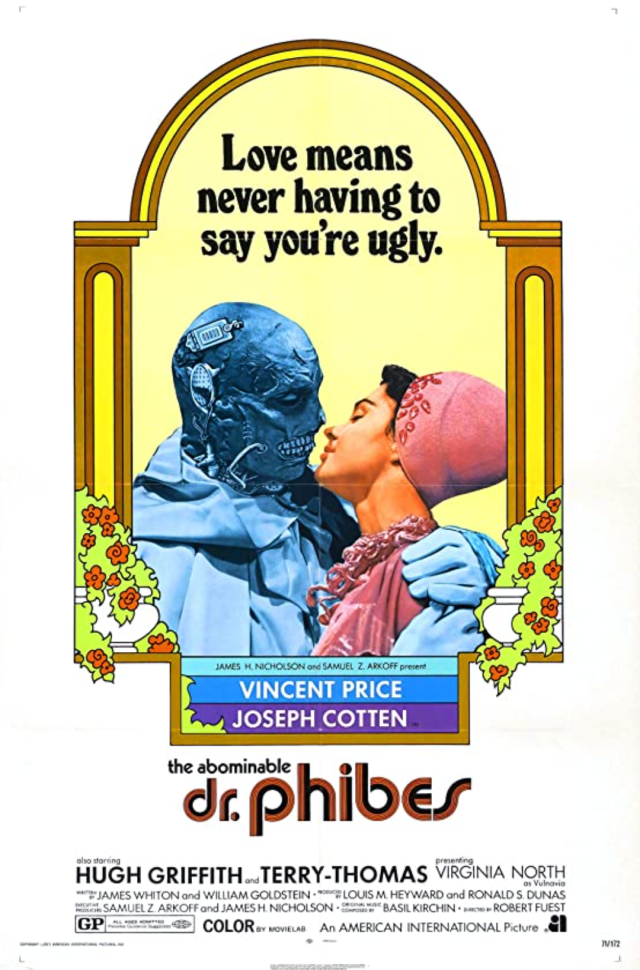
The Abominable Dr. Phibes was recommended by one of my readers named Michael. When I found out the movie was considered a horror-comedy, I thought it’d be a perfect entry for MovieRob’s Genre Grandeur, as horror-comedies are the theme for February. Then I discovered the film was released in 1971. Because Kim and Drew, from Tranquil Dreams and Drew’s Movie Reviews, are hosting the 6th Annual Ultimate Decades Blogathon, where the subject is movies premiering in years ending in 1, I decided to review The Abominable Dr. Phibes for both blogathons! As of early 2021, this is the fifth film of Vincent Price’s I’ve seen and written about. Most of these movies have either belonged in the horror genre or have been mysterious in nature. With The Abominable Dr. Phibes, this will be a little different, as part of the story is a comedy. Out of the movies of Vincent’s I have seen, none of them have featured a large amount of humor. So, by choosing this film for the aforementioned blogathons, I am given an opportunity to see Vincent work with slightly different material!
The mystery: In horror movies, there is usually a mysterious element that can come in a variety of forms. One of these forms is a mystery. Throughout The Abominable Dr. Phibes, the detectives at Scotland Yard are attempting to figure out why several doctors in their neighborhood are dying of mysterious causes. The way the mystery is presented allows the audience to solve it alongside the characters. This presents the idea of the audience sharing an experience with the detectives in the film. Even though we see what is making these doctors die, it doesn’t take away from the intrigue of the mystery. In fact, it keeps the audience invested in what is about to happen next. Seeing how all the pieces of the story connected was interesting to see. It definitely kept my attention as I watched the film!
The craftmanship: There were several items in this movie that caught my eye due to their quality and artistry. A frog mask is just one example. The head covering mask is covered in three different shades of green, allowing it to shine from many different angles. Gold piping can also be found on the mask, assisting in distinguishing its shape. Jewels add finishing touches as the mask features gold gems around the frog’s eyes and an emerald clasp in the back. Dr. Phibes’ mask also boasts incredible craftsmanship! The eye covering mask is shaped like a bird and is coated in shiny shades of green, bronze, and gold. Both masks were two of the most beautiful I’ve ever seen!
The set design: The Abominable Dr. Phibes features several interesting set designs that are worth noting. Despite Dr. Phibe’s house only being shown at night and only part of its exterior could be seen, it was a magnificent structure! Its Victorian style brightened the night with its white frames and cherry wood doors. The house features a grand white marble staircase paired beautifully with chandeliers and crystal sconces. I wish more scenes had taken place by this staircase, as it is an impressive part of Dr. Phibes’ residence! Other locations in the story also displayed memorable set designs. Dr. Vesalius’ apartment is a great example. Near the front door is a curved, frosted window. The door itself was covered in a light and dark wood that ending up complimenting the faded yellow walls. This location looked reflective of the late ‘60s to early ‘70s due to its color scheme and furniture selections.
The underutilization of Vincent Price: As I said in my introduction, this is the fifth film of Vincent Price’s I’ve seen. Therefore, I, as an audience member, know what he is capable of, talent wise. Despite being the top billed actor in The Abominable Dr. Phibes, Vincent wasn’t given much material to work with. He didn’t have any speaking lines in this movie. While there is an explanation given within the story, the only time we hear Vincent’s iconic voice is through recordings. It also doesn’t help that the different ways Dr. Phibes went after his victims overshadows Vincent’s performance. The more I think about it, the more I wonder if the creative team behind this film cast Vincent Price simply to get more people to see the movie?
Weak on comedy: The Abominable Dr. Phibesis classified as a horror-comedy. When I made this discovery, I was expecting the movie to be more like Young Frankenstein. Even though there were a few times I found myself giggling, the film didn’t contain much humor. The Abominable Dr. Phibes relies more on the horror genre. It also contains a mystery within the overall plot, which would make it a horror-mystery. I felt misled after these reveals.
Depiction of demises partially used for shock value: Strictly from a story-telling perspective, it was interesting to see how Dr. Phibes carried out his plan. But when the plan is put into practice, the depiction of his victims’ demises comes across as more gross than scary. Within a segment of the story involving rats, there was a brief shot of a rat chewing on what looks like a bloody bone. I won’t spoil The Abominable Dr. Phibes, in case any of my readers haven’t seen it. But parts of the film like the one I described feels like the movie’s creative team just wanted to shock their audience.
When I think of the term “horror-comedy”, Young Frankenstein immediately comes to mind. Even though I haven’t seen this film, I am aware of its premise. Because of my expectations, I was somewhat let down by The Abominable Dr. Phibes. Sure, its mystery was intriguing and kept me invested in the overall story. But as I look back on this movie, I find myself expecting more. Despite its classification as a horror-comedy, it ended up being a horror-mystery, with very little comedy to be found. I was also disappointed to see Vincent Price underutilized in The Abominable Dr. Phibes. While he was given different material to work with, he didn’t have any speaking lines. The way Dr. Phibes’ victims met their demise overshadowed Vincent’s performance. These factors make his portrayal of the titular character feel like a part of an ensemble instead of someone leading a film. This is an interesting movie, but I can think of stories of this nature that are stronger than this one. I still prefer a picture like The Crow over The Abominable Dr. Phibes.
Overall score: 7-7.1 out of 10
Have you seen a horror-comedy? Which film of Vincent Price’s would you recommend? Share your thoughts in the comment section!
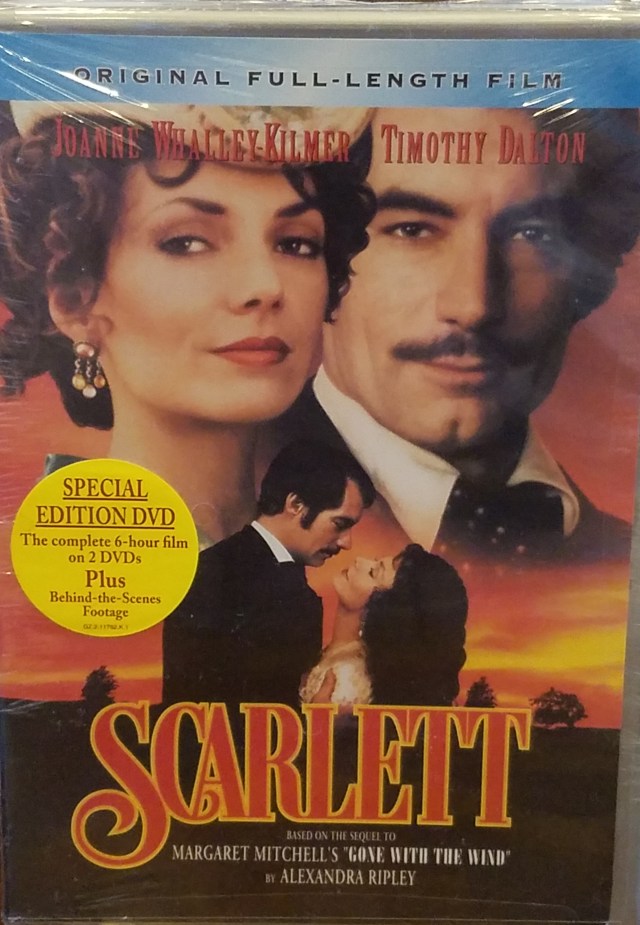
Originally, I was going to review a different movie for the 3rd Annual So Bad It’s Good Blogathon. But when I found a DVD copy of Scarlett at a local consignment store, I couldn’t pass up an opportunity to review the film! Last year, I discovered Gone with the Wind received a sequel many years after its release. While I’m not a fan of the sequel’s predecessor, I thought the 1994 film would be perfect content for the aforementioned event. According to IMDB, Scarlett premiered as a TV mini-series. This gives the sequel a run-time of six hours, which is even longer than the first movie. I never thought Gone with the Wind needed another chapter, as everything ended on a definitive note. However, curiosity got the best of me, as I wanted to find out if this could finally be the “so bad it’s good” movie I’ve been looking for!
This is the DVD I purchased from a local consignment store. Even the packaging calls Scarlett a six hour film. Screenshot taken by me, Sally Silverscreen.
Things I liked about the film:
The acting: While I like the acting overall, there were three performances that were stand-outs. The first one came from Sean Bean. I haven’t seen much from his filmography, but I remember his portrayal of Ian Howe from National Treasure. Based on these two movies, it seems Sean is very talented when it comes to portraying on-screen villains! Without spoiling the film, I will say Lord Richard Fenton is a despicable individual. However, it was interesting to see how Sean carried his character in each scene he appeared in. Whenever in public or around Scarlett, Richard comes across as a dashing gentleman. But behind closed doors, he reveals himself to be selfish and controlling, which makes Richard’s overall persona very ugly. In all my years of watching movies, I’ve seen few actors effectively portray characters that had likable and unlikable qualities. Within the film, Scarlett, Sean single-handedly accomplished this; making the audience despise Richard, but appreciate Sean’s acting abilities! The second stand-out performance was Annabeth Gish’s! In historical fiction/period stories, few female characters from a wealthier background contain a personality that is gentler in nature. With the way Annabeth approached her character, Anne, she brought something to the table that isn’t seen often. This not only provided a contrast to Scarlett, but allowed Anne to be her own character. Anne’s gentleness came across on screen very naturally as well! Tina Kellegher’s portrayal of Mary Boyle is the third stand-out performance! A strong sense of emotionality worked in Tina’s favor. This component to her performance presented her character as a believable individual, as if Mary had actually existed at some point in time. Miss Boyle experiences some difficult situations throughout the movie. However, Tina pulled off a performance that appeared flawless!
The costumes: In period films, one of the notable aspects is the costumes. They are one example of a physical representation of the story’s respective time period. The costumes in Scarlett not only looked historically accurate, but also impressive! It also helps how the costumes compliment the actors wearing them. Scarlett’s wardrobe was amazing! It featured a color palette that never appeared over-the-top. Each piece featured patterns and textures that felt fitting for the 1870s, with color combinations working well together. I honestly can’t choose a favorite outfit, as it was fun to discover what outfit Scarlet would wear next! While I realistically don’t have any place to wear one of Scarlett’s outfits, it’s nice to think about which piece I’d like to own in real-life.
The conflict between the British and Irish: Within the overall story, there was an ongoing conflict between the British and Irish. According to the Irish characters, this was due to the British wanting to take over Ireland. I’m not familiar with this particular period in world history. Despite that, I found this part of the story to be fascinating! Because of Scarlett’s Irish heritage and the fact she had family living in Ireland, it gave Scarlett a reason to be aware of the political and social environment around her. Her interactions with Richard also highlight the different sides of the conflict itself. There were other people in this story who were directly connected to this conflict as well. One of Scarlett’s cousin’s, Colum, is a priest. However, he is also a member of a group of Irish people fighting for freedom against the British. It was interesting to see how Colum navigated his own struggles of religious duty and standing up for his people.
Scarlett and Rhett’s on-again/off-again relationship: I am not a fan of Scarlett and Rhett’s relationship. Even when I try to give it a fair chance and watch it with an open mind, I still do not like their relationship in this movie. One of the reasons why is how it was continually on-again/off-again. This was so repetitive, it became tiresome. It was also difficult to determine if Joanne Whalley and Timothy Dalton, the actor and actress who portrayed Scarlett and Rhett, had any on-screen chemistry. Scarlett and Rhett’s relationship problems did not need to be explored, especially after Gone with the Wind’s ending. In fact, seeing Scarlett and Rhett’s on-again/off-again relationship diminishes one of the most famous scenes and quotes in cinematic history, where Rhett says “Frankly, my dear, I don’t give a damn”. In my opinion, this situation took place simply to justify the sequel’s existence.
Unnecessary stories: As I already mentioned in my previous point, Scarlett and Rhett’s on-again/off-again relationship felt like it was taking place simply to justify the sequel’s existence. This wasn’t the only story within the film to make me feel this way. In the first half of Scarlett, Ashley is struggling to keep his business afloat. Scarlett recruits Sam, a former slave of the O’Hara household, to assist Ashley in building more homes, in order to save Ashley’s business. That storyline is one I found myself not caring about. It also didn’t lead anywhere, as it didn’t have a consistent presence in the overall film. Scarlett’s feud with her sister was another story I thought was unnecessary. Throughout the film, they refused to see eye-to-eye about the future of Tara. While Scarlett’s sister was still living in the house, Scarlett was considering selling it. I thought it was odd for Scarlett to think about selling Tara. In the first movie, she loved Tara so much, Scarlett slapped a woman in the face for expressing her opinion against the place. For Scarlett to completely change her mind without any explanation seemed random.
Choppy scene transitions: At some points in the movie, there were scene transitions that were so abrupt, it caused the film’s overall flow to feel choppy. When visiting a family member, Scarlett is about to share how she became so wealthy. Right as she was about to tell her story, the next scene started, showing another family member walking toward his house. It seemed like parts of the movie were missing. Some of these scene transitions were so jarring because the change of tone was so drastic. One scene showed Colum speaking with an Irish neighbor about their plans to fight the British. This dramatic and serious moment was met with a light-hearted scene where Scarlett goes to a horse fair. The journey from point A to point B needed a bridge.
I can’t call Scarlett “so bad it’s good”. In fact, I would never consider it a bad movie. Objectively, this is a competently made project, where the creative team behind it clearly knew what they were doing. Subjectively, Scarlett is a mixed bag. The conflict between the British and Irish was the best part of this story! It was fascinating to see it unfold and discover how the characters were involved. With the parts of the story directly referencing Gone with the Wind, I found those to exist simply to justify the sequel. Until Scarlett went to Ireland, I was questioning why the movie was made. Personally, I would rather watch a miniseries about the British and Irish conflict over the one I just did. As I wrap up this review, I realize I still haven’t found my “so bad it’s good” movie. Time to go back to square one.
Overall score: 6.1 out of 10
Do you have a movie in your life that you’d consider “so bad it’s good”? If so, what is it? Let me know in the comment section!