I wrote a Word on the Street story three days ago about movie theaters in the United Kingdom broadcasting Eurovision’s Grand Final for a third year. Last February, I wrote another Word on the Street story about Eurovision’s Grand Final being presented in Spanish cinemas. Like the United Kingdom, Spain will continue their cinematic tradition! Eurovoix News reports Cine Yelmo, a “cinema company” from Spain, “will be airing the Grand Final of the contest live in their 42 cinemas across the country”. Those interested in attending the event can “buy tickets through a pre-sale on the company’s website”. Also like the United Kingdom, Spain is taking advantage of their participation in the Eurovision Song Contest. Because they are one of the “big five” countries, they are automatic qualifiers of the contest’s Grand Final. Spain is hosting PrePartyES, from April 17th to April 19th.
What are your thoughts on this piece of news? Are there any Eurovision participating countries you wished screened the Grand Final at their theaters? Tell me in the comment section!
Last April, I wrote a Word on the Street story about multiple cinemas in the United Kingdom (U.K.) broadcasting Eurovision’s Grand Final. This year, the tradition continues! In an article from Eurovoix News, it’s reported that “CinemaLive who are distributing the contest in cinemas, will for a third year in a row enable fans of the contest to watch the Eurovision Song Contest on the big screen in the United Kingdom”. John Travers, who helped bring the experience to fruition in 2024, said, “There’s simply no better way to enjoy the biggest night in music than in a cinema, surrounded by fellow fans”. The U.K. is, once again, capitalizing on their involvement in the Eurovision Song Contest. They are one of the “big five” countries, so they automatically qualify for the contest’s Grand Final. United Kingdom will also host London Eurovision Party on April 13th.
What are your thoughts on this piece of news? Which Eurovision participating country do you wish screened the Grand Final at their theaters? Please tell me in the comment section!
Two months ago, I wrote a Word on the Street story about how a movie theater chain in Spain will present Eurovision’s Grand Final in their cinemas. In that article, I said I hoped fellow Eurovision participating countries are inspired to provide experiences like the aforementioned Spanish theaters to their Eurovision fans. According to Eurovoix News, I kind of got what I wanted! Originally reported on April 6th, the second-year event will be broadcast “in over 100 cinemas across the United Kingdom”. An official statement from John Travers, from CinemaLive, said, “We want audiences to enjoy themselves, come along in groups, get your fancy dress on, and come together to enjoy this incredible occasion on the big screen!” Similar to Spain, the United Kingdom (U.K.) is capitalizing on their involvement in the song contest. Labeled as one of the “big five” countries, the U.K. is an automatic qualifier for Eurovision’s Grand Final. It is also one year since the U.K. delegation co-hosted Eurovision in 2023.
Theater seats image created by weatherbox at freeimages.com. “FreeImages.com/weatherbox.”
What are your thoughts on this piece of news? Which Eurovision participating country do you wish screened the Grand Final at their theaters? Please tell me in the comment section!
Though this piece of movie news isn’t actually “movie news”, it does involve movie theaters. Therefore, this month’s Word on the Street story provides an interesting tidbit of news. Originally reported on February 23rd by Eurovoix News, the Spanish theater chain, Cinesa, has agreed to present Eurovision’s Grand Final in their theaters. With tickets becoming available on April 1st and continuing this screening for a seventh year, Cinesa is carrying their tradition of bringing Eurovision to the contest’s Spanish fans. Over the years, I’ve heard of sporting events and theatrical productions being broadcast in cinemas. There have even been concerts recorded in a documentary style and screened at theaters. But this is the first time I have heard Eurovision being shown in a movie theater. Spain is certainly capitalizing on their presence in the competition, as Spain is not only competing in Eurovision’s Grand Final, the Spanish band, Megara, will be representing San Marino. Cinesa’s decision to present Eurovision’s Grand Final makes me hope fellow Eurovision participating countries are inspired to provide experiences like this for their Eurovision fans!
At the beginning of this year, I announced I was participating in the Eurovisionathon readathon. Created by Helen, from the Youtube channel, Helen’s Book Haven, the goal of this readathon is to read books associated with countries competing in Eurovision within a month-long time-frame. One of the books I planned to read was The Geography of Bliss: One Grump’s Search for the Happiest Places in the World, as one of the countries featured in the text is Moldova. When the themes for 2023’s Buzzwordathon were announced, I discovered April’s theme was ‘emotions’. This means at least one emotion related word had to be in a book’s title. The Geography of Bliss: One Grump’s Search for the Happiest Places in the World happens to contain three emotion related words: bliss, grump, and happiest. Therefore, I was able to read this book for both readathons!
In The Geography of Bliss: One Grump’s Search for the Happiest Places in the World, Eric Weiner, the book’s author, attempts to find the happiest countries in the world, based on data and research. Each chapter to devoted to this exploration, with Eric including study results, some of a country’s history, and even insight from a few of a country’s residents. Throughout the text, Eric brings up thought-provoking ideas that made me contemplate how Eric’s findings applied outside of the book. One common finding was Eric’s discovery of more ways to describe sadness than happiness. This discovery reminded me of my best and worst movies of the year lists. When I write these lists, I find it easier to talk about movies I don’t like. That’s because I feel compelled to explain why a movie is bad. But if I come across a movie I like, that movie, in my opinion, speaks for itself. This makes me put more thought into writing about good movies.
The Geography of Bliss: One Grump’s Search for the Happiest Places in the World contains ten chapters. Most of these chapters are longer in page length, ranging from about fifteen to twenty pages. If I were reading this book just for Buzzwordathon, the length of the chapters wouldn’t be an issue. Since I read the book for Buzzwordathon and Eurovisionathon, the chapters made the book feel longer than necessary. Despite its flaws, though, The Geography of Bliss: One Grump’s Search for the Happiest Places in the World is a fine and interesting book. While I don’t plan on revisiting it, the book did allow me to expand my literary horizons!
Overall score: 3.6 out of 5
Have fun during Buzzwordathon and Eurovisionathon!
Sally Silverscreen
Disclaimer: The Geography of Bliss: One Grump’s Search for the Happiest Places in the World contains content that may be offensive to some readers, as Eric’s approach to each country discussed is honest and realistic. Reader discretion is encouraged.
With my Travel Gone Wrong Blogathon underway and the start of May around the corner, it’s time for another Buzzwordathon book review! For April, the theme is ‘Big & Little’. Participants had one of two options: 1. Read a book that has the word ‘big’ or ‘little’ in the title or 2. The title has to feature a word associated with ‘big’ or ‘little’. Because I happen to own a beautiful copy of A Little Princess and because ‘little’ is in the middle of that book’s title, I decided to read Frances Hodgson Burnett’s classic! The 1905 story has been a favorite of mine for a very long time. However, this is the first time I read it in a novel format.
Here is a screenshot of my copy of A Little Princess. Sorry if the cover’s bottom half appears blurry. I tried to capture how sparkly the cover is. Screenshot taken by me, Sally Silverscreen.
While reading A Little Princess, I became nostalgic of the 1995 adaptation, as I have loved that film since its release. So, it was interesting to read how similar and different the movie was from its respective source material. One major difference is how Frances provides explanations for character motivations and situations. I haven’t seen the 1995 adaptation of A Little Princess in years. From what I remember, though, Sara’s dad goes missing during battle and is assumed dead. This provides the catalyst for Sara’s struggles and lost fortune. Looking back on the film, it never made sense, to me, for Sara to lose everything simply because her father was missing in action. If her dad knew there was a chance he could be in danger, wouldn’t he have created a will for Sara? The source material provided a stronger explanation for the lost fortune, as Sara’s father invested in diamond mines, but his money was mishandled. Even though this situation is resolved by the book’s end, the inclusion of these explanations was a strength for the book itself!
Another strength of the book is how Frances used descriptions to flesh out the characters and their world. At the beginning of the story, Sara is referred to as “wise beyond her years”. She’s also described as “intelligent”, “imaginative”, and “courageous”. Interactions between characters and narrations from an anonymous narrator provide proof of those statements. On the first day of class, Miss Minchin gives Sara a French textbook in preparation for an upcoming French lesson. Throughout this scene, Sara tries to explain to the headmistress that she already knows basic French, as she grew up learning the language from her dad. It’s not until the French teacher arrives that he and Miss Minchin discover how advanced Sara is in French. In the 1995 adaptation, important and timeless messages and themes can be found throughout the story. That is also true for the source material! Because Sara imagines she is a princess, she assumes how a princess would behave. This includes assuming how a princess would treat others. After finding some money on the ground, Sara plans to buy some food from a nearby bakery. But just before she enters the bakery, Sara sees a girl who appears to be worse off than herself. With the found money, Sara purchases a set of rolls. But she ends up giving most of the rolls to the aforementioned girl.
Here is one of the full page illustrations that is featured in my copy of A Little Princess. Artwork created by Ethel Franklin Betts and found on https://en.wikisource.org/wiki/A_Little_Princess.
Even though A Little Princess has been near and dear to my heart, I’ll be one of the first readers to admit it is not a perfect or near perfect book. Though this flaw wasn’t consistent throughout the text, there were times when parts of the story were repetitive. A portion of the book’s last chapter provides a great example, as it re-caps almost everything that happened prior to that point. As a reader, I don’t like longer chapters. This can, sometimes, cause a book’s pace to be slower. While A Little Princess’ pace was steady, the book contained longer chapters, with thirteen pages given to the longest chapter. In my copy of the book, there are full page illustrations that bring to life certain parts of the story. I honestly wish these illustrations had a more consistent presence, as they could have broken up some of the chapters. Other than that, though, I still enjoyed reading A Little Princess all these years later! I’m so glad I was given the opportunity to read it again!
Overall score: 4.1 – 4.2 out of 5 stars
Have fun during Buzzwordathon!
Sally Silverscreen
Disclaimer: Because A Little Princess was published in 1905, some of the words and phrases are reflective of that time, with their context different from today. A few of these words are “queer”, “gay”, “fat”, and “chubby”. At one point in the story, a man from India is referred to as “oriental”. There is also a stereotype about Chinese people included in the text. Again, these parts of the story are reflective of the book’s time; 1905.
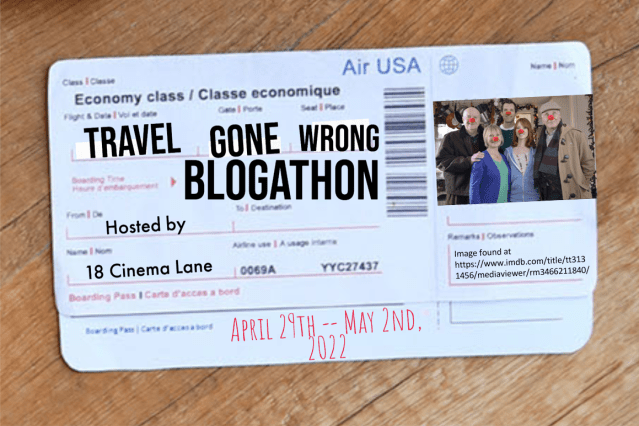
Hi everyone! I just wanted to let you know that if you’re interested in participating in my Travel Gone Wrong Blogathon, you have a month left to sign up! Just click on the link in this post to learn more about the event!
As I start this blogathon announcement, I’d like to thank Gill, from Realweegiemidget Reviews, and Rebecca, from Taking Up Room. If they hadn’t chosen Red Corner for me to review for their Odd Or Even Blogathon, I wouldn’t have found an inspiration for this year’s event! While looking back on the 1997 movie, I thought about all the movies or television show episodes where a trip doesn’t go according to plan. Realizing how many I could think of off the top of my head, my blogathon theme was born! Like past events, The Travel Gone Wrong Blogathon invites participants to get creative by reviewing, analyzing, or discussing a movie, tv show episode, piece of music, stage play, book, artwork, or any other entertainment media relating to this year’s theme! If you’re interested in taking a (figurative) trip from April 29th to May 2nd, keep reading as I share my blogathon’s official rules!
Please be respectful toward other participants and the subject(s) you’re writing about.
Please let me know in advance if you plan on publishing your post(s) earlier or later than the allotted time-frame (April 29th to May 2nd).
Only new posts will be eligible for this year’s event.
Because this year’s theme is so broad, I am not allowing duplicate entries.
There is a three-entry limit for each participant.
All entries must be original work.
No travels are too big or small. Your entry can revolve around trips as extensive as week or month long excursions or as simple as a trip to the grocery store.
Domestic (within the United States), international, or galactic travel is eligible for your entry/entries.
Entries will be placed in one of two categories; hilariously wrong or horrifyingly wrong. Hilariously wrong means the results of a trip gone wrong are supposed to make you laugh. Some examples are the Walt Disney World episode of The Middle, A Very Merry Mix-Up, and Home Alone 1 and/or 2. Horrifyingly wrong means the results of a trip gone wrong are supposed to horrify you. Examples include Red Corner, the Touched by An Angel episode, ‘The Spirit of Liberty Moon’, and Taken.
If you’re interested in participating, please share your idea(s) in the comment section below.
Pick one of the four banners and let others know about The Travel Gone Wrong Blogathon, so they can join in on the fun!
Hilariously Wrong
Rebecca from Taking Up Room — Review of Andy Hardy Meets Debutante (1940)
Hamlette from Hamlette’s Soliloquy — Review of French Kiss (1995)
Gill from Realweegiemidget Reviews — Review of Our Ladies (2019)
J-Dub from Dubsism — Review of Planes, Trains, and Automobiles (1987)
Ruth from Silver Screenings — Review of Mr. Hobbs Takes a Vacation (1962)
Classic Movie Muse from The Classic Movie Muse — Review of The Great Race (1965)
Crystal from In The Good Old Days Of Classic Hollywood — Review of The Long, Long Trailer (1954)
Created by Sally Silverscreen at Adobe Creative Cloud Express
Created by Sally Silverscreen at Adobe Creative Cloud Express
Horrifyingly Wrong
Evaschon98 from Classics and Craziness — Review of Flightplan (2005)
J-Dub from Dubsism — Review of Airport (1970)
Debbie from Moon In Gemini — Review of Train to Busan (2016)
Eric from Diary of A Movie Maniac — Review of The Lost Weekend (1945)
Created by Sally Silverscreen at Adobe Creative Cloud Express
Created by Sally Silverscreen at Adobe Creative Cloud Express
Earlier this month, 18 Cinema Lane received 340 and 345 followers! Before I continue, I’d just like to say thank you to each and every person who has chosen to follow my blog. I appreciate you taking the time to read my articles and listen to what I have to say. Speaking of articles, let’s back to the review! For April’s Genre Grandeur, the theme is “travel films”. Because this topic is so broad, it took me a while to figure out which film I would write about. Then I remembered I had the 1966 movie, Born Free, on my DVR. While Joy and George Adamson, the story’s protagonists, do travel within the movie, it is not the central component of the story. I also have participated in Thoughts From The Music(al) Man’s Star/Genre Of The Month Blogathon, with my review of China Seas being my first contribution. April doesn’t have a theme, so I thought Born Free would be the perfect choice for the blogathon! Prior to writing this review, I had heard of, but not seen, the 1966 picture. This is because I was familiar with the movie’s theme when it was featured on the soundtrack for the film, Madagascar. Now, the moment you’ve been waiting for; the start of this review!
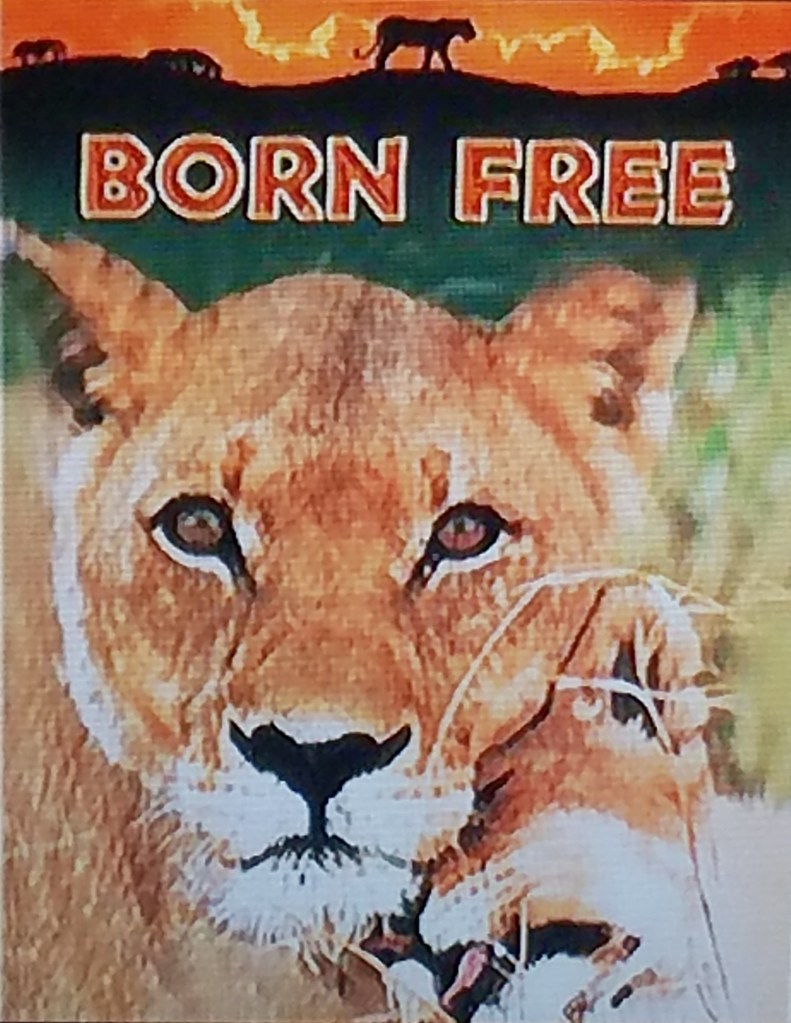
Because I recorded this movie on my DVR, I took a screenshot of the movie’s poster from my phone. Screenshot taken by me, Sally Silverscreen.
Things I liked about the film:
How the animals were showcased: While I liked the acting in Born Free, it’s the animals that steal the show! Animals were showcased in a natural way, allowing them to be shown in situations that are more realistic. None of the animals were given voice-overs, giving the audience a chance to witness their authentic expressions. A great example is when Elsa, the lion Joy and George take care of, interacts with a male lion. Throughout the scene, Elsa and the male lion take turns roaring. They also can be seen fighting over food. The way these lions were presented made it look like they were having a conversation. The human characters’ conversations about these animals also gave them a humanistic quality. After Joy and George leave Elsa alone with the aforementioned lion, Joy compares the experience to waiting for a daughter to come home from a date. The cinematography and script gave the animals just as much importance as the human characters!
The scenery: The majority of Born Free takes place outdoors, as the African landscapes serve as the principal scenery for the story. Toward the beginning of the movie, Joy is painting in her front yard. A clear blue sky enveloped a large space of plains. This specific location appeared peaceful as long shots were used to capture it on film. Another impressive location was the beach that Elsa, Joy, and George visit. Once again, a blue sky is visible, soaring over the blue of the ocean and bright beige of the sand. The beach was very photogenic, with long and medium shots helping to showcase that location!
The music: I liked the use of music in Born Free! The pieces of instrumental tunes provided the tone for each scene it was included in. When a suspenseful and tense moment took place, the sound of beating drums could be heard. This sound elaborated on the seriousness of what was happening in that particular scene. One example is when, toward the end of the film, Elsa is fighting with another female lion. For more light-hearted, joyful moments, the movie’s theme played in the background. Some scenes that featured this piece of music revolved around Elsa and her sisters as lion cubs.
An inconsistent narrative: When a close friend named John suggests Elsa should be placed in a zoo, Joy is completely against the idea. This decision has even resulted in a heated argument between Joy and George. Joy’s decision for wanting Elsa to remain wild is understandable. However, earlier in the film, she doesn’t object to sending Elsa’s two sisters to a zoo. Joy also takes in a baby elephant that Elsa happened to be chasing one day. This specific narrative was inconsistent, which prevented me from getting fully invested in Joy’s side of the story.
The run-time: According to IMDB, Born Free is an hour and thirty-five minutes. But because the story is a simpler one, I don’t think this movie needed that run-time. While watching the film, I noticed how some scenes contained montages. For example, when Joy, George, and Elsa go to the beach, a montage lasting several minutes featured these characters playing on the beach and in the ocean. I feel these montages were placed in the film to satisfy its run-time. Had these montages been shortened, the movie could have had a run-time of an hour or less.
Unnecessary voice-overs: Throughout the film, Joy provides voice-overs to explain what is happening in the story. These voice-overs were beneficial in understanding Elsa’s journey. But there were some scenes where Joy’s voice-overs were not necessary. At the beginning of a scene where Joy, George, and Elsa are at a camp, Joy explains how, one night, she heard the roar of a lion who was eating the livestock of a nearby African village. If the voice-over had not been included in this scene, the on-screen event could have spoken for itself. Having the voice-over only reminded the audience of what they already knew.
When you think of “travel films”, a movie where the protagonist takes an extravagant and adventurous trip will likely come to mind. However, traveling can mean different things for various people. In the case of Born Free, Joy and George Adamson travel from England to Africa. Throughout the film, they also travel to town and several African villages. As I mentioned in the introduction, Born Free does not focus on the travels of Joy and George. Instead, it prioritizes the relationship these characters share with Elsa. While I liked the natural portrayals of the animals, these depictions are more suited for an older audience. This is also a simpler story, calling for a shorter run-time than the one it received. Not only were some of Joy’s voice-overs unnecessary, but her stance on keeping Elsa out of a zoo was inconsistent. Despite these flaws, I thought Born Free was a fine film! If you are interested in the subject of animals, I feel this is the movie for you!
Overall score: 7.1-7.2 out of 10
Have you seen any “travel films” lately? Do you have any films to recommend for the next blog follower dedication review? Let me know in the comment section!
I’ve been working on a personal creative project that has taken me longer than I expected. But now I’m back to publish another poll for the 3rd Annual Gold Sally Awards! For this poll, you can vote for who is the Best actress from the movies I saw in last year. While you are able to choose more than one nominee, you can only vote once per person. This poll begins today, April 21st, and ends on April 28th.
Image of prom boutonniere created by Cynthia Lutes at freeimages.com. Photo by <a href=”/photographer/cindylutes-60975″>Cynthia Lutes</a> from <a href=”https://freeimages.com/”>FreeImages</a>. Image found at freeimages.com.







 18 Cinema Lane