Take 3: A Little Romance (1979) Review

Back in 2022, I wrote a list of the top ten movies I’d love to review. One of the films on that list was 1979’s A Little Romance. Since publishing that article three years ago, I haven’t gotten around to reviewing the movie. But Gill’s (from Realweegiemidget Reviews) and Barry’s (from Cinematic Catharsis) blogathon, Adventure-A-Thon, finally gave me an opportunity to check A Little Romance out! When it comes to “adventure” in cinema, that term can have different meanings depending on who you ask. For me, an “adventure” movie is when the story’s characters go on a journey to achieve something. In the case of A Little Romance, the protagonists, Daniel and Lauren, travel to Italy to prove the legitimacy of a legend. The 1979 film is not the only picture I’ve reviewed this year involving Italian travel. I wrote about Roman Holiday back in January. In my opinion, the movie was just ok, as I wanted to like it more than I did. Was A Little Romance ok like Roman Holiday? Let’s start the adventure of this review!

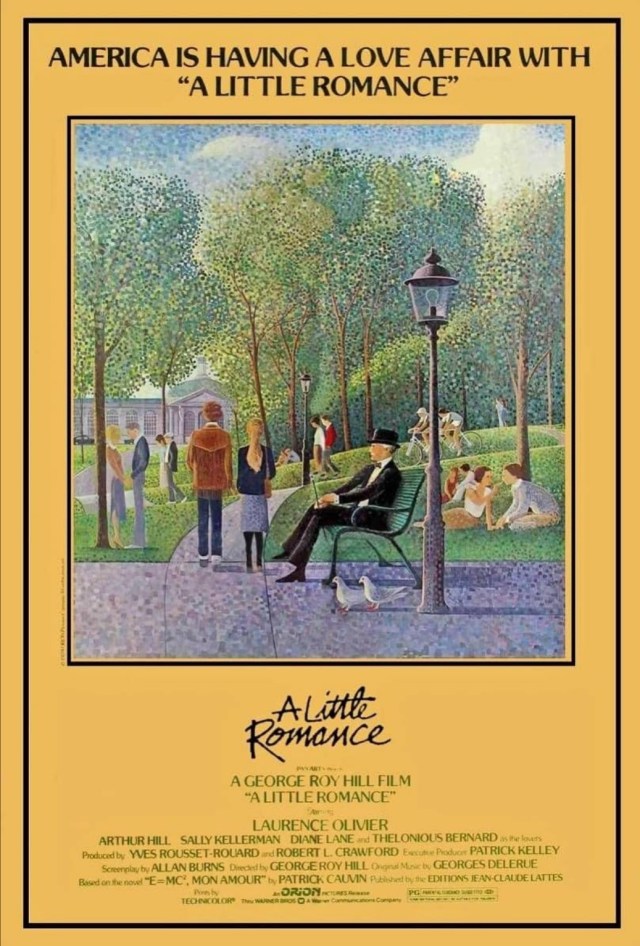
A Little Romance (1979) poster created by Orion Pictures, Pan Arts, Trinacra Films, and Warner Bros.

Things I liked about the film:

The acting: When it comes to teenagers in movies, it can be easy for a creative team to present those characters stereotypically. If written or directed to adopt certain behaviors and attitudes, teenage characters could even come across as caricatures. Fortunately, this was not the case in A Little Romance! Though there are only four teenage characters in the movie, their interactions didn’t feel scripted, making the characters themselves seem realistic. One example shows Lauren (portrayed by Diane Lane) and her friend, Natalie (portrayed by Ashby Semple), looking at sculptures during a class trip. As they observe the sculptures, Lauren nonchalantly tells tall tales about her time spent with Daniel. Natalie naively believes Lauren, her eyes becoming wide and her tone of voice revealing how shocked she is. Lauren, with a casual smile on her face and a giggle in her voice, then shares with Natalie how her tall tales were fabricated. This exchange between the two friends illustrates how teenagers can sometimes tease and joke with each other.

In this review’s introduction, I mentioned how the protagonists, Daniel and Lauren, travel to Italy to prove the legitimacy of a legend. Their journey was enjoyable to watch because of how strong Diane Lane and Thelonious Bernard’s on-screen chemistry was! Every time Lauren and Daniel interacted with one another, they always looked like they got along so well. There was a sweetness to their relationship that was wholesome and charming. It also helps how both Daniel and Lauren had likable personalities that complimented each other. While Thelonious and Diane deserve credit for their performances, credit should also be given to the screenwriting.

An appreciation for film: Before watching A Little Romance, I knew what the basic premise was about. But when I finally saw the 1979 picture, I was pleasantly surprised by the appreciation for film woven into the script! As soon as the movie starts, the audience sees Daniel watching a collection of films in a local cinema. As the story progresses, he sometimes quotes the movies he sees and even wants Lauren to call him “Boggie”, as he believes Humphrey Bogart and Lauren Bacall were meant to be together. Daniel’s decisions and perspectives are also influenced by the world of film. When Daniel receives rude comments about his relationship with Lauren from a movie director named George de Marco, Daniel punches George. Not only does Daniel strongly dislike George’s films, Daniel believes George’s comments cheapen the meaning of love he’s learned from movies.

The dialogue: In some of the movies I’ve reviewed this year, one of the strengths was the dialogue. The way it was written and delivered allowed this film-making component to be memorable for the right reasons. The dialogue was also a strength in A Little Romance! Through the screenwriting, the audience can tell how much thought was put into this aspect of the 1979 production. While Lauren talks about her family, Daniel asks her why she calls her stepfather ‘Richard’. Lauren replies by saying “It’s easier to lose a Richard than a dad”. From that one quote, Lauren is able to express how her mother’s multiple marriages have affected the family dynamic. In order to make enough money for their trip to Italy, Daniel and Lauren plan to bet on race horses. They want to figure out the betting odds to increase their chances of choosing a winning horse. When Lauren suggests using a computer to get these numbers, Daniel says “I am not a computer”. This simple quote stresses how humans, as well as betting odds, don’t always provide the correct answers.

The Adventure-A-Thon banner created by Gill from Realweegiemidget Reviews and Barry from Cinematic Catharsis

What I didn’t like about the film:

The adventure’s prolonged delay: Like I said in this introduction, Daniel and Lauren travel to Italy to prove the legitimacy of a legend. But their Italian journey doesn’t begin until a little over an hour into an hour and fifty-minute story. That’s because the first half of the movie is devoted to setting up the motives for the journey and building up to the trip itself. It’s important for any creative team to set up their movie’s premise and provide build up to significant parts of the presentation. For A Little Romance, however, that set up/build up took a little too long.

Lack of subtitles: About half of A Little Romance takes place in France. This means some scenes feature characters speaking in French to one another. But when the story presented French dialogue, subtitles did not appear on screen. For viewers who are not fluent in French, they may feel like the creative team is withholding context from them. Even though clues such as body language can help the audience assume what is happening in the story, I still wish subtitles had been included in A Little Romance.

An absence of Daniel’s father: At the beginning of A Little Romance, the audience is introduced to Daniel and his father, Michel. According to Daniel, Michel is a taxi driver who watches horse races from time to time. Throughout the movie, however, Michel’s appearances are so far and few between, I almost forgot he was in the movie. Meanwhile, Lauren’s parents, Richard and Kay, are consistently involved in the story. I recognize A Little Romance revolves around Daniel and Lauren’s relationship and adventure. But I still think Michel should have received a larger role in the film. Perhaps his involvement in the story could have related to one of the movie’s central themes.

Colorful travel suitcase image created by Pikisuperstar at freepik.com. <a href=’https://www.freepik.com/free-vector/beautiful-illustration-of-travel_2686674.htm’>Designed by Freepik</a>. <a href=”https://www.freepik.com/free-photos-vectors/watercolor”>Watercolor vector created by Pikisuperstar – Freepik.com</a>. Image found at freepik.com.

My overall impression:

When I first brought up A Little Romance in 2022, I said the story seemed like a light-hearted version of Rich Kids. While there is some truth to this statement, my initial claim now seems a bit too simplistic. Both Rich Kids and A Little Romance revolve around adolescent characters relying on themselves and each other to navigate the world around them. But unlike Rich Kids, there’s a hopeful optimism in A Little Romance! Because the story emphasizes Daniel and Lauren’s Italian journey, the audience witnesses Lauren and Daniel’s relationship grow throughout the story. The acting performances and screenwriting allow these characters to share meaningful and heart-felt moments together. Strong messages and themes are sprinkled into the script, from the importance of being your authentic self to having the courage to achieve dreams. Though it took a little over an hour for the journey to begin, A Little Romance is a delightful, pleasant film! A significant point the film makes is how adventure can come in different forms. The 1979 picture can also cause viewers to think about what it truly means to be a “legend”.

Overall score: 7.3 out of 10

Have you seen A Little Romance? What does the term “adventure movie” mean to you? Let me know in the comment section!

Have fun at the movies!

Sally Silverscreen
Take 3: Orca (1977) Review

When I participated in the first ‘Favorite Stars in B movies’ Blogathon two years ago, I reviewed the 1963 film, The Raven. I found Vincent Price’s picture to be a fine, likable one, which left me amazed how a simple story from Edgar Allan Poe could be turned into a feature presentation. For this year’s Third ‘Favorite Stars in B movies’ Blogathon, there were plenty of movies from Vincent Price’s filmography for me to choose from. But this time, I decided to go in a different direction. As I looked back at the history of my blog, I came to realize none of Richard Harris’ films have been covered on 18 Cinema Lane. I also remembered how the 1977 movie, Orca, was recommended to me by Eric Binford (from Diary of a Movie Maniac). With these two facts in mind, I found the perfect title to write about for the Third ‘Favorite Stars in B movies’ Blogathon! When Eric suggested Orca to me, he said the film steals from Jaws. Because I’ve seen the 1975 blockbuster, I imagined Orca to be a knock-off/rip-off of the iconic movie. But is the 1977 picture a copy of Jaws? Let’s dive into this review and find out!

Orca (1977) poster created by Famous Films (II), Dino De Laurentiis, and Paramount Pictures

Things I liked about the film:

Richard Harris’ performance: Because Richard Harris is one of the reasons why I chose to review Orca, I will now take the time to highlight his performance. In the 1977 movie, Richard portrays Captain Nolan, a fisherman who desires catching a whale in order to receive a large sum of money. His versatile acting abilities helped create a multi-layered character, one that is both tragic and complicated. After killing a pregnant whale, Nolan is very remorseful of his actions. One evening, he confides with Rachel Bedford (portrayed by Charlotte Rampling) over how he’d apologize to the dead whale’s mate. During this confession, Nolan adopts a somber look on his face, his eyes on the verge of tears. He even boasts a long frown. Nolan’s tone of voice is serious, sounding like he’s pleading for forgiveness. This one exchange presents a perfect example of Richard using his acting talents to bring his character to life!

An introduction to Orca Whales: Toward the beginning of the movie, Rachel Bedford lectures a group of students (and the film’s audience) about Orca Whales. This lecture is packed with information, from an explanation of the word ‘orca’ in Latin to showing a picture of an Orca fetus. On Captain Nolan’s boat, Annie (portrayed by Bo Derek) shares with Nolan how Orca Whales stay with their mate for life. He even receives a book from Rachel about whales in mythology. While some of the movie’s information may be dated (due to what’s been discovered about Orcas since the film’s release), it does provide an introduction to Orca Whales. Including this information into the script feels like the creative team made an effort to educate their audience.

Tonal variety in music: One of the most iconic pieces of music in film history is the theme from Jaws. John Williams’ score and the image of the titular shark sneaking up on its victims created a perfect, memorable combination. But compared to Orca, this piece of music seems to sensationalize the shark itself, as the suspenseful tune is the only music heard whenever the shark comes around. The first shot of the 1977 picture shows a group of Orcas swimming in their natural habitat. Peaceful, orchestral music plays in the background anytime whales are, simply, gliding from place to place. The only time suspenseful music is heard is when the titular Orca is causing chaos and destruction. This creative choice emphasizes how the whale has been provoked. Tones between different pieces of music show that while Orca Whales can have dangerous behavior, they can also be a great source of fascination.

The Third ‘Favorite Stars in B movies’ Blogathon banner created by Brian from Filmsfrombeyond.com

What I didn’t like about the film:

Inconsistent voice-overs: In Orca, Rachel narrates what is happening in the story. I actually liked this creative decision, especially since she was one of the most educated characters when it came to Orca Whales. What I didn’t like was how Rachel’s voice-overs were inconsistent. In fact, she only narrated about three times throughout the one hour and thirty-two-minute film. Had these voice-overs been more consistent, they could have been used as a bridge between scenes.

The underutilization of Will Sampson: Another reason why I wanted to review Orca is Will Sampson’s involvement in the project. After seeing One Flew Over the Cuckoo’s Nest and The White Buffalo, I was looking forward to watching another movie from Will’s filmography. When I finally checked out Orca, I was disappointed by how Will’s acting talents were underutilized. Not only did he appear in the film for a limited amount of time, he also received very few lines in the script. I, honestly, wish Will’s character, Jacob, had played a larger in the story, especially since he shared great insight about Orca Whales.

Limited character development: The story of Orca primarily revolves around the battle between the titular whale and Nolan. Because of this creative decision, Nolan becomes the only (human) character to receive character development. Other characters are simply known by their profession or an experienced scenario. Rachel is characterized as the scientist who is educated about Orca Whales. Annie is known as the lady who broke her leg. I understand there is only so much story to tell in one hour and thirty-two-minutes. However, I still believe a little more character development should have been included in the script.

Orca Whale image created by Freepik at freepik.com. Label vector created by freepik – www.freepik.com. Image found at freepik.com.

My overall impression:

In the introduction of my review, I said I imagined Orca to be a knock-off/rip-off of Jaws. But now I have seen the 1977 picture, calling it that does the film a disservice. I never got the impression Orca’s creative team was intentionally trying to copy the 1975 blockbuster. Instead, the film serves as a cautionary tale of how one’s actions toward animals and their natural environment have consequences. As I said in my review, including information about Orca Whales into the script feels like the creative team made an effort to educate their audience. This is different from Jaws, where (as far as I remember) education about sharks was far and few between. With that said, I wonder what would have happened if Orca had received anywhere near as much attention as Jaws? On the one hand, society’s perspective and treatment of Orca Whales may have changed much sooner. More knowledge and awareness may have already been reached before the 21st century. But, seeing how much merchandising and commercialism Jaws has produced in a fifty-year timespan, maybe Orca’s intended message would have gotten lost among the shuffle.

Overall score: 6 out of 10

Have you seen Orca? What are some of your favorite films with animals in title roles? Let me know in the comment section!

Have fun at the movies!

Sally Silverscreen
Comparing with the Critics – Worst of 1976 – Gable and Lombard

This review is from my series, Comparing with the Critics. If you’d like to learn more about the series, click on the link below.

Introducing my new series, Comparing with the Critics!

In the ‘Best Films of 1976’ episode of Opening Soon…at a Theater Near You, Gene Siskel stated “1976 was a pretty lousy year for movies”. He emphasized that statement by saying “the year was littered with dogs”. Since I haven’t seen a lot of movies from 1976, I can’t agree or disagree with Siskel’s claim. But what I can do is talk about one of Siskel’s choices for worst movies of 1976. As I said in my 1976 introduction of Comparing with the Critics, one episode was primarily focused on discussing the best movies from a given year. This left Siskel and Ebert with only a few minutes to talk about some of the year’s worst films. Despite the 1976 episode’s limited selection of “bad” movies, I chose Gable and Lombard for this edition of Comparing with the Critics Worst of review. What made Gable and Lombard the most interesting title from the episode’s collection of “bad” movies was the story’s emphasis on Clark Gable and Carole Lombard’s relationship. I am somewhat familiar with Clark and Carole, as I have reviewed at least one of their movies on 18 Cinema Lane. Because I hadn’t heard of Gable and Lombard until I saw the ‘Best Films of 1976’ episode of Opening Soon…at a Theater Near You, I viewed the film as a way to expand my cinematic horizons and learn more about Carole and Clark. Now that I have seen the movie for myself, I believe Siskel’s, and even Roger Ebert’s, thoughts on the film were a tad harsh.

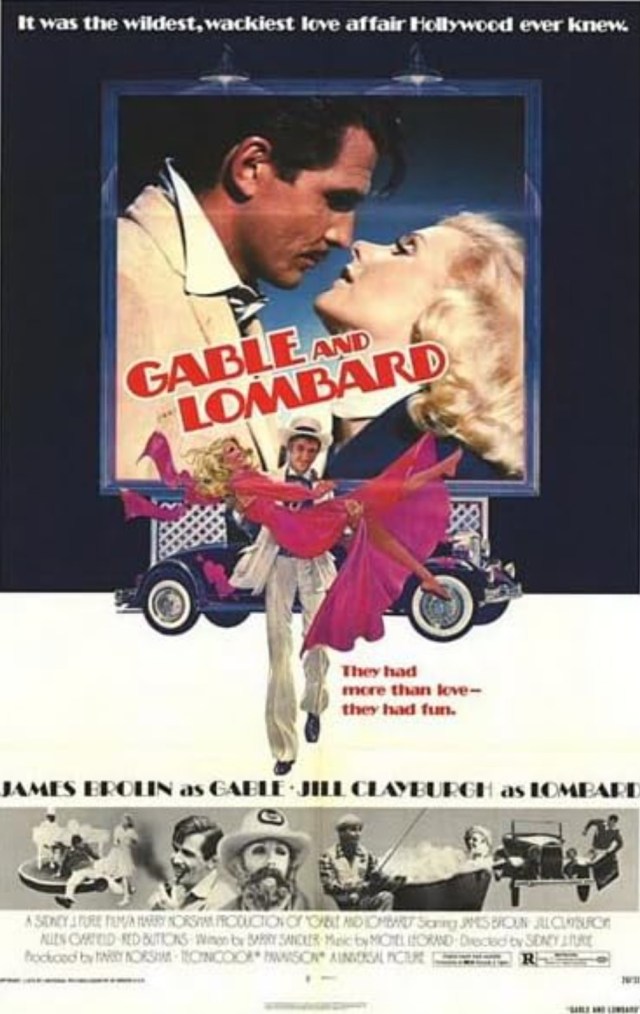
Gable and Lombard poster created by Universal Pictures

Before revealing his choices for the worst movies of 1976, Siskel says the year featured “two kinds of cinematic canines: cheap, lousy pictures and expensive, lousy pictures”. Based on what films he chose, Gable and Lombard was placed in the latter category. According to Wikipedia, the film’s budget was $4.5 million. It appears most of the budget was spent on Gable and Lombard’s set design. One scene took place outside, with the guests at a ball wearing white. Small candles surrounded the pool’s perimeter. In the pool were small islands of white flowers and candles, along with swans peacefully gliding through the water. Overall, this part of the set was absolutely gorgeous! Throughout Gable and Lombard, some scenes took place in Clark or Carole’s dressing room. These dressing rooms looked more like condominiums; distinct spaces that appear livable. Carole’s dressing room boasted a color combination of yellow and white. Featuring design choices like a white dining room set gave the dressing room a feminine style. Meanwhile, dark wood surrounded the fireplace in Clark’s dressing room. There was even a pool table located near the fireplace. These design choices created a more masculine space. Carole and Clark’s dressing rooms provided a good visual representation of how different they were despite having a similar career path.

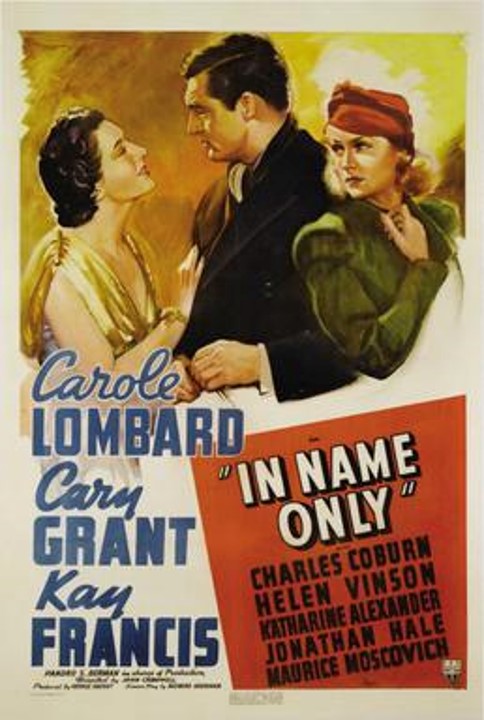
In Name Only poster created by RKO Radio Pictures. Image found at en.wikipedia.org/wiki/File:In_Name_Only.jpg

While Roger Ebert never shared his thoughts on Gable and Lombard in the ‘Best Films of 1976’ episode, he did write a review for the movie, which can be found on rogerebert.com. In his review, Ebert states “Brolin does, indeed, look a lot like Gable – but imitation here has nothing to do with flattery”. While I agree with Ebert’s opinion on James Brolin’s appearance in the movie, I disagree with the rest of Ebert’s statement. Not only did James look like Clark, he even sounded like him too! It almost felt like James transformed into another person. During Gable and Lombard, James consistently carried an easy-going attitude. This choice in acting and directing showcased Clark’s down-to-earth personality. Meanwhile, Carole was a comedic, life of the party. Portrayed by Jill Clayburgh, Carole’s up-beat personality made her one of the most popular actresses of her time. But behind closed doors, Carole had her doubts and insecurities. In one scene, Carole is sharing with Clark how she feels undeserving of a recent achievement. Her eyes reveal a sense of worry. Concern, even sadness, can be heard in her voice. During her conversation with Clark, Carole looks and sounds truly discouraged. Clark, with a warm smile and calming tone of voice, reassures Carole what’s most important is surrounding herself with people who support her. Jill’s and James’ performance is one of the reasons why this scene is one of my favorites in Gable and Lombard!

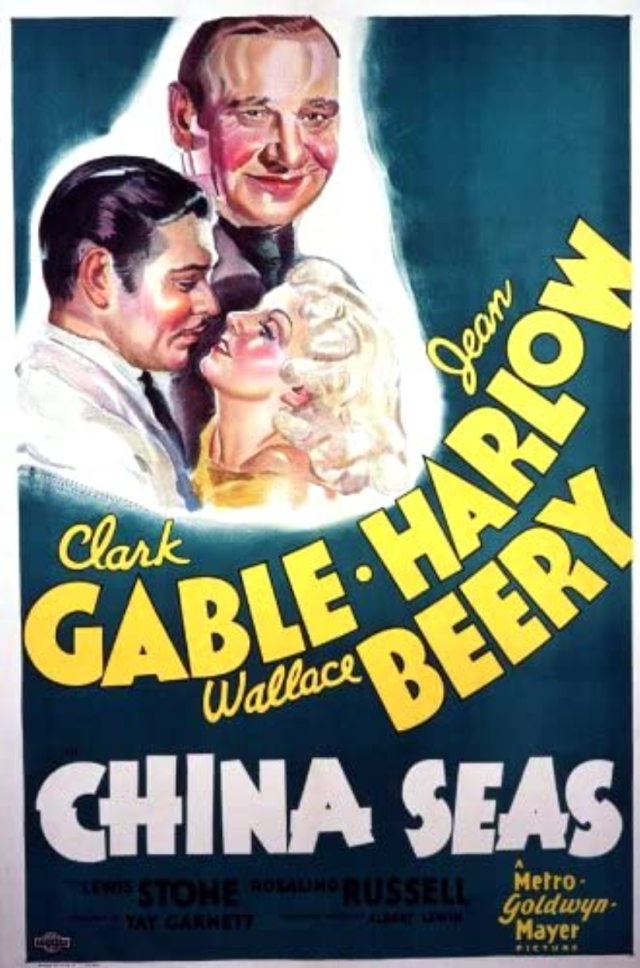
China Seas poster created by Metro-Goldwyn-Mayer.

Sidney J. Furie, the director of Gable and Lombard, chose to make “a movie about just folks”, primarily focusing on the personal lives of Clark Gable and Carole Lombard. While Ebert says this decision gave “the movie a certain originality”, he also criticizes Sidney’s choice, claiming that “by limiting itself to this aspect of their lives the movie never deals with the reasons we find them interesting in the first place”. As I said in this review’s introduction, I am somewhat familiar with Clark and Carole. Because I don’t know which parts of Gable and Lombard are factual or creative liberty, I took the story of Carole and Clark’s relationship with a grain of salt. From the way Louis B. Mayer (portrayed by Allen Garfield) talked to Clark about groups of people demanding certain elements of films be changed due to “indecency”, I knew he was talking about the Breen Code, a series of morality related guidelines enforced in Hollywood from 1934 to 1954. Therefore, I saw Gable and Lombard as a character study of how a portion of the Breen Code era affected the professional and personal lives of the Hollywood landscape, with Carole and Clark serving as just two examples. When Clark is accused of having an affair with a waitress, Carole volunteers to testify in court. Everyone from her inner circle knows if she testifies, she will expose her and Clark’s relationship as well as end her career. While explaining why he doesn’t want Carole to testify, Louis B. Mayer shares with Clark the ugly truth about what happened to some actresses after their careers ended. This scene is honest about the consequences if the Breen Code was broken. By viewing the film from the lens of the Breen Code, Gable and Lombard’s narrative is not only compelling, it is given higher stakes.

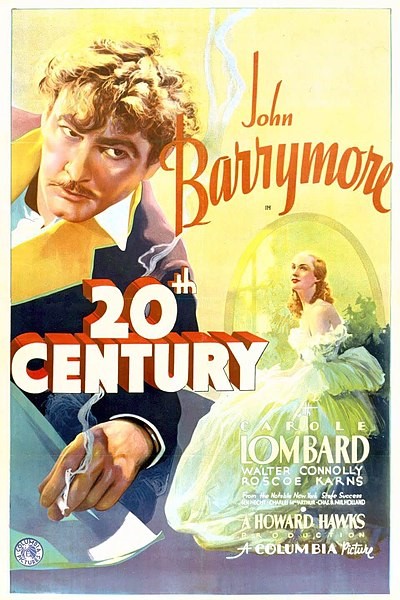
Twentieth Century poster created by Columbia Pictures.

I said earlier in this review how Ebert and Siskel were only given a few minutes to talk about the year’s worst films. This made Siskel’s discussion of Gable and Lombard sound vague, as he states “in real life, you can get arrested for playing around with dead bodies. The same should be true for movie-makers who desecrate the memory of great, dead actors”. Because this review affords me more time to elaborate on my opinion, I will now discuss what I didn’t like about Gable and Lombard. At the beginning of the movie, Clark is told Carole was in a plane crash, but her whereabouts are unknown. The very next scene shows Carole riding in an ambulance, alive and appearing uninjured. That scene took place years before the plane crash happened. With no on-screen text acknowledging the story’s time and place, it was sometimes difficult to figure out the story’s timeline. I liked James’ and Jill’s portrayal of Clark and Carole. However, I found their on-screen chemistry inconsistent. When their story began, Carole and Clark went from enemies to lovers. For the rest of the story, they continuously broke up then got back together. I recognize Gable and Lombard is based on a real-life relationship. But because of the back-and-forth nature of that relationship, I couldn’t stay fully invested in the relationship of Clark and Carole.

Comparing with the Critics banner created by me, Sally Silverscreen. TV show title cards created by WTTW National Productions, WTTW, Public Broadcasting Service (PBS), Lifetime Television, Tribune Entertainment, Buena Vista Television, and Disney-ABC Domestic Television

Looking back on Gable and Lombard, I believe Siskel’s, and even Roger Ebert’s, thoughts on the film were a tad harsh. I wouldn’t call it a “dog” or “lousy”, as the movie does have its merits. But I do believe the marketing is a bit misleading. The quotes on Gable and Lombard’s poster are “It was the wildest, wackiest love affair Hollywood ever knew” and “They had more than love – they had fun”. In the ‘Best Films of 1976’ episode of Opening Soon…at a Theater Near You, Carole dumped salad on Clark’s head, one of the more humorous scenes from the film. While there were comedic moments sprinkled throughout the story, the movie’s marketing presents the false idea it is solely a comedy. Seen from the lens of the Breen Code, Gable and Lombard presents a character study of how a portion of the Breen Code era affected the professional and personal lives of the Hollywood landscape. With the story emphasizing Carole and Clark’s relationship, they navigate complicated decisions, as well as honesty about feelings and emotions. The balance of comedy and tragedy adds a sense of maturity to the overall story. At worst, the movie prioritizes style over substance. as most of the budget seems to be put toward the set design. But, at best, Gable and Lombard is just ok.

This review was brought to you by

Sally Silverscreen

Comparing with the Critics – 1976 – Introduction

In the 1970s, when Gene Siskel and Roger Ebert’s show was called Opening Soon…at a Theater Near You and then Sneak Previews, there were no separate episodes for the year’s best and worst movies. Instead, one episode would show Ebert and Siskel devoting most of their time to talking about the best films of a given year. In the last few minutes of that episode, Siskel and Ebert would briefly mention some of their choices for the year’s worst titles. The first episode of any iteration of Ebert and Siskel’s show premiered in late November, 1975. That made 1976 the first year to receive a year-end episode of the best and worst movies. This is an interesting coincidence, as Network became the first movie I reviewed for my Comparing with the Critics series. For worst of 1976, I didn’t have many films to choose from due to the episode’s limited selection. But after seeing which pictures Siskel and Ebert selected, I chose Gable and Lombard as the Worst of 1976. As I already said in this introduction, I reviewed Network. That movie was picked as the Best of 1976.

Comparing with the Critics banner created by me, Sally Silverscreen. TV show title cards created by WTTW National Productions, WTTW, Public Broadcasting Service (PBS), Lifetime Television, Tribune Entertainment, Buena Vista Television, and Disney-ABC Domestic Television

The Top Ten Worst Movies I Saw in 2024

While 2024 was, for me, a better year for movies, I still saw some movies I didn’t like. Similar to my worst movies list of 2023, most of the films on this year’s list were disappointing or average. But, unlike 2023, the top four titles are from different genres. The dishonorable mentions section has returned! This time, however, there are more DNFs (did not finish). Like I have said in past lists, my top ten worst movies I saw in 2024 list is not intended to be mean-spirited, negative, or disrespectful. It’s just a list of my own, honest opinion. Since I reviewed some of the movies on my list, I will provide the links to those reviews in this article.

Dishonorable Mentions

The Reluctant Debutante, The Gambler: Luck of the Draw, Jazz Ramsey: A K-9 Mystery, Million Dollar Lethal Listing, CrimeTime: Freefall (I turned it off after about forty minutes), Mermaid Down (I turned off this movie after about twenty minutes), Blood, Sweat and Cheer (I turned it off after about eighteen minutes), and Temptation Under the Sun (I turned off this movie after about twenty-two minutes)

Image by starline on Freepik

10. Crimes of Fashion: Killer Clutch

In the 2020s, Hallmark has come up with story ideas that worked well enough for a stand-alone mystery movie, but unsustainable for a multi-chapter series. One of these ideas came from Crimes of Fashion: Killer Clutch. This film made the same mistake as Mystery Island: not allowing the protagonist to use her skills to solve the case. For Lauren, the main character in Crimes of Fashion: Killer Clutch, her psychology skills were so underutilized, she seemed more like an over glorified intern. Thick French accents making several characters difficult to understand is another major flaw of the film. It prevented me from being fully invested in the story. Crimes of Fashion: Killer Clutch was, in my opinion, a disappointing movie. But compared to the other titles on 2024’s worst of the year list, Hallmark’s production was, simply, ‘underwhelming’.

Take 3: Crimes of Fashion: Killer Clutch Review

9. Boy in the Walls

When I first read the synopsis for Boy in the Walls, I thought the film would be a spookier version of 2016’s Boy in the Attic. Sadly, this was not the case. The 2023 Lifetime presentation contained a mystery that was drawn out for too long. It also doesn’t help how the protagonist made one dumb decision after another. Without spoiling the film, all I’ll say is the title is misleading. If you haven’t watched either referenced movie, I’d recommend Boy in the Attic.

8. The 39 Steps

In my review of The 39 Steps, I said the 1935 picture was the most “meh” title from Alfred Hitchcock’s filmography. This statement was made due to the limited sense of urgency and intrigue within the story. As I also said in my review, The 39 Steps seems longer than an hour and twenty-six minutes. The drawn-out nature of the movie created a slow and boring build-up to a reveal that feels kind of ridiculous and anti-climactic. While romance has been incorporated in some of Alfred’s films, it didn’t work in The 39 Steps. Richard and Pamela’s attraction for one another was too abrupt, welcoming the presence of the “insta-love” trope. Even though The 39 Steps was a disappointing movie, I gave it a lower placement on my list. Comparing the 1935 film to Alfred’s other productions, Hitchcock’s filmography shows how much he improved as a director.

Take 3: The 39 Steps Review

7. Hallmark Hall of Fame’s Pack of Lies

There are some movies that, in my opinion, should have been documentaries instead. The 1987 Hallmark Hall of Fame presentation, Pack of Lies, is just one example. This film in the Hallmark Hall of Fame collection is based on a true story. While “based on a true story” movies can be engaging, intriguing, and even thought-provoking, Pack of Lies was disappointing. Like I said in my review of the 1987 production, the film was a two hour slow and tedious build-up to a resolution that was underwhelming and anti-climactic. The creative team’s decision to choose telling over showing caused other flaws, from little lapse in time to things not making sense. Pack of Lies proves Hallmark Hall of Fame movies are not created equally. However, there are other Hallmark Hall of Fame presentations from the 1980s I like, such as the adaptations of The Secret Garden and A Tale of Two Cities.

Take 3: Hallmark Hall of Fame’s Pack of Lies Review

6. One Bad Apple: A Hannah Swensen Mystery

While A Sprinkle of Deceit: A Hannah Swensen Mystery was slightly better than One Bad Apple: A Hannah Swensen Mystery, I was still disappointed in the latter film. For starters, Victor Webster and Alison Sweeney had no on-screen chemistry. A character (not Hannah) solves the mystery by making an assumption about the case and being conveniently correct. But the worst part about One Bad Apple: A Hannah Swensen Mystery was Delores’ subplot. Up until this film, Delores was very against Hannah getting involved in cases, as well as dating Mike. So, for Delores to become a private investigator and seem to treat her new job as a joke completely went against her character. In fact, this was such a bad creative idea, Delores’ private investigating career was barely mentioned in A Sprinkle of Deceit: A Hannah Swensen Mystery. If there are more Hannah Swensen films in the works, I really hope Delores receives better story ideas.

Hallmark Hall of Fame’s Pack of Lies poster created by Hallmark Hall of Fame Productions, Robert Halmi, and CBS

5. My Life Is on the Line

This Lifetime movie had one of the network’s most creative story ideas. The 2024 picture was about a woman who tried to solve a mystery on her computer at her office cubicle. But the longer I watched this movie, the sooner I realized that aforementioned idea wasn’t sustainable for a feature-length production. Instead, the novelty of how the mystery was solved got old very quickly. My Life Is on the Line is yet another Lifetime film where the protagonist makes a collection of dumb choices. Her decision-making is so bad, other characters in the story, including her boss, call her out for it. Lifetime’s 2024 presentation was, for me, the most disappointing movie of the year.

4. Network

Network holds the honor of not only being the first film I reviewed for my Comparing with the Critics series, it’s also the first film I disagreed with the critics on. Even though Gene Siskel and Roger Ebert placed the movie in their list of the top five films from 1976, I would call Network one of the “Dogs of the Year”. For me, it was more of an endurance test, where the story’s first half was a drawn-out search for a resolution to the movie’s conflict and the second half was a yelling contest. Being a pretentious picture by taking itself too seriously and telling a dry, boring story didn’t work in Network’s favor. There are movies from the 1970s I like. Unfortunately, Network isn’t one of them.

Comparing with the Critics – Best of 1976 – Network

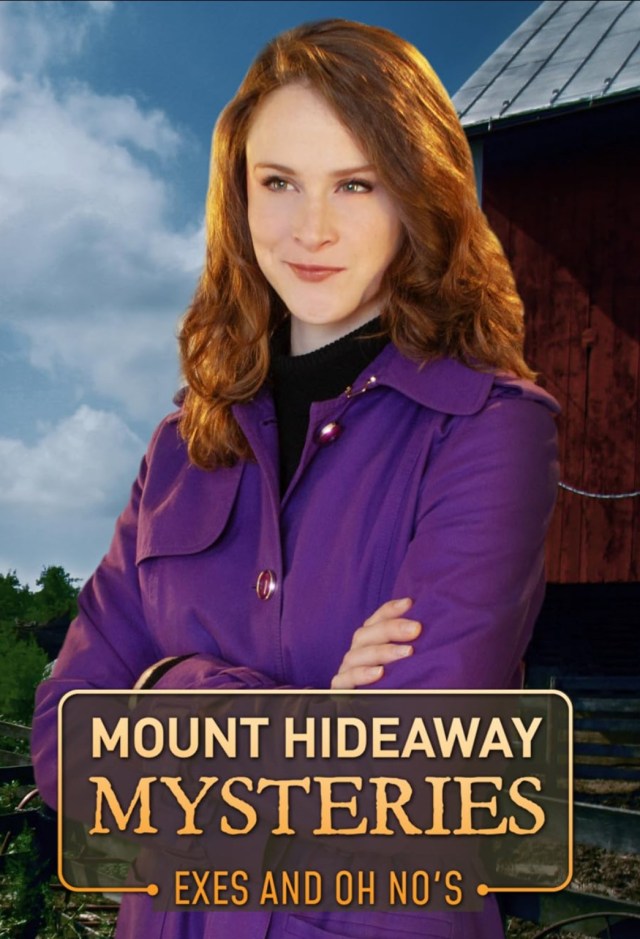
3. Mount Hideaway Mysteries: Exes and Oh No’s

It’s ironic that Mount Hideaway Mysteries: Heartache and Homecoming became the third worst movie of 2023 and now Mount Hideaway Mysteries: Exes and Oh No’s became the third worst movie of 2024. When you look past this irony, you’ll see how Mount Hideaway Mysteries: Exes and Oh No’s shares some of the same flaws as its sequel, like not understanding how technology works. Mount Hideaway Mysteries: Exes and Oh No’s contains its own flaws, with poor special effects as one example. While this movie is so bad, it’s, at times, unintentionally funny, I do acknowledge how challenging it can be to create a cinematic project. In fact, the best way to sum up Mount Hideaway Mysteries: Exes and Oh No’s is the quote, “Mistakes are proof that you are trying”.

Take 3: Mount Hideaway Mysteries: Exes and Oh No’s Review

2. Revenge Best Served Chilled

This Lifetime movie from 2022 had a very misleading title and synopsis. Not only is there no revenge in the story, there’s also nothing being chilled throughout the film. According to a plot summary I read, Revenge Best Served Chilled is about a series of murder mysteries taking place at a wine expert competition, with the protagonist trying to clear her name and solve the mysteries. The movie actually emphasizes the wine expert competition to the point where there is little to no mystery involved. Like Boy in the Walls and My Life Is on The Line, the protagonist, Emily, makes so many dumb decisions. I, honestly, should have turned this movie off after Emily doesn’t lock her family’s restaurant’s front doors as she’s spending the night at the restaurant. But I naively thought Revenge Best Served Chilled was going to be a better movie.

1. Frankenstein (2004)

I referenced this movie while reviewing the Hallmark adaptation of Frankenstein, as I was pointing out a technical error on Wikipedia. When I saw the version of Frankenstein starring Vincent Perez, I immediately knew it was going to be the worst movie I saw in 2024. While this movie contains some interesting ideas, those ideas are bogged down by other ideas. The excessive number of ideas made the story feel like a series of vignettes either loosely connected to each other or not connected at all. What also makes the overall story weak is how nothing is explained. The ending is one of the most “sequel bait” endings I’ve seen in a long time. I would strongly discourage readers from checking out this version of Frankenstein. More time will be spent being frustrated than entertained.

Mount Hideaway Mysteries: Exes and Oh No’s poster created by Glass House Distribution

Have fun in 2025!

Sally Silverscreen

Comparing with the Critics – Best of 1976 – Network

This review is from my series, Comparing with the Critics. If you’d like to learn more about the series, click on the link below.

Introducing my new series, Comparing with the Critics!

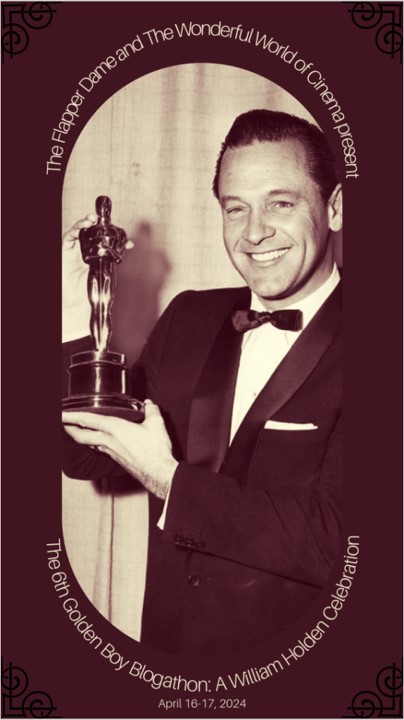
There are two reasons why I chose Network for my first review of Comparing with the Critics. The first reason is how the movie is an appropriate title for The 6th Golden Boy Blogathon: A William Holden Celebration, hosted by Virginie and Emily from The Wonderful World of Cinema and The Flapper Dame. Network appearing on Gene Siskel’s and Roger Ebert’s list of the top five films from 1976 is the second reason. When I looked through William Holden’s IMDB filmography in preparation for the blogathon, I remembered how Ebert and Siskel liked Network. In fact, it was one of the few films they agreed on. I was aware of Network prior to the Comparing with the Critics series because I had heard it was adapted into a stage play. Toward the beginning of the ‘Best Films of 1976’ episode, Siskel proclaimed how “1976 was a pretty lousy year for movies”. I can’t speak on the cinematic year of 1976 as a whole. But based on my thoughts on Network, this movie would fit Siskel’s argument about the state of 1976 when it comes to film.

Network poster created by Metro-Goldwyn-Mayer (MGM) and United Artists


When it’s his turn to talk about Network, Siskel says
“I think she’s gonna win an Oscar for this picture”, referring to Faye Dunaway’s
performance in the film. Siskel got his wish when Faye did win the Best Actress
award at the 49th Academy Awards. While I can’t compare her portrayal
of Diana Christensen to the other performances that were nominated that year, I
can comment on how interesting some of Faye’s interactions were with William
Holden’s character, Max Schumacher. While having dinner one evening, Diana asks
Max a series of questions, in order to learn more about her co-worker. The more
personal the questions become, the more reserved Max appears. This reserved demeanor
is consistently carried by William throughout the movie, using emotion more
subtly. When Max does become more emotional, it happens at certain moments,
such as when he’s recalling a story about his first broadcasting job. Meanwhile,
Diana expresses her emotions more openly. She’s more honest when it comes to
her perspective, believing no subject is off limits. The pairing of Max and Diana,
portrayed by William and Faye, represents the “old school” and “new school”
mentality of the world of broadcast television. It also represents “old” and “new”
Hollywood.

News reporter being filmed image created by Macrovector at freepik.com. <a href=’https://www.freepik.com/free-vector/journalist-reporter-profession-isometric-banner_2875517.htm’>Designed by Macrovector</a>. <a href=”https://www.freepik.com/free-photos-vectors/banner”>Banner vector created by Macrovector – Freepik.com</a>, Image found at freepik.com.

Some of Hallmark’s movies have pulled back the curtain on
certain industries. One great example, Cooking with Love, shows a
behind-the-scenes look at how to create a television show. As you’re reading
this editorial, you’re probably wondering what a film such as Cooking with
Love
has to do with Network. Similar to the 2018 aforementioned production,
the 1976 film explores the behind-the-scenes operations of network television. Network shows the various steps that are needed
to make network television run as smoothly as possible. The movie also
addresses how television programs are brought to the screen. During a typical
work day, Diana was presented with a set of tv pilots. Hearing the premise of these
pilots makes her realize how similar they all sound. This revelation inspires Diana
to create a program that is drastically different. While talking about Network,
Siskel shares how “I also like movies that deal with what’s really going on in
the world”. Because the movie, more often than not, grounds itself in reality,
the realistic presentation of network television’s behind-the-scenes are
insightful and even educational for the audience.

The 6th Golden Boy Blogathon: A William Holden Celebration banner created by Virginie and Emily from The Wonderful World of Cinema and The Flapper Dame

As I just wrote about in this editorial, Network explores
the behind-the-scenes operations of network television. While I liked this
aspect of the movie, there were times when I felt the movie’s creative team
expected their audience to know what they were talking about. The mention of “shares”
is just one example. The term “shares” was thrown around like confetti on New
Year’s Eve. Diana even dreams about creating a show that will earn a certain number
of shares. Trying to figure out what this part of network television was, I was
confused if the characters were referencing the Stock Market or a program’s
viewership. According to Wikipedia, Network is considered a “satirical
drama”. I could tell when moments were intended to be satire. But, in my
opinion, effective satire is when a story’s creative team knows when to play it
straight and when to acknowledge the joke. Network’s creative team
played it a little too straight, taking their production too seriously. All of
this led to a movie that was pretentious.

Newspaper image created by Zlatko_plamenov at freepik.com. <a href=’https://www.freepik.com/free-psd/newspaper-mockup_1386098.htm’>Designed by Freepik</a>. <a href=”https://www.freepik.com/free-photos-vectors/mockup”>Mockup psd created by Zlatko_plamenov – Freepik.com</a>. Image found at freepik.com.

In this review’s introduction, I mentioned how Network was one of the few films Ebert and Siskel agreed on. They both stated how comedic Network was. While Ebert called the film “funny”, Siskel said “I laughed a lot at Network”. Comedy, like cinema, is subjective. With that said, the only time I giggled during the film was when Max Schumacher suggests hiring a psychic to report the weather. The story overall was not only dry, it took itself too seriously, as I already mentioned in this review. Network’s first half was a drawn-out search for a resolution to the story’s conflict. The movie’s second half turned into a contest to figure out which character could yell the loudest and angriest. To me, this was a recipe for a headache and not a hilarious two hours. Then again, I don’t find characters yelling and screaming at each other funny.

Comparing with the Critics banner created by me, Sally Silverscreen. TV show title cards created by WTTW National Productions, WTTW, Public Broadcasting Service (PBS), Lifetime Television, Tribune Entertainment, Buena Vista Television, and Disney-ABC Domestic Television


Network was one of the films featured in the ‘Best Films
of 1976’ episode of Opening Soon…at a Theater Near You. As stated in
this review’s introduction, the movie appeared on Gene Siskel’s and Roger Ebert’s
list of the top five films of 1976. If I made a guest appearance on the show, Network
would not be on my top five or even top ten films list of that year. In fact, I’d
consider the movie as one of the “Dogs of the Year”. Network, for me,
was an endurance test that almost made me fall asleep. Taking itself too
seriously by expecting too much from the audience and telling a dry, boring
story didn’t help Network’s case. Though comedy is subjective, I didn’t
find the film very funny. However, there were aspects of the film I liked, such
as the acting and the peek behind network television’s curtain. But, like
network television itself, there are many parts needed to make a movie work. As
I wrap up this review for Comparing with the Critics, I’d like to respond to
the film’s overarching quote; I’m bored as heck, and I wish Network used
its indoor voice.


This review was brought to you by

Sally Silverscreen


The 6th Annual Gold Sally Awards are Here!

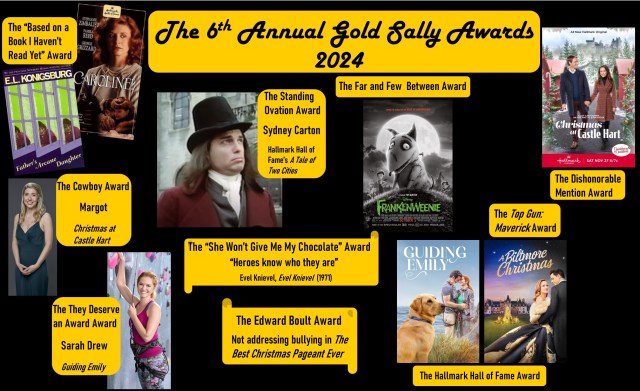
Since 2024 is a Leap Year, I wasn’t going to miss the opportunity to publish the Gold Sally Awards on Leap Day! For new readers of 18 Cinema Lane, the Gold Sally Awards are one of my blog’s annual traditions to commemorate 18 Cinema Lane’s anniversary. These award categories are created by me, based on topics I’ve brought up on my blog. While most of the awards are the same as in 2023, a few of them have changed. For those awards, I’ll explain the significance of those categories. But just like last year, I will discuss why I chose each recipient. So, now, the moment you’ve been waiting for! The 6th Annual Gold Sally Awards are about to begin!

6th Annual Gold Sally Awards Winners created by me, Sally Silverscreen.

The “She Won’t Give Me My Chocolate” Award

(Best Quote from a Movie)

“Heroes know who they are” – Evel Knievel, Evel Knievel (1971)

In my review of the 1971 biopic, Evel Knievel, I mentioned how surprised I was by the story’s messages and themes. One example I provided was when Evel explained to Linda why he doesn’t want a lettermen sweater. To elaborate how he doesn’t need to prove he’s a hero, Evel says to Linda, “heroes know who they are”. This quote is not only though-provoking, it is also profound without trying too hard to be. To me, that quote (as well as that scene) was given a lot of thought by the biopic’s creative team!

The Standing Ovation Award

(Character Most Deserving of Receiving Their Full Potential)

Sydney Carton from Hallmark Hall of Fame’s A Tale of Two Cities

My favorite character from Hallmark Hall of Fame’s A Tale of Two Cities is Sydney Carton! Because of his personality, I wanted to know more about him. I was also curious to see where his story would go. Without spoiling this movie, though, all I’ll say is Sydney deserved more than the story provided him. Similar to Kili from The Hobbit trilogy, Sydney is, in my opinion, the MVP of A Tale of Two Cities!

The They Deserve an Award Award

(An Actor or Actress Who Deserves Recognition)

Sarah Drew (for her performance in Guiding Emily)

In the Hallmark Movies & Mysteries film, Guiding Emily, the protagonist loses her eyesight. This prevented Sarah Drew, the actress who portrayed Emily, from using her eyes for emotional expression. However, she used other acting techniques to her advantage; such as body language, vocal inflections, and movements of the mouth. Sarah’s performance in Guiding Emily was so good, I specifically highlighted it in my review of the 2023 movie! Through versatility in her acting abilities, Sarah’s portrayal of Emily appeared believable! In fact, I think Sarah should have, at least, been nominated for an award.

The Cowboy Award

(Character Who Makes an Unnecessary, Drastic Change)

Margot from Christmas at Castle Hart

Cowboy, from the Hallmark Hall of Fame movie, A Painted House, is a character I’ve mentioned on 18 Cinema Lane. The context was when he was featured in the dishonorable mentions section of my list of the top ten characters ruined by Hallmark. Because I won’t spoil the aforementioned Hallmark Hall of Fame film, all I will say is Cowboy makes an unnecessary, drastic change that, in my opinion, was jarring to witness. It was also jarring to watch Margot, from Christmas at Castle Hart, drastically change. For most of the 2021 movie, Margot comes across as a somewhat annoying character obsessed with Irish stereotypes. But when her sister, Brooke, confronts her about how they should stop lying, Margot becomes a selfish and manipulative person. She even convinces Brooke into believing that if their lies fall apart, it will be Brooke’s fault. In an instant, Margot became a character who cared more about her career than about how others would be affected by her lies.

The “Based on a Book I Haven’t Read Yet” Award

(Movie Based on Source Material I Have Not Yet Read)

Hallmark Hall of Fame’s Caroline?

Hallmark Hall of Fame’s Caroline? became my favorite movie of 2023! After watching the film, I remembered how it was based on the book, Father’s Arcane Daughter by E. L. Konigsburg. As well as trying to check out as many Hallmark Hall of Fame movies as I realistically can, I’d like to read as many books based on Hallmark Hall of Fame movies as possible. In fact, I even created a Hallmark Hall of Fame reading challenge! Since I haven’t read Father’s Arcane Daughter yet, I need to find an excuse to finally seek this book out.

The Edward Boult Award

(Missed Opportunity in Cinema)

Not Addressing Bullying in The Best Christmas Pageant Ever

If you’re going to create a story for a younger audience, you need to be mindful when it comes to addressing serious, real-world issues. That’s because a younger audience can be very impressionable. The creative team behind the 1983 television production, The Best Christmas Pageant Ever, should have kept this in mind when they chose to not address bullying in their film. As I talked about in my review, the Herdman children bully their peers. The bullied children don’t stand up for themselves against the Herdmans. It also doesn’t help how the adults in the story do not resolve this issue. Because of everything I just said, some younger audience members might believe they shouldn’t bring up bullying if it occurs in their life.

The Top Gun: Maverick Award

(Movie That Exceeded My Low Expectations)

A Biltmore Christmas

When I included Top Gun: Maverick in my list of the top ten best movies I saw in 2022, I admitted how skeptical I was about the movie’s quality. As I said in that list, sequels released over ten years after their predecessor can be hit or miss. But Top Gun: Maverick exceeded my expectations, becoming my second favorite picture from that year! In 2023, I was skeptical about A Biltmore Christmas due to its hype and publicity. Similar to Top Gun: Maverick, A Biltmore Christmas was so good, it ended up in the top three of my year end best movies list! Like I said in my list of the best movies I saw in 2023, there were so many things Hallmark got right in this Christmas movie. It also helps how the story provided a different type of narrative for Hallmark’s Christmas presentations. Because of how much I liked A Biltmore Christmas, I’m looking forward to seeing what Hallmark has in store for this year’s Christmas season!

The Dishonorable Mention Award

(Worst Movie from the Dishonorable Mention Category)

Christmas at Castle Hart

Because I didn’t see enough movies to include an honorable mention category, I wasn’t able to award a winner for the Honorable Mention Award. Since my worst movies of 2023 list featured a dishonorable mention category, I was able to find a recipient for this year’s Gold Sally Awards. Christmas at Castle Hart is the most disappointing film to not make my worst films of the year list. In my review of that movie, I stated how I had waited since 2018 to see Stuart Townsend star in a Hallmark production. Sadly, the final product Hallmark gave me wasn’t worth the wait. Stuart’s acting talents were underutilized to the point where his character, Aiden, spent most of the story driving the female protagonist around Ireland. Christmas at Castle Hart contained other flaws, such as bad CGI and an underutilized subplot. Looking back on the Dishonorable Mention Award, I realized how both recipients were Hallmark films.

The Far and Few Between Award

(Best Movie from a Genre, Film Category, or Decade Not Often Covered on 18 Cinema Lane)

Frankenweenie (2012)

Even though 18 Cinema Lane has been around for six years, there are some areas of cinema that are not often covered on my blog. One of those areas is animation. While it’s rare for an animated movie to receive a movie review, it’s even rarer for an animated movie to appear on my best films of the year list. 2012’s Frankenweenie achieved these feats in 2023, presenting a collection of good creative choices as well as heart. This movie was such a pleasant, memorable surprise, which surpassed my expectations. I’m thankful I took the chance to write about it!

The Hallmark Hall of Fame Award

(Movie That Feels Like It Belongs in the Hallmark Hall of Fame Collection)

Guiding Emily and A Biltmore Christmas

When I shared my overall impression of Guiding Emily, I said how the movie felt reminiscent of Hallmark Hall of Fame projects of yesteryear. This is because the film tells a more unique story from what Hallmark typically creates today. In the case of A Biltmore Christmas, the story provided a different type of narrative within Hallmark’s Christmas films. It also included a historical component to the story. When Hallmark Hall of Fame was in its prime, historical/period films or movies with inspirational themes were added to the Hallmark Hall of Fame collection. If this collection still existed, Guiding Emily and A Biltmore Christmas would have been chosen as 2023’s Hallmark Hall of Fame presentations.

Have fun at the movies!

Sally Silverscreen

The Top 10 Worst Movies I Saw in 2023

I’m going to be honest with my readers; in 2023, I saw more movies I disliked than liked. Luckily, I saw enough films to create a top ten best movies of the year list! When it comes to the movies I disliked, the majority of these titles were disappointing or average. This is different to my list of the worst movies of 2022. What’s also different about this year’s list is how my top three worst films are not all Hallmark projects. Like I have said in past lists, my top ten worst movies I saw in 2023 list is not intended to be mean-spirited, negative, or disrespectful. It’s just a list of my own, honest opinion. Since I reviewed some of the movies on my list, I will provide the links to those reviews in this article.

Dishonorable Mentions

Family History Mysteries: Buried Past, Sea Change, Murder 101: College Can Be Murder, Murder 101: The Locked Room Mystery, She Inherited Danger, My Diary of Lies, Double Nickels, A Zest for Death: A Hannah Swensen Mystery, Blackbeard, the Pirate, Christmas at Castle Hart, Shadow Island Mysteries: Wedding for One, and A Hidden Life (I turned this movie off after 42 minutes)

Image by starline on Freepik

10. The Curse of Frankenstein

After I watched and reviewed Frankenweenie, I was hoping the creative team of The Curse of Frankenstein would follow Mary Shelley’s source material closer than the Disney animated film did. Instead of doing that, they relied more on creative liberties. As I said in my review of The Curse of Frankenstein, I found this distracting, especially since I read the book prior to watching the film. Some of these creative liberties were adopted just for the sake of it. One of them was presenting Victor Frankenstein’s creature as a bumbling, destructive machine. This creative decision was a disservice not only to Mary Shelley’s work, but also to Christopher Lee, the actor who portrayed Frankenstein’s creature.

Take 3: The Curse of Frankenstein Review

9. The Last Child

I selected The Last Child for the Futurethon blogathon because of the film’s creative presentation; a futuristic story surrounded in a “contemporary” aesthetic. Unfortunately, the creativity of the 1971 made-for-TV movie didn’t reach beyond the surface. Despite the concern of population control within the story, there was little sense of urgency. That caused the movie to have too many low-stakes. It also didn’t help how the future in The Last Child wasn’t explained. This is another television film from the ‘70s that failed to impress.

Take 3: The Last Child Review

8. A Walk in the Spring Rain

Out of all the movies I saw and reviewed this year, A Walk in the Spring Rain is the most flavorless film. Even though this is a movie where the audience waits for the inevitable to happen, the meandering nature of the script forces viewers to focus on drawn-out subplots, such as the protagonists’ daughter, Ellen, thinking about law school. What adds to the film’s meandering nature are stretched out scenes, making A Walk in the Spring Rain feel longer than necessary. Like I said in my review of the 1970 production, every beloved film star has at least one project on their IMDB filmography that is lesser known. For Ingrid Bergman, A Walk in the Spring Rain is one of her more forgettable films.

Take 3: A Walk in the Spring Rain Review

7. Carrot Cake Murder: A Hannah Swensen Mystery

In 2023, Hallmark Movies & Mysteries released two new chapters in the Murder She Baked/Hannah Swensen series: Carrot Cake Murder: A Hannah Swensen Mystery and A Zest for Death: A Hannah Swensen Mystery. While I found both entries disappointing, Carrot Cake Murder: A Hannah Swensen Mystery was the most disappointing movie out of the two. Other than solving a mystery, this story didn’t progress the series forward. Something happens in Mike and Hannah’s relationship that is resolved in A Zest for Death: A Hannah Swensen Mystery. This made Carrot Cake Murder: A Hannah Swensen Mystery an even more pointless chapter in the series. If you’ve never watched the Murder She Baked/Hannah Swensen series, skip this film, as you wouldn’t be missing much.

Take 3: Carrot Cake Murder: A Hannah Swensen Mystery Review

6. Silent Night, Fatal Night

Silent Night, Fatal Night is a Lifetime movie that is basically a gender-swapped, Christmas version of Misery, with a bit of a twist. Unlike the 1990 film, almost every character in Silent Night, Fatal Night makes one dumb decision after another. While the antagonist in the Lifetime film was unsettling, he was more annoying. Plus, I found it difficult to believe the protagonist, a mystery author, wouldn’t have more intuition to save herself. This isn’t the first time Lifetime has told a story similar to Misery. However, I wish the network would create stories that are less reminiscent of other, better movies from the 1990s.

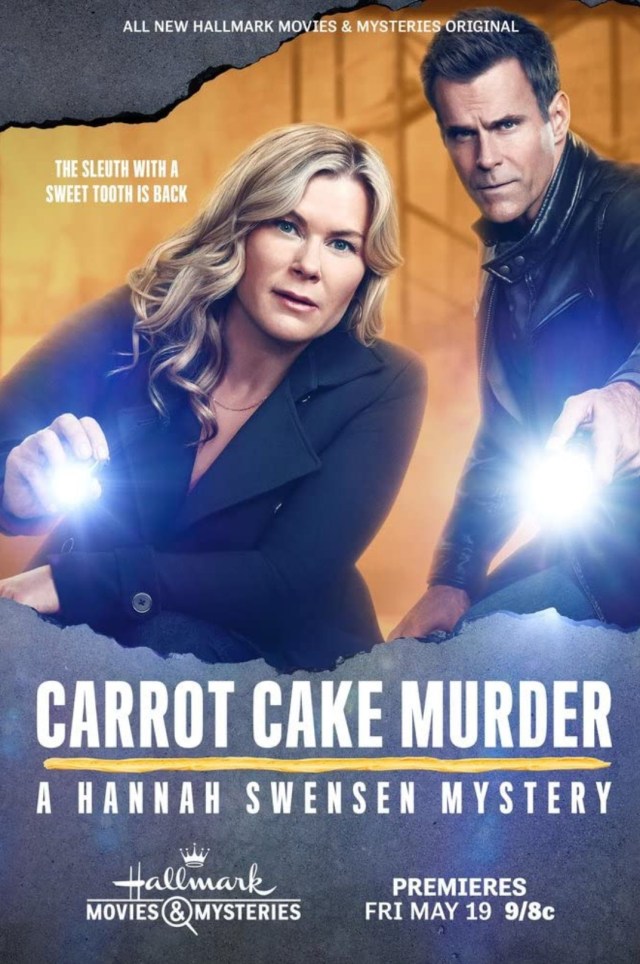
Carrot Cake Murder: A Hannah Swensen Mystery poster created by Lighthouse Pictures, Looking Glass Productions, and Hallmark Movies & Mysteries

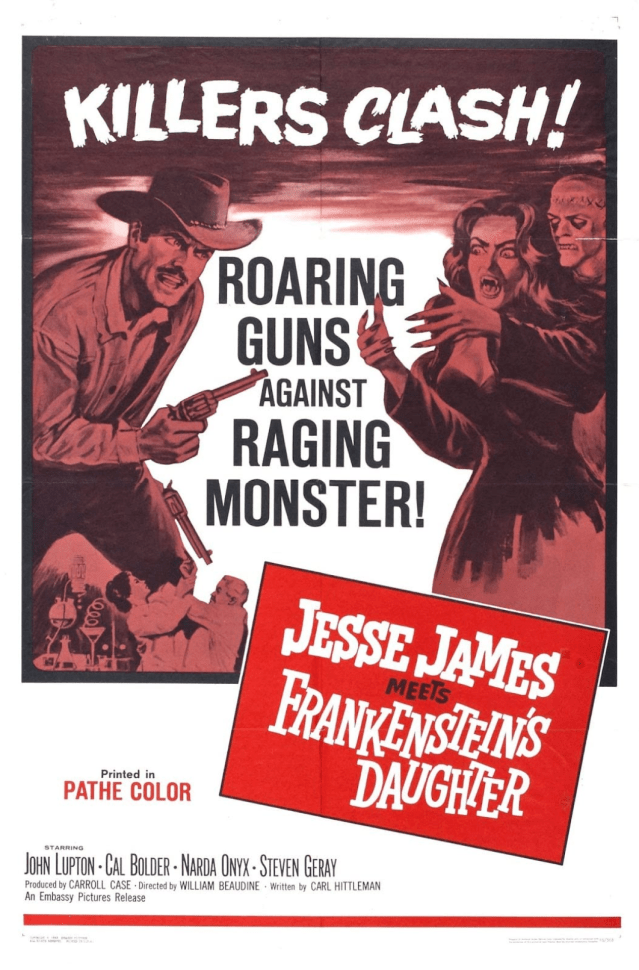
5. Jesse James Meets Frankenstein’s Daughter

Chosen for the Fifth So Bad It’s Good Blogathon, Jesse James Meets Frankenstein’s Daughter was built on a gimmick. Instead of embracing the silliness of that gimmick, the movie’s creative team took their project a little too seriously. Their project was misleading as well, no friendship or romance forming between Jesse and Frankenstein’s granddaughter. Though Jesse James Meets Frankenstein’s Daughter is classified under the western and horror genre, the western genre is emphasized more, preventing a balance between the two genres. The 1966 film is not my “so bad it’s good” movie. Since I did giggle a few times while watching it, I took a step in the right direction to find my “so bad it’s good” film!

Take 3: Jesse James Meets Frankenstein’s Daughter Review

4. Jesse Stone: Night Passage

For me, 2023 was not the year for mysteries, as the top four worst movies on my list are mystery films. The main issue with Jesse Stone: Night Passage is how none of the detectives do any detective work. What they do instead is pull assumptions out of their pockets, with those assumptions being conveniently correct. Subplots were prioritized over the mystery itself. This creative decision caused the story to lack any sense of urgency. It was nice to see familiar faces like Saul Rubinek (who portrayed Artie on Warehouse 13) and Liisa Repo-Martell (who portrayed Maida Flynn on Emily of New Moon). Sadly, there wasn’t much the cast could do to save Jesse Stone: Night Passage.

3. Mount Hideaway Mysteries: Heartache and Homecoming

This movie is so bad, it was, at times, unintentionally funny. Parts of the script reminded me of The Cookie Mobster, with the screenwriters not displaying an understanding for how some things worked. One such example is how Game Boy Color video game consoles were incorporated into the story. The film was riddled with other flaws, such as the color of a character’s earrings changing from scene to scene. Another, more consistent, flaw was telling instead of showing, like other characters mentioning how good looking the male protagonist is every time he appears in a scene. Also, just because the protagonist is a veterinarian does not mean she has to hold an animal every time a scene takes place at the veterinary clinic.

2. The Abigail Mysteries

I have never reviewed or talked about a movie from Great American Family on 18 Cinema Lane. So, it’s a shame that when I do talk about one of their movies, it’s because the project is bad. It is possible to create a good mystery story with elements of faith. But because The Abigail Mysteries heavily prioritized the elements of faith, the mystery was overshadowed, causing the overall story to lack a sense of urgency. From no on-screen chemistry to inconsistent audio quality, The Abigail Mysteries was filled with flaws. There were even times when actors would deliver their lines too quickly, making it difficult to understand what they were saying. I know this is the network’s first attempt at making a mystery movie. But if Great American Family is serious about creating more mystery projects, their efforts need to be better than The Abigail Mysteries.

1. Mystery Island

This is the second year in a row where a newly released Hallmark Movies & Mysteries movie is the worst film I saw. With Hallmark no longer prioritizing the mystery genre, I can’t say I’m that surprised. The poor writing is the biggest problem of Mystery Island. The mystery’s reveal is so ridiculously written, it makes the entire story feel pointless. Emilia Priestly, the film’s protagonist, has a legitimate reason to get involved in the movie’s mystery, as she is a psychiatrist for Scotland Yard. Instead of using her skills to solve the case, Emilia a) flips through books, b) eavesdrops on other characters’ conversations, and c) follows people into the jungle and runs out of that same jungle in wedge sandals. I’d like to think Hallmark will find the motivation to create better mystery productions. But as of late 2023/early 2024, I’m not getting my hopes up.

Jesse James Meets Frankenstein’s Daughter poster created by Circle Productions, Embassy Pictures, and Embassy Home Entertainment

Have fun in 2024.

Sally Silverscreen

Take 3: …and Your Name Is Jonah (1979) Review

I will admit I was a bit overwhelmed by my blogathon theme. With the theme of family being so broad, I could have chosen almost any movie, television episode, or book to write about. On a trip to IMDB, however, I came across the 1979 made-for-tv film, …and Your Name Is Jonah. Since I had never seen, let alone heard of, this movie prior to the event, that is what I selected for Familyathon! As I’ve stated before on 18 Cinema Lane, I haven’t had the best of luck finding a television film from the ‘70s I like. Out of these titles, they have ranged from fine, ok, or disappointing. During my search for my Familyathon topic, I also realized how I’ve heard of few programs revolving around a family dealing with a misdiagnosis. So, reviewing …and Your Name Is Jonah is bringing something new to my blog’s table!

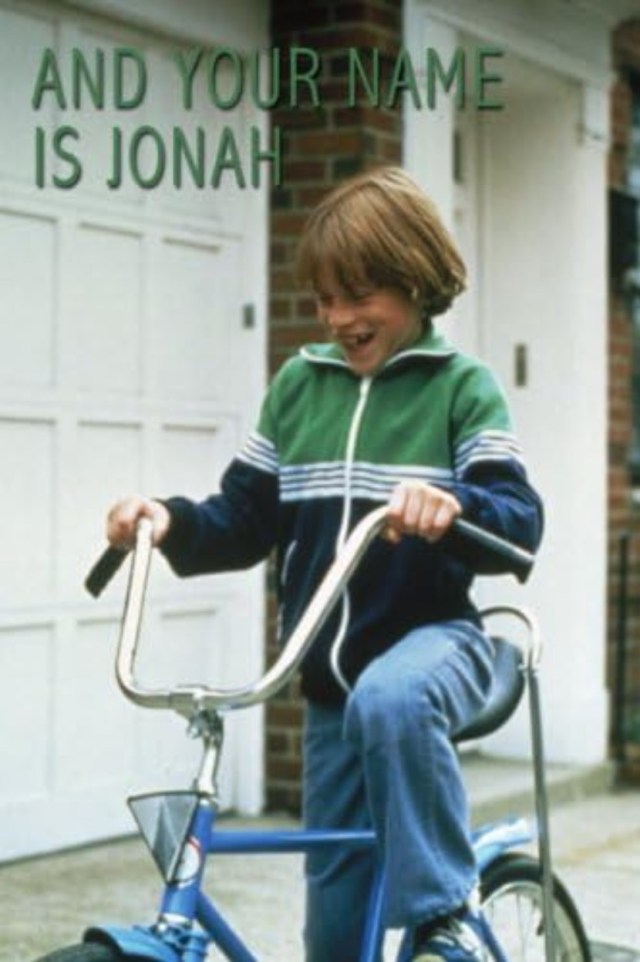
…and Your Name Is Jonah poster created by Charles Fries Productions and CBS

Things I liked about the film:

The acting: Like I mentioned in my review’s introduction, …and Your Name Is Jonah is about a family dealing with a misdiagnosis. At the beginning of the movie, Jenny and Danny, the titular character’s parents, learn their son is deaf after years of believing he had an intellectual disability. Learning about a misdiagnosis and adjusting to a new diagnosis can be overwhelming for a family. Through their portrayal of Jonah’s parents, Sally Struthers and James Woods make these feelings of stress and frustration come across realistically. During dinner, Jonah throws his peas on the floor, indicating how he doesn’t want to eat them. Genuine confusion can be seen on Danny’s face and heard in his voice as he takes Jonah’s plate away, in order to stop Jonah from throwing his food on the floor. Meanwhile, Jenny tells her son to stop making a mess in a calm, yet stern voice. She even points to her own plate, trying to get Jonah to eat his food. After Jonah receives his plate of food back, he continues to throw the peas on the floor. Agitation grows in Danny’s voice when he finds out the behavior hasn’t stopped. When Jenny decides to move Jonah’s plate into the kitchen, informing her husband about her plan in a calm manner, Jonah has a temper tantrum. This causes Danny to become frustrated over the situation, even sounding agitated with his other son, Anthony. Jenny, simply trying to keep the peace, attempts to stand up for Jonah, her voice sounding like she’s begging her husband for understanding. She also looks exhausted and overwhelmed.

When given a role that has little to no dialogue, an actor or actress must use facial expressions, emotions, and body language in order to show what their character is not saying. Jeffrey Bravin, the actor who portrayed Jonah, effectively utilized these acting techniques! This allowed the audience to learn more about Jonah, even knowing more information than his parents did. When Jonah wears his hearing aid for the first time, Danny and Jenny get into an argument over the hearing aid. Meanwhile, Jonah removes the hearing aid, his face expressing discomfort while doing so. His face continues to express discomfort when Jenny puts the hearing aid back into his ear. Jonah then looks sad and confused as he’s trying to figure out what his parents are saying. Through Jonah’s perspective, the audience can hear that, to him, Danny and Jenny sound like they’re arguing underwater. This scene helps the audience learn, before Jenny and Danny, that the hearing aid is not helping Jonah like it was intended to.

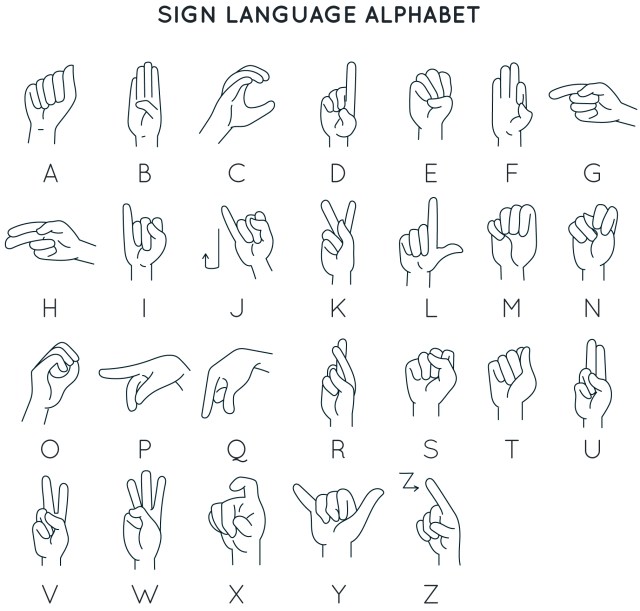
An introduction to deaf culture: Last year, when I reviewed Children of a Lesser God, I discussed how the film served as an introduction to deaf culture. This was achieved by the audience getting to know the characters and learning why they do or don’t want to learn to speak. …and Your Name Is Jonah also serves as an introduction to deaf culture. However, the introduction came from Danny and Jenny learning more about their son’s diagnosis. Toward the beginning of the movie, Jenny and Danny discover Jonah might benefit from using a hearing aid. An audiologist explains to Jonah’s parents how a hearing aid will help their son hear sounds he can just barely hear. This explanation provides a basic understanding of hearing aids for both Jonah’s parents and the audience. Later in the movie, Jenny gets invited to attend a deaf club. While attending one of the club’s meetings, Jenny learns some signs, ranging from describing animals to feelings. This demonstration was a beneficial introduction to sign language for Jenny as well as the audience.

Diversity in education: The idea of education not being “one size fits all” has gained attention in the 21st century. That idea included as an overarching theme in …and Your Name Is Jonah seems ahead of its time, as the film was released in 1979. Throughout the movie, Jonah’s family try to teach him to speak through speech. But these efforts are met with little to no results. Instead of letting frustration get the better of her, Jenny admits that her approach to education is not the right fit for her son. After this realization, she seeks out other options in order to help Jonah learn to speak. By Jenny seeking out a new approach, the story acknowledges how children learn differently and how various teaching techniques are available to best meet a child’s educational needs.

Familyathon blogathon banner created by Sally Silverscreen of 18 Cinema Lane

What I didn’t like about the film:

Prolonging Jonah’s break-through: In my review of I Never Promised You a Rose Garden, I talked about Deborah’s recovery process being rushed. This was the result of the film taking so long to show Deborah’s break-through, with that moment taking place in the movie’s last twenty minutes. Jonah’s break-through is also prolonged in …and Your Name Is Jonah. As I mentioned in this review, Jonah’s parents are overwhelmed by their son’s new diagnosis. However, for the majority of the story, they stubbornly try to use the same teaching technique with little to no results. While Jonah does receive a break-through, that moment takes place an hour and twenty-four minutes into an hour and thirty-three-minute movie. I wish this break-through had been reached sooner, so more time could be spent seeing Jonah thrive instead of struggling.

Lack of questions from Jonah’s parents: When Jonah is being released from the hospital, Danny and Jenny confess to the hospital’s director and the audience how their son has been at the hospital for “three years and four months”. When the hospital’s director tries to answer Jenny’s question of how Jonah got admitted in the first place, Jenny tells him, “You went over it and I just listened, and I still don’t understand”. This situation, along with Jonah’s new diagnosis, should have encouraged Jenny and Danny to ask more questions. Instead, they don’t dig beyond the surface. One example involves Jonah receiving a hearing aid. Earlier in this review, I brought up how Jonah’s parents learn about hearing aids and their intended purpose. While Jonah uses a hearing aid for the majority of the film, Danny and Jenny are frustrated by Jonah’s lack of progress. During one of Jenny and Danny’s arguments, the scene is presented from Jonah’s perspective, with the argument sounding like it’s taking place underwater. Had Jonah’s parents asked more questions about the hearing aid, they would have gained a better understanding why their son doesn’t seem to like wearing it.

An antagonistic speech therapist: One of the characters Jonah’s parents turn to for help is a speech therapist named Mrs. Marquardt. While Mrs. Marquardt had good intentions, I didn’t like how the film presented her as a more antagonistic character. When Mrs. Marquardt first meets Jenny and Jonah, Jenny tells Mrs. Marquardt how Jonah doesn’t seem to like wearing his hearing aid. Mrs. Marquardt tells Jenny how “he must learn to like it” and that his hearing aid is “his best friend”. While explaining the purpose of speech therapy to Jenny, Mrs. Marquardt tells her how children are not allowed to use sign language. Mrs. Marquardt explains how “once a child begins to use signs, he becomes lazy in learning how to use his voice and read lips”. I’m aware that some stories require the inclusion of an antagonistic character. But when a story like …and Your Name Is Jonah carries the overarching theme of how education is not “one size fits all”, the emphasis should be a teaching technique not working doesn’t necessarily mean it’s bad.

Sign language alphabet image created by Freepik at freepik.com. Hand sign vector created by freepik – www.freepik.com

My overall impression:

In my review, when I talked about the acting in …and Your Name Is Jonah, I mentioned how Jonah received a misdiagnosis. After learning their son is deaf, Danny and Jenny become so overwhelmed, they are desperate to find a solution. While watching the 1979 made-for-TV movie, I was reminded of the 2008 Hallmark Hall of Fame film, Sweet Nothing in My Ear, a story about parents trying to find a solution for their deaf son. However, I find myself preferring Sweet Nothing in My Ear over …and Your Name Is Jonah. In the 1979 film, Jonah’s break-through is prolonged, taking place in the film’s last nine minutes. For the majority of the story, Jonah’s parents don’t ask more questions, a cause for Jonah’s break-through being prolonged. This is different from Sweet Nothing in My Ear, where the parents spend that story exploring every available option for their child. Even though the conclusion of Sweet Nothing in My Ear is open-ended, that creative decision was made to allow the audience to form their own perspective. I will say …and Your Name Is Jonah provided a nice introduction to deaf culture. It also showcased good acting performances and a theme that made the film feel ahead of its time. But, overall, this movie was just fine, in my opinion.

Overall score: 7.2 out of 10

Have you seen …and Your Name Is Jonah? Are there any made-for-TV movies you’d like to see me review? Let me know in the comment section!

Have fun at the movies!

Sally Silverscreen

It’s Finally Here; the Familyathon Blogathon!

Welcome to the Familyathon Blogathon! With Thanksgiving on the horizon and the Christmas/holiday season on the way, the theme of family is recognized and celebrated! Even outside of special occasions, family has been a popular topic in entertainment media for decades. From these on-screen families, familiar faces and beloved characters have won over the hearts of fans. Their stories have served valuable lessons and even stood the test of time. Every entry in this event showcases how the subject of family has been incorporated into movies and television! From the underrated tv films to silver screen classics, let the blogathon begin!

Familyathon blogathon banner created by Sally Silverscreen of 18 Cinema Lane
Realweegiemidget Reviews — LISTS…Films Made With Their Own Kind of Family

The Midnite Drive-In — The Family That Slays Together Stays Together

Poppity Talks Classic Film — ‘Sabrina’ (1954): It’s All in the Family

Taking Up Room — Andy Hardy in the Big City

18 Cinema Lane — Take 3: …and Your Name Is Jonah (1979) Review

The Maidens of Green Gables — this is family ❤ (Katherine), Five of My Favorite Families (Grace)

Top 10 Films — The Bonds Of Family In “Running On Empty”

Silver Screenings — Old Yeller: Making the Tough Choices in Life

Hamlette’s Soliloquy — Hamlette’s Soliloquy: “Mr. Mom” (1983)