Take 3: Jack and the Beanstalk (1952) Review

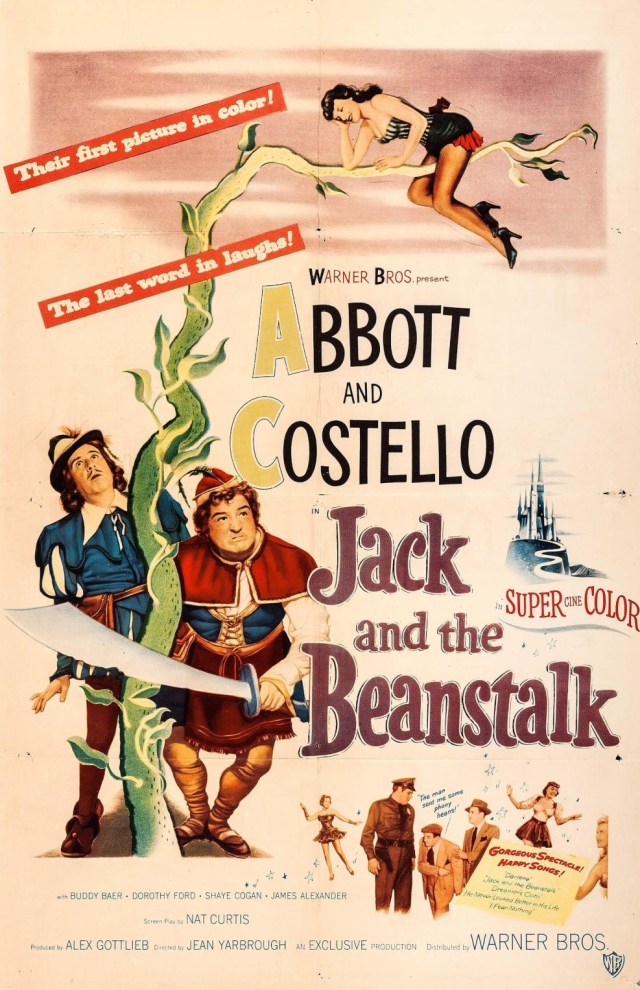
I need to make a confession: in the seven years 18 Cinema Lane has been around, I’ve never reviewed any of Abbott and Costello’s films. (insert shocked gasp here) But at 18 Cinema Lane, I am willing to expand my cinematic horizons. This is one of the reasons why I selected 1952’s Jack and the Beanstalk for the Once Upon A Time Blogathon. Another reason is how I don’t often get the opportunity to write about fantasy films. In fact, the last fantasy movie I reviewed was Cancel Christmas last December. When I came across the poster for Jack and the Beanstalk, I was surprised to read the tagline “Their first picture in color”! Abbott and Costello are household names in the world of comedy. Plus, this adaptation of the fairy tale was released thirteen years after The Wizard of Oz. So, is the movie worthy of such a historic milestone? Adventure through this review of Jack and the Beanstalk to find out!

Jack and the Beanstalk (1952) poster created by Exclusive Productions Inc., Legend Films, and Warner Bros.

Things I liked about the film:

The dialogue: Sometimes, a movie’s comedy will be woven into the dialogue. Words spoken between characters can not only be hilarious, but also clever and witty, especially if the screenwriting is strong. Dialogue was one of the best qualities of Jack and the Beanstalk! One example is from the beginning of the film. Arthur arrives at Eloise’s house to pick her up for play rehearsal. Her younger brother, Donald, answers the door, even setting up a trap that causes Arthur to fall. When Arthur asks Donald where Eloise is, Donald replies in a matter-of-fact manner, “putting on her lipstick so you can kiss off”. What makes this line so memorable is how it fits the character of Donald, who is portrayed as a precocious child. Another example happens during the ‘Jack and the Beanstalk’ story. Jack is heartbroken when his mother suggests they sell the family cow. After Jack’s mother urges him to take the cow to the market, Jack tells her, “Yes mother. You can depend on me. Whatever they bid, I’ll bid higher”. This is a line that is genuinely funny, as Jack says it with good intentions.

The use of color film: During the opening credits of Jack and the Beanstalk, it’s revealed parts of the film are presented in Super Cine Color. These parts are the ‘Jack and the Beanstalk’ story itself, while the “modern” parts of the movie are shown in black-and-white film. I actually liked this creative decision! It emphasized the magic and whimsy of the fairy tale. The use of color film also allowed the vibrant hues of the costume and set design to be visible. Overall, this production of Jack and the Beanstalk felt pleasantly reminiscent of 1939’s The Wizard of Oz!

Working as a pair: Bud Abbott and Lou Costello (also known as Abbott and Costello) have been acknowledged as one of the most beloved comedic duos in film history. So, I was curious how they would work together in Jack and the Beanstalk, since the heroic adventure typically involves only one character. Lou portrays Jack and Bud portrays Mr. Dinkelpuss (a local butcher). Even though both characters travel up the titular beanstalk, they each have their own motives. Mr. Dinkelpuss and Jack help each other escape The Giant’s castle as well. Through the acting performances and the screenwriting, this version of Jack and the Beanstalk feels like Jack was always meant to travel with a buddy.

Once Upon a Time Blogathon: Fairy Tales, Legends, & Myths banner created by Annette from Hometowns to Hollywood

What I didn’t like about the film:

Musical padding: The 1952 adaptation of Jack and the Beanstalk is a musical, with five musical numbers incorporated into the production. These numbers were very well choreographed and sounded good musically. However, they felt like padding, making the movie seem longer than its one hour and twenty-three-minute run-time. A few of the musical numbers feel drawn out, such as the almost three-minute dance between Jack and Polly. Had some of these numbers been trimmed down, the overall run-time could have been under an hour and twenty minutes.

Forgotten details: Within Jack and the Beanstalk’s script, there were a few forgotten details. Jack’s cow, Henry, presents two examples. When Henry is first brought up in the movie, Jack refers to the cow as female. He even puts makeup on her to stress this fact. But before Jack says goodbye to Henry at Mr. Dinkelpuss’ shop, Jack tells the cow to “be a good boy”. Later in the movie, Jack climbs the beanstalk. One of his intentions is to rescue Henry from the clutches of The Giant. When Jack and his friends finally escape The Giant’s castle, however, Polly is the one who ends up saving Henry.

Patrick the Harp: In The Giant’s castle resides a harp named Patrick. Not only does music play every time he talks, he’s also very critical of Polly. Personally, I was not a fan of Patrick. He spoke with a thick accent, which sometimes made it difficult to understand what he was saying. His role in the story was quite minimal, offering little to the plot. If Patrick had been written out of Jack and the Beanstalk, not much would change.

Fairytale castle image created by Freepik at freepik.com. <a href=’https://www.freepik.com/free-vector/fairy-tale-castle_837803.htm’>Designed by Freepik</a>. <a href=”https://www.freepik.com/free-photos-vectors/design”>Design vector created by Freepik</a>. Image found at freepik.com.

My overall impression:

As I mentioned in the introduction of my review, Abbott and Costello are household names in the world of comedy. However, there is a reason why they achieved this honor. Using Jack and the Beanstalk to explain my point, Costello and Abbott work together as a team. Even in a fairy tale where a team dynamic doesn’t exist, they find a way, through acting and screenwriting, to create a story where they can both shine. The dialogue was one of the strongest aspects of the 1952 adaptation, as it was hilariously clever. It also helps that the dialogue was written and delivered well. Even the use of color film enhanced the whimsical charm one would expect from a fairy tale. While Jack and the Beanstalk does have its flaws, it is, indeed, a pleasant presentation! Now, if you’ll excuse me, I need to figure out who really is on first.

Overall score: 7.4 out of 10

Have you seen 1952’s Jack and the Beanstalk? What other fairy tales would you have liked to see Abott and Costello star in? Tell me in the comment below!

Have fun at the movies!

Sally Silverscreen
Take 3: Vertigo (1958) Review

Alfred Hitchcock is a man who needs no introduction. Director by choice and legend by chance, Alfred has single-handedly become a house-hold name in the world of cinema. While I have seen (and reviewed) some of his films, there are still plenty of titles I have yet to see. One of those films was 1958’s Vertigo, which was recommended by Charity from The Sacred in the Secular! This is a movie I had been meaning to write about for a while. With The 3rd Master Of Suspense Blogathon on its way, I found a great time to finally review Vertigo! As I already mentioned, I have reviewed some of Alfred’s films. While I still think Strangers on a Train is his best movie, The 39 Steps is one of my least favorite. Now, the time has come to share my thoughts on Alfred Hitchcock’s 1958 presentation!

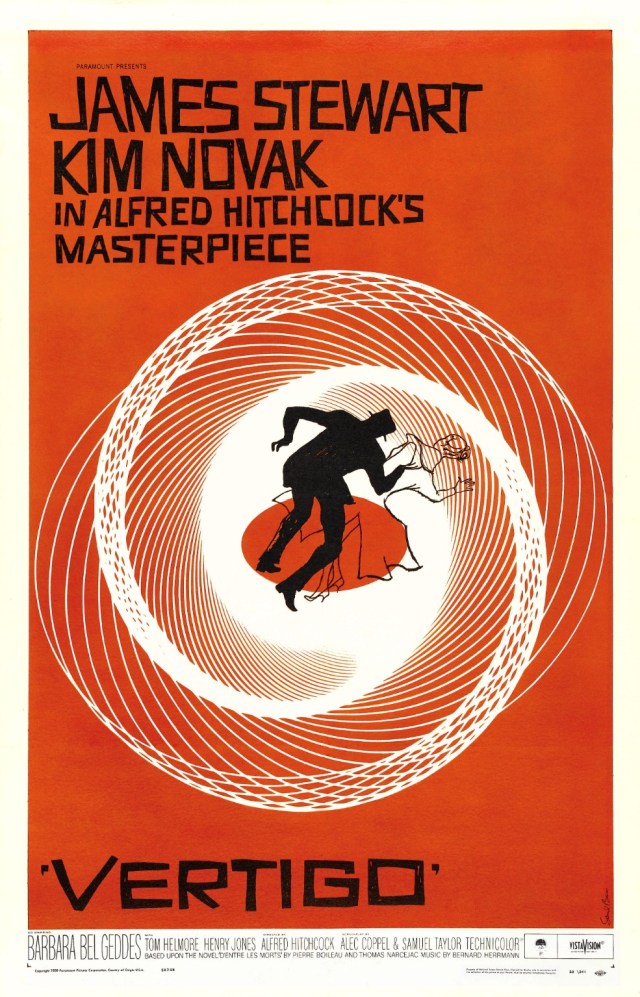
Vertigo (1958) poster created by Alfred J. Hitchcock Productions and Paramount Pictures

Things I liked about the film:

The use of music: Music can be a powerful film-making tool. Through a combination of sound, instrumentals, and even lyrics, music can elevate a scene’s mood, foreshadow parts of the story, or emphasize events happening in a scene. In Vertigo, music was utilized to compliment a scene’s given mood. A perfect example is when Scottie follows Madeleine to a flower shop. While he walks through a flower shop’s storage room, suspenseful orchestral music builds up to the moment Scottie reaches the flower shop’s door. This type of music acknowledges Scottie’s fear of the unknown, as he doesn’t know what he’ll find on the door’s other side. But once he opens the door, he discovers Madeleine is in a flower shop, purchasing a bouquet of flowers. This discovery causes calming, orchestral music to play in the background, stressing how Madeleine and the shop itself are nonthreatening to Scottie.

Incorporation of culture: The mystery in Vertigo revolves around Madeleine being obsessed with a woman named Carlotta Valdes. Scottie follows clues from art and local history in an attempt to solve the mystery. The “local history” in this movie is a fictionalized version of San Francisco’s history. However, the blending of these aforementioned cultural elements gave Vertigo a unique identity from other Hitchcock productions. The creative team’s incorporation of culture can also spark thought-provoking analysis about how culture can influence or even solve mysteries. As someone who reviews mystery films and even has a series called Sally Solves a Mystery, this aspect of Vertigo has made me look at the subject of mysteries somewhat differently.

The set design: There was some impressive set design in Vertigo! One of my favorite examples is Gavin’s office. Wood paneling covers every wall. The entire floor is covered in red carpeting, which actually compliments the wood paneling. A large, dark wood desk with intricate detailing becomes the showstopper of the space! Other design choices, such as a large model of a ship, red chairs, and a huge window overlooking the cargo ship dock emphasize Gavin’s importance in the company he inherited. Artwork and photographs covering every wall presents a glimpse into Gavin’s artistic taste.

The 3rd Master Of Suspense Blogathon banner created by Maddy from Classic Film And TV Corner

What I didn’t like about the film:

Questions left unanswered: For this part of my review, I will spoil Vertigo. If you have not seen this movie and are planning on watching it, skip to the part titled ‘The underutilization of Barbara Bel Geddes’.

After Madeleine dies, Scottie meets a woman named Judy, believing she looks like his deceased love. Shortly after Judy and Scottie meet for the first time, she writes a letter and confesses being Madeleine. In the letter, Judy claims parts of the story she and Gavin told Scottie were true. But she never specifies which parts of their story they were honest about. The creative team’s decision to leave questions unanswered frustrated me. This is because I was curious to see how the mystery of Madeleine’s psychological connection to Carlotta Valdes would be resolved.

The underutilization of Barbara Bel Geddes: In Vertigo, Barbara Bel Geddes portrays Marjorie ‘Midge’ Wood. A designer who is passionate about art, Midge was engaged to Scottie in the past. Even though their engagement didn’t last, they remain on friendly terms. Barbara’s on-screen chemistry with James was pleasant. Her performance effectively sold the idea Midge was good friends with Scottie. This made me hope Scottie and Midge would work together to solve Vertigo’s mystery. But that did not happen because Barbara was only in a handle of scenes. I think Midge is an interesting character, so this creative decision disappointed me. Not giving Barbara more material to work with was, in my opinion, a missed opportunity.

An unsolved mystery: For this part of my review, I will, once again, spoil Vertigo. If you have not seen this movie and are planning on watching it, skip to the part titled ‘My overall impression’.

At the beginning of Vertigo, Scottie is asked by Gavin to solve the mystery of why Madeleine is obsessed with a woman named Carlotta Valdes. This obsession gets to the point where Madeleine goes to places she has no memories of visiting. Because of how the fictionalized San Francisco culture and supernatural elements were combined in the mystery, I was curious to see how the mystery would be resolved. But, about halfway through Vertigo, Madeleine dies. Shortly after Madeleine passes away, the mystery of Judy’s identity begins. By the end of the movie, this new mystery is solved. If the screenwriters knew their script would contain more than one mystery, they should have resolved the first mystery before moving on the next one. The creative team’s decision to abandon Madeleine’s mystery left several questions unanswered.

Art tools image created by Freepik at freepik.com. <a href=’https://www.freepik.com/free-vector/flar-art-tools-pack_835368.htm’>Designed by Freepik</a>.  <a href=”https://www.freepik.com/free-photos-vectors/paint”>Paint vector created by Freepik</a>. Image found at freepik.com.

My overall impression:

Have you ever watched a movie where you found yourself deceived by the movie’s end? That’s how I felt after watching 1958’s Vertigo. Without spoiling the movie, I will say how even though the story contained two mysteries, only one of them is solved. This is one of the reasons why the script left questions unanswered. I also didn’t like how Barbara Bel Geddes’ acting talents were underutilized. However, there were aspects of Vertigo I liked. The film’s creative team displayed an understanding for how to effectively utilize music. Incorporating culture into the story gave Vertigo a unique identity among Hitchcock’s collection of films. I was impressed by the movie’s set design as well. But when it comes to titles created by Alfred Hitchcock, especially those starring James Stewart, I think Rear Window is stronger than Vertigo. Not only was the talent of Rear Window’s cast well utilized, the mystery was solved as well as prioritized.

Overall score: 6.5 out of 10

Have you seen Vertigo? Which film of Alfred Hitchcock’s is your favorite? Let me know in the comment section below!

Have fun at the movies!

Sally Silverscreen

Take 3: The End of the Affair (1955) Review

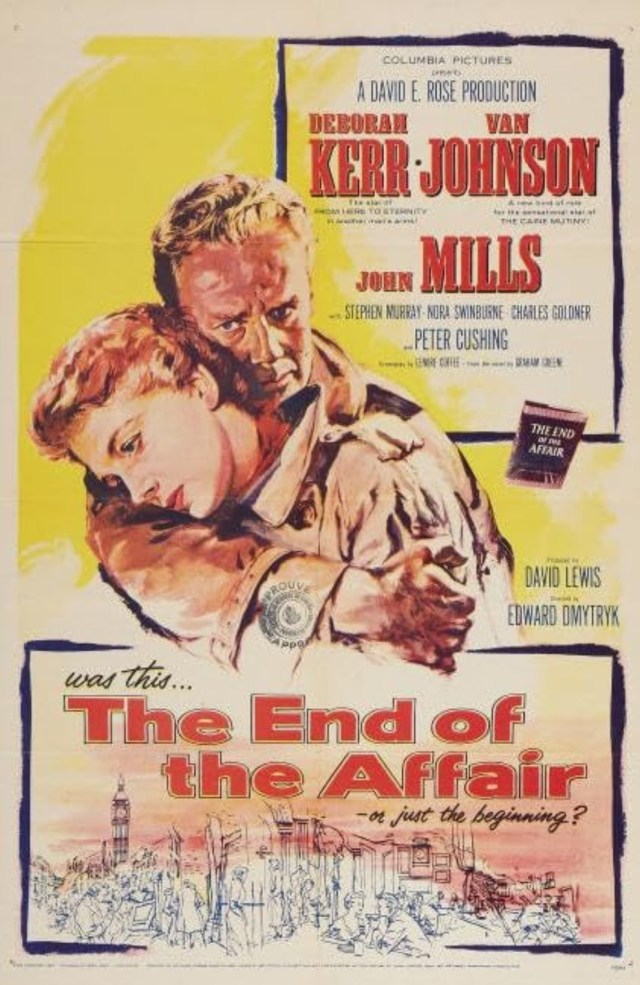
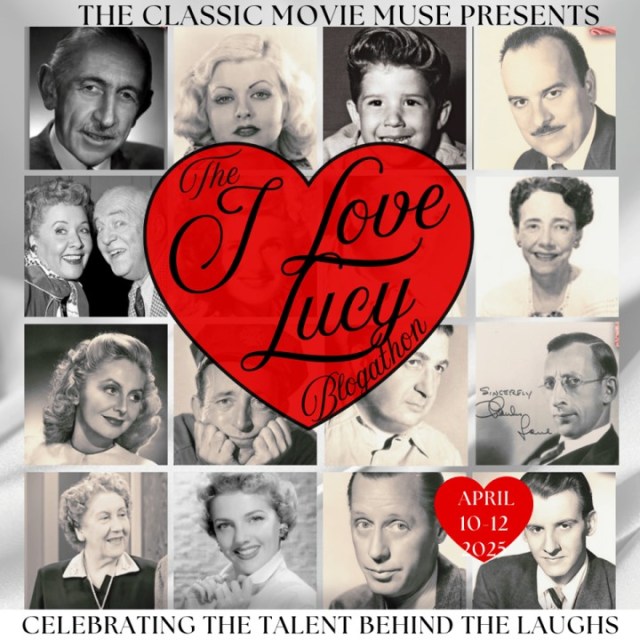
When you have a show as iconic and successful as I Love Lucy, well-known guest stars are likely to pay the show a visit. On the aforementioned show itself, a collection of guest stars graced the screen, crossing paths with Lucy, Ricky, and their friends. One of those stars was Van Johnson, an actor I’m familiar with due to reviewing some of his films and his episodes of Murder, She Wrote. Since I haven’t written about any project from Van’s filmography since 2022, I found the I Love Lucy Blogathon as the perfect opportunity to check out another of his movies! A film of Van’s I’ve been meaning to review for years is the 1955 presentation, The End of the Affair. Recommended by Maddy from Maddy Loves Her Classic Films, I was intrigued by the mystery woven into the synopsis. Who is this third man Deborah Kerr’s character may be having a relationship with? The only way I was going to find an answer to that question is by watching The End of the Affair and sharing my honest opinion about it!

The End of the Affair (1955) poster created by Coronado Productions and Columbia Pictures

Things I liked about the film:

The acting: Like I mentioned in this review’s introduction, I have written about some of Van Johnson’s films as well as his episodes of Murder, She Wrote. What I’ve noticed from these projects is how Van has strong adaptability to his character’s experiences. This was also the case in The End of the Affair. While spending time with Deborah Kerr’s character, Sarah, Van’s character, Maurice, is all smiles and appears to be in a good mood. But when a neighbor named Mrs. Tomkins unexpectedly arrives to give Sarah some food, Maurice’s mood quickly changes. His eyes are downcast, not even looking at the neighbor. Maurice’s mouth displays a worried look as he frets over his secret relationship with Sarah being discovered. Even his tone of voice with Sarah is sharp, desperately trying to contain his feelings. This scene is just one example of Van’s versatility when it comes to his acting talents!

I was pleasantly surprised to discover Peter Cushing starred in The End of the Affair! Based on what I know about Peter’s career from his filmography, he either portrayed a character in a horror movie or he appeared for a limited period of time in a film. Comparing The End of the Affair with other projects of Peter’s I’ve seen, he was given a slightly larger role in the 1955 movie. My other observation is how his character, Henry, had a consistently friendly personality. Even when he suspects Sarah of having an affair, Henry’s demeanor is that of concern, with a worried look on his face. Speaking of Sarah, I want to discuss Deborah Kerr’s performance. In The End of the Affair, there were times when Deborah’s face said so much without the use of dialogue. A great example is when Sarah and Maurice reconnect after being apart for a year. During their walk together, fear shown through Sarah’s eyes. Her mouth was even tightly pursed, revealing little to no information to Maurice. In this scene, Sarah appears to keeping a secret, a secret she’s afraid might be discovered.

The mise-en-scène: Mise-en- scène is how a film’s scene is presented to the audience. One example from The End of the Affair is how mirrors were sometimes used as a form of foreshadowing. Toward the beginning of the film, Maurice spots Sarah hugging another man. She and the man can be seen through a near-by mirror. Because the creative team emphasized this interaction, Maurice’s suspicions of Sarah are hinted at. Later in the movie, when Sarah disappears from Maurice’s life, he calls her home, hoping she’ll pick up the phone. But every time Sarah is unavailable, the camera consistently shows a close-up of Maurice’s face, emphasizing his building frustration. This built-up frustration makes Maurice’s suspicions of Sarah grow even more. Because of how well mise-en-scène was utilized by the film’s creative team, the story was able to maintain a certain degree of intrigue.

The character of Albert Parkis: In movies like The End of the Affair, where serious topics are brought up, the detective character will usually carry a persona that matches the tone of the film. But in the 1955 movie, Albert Parkis provided a bright light to a darker story. Portrayed by John Mills, Albert was the private investigator hired by Maurice to solve the mystery of Sarah’s whereabouts. Any time he appeared on screen, Albert had such a cheerful, friendly personality. He sometimes brought his son along on investigations, in order to teach him how to solve mysteries. Albert’s interactions with Maurice were so lively, they were a joy to watch unfold. I wish Albert Parkis was given a larger role in The End of the Affair, as his involvement in the story was limited.

The I Love Lucy Blogathon banner created by Ari from The Classic Movie Muse

What I didn’t like about the film:

The “insta-love” trope: As I said earlier in this review, Maurice and Sarah share a secret romantic relationship. Their affair provides the basis for the film’s overarching conflict. But it was difficult for me to determine Van and Deborah’s on-screen chemistry. This flaw was due to the movie’s creative team choosing to adopt the “insta-love” trope. The beginning of the film shows Maurice being introduced to Sarah. In this introduction, Maurice hopes Sarah will provide insight to a book he’s writing. Several minutes later, they are starting to form their relationship. Sarah and Maurice even share a kiss within the first fifteen minutes of the story. With their relationship moving so quickly, I didn’t find myself as emotionally invested in Maurice and Sarah’s story as I could have been.

The underutilization of John Mills: When I talked about Albert Parkis, I said I wish he was given a larger role in The End of the Affair, as his involvement in the story was limited. This means the acting talents of John Mills were underutilized. On the film’s poster, you will see John Mills’ name listed as one of the top three billed actors in the production. However, this poster is somewhat misleading, as Peter Cushing receives more screen-time than John. After reviewing The Chalk Garden, I was looking forward to seeing another movie from John’s filmography. I was even curious about how John’s character’s story connected to Deborah’s character’s story. While I found out how these stories connected, I was disappointed by John’s limited involvement in the project.

A randomly produced reveal: The major conflict of The End of the Affair is figuring out the identity of the third man Sarah may be having a relationship with. I will not spoil this movie, in case any of my readers haven’t seen it yet. But what I will say is the mystery’s reveal was randomly produced. When Sarah’s secret is discovered, the answers are given toward the end of the story. Since there is no build-up leading into the reveal, the reveal itself almost feels like a major tonal shift. To prevent this flaw, information or clues related to the reveal should have been sprinkled throughout the movie. That way, the transition between the mystery and its reveal could have been smoother.

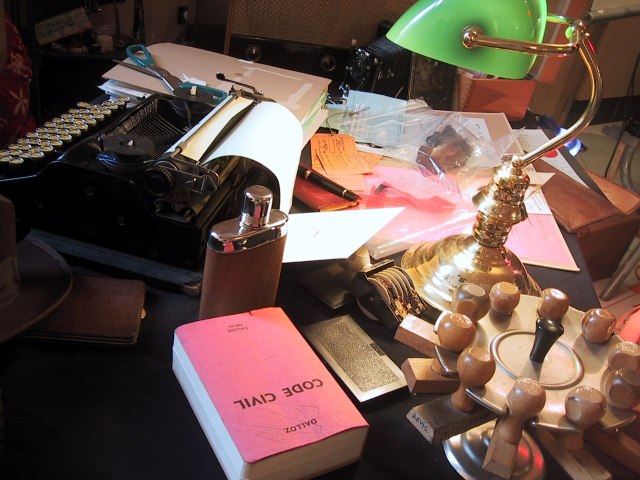
Vintage detective desk photo created by Olivier Bourgeois at freeimages.com. Photo by <a href=”/photographer/ornicar69-54520″>Olivier Bourgeois</a> from <a href=”https://freeimages.com/”>FreeImages</a&gt; Image found at freeimages.com.

My overall impression:

Van Johnson is one of the reasons why I selected The End of the Affair, as he was a guest star on I Love Lucy. When it comes to his movies, I thought those I saw were mostly ok. The 1955 project is no different. I was disappointed by the underutilization of John Mills’ acting talents, as well as the adoption of the “insta-love” trope. The mystery’s randomly produced reveal felt like a major tonal shift. However, The End of the Affair does have its strengths. The acting alone was one of the highlights of the film, from Van’s versatility to Deborah’s ability to convey ideas without using dialogue. The way mise-en-scène was used by the creative team allowed the story to maintain a certain degree of intrigue. I also liked Albert Parkis as a character. When it comes to character-driven stories involving serious topics, I find The Chalk Garden and Hallmark Hall of Fame’s A Tale of Two Cities as stronger titles. But, so far, I’ve only seen a handful of Van’s movies, so maybe I need to keep looking for a film of his I like.

Overall score: 6.1 out of 10

Have you seen The End of the Affair? Which is your favorite movie from Van Johnson’s filmography? Tell me in the comment section!

Have fun at the movies!

Sally Silverscreen

That’s a Wrap for my Second Chance Christmas Double Feature

Now we’ve come to the end of another double feature, as both chosen titles, Young at Heart and An Old Fashioned Christmas, have been watched and reviewed! In the introduction, I brought up the following question:

Did these two movies deserve a second chance?

For my answer, I’ll say Young at Heart was more deserving of a second chance than An Old Fashioned Christmas. With Young at Heart, I not only received an opportunity to check out more projects from Frank Sinatra’s and Alan Hale Jr.’s filmography, I was also given an official introduction to Doris Day’s movies. I found a good excuse to see more musicals, as well as films from the 1950s. Overall, I enjoyed Young at Heart more than Hallmark’s 2010 presentation. As someone who loves An Old Fashioned Thanksgiving, the sequel left a lot to be desired. Despite being titled An Old Fashioned Christmas, the film didn’t feel like a Christmas film. Instead of prioritizing the messages and themes of the holiday, the script primarily focused on stories that could have taken place any time of year. It also doesn’t help how so much of the story revolves around a love triangle. Looking back on An Old Fashioned Christmas, it makes me wonder if the sequel’s poorer quality, as well as becoming forgotten by time and Hallmark themselves, is the reason why I’ve, more often than not, seen DVD copies of the movie included in Christmas movie box sets?

Christmas themed movie tickets image created by Kraphix at freepik.com. <a href=’https://www.freepik.com/free-vector/movie-tickets-christmas_971544.htm’>Designed by Kraphix</a>. <a href=”https://www.freepik.com/free-photos-vectors/christmas”>Christmas vector created by Kraphix – Freepik.com</a>. Image found at freepik.com.

Have fun at the movies!

Sally Silverscreen

The Top Ten Best Stand-Alone Films

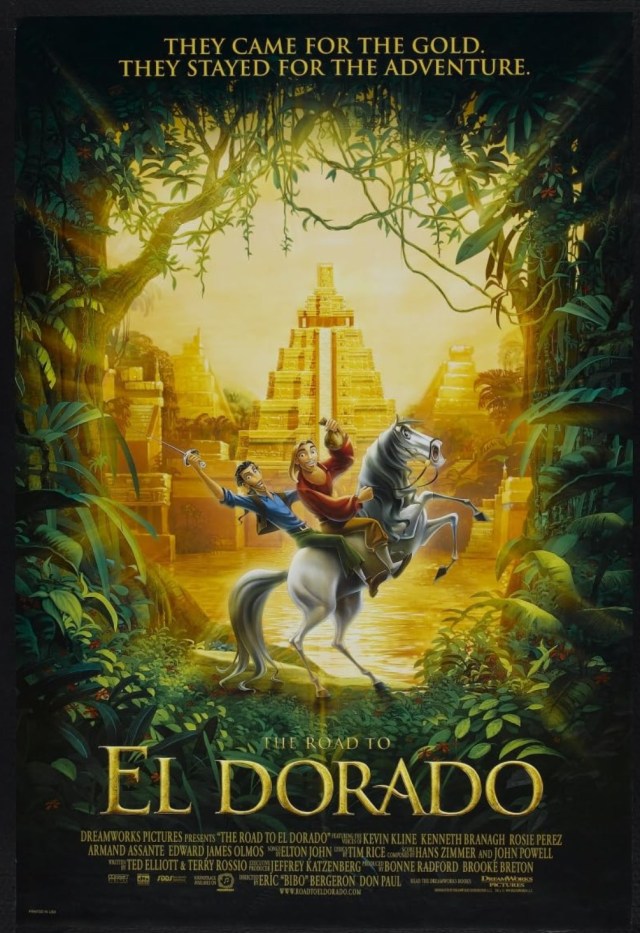
On this day in 2000, The Road to El Dorado made its official debut. While the movie didn’t meet or exceed DreamWorks’ expectations, it certainly found an audience, which stuck with the film for all these years. I once heard The Road to El Dorado was intended to be the first story in a trilogy. But fate decided it worked better as a stand-alone picture. This caused me to think about the other stand-alone movies I’ve come to love. So, in honor of The Road to El Dorado’s 25th anniversary, I have compiled a list of what I believe are the top ten best stand-alone films! For my list, the criteria for a stand-alone film is not only a title that didn’t receive a sequel, but also isn’t affiliated with a series/franchise. If I covered a film on 18 Cinema Lane, I will provide a link to that article or review in this list. Each title will be presented in order of release year and each choice is based on my opinion.

The Road to El Dorado poster created by Dreamworks Pictures, DreamWorks Animation, and DreamWorks Distribution

1. Singin in the Rain (1952)

    I start my list with a classic I was introduced to because of my blog. Now that I have finally seen Singin in the Rain, I have an understanding and appreciation for why the movie is so beloved. Gene Kelly’s iconic musical number, “Singin in the Rain”, should provide enough explanation for why you should check the film out! The number itself feels immersive, as it takes place within the story’s context. Gene adds uniqueness to the number by jumping and splashing in puddles. “Singin in the Rain” successfully represents the spirit of the film, while also delivering the message of seeing the good in a not-so-good situation. That number is just one reason why Singin in the Rain is a solid musical!

    Watching ‘Singin in the Rain’ for the First Time

    2. Ben-Hur (1959)

    If you’re going to watch any classics, you have to see 1959’s Ben-Hur! Though the three-hour run-time can seem intimidating, that time flew by for me, as I was so engrossed in the story. The emotional intensity of Charlton Heston’s, Stephen Boyd’s, and Haya Harareet’s performance complimented the scope of the overall film. Ben-Hur contains other likable qualities as well, from the magnificent sets/scenery to the interesting cinematography. How Christianity/faith was incorporated into the story sets the 1959 production apart from other “sword and sandal” pictures. Those who celebrate Easter may find Ben-Hur an appropriate seasonal title.

    Take 3: Ben-Hur (1959) Review + 60 Follower Thank You

    3. To Kill a Mockingbird (1963)

    While the book, To Kill a Mockingbird, received a sequel, the film adaptation did not. The 1963 movie presents one of the few times where, in my opinion, the film was better than its source material. Getting straight to the point a lot sooner was a main focus for the creative team. The film’s visual nature worked in the favor of certain elements from the book. Showing suspenseful moments from the source material makes those moments seem real, as well as intensifies uncertainty. Leaving out scenes that feel like padding helps the movie maintain a steadier pace.

    Take 3: To Kill a Mockingbird Review

    4. The Boy Who Could Fly (1986)

    When I first saw The Boy Who Could Fly, it subverted my expectations. That’s because the 1986 picture aged surprisingly well! Through Milly and Eric’s friendship, the script shows how people with Autism can create and maintain meaningful relationships. Helping someone with Autism based on their personal preferences and accommodations may have seemed ahead of its time back in the mid to late ‘80s. Timeless messages and themes make up one of the reasons why I love the 1986 film. Showing compassion for others, dealing with grief, and understanding people’s differences take center stage.

    Take 3: The Boy Who Could Fly Review (PB & J Double Feature Part 2)

    5. The Bodyguard (1992)

    In 2022, I wrote an editorial explaining why The Bodyguard held up thirty years later. Because I love the 1992 film, finding explanations wasn’t difficult. “The kitchen scene” is, in my opinion, the best scene from any action movie. One reason why is how the kitchen’s smaller space is seen by the actors as a challenge instead of a hindrance. What also worked in The Bodyguard’s favor was Whitney Houston’s portrayal of Rachel Marron. Throughout the story, Whitney realistically showcases emotions and expressions. This helped Rachel become a multi-layered character.

    I Will Always Love You: ‘The Bodyguard’ at 30

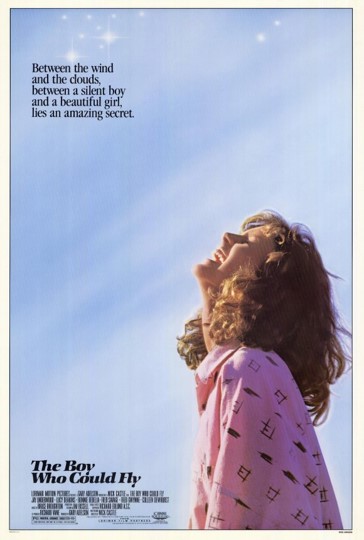
    The Boy Who Could Fly poster created by Lorimar Motion Pictures and 20th Century Fox. Image found at https://www.imdb.com/title/tt0090768/?ref_=nv_sr_srsg_0.

    6. Swept from the Sea (1998)

    Swept from the Sea was one of the earliest hidden gems I discovered in 2019. It’s a movie that’s so great, I just had to include it on this list. There are so many things to like about Swept from the Sea. From Vincent Perez’s captivating performance to the beautiful scenery, the film’s components came together to create an endearing and emotional presentation! The 1998 film is a character-driven story, relying on on-screen chemistry in order to work. Because of Vincent Perez’s and Rachel Weisz’s differing acting styles, the on-screen chemistry between Yanko and Amy was very sweet and genuine.

    Take 3: Swept from the Sea Review (A Month Without the Code — #8)

    7. Phantom of the Megaplex (2000)

    This is another movie I just had to include on my list. But this time, it’s because Phantom of the Megaplex is also celebrating its 25th anniversary this year! The Disney Channel picture showed that the movie-going experience can be fun. As I explained in my editorial celebrating the film’s 20th anniversary, the made-for-TV movie also serves as a time capsule of how the cinema operated in the beginning of the millennium. Phantom of the Megaplex even shows how movies can influence our lives. Though I’m not sure if that aspect of the story was intentional, it makes the 2000 title, somewhat, thought-provoking.

    ‘Phantom of the Megaplex’ at 20: A Reflection on the Movie-Going Experience

    8. I Am David (2004)

    I Am David was the biggest pleasant surprise of 2024. It became the year’s best movie in March and stayed number one until the very end! What set I Am David apart was the film’s genuine emotion and sincerity. This was seen and felt through every aspect of the production. The 2004 movie emphasized visual depth. Achieved by exploring light and darkness, as well as showcasing Europe’s natural landscape, the creative team used the visual nature of film to their project’s advantage. Two effective plot twists are another reason why I liked I Am David. Their delivery in the story was well-written.

    Take 3: I Am David Review (Double Feature: 2004 Edition Part 1)

    9. From Up on Poppy Hill (2011)

    This 2011 presentation is one of Studio Ghibli’s stronger projects. A reason is one of the overarching themes; honoring the past. The film intelligently and creatively shows its audience how important history is in our lives and our world. Whether referencing the 1964 Olympics or focusing on the characters’ relationships, the theme of honoring the past acts as an umbrella sheltering Poppy Hill and its surrounding areas. Studio Ghibli’s signature colorful palette is consistently on display in the 2011 film. The strong understanding for how and when to use color makes scenes look like priceless pieces of art! Personally, I think movies like From Up on Poppy Hill present an argument why 2-D animation still has its time and place.

    Take 3: From Up on Poppy Hill Review + 200 Follower Thank You

    10. The Wild Robot (2024)

      I think it’s fitting to close this list with a DreamWorks movie, as a DreamWorks movie is the reason why I created this list in the first place. Though this was a recent watch for me, The Wild Robot is, so far, the best film I’ve seen this year! The animation itself is absolutely gorgeous! Sometimes, scenes look like paintings and other times, they look like priceless photographs. I was not expecting the story to contain as much emotional depth as it did. An abundance of good messages and themes add a sense of timelessness to the production. Though it’s unknown right now if The Wild Robot will gain an audience like The Road to El Dorado has, I can confidently say it was a really good movie!

      Phantom of the Megaplex poster created by the Walt Disney Company and Disney Channel. © Disney•Pixar. All rights reserved. Disney XD© Disney Enterprises, Inc.

      Have fun at the movies!

      Sally Silverscreen

      Take 3: Young at Heart Review (Second Chance Christmas Double Feature Part 1)

      Thank you for joining me for the first part of my Second Chance Christmas Double Feature! Similar to last year’s review of I Am David, my review of Young at Heart is spoiler-free. If you’re curious about why I chose Young at Heart for this double feature, you can check out the introduction in the link below.

      Coming Soon to a Blog Near You; The Second Chance Christmas Double Feature!

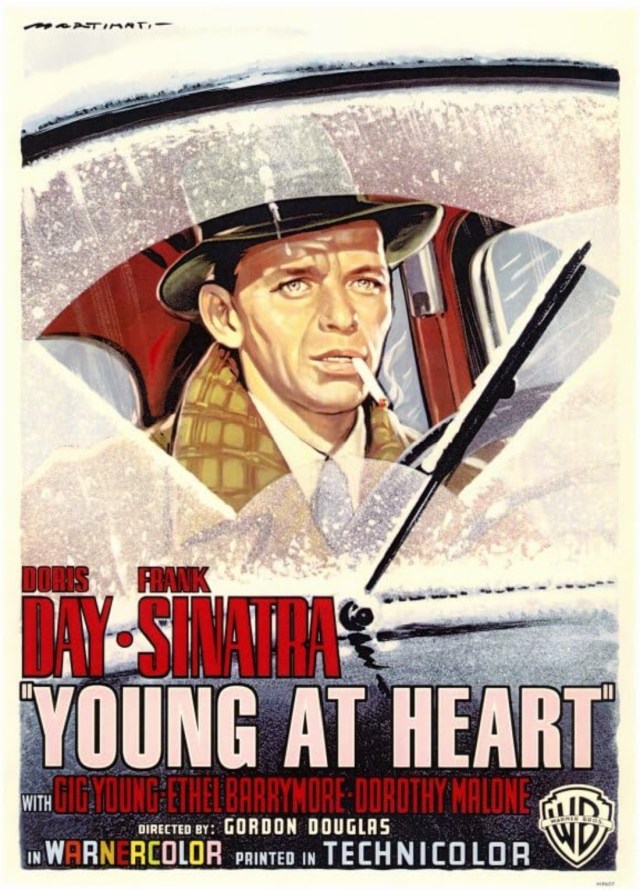
      Young at Heart poster created by Arwin Productions and Warner Bros.

      1. How were you introduced to Young at Heart and why was it selected for this double feature?

      I was introduced to Young at Heart back in January of 2020, through a recommendation from Maddy (of the blog, Maddy Loves Her Classic Films). Several months later, I received another recommendation for Young at Heart. This time, the suggestion came from Moviecriticqueen (of the blog, Movies Meet Their Match). For five years, this movie has stayed on my movie recommendation board on Pinterest. But I have tried to find the right opportunity to write about the film. When I participated in the Sixth Annual Barrymore Trilogy Blogathon, I was originally going to review two movies; Young at Heart and Twentieth Century. Due to technical difficulties, I only had time to write about one film, which I selected the 1934 title. In 2021, I wanted to participate in the Star/Genre Of The Month Blogathon, as January’s featured star was Doris Day. But a busy schedule prevented me from joining the event.

      2. You discovered Young at Heart was a Christmas movie after you learned more about the film on IMDB. What else have you discovered about the 1954 picture?

      While watching Young at Heart, I discovered Alan Hale Jr. portrayed a character named Bob. Those familiar with their television history would recognize Alan from his starring role (‘Skipper’) on Gilligan’s Island. I will admit the only projects from his filmography I’ve seen are Gilligan’s Island and The North Avenue Irregulars. Even though I’m more familiar with Alan’s appearances on Gilligan’s Island, it was a pleasant surprise to see him star in a different medium!

      3. Is the theme of “second chances” incorporated in Young at Heart’s story? If so, how?

      Yes, specifically in Barney’s part of the story! When he’s introduced in Young at Heart, Barney (portrayed by Frank Sinatra) is a very pessimistic man. He feels no matter what he does, he will never find success. Throughout the film, one of the few people who believes in Barney is Doris Day’s character, Laurie. During their initial meeting, Laurie tells Barney how anyone can control their own fate. She also encourages him to complete one of his songs. By befriending Barney, Laurie gave him a second chance to prove how valuable he is. Without spoiling the movie, Laurie and Barney’s friendship pays off!

      4. Was there anything about Young at Heart you liked or didn’t like?

      One of the best aspects of Young at Heart was the dialogue! The writing and delivery were so sharp and witty, it made interactions between the characters interesting! When Barney first arrives at the Tuttle family’s house, he meets Aunt Jessie. During their conversation, Barney nonchalantly asks Aunt Jessie what kind of aunt she is. With a stern tone in her voice, Aunt Jessie promptly tells him her name came first and the curtains came later. This simple exchange between Aunt Jessie and Barney shows some of their character development, as well as the dynamic these characters share.

      As I answered for question number three, Barney is a very pessimistic man who believes he can’t find success. I recognize how overcoming insecurities and doubts takes time. But, in Young at Heart, Barney spends most of the movie being pessimistic. He doesn’t change his perspective until the end of the film. This creative choice made Barney a static character. I wish his transformation had gradually taken place over the course of the story.

      Adorable Christmas card image created by Rawpixel.com at freepik.com. <a href=’https://www.freepik.com/free-vector/christmas-greeting-card-vector_2824854.htm’>Designed by Rawpixel.com</a>. <a href=”https://www.freepik.com/free-photos-vectors/christmas”>Christmas vector created by Rawpixel.com – Freepik.com</a>. Image found at freepik.com.

      5. On 18 Cinema Lane, you’ve covered plenty of Christmas films. How is Young at Heart similar to or different from other Christmas pictures written about on your blog?

      It is true that Christmas has a place in Young at Heart. However, the story spans over the course of several months. This means only a portion of the movie is set during Christmas. So, if I had to compare Young at Heart to any of the Christmas films I’ve reviewed, it would be Meet Me in St. Louis. The 1944 movie not only takes place over a year, there is one scene set during Christmas.

      6. Did you develop any thoughts and/or questions while watching this film?

      As I was watching Young at Heart, I found moments of irony when it came to Barney. When Barney first meets Laurie, he talks about serving in the military during World War II. This reminded me of how Frank’s character, Clarence “Brooklyn” Doolittle, was in the Navy in Anchors Aweigh. During his conversation with Laurie, Barney says he’s never created a hit song. Throughout Frank’s career, he had several hit songs to his name. One notable example is “New York, New York”, which has become the unofficial theme song for New Year’s in Times Square. Any time Barney performed at a restaurant, the patrons didn’t pay him any attention. I’d like to think if Frank had shown up at any restaurant, most of the patrons would have stopped what they were doing to focus on Frank.

      7. How would the story of Young at Heart change if it revolved around another holiday?

      Like I answered for question number five, Young at Heart spans over the course of several months, with Christmas playing a role in only a portion of the movie. Therefore, I don’t think the story would change much had another holiday served as the primary focus.

      8. Did Young at Heart deserve a second chance? If so, why?

      I do believe Young at Heart deserved a second chance! By finally checking this movie out, it gave me an opportunity to see more projects from Frank Sinatra’s and Alan Hale Jr.’s filmography. Young at Heart also became my introduction to Doris Day’s films, as I had never seen any of her movies before 2025.

      9. After watching Young at Heart, is there anything you can take away from your movie viewing experience?

      Young at Heart and The Chalk Garden share one thing in common; a character-driven story that works because of the strength of the cast. But a major difference between these films is how Young at Heart’s script is more “slice of life”. There were conflicts woven into the story. However, these conflicts were either abandoned or resolved at the very end of the movie. I wish Young at Heart had put a little more emphasis on problem-solving among the characters. Another thing The Chalk Garden and Young at Heart have in common is the dialogue, as it was well-written and delivered in both films. There was, clearly, thought and effort put into this film-making component, which made interactions between characters interesting. While I found The Chalk Garden good, Young at Heart was, in my opinion, just fine. The 1954 production could be used as an introduction to Doris Day’s filmography.

      Group of puppies image created by Rawpixel.com at freepik.com. <a href=”https://www.freepik.com/free-photos-vectors/background”>Background photo created by rawpixel.com – http://www.freepik.com</a>. Image found at freepik.com.

      Have fun at the movies!

      Sally Silverscreen

      Coming Soon to a Blog Near You; The Second Chance Christmas Double Feature!

      Whenever I publish one hundred posts, I commemorate the achievement by creating a double feature! The two movies are chosen based on a shared theme. My 900th post was a Comparing with the Critics introduction to 1976. But my review of The Chalk Garden is what inspired this edition’s double feature. When I reviewed the 1964 film earlier this month, I talked about receiving a second chance to write about the movie. This opportunity caused me to think about other titles I’ve been meaning to check out. Looking back on all the blogathons I participated in, I realized I still haven’t seen 1954’s Young at Heart. Upon discovering it was a Christmas movie, I immediately found the perfect excuse to finally see An Old Fashioned Christmas. After selecting and watching these films, I will try to answer the following question:

      Did these two movies deserve a second chance?

      Christmas Tree with boxes image created by Freepik at freepik.com. <a href=’https://www.freepik.com/free-vector/christmas-tree-out-of-gift-boxes_1448089.htm’>Designed by Freepik</a>. <a href=”https://www.freepik.com/free-photos-vectors/background”>Background vector created by Freepik</a>. Image found at freepik.com

      Have fun at the movies!

      Sally Silverscreen

      It’s Time for the 7th Annual Gold Sally Awards!

      Here at 18 Cinema Lane, I maintain several annual traditions to give my readers something to look forward to. One of those traditions is the Gold Sally Awards, which commemorates my blog’s anniversary! The award categories are created by me and based on topics I’ve brought up on my blog. With two new awards in 2025, I’ll explain the significance of those categories. Like in 2024, I will discuss why I chose each recipient. Now, let the 7th Annual Gold Sally Awards begin!

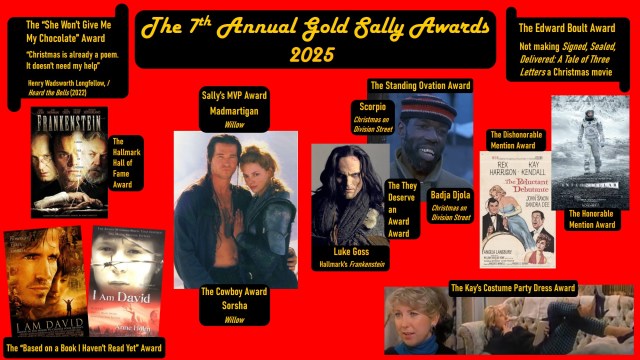
      7th Annual Gold Sally Awards Winners created by me, Sally Silverscreen.

      The Kay’s Costume Party Dress Award

      (Best Outfit from a Movie)

      Helen’s Christmastime Outfit from Hallmark Hall of Fame’s Pack of Lies

      When I thought about the various categories of the Gold Sally Awards, I realized there was no category recognizing the wardrobe department of the movie industry. To fix that, I created the Kay’s Costume Party Dress Award! The name of this award references the dress Kay (Joan Collins’ character) wore at a costume party in the 1983 tv movie, Making of a Male Model. I loved this dress so much, it was featured in 2021’s Movie Blogger’s Christmas Wish-List! From the films I saw in 2024, there were several outfits I really liked. The one that was the most memorable, however, came from the Hallmark Hall of Fame presentation, Pack of Lies! The outfit in question was featured in my Movie Blogger’s Christmas Wish-List from last year; the black and blue ensemble Helen (portrayed by Teri Garr) wore during Christmastime. This timeless outfit was worn in only one scene. That fact is why Helen’s outfit earned the inaugural Kay’s Costume Party Dress Award!

      The Edward Boult Award

      (Missed Opportunity in Cinema)

      Not making Signed, Sealed, Delivered: A Tale of Three Letters a Christmas movie

      Last June, I speculated how Signed, Sealed, Delivered: A Tale of Three Letters could be a Christmas film. In my editorial about my speculation, I explained how the movie’s title could be a reference to either the Nativity story or A Christmas Carol. I also wondered if Signed, Sealed, Delivered: A Tale of Three Letters and “Signed, Sealed, Delivered: To the Moon and Back” could be a two-part adaptation of A Christmas Carol, with the rock star character intended to be a Marley-like character. The official marketing for Signed, Sealed, Delivered: A Tale of Three Letters proved my speculation wrong. But the more I think about how this movie could have been a Christmas picture, the more I wish it had been a Christmas production. As of early February, 2025, the Signed, Sealed, Delivered series has received only one Christmas movie. Plus, my aforementioned editorial provided ideas for a potential Christmas script. With Hallmark Mystery’s ‘Miracles of Christmas’ viewership numbers lower in 2024 than 2023, maybe the network will consider creating another Signed, Sealed, Delivered Christmas film.

      The They Deserve an Award Award

      (An Actor or Actress Who Deserves Recognition)

      Luke Goss (for his performance in Hallmark’s Frankenstein) and Badja Djola (for his performance in Christmas on Division Street)

      There were several good acting performances I saw in 2024. So, it was difficult to choose just one recipient for this year’s Gold Sally Awards. Both Luke Goss’ and Badja Djola’s performance was so impressive! In Hallmark’s Frankenstein, Luke’s use of emotion allowed The Creature to speak without actually speaking. An example I used in my review of the 2004 television film was when The Creature bursts into tears while seeking refuge in a barn. Luke’s acting skills made his character as complicated as he was in Mary Shelley’s source material. Badja made his character, Scorpio, so memorable, despite having limited appearances in Christmas on Division Street. With a consistently commanding presence, Scorpio was a character I looked forward to seeing on screen. That’s because Badja used his acting talents to give Scorpio captivating interactions with other characters. The scene where Scorpio shares some of his backstory with Cleveland is the example I used in my Christmas on Division Street review.

      The Cowboy Award

      (Character Who Makes an Unnecessary, Drastic Change)

      Sorsha from Willow

      You’re probably wondering why I gave Sorsha the Cowboy Award, even though I grew to like her as a character. While I found her transformation from villain to hero necessary, it was drastic. In my Comparing with the Critics review of Willow, I shared how Sorsha’s aforementioned evolution was too abrupt. The transformation gave Sorsha some character development, but it left some questions unanswered. For this flaw, blame lies in the screenwriting.

      Sally’s MVP Award

      (Character Who Left a Memorable, Showstopping Impression)

      Madmartigan from Willow

      When I watch a movie, there is, sometimes, a character who leaves such a memorable impression on me, they end up stealing the show. I have called these types of characters “MVP”. To acknowledge the “MVPs” of 18 Cinema Lane, I created the new Sally’s MVP Award! One of these “MVPs” was Madmartigan from Willow. In my Comparing with the Critics review of the 1988 film, I talked about how Madmartigan was the story’s comic relief. His personality and comedic timing captivated my attention and kept me invested in his story. What helped Madmartigan become the “MVP” of Willow was the screenwriting and Val’s performance.

      The “She Won’t Give Me My Chocolate” Award

      (Best Quote from a Movie)

      “Christmas is already a poem. It doesn’t need my help” – Henry Wadsworth Longfellow, I Heard the Bells (2022)

      In the 2022 movie, I Heard the Bells, Fanny (portrayed by Rachel Day Hughes) encourages her husband, Henry, to create a Christmas themed poem. Henry (portrayed by Stephen Atherholt) told his wife, “Christmas is already a poem. It doesn’t need my help”. When Henry said this, I started to think about what his quote meant. Poems require planning and putting the right pieces together, in order for that poem to have good flow and writing structure. Christmas festivities require a certain amount of planning, whether it’s a local church’s Nativity play or a family’s Christmas party. Using these two examples, finding the right pieces is important, such as who will portray the Three Wise Men or what will be the entrée of Christmas dinner. Poems can also tell stories. One classic example is ‘‘Twas the Night Before Christmas’. Christmastime is filled with stories, from the Nativity story to A Christmas Carol. Henry’s aforementioned quote made me see Christmas in a completely different way! Plus, a quote from a Christmas movie has never won the “She Won’t Give Me My Chocolate” Award before.

      The Honorable and Dishonorable Mention Award

      (Best and Worst Movie from the Honorable and Dishonorable Mention Category)

      Best – Interstellar

      Worst — The Reluctant Debutante

      For last year’s Gold Sally Awards, there was only the Dishonorable Mention Award. That’s because I didn’t see enough movies to include an honorable mention category. With the honorable mention category returning in 2024, the Honorable Mention Award is also coming back! Science fiction stories about space exploration will typically emphasize the thrills and wonder of the galaxy. This can make it easy for a movie’s audience to get caught up in how adventurous and exciting outer space can seem. In Interstellar, a major focus is space travel’s effect on human beings. So, themes of family, sacrifice, and the price of scientific achievement are woven into the script. That, along with quality acting performances and impressive special effects, is why I liked Interstellar!

      Out of all the movies that ended up in the dishonorable mention category, I had the highest expectations for The Reluctant Debutante. This is because I not only reviewed the film for The John Saxon Blogathon, there was some well-known talent involved with the project. Unfortunately, the 1958 movie fell short of those expectations. The Reluctant Debutante was a premise driven story that felt longer than one hour and thirty-four minutes, due to the jokes being drawn-out. It also didn’t help how some story ideas were overlooked. When I reviewed the 1958 film, I shared how movies from the 1950s are covered so infrequently on 18 Cinema Lane. So, it’s disappointing when a production from the ‘50s is weaker than expected.

      The Hallmark Hall of Fame Award

      (Movie That Feels Like It Belongs in the Hallmark Hall of Fame Collection)

      Hallmark’s Frankenstein

      There are different kinds of stories in the Hallmark Hall of Fame collection. One kind of story is adaptations of pre-existing literature. Sometimes, “classic” literature became Hallmark Hall of Fame presentations, like The Secret Garden and A Tale of Two Cities. When these adaptations are good, they can be an immersive experience. This is how I would describe Hallmark’s Frankenstein! Due to the combination of screenwriting, acting performances, set design, and costume design, the movie made me feel like I was transported to another time and place. I also appreciate how close to the source material the 2004 television film is. Looking back on Hallmark’s Frankenstein and the Hallmark Hall of Fame collection, I’m actually surprised Mary Shelley’s novel wasn’t adapted into a Hallmark Hall of Fame project. Everything I said is why I chose Hallmark’s Frankenstein for the Hallmark Hall of Fame Award!

      The “Based on a Book I Haven’t Read Yet” Award

      (Movie Based on Source Material I Have Not Yet Read)

      I Am David

      Movies that won the “Based on a Book I Haven’t Read Yet” Award were first placed on a best films of the year list. I Am David is continuing that tradition! The 2004 film earned the top spot on my best movies list of 2024. This is the second time a number one movie of the year received the “Based on a Book I Haven’t Read Yet” Award! After I reviewed I Am David, I learned the movie was based on a book. I’m not sure how affective the story’s plot twists will be, as I already know what they are because I saw the film. However, I’d still be interested in reading I Am David someday!

      The Standing Ovation Award

      (Character Most Deserving of Receiving Their Full Potential)

      Scorpio from Christmas on Division Street

      When the Gold Sally Awards presented the Standing Ovation Award, the recipients were characters who should have received their “standing ovation”, but were denied that for various reasons. Scorpio (from Christmas on Division Street) actively worked toward getting where he wanted to go. As I said during the They Deserve an Award Award, Scorpio had limited appearances in the 1991 made-for-TV movie. Despite that, the audience learned enough about him to know what he had gone through. During this limited period of time, Scorpio attempts to overcome his obstacles. While I won’t spoil Christmas on Division Street, I will say those attempts earned Scorpio the Standing Ovation Award!

      Have fun at the movies!

      Sally Silverscreen

      Take 3: Roman Holiday Review

      Reviewing Roman Holiday is a full circle moment for me. Back in 2019, the Hallmark Channel movie, Rome in Love became one of the top three best films I saw that year. That movie was about a woman starring in a remake of Roman Holiday. I also read the book Rome in Love was based on. When I signed up for the Journey to Italy Blogathon, I was surprised no one had chosen the 1953 production. Because Roman Holiday is considered a “classic”, I would have expected the movie to be one of the first to be selected. So, I was grateful for the opportunity to check out the film! Audrey Hepburn and Gregory Peck are no strangers to 18 Cinema Lane. Some of their films have been covered on my blog. In fact, there’s been a few pictures I’ve liked; such as Funny Face, The Nun’s Story, and To Kill a Mockingbird. How does Roman Holiday compare to those movies? Find out in this review!

      Roman Holiday poster created by Paramount Pictures

      Things I liked about the film:

      The acting: Roman Holiday introduced cinema’s audience to Audrey Hepburn as a lead actress. Not only that, the 1953 presentation earned Audrey an Oscar. Thinking about her portrayal of Princess Ann, I can understand why Audrey was, at least, nominated for an Academy Award! Even though this was her first starring role, Audrey proved her talents were strong enough to appear convincing. A great example happened when Princess Ann was sleepily wandering around Rome. Through her wanderings, Princess Ann meets Joe Bradley (portrayed by Gregory Peck). The stumbling and mumbling of Princess Ann make her look drunk. Even Joe thinks Princess Ann had too much to drink, due to her speech sounding slurred and her eyelids consistently rising and falling. In Audrey’s performance, Princess Ann proves looks can, indeed, be deceiving.

      One of my favorite scenes in Roman Holiday takes place toward the beginning of the story. During a ball, Princess Ann’s shoe is visible on the floor. The shoe was noticed by Countess Vereberg (portrayed by Margaret Rawlings) and General Provno (portrayed by Tullio Carminati). But the way these characters looked at each other and the shoe communicated the shock and embarrassment they were feeling. With the use of eye movements and facial expressions, this exchange was such a hilarious moment! Another performance I liked was Gregory Peck’s portrayal of Joe Bradley! A newspaper reporter from the United States, Joe had a consistent confidence that made him sure of himself. His reactions appeared believable; from a surprised look at seeing Princess Ann’s portrait in the paper to the joy on his face while dancing on a boat. Gregory used a variety of emotions throughout the film. This is one of the reasons Joe became a likable character!

      The Italian setting: During the opening credits of Roman Holiday, it’s revealed the production was filmed in Rome, Italy. Through the cinematography and screenwriting, Princess Ann’s time in Italy served as an introduction to the film’s audience. Several iconic landmarks were featured; including the Colosseum, the Trevi Fountain, and the Mouth of Truth. There were even some lesser-known areas from The Eternal City included in the story. During Princess Ann’s day in Rome, she and Joe visit a wall of granted wishes. As explained through dialogue, if someone’s wish came true, they must place a commemorative plaque on the wall. Unfortunately, I couldn’t find any confirmation this wall actually exists. But if it is real, I loved this tradition!

      Avoiding the “it’s not what you think” cliché: In Roman Holiday, Joe Bradley makes a bet with his boss to conduct an interview with Princess Ann, including photos to prove the interview took place. This, along with Joe keeping his identity a secret, provided the perfect excuse to include the “it’s not what you think” cliché. However, the film’s creative team didn’t utilize this predictable piece of story-telling. Instead, Joe changes his mind about the bet, which gave him some character development. Even Joe’s friend, Irving Radovich, reconsiders submitting his photographs of Princess Ann’s adventure. After watching my fair share of rom-coms where the same tropes and clichés are incorporated, I appreciate Roman Holiday thinking outside the box!

      The Journey to Italy Blogathon banner created by Gill from Realweegiemidget Reviews and Kristina from Speakeasy.

      What I didn’t like about the film:

      A drawn-out story: Roman Holiday has a run-time of one hour and fifty-eight minutes. While watching the movie, that run-time was felt. The story of Princess Ann running away to go on an adventure was drawn-out. One reason is how some moments are longer than necessary. A perfect example is when Princess Ann meets a group of reporters. Each introduction was a slow procession that seemed to last about a minute and a half. Another example is when Princess Ann’s governess reads an itinerary. She slowly reads each event listed on Princess Ann’s schedule, making that part of that scene feel like almost a minute had crawled. To avoid this flaw, the script needed to be tighter.

      Little sense of urgency: As I already brought up in this review, Princess Ann runs away to go on an adventure. While Princess Ann was having the time of her life, those in her life were frantically trying to find her. But very few scenes stressed this point. In fact, only three scenes addressed the urgency of bringing Princess Ann home. By providing the story with little sense of urgency, the seriousness of Princess Ann going missing was downplayed. Though I recognize how Roman Holiday is primarily Princess Ann’s story, her actions having consequences were mostly ignored.

      Almost no one recognizing Princess Ann: The reason Princess Ann spends time in Italy is because the country was included in her “goodwill tour”. Shortly after running away, Princess Ann’s portrait is printed in every Italian newspaper, according to Joe Bradley’s boss. However, throughout Princess Ann’s adventure, only two people recognize her; Joe and his friend, Irving Radovich. Even before Princess Ann receives a hair-cut, no one acknowledges her true identity. I know fictional stories like Roman Holiday require a suspension of disbelief. But I couldn’t take that part of the movie seriously.

      Princess tiara image created by Freepik at freepik.com. <a href=’https://www.freepik.com/free-vector/ornamental-princess-crowns_1109199.htm’>Designed by Freepik</a>. <a href=”https://www.freepik.com/free-photos-vectors/gold”>Gold vector created by Freepik</a>. Image found at freepik.com.

      My overall impression:

      Before reviewing Roman Holiday, I had heard so many good things about the movie. As I said in the introduction, the film is considered a “classic”. This is definitely not a bad picture. But I wanted to like it more than I did. Roman Holiday’s run-time feels as long as it is. At almost two hours, the story is drawn-out, partly due to moments that last longer than necessary. Having little sense of urgency not only downplays the seriousness of Princess Ann running away, it also mostly ignored Princess Ann’s actions having consequences. However, I believe the 1953 production has merit. The acting was one of the strongest aspects of this movie. Like I said in my review, I can understand why Audrey was, at least, nominated for an Academy Award! I actually think Roman Holiday should have been included in American Film Institute’s 100 Movies list. According to IMDB, it was “the first American film to be made in its entirety in Italy”. While I’m thankful for the chance to have finally seen Roman Holiday, I prefer Audrey’s pictures like The Nun’s Story and Funny Face. For Gregory Peck, I still believe To Kill a Mockingbird is the stronger movie.

      Overall score: 6.1 out of 10

      Have you seen Roman Holiday? Which films from Audrey Hepburn’s or Gregory Peck’s filmography do you like? Please tell me in the comment section!

      Have fun in Italy!

      Sally Silverscreen

      Take 3: The Reluctant Debutante Review

      Out of all the decades covered on 18 Cinema Lane, the 1950s make such infrequent appearances. I did review the 1954 film, Dial M for Murder, last month. But my review before that was from last December, when I wrote about 1957’s The Curse of Frankenstein. This infrequency is one of the reasons why I’m reviewing the 1958 film, The Reluctant Debutante! Another reason is John Saxon’s involvement in the project. When I joined Realweegiemidget Reviews’ and Cinematic Catharsis’ blogathon, I wasn’t familiar with John Saxon as an actor. So, while exploring his filmography, I came across the 1958 movie. I was surprised to discover Angela Lansbury also starred in The Reluctant Debutante. Since I’ve seen few of Angela’s live-action films, there was yet another reason for me to review this production.

      The Reluctant Debutante poster created by Avon Productions and Metro-Goldwyn-Mayer (MGM)

      Things I liked about the film:

      The acting: As I said in this review’s introduction, John Saxon is one of the reasons why I’m reviewing The Reluctant Debutante. Even though I wasn’t familiar with him as an actor, I liked his portrayal of David Parkson! Whenever he appeared in the movie, David always looked confident. Paired with that confidence was charisma, which helped David become such a memorable and likable character! What worked in John’s favor was the consistency of his performance. Having good on-screen camaraderie with Sandra Dee also worked in John’s favor. In the few scenes David and Jane, Sandra’s character, spent together, they appeared to get along so well. They also seemed to be on the same page when it came to several topics, such as the symbolism behind dancing and exploring the world. I, honestly, wish Sandra and John were given more appearances in The Reluctant Debutante because both of their performances were strong!

      Like I also mentioned in this review’s introduction, Angela Lansbury’s involvement is another reason why I wrote about The Reluctant Debutante! Despite having limited appearances in the story, I really enjoyed watching Angela’s portrayal of Mabel Claremont! The best way I can describe this character is “the life of the party”. From the very first scene she appeared in, Mabel had such an exuberant personality. There was such a brightness to Mabel, I could understand why other characters might want to invite her to their events. Similar to John Saxon’s performance, Angela’s portrayal of Mabel was consistent. Mabel is another character I wish received more screen-time!

      The on-screen chemistry: Rex Harrison and Kay Kendall portrayed Jane’s parents, Jimmy and Sheila, in The Reluctant Debutante. Shortly after these characters were introduced, I could immediately sense Kay and Rex’s on-screen chemistry! Throughout the story, Sheila and Jimmy’s marriage felt believable, like they were always meant to be together. When it came to the “debutante season”, Jimmy was the casual participant and Sheila became more involved in the process. Though they had their reasons for their “debutante season” beliefs, they still found a way to come together when it came to what was important, such as the well being of their daughter. Based on everything I said, Sheila and Jimmy displayed the “opposites attract” trope. With the strength of Kay and Rex’s acting abilities, both individually and together, this trope worked in Jimmy and Sheila’s favor!

      The wardrobe: Debutante balls are known for showcasing exquisite fashion! When it came to the wardrobe department, The Reluctant Debutante did not disappoint! At a ball toward the beginning of the movie, Mabel wore a long-sleeved gown. This scoop-neck gown was covered in a lacy, deep-blue material, complimenting Angela’s light blonde hair. Adding extra sparkle was a large diamond necklace, a diamond tiara, and diamond earrings. One of my favorite dresses was Jane’s light-blue gown! Tiny bows found their place on the gown’s skirt. Sandra sometimes wore this dress with a light-blue satin cape and white gloves, which added elegance to the overall ensemble. Another outfit I liked is more casual in style. While at a restaurant with David Parkson, Jane wore a beige and brown plaid jumper dress over a beige blouse. Paired with this outfit was a khaki trench coat and a beige hat.

      The John Saxon Blogathon banner created by Gill from Realweegiemidget Reviews and Barry from Cinematic Catharsis

      What I didn’t like about the film:

      A premise driven story: In the past, I’ve explained the difference between a premise driven and a plot driven story. In the case of The Reluctant Debutante, this story was premise driven. According to IMDB, the movie is about Jane and her parents participating in “Debutante season”. That part of the story was prioritized throughout the film. Taking a behind the scenes look at the debutante world is interesting. Halfway through the movie, though, I found myself asking, “Where’s the plot”? What The Reluctant Debutante was missing was a conflict, something to make the audience ask, “and then what happened”. This conflict could have ranged from Sheila and Jimmy organizing Jane’s debutante ball to Mabel convincing the Queen to continue the tradition of “debutante season”.

      Drawn-out jokes: IMDB classifies The Reluctant Debutante as a comedy. Despite this label, I didn’t find myself laughing while watching the film. This weakness was due to the story’s jokes being drawn-out. A perfect example is how Sheila and Jimmy’s plans to overprotect Jane don’t go as expected. At one ball, Jimmy and Sheila are trying to find Jane. They race around the ballroom frantically looking for their daughter. Toward the end of the event, they discover Jane left with David Parkson. The very next scene revolves around Sheila and Jimmy worrying about Jane’s whereabouts, even going so far as to hiding in the kitchen and eavesdropping when Jane arrives home. I understand The Reluctant Debutante’s creative team was trying to tell a “comedy of errors” kind of story. In this movie, however, it took a long time for the errors to be resolved. In my aforementioned example, it took two whole scenes for Jane to be reunited with her parents. Watching The Reluctant Debutante felt like listening to a comedian spending too much time reaching their joke’s intended punchline.

      Overlooked story ideas: While sightseeing in London, Mabel’s daughter, Clarissa, explains the “debutante season” to Jane. During this explanation, Clarissa tells Jane 1958 will be the last year for the “season” due to the Queen believing the practice outdated. Outside of Jane and Clarissa’s conversation, however, this detail isn’t brought up. Plus, none of the characters act as if the tradition of the “season” is ending anytime soon. I wish this part of the story had played a bigger role in The Reluctant Debutante. As I mentioned earlier in this review, it could have served as one of the story’s conflicts. It also would have given other characters, like Mabel and Clarissa, more involvement in the film.

      Image of high school students dancing at prom created by Jan Sundstedt at freeimages.com. Photo by <a href=”/photographer/jansun-33414″>Jan Sundstedt</a> from <a href=”https://freeimages.com/”>FreeImages</a&gt;. Image found at freeimages.com.

      My overall impression:

      Movies from the 1950s are reviewed so infrequently on 18 Cinema Lane. So, when I find a film from the ‘50s to write about, I always root for that film to be good. With The Reluctant Debutante, however, I can’t say this movie is good. If anything, I was disappointed by it. The 1958 production was a premise driven story, a type of story that, in my opinion, contains less intrigue. The jokes lasted so long, it made the movie feel longer than one hour and thirty-four minutes. At one point, I almost fell asleep watching The Reluctant Debutante. Though I kept watching because the cast gave such strong performances. From Kay and Rex’s on-screen chemistry to Angela’s character being “the life of the party”, the acting was one of the few things I liked about the film. There’re even characters that should have received more screen-time, like David Parkson and Jane. During The Reluctant Debutante’s opening credits, I learned the movie was based on a play. What I also learned is how some plays were not meant to be adapted into a film.

      Overall score: 5.5 out of 10

      Have you seen The Reluctant Debutante? Which movie from the 1950s is your favorite? Let me know in the comment section!

      Have fun at the movies!

      Sally Silverscreen