Take 3: I Dream of Jeanie (1952) Review

I’m participating in two blogathons; the Musicals: With A Song And A Dance In My Heart Blogathon and The Biopic Blogathon. Because of this choice, I wanted to review a movie that was “the best of both worlds”. One day, while on Youtube, I came across the 1952 film, I Dream of Jeanie. After learning it was a musical biopic about the composer, Stephen Foster, I knew I had found the perfect entry! Prior to these events, I had never heard of I Dream of Jeanie. In fact, I was not familiar with Stephen Foster either. But I wanted to use my participation as an opportunity to learn more about him. I also wanted to be introduced to films that were newer to me. Did my plan work? Continue reading if you want to find out!

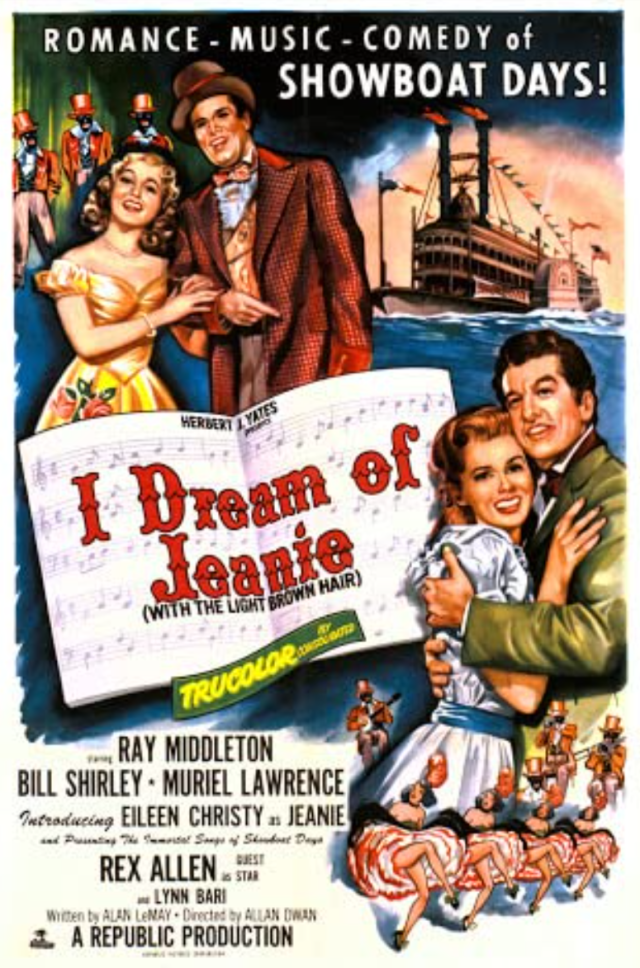
I Dream of Jeanie (1952) poster created by Republic Pictures

Things I liked about the film:

The acting: Bill Shirley is an actor I’m not familiar with. While I have seen Disney’s Sleeping Beauty, I have never seen any of his live-action films. Despite this, I did enjoy watching his acting performance! His mannerisms and line delivery reminded me of Jimmy Stewart. This is because of the tender-hearted nature Bill presented. His singing talents were amazing in this movie! One of his best performances was his solo, “Beautiful Dreamer”. With his deeper vocals and the heart-felt lyrics, there was emotion found in the song. He also sang beautifully with Eileen Christy, who portrayed Jeanie. Toward the beginning of the film, they sang a duet of “Oh! Susanna”. Bill and Eileen displayed good harmony during their performance. Having nice on-screen chemistry also worked in their favor.

While we’re on the subject of Jeanie, let’s talk about Eileen Christy’s performance. Throughout the film, she presented her character with a likable persona. Jeanie was sometimes the film’s “comic relief” as well. When a script adopts a “comic relief” character, that individual can either be goofy or be seen as dumber than the protagonist. With Jeanie, that was never the case. Even though she was silly, her intelligence never faltered. Another actress who gave a good performance is Muriel Lawrence. Portraying Jeanie’s sister, Inez, she provided an embodiment of a “diva”. Her strong will and determination to get her way made Inez one of the film’s more unlikable characters. But as an actress, Muriel had star qualities!  Whenever she appeared on screen, Muriel was able to garner the camera’s attention, even when her character wasn’t the focus of a scene. It also helps that she sang beautifully in this movie.

The musical numbers’ inclusion in the story: In some musicals, a musical number can make the story feel paused. With I Dream of Jeanie, the musical numbers pushed the story forward and made sense within the context of the story. A perfect example is Muriel’s solo, “Lo, Hear the Gentle Lark”. Toward the beginning of the movie, Inez and Stephen talk about an upcoming recital, where Stephen hopes Inez will agree to an engagement. When the event arrives, the performance is used to make Inez shine, showing how she craves attention. During the recital, unpublished songs by Stephen are introduced. The secret of Stephen’s involvement with “Oh! Susanna” is revealed at this event as well. Similar to “Lo, Hear the Gentle Lark”, the inclusion of these aforementioned songs also fit within the story.

A glimpse into the legal side of the music industry: One of the conflicts Stephen experiences is his lack of royalties from “Oh! Susanna’s” success. Whenever the song is performed, Stephen’s name is never mentioned. This surprises everyone in his life, including his brother. Stephen also faces legal threats due to the song’s copyright. This is because he presented the song to multiple publishers. Since I’m not well versed in the legalities of the music world, I found this brief exploration fascinating! That part of the story allowed me to learn something new. It also showed how different copyright laws and royalty agreements were in the 1840s.

The Musicals: With A Song And A Dance In My Heart Blogathon banner created by Neil from Thoughts From The Music(al) Man

What I didn’t like about the film:

Not really biographical: The purpose of a “biopic” is to provide some education to an audience about a particular individual. In the case of I Dream of Jeanie, this movie is meant to tell the story of Stephen Foster. But I ended up not learning much about the composer. While I discovered he wrote ‘Oh! Susanna’, I was expecting to learn more about Stephen. How did he become interested in music? Did he receive any professional training? This film doesn’t answer these questions. Instead, the script focuses more on other characters and events.

The characterization of Stephen Foster: No main individual in any “biopic” is meant to be seen as “perfect”. However, one of the staples of a “biopic” is to present the admirable aspects of a given individual. With I Dream of Jeanie, Stephen Foster, more often than not, came across as a desperate push-over. I don’t blame Bill Shirley for this, as he did a good job with the acting material he received. But I will put blame on the film’s screenwriter, Alan Le May. For the majority of the movie, Stephen loves a woman named Inez. She not only doesn’t like the type of music he makes, she also hates “Oh! Susanna”. In an attempt to win her love, Stephen announces how he’s trying to achieve a “redemption” by only playing classical music. He does this instead of standing up for himself or trying to compromise with Inez. This is, sadly, just one example of Stephen’s characterization.

The character of Edwin P. Christy: Not every character is meant to be likable. Sometimes, a character’s likability is based on personal preference. In my opinion, Edwin P. Christy was annoying. Once again, blame is given to Alan Le May. Edwin was a flamboyant and over-the-top showman. But what made him unlikable for me was how he used every opportunity to put the spotlight on himself. During Inez’s recital, Edwin disrupts the event by loudly playing one of Stephen’s songs at Stephen’s nearby stable. Edwin then crashes the recital and performs some of Stephen’s unpublished music, with no granted permission from Stephen. After some time, Edwin’s antics became unpleasant. It almost felt like Edwin tried to make the story about himself as well.

The Biopic Blogathon banner created by Annette from Hometowns to Hollywood

My overall impression:

In my introduction, I said I wanted to use my participation in these blogathons to learn more about Stephen Foster. Unfortunately, that’s not what happened. Don’t get me wrong, I did learn a few things about him and about some of the legalities of the music world’s early years. But it wasn’t enough to justify an hour and twenty-nine-minute movie. If anything, it almost seems like this film was about anything but Stephen. When characters like Edwin P. Christy try to take the spotlight for themselves, it makes the project look less biographical. As I mentioned in this review, some of the blame falls on the screenwriting. The quality of a project’s script is what makes or breaks it. If the script is weak, there’s only so much the other members of the creative team can do to salvage it. Now, as I wrap up this review, I must take a detour to Wikipedia.

Overall score: 5.6 out of 10

Have you seen any biopics? If so, which one is your favorite? Let me know in the comment section below!

Have fun at the movies!

Sally Silverscreen

Take 3: Pollyanna (1920) Review

When I discovered The Silent Movie Day Blogathon, hosted by In The Good Old Days Of Classic Hollywood and Silent-ology, I knew I had to take part in the event! As I mentioned in my review of The Cabinet of Dr. Caligari, silent movies are not often covered on 18 Cinema Lane due to their availability. Speaking of the aforementioned film, that review was published back in January. So, my blog was due for another article about a silent picture. I was fortunate to find 1920’s Pollyanna on Youtube. While choosing this movie for the blogathon, I realized this would be the first adaptation of Pollyanna I would see in its entirety. While I have seen the adaptation starring Hayley Mills, I only watched pieces of it. Therefore, I can’t give an honest opinion on that film. I am familiar with the general premise of Pollyanna, despite never reading the source material or seeing an entire film version. I also haven’t sought out any of Mary Pickford’s movies before. Because of everything I’ve said in this introduction, I knew watching 1920’s Pollyanna would be an exciting experience!

Pollyanna (1920) poster created by United Artists

Things I liked about the film:

Mary Pickford’s performance: I thought the cast of Pollyanna was solid. But the one actor that shined the brightest was Mary Pickford! As I’ve mentioned before, actors and actresses in silent films must rely on body language, facial expressions, and emotions to convey what a character is thinking and feeling. While portraying Pollyanna, Mary was so expressive, using the aforementioned acting components to her advantage. She was even able to quickly adapt to each situation very effortlessly! What I also liked about Mary’s performance was how she displayed feelings of sadness and frustration. Realistically, carrying a happy persona is tiring. You can only be happy for so long and so often until the feeling itself starts to wear off. Because of Mary expressing these emotions, she helps prevent her character from being one-dimensional.

Mary’s wardrobe: An element of this project that, surprisingly, stood out to me was Mary’s wardrobe. Even though these outfits appear age appropriate for her character, a more creative reason is what caught my eye. The majority of Mary’s wardrobe consisted of light-colored outfits. These outfits allowed Mary to stand out and become the focus of a given scene. This creative decision was a simple one that worked in the project’s favor. It shows how much thought was put into the film’s presentation.

The messages and lessons: Before watching this adaptation of Pollyanna, I knew the titular character’s purpose was to, simply, make people happy. While there is truth to this statement, making people happy only scratches at the surface. Pollyanna, more often than not, tries to find the “silver lining” that will help her move forward in life. This mentality allows her to see the good in everyone she meets, even her stubborn Aunt Polly. In the 21st century, it can sometimes be difficult to put ourselves in a good mood. Even in the world of movie blogging, it can be easier to talk about bad movies or unfavorable movie news. But Pollyanna shows the audience that it is possible to find the “silver lining” in our lives, even finding the good in ourselves. These are lessons and messages that are not only relatable, but timeless as well.

The Silent Movie Day Blogathon banner created by In The Good Old Days Of Classic Hollywood and Silent-ology

What I didn’t like about the film:

An unexplained scene: When Aunt Polly is first introduced, two small children dressed up as bunnies appeared on the table. They approach Aunt Polly with pitchforks in their hands, one of these “bunnies” even poking Aunt Polly with their pitchfork. After that scene, the “bunnies” never appeared again. They were never referenced by any of the characters either. It also doesn’t help that no title card provided context to the “bunnies”. This is a scene I wish was given more explanation.

Musical selections: To make up for the lack of dialogue, music is used to emphasis the tone of a given scene. While there were musical selections in Pollyanna that matched what was happening on screen, some of these musical selections felt out of place. In the second half of the film, Pollyanna deals with a difficult situation. This situation brought up feelings of sadness and low self-esteem. But the background music during this situation was a cheery, upbeat tune. Because of this musical choice, it kind of took me out of the film.

Pollyanna’s lack of uniqueness: Like I said in the introduction, I was familiar with the general premise of Pollyanna prior to watching this adaptation. Based on what I knew, I was expecting the titular character to magically make everyone feel happy, with the script making it seem like that was Pollyanna’s “magical power”. But as I watched the movie, Pollyanna reminded me of other characters; such as Anne Shirley, Heidi, and Annie. While I liked her promotion of the “glad game”, Pollyanna’s attempts at spreading joy to those around her didn’t feel much different from the attempts of the aforementioned characters. This discovery disappointed me because I expected Pollyanna and her story to be different from Annie, Heidi, and Anne of Green Gables.

Image of vintage movie camera created by Macrovector at freepik.com. <a href=”https://www.freepik.com/free-photos-vectors/background”>Background vector created by macrovector – http://www.freepik.com</a>. Image found at freepik.com.

My overall impression:

Mary Pickford is someone I’d like to call one of the “grandmothers of cinema”. A face of Hollywood’s early years, she helped play a role in showing what was possible for, at the time, a new medium. This particular film also shows what is possible when it comes to adaptations. 1920’s Pollyanna is a fine film. With strong acting, effective creative choices, and good messages, it contains likable qualities. However, the movie kind of felt like a copy of similar stories. Pollyanna herself reminded me of other young characters with shining personalities, like Anne Shirley or Ceddie. Even the older characters’ transformations in attitude were reminiscent of those such as Daddy Warbucks, Marilla Cuthbert, and Heidi’s grandfather. With all this said, the movie didn’t add much to the adaptation table. I am aware of two other adaptations of Pollyanna, including Hayley Mills’ version I mentioned in the introduction. One day, I’d like to check these films out and see which one I like best!

Overall score: 7.2 out of 10

Have you seen any silent films? If so, which one would you like to recommend? Let me know in the comment section!

Have fun at the movies!

Sally Silverscreen

Evenings At The Shore: What is Your Gift?

Throughout this episode of Chesapeake Shores, Caitlyn is searching for a gift. In an attempt to find it, she asks Abby what the other characters’ gifts are. This question actually brought up a really good point that I hadn’t thought about until Caitlyn mentioned it. Chesapeake Shores is a show that has a larger cast. Because of this, each character has their own unique gift they bring to the show’s table. As Abby herself points out, her gift is numbers. Arthur’s gift is art, but he sees more as a curse. In this episode, we learn Evan’s gift is thinking. During the duration of Chesapeake Shores, the characters have used their gifts to their advantage. Still, there are characters whose gifts are unknown. Like any gift, the anticipation and excitement of discovering what it is makes that moment so memorable. But until each character’s gift is revealed, let’s re-cap this episode of Chesapeake Shores!

Just a reminder: If you did not see this episode of Chesapeake Shores, there are spoilers in this re-cap.

Chesapeake Shores Season 5 poster created by Crown Media Family Networks and Hallmark Channel.

Season: 5

Episode: 7

Name: What’s New

Abby’s story: One morning, Evan arrives at the O’Brien family home. He’s there to give Abby the legal papers related to his departure from the hotel project. While looking at O’Brien family photos, Evan accidently drops Mick’s childhood portrait. As he’s attempting to pick the picture up, Evan has a back spasm. When Nell hears about Evan’s unfortunate circumstance, she insists he stay on the O’Brien family’s couch until his back heals. For Abby, this is an awkward situation. But for Evan, he makes the best out of his troubles. He is able to work on his phone and laptop, even teaching Caitlyn how to create a video game. Mandrake, Evan’s chauffeur and personal assistant, is able to help Evan wherever help is needed. In a private conversation with Abby, Mandrake reveals Evan was diagnosed with Dyslexia later in life, which explains why Evan tries to avoid reading. He also reveals how Evan originally hurt his back in an accident, but hasn’t been told any of the details. After receiving all this information, Abby sees Evan in a new light. But her opinion on him hasn’t completely changed. A few days later, Evan’s back has finally healed. He also rips up the aforementioned legal documents. When Abby asks why he made such a dramatic gesture, Evan explains how his time with her family has given him an idea. Instead of scrapping the hotel project altogether, he shares his plans to build the hotel on the lot next door, a lot he already purchased. On the original hotel lot, Evan plans to build a museum to house all the artifacts that are found on the excavation site. His problem-solving skills prove Abby right, showing how his gift is thinking.

Kevin and Sarah’s story: With Gahagan stepping down from his Fire Chief position, new leadership positions are available at the fire station. One of the members of the station, Chief Lee, tells Sarah she’s eligible for the Lieutenant position. This news puts Sarah at a crossroads. Later that day, Sarah shares this news with Kevin, mentioning how she’s always wanted to be Lieutenant. But she wants to try to have a baby. This frustrates Kevin, as he’s worried he and Sarah are not on the same page. While helping Connor renovate his law office, Bree can sense that something is bothering Kevin. After Kevin shares his concerns with Bree, she reminds him how the point of marriage is figuring out how to navigate life while on two separate pages. Bree’s words of wisdom make Kevin feel better about his situation. The next day, Kevin tells Sarah how he supports whatever decision she makes. After Kevin leaves on a call, Sarah is asked to help fix a nearby banner. But while she’s on the ladder, Sarah falls off due to dizziness. At the hospital, Sarah is fine, despite still feeling dizzy. As the doctor is releasing Sarah from the hospital, the doctor reveals that Sarah is pregnant.

Jess and David’s story: After their first night as a married couple, David tells Jess how she kicked him in her sleep. This information makes Jess feel self-conscious. While spending time with Abby, Jess tells her about David’s discovery. Abby reminds Jess of when they were younger, how they would share a bed while on vacation. She recalls Jess kicking her while they were sleeping, but quickly points out that started happening after Megan left the family. Abby tells Jess that maybe she is anxious about something. Later that night, Jess decides to wear socks to bed. When David points out the socks, Jess tells David that she’s anxious about this new chapter in her and David’s life. David reveals how he’s anxious too, but it’s important to know they’re in this together. After their heart-to-heart conversation, both Jess and David have a more restful night’s sleep.

Sleepover guest image created by Macrovector at freepik.com.<a href=”https://www.freepik.com/free-photos-vectors/infographic”>Infographic vector created by macrovector – http://www.freepik.com</a&gt; Image found at freepik.com.

Bree’s story: Bree and Luke volunteer to help Connor renovate his law office. During this activity, Bree tells Kevin how she likes both Luke and Jerome. But she doesn’t know how to let one of these men down gently. Kevin tells her being honest as soon as possible is the best way to go. The next day, at the University of Maryland, Bree tells Jerome that she doesn’t see him the way he sees her. This means that Bree is not interested in pursuing a romantic relationship with Jerome. Jerome takes this decision well by agreeing to just be friends with Bree. Meanwhile, Luke is dealing with his own dilemma. While removing the floorboards from Connor’s law firm, Luke shares with Connor how he has gone to prison. He also tells Connor that Mick already knows this information. Luke wants to share this part of his story with Bree, but is waiting for the right time. Connor reassures Luke that Bree is a good sister, but reminds Luke that he needs to tell her his news. He also agrees to help Luke after Luke mentions how he’d like to switch parole officers.

Nell and Arthur’s story: Nell and Arthur have been spending more time together. Because Arthur has been providing Kerry art advice, he has been making visits to the O’Brien family home. Nell and Arthur reminisce about the past. They even do this during their outing in town. Arthur and Nell appear to enjoy each other’s company. He even secretly sketches Nell, applying he is learning to enjoy art again. While all of this is taking place, Megan is planning an art show to showcase Arthur’s art. After making several failed phone calls, she reaches out to an art dealer in New York. Megan makes the discovery that this art dealer owns the rights to Arthur’s art, with the pieces increasing in value after Arthur dies. The art dealer plans to go to Chesapeake Shores to check out Arthur’s pieces, but Megan is not intimidated.

Law school textbooks image created by Peter Skadberg at freeimages.com. “FreeImages.com/Peter Skadberg.”

Some thoughts to consider:

  • While I’m glad Bree’s love triangle with Luke and Jerome was shorter than When Calls the Heart’s, I’m not surprised she chose Luke. This decision gives Luke a reason to stay on the show longer. He also serves as the O’Brien family’s only connection to The Bridge. It also helps how Stephen Huszar appears to fit right in with Chesapeake Shores’ series regulars. With any new cast additions, it can be hit or miss. In Stephen’s case, it feels like he was meant to be on this show.
  •  With Megan trying to host an art show without Arthur’s knowledge, I wonder if Arthur is going to find out about Megan’s plans? If he did, how would he react? Arthur is still distancing himself from art. But he did secretly sketch Nell while he and Nell were in town. So maybe he’s turning over a new leaf?
  •  I don’t think the creative team behind Chesapeake Shores is considering a spin-off show. But, if they did, I wouldn’t oppose to having a spin-off story revolve around Connor and his law firm. Because Connor is a character who regularly appears on Chesapeake Shores, he has a direct connection to the main story. But his work at his own law firm would allow a new story to be told. As of late September 2021, Hallmark Channel only has two television shows on air; Chesapeake Shores and When Calls the Heart. Maybe Hallmark would consider giving Chesapeake Shores a spin-off and have it air during the Spring?
Evening view from the shore image created by 0melapics at freepik.com. <a href=’https://www.freepik.com/free-vector/landscape-in-a-swamp-at-night_1042860.htm’>Designed by Freepik</a>. <a href=”https://www.freepik.com/free-photos-vectors/background”>Background vector created by 0melapics – Freepik.com</a>. Image found at freepik.com.

What do you think of this episode? Do you have any predictions for the next episode? Please let me know in the comment section!

Have fun in Chesapeake Shores!

Sally Silverscreen

Take 3: Kingdom of Heaven Review

This is my second year participating in the Rule, Britannia Blogathon. In 2020, I reviewed the 2002 adaptation of Nicholas Nickleby, a movie I ended up liking so much, I now want to read the source material. For the 8th annual event, I chose to write about another film from the 2000s; 2005’s Kingdom of Heaven. This is a movie I have heard about, but never got around to seeing. Until this blogathon, it had sat on my DVR for three years. Since the movie stars Orlando Bloom, a British actor, the Rule, Britannia Blogathon seemed like the perfect opportunity to finally check the film out. One of the few things I knew about this movie was that it had something to do with the Crusades. This is a time period I know very little about. However, this didn’t stop me from giving the film a fair chance. What did I think of this 2005 title? Keep reading if you want to find out!

Kingdom of Heaven poster created by Scott Free Productions, Inside Track, Studio Babelsberg Motion Pictures GmbH, 20th Century Fox, and  Warner Bros. Pictures

Things I liked about the film:

The acting: As I said in the introduction, Orlando Bloom’s involvement in this project is one of the reasons why I chose to review Kingdom of Heaven. Prior to watching the film, I had seen the Pirates of the Caribbean trilogy, where Orlando consistently portrayed Will Turner. While the character of Balian is similar to Will, each role is distinct. To an extent, Orlando’s performance in Kingdom of Heaven reminded me of Vincent Perez’s portrayal of Yanko from Swept from the Sea. While Balian is a masculine character, he also displayed a gentle charm. A good example is when Balian arrives in Jerusalem. He gives his prize horse to the servant of his opponent. When the servant asks why Balian would make this decision, Balian replies how he doesn’t want the horse to suffer.

In Kingdom of Heaven, Eva Green portrayed a queen named Sibylla. Despite appearing in the movie for a limited amount of time, I did enjoy watching her performance! I noticed how fluid Eva’s emotions were. This allowed her to adapt to any situation her character faced. It also helps that she was able to excel, acting wise, alongside her co-stars. Another character I wish appeared in the film more was King Baldwin IV. Portrayed by Edward Norton, this character was a leper. Therefore, he was completely covered and wore a mask. Edward’s use of body movement and expressive eyes make up for the lack of facial expressions. His approach to his role made King Baldwin IV a compelling character to watch!

The scenery: “Sword and sandal” movies are known for featuring breath-taking scenery. Kingdom of Heaven also brings beautiful scenery to the table, showcasing desert, oceanic, and forest landscapes. Toward the beginning of the movie, Balian resided in the French countryside. This area was surrounded by deep green forestry, the ground and trees lightly covered in snow. As Balian travels to Messina, the city is met with a clear, blue ocean. The hue of the water beautifully complimented the warm sandstone of the nearby buildings. While Jerusalem is in the middle of a desert, palm trees brought a pop of color to the environment. These plants helped make Jerusalem appear as an oasis.

The historical accuracy: I’m not familiar with this particular period in history. But based on the limited information I do know, the movie appeared to be historically accurate. Throughout the film, knight’s armor could be seen. Helmets, swords, and other related gear adopted an older style. Some of the swords boasted jewels, with Balian’s sword displaying a giant ruby. Even the attack towers from one of the film’s battles looked as if it came directly from the time of the Crusades. As I’ve said about other period films, details like the ones I mentioned show how much the creative team cared about the presentation of their project!

The 8th Annual Rule, Britannia Blogathon banner created by Terence from A Shroud of Thoughts.

What I didn’t like about film:

Sibylla’s unclear motives: During Balian’s time in Jerusalem, Sibylla becomes romantically interested in him. But she’s already married, a fact that Balian himself is aware of. Balian’s reason for going to Jerusalem was to seek forgiveness for his and his deceased wife’s sins. After meeting Sibylla, he, more often than not, doesn’t object to Sibylla’s romantic interest for him. I was left confused on what her motives were for wanting to be with Balian. At times, I wondered if Sibylla’s situation was similar to Rose’s from Titanic, simply stuck in a loveless relationship and desperately looking for a way out. Other times, I thought Sibylla was attempting to seduce Balian toward sin. I wish these motives were clarified in the script.

A limited incorporation of religion/faith: Because Kingdom of Heaven takes place around the time of the Crusades, I was expecting religion/faith to be one of the cornerstones of this story. While the topic is included in the film, its incorporation is very limited. Before watching this movie, I thought the story was going to be similar to 1959’s Ben-Hur, with the protagonist trying to live his life as a man of the people and of faith. But we never get to see Balian’s internal struggle with these responsibilities. Instead, the audience sees Balian resolve smaller non-religious conflicts which lead to a much bigger conflict. Even though people can be seen praying, there is more to religion/faith than prayer. The script relied more on who would rule Jerusalem than how religion/faith played a role within that world.

A more episodic story: When it comes to “sword and sandal” movies, there is usually an overarching conflict the characters work to resolve over the course of the story. But in Kingdom of Heaven, most of the story is episodic. As I said earlier, Balian wants to go to Jerusalem to seek forgiveness for his and his deceased wife’s sins. Once he has achieved his goal, he moves on to another conflict that is resolved within a short amount of time. This is how the story plays out for about the first half of the movie. There is a major conflict that receives a lot of attention in the film’s second half. However, it feels more like a climax than an event the characters are working towards.

White horse image created by Gabor Palla at freeimages.com. “FreeImages.com/Gabor Palla.”

My overall impression:

Two years ago, I reviewed 1959’s Ben-Hur, a classic “sword and sandal” film. Despite seeing it for the first time, I was over the moon by the strength of the movie’s quality. With Kingdom of Heaven, I didn’t feel the same way. Yes, the 2005 title is a fine, well-made production. But there were times I was confused as I followed along with the story. Like I mentioned in my review, Sibylla’s motives for being romantically interested in Balian were not made clear. However, this is one example of my confusion. Even though this movie was released over ten years ago, I won’t spoil it for anyone who hasn’t seen it. But I will say that something happens toward the end of the film that left me wondering if everything the characters worked for was worth it. As someone who knows very little about the Crusades, I was hoping to use my movie viewing experience as a learning opportunity. While I did learn some information, I feel there’s far more I need to discover. I’ve heard there is a director’s cut of Kingdom of Heaven. If this information is true, maybe I’ll check it out and see which version I like more.

Overall score: 7.2 out of 10

Have you seen Kingdom of Heaven? What is your favorite “sword and sandal” film? Tell me in the comment section!

Have fun at the movies!

Sally Silverscreen

Evenings At The Shore: You’re Never Too Old for a Balloon

During a phone conversation, Nell tells Arthur how he’s never too old for a balloon. While she was referencing his birthday, Nell’s quote stuck out to me. When you think of a balloon, simpler and happier times usually come to mind. From the way I interpreted her quote, I think what Nell is trying to say is how you’re never too old to enjoy the simpler and happier things in life. Throughout the series, we have seen the characters try to achieve this in their lives. By Jess and David working together at The Inn at Eagle Point, they always appear to be happy. Megan has re-visited a passion from her past, currently using it to help a fellow artist. But there are characters whose passions are still unknown, the audience left wondering what truly makes them happy. Until that can be discovered, let’s re-cap this episode of Chesapeake Shores!

Just a reminder: If you did not see this episode of Chesapeake Shores, there are spoilers in this re-cap.

Chesapeake Shores Season 5 poster created by Crown Media Family Networks and Hallmark Channel.

Season: 5

Episode: 6

Name: Love is Here to Stay

Abby’s story: Abby continues to work with Evan on their hotel project. But due to the possibility of the hotel residing on a potential excavation site, the project may come to a halt. In the previous episode, some artifacts were discovered by Abby. In this episode, a representative from the Smithsonian reveals to Abby and Mick how more artifacts were found. The representative also shares that the artifacts might belong to a ship from the 1600s. Because of these findings, the site where the hotel project resides is now deemed an excavation site. Before this news is revealed to Evan, Evan discovers the elevator company working on the project is one that he doesn’t like. He also tells Abby that it bothers him how she kicked him in the head at Tae Kwon-Do class the other day. Later in the episode, after returning from his trip to Iceland, Evan apologizes to Abby by offering her a sweater. Abby uses this time as an opportunity to tell Evan about the hotel project site finds. Before leaving Abby’s office, Evan tells her he’ll think about pulling out of the project. Abby gets her answer at Jess and David’s wedding, as Evan was invited by the bride and groom. He tells Abby he is pulling out of the hotel project, which upsets Abby.

Bree’s story: While walking to her car at the University of Maryland, Jerome keeps Bree company by walking with her. During their conversation, she mentions how she’ll not only be attending her sister’s wedding, but she’ll also be officiating it. Bree invites Jerome to be her plus one. He accepts her invitation and gives her a kiss. One day, while on the beach with Abby, Bree shares what happened at the University. She also reveals there’s another guy she is interested in. At Jess and David’s reception, Jerome apologizes to Bree for spontaneously kissing her. They both agree to act like it never happened. During the event, Bree learns that Kevin invited Luke to the wedding. To avoid any awkwardness, she spends time with Luke after Jerome leaves the reception. But, while Bree and Luke are dancing, Jerome sees them together.

Connor’s story: Connor has spent the past two weeks unemployed. He feels defeated about his dream job turning into a nightmare. However, Mick’s case is what helped make Connor’s decision to leave a little easier. Connor seriously considers his father’s advice of starting a firm in Chesapeake Shores. He even looks at a property for sale, a building that used to be the town’s pet store. While Connor shows his father the property, Mick is impressed with the building’s architecture. He is also impressed with Connor’s blue-print for the firm. Mick not only offers to help, he also gives Connor valuable advice. He tells his son that one of the most important parts of growing up is knowing when to ask for help.

Bride and Groom image created by Freepik at freepik.com  <a href=’https://www.freepik.com/free-vector/nice-couple-wedding-invitation_841530.htm’>Designed by Freepik</a> <a href=”https://www.freepik.com/free-photos-vectors/wedding”>Wedding vector created by Freepik</a> Image found at freepik.com

Jess and David’s story: During the week of the wedding, Jess keeps having recurring dreams about something bad happening to David. So, she wants to get married as soon as possible, in order for these dreams to stop. While David doesn’t think much of the dreams, Jess’s siblings have their own ideas of whether her dreams will go away after the wedding. Despite all of this, the wedding runs smoothly with no issue in sight. Even the reception turns out great! David’s parents change their minds about the wedding location, as they think it was perfect for David and Jess. When Abby asks Jess what she thinks of her wedding, Jess says it was better than her dreams, especially since David survived.

Arthur and Nell’s story: One day, Nell calls Arthur to wish him a Happy Birthday. Arthur responds by telling her it’s been a long time since anyone has called him on his special day. During this call, Nell tells him to go to his front door. After listening to Nell’s directions, Arthur discovers a basket of baked goods on his doorstep. In this basket, he finds birthday cards from Kerry and Caitlyn. When Arthur discovers the artwork inside Kerry’s card, he gets an idea. Later in the episode, Arthur gives Kerry his painting supplies. He explains how he hasn’t used them in years, believing Kerry will put them to better use. When Kerry expresses how nervous she is to paint anything, Arthur tells her to paint anything how she sees it.

Birthday cake image created by Freepik at freepik.com. <a href=’https://www.freepik.com/free-vector/chocolate-birthday-cakes-collection_765437.htm’>Designed by Freepik</a>. <a href=”https://www.freepik.com/free-photos-vectors/birthday”>Birthday vector created by Freepik</a>. Image found at freepik.com.

Some thoughts to consider:

  • In this episode, Bree expresses her interest in Luke. But she doesn’t know about his past yet. As of this point in the season, the only person who knows about Luke’s past is Mick. If Bree did find out, I wonder how she’ll respond to that information? Would her interest in Luke change?
  • While Arthur performed a nice gesture by giving his art supplies to Kerry, it did make me ask one question. When Arthur said he hadn’t used the supplies in years, I wondered if the paint had expired? For Kerry’s sake, I’m hoping the paint is still good to use. Otherwise, replacing all that paint would probably get expensive.
  • I’m glad this episode didn’t contain the “planning-a-wedding-in-an-unrealistic-time-period” cliché. However, I wish Jess’s concerns over her dreams had been taken more seriously. It was kind of frustrating to see her family brush off her concerns like they were no big deal. Even David didn’t offer any words of encouragement. From a screen-writing perspective, I know creating a subplot out of this concept would have been difficult. But I don’t think Jess’s concerns should have been glossed over like they were.
Evening view from the shore image created by 0melapics at freepik.com. <a href=’https://www.freepik.com/free-vector/landscape-in-a-swamp-at-night_1042860.htm’>Designed by Freepik</a>. <a href=”https://www.freepik.com/free-photos-vectors/background”>Background vector created by 0melapics – Freepik.com</a>. Image found at freepik.com.

What did you think of this episode? Are you looking forward to the next one? Let me know in the comment section!

Have fun in Chesapeake Shores!

Sally Silverscreen

Take 3: The Elephant Man Review

Two years ago, I reviewed It’s a Mad, Mad, Mad, Mad, World. I chose to re-watch this movie in an attempt to give it a second chance. For the Anne Bancroft: A 90th Birthday Celebration Blogathon, I decided to do something similar with another movie. This time, the film of choice is The Elephant Man. Many years prior, I saw about ten minutes of the 1980 title.  At the time, I thought the film was boring. Upon discovering Anne starred in The Elephant Man, I thought it would give me a good excuse to re-visit this movie. It also provided a good opportunity to check out more of Anne’s filmography. So, in honor of Anne’s birthday, let’s raise the curtain on this review of The Elephant Man!

The Elephant Man poster created by Brooksfilms, Columbia-EMI-Warner Distributors, and Paramount Pictures

Things I liked about the film:

The acting: When I reviewed The Picture of Dorian Gray last week, I talked about how I was disappointed to see Peter Lawford in a smaller role, as he was one of the reasons why I watched the film in the first place. Anne Bancroft’s role in The Elephant Man made me feel similarly. She is one of the reasons why I chose to review the 1980 title. Like Peter Lawford, she appeared in the film for a short amount of time. However, I did like her acting performance! Portraying a stage actress named Mrs. Kendal, she brought a brightness to the story that was greatly needed. Her kind disposition is one of the reasons why I liked her interactions with John Merrick/ “The Elephant Man”. One of my favorite scenes is when Mrs. Kendal and John are reciting Romeo and Juliet. The way these actors conversed with one another helped create a genuinely sweet moment for both characters!

Speaking of John, I also liked John Hurt’s portrayal of the titular character! When it comes to historical figures or real-life people, it can, sometimes, be difficult to picture that person existing in the same world as us. That’s because we are, at times, so far removed from these individuals. With John’s performance, it made the realization of John Merrick’s/ “The Elephant Man’s” existence come alive. With the help of elaborate makeup, John was able to transform into another person. At the same time, he was able to bring the humanity out of his character. During the movie, John Merrick/ “The Elephant Man” builds a replica of a nearby cathedral. Even though this example is a simple one, it highlights John’s personality, as well as his desire to learn and dream.

Prior to re-watching The Elephant Man, I had seen some of Anthony Hopkins’ films. Out of the films I have seen, most of Anthony’s roles were a source of fear. For example, as I talked about in my review of Audrey Rose, his character seemed to have power over the situation. That’s because he carried the answers Ivy’s parents were desperately seeking. But in The Elephant Man, his character was not a source of fear. This gave Anthony different material to work with. While portraying Dr. Frederick Treves, he came across as charming. Frederick always had his heart in the right place, going to the ends of the earth for John Merrick/ “The Elephant Man”. But there was one scene when Frederick was angry for the right reasons. In that scene, he was truly scary, from angrily yelling to pushing someone across a room. However, this incident was meant to show how one’s suffering can cause another person to react.

The use of black-and-white imagery: Because this story takes place in the Victorian era, the creative team chose to present their project in black-and-white imagery. I found this to be an interesting choice, especially since the film was created during a time when color cinematic imagery was available. Whenever illustrations or pictures from the Victorian period are shown, they are typically in black-and-white. Therefore, the imagery gave the illusion of these illustrations and pictures coming to life. This creative choice allowed the audience to be transported back to that time. To me, I found the overall project immersive, thanks in part to the black-and-white imagery!

The cinematography: Another area of interest was the movie’s cinematography! At times, the camera was positioned as if the view is from John Merrick’s/ “The Elephant Man’s” perspective. When John first goes to Frederick’s office, he stands in a corner of the room. As Frederick is entering his office, the scene is presented from John’s corner, as if John himself is holding the camera. When it came to the cinematography, creative decisions were found. As John is entering the hospital for the first time, Frederick meets him at the front desk. During this interaction, a long shot looking down on John shows him walking around the front desk. This was an interesting way of presenting this scene, shown in a way I never would have considered.

Anne Bancroft: A 90th Birthday Celebration blogathon banner created by Crystal from In The Good Old Days of Classic Hollywood

What I didn’t like about the film:

Lots of establishing shots: Throughout the film, establishing shots built up to certain parts of the story. However, the abundance of these shots felt more like padding. A good example is when Frederick is on his way to see John/ “The Elephant Man” for the first time. Before Frederick arrives at his destination, scenes of him walking down streets and alleys are shown. But instead of the three or four establishing shots presented, there should have been only one. If some of these shots were cut, the movie would have a run-time of less than two hours.

Prolonging John’s/ “The Elephant Man’s” appearance: As the title suggests, The Elephant Man revolves around John Merrick/ The Elephant Man. The film is also based on an article titled The Elephant Man: A Study in Human Dignity by Ashley Montagu. With all that said, it appears the creative team tried to emphasize the idea of someone having different life experiences or medical conditions than ourselves. But instead of normalizing John’s appearance by showing him on-screen sooner, John’s presence was prolonged for the first thirty minutes of the movie. During that time, John was either shown very briefly or his appearance was hidden. One example is during a medical presentation, where only John’s shadow could be seen. Even the movie’s poster features John covered up by a mask and cape. These creative choices went against the team’s good intentions.

Missed opportunity for a mystery: While John is having tea at Frederick and Ann’s house, he mentions how he’d like to find his mother and meet her. As soon as John said this, I thought Frederick was going to solve the case. Sadly, this part of the story never came to fruition. This disappointed me because omitting this mystery felt like a missed opportunity. At the same time, I can understand why this mystery was, simply, a passing comment. As I mentioned before, The Elephant Man revolves around the true story of John Merrick/ The Elephant Man. If little to no information is known about his mother, then it wouldn’t be faithful to make up details for the sake of intrigue.

Theater seats image created by weatherbox at freeimages.com. “FreeImages.com/weatherbox.”

My overall impression:

In The Elephant Man, Mrs. Kendal tells John “the theater is the most beautiful place”. While the theater, both on screen and stage, can be beautiful, it can also be quite ugly. Throughout the 1980 film, the script presents both ugly and beautiful moments in John’s life. The story is told in a way that I’d refer to as a “slow burn”. Even though this movie is based on a true story, it is a character driven narrative. It is also presented in an interesting way. I’m glad I gave this film a second chance! Because of my choice, I got to see familiar actors take on different roles. I also got to see more films from the 1980s. Looking back, I realize both films I re-visited, The Elephant Man and It’s a Mad, Mad, Mad, Mad, World, were because I reviewed them for a blogathon. It will be interesting to see what film I plan to re-visit next.

Overall score: 7.4-7.5 out of 10

Have you seen The Elephant Man? Did you re-visit a film recently? Please tell me in the comment section!

Have fun at the movies!

Sally Silverscreen

Evenings At The Shore: Spies Among Us

Due to weather related and technical issues, this re-cap is published later than usual. However, that hasn’t discouraged me from consistently delivering these posts to my readers. Similar to this season’s second episode, I was surprised by how often spies were brought up in the fifth episode. From Abby thinking Evan is spying on Jess and David’s business to Connor being paranoid someone is spying on him, this subject was somewhat consistent throughout the story. But it made me realize something. When has any of the show’s characters been in serious danger? Maybe there’s been an incident here or there. However, these incidents were, more often than not, resolved in a short amount of time. Come to think of it, safety seems to be an overarching theme among Hallmark’s other shows. I can’t say if this was intentional or if that’s just how things worked out. But it does present an interesting coincidence.

Just a reminder: If you did not see this episode of Chesapeake Shores, there are spoilers in this re-cap.

Chesapeake Shores Season 5 poster created by Crown Media Family Networks and Hallmark Channel.

Season: 5

Episode: 5

Name: You Can’t Take That Away from Me

Abby’s story: Abby is still working with Evan on his hotel project. While in Chesapeake Shores, Evan decides to stay at The Inn at Eagle Point, Jess and David’s bed and breakfast. Abby thinks Evan is spying on his competition, but Evan has other plans. While visiting her sister at The Inn, Abby confesses how she finds Evan annoying. Evan overhears this conversation, but takes it all in stride. He introduces himself to Jess and David, leaving a good impression on them. He even shares dinner with Jess, David, Sarah, and Kevin. Over time, Abby learns Evan has a bungalow along the shore. But when she gives Evan a lift home, she begins to see that not all glitters is gold. The next day, at the Inn, Abby learns why Evan likes to stay at the Inn, despite having a place of his own. Evan reveals how there’s always something happening at the bed and breakfast, like a family gathering. He also tells Abby how, growing up, he didn’t really have much family. This information starts to make Abby feel sorry for her client.

Connor’s story: When Mick confesses the news of Dilpher’s lawsuit to Connor, Connor tells his father how his law firm is representing Dilpher. He also tells Mick of the evidence he and Abby recently found. Meanwhile, at the firm, Connor is still paranoid of someone spying on him. Margaret’s words of warning come to mind, as he wonders if his desk drawer is being tampered with. When Connor asks Margaret what is going on, she says he is responsible for what he puts in his desk. This gives him an idea. Later in the episode, Connor places a note to Abby in his desk drawer, hoping his plan will work. The next day, a meeting regarding the lawsuit is held. Linda, as well as the law firm partners, try to use Connor’s note against Mick. The note, written by Connor, tells Abby how Mick needs to tell the truth. However, Connor is able to not only prove Mick’s innocence, but that the partners are overstepping their boundaries. Before the meeting, Connor wrote and printed off another note. This second note reveals how Connor wants Mick to tell the truth about eating Nell’s coffee cake.  Before resigning, Connor brings forth the evidence he and Abby found, as well as revealing how he will report the partners to the bar association. At the end of the episode, Mick tells his family how the lawsuit has been dropped and how criminal charges were being placed on Dilpher.

Kevin and Sarah’s story: At the beginning of the episode, Bree and Jess see Sarah near the OB/GYN’s office. They think Sarah has good news, but looks can be deceiving. During a dinner at the Inn, Sarah reveals to Jess, in private, how she has been diagnosed with a condition that could prevent her from conceiving. Sarah does eventually tell Kevin the news. However, Kevin reassures her that everything will work out. They see another OB/GYN for a second opinion. The doctor tells Sarah and Kevin to wait six months before taking any more steps. Meanwhile, Kevin is still concerned over Captain Gahagan’s health. During an emergency at the library, these concerns heighten. Kevin tells Gahagan to give the patient a .3 dose of epinephrine. But as Gahagan is about to give the patient the dose, Kevin notices the dose is .6. Since this is a higher dose than was originally said, Kevin stops the procedure to lower the dose. After talking with Sarah about the incident, Kevin decides to confront Gahagan about what happened. But when he arrives at Gahagan’s house, he not only finds the front door unlocked, he also finds Gahagan’s home covered in sticky notes. Gahagan confesses to Kevin how his memory related issues have been going on for a while. The library incident served as a wake-up call. Gahagan tells Kevin he will not only continue to see his doctor, he will also step down from his Fire Chief position. He makes his retirement public after the Chesapeake Day Triahalon.

Winner’s medal image created by Freepik at freepik.com. <a href=’https://www.freepik.com/free-vector/golden-awards-set-with-colors-details_844356.htm’>Designed by Freepik</a>. <a href=”https://www.freepik.com/free-photos-vectors/gold”>Gold vector created by Freepik</a>. Image found at freepik.com.

Jess and David’s story: After hearing about Sarah’s struggles to conceive, Jess shares this news with David. This information disappoints David, giving Jess the indication he would like to have children someday. Jess begins to realize how Megan’s absence has affected her life, making her feel unprepared to be a mother. She turns to Bree about her concerns, but Bree tells her how she will figure it out as time goes on. Later in the episode, Jess confesses her thoughts to David. She’s afraid David will want to end their relationship. But David proves her wrong by just giving her a hug. The next day, Jess tells David how she isn’t sure if she wants children. David tells her that even though he would love to be a father one day, what matters most is if he and Jess are on the same page. What Jess can make a decision on is Abby being her Maid of Honor and Bree officiating the ceremony.

Bree’s story: Bree is still making preparations for her upcoming class. While the class’s structure is there, Jerome tells her she needs to come up with an official name. Bree knows it has to catch the attention of potential students. So, she sets to work as soon as possible. At Sally’s Café, Luke shows up just as Bree is coming up with ideas for the class name. After bouncing off suggestions, Luke finally helps her come up with a name that they both think is perfect. He also jokes how he’s an undercover spy, giving Bree an explanation for his appearance at the café. Luke gives Bree his number in case she sees anything “suspicious”.

Megan’s story: One morning, Megan finds Nell in the O’Brien family kitchen. Nell explains she is making dinner for Arthur, helping Megan have a more meaningful interaction with the artist. When they arrive at his home, Arthur is about the close the door on Megan again. But when he sees Nell, he changes his mind, inviting them both for dinner. During their meal, Arthur talks about how he hasn’t created any new art in many years. He says that part of himself existed in another life. As Nell and Arthur reflect on the past, she recalls a schoolhouse that used to stand in Chesapeake Shores. Arthur not only remembers this location, he also captured it in a painting. After giving this painting to Nell, she places her hand on his hand.

Art tools image created by Freepik at freepik.com. <a href=’https://www.freepik.com/free-vector/flar-art-tools-pack_835368.htm’>Designed by Freepik</a>.  <a href=”https://www.freepik.com/free-photos-vectors/paint”>Paint vector created by Freepik</a>. Image found at freepik.com.

Some thoughts to consider:

  • During Bree’s conversation with Jerome, it was revealed Bree’s class would be taught in the fall. I also noticed Connor’s note bared a June 27th date. This disappoints me, as I was hoping to see Bree interacting with her students. I was also hoping to see who would be cast as the students themselves. I’m wondering if this creative decision was made to combat COVID concerns by featuring less cast members on screen? Nevertheless, it gives me something to look to if Chesapeake Shores returns for a sixth season!
  • In my re-cap of the fifth season’s third episode, I wondered if Luke would join Kevin’s Triathlon team. However, I was proven wrong when David was shown participating in the event. Looking back, it makes more sense for David to team up with Kevin and Connor. Not only is the O’Brien family more familiar with David, but he will soon be joining the family through marriage.
  • On a wall in the law firm’s meeting room and on Connor’s note, the initials D.L.P. can be seen. These initials belong to the names of the law firm’s partners. But if you watch the end credits, you will see that D.L.P. also stands for Daniel L. Paulson Entertainment, one of the show’s production companies. It’s always cool to see “Easter eggs” like this on Chesapeake Shores! It reminds me of the band manager, Mark Hall, from season three. His name was a variation of the word Hallmark.
Evening view from the shore image created by 0melapics at freepik.com. <a href=’https://www.freepik.com/free-vector/landscape-in-a-swamp-at-night_1042860.htm’>Designed by Freepik</a>. <a href=”https://www.freepik.com/free-photos-vectors/background”>Background vector created by 0melapics – Freepik.com</a>. Image found at freepik.com.

What are your thoughts on this episode? What are you hoping to see in the fifth season’s second half? Tell me in the comment section!

Have fun in Chesapeake Shores!

Sally Silverscreen
Take 3: The Picture of Dorian Gray (1945) Review

Whenever I think of Dorian Gray as a character, Stuart Townsend’s portrayal in The League of Extraordinary Gentlemen comes to mind. While I’ve never seen that film, I did watch a video review of it years ago. However, I know that, sometimes, no singular portrayal of a given character is the “end all, be all” when it comes to story-telling. This is one of the reasons why I chose to review the 1945 adaptation of The Picture of Dorian Gray. The other reason is Peter Lawford’s involvement in the project. Once again, I am participating in the Peter Lawford Blogathon, hosted by Kristen from Hoofers and Honeys of the Classic Movie Era/KN Winiarski Writes. Last year, I wrote about 1960’s Ocean’s Eleven. At the time, I was not familiar with Peter’s filmography. Now that I have seen at least one of his movies, I had a starting point for which film to choose next! Before Dorian’s portrait transforms on us, let’s get this review started!

The Picture of Dorian Gray (1945) poster created by Metro-Goldwyn-Mayer and Loew’s Inc.

Things I liked about the film:

The acting: I haven’t seen many of Peter Lawford’s films. But based on 1960’s Ocean’s Eleven and 1945’s The Picture of Dorian Gray, it seems like he can be found in movies with larger ensembles. When it comes to the 1945 title, I was disappointed by this, as I was hoping to see more of his performance. Nevertheless, Peter did do a good job with the material he was given! Portraying David Stone, a man interested in courting Gladys Hallward, he resembled the youth Dorian himself desperately sought after. Despite appearing in a handful of scenes, David’s concern of Gladys felt genuine. You can hear it in the inflection of Peter’s voice and the expressions on his face. In a way, these things made David seem like a “voice of reason”.

During the film’s opening credits, I was surprised to discover Angela Lansbury also starred in The Picture of Dorian Gray. But similar to Peter Lawford, she also appeared in a handful of scenes. Despite this, I enjoyed seeing her portrayal of Sibyl Vane! Within this film, she sang a song called “The Little Yellow Bird”. It was nice to hear a musical performance from Angela, as I feel her singing abilities are underrated. When it came to her acting performance, Angela carried her character with a youthfulness I haven’t noticed in her other roles I’ve seen. Her expressions were more subtle, but worked for her character. Another actor who had subtle expressions was Hurd Hatfield. I’m not familiar with his acting work. But based on his portrayal of the titular character, he carried himself with a sense of professionalism. Hurd did, however, have very expressive eyes. At one point during the story, Dorian makes a mistake. When he realizes what he did, his eyes grow wide with alarm. Meanwhile, Hurd still shows a composure that he partly gave to Dorian, which maintains consistency.

The lessons and morals: Since this film premiered in 1945, that means it had to follow the Breen Code guidelines. The Picture of Dorian Gray certainly obeys those guidelines, but it also serves up some good lessons and morals. Toward the beginning of the story, Lord Henry tells Dorian how lucky he is to be young and attractive. He also tells Dorian to not squander his youth. These pieces of conversation can be used as lessons to appreciate the things you have and to not take anything for granted. Certain events in Dorian’s life highlight these lessons well. Another idea that is addressed in this script is actions speaking louder than words. This can be seen throughout Dorian’s relationship with Sibyl. While I won’t spoil what happens, I will say something comes up that relates to the aforementioned idea.

The cinematography: A surprising element in The Picture of Dorian Gray was the cinematography. This is because of how creative and well filmed it was! My favorite use of cinematography was when Sibyl visits Dorian’s house. As Dorian is playing the piano, Sibyl enters his study. But before she walks through the doorway, you can only see Sibyl’s shadow. Even when she does appear in the doorway, Sibyl’s face isn’t shown until she reaches Dorian’s piano. That was a good way of building anticipation for Sibyl’s appearance. A filming technique that appeared in several moments of the film was framing a scene as if the camera was following a character or hiding from them. A great example is when Dorian was placing a letter in his fireplace. The camera is positioned inside the fireplace while he is burning the letter. It provides the illusion of the audience watching from the outside looking in.

The 2nd Annual Peter Lawford Blogathon banner created by Kristen from Hoofers and Honeys of the Classic Movie Era/KN Winiarski Writes

What I didn’t like about the film:

Limited use of Technicolor: In the movie’s opening credits, it was mentioned that Technicolor was used in the movie. This made me excited to see how Technicolor would be utilized in the story. While I wasn’t expecting as much Technicolor as in The Wizard of Oz, I was hoping it would be consistently featured throughout the film. Unfortunately, that is not the case for The Picture of Dorian Gray. The Technicolor was applied to Dorian’s painting. But it was only used three times during the whole movie. I think if Dorian’s painting had been consistently presented in Technicolor, it would have highlighted the importance of the painting within the story.

The painting is kind of an afterthought: For those who don’t know, a MacGuffin can be an object that progresses a story forward. In the case of The Picture of Dorian Gray, Dorian’s painting is that story’s MacGuffin. However, its presence wasn’t as significant as I expected. In the script, the state of Dorian’s relationships is given more focus than the painting. In fact, the painting is sometimes not shown on-screen. This made the painting itself kind of seem like an afterthought.

Dorian’s confusing choices: There were times when Dorian made choices that left me confused. One of these choices took place during his relationship with Sibyl. Throughout that relationship, Dorian appears to truly love her. He even seriously considers marrying Sibyl. But, out of the blue, Dorian changes his mind. Even the build-up toward that moment was confusing, making it difficult to interpret what happened. I realize all of that connects with the lessons I mentioned earlier. However, Dorian’s sudden change in attitude and choices was, to me, confusing.

Paint palette image created by Freepik at freepik.com <a href=’https://www.freepik.com/free-vector/hand-drawn-artsy-tools_836777.htm’>Designed by Freepik</a> <a href=”https://www.freepik.com/free-photos-vectors/hand”>Hand vector created by Freepik</a> Image found at freepik.com

My overall impression:

There are movies that have fallen short of my expectations. Not all of these films have been bad. However, I was left desiring more from them. The Picture of Dorian Gray has now become one of those movies. Before watching this adaptation, I was familiar with the premise of this story. But that premise led me to believe the film would be more profound and thought-provoking than it was. The script did provide good lessons and morals. But I’m not left contemplating any deeper meaning on any particular theme. I was also disappointed by Peter Lawford’s limited appearance in the movie. Peter’s involvement in the project is one of the reasons why I chose to review it in the first place. Even though I liked his portrayal of David, I was expecting to see him receive a larger spotlight than in Ocean’s Eleven. If the Peter Lawford Blogathon returns for a third year, I’ll try to find a film where Peter was a leading actor.

Overall score: 7.2 out of 10

Have you seen any adaptation of The Picture of Dorian Gray? Would you like for me to read the book? Please let me know in the comment section!

Have fun at the movies!

Sally Silverscreen

Twentieth Century vs. Queen of the Damned at the Against the Crowd Blogathon

I’ve been participating in blogathons for three years. For most of those events, a variety of content was welcome, highlighting the broad nature of a chosen theme. The Against the Crowd Blogathon is a different type of event for me, as editorial style articles are preferred. I discovered this blogathon on the blog, Realweegiemidget Reviews, as Gill included it in a list of upcoming events. When I looked at past entries, I knew I could bring something new to the table. This blogathon asks their participants to share two movies; a movie you love that everyone hates and a movie everyone loves that you hate. For my entry, I chose to talk about two films I have reviewed before. While I will bring up points I brought up in my reviews, the purpose of this post is to explain why I like or don’t like a movie. This article is not meant to be disrespectful or mean-spirited. Everything I say will be solely based on my opinion.

Against the Crowd Blogathon 2021 banner created by Dell from Dell on Movies

A Film Everyone Loves, But You Hate

Twentieth Century poster created by Columbia Pictures.
Twentieth Century Rotten Tomatos score created by Rotten Tomatos

Remember on Seinfeld, when Elaine was the odd one out for not liking The English Patient? Well, the way she feels about that movie is the way I feel about Twentieth Century. Receiving a “fresh” critic score of 86% and a 7.4 out of 10 on IMDB, this film is considered beloved among cinephiles. Even legendary critic Leonard Maltin likes Twentieth Century. In his 1989 edition of TV Movies & Video Guide, Leonard not only gave the movie four out of four stars, but also called it a “super screwball comedy”. But the genre classification of this particular title is one of the reasons why I found this movie so bad, it was appalling.

When I reviewed Twentieth Century last November, I pointed out how the movie was labeled a “romantic comedy”. As someone who has watched my fair share of Hallmark Channel productions, I know the typical components of the “rom-com” genre. With the 1934 title, it doesn’t feel like a “rom-com”. That is because it is missing one key ingredient: likable characters. All of the characters are horrible to varying degrees. But the worst one is Oscar. He is so selfish, from “firing” his friends on multiple occasions to trying to break up an established relationship. Oscar is also abusive toward his girlfriend, Lilly. Throughout their relationship, Oscar is possessive and controlling. He goes so far as to physically hurt Lilly, even using his mortality as a manipulation tactic to keep her with him. To me, none of that screams “romantic” or “funny”. It is actually downright despicable. By placing Twentieth Century in the “rom-com” genre, the awfulness of the characters and their situations are completely undermined.

Take 3: Twentieth Century Review

The Top 10 Worst Movies I Saw in 2020

A Film You Love, But Everyone Hates

Queen of the Damned poster created by Warner Bros. Pictures. Image found at https://www.warnerbros.com/queen-damned

Isn’t it ironic how, for this blogathon, I chose two movies that feature a predominant abusive relationship? While I wouldn’t go so far as to say I love Queen of the Damned, I do enjoy it for what it is. In fact, I wrote two editorials related to the film, with one of them becoming my most popular editorial I’ve ever written. That article is about how unhealthy Lestat and Akasha’s relationship is. Unlike Twentieth Century, the characters surrounding this relationship realize how terrible it is. Akasha, who I explained in my editorial as the reason for the relationship’s problematic nature, also faces accountability for her behaviors and choices.

In my review of The Karate Kid Part II, I talked about how the sequel didn’t feel like a carbon copy of the first film. Despite having only seen the Interview with the Vampire trailer, I can tell Queen of the Damned’s creative team tried to give their project its own identity. As I said in my review, the 2002 project focuses on the new-school/modern gothic style. It also presents Lestat as a more likable protagonist. I did like how voice-overs from both Jesse and Lestat could be heard throughout the story. Like I said in my review, they provided depth to the script. To me, this movie is better than its soundtrack, an opinion that I’m sure is very unpopular. I also like Lestat and Jesse’s relationship.

Take 3: Queen of the Damned Review (Halloween Double Feature Part 2)

Toxic Valentine: Why Lestat and Akasha’s relationship is very problematic in Queen of the Damned (2002)

What is the Net Worth of the Characters from the ‘Queen of the Damned’ film?

Have fun at the movies!

Sally Silverscreen

Take 3: Brave Review

When Gill from Realweegiemidget Reviews announced the No True Scotsman Blogathon, there was a list of recommendations on the announcement post. On that list, the Disney Pixar film, Brave, was mentioned. At the time I signed up for the event, no other participant had chosen that movie to review. This surprised me, as Brave is a well-known title. Since I happen to own a copy of this film on DVD, I chose to write about it for the event. This DVD was given to my family as a gift several years ago. But until this blogathon, I never got around to watching it. Animated films are also not reviewed on my blog often. This is because I’ve already seen most of animation’s beloved titles. But there are times when there is that one movie that I skipped over on my journey as a movie blogger. Brave is one of those movies, so now it’s time to finally talk about it.

My picture of my DVD copy of Brave. Screenshot taken by me, Sally Silverscreen.

Things I liked about the film:

The animation: Disney Pixar has a reputation for framing their stories in impressive technology. Brave certainly carries that tradition, as the animation looks realistic! In one scene, a close-up of an archery target board is shown. The rough texture was captured through animated technology, making it easy to forget the board wasn’t real. Many scenes took place in a forest at different parts of the day. The natural greens and browns were appealing to the eye, adding depth to the world around the characters. Speaking of hues, I really liked the use of color in this movie! Merida’s hair is a perfect example! No matter where she went, her bright orange hair provided a great contrast. There was one scene where Merida was in a forest at night. Since black was the primary hue in the forest, Merida’s hair gave a pop of color to that scene.

The humor: I haven’t seen a Disney Pixar film in a while. But, from what I remember, humor is a consistent component among these types of projects. When it comes to Brave, the humor was spontaneous, the type of humor I’m a fan of. After a successful day of exploring, Merida is talking to her horse, Angus. Then, out of nowhere, Angus hits Merida with his tail in a silly way. Later in the film, Merida’s suitors are being introduced. The father from one of the clans appears to be talking about a very muscular young man. As the introduction continues, the audience learns the father’s son was hiding behind the muscular young man, actually being much smaller in size.

The writing’s cleverness: While watching this movie, I was able to pick up on the cleverness within the script. When the various clans arrive in Merida’s kingdom, Merida’s mother, Elinor, is making a speech. During that speech, Merida discovers a loop hole that she can use in her favor, as she doesn’t want to get married yet. While we’re talking about the clans, let’s talk about one of the suitor’s fathers. Throughout the story, this character was known as Macintosh. At first, this sounds like a typical Scottish name. However, Brave was dedicated to Steve Jobs, who passed away a year prior to the movie’s release. One of Apple’s products was a Macintosh computer, so naming one of the characters after something related to Steve’s company makes sense.

No True Scotsman Blogathon banner created by Gill from RealWeegiemidget Reviews

What I didn’t like about the film:

Inconsistent characters: At the beginning of the movie, Elinor is introduced as a caring, protective mother. During her interactions with her daughter, she didn’t come across as overbearing in her protectiveness. But as Merida grows up, Elinor’s personality becomes a “bait and switch”. While she states in the story how she means well, she is overbearing in her protectiveness. At times, Elinor’s change in personality felt over-the-top. Merida herself is another character I found inconsistent. There were times where her clever and critical thinking skills shined, showing how she is an intelligent explorer. However, there are also times when Merida acts like a stereotypical teenager. I understand Merida is a young character and is not meant to be “perfect”. To me, though, it seems like the writers couldn’t decide which aspects of this character they wanted to emphasize.

Things happening too quickly: There were parts of the story that, to me, happened too quickly. As I mentioned earlier in this review, Merida doesn’t want to get married yet. This causes a conflict between her and her mother. While I won’t spoil the movie, I will say the resolution for this conflict was reached with little build-up. The bridge from Point A to B wasn’t as strong as it could have been. In fact, so much time was spent with Elinor and Merida fighting or both of them working to resolve another conflict, that the marriage conflict was somewhat overshadowed.

Parts of the story that didn’t make sense: Toward the beginning of the film, Merida’s father, Fergus, lost one of his legs while attempting to fight an evil bear. While that part of the story is simple to understand, it’s what can be seen in his castle that didn’t make sense to me. At one point, at least one taxidermic bear is found standing against a wall. After going through such a traumatizing experience, why would Fergus want any association with the animal that severely injured him? While we’re on the subject of bears, there is a witch in the story who is a woodcarver, with her work resembling bears. It is never explained why she chooses bears as her artistic focus. Therefore, her emphasis on this specific type of animal kind of felt random.

Essentials of Scotland image created by macrovector_official at freepik.com. <a href=”https://www.freepik.com/free-photos-vectors/background”>Background vector created by macrovector_official – http://www.freepik.com</a>. Image found at freepik.com.

My overall impression:

After sitting in a cabinet still wrapped in the manufacturing plastic, my DVD of Brave has finally gotten some use out of it. Now, you’re wondering what my opinion on the film is. Well, I thought it was just fine. There is good effort that was put into this project, as the animation itself shows. But I can think of other Disney/Disney Pixar titles that are stronger than Brave. While I liked the cleverness found in the script, there was more to be desired from the story. Structural issues, like weaker bridges from Point A to B, hurt the script. Also, it didn’t help how some parts of the story didn’t make sense. Despite all of this, Brave does bring something unique to the table. It’s also nice to see Scottish culture/heritage receive more recognition in the world of cinema.

Overall score: 7.2 out of 10

Have you seen Brave? If so, what are your thoughts on it? Tell me in the comment section!

Have fun at the movies!

Sally Silverscreen