
I’ve been participating in Taking Up Room’s So Bad It’s Good Blogathon since the very beginning. Because I didn’t have a go-to “so bad it’s good” movie at the time, I have seen the blogathon as an opportunity to search for my “so bad it’s good” title, with the search itself becoming a saga on 18 Cinema Lane. In my review of Jesse James Meets Frankenstein’s Daughter, I learned to look for films that were built on a gimmick. Then, after watching Mount Hideaway Mysteries: Heartache and Homecoming, I learned to search for movies that are so bad, they are, at times, unintentionally funny. But for this year’s So Bad It’s Good Blogathon, I chose my selected title differently. I heard from several movie-related Youtubers that Kraven the Hunter possessed qualities that made the film “so bad it’s good”. Remembering their opinions, I picked the 2024 movie with an open mind, hoping I had finally found my “so bad it’s good” title. Though there were moments in the movie that were unintentionally funny, I can’t say Kraven the Hunter will earn the coveted title of “so bad it’s good”. To explain why I feel this way, I will compare the 2024 film to a movie that has been widely regarded as “so bad it’s good”; Mommie Dearest. Even though I will bring up the 1981 movie from time to time, it’s to emphasize the point that Kraven the Hunter didn’t really live up to its “so bad it’s good” potential.
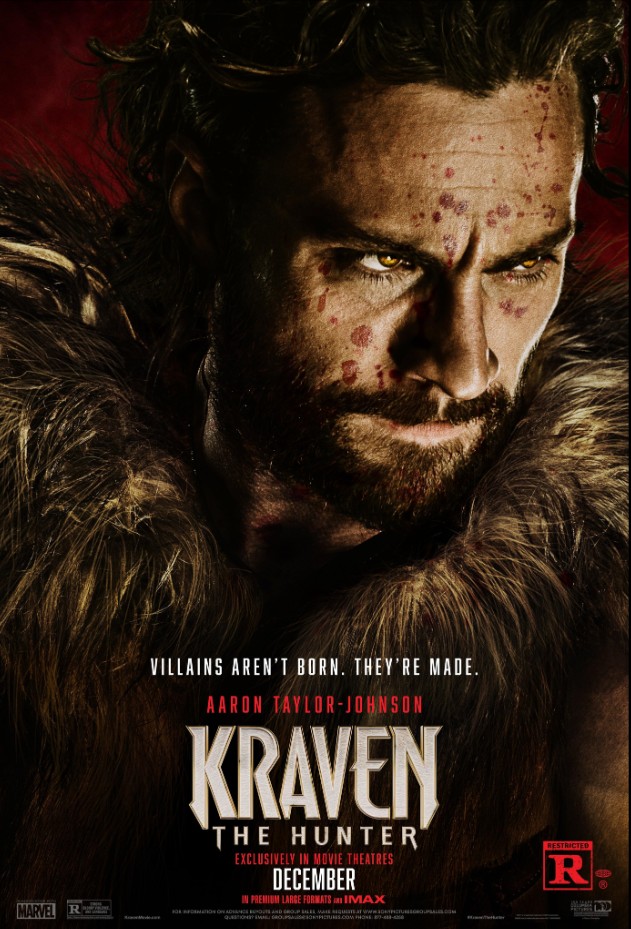
When it comes to Mommie Dearest, I see the movie less as a “so bad it’s good” picture and more of a character study about family dynamics and the motivations behind them. However, I can recognize why the 1981 title is regarded as “so bad it’s good” in the eyes of many. One of these reasons is Faye Dunaway’s over-the-top portrayal of Joan Crawford. Her antics stand out against a backdrop that feels ordinary or mundane. Even her lines like “No wire hangers, ever!” and “Tina! Bring me the axe!” have become iconic because of Faye’s excessively dramatic delivery. But in Kraven the Hunter, the only memorable character is Sergei/Kraven himself, as he is the film’s protagonist. The rest of the characters weren’t given the context in order to stand out. Two of the movie’s villains, the Foreigner and Aleksei/Rhino, seemed interchangeable. They don’t have many discernible characteristics that allow them to embrace uniqueness. Even when Aleksei transformed into his alter ego, Rhino, it was for the benefit of the plot instead of helping Aleksei become a memorable character. Meanwhile, Sergei’s/Kraven’s father, Nikolai, tries to stand out within the story. However, these efforts feel forced, with his lines sounding less like conversation and more like lines found on the movie’s official merchandise.

From what I’ve heard over the years, Mommie Dearest was never intended to be a “so bad it’s good” presentation. In fact, it was meant to provide a chance for Faye to potentially earn an Oscar, let alone a nomination. Despite this good intention, the 1981 film shows its audience how good ideas led to bad results. The simpler reasons for the movie’s existence allow viewers to accept its “so bad it’s good” status at face value. As I watched Kraven the Hunter, however, I kept wondering what the point of the movie was supposed to be. When I brought the film up in my list of Ten Movie Trends I Don’t Understand, I said it was a Spider-verse villain movie without the presence of Spider-Man. But Kraven the Hunter doesn’t take the time to build up Sergei/Kraven as a legitimate threat for Marvel’s friendly, neighborhood superhero. Instead, Sergei/Kraven is reminiscent of Eric Draven and Ashe Corven from The Crow and The Crow: City of Angels; only inflicting violence on villains and criminals that deserve to face accountability. This makes some of the characters’ warnings about karma and the dangers of Sergei/Kraven becoming like his villainous father not make sense. Even the movie’s plot twist was so convoluted, it makes that part of the story pointless. Instead of seeing Kraven the Hunter as “so bad it’s good”, it was so confusing, I found it difficult to understand what the film was trying to say.
One of the most unbelievable moments from Mommie Dearest is when Joan took her daughter, Christina’s, role on the soap opera Christina starred on. While Christina (who was 27 at the time) was recovering from surgery, Joan temporarily starred on Christina’s soap opera as Christina’s character, even though Joan was much older than the character herself. Though this moment seems too good to be true, it actually happened. There’s even a New York Times article about this creative decision. The idea of Joan, who was 60 years old when she appeared on Christina’s soap opera, portraying a character that’s in her twenties seems “bonkers”, adding to Mommie Dearest’s “so bad it’s good” reputation. Kraven the Hunter, on the other hand, doesn’t really have any “bonkers” moments or situations. This is because the film takes itself a little too seriously as an action picture. The concept of a man possessing animalistic instincts, skills, and powers to defeat other characters could sound “bonkers” on paper. Even the idea of a man becoming a rhino seems like a silly gimmick. But the creative team behind Kraven the Hunter didn’t embrace the sillier aspects of the source material they were adapting. While there were moments in the movie that were unintentionally funny, as I mentioned in this review’s introduction, these moments were inconsistent.

According to IMDB, Paramount (the studio that distributed Mommie Dearest) took advantage of their audience’s fascination with Mommie Dearest by billing “the film as a camp classic”. People even “flocked to see the film armed with Ajax and wire hangers to actively “participate” with the film”, in a similar fashion to movies like The Rocky Horror Picture Show. Like I mentioned earlier in this review, Mommie Dearest featured iconic lines like “Tina! Bring me the axe!” and “No wire hangers, ever!”. There are also memorable moments like Joan cutting Christina’s hair. People developed an interest in Mommie Dearest because it was memorably bad. But Kraven the Hunter lacks the memorability Mommie Dearest achieved. One previously mentioned contributor was the lack of stand out characters (besides Sergei/Kraven himself). Another contributor is how, in Kraven the Hunter, there are stretches of time where characters just talk between each other. If these dialogue-heavy moments had been evenly spaced out throughout the story or had the writing itself been a little bit stronger, maybe the dialogue could have added memorability to the movie. But the writing was so flat, it made Kraven the Hunter feel uninspired. The stretches of time featuring dialogue-heavy scenes not only affected the overall pace of the film, it also caused Sergei/Kraven to have less screen-time than the title of the movie would suggest.

Have you ever seen a movie that was just “meh”? That’s how I feel about Kraven the Hunter; too weak to be good or great but not outrageous enough to be bad or disappointing. When I participate in the So Bad It’s Good Blogathon, I expect my selected movie will not be as strong as movies I’ve actually enjoyed. But I hope my experience watching the film will, at least, be somewhat entertaining. While there were entertaining moments because they were unintentionally funny, I can’t say the same for the rest of Kraven the Hunter. The film as a whole was uninspired largely due to the writing. From most of the characters being unmemorable to stretches of time where dialogue-heavy scenes were emphasized, I found myself being underwhelmed, more often than not. But the biggest opportunity missed by the film’s creative team was not embracing the gimmick and its silliness from their project’s source material. If Kraven the Hunter’s creative team hadn’t taken their project so seriously, maybe my movie-viewing experience would have been similar to when I reviewed Tarzan in Manhattan last year. Or maybe finding my “so bad it’s good” movie requires an acquired taste I haven’t quite received yet.
Overall score: 5 out of 10
Have fun at the movies!
Sally Silverscreen
 18 Cinema Lane
Pingback: So Bad It’s Good 2026: Day Three – Taking Up Room
This is probably the only Marvel Comics based movie I haven’t seen yet. Missed it while it was in the theater, and haven’t run across it yet in either the library stacks or the local used movie store. But my opinion is it has a long road to hoe to top “Madame Web”. Gotta keep looking for it. Good review.
LikeLiked by 1 person
Thank you, wjquiggy, for reading my review! I haven’t seen Madame Web, but I’ve heard it was pretty bad. If you check out Kraven the Hunter, I’d be interesting in hearing your thoughts on the film.
LikeLike
“When it comes to Mommie Dearest…”
If this event goes on long enough, eventually every film blogger on earth will have written about it. Hell, I did for the 5th So Bad It’s Good event, and I’m not even a “real” movie blogger…I’m just some half-assed sports hybrid 🙂
LikeLiked by 1 person
Thanks, J-Dub, for checking out my review! As I mentioned in my article, I brought up Mommie Dearest to emphasize the point that Kraven the Hunter didn’t really live up to its “so bad it’s good” potential. For this So Bad It’s Good Blogathon entry, I wanted to do something different by comparing my selected title to a movie that does have the “so bad it’s good” label.
LikeLiked by 1 person
Ha, interesting juxtaposition of the two films…obviously to be “so bad it’s good” there has to be a camp value: unintentional humor, over-the top elements in performance or production design, a guilty pleasure aspect that makes you want to see again, if only to check, “is it really that bad?” Kraven just looks like a misfire and a miscasting and lacked the storytelling it needed to be good. If you don’t want to see it again (and even again), it might not be “so bad it’s good.”
LikeLiked by 1 person
Thank you, Christopher, for sharing your thoughts on my review! Like I said in my article, the creative team behind Kraven the Hunter didn’t embrace the sillier aspects of the source material they were adapting. Had they done this, the movie could have been a fun picture, like Tarzan in Manhattan. As I also said in my review, the writing was so flat, it made Kraven the Hunter feel uninspired. Personally, I found the writing to be the film’s biggest flaw, as the movie could have been better with a stronger script.
LikeLike
Keep searching, Sally!
You may one day find a movie that you know deep down is a bad film, but love it despite or because of its critical faults!
From your description of Kraven, I think I’ll skip it and re-watch Mommie Dearest instead!
LikeLiked by 1 person
Thanks, John, for the encouragement! Because Kraven the Hunter did contain unintentionally funny moments, I moved another step in the right direction toward finding my “so bad it’s good” movie! Like I said in the introduction of my review, the So Bad It’s Good Blogathon has become an opportunity for me to search for my “so bad it’s good” title.
LikeLike
Hi, Sally! Sorry it’s taken me so long to read this–I’ve had some stuff happen. Anyway, great review! I like that you used Mommie Dearest as a comparison to Kraven. Some bad movies are just blah. Thanks again for joining the blogathon. It’s always great to have you. 🙂
LikeLiked by 1 person
You’re welcome and thanks for reading my review! Because I’ve been participating in the So Bad It’s Good Blogathon since the very beginning, I wanted to do something different for this year’s event.
LikeLiked by 1 person
You’re very welcome, and it worked. Very cool. 🙂
LikeLiked by 1 person