For the Legends of Western Cinema Week, Hamlette and Heidi created a special tag for participants to engage in. Because the event revolves around westerns, the questions are western themed as well. Out of all the blogathons I have participated in, this is the first one that has a tag associated with it. It’s also the third tag I have posted on 18 Cinema Lane. However, the other two tags correlated with National Reading Month. The western genre is not one that I regularly watch, so my answers may seem like a stretch. However, I have tried my best to provide an honest perspective on this particular area of film.
2. A western of any stripe (happy or tragic) where you were highly satisfied by the ending?
INSP does not often create their own movies, so it’s nice to check out their efforts when they do release a new project. One of their stronger pictures is The Legend of 5 Mile Cave, which premiered last year. The overall story was solid and everything wrapped up nicely in the end. It had a mystery element that kept me invested from start to finish.
3. The funniest western you’ve seen?
I haven’t seen this movie in quite some time, but I do have fond memories of The Three Amigos! The scene with the singing horses and the talking turtle makes me smile every time I think about it.
4. What similar elements/themes show up in your favorite westerns?
When I think about the western genre, a sense of mystery is something that comes to mind. What I mean by this is there’s always that mystery of how the overarching conflict is going to get resolved. Most westerns also contain a journey, where the characters travel over a certain period of time. This creates the feeling of the audience going on an adventure with the characters.
5. Scariest villain/antagonist in a western?
For this question, I’ll give two answers. My first one is Dr. McQueen from my favorite Little House on the Prairie episode, ‘The Wild Boy’ Part 1 and 2. Not only does this villain think it’s acceptable to mistreat a child, he also represents a type of villain that I find to be the scariest. Dr. McQueen thinks in his mind he can justify his choices, even though he is clearly in the wrong. My second choice is Connie’s husband, Brad, from the Walker, Texas Ranger episode ‘The Juggernaut’. He also thinks he can justify his actions, as well as being the type of villain someone could cross paths with in real-life.
I’ll choose Rosemary and Lee Coulter from When Calls the Heart! When it comes to their relationship, they bring out the best in each other. They have also come a long way since they were first introduced in the story. It does help that Pascale Hutton and Kavan Smith have great on-screen chemistry. Both Rosemary and Lee are the glue that keeps that show together, as they are two of the best things to happen to When Calls the Heart.
7. Three of your favorite westerns?
Here are three westerns I would recommend:
The Legend of 5 Mile Cave – One of the stronger films from INSP. The mystery element allows the audience to stay invested in the story.
When Calls The Heart: The Christmas Wishing Tree – The best movie out of When Calls the Heart’s collection of films. It took a tried-and-true idea from other Hallmark projects and gave it a new twist.
Cowgirls ‘N Angels – Even though this is a modern western, it was one of the best movies I saw in 2018. The acting was solid and the story was endearing.
8. Favorite actress who made 1 or more westerns?
A movie that I enjoy is Portrait of Jennie! Jennifer Jones’ performance is one of the reasons why I like that film. After doing from research on thegreatwesternmovies.com, I discovered that Jennifer starred in the 1946 movie, Duel in the Sun. I have not seen this movie, so I’ll try to find time to check it out!
9. Favorite western hero/sidekick pairing?
Charles Ingalls and Isaiah Edwards from Little House on the Prairie will be my choice for this question. While they’re not western heroes in the traditional sense, they are heroes in their own right. This is because they try to do the right thing and make Walnut Grove a better place.
10. Share one (or several!) of your favorite quotes from a western.
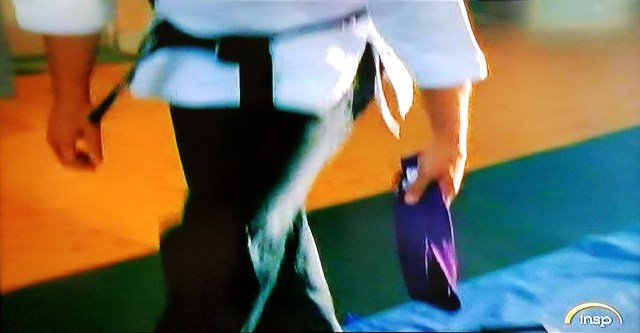
A quote I like comes from the Walker, Texas Ranger episode ‘The Covenant’. Walker tells his students “These belts don’t come easy. You have to earn them” after they graduate to a green belt. This quote highlights how one should expect to work hard if they truly want something.
White horse image created by Gabor Palla at freeimages.com. “FreeImages.com/Gabor Palla.”
What are your thoughts on this tag? Which westerns do you enjoy watching? Share your thoughts in the comment section!
For the Legends of Western Cinema Week, I was trying to decide if I should write a movie review for the 2015 film, Forsaken or create another television show review for Walker, Texas Ranger. Instead of selecting just one, I chose both options as my submissions for the blogathon! Prior to writing this post, I had never seen Walker, Texas Ranger. When I accepted my fourth Liebster Award back in July, I shared how I had never watched anything from Chuck Norris’ filmography. Hamlette and Heidi’s event gave me an excuse to not only change that, but to also expand my cinematic horizons to more westerns. Similar to last March’s review of Murder, She Wrote, I have randomly selected three episodes that happened to be airing on the INSP channel. This time, the episodes will be in the order of when I watched them, instead of chronologically. Each episode will be broken down into five categories: what I liked about the episode, what I didn’t like about episode, the story itself, other factors from the episode, and my overall thoughts. After reviewing these three episodes, I will share my final assessment of the show as a whole.
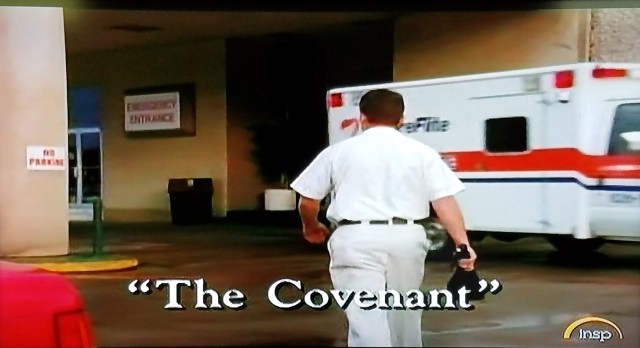
The title card for “The Covenant”. Screenshot taken by me, Sally Silverscreen.
What I liked about this episode:
My favorite scene in ‘The Covenant’ takes place toward the beginning of the episode. During a karate class, Walker notices how one of his students, Ricardo, is missing their purple belt. When he asks Ricardo about the whereabouts of his belt, Ricardo tells Walker he placed the belt in his recently deceased sister’s casket so she could take it to Heaven. After his confession, Walker gives Ricardo another purple belt. When this happens, Ricardo’s face immediately lights up. The music playing during this moment sounded like a tune you’d hear when an athlete in an inspirational sports movie reaches a breakthrough. This scene was both heart-breaking and heart-warming, allowing it to stand out in this episode!
What I didn’t like about this episode:
Chuck Norris’ claim to fame is his karate skills, which have become a huge draw for any of his productions. This fact is the reason why Walker is an intelligent karate master. While karate was incorporated into this episode, its presence was very limited. In fact, the story was 80% crime drama, with 20% action. Before watching ‘The Covenant’, I had expected the episode to be 50/50 when it comes to the drama and action. However, the only times karate could be seen are in a montage during a karate class and in the story’s climax.
The story itself:
When I first read the synopsis for ‘The Covenant’, it caused me to ask two “what ifs” about The Karate Kid (the original 1984 film). What if Daniel had never crossed paths with Mr. Miyagi? What if Daniel had joined Cobra Kai? I thought watching this episode of Walker, Texas Ranger would give me a basic idea of what these “what ifs” might look like. But as I reflect on ‘The Covenant’, I realize that comparing the stories of Daniel and Tommy, a student of Walker’s, is like comparing an apple pie to an Apple computer. While Cobra Kai was the villainous/antagonistic group in The Karate Kid, I don’t recall any member of that group breaking the law. Meanwhile, the gang that Tommy interacts with are comprised of legitimate criminals with violent actions and police records. This makes Tommy’s situation more dire than Daniel’s.
To me, this episode of Walker, Texas Ranger felt rushed, as the overall pace was faster than other shows of this nature. I don’t know if this is because ‘The Covenant’ was the first episode of Walker, Texas Ranger I had ever seen or if this was a legitimate creative error. But whatever caused this to happen, I found it difficult to keep up with the story. Another flaw I noticed was how context was missing in certain areas of the narrative. Even though this episode is called ‘The Covenant’, I am still confused as to what the covenant is in relation to the plot. Was it an ideology or a group? This question was never answered.
The other factors from this episode:
I was not expecting this episode to be Christmas-themed. However, the plot did not feel like a Christmas story. Sure, there were decorations shown in the background. But ‘The Covenant’ could have taken place in any time of year and it wouldn’t have made a difference.
Every television show is bound to have aspects that feel of its time. With Walker, Texas Ranger, there are elements that definitely look like it came from the ‘90s. This can be seen through the characters’ clothes, the background graffiti, and even the opening montage. These things definitely make any show feel like a time capsule.
Throughout my life, I’ve seen established shows include real-life topics in their episodes. Sometimes, these topics are effortlessly woven in with the episode’s plot. The anti-gang message of ‘The Covenant’ seems like a PSA was wedged into the overall story. I was given the impression the show’s creative team had chosen to write a narrative around an actual issue. There was some dialogue that sounded more like potential slogans than actual conversation. Even a message at the end of the episode revealed how the ‘The Covenant’ was dedicated to young victims of gang violence.
My overall thoughts:
‘The Covenant’ is the episode that inspired me to write about Walker, Texas Ranger. The “what ifs” relating to The Karate Kid are also a part of that inspiration. This episode ended up being different from what I expected, as the limited presence of karate is one reason why this is the case. Even though I liked the inclusion of karate, there was less of the sport than I had been led to believe. This is because the episode leaned more toward the criminal/police procedural part of the overall story. If anything, ‘The Covenant’ came across as part crime drama, part “after school special”, with the anti-gang message being dropped into the story rather than woven in. While this is not one of the worst television episodes I’ve ever seen, it definitely could have been stronger.
Rating: A 3 out of 5
As Walker says in ‘The Covenant’, “These belts don’t come easy. You have to earn them”. Screenshot taken by me, Sally Silverscreen.
Episode Name: The Juggernaut
Season 3, Episode 16
Premiere Date: February 10th, 1996
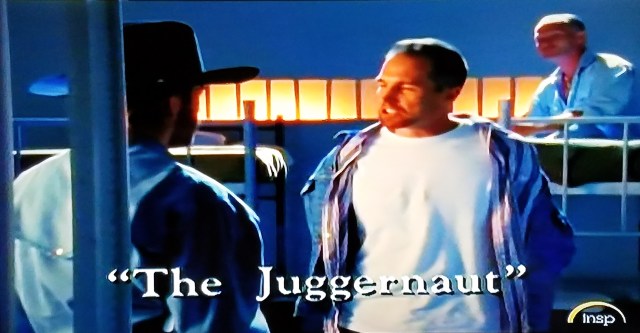
The title card for “The Juggernaut”. Screenshot taken by me, Sally Silverscreen.
What I liked about this episode:
In ‘The Juggernaut’, Walker has a limited presence within the story because he has to attend a weekend tournament. This creative decision allows the stakes to be raised to a higher level. It presents a scenario where the hero isn’t always readily available to save the day. It also forces the secondary characters to rely on their own skills to resolve the overarching conflict. Another component is how the episode’s villainous character posed a legitimate threat to Walker and those around him. Connie’s husband, Brad, was a terrifying character because of his realistic nature. Patrick St. Esprit’s performance added to Brad’s sinister persona as well. All of these elements helped make the episode suspenseful and it made me fear for the characters’ lives.
What I didn’t like about this episode:
As I just mentioned, Walker has to attend a weekend tournament. Because of this, Trivette steps in to host a self-defense class at a retreat for domestic violence survivors. I liked how the actual tournament was shown in the episode, as referenced events or situations aren’t always visually presented in TV episodes. But what I didn’t like was how the tournament itself seemed more like a karate clinic. This is because the referee was coaching the athletes during duels and the athletes were surrounding the ring as if listening to an instructor in a class. At the retreat, Trivette led his self-defense class in an interesting way, allowing the survivors to hit him while he was wearing multiple layers of padding. This helped the survivors become comfortable with striking an attacker. The actual lesson didn’t take place until the episode’s halfway point. In my opinion, this moment should have happened sooner in the story.
The story itself:
Unlike ‘The Covenant’, the topic of domestic violence was woven into the story of ‘The Juggernaut’. Instead of dropping this real-life subject into the plot and making it seem like a PSA, the situation presented in this episode feels like it belongs in the show’s world. It gives the message an opportunity to organically grow within the story. Because the retreat is led by Alex, a deputy district attorney and a friend of Walker’s, she’s the one who takes charge of the plot. She was also able to use her skills and expertise to save the day. I like how Alex progressed the narrative forward, as it gave one of the show’s secondary characters a moment to shine. It reminded me of The Babysitter’s Club, where each book is told from a different perspective.
The other factors from this episode:
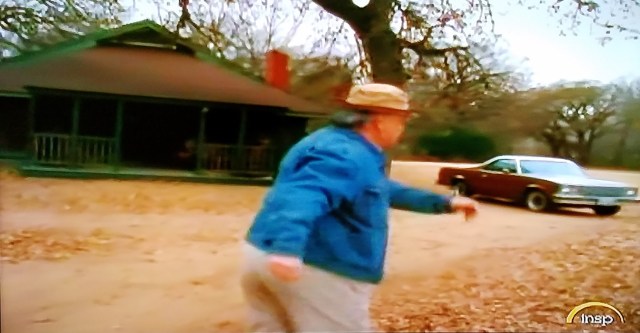
I thought Alex’s cabin looked cute, despite the living room being the only interior shot shown! The green porch was not only eye-catching, but inviting as well. I also think the grounds surrounding the cabin were scenic. I don’t know if this is a real-life house or if it was a set created for the show. However, the location scout did a good job when choosing this particular spot!
During the retreat, C.D. tells Connie a story about a retreat participant who was able to turn her life around. After this story was told, C.D. asks Connie if she’ll write a happy ending to her own story. When Connie asks him why he wants to know, C.D. tells her how he wants to share her story with future retreat participants. To me, this was the sweetest moment of the episode!
Speaking of C.D., ‘The Juggernaut’ presented the second time I’ve seen C.D. become seriously injured. I’m not sure if this happened often on the show or if it’s just a coincidence. But I felt like bringing it up as a factor of this episode.
My overall thoughts:
When I first reviewed Murder, She Wrote last March, I ended up liking the second episode, ‘Film Flam’ more than the first one, ‘The Legacy of Borbey House’. The exact same thing has happened with ‘The Covenant’ and ‘The Juggernaut’, as I prefer ‘The Juggernaut’ over ‘The Covenant’. The story of the third season’s sixteenth episode contained a better written narrative. It also helped that the delivery of the domestic violence topic didn’t feel forced or preachy. With Walker in the episode for a limited amount of time, it allowed the story to have higher stakes. It also gave secondary characters more screen time and opportunities to be involved in the plot. ‘The Juggernaut’ kind of reminded me of Touched by an Angel, where the series’ regulars approached real-life topics with their wisdom in tow and kindness toward those who needed their help. Maybe this is one of the reasons why I liked ‘The Juggernaut’!
Rating: A solid 4 out of 5
This is one of the few shots of Alex’s cabin that was shown in broad daylight. I wonder how many times it was featured on the show? Screenshot taken by me, Sally Silverscreen.
Episode Name: The Lynching
Season 3, Episode 8
Premiere Date: November 18th, 1995
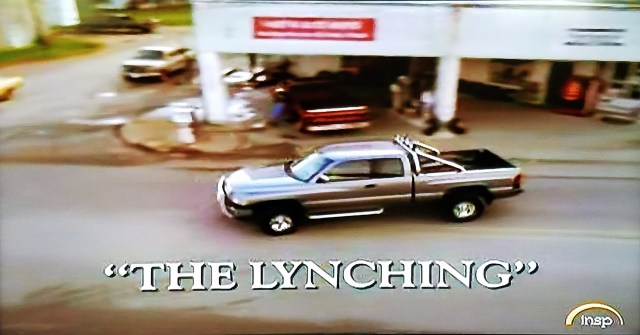
The title card for “The Lynching”. Screenshot taken by me, Sally Silverscreen.
What I liked about this episode:
There were two scenes in ‘The Lynching’ where Walker interacts with Jonah, a man who is accused of killing a local woman. In the first scene, Walker is questioning Jonah about the murder. When he is asked why he ran away from the crime scene, Jonah reveals he was so afraid, that he wanted to go to “Jonah’s Island”. It is implied that “Jonah’s Island” is an imaginary world Jonah created in his mind. Another scene has Jonah stating that he’s “slow in the head”. Walker tells him how there’s nothing wrong with him and how some people get in trouble for moving too fast. These moments were emotionally touching and contained heart.
What I didn’t like about this episode:
Wilma Casey, a local woman from a smaller Texas town, is killed in broad daylight. The people in this town are so upset by her death, that they form a mob against Jonah. Statements such as “Wilma was a good woman” were spoken among the members of the mob. Other than those vague statements, no explanation was given for why Wilma was so beloved. A small amount of information about Wilma is provided in this episode, revealing how she’s wealthy and how she helped Jonah after his parents died. But her influence in the town is not told. Was she a philanthropist or a former governor? These questions were never answered in ‘The Lynching’.
The story itself:
The story within the ‘The Lynching’ is a murder mystery, as Walker and other members of law enforcement come together to solve Wilma’s case. With a variety of clues and some shady characters, this plot was intriguing as well as engaging! It also made more sense for the plot to rely on the criminal/police procedural aspect of the show, as the majority of murder mysteries incorporate law enforcement officers in the story. The actions and choices of the people involved in the case did raise more questions than I expected to ask. In one scene, Walker comes across an object that could be used in court. However, he chooses not to collect this object as evidence. These questions didn’t take me out of the episode, but it happened more often than it should have.
The other factors from this episode:
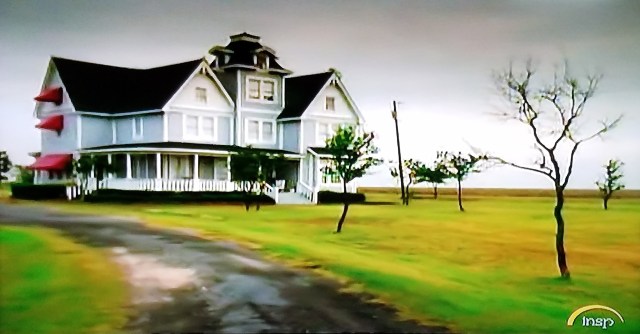
Wilma’s house in ‘The Lynching’ was absolutely picturesque! Most of this location was captured in exterior shots, with only the kitchen and office being shown on screen. Like Alex’s cabin in ‘The Juggernaut’, I’m not sure if this is a real-life structure. But whoever was the location scout for Walker, Texas Ranger deserves recognition!
According to INSP’s website, Trivette “is a little less “high noon,” and more “high tech” when it comes to fighting crime”. Based on the three episodes of Walker, Texas Ranger I saw, Trivette doesn’t use technology more or less than the other characters. INSP’s description makes it seem like he is the go-to guy for technology, similar to Angela’s adopted role on Bones. After seeing this show, I think the article from INSP is a little misleading.
At one point, Jonah has to be transferred from the jail to another location. Instead of taking him to a second jail, the people associated with Wilma’s case take Jonah to a secret area. What surprised me was how Walker didn’t suggest Alex’s cabin as a safer place for Jonah to stay. Even though the cabin is used for Alex’s domestic violence survivor retreats, I’d like to think she wouldn’t mind allowing Jonah to temporarily stay at her cabin.
My overall thoughts:
While I didn’t enjoy this episode as much as ‘The Juggernaut’, I did like it more than ‘The Covenant’. As someone who goes out of their way to talk about mysteries from time to time, the story was interesting enough to keep me invested in the plot. It contained the components that are usually found in a mystery: a collection of clues, potential suspects, some surprises, and suspense. Having this episode lean more toward the crime drama side of the show made sense with the narrative being told. This story is not without its flaws, however. Some of the actions and choices of the people involved in the overarching case were questionable in terms of believability. The lack of explanation for Wilma’s importance also didn’t help. Similar to ‘The Juggernaut’, the situation in ‘The Lynching’ felt it belonged in the world of Walker, Texas Ranger. This episode could have easily followed the footsteps of ‘The Covenant’, placing a message in the script and writing a story around it. Instead, ‘The Lynching’ focuses on themes that the audience could relate to; such as treating others as they would like to be treated.
Rating: A 3.6 out of 5
Is is just me or does this house remind anyone of Laura’s boarding house from Little House of the Prairie? Screenshot taken by me, Sally Silverscreen.
My final assessment:
In my first review of Murder, She Wrote, I said the show as a whole, based on the three episodes I wrote about, was fine. I also said that I’d watch the show if I had nothing else to do. With Walker, Texas Ranger, I thought it was fine as well. However, the overall quality of the episodes was more consistent than the ones from my Murder, She Wrote review. Even though ‘The Juggernaut’ was the best episode of the three I chose, I did enjoy watching ‘The Lynching’. My least favorite episode was ‘The Covenant’, as I thought it was just ok. One aspect that stood out to me was how karate was only used during select moments of each episode. There was enough action in ‘The Juggernaut’ and ‘The Lynching’ to keep the plot interesting. However, I thought ‘The Covenant’ was a little light on action. While I probably don’t see myself watching Walker, Texas Ranger religiously, I wouldn’t mind checking out an episode or two if it happened to pop up on my television. But who knows? Since last March, I’ve seen more episodes of Murder, She Wrote than I originally expected.
Have you seen Walker, Texas Ranger? Are there any episodes you’d want to see me review? Tell me in the comment section!


 18 Cinema Lane