Comparing with the Critics – Best of 1984 – Amadeus

This review is from my series, Comparing with the Critics. If you’d like to learn more about the series, click on the link below.

Introducing my new series, Comparing with the Critics!

I was intrigued to review Amadeus for a number of reasons. One of those reasons was the song, “Rock Me Amadeus” by Falco. For years, I thought the song was created to promote the movie, given the coincidence of two pieces of Amadeus related media debuting in the ‘80s. With the song released in 1985, a month before Amadeus won Best Picture at the 57th Academy Awards, I’d like to believe I was kind of right. In At The Movies’ ‘Best of 1984’ episode, both Gene Siskel and Roger Ebert liked the glamourous, musical biopic. Roger made the film his “personal choice for the best film of 1984”. Like Network and Harry & Son, I had never seen Amadeus, so I approached the movie with little to no expectations. Though I heard good things about the picture since its premiere in 1984. As I write this review after watching the movie, I can definitely see why Amadeus was, at least, nominated for an Oscar.

Amadeus poster created by The Saul Zaentz Company, AMLF, and Orion Pictures

When I reviewed RKO 281 last July, I complimented Liev Schreiber’s portrayal of Orson Welles. In that review, I said Liev brought humanity back to Orson’s name, finding the heart of the “genius” and putting some genuine emotion behind it. This is the same way I felt while witnessing Tom Hulce’s portrayal of the titular man. Reading about an iconic figure like Amadeus can make one wonder what his personality was like. Similar to Orson Welles, Amadeus can be thought of as more than just a man with a gift. Through good times and bad times, Tom shows the film’s audience how Amadeus was, simply, human. As his father comes to visit him in Vienna, Amadeus expresses pure joy when he sees his father at the top of the stairs. Amadeus’ smile alone showcases the happiness within his heart. One evening, when Amadeus is composing an opera, he slowly slips into exhaustion. His eyelids rise and fall, he sways out of rhythm, and his face looks as white as the lace on his shirt. Roger claimed Tom’s portrayal of Amadeus was “one of the year’s most engaging performances”. Tom’s performance serves as an example where Roger, the Academy, and I were on the same page.

F. Murray Abraham’s portrayal of Antonio Salieri reminded me of Gloria Swanson’s portrayal of Norma Desmond in Sunset Boulevard. What I mean by this is the character in question’s search for fame is so strong, it forces the character to become increasingly obsessive, even making questionable choices. Throughout Amadeus, Antonio reflects on his life and how it was impacted by the success of Amadeus. At the beginning of his story, wistfulness can sometimes be heard in Antonio’s voice as he shares his dream of making music for God. As his reflected encounters with Amadeus continue, the tone in Antonio’s voice evolves into bitterness, hinting at the frustration he bottled up over the years. This frustration can also be seen if one looks closely at Antonio’s facial expressions. Before a scene from the movie was shared in the ‘Best of 1984’ episode, Roger called F. Murray’s portrayal “a brilliant performance”. The Academy certainly agreed with Roger, as F. Murray won the Best Actor Oscar instead of Tom at 1985’s Academy Awards. Personally, I liked both F. Murray’s and Tom’s performance for various reasons. Through their portrayals, Tom and F. Murray displayed how fame can negatively impact the human soul.
It’s In The Name Of The Title Blogathon banner created by Gill from Realweegiemidget Reviews and Rebecca from Taking Up Room

As I mentioned in this review’s introduction, Roger chose Amadeus as his “personal choice for the best film of 1984”. One reason why is how “this movie doesn’t contain one bit of the pretentious, solemnity that we usually associate with movie biographies of classical musicians”. To add to Roger’s comment, I’d like to point out how the film serves as an immersive, detail-oriented character study of how the music industry can be both rewarding and cruel. When Antonio shares his life story with a visiting priest, he emphasizes how he was the only member of his family who was interested in music. This organic talent and rise to prominence provide an opposite view of how Amadeus claimed his fame. Scenes and dialogue illustrate how Amadeus was raised to be a star, with his father providing both the music education and connections for a comfortable future. While discussing a new opera with the Emperor, Amadeus successfully argues why his opera should be performed. He states how he worked many hours on the project and how the opera’s lack of politics will prevent the audience from being alienated. The examples I provided in this paragraph show how, sometimes, talent isn’t enough when it comes to the music industry. It also highlights the effort that goes into making music, let alone one song.

String of musical notes image created by Freepik at freepik.com. <a href=’https://www.freepik.com/free-vector/pentagram-vector_710290.htm’>Designed by Freepik</a> <a href=”https://www.freepik.com/free-photos-vectors/background”>Background vector created by Freepik</a>. Image found at freepik.com. 

While sharing his thoughts on Amadeus, Roger stated how the film was “a cheerful, rambunctious, irreverent film”.  I disagree with his statement to an extent. There are cheerful moments within the movie. However, I wouldn’t claim the movie itself is “cheerful”. The overall story contains darker, sadder moments as well, especially toward the end of Amadeus’ life. One part of the story revolves around someone masquerading as a deceased loved one Amadeus knows. Due to his grief and unresolved issues, Amadeus truly believes the masquerading imposter is the loved one brought back from the dead. This imposter is so cruel to use Amadeus’ pain for their own personal gain. Another statement of Roger’s I disagree with is about how the movie views Amadeus himself. Roger claims how the film “doesn’t so much concern with the actual details of Mozart’s life as with its own feelings about his genius, his personality”. The movie allows the characters, including Amadeus, to be flawed. But there were a few instances where the story seemed one sided. After a successful opera performance, Antonio’s student is upset because she learned Amadeus was engaged to a woman named Constanze. This leads Antonio to believe Amadeus and the student had a relationship. However, the story never clarifies if Antonio’s belief was true. In fact, Antonio stated he didn’t know how his student and Amadeus met or how long they knew each other. To me, this goes against what a cinematic biography should do; introducing an audience to a historical figure through an unopinionated lens.
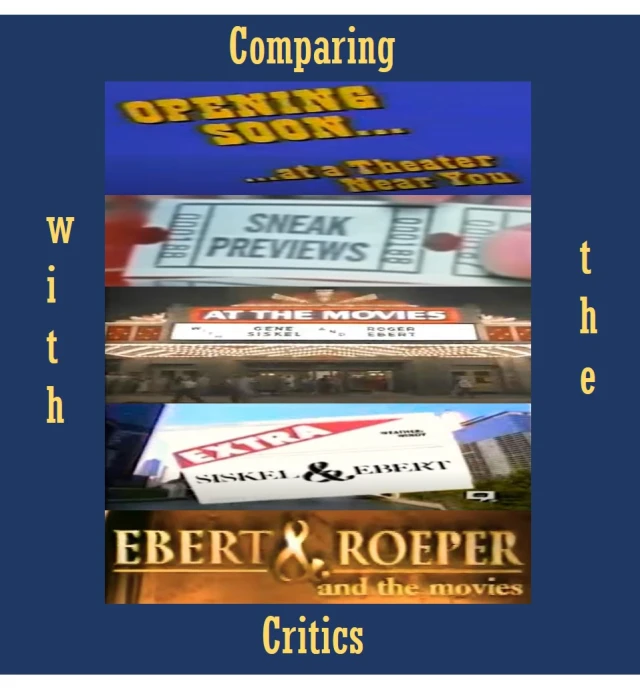
Comparing with the Critics banner created by me, Sally Silverscreen. TV show title cards created by WTTW National Productions, WTTW, Public Broadcasting Service (PBS), Lifetime Television, Tribune Entertainment, Buena Vista Television, and Disney-ABC Domestic Television

Before moving on to the next featured film in At The Movies’ ‘Best of 1984’ episode, Once Upon A Time in America, Gene tells Roger “what I love about the film is that it celebrates creativity and that is a subject that most Hollywood movies are simply not concerned with”. As I was about to disagree with Gene by bringing up RKO 281, I remembered that a) RKO 281 was an HBO made-for-TV movie and b) RKO 281 was released in 1999, a decade after Amadeus. But this review is not debating how much creativity is incorporated into Hollywood’s films, especially during the mid-80s. This article is simply an exploration of whether I agree or disagree with Roger and Gene’s thoughts on Amadeus. Earlier in this review, I mentioned how the film was an immersive, detail-oriented character study of how the music industry can be both rewarding and cruel. The movie’s immersion and focus on detail can be seen in the production’s costume and set design. These elements make the entire picture look and feel historically accurate. While Amadeus is a beautiful looking film, it also contains substance. The script provides thought-provoking material, exploring themes like how success can affect someone both positively and negatively. The glamourous and not-so-glamourous sides of the music industry are shown through the stories of both Amadeus and Antonio. Like I previously brought up in this review, Amadeus successfully argued why his opera should be performed. With everything I said, it makes me wonder how much Falco argued in favor of his song, “Rock Me Amadeus”?

This review was brought to you by

Sally Silverscreen
Take 3: The Third Man Review

When the terms “American Film Institute”, “classic”, and “Austria” are put in the same sentence, most people would think of the 1965 film, The Sound of Music. While that movie has become a beloved staple in cinema, there’s another title that fits the aforementioned criteria; 1949’s The Third Man. This film also fits the criteria for Hometowns to Hollywood’s Celluloid Road Trip Blogathon: International Edition. I’ve seen several movies from American Film Institute’s list of the top one hundred films of all time. Some of these films have, in my opinion, earned their respective places on that list. Other films have left me confused, questioning why a given film is on the list in the first place. While American Film Institute’s list comes across as objective, I have learned that almost any movie list is subjective. Therefore, I’m checking out The Third Man for myself, determining if I think the 1949 film should be on American Film Institute’s list!

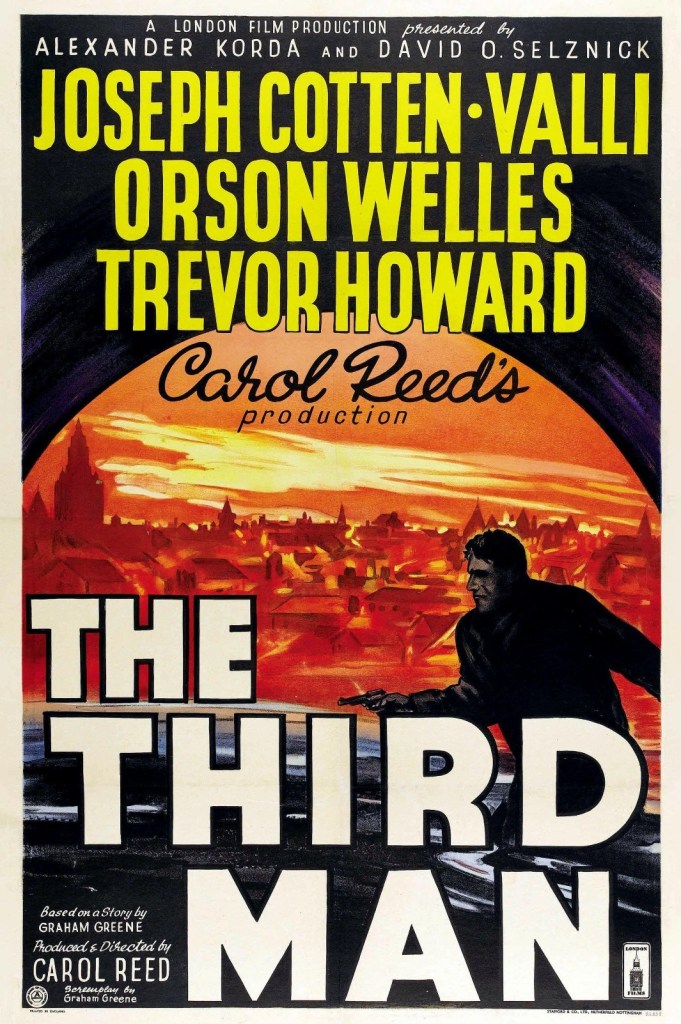
The Third Man poster created by London Film Productions, StudioCanal International, and Selznick Releasing Organization

Things I liked about the film:

The acting: In The Third Man, Ernst Deutsch portrayed Baron Kurtz, a friend of Harry Lime. Despite appearing in the film for a limited period of time, Ernst, in my opinion, stole the show! Anytime he appeared on screen, Ernst’s facial expressions were very fluid and expressive, allowing his character’s reactions to be on point. His performance makes me wish he had more appearances in The Third Man! Individual portrayals were not the only memorable performances, as I liked the on-screen chemistry between Joseph Cotten and Alida Valli. One scene shows Holly and Anna discussing Holly’s friend, Harry. This scene gave Alida and Joseph the opportunity to give their characters genuine emotion, from Anna shedding tears over how the world grew up around Harry to Holly smiling over a past memory of his friend. Their performances made their characters feel like they were meant to be together.

The set design: As mentioned in the introduction, The Third Man takes place in Austria. With the story set in Vienna, the landscape is urban, boasting a European charm that is reflective in the set design. Toward the beginning of the film, Holly goes to a restaurant in the middle of the city. The crown jewel of this location is the marble columns holding up the ceiling. Carved detailing bordered the edges on the ceiling, adding quaint elegance to the restaurant. Even the police station featured elegant design choices, such as the patterned wallpaper. The set design of The Third Man serves as a visual example of timeless beauty, still holding up 74 years later!

An honest glimpse of post-World War II Europe: The story of The Third Man takes place after World War II. Through visual presentation and the dialogue, the state of Vienna, Austria is showcased in an honest way. In one scene, Holly is being chased through the city. During this chase, Holly runs over rubble and hides in an abandoned car. Holly’s hiding place, as well as the rubble, are remnants of the war. Featuring these remnants prominently in the chase scene highlights the aftermath Vienna, Austria faced.

The Celluloid Road Trip Blogathon: International Edition banner created by Annette from Hometowns to Hollywood

What I didn’t like about the film:

Tilted angles: The role of a cinematographer is to present a scene in visually appealing ways. Creative decisions relating to cinematography can make a scene memorable, allowing the audience to bring up specific moments. In The Third Man, several scenes stood out because of cinematography, as these scenes were delivered at a tilted angle. However, there was no reason for those scenes to be presented that way. In fact, the tilted angles came randomly. It felt like those scenes were filmed that way simply for the sake of it.

Tonally unfit music: Acoustic guitar served as the only soundtrack for The Third Man. While this sound was pleasant to hear in some scenes, it was jarring to hear in other scenes. When the police, in one scene, dig up a grave in order to solve a mystery, the acoustic guitar sound gave off a cheerful tone. Yet, the scene itself was very serious in tone, as the film’s mystery is a murder mystery. This is just one example of the music being tonally unfit.

Inconsistent sense of urgency: As I just mentioned, the mystery in The Third Man is a murder mystery. In these types of stories, there is typically a strong sense of urgency, as the protagonist wants to stop the guilty party from hurting other people. But in The Third Man, the sense of urgency was inconsistent. Chase scenes and the climax are where the urgency was present. However, these moments were far and few between. Most scenes featured characters talking with one another. While there can be urgency included in these moments, urgency was not prioritized in the script.

My overall impression:

In 2008, the American Film Institute released a revised list of their one hundred films of all time. On this list, The Third Man was replaced by other titles. However, it does make me wonder why this film was on American Film Institute’s original list in the first place? As I stated in my review of The Bridge on the River Kwai, movies that appear on lists such as American Film Institute’s should, in my opinion, fit one of two categories; those that represent the time they were released and those that brought something new to the cinematic table. The only explanation I can think of is how The Third Man shows Europe post-World War II. Yet Roman Holiday takes place in Italy post-World War II and never appeared on any of American Film Institute’s lists. As for bringing something new to the cinematic table, I can’t think of how The Third Man achieved that. Similar to The Bridge on the River Kwai, this movie has left me confused.

Overall score: 6-6.1 out of 10

Have you seen The Third Man? How many movies from American Film Institute’s lists have you watched? Please share your thoughts in the comment section below!

Have fun at the movies!

Sally Silverscreen

Word on the Street: News about Upcoming and Potential Hallmark movies!

I am back with my first Word on the Street story for December! While Hallmark’s Christmas line-ups are winding down and the “Winterfest” line-up is on its way, I found several Hallmark related movie news stories that I had to share with my readers and followers. Some of these projects are currently in production, but others haven’t even started filming yet. Most of these stories come from the Twitter account, Hotline to Hallmark. Two of these movies can be found on the website, Creative B.C. For this post, I will be reporting on these pieces of movie news and share my sources within this article. Since there’s so many films to talk about and since most of the information is on the basic side, I won’t be sharing my insight this time.

Vector set of isometric illustrations making movies and watching a movie in the cinema.
Movie process chart created by Vectorpocket at freepik.com <a href=’https://www.freepik.com/free-vector/vector-set-of-isometric-illustrations-making-movies-and-watching-a-movie-in-the-cinema_1215936.htm’>Designed by Freepik</a> <a href=”https://www.freepik.com/free-photos-vectors/business”>Business vector created by Vectorpocket – Freepik.com</a> Image found at freepik.com

On December 10th, the Twitter account, Hotline to Hallmark, released a tweet about a potential Hallmark project. In this post, it was announced that Hallmark actor, Clayton Chitty, will be starring in a film called “Blueprint to the Heart”. Also, the tweet mentioned that the movie’s network was unknown, as of December 2019. On the website, Creative B.C., this movie is listed on the “In Production” page. Apparently, this project will finish filming on December 13th. Six days prior, on December 4th, Cindy Busby, who is a regular star of Hallmark, tweeted that she was working on a movie in Australia. This tweet, that was re-tweeted by Hotline to Hallmark, shares a link to an article about the film. The article, found on if.com.au, revealed that the project is currently titled “Romance on the Menu”. Based on the synopsis, it sounds like a Hallmark movie. But, as of December 2019, it’s unknown where this film will premiere.

You can visit the Twitter account of Hotline to Hallmark by typing @HotlineHallmark into Twitter’s search bar.

The article about “Romance on the Menu”: https://www.if.com.au/first-time-feature-director-rosie-lourde-finds-romance-on-the-menu/

The link to Creative B.C.’s “In Production” page: https://www.creativebc.com/crbc-services/provincial-film-commission-services/in-production/films.php?type=tv_movie (after December 13th, “Blueprint to the Heart” will be removed from the page)

216982-P0L3YH-117
String lights with hearts created by Freepik at freepik.com <a href=’https://www.freepik.com/free-vector/valentine-s-day-background-with-string-lights_1476879.htm’>Designed by Freepik</a> <a href=”https://www.freepik.com/free-photos-vectors/background”>Background vector created by Freepik</a> Image found at freepik.com

While the two aforementioned projects have no known fate, there are a few upcoming films that have been confirmed as Hallmark movies. Some of these confirmations have been announced from the stars of those films. One of them is a movie that will premiere in the 2020 Christmas season! In a tweet that was included in Hotline to Hallmark’s tweet, Brennan Elliott, a familiar face on both of Hallmark’s networks, revealed that he was working on a movie called “Christmas in Vienna”. In this same tweet, he also shared that the project would be filmed in Vienna, Austria and that the movie’s female lead will be Sarah Drew. Also, on Hotline to Hallmark, news about Taylor Cole’s Valentine’s Day movie was announced! In a Word on the Street story last month, I talked about how Taylor would be starring in a Hallmark Valentine’s Day movie alongside Ryan Paevey. This was one of the reasons why I speculated that One Winter Wedding could either be a “June Weddings” or Christmas movie. In Hotline to Hallmark’s tweet, it mentioned that Taylor herself confirmed that the third One Winter movie was still happening! This tweet says “that the script for Hallmark’s “One Winter Wedding” is being worked on”. As for the Valentine’s Day movie, it now has a working title called “Matching Hearts”. Two other cast members have been announced as well. They are Antonio Cayonne and Latonya Williams.

You can visit the Twitter account of Hotline to Hallmark and Brennan Elliott by typing @HotlineHallmark and @brennan_elliott into Twitter’s search bar.

8_Cupcakes1-01
Cupcake with hearts image created by Freepik at freepik.com. <a href=’https://www.freepik.com/free-vector/delicious-cupcakes-illustrations_779154.htm’>Designed by Freepik</a>. <a href=”https://www.freepik.com/free-photos-vectors/food”>Food vector created by Freepik</a>. Image found at freepik.com.

Two other Hallmark movies have been announced outside of the Hotline to Hallmark twitter account. In an article from International Business Times, several Hallmark stars were interviewed during Christmas Con, a Christmas themed convention that took place in early November. The majority of questions that were asked were about future movie projects. While the answers consisted of wishful thinking and vagueness, only one was definitive. When asked about Hallmark’s Wedding March series, Jack Wagner, one of the stars of that series, said “We will be doing “Wedding March 6” in the spring”. This means that another Wedding March chapter will likely be seen in 2020’s “June Weddings” line-up! On the website, Creative B.C. another movie from the Mystery 101 series has been listed on the “In Production” page. Currently, the film is called Mystery 101: Educated Murders. The “In Production” page reveals that the movie will go into production from January 6th to the 31st. Based on this fact, I’m guessing that the film will premiere in either spring or summer of 2020.

The article from International Business Times: https://www.ibtimes.com/christmas-con-2019-recap-biggest-news-hallmark-lifetime-stars-revealed-during-panels-2879266

The link to Creative B.C.’s “In Production” page: https://www.creativebc.com/crbc-services/provincial-film-commission-services/in-production/films.php?type=tv_movie (after January 31st, Mystery 101: Educated Murders will be removed from the page)

Female detective with magnifying glass
Female detective image created by Brgfx at freepik.com. <a href=’https://www.freepik.com/free-vector/female-detective-with-magnifying-glass_1250814.htm’>Designed by Freepik</a>. <a href=”https://www.freepik.com/free-photos-vectors/background”>Background vector created by Brgfx – Freepik.com</a>. Image found at freepik.com.

What are thoughts on these upcoming films? Which one sounds the most interesting to you? Tell me in the comment section!


Have fun at the movies!

Sally Silverscreen