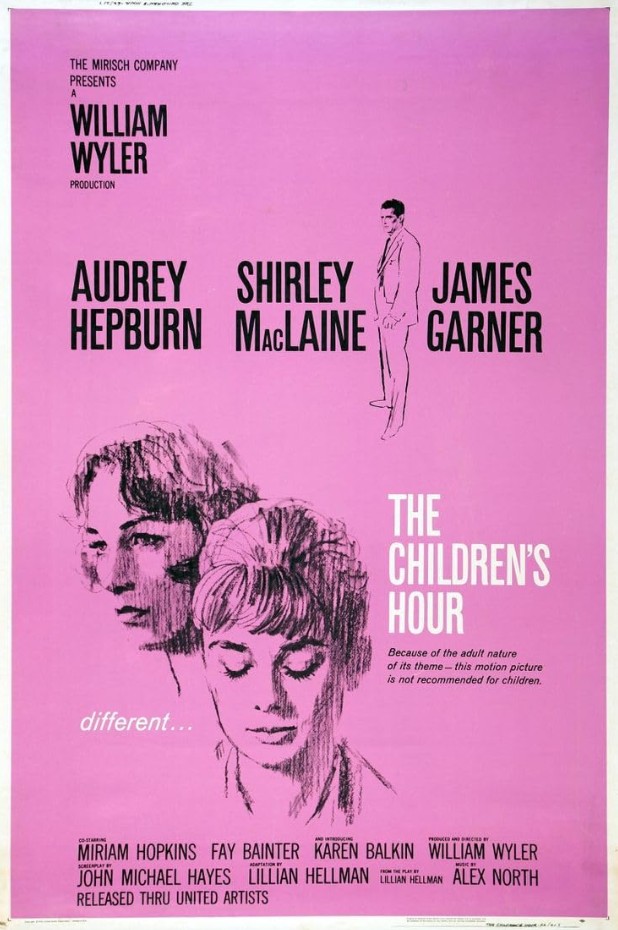
Audrey Hepburn is no stranger to 18 Cinema Lane. In the eight years I’ve been blogging, I have reviewed The Nun’s Story (which I liked), Funny Face (which I also liked), and Roman Holiday (which was, in my opinion, ok). For Classic Film And TV Corner’s Audrey Hepburn Blogathon, I decided to pick a movie I don’t often hear in the discussion of Audrey’s films. Over the years, I’ve heard 1961’s The Children’s Hour has been considered “controversial”. Though I wasn’t sure if the movie still carried that title today or if it once held that title when the film was originally released. Wanting to find an answer to that question, I selected The Children’s Hour to write about for the event. Another actor who’s no stranger to 18 Cinema Lane is James Garner. Despite only reviewing one of his films, Hallmark Hall of Fame’s Promise, I have seen other projects from his filmography, such as Atlantis: The Lost Empire, The Notebook, and Hallmark Hall of Fame’s Decoration Day. So, I was pleasantly surprised to discover James starred in The Children’s Hour.
Things I liked about the film:
The acting: As I said in this review’s introduction, I’ve written about three of Audrey Hepburn’s films; The Nun’s Story, Funny Face, and Roman Holiday. Through her roles in these films, Audrey has proven to be a very expressive actress who allows her characters to adapt to any situation. This sentiment holds true in The Children’s Hour, as Audrey portrays a teacher named Karen. One great example of Audrey’s expressiveness takes place during a conversation Karen shares with a doctor named Joe (portrayed by James Garner). Throughout their conversation, Karen shares her desire to get married. As soon as Joe agrees to marry Karen, her face lights up, complete with wide eyes and a big ear-to-ear smile. It also helps how this reaction from Karen appears genuine. Speaking of James Garner, I also want to talk about his portrayal of Joe. During his and Karen’s aforementioned conversation, Joe is frustrated by lack of funds and resources at the hospital where he works. As he takes Karen for a car ride, Joe carries that frustration on his face, from a narrowed stare to his mouth turning in a scowl. The look on Joe’s face is consistent from a previous conversation he shared with Karen’s friend, Martha (portrayed by Shirley MacLaine). In his and Martha’s conversation, Joe expressed his frustration through his facial expressions and tone of voice. This consistency, as well as his versatility, showed just how strong of a performance James gave in The Children’s Hour!
Like I mentioned earlier, Audrey portrays a teacher named Karen. This means throughout The Children’s Hour, Karen’s students appear in the story from time to time. Out of the young actresses who received lines in the movie, two of the strongest performances came from Karen Balkin and Veronica Cartwright! In The Children’s Hour, Karen portrays Mary, a manipulative girl who never takes ‘no’ for an answer. Meanwhile, Veronica portrays Rosalie, a fellow student of Mary’s who is terrified of Mary. Whenever Mary tries to control Rosalie into following a plan of hers, Rosalie’s terror for Mary is visibly displayed through her wide eyes and appearance of fear on the rest of her face. Even when she’s questioned about the rumor about Martha and Karen, Rosalie bursts into tears as Mary’s figurative grip on her is just too powerful. On the other hand, Mary’s mood changes depending on the situation. One moment, as she’s presenting flowers to another teacher named Lily, Mary displays a sweet demeanor with a smile on her face. But when Karen catches Mary in a lie about those flowers, Mary’s attitude immediately changes to being defensive, complete with a sharp tone of voice and an angry look in her eyes. The strong execution of Karen’s and Veronica’s performance made me, as a viewer, effectively empathize with Rosalie and despise Mary.
The dialogue: I brought up earlier in this review how Shirley MacLaine portrayed Karen’s friend, Martha. One of the reasons why I liked her performance was her execution of the dialogue. To add to this, some of the dialogue in The Children’s Hour was cleverly written. A great example takes place during a conversation between Martha and Karen. While bringing up the subject of money, Karen addresses her concern for Martha’s wardrobe. Martha casually and confidently responds to Karen’s concern by saying, “I’m a skirt-and-blouse character. We’re always in style”. Later in The Children’s Hour, Martha and Lily have a disagreement. During this disagreement, Martha suggests Lily leave to pursue her Broadway dreams, even offering to give her money. Lily refuses to accept Martha’s offer and says she’d “rather scrub floors first”. Martha, her voice fueled with sarcasm, replies “You’ll change your mind after the first floor”. The cleverness of the dialogue’s writing, as well as the dialogue’s delivery, was such a pleasant surprise!
The mise-en-scène: While watching The Children’s Hour, I noticed interesting mise-en-scène that was sometimes utilized during the movie. One example shows Mary spying on Karen and Martha as they share a conversation in Martha’s room. The door to Martha’s room is in the background near the left-hand side of the frame. In the foreground near the right-hand side of the frame is Mary’s face hiding behind the door of her room. Shots like the one I described present the illusion of putting the audience in a scene alongside the characters. This creative decision was, for me, an unexpected yet memorable aspect of the movie!
What I didn’t like about the film:
Telling instead of showing: Throughout The Children’s Hour, Martha and Karen recount how Mary’s rumor negatively impacted their lives and careers. They planned on filing a libel and slander lawsuit, but ended up losing that lawsuit. The rumor became national news, as Martha mentions it made the front page. But none of these events are shown in the film. No newspapers are presented with that rumor as headline news. There’s no courtroom scenes either, so the audience is forced to take Karen and Martha’s word for it. Because of the script’s reliance on telling instead of showing, the severity of the situation isn’t fully felt. The closest The Children’s Hour gets to addressing the severity is when the students actively leave the school.
Not addressing Mary’s accountability: Karen, Martha, and even Joe are hated by Mary because they do what Mary’s grandmother failed to do: hold Mary accountable for her bad decisions. This hatred is what caused Mary to start the rumor about Martha and Karen in the first place. But The Children’s Hour spends so much time focusing on the fallout from the rumor, Mary isn’t shown facing any accountability for creating the rumor. Sure, the rumor is debunked and Mary’s grandmother discovers the truth. However, the script never addresses what happened to Mary when the truth came to light. As a viewer who was waiting for Mary to face her comeuppance, I was disappointed.
Drawn-out scenes: There were a few times within The Children’s Hour where scenes were drawn out longer than necessary. One example is when Joe confronts Karen about the rumor. While I understand this scene was intended for Karen to debunk the rumor and re-confirm the status of her and Joe’s relationship, the scene itself felt like it lasted between five to ten minutes. Because there’s only so much story you can tell in an hour and forty-eight minutes, I believe scenes like the one I described should have been trimmed a bit.

My overall impression:
In the world of cinema, there are three types of movies: those that stand the test of time, those that were ahead of its time, and those that are a product of its time. Personally, I think The Children’s Hour fits in the latter category, primarily due to how the dialogue tries to skirt around the rumor instead of being straightforward about it. However, I don’t believe this makes The Children’s Hour a bad movie. In fact, the 1961 picture has its merits. The acting was solid, from Audrey’s portrayal of Karen and James’ portrayal of Joe to the performances from the younger actresses like Veronica and Karen. I also liked how clever some of the dialogue was and how the mise-en-scène was utilized. But the creative team behind The Children’s Hour didn’t take the opportunity to expand the story beyond the stage it was adapted from. The script relied on telling instead of showing, which prevented the severity of the situation from being fully felt. Some scenes were drawn out longer than necessary and Mary’s accountability for starting the rumor isn’t addressed in the story. Therefore, I like Funny Face and The Nun’s Story over The Children’s Hour.
Overall score: 6.1 out of 10
Have you seen The Children’s Hour? Which movie from Audrey Hepburn’s filmography would you like to see me review next? Let me know in the comment section below!
Have fun at the movies!
Sally Silverscreen
![20200510_224736[1]](https://18cinemalane.com/wp-content/uploads/2020/05/20200510_2247361-e1589230225660.jpg)