
The Gold Sally Awards, a beloved tradition on 18 Cinema Lane, have returned! For those new to my blog, this is an annual post I publish to commemorate my blog’s anniversary. Winners of the Gold Sally Awards are chosen based on movies I saw the previous year. The award categories are created by me, based on topics I’ve brought up on 18 Cinema Lane. Every year, I try to introduce at least one new award category. But in 2026, I’ve brought back two existing categories instead. I will discuss why I chose each recipient, like I’ve done in past award posts. So now, let the 8th Annual Gold Sally Awards begin!
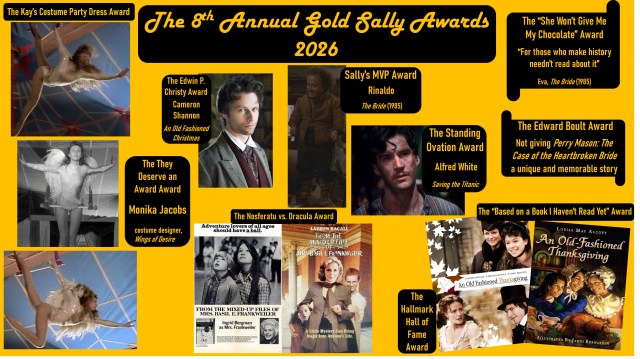
The Standing Ovation Award
(Character Most Deserving of Receiving Their Full Potential)
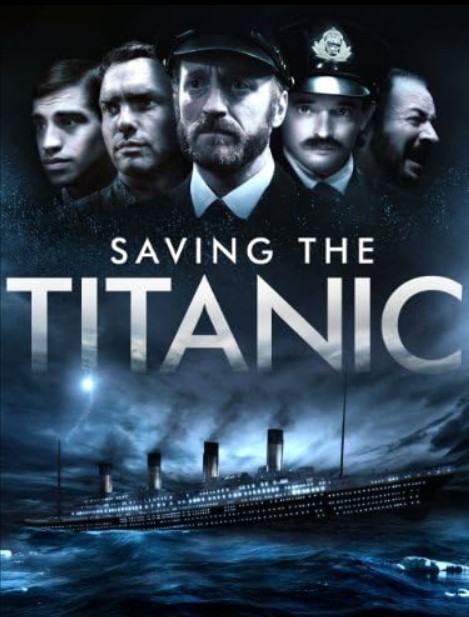
Alfred White from Saving the Titanic
Overcoming a fear takes bravery, determination, and perseverance. When one conquers a fear that was holding them back, it is an accomplishment worth celebrating, especially considering what that person may have gone through to reach that accomplishment. In Saving the Titanic, Alfred White had a fear of heights. He eventually overcame his fear when tasked with reporting everything happening above Titanic’s deck. The fact Alfred faced and conquered his fear during the highly stressful time of Titanic’s sinking is quite amazing. But as Alfred was addressing his fear of heights, he also taught me about the Titanic’s fourth fake funnel, a fact I was unaware of before watching Saving the Titanic. For these reasons, I have chosen Alfred White to receive this year’s Standing Ovation Award!
The Hallmark Hall of Fame Award
(Movie That Feels Like It Belongs in the Hallmark Hall of Fame Collection)
An Old Fashioned Thanksgiving
When I gave Hallmark’s Frankenstein the Hallmark Hall of Fame Award last year, I described the 2004 television movie as an immersive experience. The combination of screenwriting, acting performances, set design, and costume design presented the illusion of transporting me to another time and place. This is exactly how I felt when revisiting An Old Fashioned Thanksgiving! In the case of the 2008 tv film, this illusion was achieved through attention to detail and historical accuracy. Similar to Hallmark’s Frankenstein, I’m surprised An Old Fashioned Thanksgiving wasn’t a Hallmark Hall of Fame presentation. It’s even more surprising none of Louisa May Alcott’s literary work was adapted into Hallmark Hall of Fame titles. So, those are the reasons why I chose An Old Fashioned Thanksgiving for this year’s Hallmark Hall of Fame Award!
The “She Won’t Give Me My Chocolate” Award
(Best Quote from a Movie)
“For those who make history needn’t read about it” – Eva, The Bride (1985)
I will admit this was the most difficult category to choose a winner for. That’s because there were several strong quotes that were deserving of this year’s “She Won’t Give Me My Chocolate” Award. But the quote I ended up selecting was the one Eva told Josef in 1985’s The Bride. Outside the movie’s context, the quote itself is powerful and epic. Within the movie, however, it’s a simplistic yet meaningful acknowledgment of how far Eva came from when she was first introduced in the story. By Eva telling Josef, “For those who make history needn’t read about it”, she’s no longer the blank slate Frankenstein originally created her to be. Instead, Eva can think and speak for herself, even if she did need some help along the way. This quote provides character development in an interesting and memorable way!
The Edwin P. Christy Award
(Most Annoying Character in Film)
Cameron Shannon from An Old Fashioned Christmas
Looking back on 2025, Cameron Shannon, from An Old Fashioned Christmas, sticks out in my memory. But his memorability is for the wrong reasons. As I said in my review of the 2010 tv picture, Cameron was the worst character in An Old Fashioned Christmas. This was due to how annoying he became over the course of the movie. Cameron always acted like he had something to prove, as well as attempting to get the last word in every argument or conversation. So, it was satisfying to see Gad confront Cameron toward the end of the story. Like I also said in my An Old Fashioned Christmas review, the majority of the film emphasized the love triangle between Tilly, Gad, and Cameron. Honestly, I don’t know what Tilly saw in Cameron because his unlikability was static.
The Edward Boult Award
(Missed Opportunity in Cinema)
Not giving Perry Mason: The Case of the Heartbroken Bride a unique and memorable story
Last July, when I reviewed Perry Mason: The Case of the Heartbroken Bride, I criticized the movie for its missed creative opportunities. This major flaw made the twenty-third chapter in the Perry Mason movie series lackluster. In my review, I gave two subplot ideas that could have helped Perry Mason: The Case of the Heartbroken Bride obtain a more memorable story. The first is how Hannah, the sister of Kaitlynn’s fiancé, converted her failed music career into a promising legal career. Kaitlynn’s real personality being quite different from her celebrity persona serves as the second subplot idea. Sadly, these ideas weren’t utilized nor did they contribute to the mystery of Perry Mason: The Case of the Heartbroken Bride. The 1992 television film was Perry Mason’s “bad day at the office”.
The “Based on a Book I Haven’t Read Yet” Award
(Movie Based on Source Material I Have Not Yet Read)
An Old-Fashioned Thanksgiving
Louisa May Alcott is best known for her iconic novel, Little Women. But she has written some short stories throughout her career. One of those short stories was An Old-Fashioned Thanksgiving, which was the source material for the 2008 Hallmark Channel movie of the same name. You’d think with how much I adore An Old-Fashioned Thanksgiving’s film adaptation, I would have read the source material by now. But as of late February to early March, 2026, I still have not read Louisa May Alcott’s short story. Hopefully, I can finally check out An Old-Fashioned Thanksgiving this year!
The Nosferatu vs. Dracula Award
(Two Movies That Feel Like You’re Watching the Same One)
From the Mixed-Up Files of Mrs. Basil E. Frankweiler from 1973 and 1995
If you read my review of 1973’s From the Mixed-Up Files of Mrs. Basil E. Frankweiler, you would know this adaptation, as well as the 1995 version, would likely receive the Nosferatu vs. Dracula Award. This is due to both movies sharing a lot of the same strengths and flaws. Even though each version of From the Mixed-Up Files of Mrs. Basil E. Frankweiler does have its differences, it’s not enough to give the films strong differentiations between them. Even though I slightly prefer the 1995 adaptation over the 1973 version, these movies made me feel like I was watching the same film twice.
The Kay’s Costume Party Dress Award
(Best Outfit from a Movie)
Marion’s Angel Costume from Wings of Desire
In my Comparing with the Critics review of Wings of Desire, I complimented the movie’s costume design. I even described one of Marion’s trapeze artist costumes in detail. That costume is the angel costume Marion wore when she was first introduced in Wings of Desire. The craftsmanship and detail that went into creating the costume allowed the costume itself to stand out long after the movie was over. As I said in my review, the exquisiteness of Marion’s costumes, including her angel costume, makes me wish they were shown in color more consistently.
Sally’s MVP Award
(Character Who Left a Memorable, Showstopping Impression)
Rinaldo from The Bride (1985)
Back in June, 2025, when I reviewed The Bride, I proclaimed Rinaldo was the movie’s MVP. So, when it came time to decide who should receive the Sally’s MVP Award, I already knew the perfect winner! From the moment he meets Viktor, Rinaldo genuinely has Viktor’s best interests at heart. He strives to give Viktor a better life than Frankenstein did, even going so far as to educating Viktor on the importance of his name, which means “He will win”. Rinaldo always refers to Viktor as “his friend”. If it wasn’t for Rinaldo, I don’t believe Viktor would have received the “hero’s journey” he did in The Bride. Similar to when I gave Madmartigan the Sally’s MVP Award last year, Rinaldo became The Bride’s MVP because of David Rappaport’s performance and the screenwriting.
The They Deserve an Award Award
(Someone Associated with a Movie Who Deserves Recognition)
Monika Jacobs (for her costume designs in Wings of Desire)
In the past, I would give this award to actors or actresses who gave a performance that was memorably showstopping. But this year, I decided to expand the They Deserve an Award Award to other departments of film-making. That’s because there are other important components of creating a movie besides acting. When I reviewed Wings of Desire, I praised the film’s costume design, specifically pointing out one of Marion’s trapeze artist costumes. I said I wish Wings of Desire’s costume designer, Monika Jacobs, was nominated for, at least, one award. Costume design isn’t just about crafting attire that’s appealing to the eye. It’s also about creating attire that compliments the actor or actress wearing it. Through Marion’s wardrobe in Wings of Desire, Monika achieved these objectives. Even though Marion’s trapeze artist costumes were stunning, her casual and formal attire made Solveig Dommartin look like the best dressed star of Wings of Desire!
Have fun at the movies!
Sally Silverscreen
![20181227_182101[1]](https://18cinemalane.com/wp-content/uploads/2018/12/20181227_1821011-e1545963069579.jpg)


 18 Cinema Lane