Comparing with the Critics – Best of 1985 – Mad Max Beyond Thunderdome

This review is from my series, Comparing with the Critics. If you’d like to learn more about the series, click on the link below.

Introducing my new series, Comparing with the Critics!

In my Comparing with the Critics review of Amadeus, I mentioned the Falco song, “Rock Me Amadeus”, being one of the reasons why I was intrigued to review the movie. I actually have a similar experience with Mad Max Beyond Thunderdome. Every time I think of this film, I think of the Tina Turner song, “We Don’t Need Another Hero (Thunderdome)”. This is an ironic coincidence, as “We Don’t Need Another Hero (Thunderdome)” and “Rock Me Amadeus” were released in 1985. Another ironic coincidence is how, for the Comparing with the Critics series, I, once again, selected an ‘80s film both Roger Ebert and Gene Siskel liked. Though Mad Max Beyond Thunderdome only appeared on Roger’s list of the top ten best films of 1985, each critic gave the movie a thumbs-up when they reviewed it on an episode of At The Movies. Before this Comparing with the Critics review, I had never seen any of the Mad Max movies, let alone Mad Max Beyond Thunderdome. Therefore, I couldn’t agree or disagree when Roger stated that Mad Max Beyond Thunderdome was “the best of the Road Warrior movies” or when Gene declared it was “a great, violent, fun picture”. Now that I have seen the film, I can honestly say I don’t agree with Gene’s and Roger’s praise. It’s not that Mad Max Beyond Thunderdome is a bad movie, I just didn’t like or love it as much as the critics did.
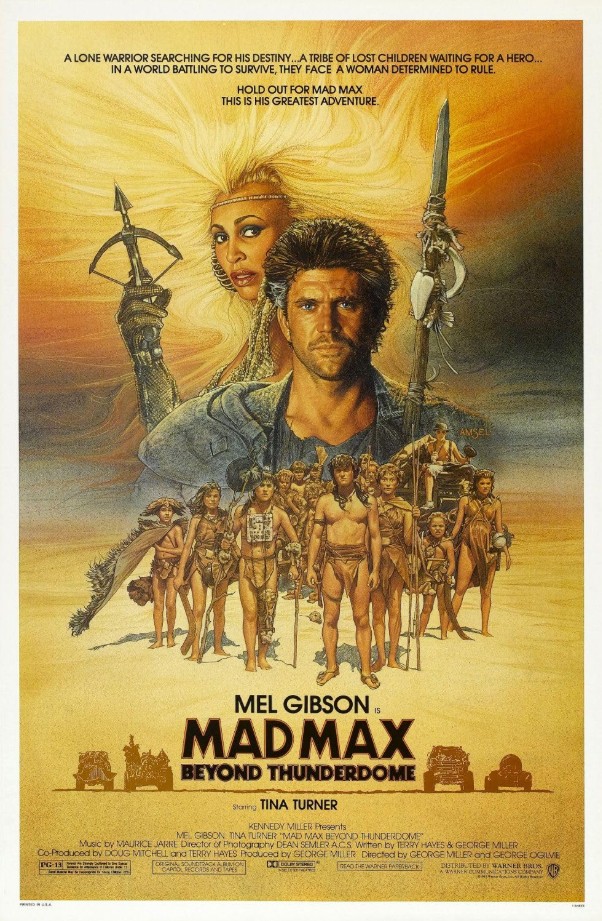
Mad Max Beyond Thunderdome poster created by Kennedy Miller Productions and Warner Bros.

While sharing his opinion on Mad Max Beyond Thunderdome in an episode of At The Movies, Gene complements the directors, George Miller and George Ogilvie, as both of them “successfully creates a complete alien world on film”. To add to Gene’s statement, Roger commented how the film’s “world is as rich as Casablanca or as rich as Oz”. I admit one of the strengths of Mad Max Beyond Thunderdome was its set design, as the movie’s creative team presented an atmosphere that felt immersive! One of the conflicts in the story is Max battling in a duel against a character named Blaster, in order to retrieve his stolen items. They fight within the titular Thunderdome, a circular caged structure built out of steel-like material. What adds to the scene’s immersion is the medium and close-up shots captured within the Thunderdome. The combination of these creative choices helps the audience feel like they are right in the middle of the excitement! Even the sign advertising the Thunderdome is a blend of color, light, and dirt. This specific prop captures the thrill of the dueling action while also consistently displays the film’s aesthetic.

Image by Freepik

As I said in this review’s introduction, Mad Max Beyond Thunderdome ended up on Roger’s list of the top ten best films of 1985. One of his reasons was how he “was overwhelmed by the wealth of new ideas they came up with in the third picture”. Specifically speaking about Max and Blaster’s aforementioned duel, Roger explains how this scene presents two new ideas; “a new place to put the audience, which is over the top of the dome, and a new way to fight by putting the people on elastic bands so they have a three or a four dimensional, if you will, fight instead of regular punching it out”. Adding to Roger’s explanation, both Max and Blaster were given more freedom to move around the Thunderdome because of their elastic harnesses. While there was fist-fighting in the duel, flips and large jumps were incorporated in the fight choreography. Blaster and Max were presented with a variety of weapons, which added to the duel’s unpredictability. It also shows how the duel itself was a battle of strategy. This scene is definitely one of the most memorable from Mad Max Beyond Thunderdome!
Back to 1985 Blogathon banner created by Quiggy from The Midnite Drive-In and Hamlette from Hamlette’s Soliloquy

While Gene and Roger sang the praises of Mad Max Beyond Thunderdome, I was disappointed they ignored Tina Turner’s portrayal of Aunty Entity. Personally, I think Tina is a better actress than some people give her credit for. Her performance in this film proves that. A great example is when Master confronts Aunty Entity about the true leadership of Bartertown. Before this confrontation, Aunty Entity is confident in her ability to rule over this little community. Master calls her out by questioning who’s in charge. Aunty’s confidence gradually turns into anger. She develops a stern look on her face, the anger itself filling her eyes. There’s even a point where Aunty’s bottled-up anger causes her to shake. This scene shows how Tina’s performance was able to say so much while utilizing very little dialogue.

Illustrated image of Arizona desert created by pikisuperstar at freepik.com. Background vector created by pikisuperstar – www.freepik.com

Like I brought up in my review’s introduction, I didn’t like or love Mad Max Beyond Thunderdome as much as Roger and Gene did. A reason for my opinion is how the script left several questions unanswered. When Max meets the children of the Planet Erf tribe, the children believe he is Captain Walker. They describe Captain Walker as a plane pilot who will lead them to a better land. Because Jedediah was introduced in Mad Max Beyond Thunderdome as a man who could successfully fly a plane, I thought he could be Captain Walker, connecting him to the Planet Erf tribe’s part of the story. But this wasn’t the case, leaving questions about Captain Walker’s whereabouts. I was also not a fan of the creative team’s decision to prioritize telling over showing. A good example is when Blaster is about to be defeated in his and Max’s duel. Master begs Max not to kill Blaster, as he has a lot of respect for Blaster. However, this respect isn’t shown leading up to that scene. The only interactions with Master and Blaster are Master simply using Blaster as a means of transportation. Had the respect and camaraderie between Blaster and Master been better displayed, the duel itself and even its aftermath would have carried more emotional weight.
Comparing with the Critics banner created by me, Sally Silverscreen. TV show title cards created by WTTW National Productions, WTTW, Public Broadcasting Service (PBS), Lifetime Television, Tribune Entertainment, Buena Vista Television, and Disney-ABC Domestic Television

When Roger Ebert placed Mad Max Beyond Thunderdome on his list of the top ten best films of 1985, he called it “a great looking, high styled thriller”. Gene Siskel even claimed that “kids are gonna want toys out of this film” and “people are gonna dress like out of this film”. I can only speak for myself, but I wouldn’t go out of my way to seek out merchandise related to this movie or even revisit this movie. That’s because I thought Mad Max Beyond Thunderdome was just a fine, well-made picture. I couldn’t become fully invested in this story because of the collection of unanswered questions, which left me confused. I did not like the creative team’s decision to emphasize telling over showing as well. But the movie does have its merits. The world-building was one of the strongest aspects of the production, as the directors helped create an on-screen world that felt immersive. I not only liked the acting, I also believe the Thunderdome duel was one of the film’s most memorable scenes. So, this is yet another review where I didn’t agree with the critics. Now, if you’ll excuse me, I’ve got to go sing along to Tina Turner’s song, “We Don’t Need Another Hero (Thunderdome)”!

This review was brought to you by

Sally Silverscreen
Take 3: Tommy Review

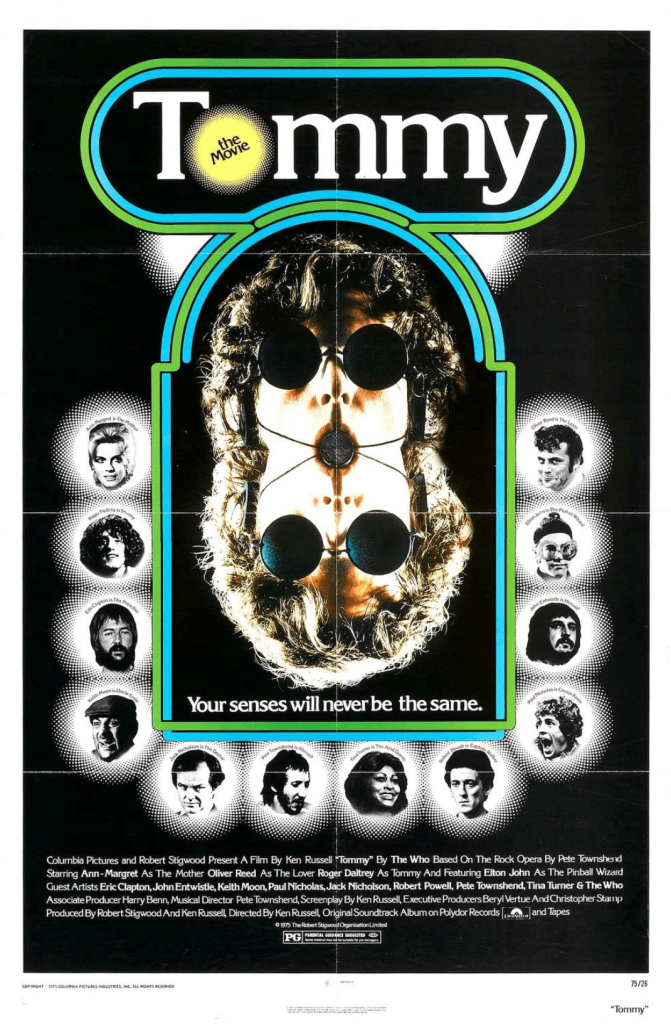
For my third year participating in the Rule, Britannia Blogathon, I, at first, considered reviewing an adaptation based on a book I’ve read. This would be similar to when I wrote about the 2002 adaptation of Nicholas Nickleby. But the more I thought about it, the more I realized I had a perfect opportunity on my hands. That opportunity was the chance to review the 1975 film, Tommy! Years ago, long before I became a movie blogger, I saw a trailer for Tommy on Turner Classic Movies (TCM). On the one hand, the story itself seemed interesting; a man with disabilities living his best life and making his dreams come true. But, on the other hand, the visuals within this trailer appeared “bonkers”, making the movie seem intimidating. After reading some reviews, I came to the conclusion Tommy is a polarizing film. This isn’t the first time I have written about a movie that received mixed reviews. Two years ago, for another blogathon, I reviewed the 2011 Hallmark film, The Cabin. Historically, this is considered one of the most polarizing titles the network has ever created. When I got around to seeing it, I found The Cabin so bad, it was disappointing.

Tommy poster created by Robert Stigwood, Organization Ltd., Hemdale Film Corporation, and Columbia Pictures

Things I liked about the film:

The acting: Prior to watching Tommy, I had seen Bye Bye Birdie. In the 1963 film, Ann-Margret gave an expressive portrayal of Kim MacAfee. The 1975 movie shows Ann-Margret in a completely different role, which allowed her to expand her acting abilities. Portraying the titular character’s mother, Nora, Ann-Margret gave a well-rounded performance! Because this story incorporates heavier subjects, her portrayal contains the emotional intensity required for a story of this nature. While watching television, Nora sees her son on TV. As she’s watching, a sense of guilt grows within her. This guilt causes Nora to appear disgusted, a grimace slowly overcoming her face. She attempts to change the channel in order not to see Tommy, only for the TV to magically switch to Tommy’s image. Angry about her plan not working, Nora throws her champagne bottle at the television, which results in a flood of laundry detergent, beans, and chocolate. Relieved to instantly receive the items she just saw in television commercials, Nora suddenly is taken over by pleasure. A smile appears on her face as she rolls around on the floor in the commercial materials.

When discussing a movie heavily revolving around a titular character, it’s important to talk about the actor or actress portraying that character. In the case of Tommy, that role was given to Roger Daltrey. Based on some reviews I’ve read of Tommy, it seems like Roger had little to no acting experience prior to working on this movie. Despite this, his performance was such a strong addition to the story! Roger’s portrayal had the emotionality and versatility to make Tommy a character worth rooting for. These aspects also held my interest in Tommy’s journey. In one scene, Tommy stays over at Cousin Kevin’s house. During his stay, Kevin tries to burn Tommy with a cigarette. As Tommy is sitting tied up in a chair, his face instantly changes from exhaustion and writhing in pain. This change in facial expressions is seamless, Roger never missing an emotional beat.

While I have heard good things about Tina Turner’s acting performances, this was the first time I had seen any of them. Tommy shows Tina portraying The Acid Queen. Even though her performance was limited to one scene, she gave so much energy to her role. While her portrayal was over-the-top, it fit the tone and vibe the movie was going for. With all that said, I honestly wish Tina had received more appearances in this film.

Ann-Margret’s wardrobe: Even though I knew Ann-Margret would be starring in Tommy, I was pleasantly surprised by how much I liked her wardrobe! Each outfit she wore complimented her so well, while also looking great on-screen! Toward the beginning of the movie, as Nora and her husband, Captain Walker, are running through the war-torn streets of England, she wore an asymmetrical, sky-blue gown. The dress itself was simple, but it was elegant enough to not be plain. Ann-Margret’s strawberry blonde hair paired beautifully with the color of the dress. Later in the movie, Nora wears a silver, mesh pant suit. Accompanied by shiny, silver sandals and a white furry cape, this ensemble boasted a posh look. While the outfit felt very reflective of the 1970s, it was a divine version of that type of outfit. Ann-Margret definitely pulled off this film’s wardrobe in style!

The symbolism: In some reviews I read about Tommy, it was mentioned how there was symbolism found among the over-the-top, flashier imagery. Since I knew before watching the movie there was going to be this type of imagery, it allowed me to focus on what the film’s creative team was trying to say through their story. In a desperate attempt to cure her son, Nora takes Tommy to The Church of Marilyn Monroe. Other patrons with disabilities are also in attendance, from a woman with a guide dog to multiple people utilizing wheelchairs. Marilyn’s likeness can be seen throughout the facility, with the most notable being a giant statue of Marilyn in the iconic flown skirt pose. I interpreted the scene as a piece of commentary on how people who claim to be religious and/or contain the ability to cure everyone with anything can, sometimes, take advantage of those in vulnerable positions. Those people could be considered “false prophets”. So, choosing Marilyn as the film’s church icon is interesting, as Marilyn’s name and image were all a fabricated version of Norma Jean.

The 9th Annual Rule, Britannia Blogathon banner created by Terence from A Shroud of Thoughts

What I didn’t like about the film:

Some villains not receiving their comeuppance: There were several characters in Tommy’s life that failed him. While a few of these characters did receive their comeuppance, most of them did not. Whenever Tommy went to stay at Cousin Kevin’s house, Kevin would physically abuse and torment Tommy. Kevin only appeared in a sequence of scenes showing Tommy mistreated by him. Because of this, Kevin’s comeuppance was never shown. I’m not sure if this creative decision was made because there wasn’t enough time to show each character’s comeuppance or if it was meant to show how unfair life can be.

Some confusing parts of the story: At one point in Tommy’s story, his parents take him to see The Specialist, in an attempt to figure out why Tommy has several disabilities. During this appointment, Nora and The Specialist continuously flirt with each other. After this scene, this interaction and The Specialist himself are not brought up again. I was unsure if Nora planned on leaving Frank to start a relationship with The Specialist or if she was flirting with The Specialist simply to encourage him to lower her son’s medical bills. Either way, the movie does not provide a clear explanation.

An unclear time-line: This story starts during and shortly after World War II. The script heavily implies Tommy was born sometime in 1945. Most of this story takes place when Tommy is an adult. If Tommy were, say, twenty during the film’s events, that would mean the story takes place in 1965. With that said, why do the wardrobe, set design, and special effects look like they came straight out of the 1970s? I know this film was released in 1975. But because Tommy’s age is not specified, the movie’s time-line is unclear.

Music and stage image created by Topntp26 at freepik.com. <a href=’https://www.freepik.com/free-photo/music-sign_1179519.htm’>Designed by Topntp26</a>. <a href=”https://www.freepik.com/free-photos-vectors/vintage”>Vintage image created by Topntp26 – Freepik.com</a>. Image found at freepik.com.

My overall impression:

The way I feel about Tommy is similar to how I feel about Queen of the Damned. Is this one of my favorite films? No. Is it one of the best movies I’ve seen this year? Also, no. But, for what it was, I enjoyed it. Yes, the visuals can be “bonkers”. When you look past all of that, though, you will see the film’s creative team had something interesting to say. The story itself was easier to follow. The symbolism and messages associated with it appeared to be given a lot of thought and effort. Therefore, artistic merit can be found in this movie. The story of Tommy is a heartbreaking one. However, it is also a somewhat uplifting story. I won’t spoil the film for those who may be interested in seeing it. I will say when a climatic event happens, the moment itself feels earned.

Overall score: 7.3 out of 10

Have you seen Tommy? Are there any musical films you’d like to see me review? Let me know in the comment section below!

Have fun at the movies!

Sally Silverscreen