Take 3: Play Misty for Me Review

August’s theme for Genre Grandeur is “Eastwood connected Movies (Clint or his progeny in any capacity)”. As soon I discovered this month’s selected theme, I immediately knew which movie I would choose! For years, I wanted to check out the 1971 film, Play Misty for Me. This is because I had heard Play Misty for Me is the precursor to Fatal Attraction. Since I have seen the 1987 movie, I was curious to see how many similarities or differences Play Misty for Me and Fatal Attraction shared. With this month’s Genre Grandeur theme, I am finally getting that chance! By writing about Play Misty for Me, this is the first time I’m reviewing any of Clint Eastwood’s movies on 18 Cinema Lane. I am familiar with Clint as an actor, so I knew the types of roles he’s typically known for. Therefore, choosing to review Play Misty for Me as the first film of Clint’s covered on my blog is interesting, as it’s quite different from the westerns and action pictures he has usually starred in.
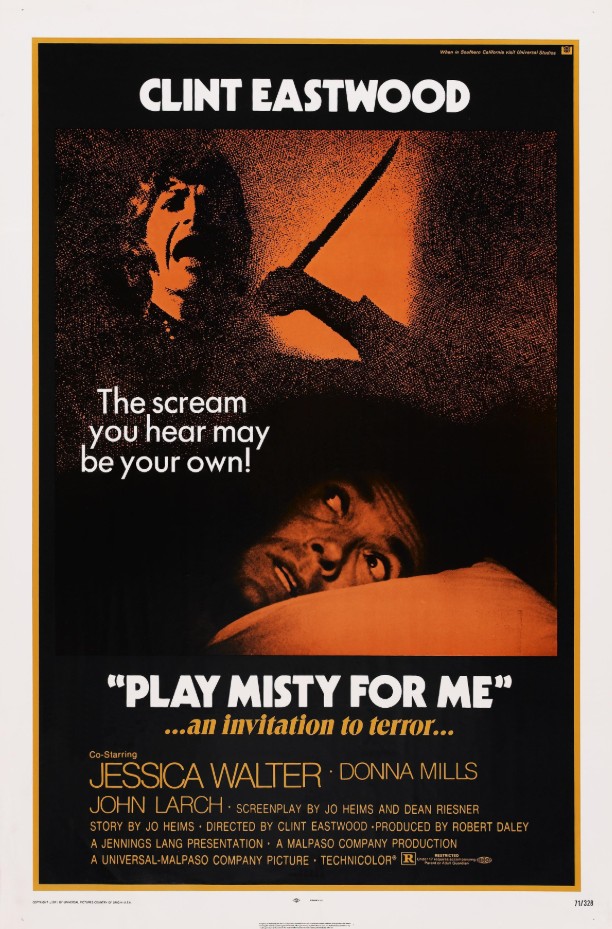
Play Misty for Me poster created by Universal Pictures, Jennings Lang, and The Malpaso Company

Things I liked about the film:

The acting: While I liked the acting as a whole in Play Misty for Me, I have to highlight Clint Eastwood’s and Jessica Walter’s performance. This is because their characters were given the most screen time. Throughout his film career, Clint has gained a reputation for portraying tough, unbreakable heroes. That reputation has been a result of starring in films from the western genre and in titles like Sudden Impact. But in Play Misty for Me, Clint’s character, Dave, adopted a very different persona. The radio disc jockey carries a suave personality with a hint of gentleness. In a great example when Jessica’s character, Evelyn, is restocking Dave’s refrigerator in preparation for dinner, Dave explains to Evelyn how he already has dinner plans. His explanation, however, is calm, which puts Evelyn at ease. Dave’s kind tone of voice, the understanding look in his eyes, and even the relaxed look on his face shows how he isn’t mad at Evelyn. Clint’s versatile acting abilities effectively portray how easy it is to fall in love with Dave!

As I just mentioned in this review, Jessica Walter portrays Evelyn. What I liked about her performance was her ability to seamlessly adopt different emotions. One perfect example is when Evelyn and Dave are having a conversation outside. Before Evelyn leaves Dave’s house, her attitude is friendly. A smile is painted on her face and her personality seems bubbly. But when a neighbor comes outside to complain about the noise, Evelyn immediately becomes very angry. She yells at the neighbor and her entire demeanor is tense. As soon as the neighbor leaves, Evelyn goes back to being friendly like nothing unusual had taken place. Jessica’s ability to seamlessly adopt different emotions was consistent throughout Play Misty for Me. This acting strength made Evelyn an unpredictable character.

The scenery: The biggest pleasant surprise in Play Misty for Me was the scenery! Filmed in Monterey and Carmel, California, the 1971 film features a lot of scenes showcasing the ocean and its surrounding landscape. A perfect example of how photogenic the scenery is can be seen when Dave and Tobie are on a date. One shot proudly displays the ocean at sunset. An orange and yellow sky is met with calm waters shimmering in blue, periwinkle, and lavender. In the foreground, a nearby tree, the edge of a cliff, and the characters’ silhouettes are shadowed, which are contrasted against the lighter colors of the sea. To me, this was one of the most beautiful shots in Play Misty for Me!

The incorporation of jazz music: In movies classified as “psychological thrillers”, the soundtrack primarily consists of suspenseful orchestral music to increase the suspense within that story. The creative team behind Play Misty for Me decided to take a different approach. Jazz tunes provide the main musical sound in the 1971 movie. This is not only because Dave works at a jazz radio station, he also attends a jazz concert. The sounds of this particular music genre invoke a sense of maturity and sophistication. That sophistication and maturity were woven into Play Misty for Me, which allowed the story to be taken seriously. Jazz music also pairs nicely with the oceanic scenery I talked about earlier in this review. The rhythmic movements of the waves and the steady notes of the music create a visual and auditory paradise!

String of musical notes image created by Freepik at freepik.com. <a href=’https://www.freepik.com/free-vector/pentagram-vector_710290.htm’>Designed by Freepik</a> <a href=”https://www.freepik.com/free-photos-vectors/background”>Background vector created by Freepik</a>. Image found at freepik.com. 

What I didn’t like about the film:

A more annoying antagonist: Alex, from Fatal Attraction, is one of the scariest antagonistic characters in film history. While she is emotionally unstable, her attempts to infiltrate Dan’s life are calculated and intentional. A classic example is when Dan discovers the fate of his daughter’s pet rabbit. When I watched Play Misty for Me, Evelyn came across as more annoying than scary. That’s because her efforts to infiltrate Dave’s life are sporadic, whiny, and desperate. These factors caused me to not take Evelyn as seriously as Alex when it comes to being an antagonist.

Inconsistent suspense: Like I said in this review’s introduction, I have heard Play Misty for Me is the precursor to Fatal Attraction. Though it’s been years since I’ve seen the 1987 movie, I remember the story’s suspense being consistent. With all that said, I believed the suspense in Play Misty for Me would be consistent as well. Unfortunately, I was proven wrong. The suspense of Play Misty for Me was sparingly incorporated, only appearing in certain moments of the story. Most of the film features mundane moments with low energy, such as Tobie and Dave’s date, which lasts for about five minutes. That creative decision caused Play Misty for Me to lack a strong amount of adrenaline and intrigue.

A drawn-out film: According to IMDB, Play Misty for Me has a run-time of an hour and forty-two minutes. To me, though, the film felt longer than its run-time. This feeling was the result of some scenes being drawn out longer than necessary. Earlier in this review, I mentioned Dave attending a jazz concert. The scene featuring the concert lasted approximately five minutes. I mentioned Tobie and Dave’s date lasting about five minutes as well. Had these scenes been trimmed down to maybe three minutes or less, more time could have been spent providing Play Misty for Me with more suspenseful moments.

Recording studio image created by Senivpetro at freepik.com. Music photo created by senivpetro – www.freepik.com

My overall impression:

In my review’s introduction, I said I heard Play Misty for Me is the precursor to Fatal Attraction. Now that I’ve seen both movies, I can honestly say I’d prefer Fatal Attraction over Play Misty for Me. From what I remember of the 1987 film, the story’s suspense is consistent. Plus, Alex is a much scarier antagonist than Evelyn. Play Misty for Me contains flaws like inconsistent suspense and the film itself being drawn out. However, the 1971 movie does have its merits. I liked the acting performances, especially those from Clint Eastwood and Jessica Walter. The scenery was the biggest pleasant surprise of the film. Incorporating jazz music was an interesting approach to the psychological thriller genre, giving the story a sense of maturity and sophistication. With everything I’ve been saying, Play Misty for Me is, in my opinion, just ok.

Overall score: 6 out of 10

Have you seen Play Misty for Me? Are there any projects from Clint Eastwood’s or Jessica Walter’s IMDB filmography you’d like to see me cover on 18 Cinema Lane? Let me know in the comment section!

Have fun at the movies!

Sally Silverscreen
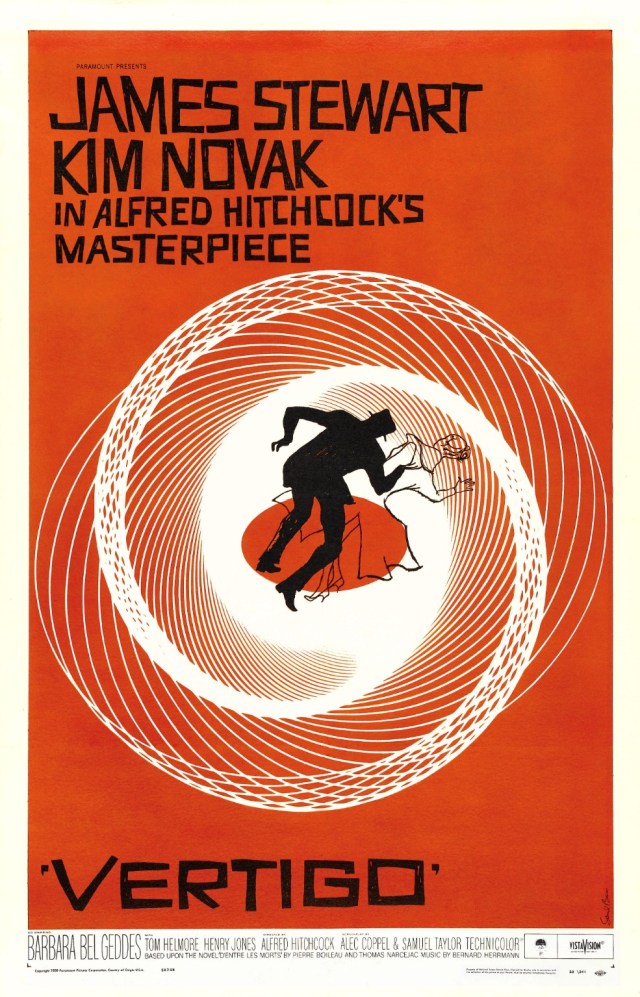
Take 3: Vertigo (1958) Review

Alfred Hitchcock is a man who needs no introduction. Director by choice and legend by chance, Alfred has single-handedly become a house-hold name in the world of cinema. While I have seen (and reviewed) some of his films, there are still plenty of titles I have yet to see. One of those films was 1958’s Vertigo, which was recommended by Charity from The Sacred in the Secular! This is a movie I had been meaning to write about for a while. With The 3rd Master Of Suspense Blogathon on its way, I found a great time to finally review Vertigo! As I already mentioned, I have reviewed some of Alfred’s films. While I still think Strangers on a Train is his best movie, The 39 Steps is one of my least favorite. Now, the time has come to share my thoughts on Alfred Hitchcock’s 1958 presentation!

Vertigo (1958) poster created by Alfred J. Hitchcock Productions and Paramount Pictures

Things I liked about the film:

The use of music: Music can be a powerful film-making tool. Through a combination of sound, instrumentals, and even lyrics, music can elevate a scene’s mood, foreshadow parts of the story, or emphasize events happening in a scene. In Vertigo, music was utilized to compliment a scene’s given mood. A perfect example is when Scottie follows Madeleine to a flower shop. While he walks through a flower shop’s storage room, suspenseful orchestral music builds up to the moment Scottie reaches the flower shop’s door. This type of music acknowledges Scottie’s fear of the unknown, as he doesn’t know what he’ll find on the door’s other side. But once he opens the door, he discovers Madeleine is in a flower shop, purchasing a bouquet of flowers. This discovery causes calming, orchestral music to play in the background, stressing how Madeleine and the shop itself are nonthreatening to Scottie.

Incorporation of culture: The mystery in Vertigo revolves around Madeleine being obsessed with a woman named Carlotta Valdes. Scottie follows clues from art and local history in an attempt to solve the mystery. The “local history” in this movie is a fictionalized version of San Francisco’s history. However, the blending of these aforementioned cultural elements gave Vertigo a unique identity from other Hitchcock productions. The creative team’s incorporation of culture can also spark thought-provoking analysis about how culture can influence or even solve mysteries. As someone who reviews mystery films and even has a series called Sally Solves a Mystery, this aspect of Vertigo has made me look at the subject of mysteries somewhat differently.

The set design: There was some impressive set design in Vertigo! One of my favorite examples is Gavin’s office. Wood paneling covers every wall. The entire floor is covered in red carpeting, which actually compliments the wood paneling. A large, dark wood desk with intricate detailing becomes the showstopper of the space! Other design choices, such as a large model of a ship, red chairs, and a huge window overlooking the cargo ship dock emphasize Gavin’s importance in the company he inherited. Artwork and photographs covering every wall presents a glimpse into Gavin’s artistic taste.

The 3rd Master Of Suspense Blogathon banner created by Maddy from Classic Film And TV Corner

What I didn’t like about the film:

Questions left unanswered: For this part of my review, I will spoil Vertigo. If you have not seen this movie and are planning on watching it, skip to the part titled ‘The underutilization of Barbara Bel Geddes’.

After Madeleine dies, Scottie meets a woman named Judy, believing she looks like his deceased love. Shortly after Judy and Scottie meet for the first time, she writes a letter and confesses being Madeleine. In the letter, Judy claims parts of the story she and Gavin told Scottie were true. But she never specifies which parts of their story they were honest about. The creative team’s decision to leave questions unanswered frustrated me. This is because I was curious to see how the mystery of Madeleine’s psychological connection to Carlotta Valdes would be resolved.

The underutilization of Barbara Bel Geddes: In Vertigo, Barbara Bel Geddes portrays Marjorie ‘Midge’ Wood. A designer who is passionate about art, Midge was engaged to Scottie in the past. Even though their engagement didn’t last, they remain on friendly terms. Barbara’s on-screen chemistry with James was pleasant. Her performance effectively sold the idea Midge was good friends with Scottie. This made me hope Scottie and Midge would work together to solve Vertigo’s mystery. But that did not happen because Barbara was only in a handle of scenes. I think Midge is an interesting character, so this creative decision disappointed me. Not giving Barbara more material to work with was, in my opinion, a missed opportunity.

An unsolved mystery: For this part of my review, I will, once again, spoil Vertigo. If you have not seen this movie and are planning on watching it, skip to the part titled ‘My overall impression’.

At the beginning of Vertigo, Scottie is asked by Gavin to solve the mystery of why Madeleine is obsessed with a woman named Carlotta Valdes. This obsession gets to the point where Madeleine goes to places she has no memories of visiting. Because of how the fictionalized San Francisco culture and supernatural elements were combined in the mystery, I was curious to see how the mystery would be resolved. But, about halfway through Vertigo, Madeleine dies. Shortly after Madeleine passes away, the mystery of Judy’s identity begins. By the end of the movie, this new mystery is solved. If the screenwriters knew their script would contain more than one mystery, they should have resolved the first mystery before moving on the next one. The creative team’s decision to abandon Madeleine’s mystery left several questions unanswered.

Art tools image created by Freepik at freepik.com. <a href=’https://www.freepik.com/free-vector/flar-art-tools-pack_835368.htm’>Designed by Freepik</a>.  <a href=”https://www.freepik.com/free-photos-vectors/paint”>Paint vector created by Freepik</a>. Image found at freepik.com.

My overall impression:

Have you ever watched a movie where you found yourself deceived by the movie’s end? That’s how I felt after watching 1958’s Vertigo. Without spoiling the movie, I will say how even though the story contained two mysteries, only one of them is solved. This is one of the reasons why the script left questions unanswered. I also didn’t like how Barbara Bel Geddes’ acting talents were underutilized. However, there were aspects of Vertigo I liked. The film’s creative team displayed an understanding for how to effectively utilize music. Incorporating culture into the story gave Vertigo a unique identity among Hitchcock’s collection of films. I was impressed by the movie’s set design as well. But when it comes to titles created by Alfred Hitchcock, especially those starring James Stewart, I think Rear Window is stronger than Vertigo. Not only was the talent of Rear Window’s cast well utilized, the mystery was solved as well as prioritized.

Overall score: 6.5 out of 10

Have you seen Vertigo? Which film of Alfred Hitchcock’s is your favorite? Let me know in the comment section below!

Have fun at the movies!

Sally Silverscreen
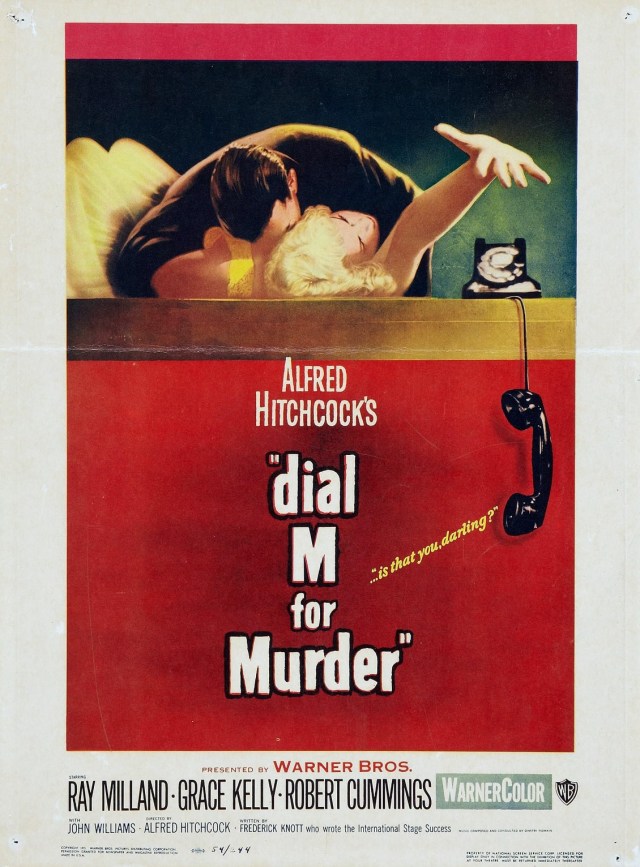
Take 3: Dial M for Murder Review

For this movie review, I chose to write about the 1954 film, Dial M for Murder, for two reasons. The first is how I selected this specific title for The 6th Wonderful Grace Kelly Blogathon, as Grace Kelly stars in the film. The second reason is how, prior to this review, I had never seen Dial M for Murder. Grace and Alfred are no strangers to 18 Cinema Lane. As of mid-November, 2024, I have reviewed two of Grace’s films; High Society (which I thought was fine) and To Catch a Thief (which I found just ok). Meanwhile, four of Alfred Hitchcock’s movies have been covered on my blog. Out of those titles, Strangers on a Train is, in my opinion, still the best one. But how does Dial M for Murder compare to any of Alfred’s films featured on 18 Cinema Lane? Find out by reading my review!

Dial M for Murder poster created by Warner Bros.

Things I liked about the film:

The acting: Since Grace Kelly is the reason why I chose to review Dial M for Murder, I will talk about her performance first. Out of her movies I’ve seen, I’ve noticed how her character portrayals have appeared at ease. Her performance in Dial M for Murder is no different, as her adopted mannerisms and reactions came across as realistic! While sharing a conversation with Mark (portrayed by Robert Cummings), Grace’s character, Margot, seems comfortable in his presence. She effortlessly moves around her apartment and, at times, stands close to him. But when she talks with Mark about how her husband, Tony, has changed, Margot appears to stare into the distance. The combination of her aforementioned stare and frown indicates how Tony’s behavior has troubled her. It also shows the audience how effective Grace’s acting talents are!

As I just said in this review, Robert Cummings portrays Mark, a close friend of Margot. Though they shared only a few scenes together, Grace and Robert displayed nice on-screen chemistry! The strength of Robert’s and Grace’s acting abilities helped their characters appear to truly get along with each other. While I liked Robert’s performance in Dial M for Murder, I was also impressed with Ray Milland’s performance! Similar to Grace’s portrayal of Margot, Ray’s portrayal of Tony showcases how adaptable his acting skills are. For example, Tony looks annoyed while at a restaurant with Mark. From the tone in his voice to constantly checking his watch, Tony clearly appears impatient. A few scenes later, as he’s on the phone with Margot, his demeanor quickly changes to concern due to what he hears over the phone. Throughout his performance, Ray effortlessly brought his character to life!

The use of lighting: Over the course of his career, Alfred Hitchcock has received the title of “Master of Suspense”. One reason why he was given this title is because of how he utilizes lighting to stir up a mood, present visually interesting concepts, or add suspense. In one scene, someone enters Margot and Tony’s apartment. This moment takes place at night, so the only light comes from the fireplace in the living room. An orange glow only providing light to certain areas of the room creates a suspenseful environment, giving the intruder places to hide. I brought up earlier in this review how Mark and Margot shared a conversation. Their conversation takes place in Tony and Margot’s apartment. Right before Tony returns home, Margot’s and Mark’s shadow departs from each other, keeping the closeness of their relationship a secret.

The use of color: Dial M for Murder’s opening credits reveal how the film’s creative team used “WarnerColor” in their project. I’m glad this movie was presented in color because it gave the creative team opportunities to utilize this visual technique to their advantage! Sometimes, the color red was incorporated into a character’s wardrobe. This ranged from Margot wearing a red dress at the beginning of the movie to Tony sporting deep red suspenders. One of the pieces of décor in Margot and Tony’s apartment were dark green curtains. In these examples, color was chosen to draw the audience’s attention to a person, object, or location in the room.

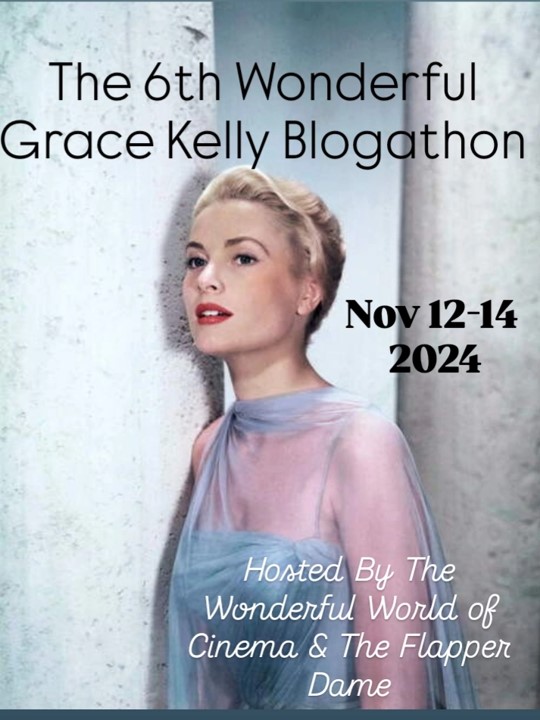
The 6th Wonderful Grace Kelly Blogathon banner created by Virginie from The Wonderful World of Cinema and Emily from The Flapper Dame

What I didn’t like about the film:

Exposition heavy: At the beginning of the movie, Margot shares with Mark how she recently lost her purse. She also tells him when her purse was returned, a letter Mark wrote her was missing. But shortly after Margot made this confession, an exposition heavy scene revealed the letter’s whereabouts, as well as who the story’s perpetrator was. Because this information was revealed so early in the movie, it took away a lot of the story’s suspense. So much exposition given within the film’s first ten minutes may also overwhelm the audience, possibly missing important information if they don’t actively pay attention to the dialogue.

A mystery that isn’t interactive: While talking about Dial M for Murder’s exposition heavy story, I said the perpetrator was revealed so early in the movie. This creative choice takes away the audience’s opportunity to solve the mystery of whodunit alongside the characters. What Dial M for Murder became was a story of how the perpetrator would get caught, similar to programs like Columbo and Diagnosis Murder. That creative decision forces the audience to simply watch the characters solve the story’s mystery. With everything I said, the mystery in Dial M for Murder wasn’t interactive.

A less intimidating antagonist: In some of Alfred Hitchcock’s movies, the antagonist is an intimidating person for a variety of reasons. Their intimidation can add suspense and intensity to a given film’s story. I will not spoil Dial M for Murder. However, I can honestly say I did not find the movie’s antagonist intimidating. Throughout the story, the antagonist kept making dumb decisions, which distracted from their attempts to be an intimidating character. It also didn’t help how the exposition heaviness of the film’s first ten minutes took away a lot of the story’s suspense. If anything, the antagonist in Dial M for Murder was annoying.

Colorful image of key created by orchidart at freepik.com. Flower vector created by orchidart – www.freepik.com

My overall impression:

As of the publication of this review, I have seen eight of Alfred Hitchcock’s films. While I was disappointed by The 39 Steps, I ended up liking Strangers on a Train. When it comes to Dial M for Murder, though, the movie lies somewhere in the middle. Grace Kelly’s performance was, once again, one of the best parts of the production! Her portrayal of Margot was so strong, her reactions and expressions appeared realistic! The use of lighting and color gave Alfred and his creative team ways to present visually creative ideas. But what held Dial M for Murder back from being a more intriguing project is how the first ten minutes of the story was exposition heavy, with this decision impacting the film’s suspense. The mystery not being interactive also takes away some of Dial M for Murder’s intrigue. Alfred’s film felt reminiscent of shows like Columbo and Diagnosis Murder, where the audience simply waits for the perpetrator to get caught. Personally, I prefer mystery stories where I’m left guessing whodunit.

Overall score: 6-6.1 out of 10

Have you seen Dial M for Murder? Which movie of Alfred Hitchcock’s would you like to see me review next? Tell me in the comment section!

Have fun at the movies!

Sally Silverscreen

Take 3: The 39 Steps Review

For the first annual Master of Suspense Blogathon (hosted by Maddy from Classic Film And TV Corner), I wrote about the 1955 film, To Catch a Thief. While I addressed how it was a “pretty looking movie”, I found To Catch a Thief prioritizing style over substance. In this year’s event, I have selected the 1935 production, The 39 Steps, which was recommended by Maddy from Maddy Loves Her Classic Films! There are several titles in Alfred Hitchcock’s filmography that have gained popularity over the years. But The 39 Steps has been overshadowed by Alfred’s more well-known projects. In fact, before signing up for the second annual Master of Suspense Blogathon, I knew very little about the film. However, I was familiar with Alfred’s forte for mystery and suspense, assuming I was, at least, going to see a creative concept come to life on screen. Was I correct in my assumption? Keep reading my review of The 39 Steps to find out!

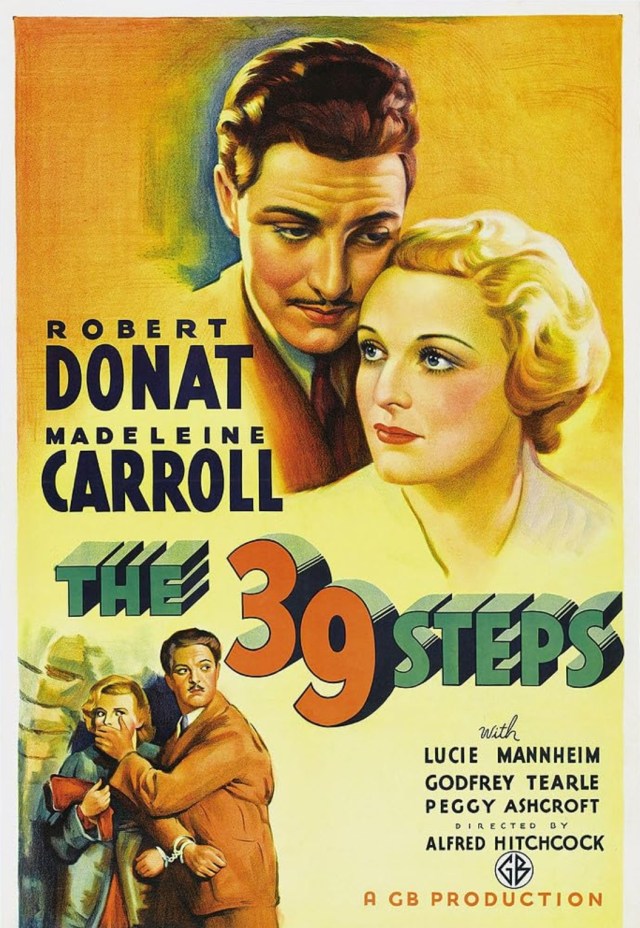
The 39 Steps poster created by Gaumont British Picture Corporation and Gaumont British Picture Corporation of America

Things I liked about the film:

Robert Donat’s performance: Throughout The 39 Steps, I found the acting performances ranging from fine to well-done. However, I did like Robert Donat’s portrayal of Richard Hannay! What stood out to me was how at ease Robert appeared on screen. A perfect example is when Richard shares some of his family history with Pamela, who was portrayed by Madeleine Carroll. While telling Pamela about his family, Richard was comfortable giving this information, despite barely knowing Pamela. His body language appears relaxed and his facial expressions presented on his face effortlessly. The story itself rolled off Richard’s tongue as if he had told it multiple times. During this conversation, Richard was also yawning, indicating how tired he was by the events surrounding him during the film’s story.

The set design of Alt-na-Shellach: During the movie, Richard visits Alt-na-Shellach, the home of a man named Professor Jordan. The only room shown on screen was the sitting room, where a party was taking place. Despite appearing in only one scene, the room boasted nice set design pieces! Characters were greeted by a large, carved, wooden door. These carvings were intricately detailed, showing how much care went into creating that door. A big, ornate rug covered the majority of the floor, nicely complimenting the space. But the showstopper was the huge window overlooking a nearby river and featuring stained glass designs. I wish more scenes had taken place at Alt-na-Shellach, as I’m pretty sure other rooms would have looked great on screen too!

The mise-en-scène: For those who aren’t familiar with the term, mise-en-scène, it means how a scene is presented in a movie. In The 39 Steps, mise-en-scène was utilized in clever and visually intriguing ways. A great example is when Richard boards a train. On this trip, Richard is sitting across from two men. To avoid eye contact, Richard hides his face behind a newspaper. Wondering if the two men are watching him, Richard peeks over the top of the newspaper, where the audience can only see the men’s eyes. These visuals symbolized how Richard was hiding something behind the windows of his soul, how the eyes are sometimes described.

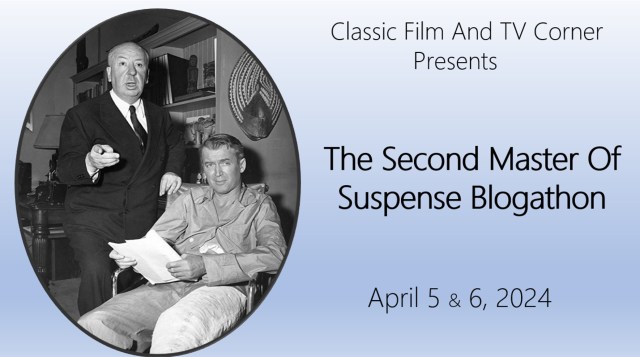
The Second Master Of Suspense Blogathon banner created by Maddy from Classic Film And TV Corner

What I didn’t like about the film:

Limited sense of urgency: Based on Alfred Hitchcock’s films I’ve seen, I’ve come to expect his stories to be filled with mystery and suspense. Because of these elements, I also expect a given story to contain a strong sense of urgency. While there were suspenseful, urgent moments sprinkled throughout The 39 Steps, these moments were not consistent. This made the story take its time being told instead of getting straight to the point sooner. During these suspenseful, urgent moments, there was no music playing in the background. A low amount of adrenaline and excitement was present in these moments partly due to the lack of music.

The “Insta-love” trope: In my recent review of Easter Parade, I explained what the “insta-love” trope was and why it was a major flaw in the 1948 movie. The “insta-love” trope was a major flaw in The 39 Steps as well. Richard and Pamela do not like each other. Even after being arrested, they continue to dislike one another. When they check into a hotel and pose as a married couple, Pamela and Richard’s dislike carries on. But hours later, they act like they’ve always been in a romantic relationship. The inclusion of the “insta-love” trope caused Richard and Pamela’s attraction to be abrupt, with the abruptness preventing on-screen chemistry between Robert and Madeleine.

An over-shadowed mystery: As I just mentioned in this review, I have come to expect stories filled with mystery based on Alfred Hitchcock’s movies I’ve seen. Because of those selected titles from Alfred’s filmography, I expect the mystery to be the story’s primary focus. In The 39 Steps, however, the story’s mystery was overshadowed due to the film’s creative team emphasizing Richard being on the run from the authorities. The mystery taking a backseat in the movie means the mystery itself wasn’t solved until the very end of the film. A longer wait time for answers causes The 39 Steps to feature a limited amount of intrigue.

Essentials of Scotland image created by macrovector_official at freepik.com. <a href=”https://www.freepik.com/free-photos-vectors/background”>Background vector created by macrovector_official – http://www.freepik.com</a>. Image found at freepik.com.

My overall impression:

Alfred Hitchcock has obtained a reputation for creating memorable productions. Whether it’s incorporating “modern” technology in The Birds or showcasing a pretty location in To Catch a Thief, Alfred’s movies have boasted his stamp of approval through various creative ideas. But out of Alfred’s films I have seen, and even reviewed, The 39 Steps is the most “meh” title from his filmography. The 1935 picture had such a limited sense of urgency and intrigue, I almost fell asleep while watching it. Richard and Pamela’s relationship was heavily affected by the “insta-love” trope, causing the relationship to feel like it belonged in a different film. This is a movie that seems longer than an hour and twenty-six minutes, creating a slow and boring build-up to a reveal that feels kind of ridiculous and anti-climactic. With all the flaws I discussed in this review, it’s a shame The 39 Steps turned out this way. That’s because there were aspects of this movie I liked, such as Robert Donat’s performance.

Overall score: 5 out of 10

Have you seen The 39 Steps? Are there any films of Alfred Hitchcock’s you like or don’t like? Let me know in the comment section!

Have fun at the movies!

Sally Silverscreen
Take 3: Argylle Review

Here at 18 Cinema Lane, “newer” theatrically released movies are rarely reviewed. One reason for this is how I have prioritized older films and made-for-TV productions. But since I recently saw Argylle, I found a good excuse to write about a “newer” theatrical film! The mystery genre is the most popular genre on 18 Cinema Lane, as I have stated before. While Argylle isn’t exactly a mystery film, it seemed to contain elements of mystery based on the movie’s marketing. The marketing also had a distinct color scheme and style, boasting argyle patterns in either blue or yellow. However, any fan of film would know it takes more than pretty looking marketing to make a good movie. All of the right pieces have to fall into place in order for a movie to not only be financially successful, but to also be acclaimed by both the critics and the audience. So, what are my thoughts on Argylle? Keep reading my review to find out!

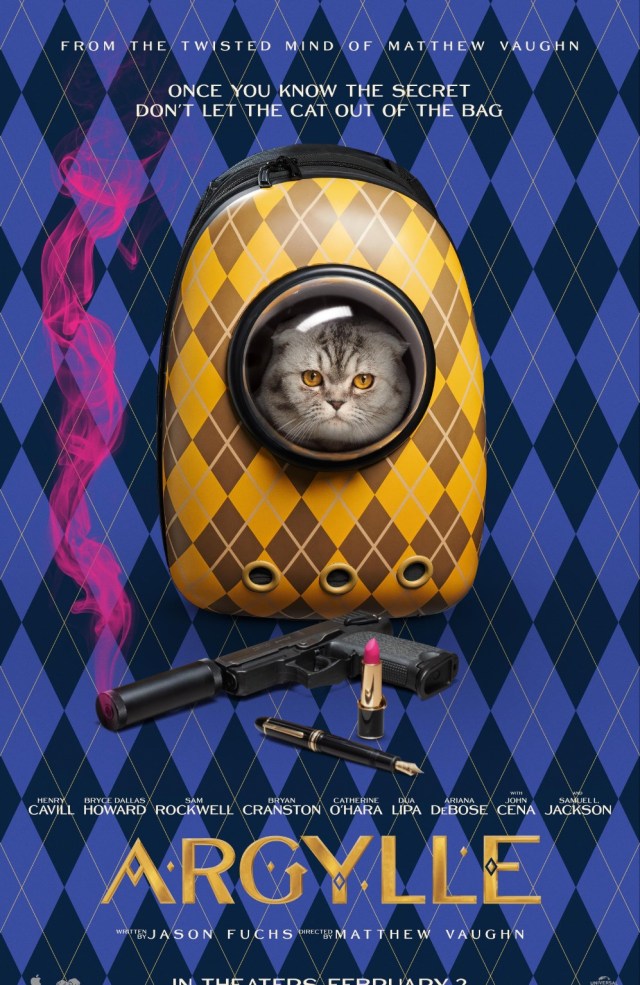
Argylle poster created by Apple Original Films, Marv Films, Cloudy Productions, Apple Studios, and Universal Pictures

Things I liked about the film:

The acting: When an actor or actress portrays a protagonist, what can work in their favor is bringing a sense of likability to their role. In Bryce Dallas Howard’s case, her portrayal of Elly presented a realistic looking performance that could make the audience feel empathetic for the story’s main character. A great example is when Elly takes her first plane ride. Due to her anxious feelings, she consistently taps and shakes her head while also shutting her eyes. She explains to Aiden how these physical gestures are intended to be a coping mechanism. Another example takes place when Elly is reunited with her cat, Alfie. When this reunification happens, Elly’s hands are shaking, a visually sign she was distressed over Alfie’s well-being.

Throughout Argylle, Elly interacts with Aiden. Portrayed by Sam Rockwell, Aiden had a laid-back personality and a dry sense of humor. Sam had nice on-screen chemistry with Bryce as well. A good scene between Elly and Aiden is during her aforementioned first plane ride. As Elly is trying to cope with her anxious feelings, Aiden helps Elly through her ordeal, calmly talking to her with a soothing tone of voice. He also gives her direct eye contact, emphasizing how he has Elly’s undivided attention. To me, this scene was one of the better scenes in Argylle, as the interaction between Aiden and Elly felt genuine!

Based on what I know about Bryan Cranston’s performances, he seems to, typically, be cast as characters that either have no-nonsense attitudes or a dry sense of humor. In Argylle, Bryan portrayed a character called Director Ritter. While Bryan consistently carried his character with a serious persona, there wasn’t much room in his performance for humor, as he portrayed an antagonist. Despite this, Bryan was expressive throughout the film! When he is frustrated by an agent’s mistake, Director Ritter has an irritated look on his face. He also has a stern look in his eye, indicating his bottled-up anger. More subtle expressions like this one worked in Bryan’s favor, allowing his character to have a distinct personality!

Fight choreography: Because Argylle is classified as an action film, there are a collection of action scenes scattered throughout the story. Several of these scenes involve choreographed fights between characters. The way the fights were choreographed was fluid and fast paced. The back-and-forth action between the characters sometimes felt like a ping pong game in motion. One such example is when Aiden fights multiple people on a moving train. As he goes from car to car, the ultimate fight continues. The adrenaline remained consistent in this scene, which helped it be an exciting moment in the film! The fight scenes in Argylle were also presented in creative ways. Different elements and materials were used to bring unique ideas to the big screen.

The allegories: Action movies aren’t typically known for having thought-provoking or creative writing. In Argylle, though, I was impressed by the incorporation of allegories! A scene that showcased a good example is when Elly and Aiden enter an empty room. Prior to this scene, Elly is told to write her next book as she and Aiden go along. Based on how I interpreted it, the empty room represented Elly’s writer’s block. The evidence that supports this claim is how, earlier in the story, Elly is experiencing difficulty writing another novel in her book series. An empty room is waiting to be furnished, just like a story is waiting to be told. While still in the empty room, Elly rips wallpaper off the walls. This, from my interpretation, was an allegory for a writer finding a breakthrough from their writer’s block!

Tools of a writer image created by Freepik at freepik.com. <a href=’https://www.freepik.com/free-photo/camera-and-coffee-near-notebook-and-accessories_2399437.htm’>Designed by Freepik</a>. <a href=”https://www.freepik.com/free-photos-vectors/vintage”>Vintage image created by Freepik</a>. Image found at freepik.com.

What I didn’t like about the film:

A drawn-out story: According to IMDB, Argylle has a run-time of 2 hours and 19 minutes. Though stories set at a little over two hours can be well paced and delivered, Argylle is drawn out. The problem was the creative team trying to satisfy their film’s run-time by placing an abundance of plot twists into their story. Most of these plot twists were effective. But I think a few of them could have been cut from the script.

Things that don’t make sense: There are moments in Argylle that don’t make sense the longer you think about them. One example is when Elly and Aiden are trying to locate someone. While sitting in a public park, Aiden and Elly do their research on Elly’s laptop. Meanwhile, antagonists are trying to locate Elly and Aiden, using technology at their disposal. Why would Elly and Aiden put themselves in a vulnerable position when they know the antagonists could easily figure out what they are doing?

Henry Cavill’s limited presence: In my review’s introduction, I briefly mentioned Argylle’s marketing. One aspect of this movie’s marketing was Henry Cavill’s inclusion. From what I remember, Henry was heavily featured in the marketing, making it seem like he was one of the film’s main stars. Even though his character, Argylle, was important in the story, Henry’s overall presence in the movie was limited. Without spoiling the film, I will say this limited presence was explained. However, this creative decision made Argylle’s marketing seem somewhat misleading.

Ice skating pair photo created by fxquadro at freepik.com. Image by fxquadro on Freepik

My overall impression:

When I chose to watch Argylle, I thought I had an idea what type of movie I was about to watch. While I was correct on some aspects, there were surprises along the way. A few of these surprises were the allegories sprinkled throughout the story and the abundance of plot twists. Out of the expected elements of the movie, Argylle had its strengths; from the acting performances to the fight choreography. But the film does have its flaws. Some of them range from having a drawn-out story to presenting misleading marketing. In my opinion, though, Argylle was an exciting, enjoyable picture! It won’t become one of the best movies of the year. But the film was, for me, a memorable experience!

Overall score: 7.2 out of 10

Have you seen Argylle? Which 2024 movie releases are you looking forward to? Let me know in the comment section!

Have fun at the movies!

Sally Silverscreen
Take 3: Cape Fear (1962) Review

Happy Halloween to all my followers and readers! Like last year, I am participating in the Spooky Classic Movie Blogathon! For the first event, I reviewed 1953’s House of Wax, a movie I enjoyed. This time around, I’m reviewing the 1962 film, Cape Fear! When it comes to choosing which movie to watch around Halloween-time, the usual selections with fictious monsters, ghost stories, and haunted tales are preferred. But in my opinion, the most effective “scary movies” are the ones that involve real-life situations. In Cape Fear, a former prisoner seeks revenge against the lawyer who testified against him. This synopsis alone sounds more realistic and terrifying than even those scary movies that are considered “classic”. But is this movie as terrifying as it sounds? The only way to find out is if you keep reading!

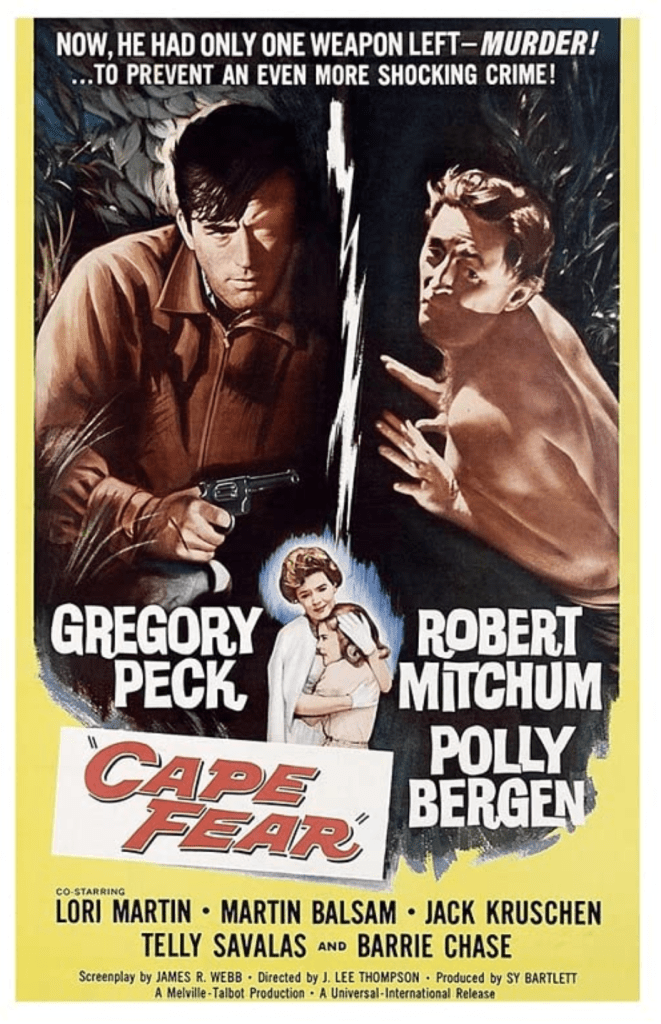
Cape Fear (1962) poster created by Melville Productions, Talbot Productions, and Universal Pictures

Things I liked about the film:

The acting: Before watching Cape Fear, I had seen and reviewed Heaven Knows, Mr. Allison. One of the best aspects of that film was Robert Mitchum’s performance. In the 1962 movie, Robert’s portrayal of Max Cady stole the show! As a character, Max was a creepy and gross fellow. This was made possible through Robert’s facial expressions, body language, and dialogue. In Max’s first scene with Sam, there is a twinge of anger in Max’s voice. But his demeanor was controlled by a sense of calm. The combination of anger and calm within Max Cady added to the character’s unsettling nature. Another actor that effectively balanced two emotions was Lori Martin! In a scene that takes place after a family emergency, Lori’s character, Nancy, appears calm. Yet, she can be seen crying as she talks to her mother in an angry tone. Without spoiling anything, Nancy did have a legitimate reason to be both sad and angry. But I found this performance impressive, especially for an actress so young!

I’ve seen and reviewed To Kill a Mockingbird and Amazing Grace and Chuck. Based on these two movies, it seems like Gregory Peck gets type-casted as either a lawyer or a politician. While he portrays a lawyer in Cape Fear, the script emphasized how his character is a family man. Like the aforementioned movies, Gregory carried his character, Sam, with professionalism and classiness. At the same time, he was given plenty of opportunity to express emotion. A great example is when Sam meets Max at a nearby restaurant. As Max is telling his story, Sam grows increasingly angry. This scene highlights the fierce protectiveness of a husband and a father. It also gave a sense of realism to Gregory’s character!

The music: Legendary composer Bernard Herrmann provided the music for Cape Fear. Throughout the film, his signature musical style could be consistently heard. Bernard’s strength is using music to elevate the suspense within a given scene.  At the very beginning of the movie, Max is walking through the town as an ominous tune can be heard in the background. This effectively clued the audience in of what would come later in the story.  It also let the audience know to pay attention to Max. With all that said, the music definitely added something special to the overall project!

The cinematography: I was not expecting the cinematography in Cape Fear to be as memorable as it was! It, honestly, reminded me of pictures directed by Alfred Hitchcock! One of my favorite scenes is when Peggy, Sam’s wife, has a dream about her and Sam. While Peggy is sleeping, ghostly images of her and Sam are presented over the main image. These images reveal their concerns over the movie’s events, as well as emphasize their desire for action. This way of presenting dialogue and character interactions was very interesting. It added a sense of spookiness to an already suspenseful story!

2nd Annual Spooky Classic Movie Blogathon banner created by Kristen of Hoofers and Honeys

What I didn’t like about the film:

An exposition heavy beginning: Within the first twelve minutes of Cape Fear, the audience learns about Sam Bowden, his family, Max Cady, his arrest, and why he was arrested. Personally, I felt this was too much information to present in the film’s beginning. In fact, I was disappointed Max’s secrets were revealed so soon. What the screenwriter should have done was sprinkle this information throughout the story. That way, the audience would have a greater reason to stay invested in the mystery.

Dumb decisions from the characters: After a family emergency involving a dog, Sam warns his wife and daughter of Max’s dangerous nature. He instructs his daughter, Nancy, to only leave school and home with either him or his wife, Peggy. But more often than not, Nancy is left by herself, with Sam and Peggy putting her in a vulnerable position. One example is when Nancy gets out of school to find her mother’s car empty. While waiting in the car, Nancy sees Max and attempts to get away from him. Even though she succeeds in this plan, she ends up getting hit by an oncoming car in the process. I know her parents are human and humans make mistakes. However, these mistakes felt unbelievable after some time.

An unrelated court case: Featured in a few scenes, a court case involving an arthritic patient receiving surgery was addressed in Cape Fear. But the only connection this case had with the rest of the story was Sam as one of the associated lawyers. I wish the case had a more significant reason to be in the film. Maybe it could have something to do with Max’s past crime, with two separate mysteries becoming one. I, honestly, wanted to learn more about that case, but was sadly not given the chance.

Scared audience image created by Katemangostar at freepik.com. <a href=’https://www.freepik.com/free-photo/terrified-friends-watching-horror-movie-in-cinema_1027311.htm’>Designed by Freepik</a>. <a href=”https://www.freepik.com/free-photos-vectors/people”>People image created by Katemangostar – Freepik.com</a>. Image found at freepik.com.

My overall impression:

As I said in my introduction, the most effective “scary movies” are the ones that involve real-life situations. Even though this is a fictional story, it is effective at being a scarier film! Max Cady is one of the most unsettling characters in film, with Robert Mitchum’s acting abilities highlighting the reason why. Come to think of it, this performance showed a different side to Robert’s talents. Bernard Herrmann’s music added to the scary nature of the story, emphasizing the suspense within the script. But the multiple dumb decisions of the characters took away some from the film’s believability. The beginning of the film was also exposition heavy. However, the overall production felt like an Alfred Hitchcock picture without actually being affiliated with Alfred Hitchcock. With this said, I’d recommend Cape Fear as your next pick for Halloween!

Overall score: 7.5 out of 10

Have you seen Cape Fear? Which movie would you watch on Halloween? Tell me in the comment section!

Have fun at the movies!

Sally Silverscreen

Take 3: The Wrong Cheerleader Coach Review

Anyone who has followed or read my blog would know that Lifetime movies are rarely reviewed. In fact, the last time I wrote about a film from Lifetime was Killer Prom back in May. This is because I don’t always find the time to include this network’s projects into my blogging schedule. But since I just watched The Wrong Cheerleader Coach, I decided to review this film before the 1st Annual Classic Movie Blogathon and Halloween. It seems like Lifetime has created a series where an unstable woman tries to bring chaos into the lives of those around her, with her occupation included in the film’s title. One of these films is The Wrong Wedding Planner, which I was not a fan of. Since cheerleading, a sport that I like, would play a role in the story of The Wrong Cheerleader Coach, I chose to watch this movie with an open mind. Cheer me on as I share my thoughts on one of Lifetime’s most recent titles!

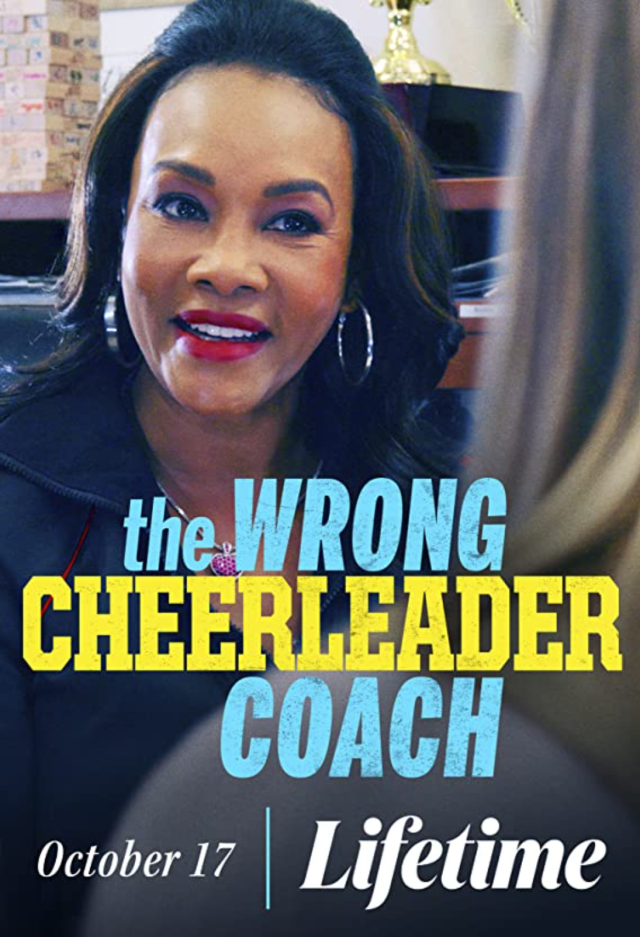
The Wrong Cheerleader Coach poster created by Lifetime Entertainment Services. 

Things I liked about the film:

The acting: Johanna Liauw is an actress I’m not familiar with. Despite this, I thought she stole the show in The Wrong Cheerleader Coach! Portraying the assistant coach, Devan, Johanna’s emotions were very fluid. A scene where Devan is eating dinner at Jon and Hanna’s house shows a perfect example of this. While eating her meal, Devan is happily enjoying her food and comfortable with spending time in their home. When Jon forces her to leave, Devan’s demeanor quickly changes, anger and discontent bursting forth. Corin Nemec’s performance is another one I liked seeing! Certain behaviors his character, Jon, adopted highlight how he experienced certain situations. One of these behaviors is when he takes his glasses off and puts them back on. This action effectively shows the audience how the stress of moving cross-country, raising a daughter on his own, and being the bread-winner of the family is visualized through a nervous habit. Even though she was in the film for a short amount of time, I enjoyed Mea Wilkerson’s portrayal of Hanna’s new friend, Claire! Mea’s on-screen personality is what made her character likeable. It also helped that Claire was the “voice of reason”, displaying skepticism and concern when interacting with the other characters. These factors made me feel that Claire truly had Hanna’s best interests in mind throughout their friendship!

The on-screen chemistry: While Jon is at work at a construction site, he meets a fellow architect named Melissa, who is portrayed by Bailey Kai. Their similarities in occupation and other areas in life bring them together. While I liked Corin’s individual performance, I liked Bailey’s performance as well. I also feel they both had good on-screen chemistry! Corin and Bailey’s personalities paired nicely with one another, giving the audience the impression their characters truly enjoyed each other’s company. This on-screen relationship also contained a brightness that served happier moments within the plot’s darkness. Seeing Jon and Melissa’s relationship unfold gave the audience a break from the story’s suspenseful nature.

The music: In most Lifetime movies, I find the music to be unmemorable or average. This is not the case for The Wrong Cheerleader Coach! During cheerleading practices, pop-techno music can be heard in the background. These musical selections were not only good to listen to, but I honestly wouldn’t change the channel if they played on the radio! When Melissa and Jon are on a dinner date, soft piano served as the scene’s official tune. It set the tone for that moment and fit within the scene’s context. Suspenseful scenes were also given music, as dramatic tunes were heard anytime a scarier situation took place. It certainly added intensity to those moments.

Cheerleading squad image created by Macrovector at freepik.com. Background vector created by macrovector – www.freepik.com

What I didn’t like about the film:

Very little cheerleading: With a film called The Wrong Cheerleader Coach, you’d think there would be a significant amount of cheerleading shown in the movie. But, in reality, this title actually featured very little cheerleading. Sure, a few stunts and practices can be seen. However, the sport itself felt more like an afterthought than a prominent part of the story. This film could have featured almost any athletic extracurricular activity and it wouldn’t make much of a difference.

A somewhat misleading title: Because of the film’s title and because Vivica A. Fox is the only cast member shown on the movie’s poster, it gives the audience the idea that Vivica’s character is the one the title is referring to. When the audience sees the film, they discover the title is actually referring to Devan, the assistant coach. By definition, Devan’s role is to assist Coach Burke, who is the head coach of the cheerleading team. This led to the result of showing Devan doing very little coaching. These factors also cause the film’s title to seem somewhat misleading.

Vivica A. Fox’s limited presence: In my One Christmas review, I talk about how Katharine Hepburn appears in the movie for a short amount of time despite being the top billed actor of the project. It felt like this decision did a disservice to Katharine’s talents, as well as the overall movie. The same thing happens with The Wrong Cheerleader Coach. This time, Vivica A. Fox is the top billed actor of the film. However, the actress who portrays Devan, Johanna Liauw, receives more screen and story time than Vivica does. Vivica did a good job with the acting material she was given. But if it was always The Wrong Cheerleader Coach’s creative team’s plan to cast Vivica as their top billed actor, they should have given her more material to work with.

Breaking heart image created by Kjpargeter at freepik.com. <a href=’https://www.freepik.com/free-vector/broken-heart-valentine-background_1041991.htm’>Designed by Freepik</a>. <a href=”https://www.freepik.com/free-photos-vectors/background”>Background vector created by Kjpargeter – Freepik.com</a>. Image found at freepik.com.

My overall impression:

The Wrong Cheerleader Coach and Killer Prom share one thing in common: both films are given an interesting concept. However, because Lifetime creates so many movies in a given year, the network creatively sells themselves short. This causes these interesting concepts to not reach their full potential. The Wrong Cheerleader Coach could have incorporated a glimpse into the pressures of being “perfect” and/or a student athletic representative of a school. Instead, the story focused on Devan’s growing attraction for Jon. This type of narrative is very typical for Lifetime, even finding a place in Killer Prom. As I’ve said about Hallmark, I’d like to see Lifetime step out of their comfort zone and use different story-telling techniques for future movies. One example would be including thought-provoking ideas that encourage viewers to think about the film long after they’ve seen it. This would help these projects stand out for a longer period of time.

Overall score: 7 out of 10

Do you watch Lifetime movies? Is there one that has been your favorite? Please tell me in the comment section!

Have fun at the movies!

Sally Silverscreen
Take 3: Killer Prom Review

It’s been two years since I last reviewed a film from Lifetime. In 2018, I talked about the remake of The Bad Seed. I ended up liking the movie more than I thought I would. Since then, I haven’t gotten around to reviewing any of Lifetime’s films. Yesterday, I saw a newer release titled Killer Prom. What caught my attention was the synopsis. The idea of a mystery/thriller revolving around prom is something I had never seen Lifetime do before. As I’ve said in the past, I have never seen a movie about the prom that was actually good. So, I was hoping Lifetime would finally deliver a good prom movie. Reviewing this movie now is also quite fitting, as prom season would normally take place around this time. But, because of the Coronavirus, proms all over the United States were cancelled.

20200506_113057[1]
In case you’re wondering, this is a screenshot of the film’s poster that I took with my phone. Screenshot taken by me, Sally Silverscreen.
Things I liked about the film:

The acting: When I reviewed The Crow, I mentioned how, through his performance, Michael Wincott was able to show how manipulative Top Dollar can be. To an extent, Yvonne Zima’s portrayal of Sienna reminded me of Michael’s portrayal of Top Dollar. This was because Yvonne was able to use various emotions to make her character appear chameleon-like. With a sinister tone included, Sienna was unsettling to watch on screen. In films like Killer Prom, it can be easy for a young actor or actress to be told or directed to act in a way that makes their teenage character come across as stereotypical. What I liked about Erica Anderson’s portrayal of Maya is how realistic the character seemed. Erica, along with the screen-writing, did a good job at presenting the character as likable with a bit of angst. This made it easy for me to root for Maya!


The Wilson family’s house: Most of the movie takes place at the Wilson family’s house, as Sienna stays with the Wilsons for a certain period of time. This location was visually appealing because it had a consistent and photogenic style throughout the space! The exterior architecture was modern with a white and gray color scheme. Inside the house, this style was reflected in various rooms. The kitchen was also white and gray, appearing sleek with its shiny cabinets and stainless-steel appliances. While this color scheme and style is shown in other areas of the house, certain design choices catch the viewer’s eye. The first is the use of circles, from the circle shaped mirrors on a wall to the “bubble lights” over a dining room table. The second was the splash of blue in the artwork and the sofa’s pillows. Choices like these make these spaces interesting to look at!


The dream prom sequences: At various moments in the film, dream sequences are projected from Sienna’s mind. These dreams showcase her idea of prom. The scenes are presented with a faded lens that makes the images look softer, but not too blurry. The lights are dim and there is a sparkly curtain in the background. Because of these elements, it gave off a vibe that would have belonged in the ‘80s or ‘90s. Because these dream sequences are coming from a character who is reflecting on a time gone by, the appearance of this vibe makes sense.

students-prom-1498151-1280x1172
Image of high school students dancing at prom created by Jan Sundstedt at freeimages.com. Photo by <a href=”/photographer/jansun-33414″>Jan Sundstedt</a> from <a href=”https://freeimages.com/”>FreeImages</a&gt;. Image found at freeimages.com.

What I didn’t like about the film:

A formulaic plot: When I read the synopsis, I was led to believe the protagonist would either volunteer on her former high school’s prom committee or chaperone at the school’s prom in an attempt to live out her dream prom experience through the students. In reality, Killer Prom is an “unstable-person-trying-to-insert-themselves-in-someone-else’s-life” story. This kind of story is as common on Lifetime as the “woman from the city coming back to her small hometown” cliché is on Hallmark; if you’ve seen one, you’ve seen them all. Because of the formulaic nature of the plot, it made the story more predictable than it needed to be.


The under-utilization of prom: Since this movie is called Killer Prom, I was expecting this event to play a significant role in the overall narrative. Sadly, it was treated as an afterthought. While it was mentioned on several occasions and preparations are made for the event, the prom itself is never shown on screen. Instead, more emphasis was placed on Sienna’s attempts to win over Maya’s dad, Tony. It felt like the prom was placed in the story for the sake of having an event take place in the plot.


Sienna’s backstory: In movies like Killer Prom, the villainous character is given a backstory to explain who they are and why they make certain choices. The build-up toward Sienna’s backstory was leading me to believe it would be memorably traumatic and shocking. When this was finally revealed, it felt no different from any other villainous backstory Lifetime has presented before. The pay-off this backstory was building up to was very under-whelming. If anything, Sienna’s backstory could be summarized in a sentence or less.

close-up-pink-dress-flower-arm-hand-1576956-639x958
Image of prom boutonniere created by Cynthia Lutes at freeimages.com. Photo by <a href=”/photographer/cindylutes-60975″>Cynthia Lutes</a> from <a href=”https://freeimages.com/”>FreeImages</a&gt;. Image found at freeimages.com.

My overall impression:

In the introduction, I said I have never seen a movie about the prom that was actually good. Unfortunately, Killer Prom isn’t going to change that. At best, this is a fine, run-of-the-mill Lifetime movie. I found the overall story intriguing enough to hold my interest. But, at worst, it is a formulaic story with a new coat of paint. I was hoping the concept of prom would serve as commentary for how a person’s experiences in high school can shape their overall perspective. This unique creative decision was not chosen, as it seemed like the network emphasized formula over creativity. It’s a shame, because it could have made the project thought-provoking. If any other event had been placed in this movie, it wouldn’t make a difference. Guess I have to go back to square one in my search for a good prom movie.


Overall score: 7 out of 10


Do you watch Lifetime’s movies? Would you like to recommend any of their films to me? Share your thoughts in the comment section!


Have fun at the movies!

Sally Silverscreen