Take 3: Anna and the King Review

I know what you’re thinking, “What does Anna and the King have to do with the number five”? Well, I’m glad you asked! As Rebecca has stated in the announcement post for the Fifth Broadway Bound Blogathon, all entries had to have something to do with the number five, to commemorate the event’s fifth anniversary. For my selection, Anna and the King, which stars Bai Ling, was released in 1999, five years after The Crow premiered. From what I’ve heard, The Crow was Bai Ling’s first American/English film. Last year, when I reviewed the 1956 adaptation of The King and I, I mentioned Anna and the King was a non-musical version of the story. As I write this review, I realize I haven’t seen many non-musical film adaptations of musicals. Sure, I’ve heard of these types of productions. But, off the top of my head, a non-musical adaptation doesn’t immediately come to mind. So, with this review, I will expand my cinematic horizons!

Anna and the King poster created by Fox 2000 Pictures, Lawrence Bender Productions, and 20th Century Fox

Things I liked about the film:

The acting: Anna and the King is a drama film with a more serious tone. Therefore, Jodie Foster’s portrayal of Anna is sterner in nature. However, Anna also comes across as being fair. A great example of this is when she is disciplining both her son and King Mongkut’s eldest son. In the evening, when the royal family is bringing Anna dinner, Jodie presents a mild-mannered sweetness that feels genuine. As she’s realizing the dinner is for her and not King Mongkut’s son, Anna never displays any meanness toward her student, as she truly wants to teach him a valuable lesson. King Mongkut himself is also a stern, yet fair character. Chow Yun-fat balances the seriousness and loving sides of his character consistently throughout the film. In one of their many conversations, King Mongkut is asked by Anna if his wives ever get jealous of one another. Even though this question is a personal one, King Mongkut never appears offended. Instead, his calm, collected, and approachable demeanor make the conversation less awkward than it could have gotten. One of these aforementioned wives is Tuptim. Portrayed by Bai Ling, Tuptim is an emotional character that expresses herself in subtle ways. It’s not until she faces a life-or-death moment where more of her emotions are drawn forward. While I won’t spoil Anna and the King for those of my readers who might be interested in seeing it, Bai delivers on the emotional intensity needed for a moment like the one I just mentioned. But even outside of that moment, Bai knows how to use emotion in her and her character’s favor.

The set design: Anna and the King is a beautiful looking film! One of the reasons why is its set design. Everywhere you look, exquisite detail and impressive structure helped elevate the world around Anna and King Mongkut. The royal family takes a trip in a massive river boat. This boat was a deep blue with gold etched artwork. At the head of the boat, a set of giant golden dragons adorn this beautiful mode of transportation. On the walls of King Mongkut’s palace, a full-length mural consistently coats the interior perimeter of rooms and even a hallway. The mural itself appears painted, depicting the natural landscape of Siam. Smaller elements like the ones I mentioned added to the overall beauty of the set design!

The costume design: Similar to the 1956 adaptation, the costume design in Anna and the King was simply elegant! One notable example was Anna’s reception gown. At this event, Anna wore a full length, white gown. The off the shoulder bodice and sparkly skirt was not only eye-catching, it also felt reminiscent of Belle’s gown from the 1991 animated film, Beauty and the Beast. At this same reception, King Mongkut’s wives also wear beautiful gowns. Tuptim’s was especially pretty, a simple yet classy red dress. What also complimented Tuptim’s ensemble was a sparkly gold and bronze crown that adorned her dark hair. The exquisiteness of the costume design carried the spirit of The King and I story!

The Fifth Broadway Bound Blogathon banner created by Rebecca from Taking Up Room

What I didn’t like about the film:

The war story-line: Because Anna and the King is a non-musical version of The King and I, there needs to be something to replace the musical numbers. In the 1999 adaptation, that replacement was a subplot about a war between the Siamese and the Burmese. While it was interesting to explore the tense side of ruling a country, I found this subplot to be the weakest one. That subplot was drawn-out, getting resolved at the very end of the movie. With the run-time being two hours and twenty-eight minutes, the war story-line felt longer than it really was.

Under-utilized characters: Anna and the King contains a larger cast of characters. Therefore, some of them are bound to receive less screen-time than others. Tuptim was, once again, one of those characters. After seeing how under-utilized Rita Moreno’s talents were in the 1956 adaptation, I was hoping Bai Ling would receive more screen time. Sadly, she only appeared in a handful of scenes. In the 1956 adaptation, Tuptim created a play based on Uncle Tom’s Cabin, giving her a reason to stay on screen a little bit longer. Because there is no Uncle Tom’s Cabin play in the 1999 adaptation and because only King Mongkut’s oldest son reads Uncle Tom’s Cabin, Tuptim, in Anna and the King, has less reasons to stay on screen.

No musical Easter eggs: Before I wrote this review, I was well aware Anna and the King was not a musical film. But because the film is an adaptation of a musical, it was a missed opportunity to not include musical related Easter eggs. In the 1956 adaptation, King Mongkut says “Et cetera, et cetera, et cetera” on multiple occasions, whenever he had something important to say. In the 1999 adaptation, however, King Mongkut never says the aforementioned quote. One of the songs from the 1956 adaptation is ‘Shall We Dance?’. During both versions of this story, King Mongkut and Anna dance with one another. However, it would have been nice to hear one of them say “shall we dance.”
Hand-written letter image created by Veraholera at freepik.com. <a href=”https://www.freepik.com/free-photos-vectors/background”>Background vector created by Veraholera – Freepik.com</a>. <a href=’https://www.freepik.com/free-vector/love-letter-pattern_1292902.htm’>Designed by Freepik</a>. Image found at freepik.com.

My overall impression:

Anna and the King is a fine, competently made film. The movie’s creative team clearly knew what they doing, displaying the clear direction they wanted to take their adaptation. But compared to the 1956 musical, I find myself liking the musical more. Without the musical numbers, it feels like the story is missing something. Even though the 1999 adaptation found a replacement for the lack of musical numbers, I was wishing they hadn’t been omitted. I would have even accepted Easter eggs related to the musical, such as quotes from the songs woven into the dialogue. But despite its shortcomings, Anna and the King does attempt to make meaningful changes that were not in the 1956 musical. One of these changes is giving Anna’s son, Louis, and some of King Mongkut’s children their own unique personalities and a little more involvement in the overall story. As for Bai Ling’s involvement in the film, I wish she was given more on-screen appearances. But because Anna and the King is based on The King and I, which also showed Tuptim in only a handful of scenes, maybe I was naïve to think more material was available?

Overall score: 7.2 out of 10

Have you seen Anna and the King or The King and I? Can you think of any musicals that received a non-musical adaptation? Let me know in the comment section!

Have fun at the movies!

Sally Silverscreen

The Winners of The 4th Annual Gold Sally Awards + the Future of the Gold Sally Awards

Since 2019, I created the Gold Sally Awards. What was once a way to recognize the best Hallmark had to offer, it evolved into a series of polls highlighting the films covered or discussed on 18 Cinema Lane. In the beginning, voter turn-out was strong. The polls served their purpose of allowing readers to interact with my blog’s content. But as time went on, voter turn-out dwindled. There were times when I’ve had to select the winners because a particular poll didn’t receive any votes. With all that said, I will continue the Gold Sally Awards. But starting next year, there will no longer be voting polls. Instead, I am going to create separate, individual awards that are more unique/creative/fun. Now that this update is out of the way, it’s time to announce the winners of this year’s Gold Sally Awards!

Similar to last year, I created a collage on PowerPoint of this year’s winners. Screenshot taken by me, Sally Silverscreen.

Best Movie: The King and I

Best Story: The Three Musketeers

Best Ensemble: The Karate Kid

Best On-Screen Couple: Marshall Williams and Natalie Hall — Sincerely, Yours, Truly

Best Actress: Janel Parrish – Holly & Ivy

Best Actor: Marshall WilliamsSincerely, Yours, Truly

Best Supporting Actress: Jean Porter – Bathing Beauty

Best Supporting Actor: Robert Mitchum – Cape Fear

Sally’s Star of the Year: Bai Ling

Have fun at the movies!

Sally Silverscreen
The Gold Sally Awards is back with On-Screen Couple and Best Ensemble Polls!

Hi everyone! The Gold Sally Awards is almost over! In these polls, you will have the chance to vote for the Best On-Screen Couple and Best Ensemble. Both polls will begin today, on May 25th, and end on June 1st. While you can vote for more than one nominee, you can only vote once per person. The link to the polls will be located under each poll. Just click on the word ‘Poll Maker’.

Who is the Best On-Screen Couple of 2021?


1. Candace Cameron Bure and Niall Matter — Aurora Teagarden Mysteries: Til Death Do Us Part
2. Daniel Brühl and Natascha McElhone — Ladies in Lavender
3. Ralph Macchio and Tamlyn Tomita — The Karate Kid Part II
4. William R. Moses and Alex Datcher — Perry Mason: The Case of the Telltale Talk Show Host
5. Marshall Williams and Natalie Hall — Sincerely, Yours, Truly
6. John Moulder-Brown and Lynne Frederick — Vampire Circus
7. Janel Parrish and Jeremy Jordan — Holly and Ivy
8. Francis Huster and Geneviève Bujold — Another Man, Another Chance
9. Fredric March and Janet Gaynor — A Star Is Born (1937)
10. Jesse Metcalfe and Sarah Lind –Poisoned in Paradise: A Martha’s Vineyard Mystery
Created with Poll Maker
What is the Best Ensemble of 2021?


1. The Karate Kid (1984)
2. The Three Musketeers (1948)
3. The Love Letter
4. Perry Mason: The Case of the Telltale Talk Show Host
5. Sincerely, Yours, Truly
6. Rigoletto
7. Holly and Ivy
8. The King and I (1956)
9. A Star Is Born (1937)
10. Poisoned in Paradise: A Martha’s Vineyard Mystery
Create your own Poll Maker

Have fun voting!

Sally Silverscreen

Gold Sally Awards Returns with the Best Supporting Actor and Actress Polls!

Hello everyone! The Gold Sally Awards’ polls are back! This time, you get to choose who will be crowned best supporting actor and actress of the year. Both polls will begin today, on April 1st, and end on April 8th. While you can vote for more than one nominee, you can only vote once per person. The link to the polls will be located under each poll. Just click on the word ‘PollMaker’.

Who is the Best Supporting Actor of 2021?


1. Noriyuki “Pat” Morita — The Karate Kid (1984)
2. Van Heflin — The Three Musketeers (1948)
3. Jeff Conaway — Making of a Male Model
4. William R. Moses — Perry Mason: The Case of the Telltale Talk Show Host
5. Anthony Hopkins — The Elephant Man
6. John Huntington — Rigoletto
7. Robert Mitchum — Cape Fear (1962)
8. Booboo Stewart — Let Him Go
9. Andy Devine — A Star Is Born (1937)
10. Reilly Dolman — Poisoned in Paradise: A Martha’s Vineyard Mystery
Created with PollMaker
Who is the Best Supporting Actress of 2021?


1. Marion O’Dwyer — Chasing Leprechauns
2. Jacqueline Chan — The World of Suzie Wong
3. Lesley Manville — Let Him Go 
4. Alex Datcher — Perry Mason: The Case of the Telltale Talk Show Host
5. Jean Porter — Bathing Beauty
6. Tracey Williams — Rigoletto
7. Marisol Nichols — Holly and Ivy
8. Rita Moreno — The King and I (1956)
9. Lori Martin — Cape Fear (1962)
10. Nhi Do — Poisoned in Paradise: A Martha’s Vineyard Mystery
Created with PollMaker

Have fun voting!

Sally Silverscreen

Take 3: The King and I (1956) Review

For the Fourth Broadway Bound Blogathon, I chose to review the 1956 version of The King and I! Years ago, I had seen the 1999 animated adaptation of the musical. Since I vaguely remember it, I can’t provide an honest opinion of that movie. Because I had only seen pieces of the 1956 film and because it was recommended to me by Maddy from Maddy Loves Her Classic Films, I now found a good excuse to finally check the film out! While I knew the play itself was successful, I was surprised to discover it had won a Tony award. As this year’s blogathon focuses on Tony winners, it gave me an opportunity to learn something new. This is one of the reasons why I love participating in blogathons! Now, let’s start this review of 1956’s The King and I!

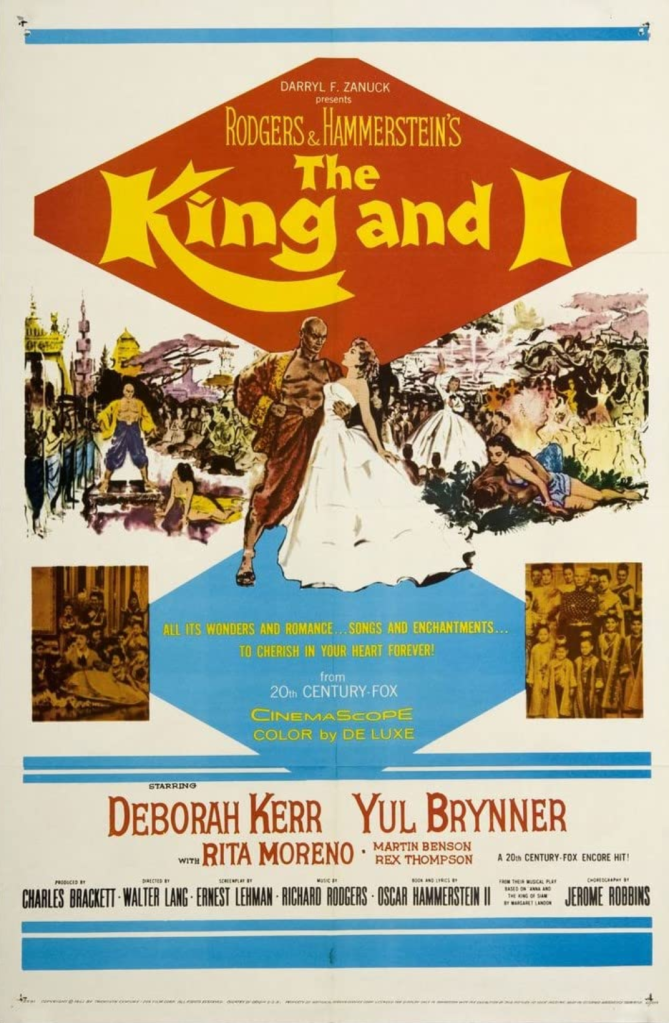
The King and I (1956) poster created by 20th Century-Fox.

Things I liked about the film:

The acting: Deborah Kerr is a dramatic actress, as her strengths can be seen in drama films. Because there were plenty of dramatic moments in The King and I, this allowed the best of Deborah’s acting abilities to be placed on display! In scenes that allowed Anna to stand up to King Mongkut, Deborah adopts a serious persona without any sarcasm. Her tone of voice is stern, while also standing up straight and looking directly at King Mongkut. Because there were light-hearted moments as well, it gave Deborah an opportunity to incorporate humor into her performance. This balance made the role suit Deborah well! This is the first time I had ever seen any of Yul Brynner’s performances. However, I was quite impressed by his portrayal of King Mongkut of Siam! Similar to Deborah Kerr’s role, there was a good balance of drama and comedy. In a scene where King Mongkut is talking to his son about what he learned in school, Yul speaks with a serious tone of voice. He also moved around the set with a posture that reflects his character’s royal power. However, when he introduced Anna to his children, King Mongkut would make silly faces in order to get them to smile. Before watching The King and I, the only film of Rita Moreno’s I had seen is West Side Story. Because of this, it was interesting to see Rita work with different material. While Anita, Rita’s character in West Side Story, is sassy and confident, Tuptim is more reserved and sensitive. When Rita didn’t have speaking lines, facial expressions and body language helped convey what Tuptim was thinking. As I liked her portrayal of Tuptim, it makes me wish Rita had appeared in more scenes.

The musical numbers: A musical is only as good as its musical numbers. With The King and I, I found the musical numbers to be entertaining! The most interesting one is the Siamese interpretation of Uncle Tom’s Cabin. Because Tuptim is reading a copy Anna gave her, she decides to write a play based on her own version of the novel. This particular number features traditional dancing, stylized face masks, and practical effects, such as a white sheet representing ice. It served as a good example of how everyone can view a text differently. The rest of the musical numbers in The King and I ranged from dramatic to comedic. One of them is ‘Getting to Know You’. In this scene, Anna dances with one of King Mongkut’s wives. Some of the children circled around their mother in order to mimic Anna’s skirt. This was a simple way humor was incorporated into some of the musical numbers.

The costume design: The King and I is known for being an elaborate musical, with elegance being found within the costume design. Bright colors were worn by almost all the characters. In a scene where Anna is introduced to King Mongkut’s children, the children’s outfits featured hues of pink, red, and green. The members of the royal family sometimes wore plaid, which complimented the rich color palette of the movie. Metals like gold could also be seen in the royal family’s attire. Some of King Mongkut’s jackets featured gold embroidery, a reminder of his wealth and affluence. Bronze coated the children’s headpieces as well. With the costume design being so exquisite, I wonder how much of this movie’s budget was devoted to it?

The Fourth Broadway Bound Blogathon banner created by Rebecca from Taking Up Room.

What I didn’t like about the film:

The under-utilization of Rita Moreno: As I mentioned earlier, the only film of Rita’s I had seen is West Side Story. Therefore, I was looking forward to seeing her performance in The King and I. I was disappointed to see Rita’s talents under-utilized. In this two hour and thirteen-minute movie, Rita appeared in a handful of scenes. While she did participate in the story’s musical components, she was only given one duet and the narration during the Uncle Tom’s Cabin play. I understand The King and I was released five years before West Side Story. But if the 1961 film has taught me anything, it’s how Rita is, talent wise, capable of so much more.

Drawn out storylines: The storylines in The King and I were drawn out because of the film’s two hour and thirteen-minute run-time. King Mongkut’s story, where he attempts to save his reputation, is one example. For about half the movie, King Mongkut wants to prevent other world leaders from thinking he is “barbaric”. Since this particular storyline lasted for so long, the resolution/payoff was fine, but somewhat anti-climactic. Lun Tha and Tuptim’s storyline took place throughout the whole movie. However, by the end of the film, it was left unresolved. It makes me wonder if it would have been resolved if The King and I’s run-time had been shorter?

Songs interrupting the story: In a typical musical, the musical numbers help progress the story forward. But in The King and I, the musical numbers interrupt the over-arching story, causing the transition between story and song to feel less seamless. After an elegant party at the palace, King Mongkut discovers Tuptim is missing. King Mongkut’s search is disrupted by Anna singing ‘Shall We Dance?’. This then turns into a private dance between Anna and King Mongkut, which is interrupted by a guard. The guard informs King Mongkut that Tuptim has been found. Moments like this one cause the story to pause for the sake of a musical number.

String of musical notes image created by Freepik at freepik.com. <a href=’https://www.freepik.com/free-vector/pentagram-vector_710290.htm’>Designed by Freepik</a> <a href=”https://www.freepik.com/free-photos-vectors/background”>Backgroundvector created by Freepik</a>. Image found at freepik.com.

My overall impression:

So far, I have seen four of Deborah Kerr’s movies. Out of those titles, I’d say The King and I is her best one! As I said in my review, the material complimented her acting abilities. There was enough drama to show off her strengths, while also having enough comedy to let Deborah have fun with the role. The film gave me a chance to see interesting performances and musical numbers, from Rita’s portrayal of Tuptim to a Siamese interpretation of Uncle Tom’s Cabin. The exquisite costume design and sets are definitely photogenic, highlighting the wealth and power within the royal family. Even though the movie as a whole is good, there are musicals I would choose over it. The songs interrupting the story instead of progressing it forward is one reason why I feel this way. I’ve heard Anna and the King is a non-musical version of this particular story, so I’d be interested in seeing how lack of musical numbers affects the overall story-telling. I’d also be interested in watching Deborah Kerr and Yul Brynner’s other film, The Journey.

Overall score: 7.7 out of 10

What are your thoughts on The King and I? Which version is your favorite? Let me know in the comment section!

Have fun on Broadway!

Sally Silverscreen