
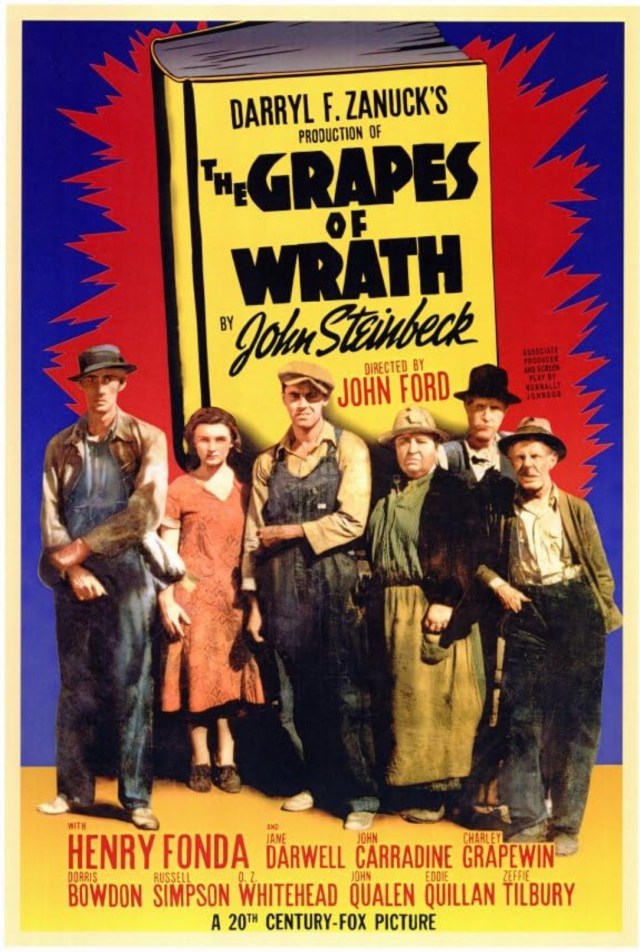
Back in May, I published a late review of John Steinbeck’s The Grapes of Wrath, my choice for the Buzzwordathon readathon. In that review, I stated how I wouldn’t plan on reading the book again, as I found the book mundane. For this year’s Classic Literature on Film Blogathon, hosted by Silver Screen Classics, I figured it would be a good idea to revisit the 1940 adaptation! Years ago, I saw The Grapes of Wrath movie. Because I only had vague recollections of the film, I wasn’t able to give an honest opinion on it. Besides that reason, I was curious to see how different or similar the adaptation was from its source material. Adaptations can be hit or miss, ranging from being unrecognizable from the book to being better than the book. Where does The Grapes of Wrath rank among these adaptations? Turn the page on this review in order to find out!
Things I like about the film:
The acting: Toward the beginning of the movie, Tom Joad, portrayed by Henry Fonda, is being driven home by a truck-driver. Suspicious of the truck-driver’s possible prejudice against him, Tom is uneasy and irritated. Just as he’s leaving the truck, Tom tells the truck-driver why he went to prison. While Tom is revealing the answer, his eyes are set in a serious stare and his mouth is presented crookedly. Speaking his answer with a loud, serious, even a bit agitated tone, the impression Tom left on the truck-driver and me, as a viewer, was chilling. However, this impression was a strong one, as it allows Tom to stand out and be remembered among the film’s large cast of characters!
A common strength I saw among the movie’s cast was how expressive the actors and actresses were. John Carradine’s portrayal of Casy serves as a great example! When he was telling Tom about his past sermons, Casy’s eyes went wide and his voice sounded animated. He even demonstrated gestures from his former services, such as jumping over a fence after a baptism. While John’s portrayal of Casy was expressive, it never felt over-the-top. This gives the audience a reason to take this character seriously. The audience can also take Ruthie and Winfield, the only children in the Joad family, seriously because their expressions seem genuine. At a fancier camp, Winfield and Ruthie are overwhelmed by the luxurious nature of the communal bathroom. When they flush a toilet for the first time, Ruthie and Winfield run out of the bathroom and hide behind the door frame, a mixture of shock and fear on their faces. The genuineness of these two characters was made possible through the screenwriting, as well as the performances of Shirley Mills and Darryl Hickman!
Similarities to the book: When it comes to film adaptations, there are some that share more similarities than differences with its respective source material. As someone who has read the book, I felt this way about the 1940 adaptation of The Grapes of Wrath! When Tom returns home, he and Casy come across Muley, one of the Joad family’s neighbors. Muley explains how several neighboring families were forced off their land by the bank. Through flashbacks, Muley’s recollection of events shows the heartlessness of land developers and the desperate nature of one tractor-driver. Readers would remember this part of the story as a separate chapter from the main narrative, not relating to any particular character. Adapting this chapter through a secondary character’s perspective was an interesting way for the movie’s creative team to respect their project’s source material!
The music: The story of The Grapes of Wrath takes place during the Great Depression, with the setting being rural. Music that can sometimes be heard in a scene’s background is reflective of the story’s time and setting. String instruments, such as guitars and banjos, make up the film’s soundtrack. These instruments helped elevate the tone of a given scene. As a member of the Joad family passes away, an acoustic guitar melody is softly playing as the Joad family is mourning their loved one. This simple tune emphasized the somberness surrounding the event itself. With the way the music fit so well in the movie, it shows how the film’s creative team cared about the presentation of their film!

What I didn’t like about the film:
A broken illusion: Because The Grapes of Wrath was released during the Breen Code era, several parts of the story had to be changed from page to screen. Rosasharn’s pregnancy was one of them. Through a variety of medium and close-up camera angles, the cinematographer, Gregg Toland, carried the illusion Rosasharn was pregnant. But audience members can tell Rosasharn wasn’t visibly pregnant due to a handful of medium and long shots. These shots broke the aforementioned illusion, taking away the authenticity of characters’ comments about Rosasharn’s pregnancy.
Things left unexplained: Within the story, and even the dialogue, there were things left unexplained. At the beginning of the movie, the audience is introduced to Tom’s brother, Noah. Halfway through the movie, Noah disappears, with no other character questioning his whereabouts or concerned about his disappearance. For those who have read the book, they would know where Noah went; abandoning his family to live near the river, as he fell in love with that location. Viewers who didn’t read the book would assume Noah’s absence was a result of poor screenwriting.
The run-time: The Grapes of Wrath has a run-time of a little over two hours. Since the story is a “slice-of-life” tale, I, personally, felt this movie didn’t need to be that length of time. There were parts of the film that consisted of shots of the Joad family’s vehicle driving down the road. Some of these shots could have been cut from the movie, as they sometimes seemed like padding. Had that creative decision been made, The Grapes of Wrath might have been about an hour and forty-five to fifty minutes.

My overall impression:
There are some adaptations where if you’ve seen the movie, you’ve already read the book. This is due to the adaptations’ shared similarities with their source material. After reading The Grapes of Wrath and seeing the 1940 film, I can honestly say my aforementioned statement rings true for the movie. While I appreciate the creative team’s attempts to respect the source material, as well as adapt it during the Breen Code era, it felt like I was consuming the same story again. I also think the movie was a bit drawn out, receiving an unnecessary run-time of a little over two hours. However, the music, set design, and costume design were good visual reflections of the story’s time and place. It did feel immersive, like the audience could be transported to that world. I’m glad to have received the opportunity to re-visit this film! Now, I can form an honest opinion about The Grapes of Wrath.
Overall score: 6-6.1 out of 10
Have you seen or read The Grapes of Wrath? If so, what are your thoughts on the story? Let me know in the comment section!
Have fun at the movies!
Sally Silverscreen

 18 Cinema Lane