The 8th Annual Gold Sally Awards Have Arrived!

The Gold Sally Awards, a beloved tradition on 18 Cinema Lane, have returned! For those new to my blog, this is an annual post I publish to commemorate my blog’s anniversary. Winners of the Gold Sally Awards are chosen based on movies I saw the previous year. The award categories are created by me, based on topics I’ve brought up on 18 Cinema Lane. Every year, I try to introduce at least one new award category. But in 2026, I’ve brought back two existing categories instead. I will discuss why I chose each recipient, like I’ve done in past award posts. So now, let the 8th Annual Gold Sally Awards begin!
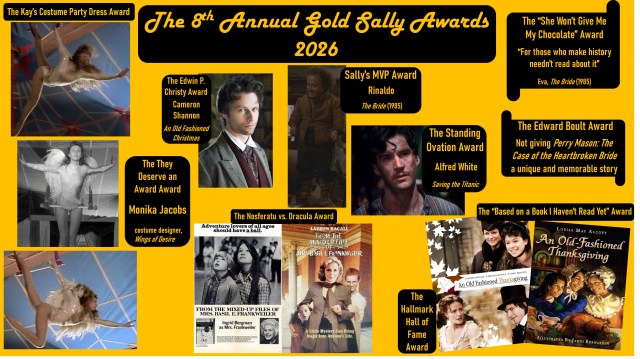
8th Annual Gold Sally Awards Winners created by me, Sally Silverscreen.

The Standing Ovation Award

(Character Most Deserving of Receiving Their Full Potential)

Alfred White from Saving the Titanic

Overcoming a fear takes bravery, determination, and perseverance. When one conquers a fear that was holding them back, it is an accomplishment worth celebrating, especially considering what that person may have gone through to reach that accomplishment. In Saving the Titanic, Alfred White had a fear of heights. He eventually overcame his fear when tasked with reporting everything happening above Titanic’s deck. The fact Alfred faced and conquered his fear during the highly stressful time of Titanic’s sinking is quite amazing. But as Alfred was addressing his fear of heights, he also taught me about the Titanic’s fourth fake funnel, a fact I was unaware of before watching Saving the Titanic. For these reasons, I have chosen Alfred White to receive this year’s Standing Ovation Award!

The Hallmark Hall of Fame Award

(Movie That Feels Like It Belongs in the Hallmark Hall of Fame Collection)

An Old Fashioned Thanksgiving

When I gave Hallmark’s Frankenstein the Hallmark Hall of Fame Award last year, I described the 2004 television movie as an immersive experience. The combination of screenwriting, acting performances, set design, and costume design presented the illusion of transporting me to another time and place. This is exactly how I felt when revisiting An Old Fashioned Thanksgiving! In the case of the 2008 tv film, this illusion was achieved through attention to detail and historical accuracy. Similar to Hallmark’s Frankenstein, I’m surprised An Old Fashioned Thanksgiving wasn’t a Hallmark Hall of Fame presentation. It’s even more surprising none of Louisa May Alcott’s literary work was adapted into Hallmark Hall of Fame titles. So, those are the reasons why I chose An Old Fashioned Thanksgiving for this year’s Hallmark Hall of Fame Award!

The “She Won’t Give Me My Chocolate” Award

(Best Quote from a Movie)

“For those who make history needn’t read about it” – Eva, The Bride (1985)

I will admit this was the most difficult category to choose a winner for. That’s because there were several strong quotes that were deserving of this year’s “She Won’t Give Me My Chocolate” Award. But the quote I ended up selecting was the one Eva told Josef in 1985’s The Bride. Outside the movie’s context, the quote itself is powerful and epic. Within the movie, however, it’s a simplistic yet meaningful acknowledgment of how far Eva came from when she was first introduced in the story. By Eva telling Josef, “For those who make history needn’t read about it”, she’s no longer the blank slate Frankenstein originally created her to be. Instead, Eva can think and speak for herself, even if she did need some help along the way. This quote provides character development in an interesting and memorable way!

The Edwin P. Christy Award

(Most Annoying Character in Film)

Cameron Shannon from An Old Fashioned Christmas

Looking back on 2025, Cameron Shannon, from An Old Fashioned Christmas, sticks out in my memory. But his memorability is for the wrong reasons. As I said in my review of the 2010 tv picture, Cameron was the worst character in An Old Fashioned Christmas. This was due to how annoying he became over the course of the movie. Cameron always acted like he had something to prove, as well as attempting to get the last word in every argument or conversation. So, it was satisfying to see Gad confront Cameron toward the end of the story. Like I also said in my An Old Fashioned Christmas review, the majority of the film emphasized the love triangle between Tilly, Gad, and Cameron. Honestly, I don’t know what Tilly saw in Cameron because his unlikability was static.

The Edward Boult Award

(Missed Opportunity in Cinema)

Not giving Perry Mason: The Case of the Heartbroken Bride a unique and memorable story

Last July, when I reviewed Perry Mason: The Case of the Heartbroken Bride, I criticized the movie for its missed creative opportunities. This major flaw made the twenty-third chapter in the Perry Mason movie series lackluster. In my review, I gave two subplot ideas that could have helped Perry Mason: The Case of the Heartbroken Bride obtain a more memorable story. The first is how Hannah, the sister of Kaitlynn’s fiancé, converted her failed music career into a promising legal career. Kaitlynn’s real personality being quite different from her celebrity persona serves as the second subplot idea. Sadly, these ideas weren’t utilized nor did they contribute to the mystery of Perry Mason: The Case of the Heartbroken Bride. The 1992 television film was Perry Mason’s “bad day at the office”.

The “Based on a Book I Haven’t Read Yet” Award

(Movie Based on Source Material I Have Not Yet Read)

An Old-Fashioned Thanksgiving

Louisa May Alcott is best known for her iconic novel, Little Women. But she has written some short stories throughout her career. One of those short stories was An Old-Fashioned Thanksgiving, which was the source material for the 2008 Hallmark Channel movie of the same name. You’d think with how much I adore An Old-Fashioned Thanksgiving’s film adaptation, I would have read the source material by now. But as of late February to early March, 2026, I still have not read Louisa May Alcott’s short story. Hopefully, I can finally check out An Old-Fashioned Thanksgiving this year!

The Nosferatu vs. Dracula Award

(Two Movies That Feel Like You’re Watching the Same One)

From the Mixed-Up Files of Mrs. Basil E. Frankweiler from 1973 and 1995

If you read my review of 1973’s From the Mixed-Up Files of Mrs. Basil E. Frankweiler, you would know this adaptation, as well as the 1995 version, would likely receive the Nosferatu vs. Dracula Award. This is due to both movies sharing a lot of the same strengths and flaws. Even though each version of From the Mixed-Up Files of Mrs. Basil E. Frankweiler does have its differences, it’s not enough to give the films strong differentiations between them. Even though I slightly prefer the 1995 adaptation over the 1973 version, these movies made me feel like I was watching the same film twice.

The Kay’s Costume Party Dress Award

(Best Outfit from a Movie)

Marion’s Angel Costume from Wings of Desire

In my Comparing with the Critics review of Wings of Desire, I complimented the movie’s costume design. I even described one of Marion’s trapeze artist costumes in detail. That costume is the angel costume Marion wore when she was first introduced in Wings of Desire. The craftsmanship and detail that went into creating the costume allowed the costume itself to stand out long after the movie was over. As I said in my review, the exquisiteness of Marion’s costumes, including her angel costume, makes me wish they were shown in color more consistently.

Sally’s MVP Award

(Character Who Left a Memorable, Showstopping Impression)

Rinaldo from The Bride (1985)

Back in June, 2025, when I reviewed The Bride, I proclaimed Rinaldo was the movie’s MVP. So, when it came time to decide who should receive the Sally’s MVP Award, I already knew the perfect winner! From the moment he meets Viktor, Rinaldo genuinely has Viktor’s best interests at heart. He strives to give Viktor a better life than Frankenstein did, even going so far as to educating Viktor on the importance of his name, which means “He will win”. Rinaldo always refers to Viktor as “his friend”. If it wasn’t for Rinaldo, I don’t believe Viktor would have received the “hero’s journey” he did in The Bride. Similar to when I gave Madmartigan the Sally’s MVP Award last year, Rinaldo became The Bride’s MVP because of David Rappaport’s performance and the screenwriting.

The They Deserve an Award Award

(Someone Associated with a Movie Who Deserves Recognition)

Monika Jacobs (for her costume designs in Wings of Desire)

In the past, I would give this award to actors or actresses who gave a performance that was memorably showstopping. But this year, I decided to expand the They Deserve an Award Award to other departments of film-making. That’s because there are other important components of creating a movie besides acting. When I reviewed Wings of Desire, I praised the film’s costume design, specifically pointing out one of Marion’s trapeze artist costumes. I said I wish Wings of Desire’s costume designer, Monika Jacobs, was nominated for, at least, one award. Costume design isn’t just about crafting attire that’s appealing to the eye. It’s also about creating attire that compliments the actor or actress wearing it. Through Marion’s wardrobe in Wings of Desire, Monika achieved these objectives. Even though Marion’s trapeze artist costumes were stunning, her casual and formal attire made Solveig Dommartin look like the best dressed star of Wings of Desire!

Have fun at the movies!

Sally Silverscreen
Comparing with the Critics – Worst of 1985 – The Bride

This review is from my series, Comparing with the Critics. If you’d like to learn more about the series, click on the link below.

Introducing my new series, Comparing with the Critics!

The summer of 1985 was a disappointing time for Gene Siskel and Roger Ebert. They were so let down by that particular time of the year, At The Movies dedicated an entire episode to discussing the worst movies of the summer. The Bride, which was released on August 16th, was the first film featured in this episode. It left such a bad impression on Roger and Gene, it also appeared on the ‘Worst of 1985’ episode of the show. In each of these episodes, Roger describes The Bride as “an ambitious film that lost it’s way” and a movie that “shot for the stars and failed miserably”. Because I hadn’t even heard of The Bride before starting my Comparing with the Critics series, I couldn’t agree or disagree with Roger’s sentiments. From the way the movie was described, it seemed to answer the question of what would happen if Victor Frankenstein’s female creation fell in love with him? This is a question that is infrequently asked in Frankenstein related media. As someone who has read Mary Shelley’s source material, I was curious to see how the film’s creative team would answer this question. But now that I have seen The Bride, I’m disappointed by how this question was approached. Unlike Gene and Roger, though, I wouldn’t go so far to say the movie is bad.

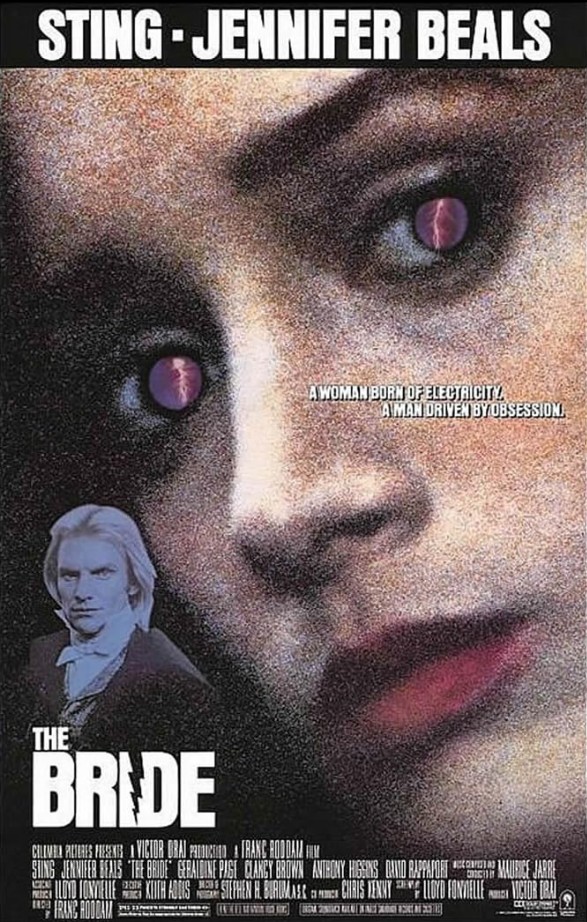
The Bride poster created by Colgems Productions Ltd., Delphi III Productions, Lee International Studios, and Columbia Pictures

After showing a clip from The Bride in At The Movies’ Worst Movies of the Summer episode, Roger claims the film “didn’t know whether it wanted to be a serious movie about the philosophical issues raised by the whole Frankenstein legend or whether it just wanted to be a glamourous, sleek remake”. I personally believe the movie’s creative team knew exactly what they were doing, accomplishing two goals in one picture. Throughout The Bride, there are two parallel stories; the first about Frankenstein and his female creation (Eva) and the second about Frankenstein’s male creation (Viktor) and Rinaldo. These stories show Viktor and Eva learning about the world around them as well as interacting with those they depend on. Every time Rinaldo introduces Viktor, he always refers to Viktor as “his friend”. Meanwhile, Frankenstein calls Eva “his ward”. The stories in The Bride were, in my opinion, intended to take a specific approach to the Nature vs. Nurture debate, presenting how two creations created by the same man could journey to the same outcome.

In Mary Shelley’s original source material, there aren’t really any heroes in that story. That’s because it focuses on the main message of some good intentions possibly leading to bad results. In The Bride, Viktor receives a “hero’s journey”, where he not only gets to fall in love, he also gets to save the day. His name, according to Rinaldo, even means “He will win”. As I mentioned in this review’s introduction, I have read Mary Shelley’s novel. From what I remember, Frankenstein destroys his female creation and his male creation is presented in the story as more of a cautionary tale. With that said, I think this creative liberty added an interesting dynamic to The Bride!

Hand-written letter image created by Veraholera at freepik.com. <a href=”https://www.freepik.com/free-photos-vectors/background”>Background vector created by Veraholera – Freepik.com</a>. <a href=’https://www.freepik.com/free-vector/love-letter-pattern_1292902.htm’>Designed by Freepik</a>. Image found at freepik.com.

While talking about The Bride’s two parallel stories, Gene says the story of Viktor and Rinaldo “was much more interesting than Frankenstein and the monster”. I find myself agreeing with Gene, especially since this story included a “hero’s journey” and a conflict that needed to be resolved. But another reason why I liked Rinaldo and Viktor’s story is David Rappaport’s portrayal of Rinaldo. When Rinaldo first meets Viktor, he’s surprisingly not intimidated by Viktor’s size. Instead, Rinaldo’s confidence helps Viktor find a sense of belonging as well as build a friendship between himself and Viktor. Rinaldo’s charisma shows the audience his good intentions, always striving to give Viktor a better life than Frankenstein did. As he’s giving Viktor a new shirt, Rinaldo is horrified by the scars on Viktor’s back. The sight immediately brings concern to Rinaldo’s face, his saddened tone of voice concluding how Viktor must have been mistreated. The scene I just described shows how David’s performance gave Rinaldo a genuineness that allowed him to be a likeable character. Though this film is titled The Bride, Rinaldo became this movie’s MVP!

Back to 1985 Blogathon banner created by Quiggy from The Midnite Drive-In and Hamlette from Hamlette’s Soliloquy

Both Roger and Gene agreed that Viktor and Eva should have spent more screen-time together. Roger proclaims “if we’re gonna have those parallel stories for two hours, let’s have a pay-off at the end”, with Gene adding “a pay-off for half an hour, not for five minutes”. Like I talked about earlier in this review, I believe the creative team’s intention for The Bride was to present a specific approach to the Nature vs. Nurture debate, as well as giving Viktor a “hero’s journey”. However, my biggest criticism with these parallel stories was the editing. The way these stories were sewn together made the movie feel disjointed. This is because some parts of the story were longer than others. One scene shows Eva studying a series of pictures by herself for only a few seconds. The very next scene shows Viktor and Rinaldo on their journey to the circus, with the scene itself lasting several minutes. Frankenstein and Eva receiving shorter screen-time sometimes prevented the audience from seeing interesting interactions between these two characters. This creative decision also gave Eva and Frankenstein’s story less intrigue.

Group of clowns image created by Freepik at freepik.com. Image by Freepik

When I was introduced to The Bride, I was given the impression the film was trying to answer the question of what if Victor Frankenstein’s female creation fell in love with him. This made me curious to see how the movie’s creative team would answer this question. But like I said in my review’s introduction, I’m disappointed by how this question was approached. That’s because the film’s creative team didn’t answer or explore the question at all. They bring up an equally interesting and infrequently asked question of what if Frankenstein fell in love with his female creation? However, so much time was spent focusing on Eva learning about the world around her, the aforementioned question was given little time for exploration or discussion. When it came to Frankenstein’s love for Eva, it simply came across as possessive and controlling. As I’ve been saying throughout this review, Viktor was given a “hero’s journey”. This means the story always intended to have Eva fall in love with Viktor, not Frankenstein. Even though I liked the creative decision of Viktor’s “hero’s journey”, I’m still disappointed by the potential questions that were left unanswered.

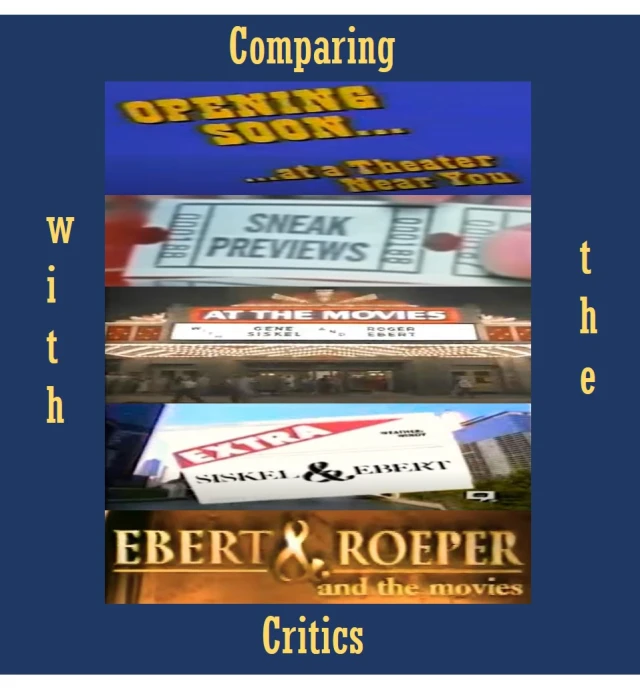
Comparing with the Critics banner created by me, Sally Silverscreen. TV show title cards created by WTTW National Productions, WTTW, Public Broadcasting Service (PBS), Lifetime Television, Tribune Entertainment, Buena Vista Television, and Disney-ABC Domestic Television

Toward the beginning of At The Movies’ Worst Movies of the Summer episode, Gene claims the summer of 1985 “happened to be one of the dullest, most juvenile, most homogenized summer movie seasons in recent memory”. Out of the movies that premiered during that time, I’ve only seen six pictures in their entirety, including The Bride. Personally, I didn’t find any of these films to be bad or disappointing. Specifically speaking about The Bride, I thought it was a fine, serviceable, interesting enough title. Though I was disappointed the movie’s creative team didn’t answer the question of what if Victor Frankenstein’s female creation fell in love with him, there were aspects of the film I liked. While the acting was one of the strengths of The Bride, David Rappaport’s portrayal of Rinaldo shined the brightest! Rinaldo was such a likable character, he became my favorite! Another strength of this film was Viktor receiving a “hero’s journey”. Even though it was a creative liberty, it added an interesting dynamic to The Bride’s story. It was also interesting to see the creative team’s approach to the Nature vs. Nurture debate. I apologize for sounding like a broken record, but this is yet another Comparing with the Critics review where I disagreed with Roger and Gene. As I continue with my series, I have to wonder how often this will keep happening?

This review was brought to you by

Sally Silverscreen

Comparing with the Critics – 1985 – Introduction

Looking back on 1985, one can see the abundance of stand-alone films released that year. While cinemas welcomed sequels, these movies were exceptions to the rule, compared to the box office of 2025. That’s because studios and film companies were more selective about which titles received another chapter. Mad Max Beyond Thunderdome joined this exclusive club. It even left such a good impression, it earned a place on Roger Ebert’s list of the top ten best films of 1985. As I mentioned earlier in this introduction, 1985 saw an abundance of stand-alone movies. However, these projects were not created equally. The Bride tried to find an answer to the infrequently asked question of what would happen if Victor Frankenstein’s female creation fell in love with him?  Both Roger and Gene Siskel were so disinterested in finding an answer to this question, that the film was not only featured in At The Movies’ Worst Films of 1985 episode, it also made an appearance in the show’s Worst Movies of the Summer episode. At this point in the introduction, you probably think Mad Max Beyond Thunderdome and The Bride being singled out is purely a coincidence. But these titles were specifically chosen for Midnite Drive-in’s and Hamlette’s Soliloquy’s Back to 1985 Blogathon, where I’m reviewing The Bride as the Worst of 1985 and Mad Max Beyond Thunderdome as the Best of 1985!

Comparing with the Critics banner created by me, Sally Silverscreen. TV show title cards created by WTTW National Productions, WTTW, Public Broadcasting Service (PBS), Lifetime Television, Tribune Entertainment, Buena Vista Television, and Disney-ABC Domestic Television