Take 3: Lovey: A Circle of Children, Part II (1978) Review

As I explained in my recent review of A Circle of Children, I’m covering the sequel, Lovey: A Circle of Children, Part II for the Film. Release. Repeat. Blogathon. Because I’ve been meaning to review the 1978 television film since 2022, I believed the blogathon was a great time to finally check the movie out! But as I also mentioned in my review of A Circle of Children, I haven’t found a made-for-tv movie from the 1970s I actually like. Whenever I’ve selected this particular type of film to write about, I find the film itself either fine, ok, or underwhelming. This is one of the reasons why I put “1970s Made-for-TV movie” on my Year-Long Bingo card, so I could, hopefully, find a television movie I enjoy from that decade. When I saw and reviewed A Circle of Children, I thought it was just ok. Will its sequel be better? Let’s begin this review to find out!
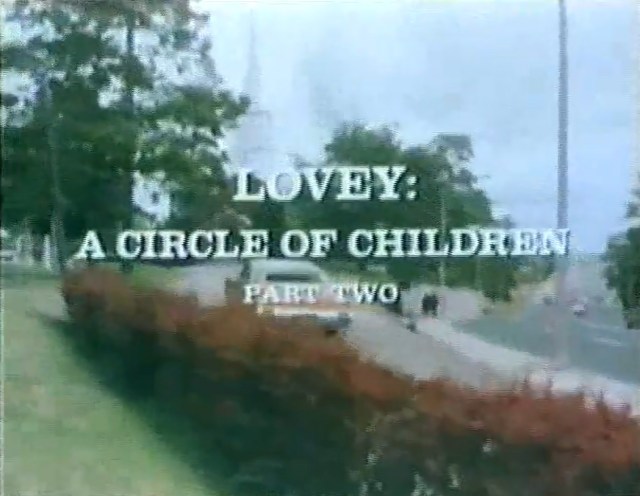
Lovey A Circle of Children, Part II title card created by Time-Life Television Productions and CBS

Things I liked about the film:

A smaller cast: In my review of A Circle of Children, I mentioned the film containing a large cast of characters. This is one of the reasons why the audience was forced to either only become familiar with the characters or not getting to know them at all. This flaw became remedied in Lovey: A Circle of Children, Part II! In the 1978 sequel, the cast is much smaller. Even Mary’s class contains fewer students. Because the story has less characters to keep track of, it gives the audience an opportunity to truly get to know the characters. The audience also has more time to spend with characters like Mary’s students and even Mary’s boyfriend, Cal, because of a tightly written script.

Progression that’s written gradually: When I reviewed A Circle of Children, I talked about how Sarah’s sudden achieved progress taking place after being a static character for half the movie felt like it was written into the story for the sake of plot and time convenience. Even though I was happy to see Sarah achieving progress, I wish that progress was gradually woven into the script. It seems like the creative team behind Lovey: A Circle of Children, Part II felt the same way I did, as Hannah’s/Lovey’s progression was gradual. Hannah/Lovey joins Mary’s class as an unruly child who is very unpredictable. But as the film goes on, Mary’s influence takes effect on Hannah/Lovey as she becomes more responsive, less violent, and even participates in class. The smaller cast size I talked about earlier certainly influenced this part of the story. It allowed Hannah’s/Lovey’s progression to receive emphasis instead of competing against other stories. The transformative power of Mary’s teaching abilities is also on full display because of the gradually written progression of Hannah/Lovey.

The dialogue: Like I said in my list of The Best and Worst Movies I Saw in 2025, how well-written the dialogue was in The Chalk Garden allowed me to remember what Laurel said about the term “good morning”. The quality of the screenwriting was also a strength in Lovey: A Circle of Children, Part II! Some of the dialogue in the 1978 movie sounded profound without trying too hard to be philosophical. A great example can be heard during a conversation between Mary and a fellow teacher named Patty. Patty feels discouraged over the lack of progress from her students. Mary reassures Patty that her impact on the students has been positive, reminding Patty how hope comes from believing the children can learn something. Patty then tells Mary, “Yeah, but you can’t mop the floors with hope”. Mary experiences her own period of discouragement after Hannah/Lovey has an angry outburst involving paint. In a voice-over, Mary says, “For a moment, my dreams and plans for Hannah shattered. But paint is only paint and never worth a dream. Besides, a teacher’s dream dies hard”. The two examples I provided show how Mary’s and Patty’s frustrations and concerns were eloquently and thoughtfully written into the script.
The Film. Release. Repeat. Blogathon banner created by Quiggy from The Midnite Drive-In and Hamlette from Hamlette’s Soliloquy

What I didn’t like about the film:

How Hannah was introduced: As I’ve already said in this review, Hannah/Lovey joins Mary’s class as an unruly child who is very unpredictable. However, I found her introduction in Lovey: A Circle of Children, Part II to be distasteful. As Mary walks down the hallway to retrieve Hannah/Lovey, suspenseful music plays over the scene. The music itself sounds as if it came straight out of a horror movie. The reveal of Hannah’s/Lovey’s face was prolonged because of specific camera angles that were utilized. When Hannah’s/Lovey’s face was finally revealed, a frozen close-up shot was presented to intentionally appear frightening. To me, the introduction I described felt sensationalized to the point of being counterproductive of what Lovey: A Circle of Children, Part II was trying to achieve; making the audience feel empathetic toward Hannah/Lovey by looking past her horrific behavior. I truly believe there was a more tasteful way Hannah/Lovey could have been introduced in the story, especially compared to how some of the students were introduced in A Circle of Children.

Doris’ limited involvement in the story: A Circle of Children introduced Doris as the director of the Children’s School for Special Education. Though she appeared in only a handful of scenes, Doris’ role was pivotal as she literally and figuratively opened the door for Mary to the world of Special Education. Doris was one of the few characters from the first movie to return in the sequel. But she was given even more limited involvement in the second film. While she was still the director of the Children’s School for Special Education, her role in Mary’s story had a reduced significance. I wish Doris received more to do in Lovey: A Circle of Children, Part II because I think she could have made a bigger impact.

Lack of further progression: I said earlier in this review how Hannah’s/Lovey’s progression was written gradually into the story. Even though this was one of the movie’s strengths, I didn’t like how there was a lack of further progression for two of Mary’s students. While Hannah/Lovey was improving her reading skills and Brian (from the first movie) was learning how to board the bus by himself, Rufus and Jamie were at a standstill in their education. With a smaller cast size I talked about in this review, there should have been room in the script to give Jamie and Rufus at least a small victory. At the end of Lovey: A Circle of Children, Part II, Mary reveals through a voice-over what happened to her students. However, not showing Rufus and Jamie achieving further progression in the movie was a missed opportunity.

Preschool classroom image created by Vectorpocket at freepik.com. <a href=”https://www.freepik.com/free-photos-vectors/background”>Background vector created by vectorpocket – http://www.freepik.com</a>. Image found at freepik.com.

My overall impression:

Sometimes, a sequel ends up becoming better than its predecessor. Lovey: A Circle of Children, Part II just so happens to be one of those films! Some of the flaws of A Circle of Children were improved upon in the second chapter, such as containing a smaller cast and the script featuring a gradual progression for Hannah/Lovey. The sequel even had its own unique strengths from its predecessor, like how well-written the dialogue was. But despite these positive aspects, Lovey: A Circle of Children, Part II did have its flaws. I believe there are more respectful ways Hannah/Lovey could have been introduced into the story, as her debut in the film was too sensationalized for my liking. I not only wish Jamie and Rufus had received further progression in the movie, I also wish Doris was given a greater significance in the script. But similar to what I said in my review of A Circle of Children, I’m grateful Lovey: A Circle of Children, Part II exists at all. The 1978 film gives the audience a glimpse into what Special Education was like in the 1970s. It’s a made-for-tv movie that was spared from getting lost to time as well.

Overall score: 7.2 out of 10

Have you seen Lovey: A Circle of Children, Part II? Are there any made-for-tv movies from the 1970s you’d like to see me cover on 18 Cinema Lane? Please tell me in the comment section!

Have fun at the movies!

Sally Silverscreen

Take 3: A Circle of Children (1977) Review

Back in 2022, I wrote a list of the Top 10 Movies I’d Love to Review. Each chosen film was categorized based on how accessible they are. Reflecting on this list, I realized that as of early January 2026, the only more “accessible” titles not yet covered on my blog were A Circle of Children and Lovey: A Circle of Children, Part II. With the Film. Release. Repeat. Blogathon (an event about remakes and sequels) on the horizon, I finally found a reason to review the 1978 sequel. However, I’ve never seen its predecessor, A Circle of Children. So, in preparation for my review of Lovey: A Circle of Children, Part II, I’m also writing about the first film. As I said in my list of the Top 10 Movies I’d Love to Review, both A Circle of Children and Lovey: A Circle of Children, Part II are based on the true story of a teacher named Mary MacCracken. Like I also said in my list, Mary’s books were not only the source material for these movies, Mary was also one of the screenwriters for both films. But over these eight years of 18 Cinema Lane’s existence, I haven’t found a made-for-tv movie from the 1970s I actually like. Will A Circle of Children change that? Let’s begin the first movie review of 2026 to find out!

A Circle of Children (1977) title card created by Edgar Scherick Productions, 20th Century Fox Television, and CBS

Things I liked about the film:

The acting: In A Circle of Children, the protagonist, Mary, visits the mother of a student named Brian O’Connell. During Mary’s conversation with Mrs. O’Connell, Brian’s mother consistently has a worn look on her face. Not only did Mrs. O’Connell’s eyes look heavy, her mouth was set in a straight line as well. Her voice almost sounded monotone, lacking emotion over her situation. Though she admits to Mary that she’s tired, Mrs. O’Connell was able to express how tired she was without relying too much on dialogue. That’s because Judy Lewis, the actress who portrayed Mrs. O’Connell, effectively utilized vocal inflection, facial expression, and even her eyes to emphasize what her character was going through.

Speaking of Brian O’Connell, I want to talk about Matthew Labyorteaux’s performance! I am familiar with his portrayal of Albert on Little House on the Prairie. Therefore, Matthew’s acting capabilities are already known to me. Mary teaching Brian to speak presents a great display of Matthew’s acting talents. When Mary is using a tape recorder in order to help Brian learn to speak, Brian has a blank look on his face. But when a teacher named Dan sings a song to the students, he offers the microphone to Brian. This time, Brian has a determined look on his face, as he intensely looks at the microphone and makes a great effort of trying to repeat Dan’s song. The next scene shows Brian receiving a second chance to speak into the microphone. His eyes become really wide and a smile spreads across his face, excited by the opportunity given by Mary and Dan. As I watched A Circle of Children, it made me believe Little House on the Prairie’s creative team chose wisely when they cast Matthew as Albert!

Since A Circle of Children is based on the true story of Mary MacCracken, I must discuss Jane Alexander’s portrayal of Mary. Throughout the movie, Jane’s performance brought empathy and relatability to her role. One great example happens when Mary encourages Brian to say his name. Brian puts together a puzzle resembling a short story he was reading earlier in the film. Because one of the characters in that story was named Brian, Mary uses this fact to motivate Brian to say his name for the first time since coming to the Children’s School for Special Education. When this plan fails, Mary develops a look of defeat on her face. Her mouth is turned into a frown and her eyes present a mixture of sadness and concern. This medium shot of Mary’s face not only says so much without saying anything at all, it also shows the audience how much she cares about the students, especially Brian.

The chemistry of Mary and Dan: When Mary first visits the Children’s School for Special Education, she meets a teacher named Dan. Over the course of A Circle of Children, Dan and Mary develop a friendship that is shown in only a handful of scenes. Despite this, their chemistry highlights how the two have become kindred spirits, bringing thoughtfulness and understanding to their friendship. The chemistry between Mary and Dan works because the on-screen chemistry between Jane Alexander and David Ogden Stiers (the actor who portrays Dan) works! The strength of their acting abilities allows David and Jane to effectively present a friendship that looked and felt believable. Because of how well they seemed to get along, I was hoping Dan and Mary’s friendship would gradually become a romance. Mary and Dan’s chemistry was such a pleasant surprise in A Circle of Children!

Creating a complex character: One of the teachers at the Children’s School for Special Education is Helga. At first, she and Mary don’t see eye to eye due to how Helga treats the students. Some examples include making a child plunge the toilet and intentionally hiding a young girl’s (literal) security blanket. But as the story goes on, Mary, as well as the audience, learns Helga actually has good intentions for the students. In fact, she wants the children to succeed just as much as Mary does. It would have been so easy for A Circle of Children’s creative team to present Helga as a one-dimensional mean teacher. Instead, the screenwriting and Rachel Roberts’ performance created a character that was complex, representing how, sometimes, approaches to education aren’t straightforward. Helga’s complexity made her a memorable character as well!

Preschool classroom image created by Vectorpocket at freepik.com. <a href=”https://www.freepik.com/free-photos-vectors/background”>Background vector created by vectorpocket – http://www.freepik.com</a>. Image found at freepik.com.

What I didn’t like about the film:

Only becoming familiar with characters: A Circle of Children consists of a large cast of characters. That’s because most of the characters are students from the Children’s School for Special Education. But A Circle of Children has a run-time of an hour and thirty-six minutes, leaving the audience with not enough time to truly get to know the characters. The film’s run-time actually forces the audience to either only become familiar with the characters or not getting to know them at all. Had A Circle of Children received a longer run-time, more opportunities to show Mary getting to know her students and help them could have been provided in the story.

Scene transitions that weren’t smooth: If a movie features smooth transitions between scenes, they can not only help the audience process the story unfolding, they can also maintain the film’s overarching pace. But in the case of A Circle of Children, choppy scene transitions sometimes created emotional whiplash. In one glaring example, Mary and her husband, Larry, confess to their daughter, Liz, of their recent separation. This confession is so upsetting, Mary herself appears to be on the verge of crying. However, the very next scene shows Mary being interviewed for a teaching aide position at the Children’s School for Special Education. This scene is intended to be less sad than the scene I previously described. To me, the transition between these two scenes felt jarring because the transition itself was choppy and abrupt.

Solutions happening for the sake of plot and time convenience: Within the first fifteen minutes of A Circle of Children, a young girl named Sarah is enrolled at the Children’s School for Special Education. According to Sarah’s mother, Sarah is unable to stand or walk. She’s also so attached to a blanket that she continuously screams at the top of her lungs if the blanket is taken away from her. For half the movie, though, Sarah is a static character. She’s either shown lying on the floor sucking her thumb or screaming because she can’t find her blanket. But at a Christmas party that takes place a little more than halfway through the movie, Sarah not only randomly starts walking, she also willingly trades her blanket for a doll. While I was happy to see Sarah achieving progress, I wish this progress was gradually woven into the script. Because Sarah suddenly achieved progress after being a static character for half the movie, the moment itself felt like it was written into the story for the sake of plot and time convenience.

String of musical notes image created by Freepik at freepik.com. <a href=’https://www.freepik.com/free-vector/pentagram-vector_710290.htm’>Designed by Freepik</a> <a href=”https://www.freepik.com/free-photos-vectors/background”>Background vector created by Freepik</a>. Image found at freepik.com. 

My overall impression:

In the introduction of this review, I said I haven’t found a made-for-tv movie from the 1970s I actually like. Sadly, A Circle of Children will not be the film to change that. The 1977 production isn’t a bad movie. In fact, it has its merits, especially when it comes to the acting performances. But I found the story itself to be too “slice of life” for my liking. Plus, there were other flaws that stood out to me, such as the run-time and choppy scene transitions. Looking back on A Circle of Children, however, I will admit my gratitude for its existence at all. This movie is like a time capsule when it comes to Special Education, giving viewers a glimpse into how this specific topic was approached in the 1970s. Though the film only shares one teacher’s perspective, it does express themes of helping others reach their full potential, working together to achieve a common goal, and not giving up on others. The creative team behind A Circle of Children definitely had their hearts in the right place. Now that I’ve finally seen this movie, it’ll be interesting to see where the story in Lovey: A Circle of Children, Part II goes from here.

Overall score: 6 out of 10

Have you seen A Circle of Children? Are you looking forward to my review of Lovey: A Circle of Children, Part II? Let me know in the comment section!

Have fun at the movies!

Sally Silverscreen

Evenings At The Shore: Spies Among Us

Due to weather related and technical issues, this re-cap is published later than usual. However, that hasn’t discouraged me from consistently delivering these posts to my readers. Similar to this season’s second episode, I was surprised by how often spies were brought up in the fifth episode. From Abby thinking Evan is spying on Jess and David’s business to Connor being paranoid someone is spying on him, this subject was somewhat consistent throughout the story. But it made me realize something. When has any of the show’s characters been in serious danger? Maybe there’s been an incident here or there. However, these incidents were, more often than not, resolved in a short amount of time. Come to think of it, safety seems to be an overarching theme among Hallmark’s other shows. I can’t say if this was intentional or if that’s just how things worked out. But it does present an interesting coincidence.

Just a reminder: If you did not see this episode of Chesapeake Shores, there are spoilers in this re-cap.

Chesapeake Shores Season 5 poster created by Crown Media Family Networks and Hallmark Channel.

Season: 5

Episode: 5

Name: You Can’t Take That Away from Me

Abby’s story: Abby is still working with Evan on his hotel project. While in Chesapeake Shores, Evan decides to stay at The Inn at Eagle Point, Jess and David’s bed and breakfast. Abby thinks Evan is spying on his competition, but Evan has other plans. While visiting her sister at The Inn, Abby confesses how she finds Evan annoying. Evan overhears this conversation, but takes it all in stride. He introduces himself to Jess and David, leaving a good impression on them. He even shares dinner with Jess, David, Sarah, and Kevin. Over time, Abby learns Evan has a bungalow along the shore. But when she gives Evan a lift home, she begins to see that not all glitters is gold. The next day, at the Inn, Abby learns why Evan likes to stay at the Inn, despite having a place of his own. Evan reveals how there’s always something happening at the bed and breakfast, like a family gathering. He also tells Abby how, growing up, he didn’t really have much family. This information starts to make Abby feel sorry for her client.

Connor’s story: When Mick confesses the news of Dilpher’s lawsuit to Connor, Connor tells his father how his law firm is representing Dilpher. He also tells Mick of the evidence he and Abby recently found. Meanwhile, at the firm, Connor is still paranoid of someone spying on him. Margaret’s words of warning come to mind, as he wonders if his desk drawer is being tampered with. When Connor asks Margaret what is going on, she says he is responsible for what he puts in his desk. This gives him an idea. Later in the episode, Connor places a note to Abby in his desk drawer, hoping his plan will work. The next day, a meeting regarding the lawsuit is held. Linda, as well as the law firm partners, try to use Connor’s note against Mick. The note, written by Connor, tells Abby how Mick needs to tell the truth. However, Connor is able to not only prove Mick’s innocence, but that the partners are overstepping their boundaries. Before the meeting, Connor wrote and printed off another note. This second note reveals how Connor wants Mick to tell the truth about eating Nell’s coffee cake.  Before resigning, Connor brings forth the evidence he and Abby found, as well as revealing how he will report the partners to the bar association. At the end of the episode, Mick tells his family how the lawsuit has been dropped and how criminal charges were being placed on Dilpher.

Kevin and Sarah’s story: At the beginning of the episode, Bree and Jess see Sarah near the OB/GYN’s office. They think Sarah has good news, but looks can be deceiving. During a dinner at the Inn, Sarah reveals to Jess, in private, how she has been diagnosed with a condition that could prevent her from conceiving. Sarah does eventually tell Kevin the news. However, Kevin reassures her that everything will work out. They see another OB/GYN for a second opinion. The doctor tells Sarah and Kevin to wait six months before taking any more steps. Meanwhile, Kevin is still concerned over Captain Gahagan’s health. During an emergency at the library, these concerns heighten. Kevin tells Gahagan to give the patient a .3 dose of epinephrine. But as Gahagan is about to give the patient the dose, Kevin notices the dose is .6. Since this is a higher dose than was originally said, Kevin stops the procedure to lower the dose. After talking with Sarah about the incident, Kevin decides to confront Gahagan about what happened. But when he arrives at Gahagan’s house, he not only finds the front door unlocked, he also finds Gahagan’s home covered in sticky notes. Gahagan confesses to Kevin how his memory related issues have been going on for a while. The library incident served as a wake-up call. Gahagan tells Kevin he will not only continue to see his doctor, he will also step down from his Fire Chief position. He makes his retirement public after the Chesapeake Day Triahalon.

Winner’s medal image created by Freepik at freepik.com. <a href=’https://www.freepik.com/free-vector/golden-awards-set-with-colors-details_844356.htm’>Designed by Freepik</a>. <a href=”https://www.freepik.com/free-photos-vectors/gold”>Gold vector created by Freepik</a>. Image found at freepik.com.

Jess and David’s story: After hearing about Sarah’s struggles to conceive, Jess shares this news with David. This information disappoints David, giving Jess the indication he would like to have children someday. Jess begins to realize how Megan’s absence has affected her life, making her feel unprepared to be a mother. She turns to Bree about her concerns, but Bree tells her how she will figure it out as time goes on. Later in the episode, Jess confesses her thoughts to David. She’s afraid David will want to end their relationship. But David proves her wrong by just giving her a hug. The next day, Jess tells David how she isn’t sure if she wants children. David tells her that even though he would love to be a father one day, what matters most is if he and Jess are on the same page. What Jess can make a decision on is Abby being her Maid of Honor and Bree officiating the ceremony.

Bree’s story: Bree is still making preparations for her upcoming class. While the class’s structure is there, Jerome tells her she needs to come up with an official name. Bree knows it has to catch the attention of potential students. So, she sets to work as soon as possible. At Sally’s Café, Luke shows up just as Bree is coming up with ideas for the class name. After bouncing off suggestions, Luke finally helps her come up with a name that they both think is perfect. He also jokes how he’s an undercover spy, giving Bree an explanation for his appearance at the café. Luke gives Bree his number in case she sees anything “suspicious”.

Megan’s story: One morning, Megan finds Nell in the O’Brien family kitchen. Nell explains she is making dinner for Arthur, helping Megan have a more meaningful interaction with the artist. When they arrive at his home, Arthur is about the close the door on Megan again. But when he sees Nell, he changes his mind, inviting them both for dinner. During their meal, Arthur talks about how he hasn’t created any new art in many years. He says that part of himself existed in another life. As Nell and Arthur reflect on the past, she recalls a schoolhouse that used to stand in Chesapeake Shores. Arthur not only remembers this location, he also captured it in a painting. After giving this painting to Nell, she places her hand on his hand.

Art tools image created by Freepik at freepik.com. <a href=’https://www.freepik.com/free-vector/flar-art-tools-pack_835368.htm’>Designed by Freepik</a>.  <a href=”https://www.freepik.com/free-photos-vectors/paint”>Paint vector created by Freepik</a>. Image found at freepik.com.

Some thoughts to consider:

  • During Bree’s conversation with Jerome, it was revealed Bree’s class would be taught in the fall. I also noticed Connor’s note bared a June 27th date. This disappoints me, as I was hoping to see Bree interacting with her students. I was also hoping to see who would be cast as the students themselves. I’m wondering if this creative decision was made to combat COVID concerns by featuring less cast members on screen? Nevertheless, it gives me something to look to if Chesapeake Shores returns for a sixth season!
  • In my re-cap of the fifth season’s third episode, I wondered if Luke would join Kevin’s Triathlon team. However, I was proven wrong when David was shown participating in the event. Looking back, it makes more sense for David to team up with Kevin and Connor. Not only is the O’Brien family more familiar with David, but he will soon be joining the family through marriage.
  • On a wall in the law firm’s meeting room and on Connor’s note, the initials D.L.P. can be seen. These initials belong to the names of the law firm’s partners. But if you watch the end credits, you will see that D.L.P. also stands for Daniel L. Paulson Entertainment, one of the show’s production companies. It’s always cool to see “Easter eggs” like this on Chesapeake Shores! It reminds me of the band manager, Mark Hall, from season three. His name was a variation of the word Hallmark.
Evening view from the shore image created by 0melapics at freepik.com. <a href=’https://www.freepik.com/free-vector/landscape-in-a-swamp-at-night_1042860.htm’>Designed by Freepik</a>. <a href=”https://www.freepik.com/free-photos-vectors/background”>Background vector created by 0melapics – Freepik.com</a>. Image found at freepik.com.

What are your thoughts on this episode? What are you hoping to see in the fifth season’s second half? Tell me in the comment section!

Have fun in Chesapeake Shores!

Sally Silverscreen

Take 3: Goodbye, Mr. Chips (1939) Review (Clean Movie Month #1)

1939; a year that many people have considered the “Golden Year of Film”. As I mentioned in my editorial, What the Code Means to Me: Breen, Hallmark, and Me, it seems like there was something for everyone at the cinema. Several films that are well known today were able to find success in the box office in 1939. One of those films was Goodbye, Mr. Chips. I had planned on reviewing this film exclusively for The Robert Donat Blogathon. But because July is Pure Entertainment Preservation Society’s Clean Movie Month, I decided to review Goodbye, Mr. Chips for that event as well. Like last year, I will be writing about films that were released during the Breen Code Era. Some of my other submissions for upcoming blogathons will also double as entries for Clean Movie Month. Now, it’s time to read this review of the 1939 movie, Goodbye, Mr. Chips!

Goodbye, Mr. Chips poster created by Metro-Goldwyn-Mayer and Denham Studios. Image found at http://www.tcm.com/tcmdb/title/76737/Goodbye-Mr–Chips/#.

Things I liked about the film:

The acting: This was my first time watching any of Robert Donat’s performances, so I didn’t know what to expect. However, I was impressed with what I saw! Robert did a good job using a multitude of emotions at various moments in the film. Even when he wasn’t speaking, his performance still carried emotional weight. A great example is anytime something bad happened to Mr. Chips, as his facial expressions alone show how emotionally exhausted he can become. Despite appearing in the film for a limited amount of time, Greer Garson gave a pleasant performance as Katherine Ellis! Not only did she have a good on-screen personality, but she also had good on-screen chemistry with Robert Donat. One of their best interactions took place on a mountain in Austria. As they exchange witty banter, it is obvious to see that both actors enjoy each other’s company. Because most of the story takes place at the Brookfield school, many young actors are present in various scenes. Even though the movie doesn’t favor one child or a small group of children, the acting from the young actors was very on-point for what those scenes called for. On April Fool’s Day, the students are excited at the idea of pranking their teacher. As soon as one of their fellow classmates shares some unfortunate news about Mr. Chips, their happy expressions quickly turn somber. This collective acting quality shows what these young actors are capable of talent-wise!

The set design: A visually appealing aspect of this film was definitely the set design! The Brookfield school alone boasted several eye-catching design choices. One of those was the ornate detailing found on wood surfaces, such as doors and walls. In the Headmaster’s office, you can even see these details over the marble fireplace. Exposed stone walls are a consistent feature at the school, bearing the old-world charm found in structures with a long life-span. These design elements reminded me of Hogwarts from the Harry Potter series. Brookfield is not the only place that highlights fine details. The ballroom in Vienna was a showstopper! Like the Headmaster’s office, there was ornate wood detailing found on the walls. It also showcased sparkling chandeliers and a spacious layout. All of the combined elements gave this room a grand and larger-than-life personality!

The dialogue: Throughout the movie, I was very impressed by the characters’ dialogue! As I mentioned before, the banter between Mr. Chips and Katherine was witty. But it’s also important to point out how the dialogue was written with care and thought. During a private gathering, one of the fellow teachers of Brookfield states that he read a book by H.G. Wells. Another teacher comments about H.G. Wells’ short-term success, saying that his works are too “fantastical” for a lasting career. Earlier in the film, Mr. Chips falls ill. When his housekeeper tells him to address his medical concerns to the doctor, Mr. Chips says he’ll give the doctor “a piece of his mind”. The film is based on a pre-existing novel, so I’m not sure if some of the dialogue can also be found in the book. However, the lines in the movie were memorable and, at times, thought provoking because they were crafted so well!

The Robert Donat Blogathon banner created by Maddy from Maddy Loves Her Classic Films. Image found at https://maddylovesherclassicfilms.wordpress.com/2020/02/29/announcing-the-robert-donat-blogathon/.

What I didn’t like about the film:

Little to no impact on the students: In stories about teachers playing a role in the lives of their students, the audience comes to know the students as characters while witnessing their growth as young scholars and individuals. Since there were so many students at Brookfield, there was no possibility for this to happen. Even when this opportunity arose in the story, it was not taken advantage of. When Mr. Chips reflects on his past, he remembers meeting a new student that was so upset, he ends up crying on the train. Several scenes and years later, this same student visits Mr. Chips to thank him for changing his life. This exchange would have been emotionally affective had we seen this character evolve from a scared child to an independent young man.

Some parts feeling rushed: I know there is only so much a movie can accomplish in an hour and fifty-four minutes. But this should not be an excuse to rush through important parts of a story. When Mr. Chips starts looking back on his past, he recalls his time as a new teacher at Brookfield. After a montage featuring students during various sporting activities, the story progresses by several years, making Mr. Chips a seasoned teacher. Personally, I don’t feel this was a smooth transition between the two points in time, as it made the story feel like it was in a hurry to reach its destination. What would have helped instead was showing a title card with the year before a new part of the story started.

A weaker plot: Before watching Goodbye, Mr. Chips, I knew the story would be about Mr. Chips’ life. While this was the case, it made the story straight-forward. The straight-forwardness of the narrative left little to no room for intrigue. Like I mentioned earlier in this review, the evolution of the students was not shown. This means that the ways Mr. Chips impacted his students or how his lessons affected the people around him wasn’t put on display. There was never an opportunity to wonder how Mr. Chips would accomplish his goals or what would happen to the students. Instead, the story put more emphasis on his private life than his career as a teacher.

Clean Movie Month banner created by Tiffany and Rebekah Brannan from Pure Entertainment Preservation Society. Image found at https://pureentertainmentpreservationsociety.wordpress.com/2020/07/01/cleanmoviemonth2020-is-here/.

My overall impression:

This is the first movie of Robert Donat’s I’ve ever seen. As I said in my review, I didn’t know what to expect, so I approached this film with an open mind. Now that I have seen Goodbye, Mr. Chips, I can honestly say that it was a fine film. There are definitely elements that help make the project a likeable picture. These are the strengths of the movie, from acting performances that come across as believable to dialogue that is clever and witty. But it does contain flaws that hold Goodbye, Mr. Chips back from being better than it was. Parts of the story were rushed and the plot was on the weaker side. This film is mostly Breen Code friendly. However, I was surprised by some of the language used in the movie. One example is when some of the students say the word “ass” as a swear word. I’m aware of how Gone with the Wind was able to include the word “damn” in their script. But I guess I was naïve to think that was the only exception in the Breen Code Era.

Overall score: 7 out of 10

Have you seen either version of Goodbye, Mr. Chips? Are you looking forward to my Clean Movie Month reviews? Let me know in the comment section!

Have fun at the movies!

Sally Silverscreen