Take 3: Ben-Hur: A Tale of the Christ (1925) Review

Back in March, I reviewed 1925’s The Phantom of the Opera in honor of the film’s one hundredth anniversary. But this is not the only movie celebrating this particular milestone. When I discovered Ben-Hur: A Tale of the Christ was also turning one hundred this year, I wanted to write about the film on 18 Cinema Lane. With “Silent Films” the theme of September’s Genre Grandeur, I found a good reason to check out this movie! Another reason why I wanted to write about Ben-Hur: A Tale of the Christ is because of how much I liked 1959’s Ben-Hur. I reviewed this version in 2019, which I ended up really liking. It was not only covered in a Blog Follower Dedication Review, it was also included on my list of ten classic movies I watched because of my blog. So, how does the original compare to the remake? Keep reading to find out!
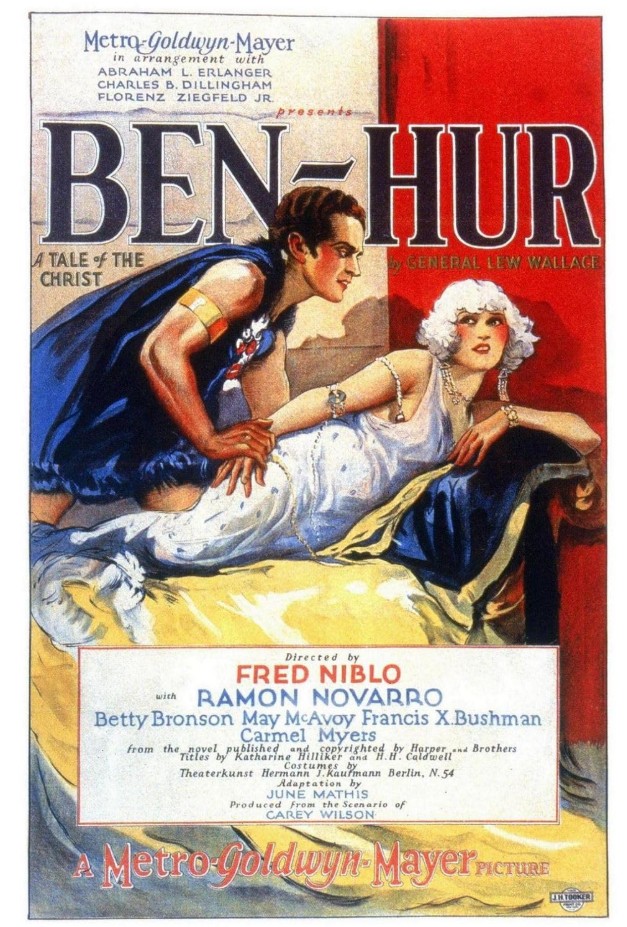
Ben-Hur: A Tale of the Christ (1925) poster created by Metro-Goldwyn-Mayer (MGM)

Things I liked about the film:

The acting: Actors in silent films are forced to rely on the physical appearance of their performance. This means they must utilize body language, facial expressions, and emotions to express what their characters are thinking and feeling. As I write this review, it’s difficult for me to choose a favorite performance in Ben-Hur: A Tale of the Christ. Each portrayal was so captivating, watching this movie was an engaging experience! When Judah Ben-Hur is sharing drinks with Messala, he displays a relaxed smile and sits in a comfortable position, believing Messala has his best interests at heart. But after learning he and Messala can no longer put their differences aside, Judah quickly becomes saddened by this reality. His eyes express the pain of losing a friend. He also adopts a slight frown, wondering why his friend would change. Because Ramon Novarro’s performance was so strong, it was able to speak where dialogue couldn’t.

In Ben-Hur: A Tale of the Christ, May McAvoy portrays Esther, the daughter of Simonides. What I loved about her performance was how expressive it was! During a conversation with her father, Esther learns some shocking information. Her eyes become wide as a horrified expression is painted on her face. The more information she learns, the more shocked Esther appears. This consistent portrayal shows concern on her face as well. Similar to what I said about Ramon Novarro’s performance, May’s performance said so much while saying so little.

Color coded film: When I reviewed 1925’s The Phantom of the Opera, I talked about how much I liked the movie’s color coded film. Color coding this presentation gave each part of the story its own distinct significance. Ben-Hur: A Tale of the Christ utilizes color coded film as well. The way the film-making technique was incorporated into the movie signified the time of day in the story. Parts of The Nativity were shown in blue tinted film, indicating these parts were set at night. Jerusalem is covered in a light-yellow tinted film, meaning Judah and Esther first meet in the daytime. Most of the scenes that were fully in color depicted Biblical events. The creative team behind Ben-Hur: A Tale of the Christ used color coded film in very clever and visually interesting ways!

The scope: “Sword and sandal” films have been known for large set pieces and presenting them in grand ways. This was accomplished in Ben-Hur: A Tale of the Christ through the use of long and medium shots. Through the streets of Jerusalem, soldiers from various countries march together in a parade. Some long shots show off a massive stone structure that makes the people look like toy figurines. Both long and medium shots capture the magnitude of the crowds, emphasizing how many people came to see the spectacle. There were even shots that showed each group of soldiers, presenting how the groups were great in size. Because of the cinematography, Ben-Hur: A Tale of the Christ looked and felt larger than life!

The title cards: A staple of silent films is the inclusion of title cards. Without the use of dialogue, these title cards feature conversations between characters and describe what was happening in the story. But what impressed me about the title cards in Ben-Hur: A Tale of the Christ is how some of them were written. Reflecting on his conversation with Messala, an accompanying title card shares Judah’s thoughts and states “In outward seeming you are the same. But in spirit – you are a stranger”. In my opinion, this was an eloquent way of stating how Messala has changed. Later in the film, Judah proclaims “I am revenged indeed, but to what profit!” This quote on the title card addresses how, to Judah, success isn’t everything. These are just two examples of how this aspect of Ben-Hur: A Tale of the Christ went above and beyond!

White horse image created by Gabor Palla at freeimages.com. “FreeImages.com/Gabor Palla.”

What I didn’t like about the film:

The randomness of Iras: Within the second half of Ben-Hur: A Tale of the Christ, the movie introduces a character named Iras. While I liked Carmel Myers’ performance, I found Iras’ inclusion in the story random. The film establishes she is in a romantic relationship with Messala. But this relationship doesn’t really lead anywhere, as these two characters only share one scene together. A scene later, Iras flirts with Judah. Even though he is initially attracted to Iras, Judah pursues his feelings for Esther. Looking back on Ben-Hur: A Tale of the Christ, I wonder what Iras’ significance in the story was supposed to be? Was she intended to represent temptation or did she originally have a bigger role in the film, only for some of her scenes to be left on the cutting room floor?

The downplaying of Christianity/faith: I talked about liking the incorporation of Christianity/faith when I reviewed 1959’s Ben-Hur. In that review, I discuss how certain Biblical events were included into the overall story and how faith affected the characters and their actions. There were Biblical events depicted in 1925’s Ben-Hur: A Tale of the Christ as well. But unlike the 1959 movie, Christianity/faith was more downplayed in the 1925 film. The story places emphasis on Judah’s quest for revenge instead of how faith guided his life. From what I remember, Balthasar (one of The Three Wise Men) plays a greater role in the 1959 movie. This creative decision was, in my opinion, disappointing, especially since Ben-Hur is one of the better faith-based films.
Chariot statue from the Roman Empire image created by Michel Meynsbrughen at freeimages.com. “FreeImages.com/Michel Meynsbrughen.”

My overall impression:

When it comes to cinema, a lot can happen in one hundred years. Trends come and go, technology changes, and color film becomes commonly used. But in those one hundred years, there are movies that stood the test of time. They achieved this by bringing something new to the table, finding their audience, or being at the right place at the right time. Ben-Hur: A Tale of the Christ from 1925 is one of these movies. It showed what “sword and sandal” films could and should be. Through cinematography, the scope of the project created a world that feels larger than life. The way some of the film’s title cards were written went above and beyond, showing how Ben-Hur: A Tale of the Christ’s creative team put thought and effort into their presentation. Though the movie has more flaws than its 1959 remake, the 1925 movie is a solid silent film! It was entertaining and engaging, due to the strengths of the project, like the acting and how color coded film was used. I’m also incredibly grateful for the restoration and preservation efforts made for Ben-Hur: A Tale of the Christ, especially since silent films have become less common in these one hundred years.

Overall score: 8.1-8.2 out of 10

Have you seen 1925’s Ben-Hur: A Tale of the Christ? Which silent films would you like to check out? Please tell me in the comment section!

Have fun at the movies!

Sally Silverscreen

Take 3: Kingdom of Heaven Review

This is my second year participating in the Rule, Britannia Blogathon. In 2020, I reviewed the 2002 adaptation of Nicholas Nickleby, a movie I ended up liking so much, I now want to read the source material. For the 8th annual event, I chose to write about another film from the 2000s; 2005’s Kingdom of Heaven. This is a movie I have heard about, but never got around to seeing. Until this blogathon, it had sat on my DVR for three years. Since the movie stars Orlando Bloom, a British actor, the Rule, Britannia Blogathon seemed like the perfect opportunity to finally check the film out. One of the few things I knew about this movie was that it had something to do with the Crusades. This is a time period I know very little about. However, this didn’t stop me from giving the film a fair chance. What did I think of this 2005 title? Keep reading if you want to find out!

Kingdom of Heaven poster created by Scott Free Productions, Inside Track, Studio Babelsberg Motion Pictures GmbH, 20th Century Fox, and  Warner Bros. Pictures

Things I liked about the film:

The acting: As I said in the introduction, Orlando Bloom’s involvement in this project is one of the reasons why I chose to review Kingdom of Heaven. Prior to watching the film, I had seen the Pirates of the Caribbean trilogy, where Orlando consistently portrayed Will Turner. While the character of Balian is similar to Will, each role is distinct. To an extent, Orlando’s performance in Kingdom of Heaven reminded me of Vincent Perez’s portrayal of Yanko from Swept from the Sea. While Balian is a masculine character, he also displayed a gentle charm. A good example is when Balian arrives in Jerusalem. He gives his prize horse to the servant of his opponent. When the servant asks why Balian would make this decision, Balian replies how he doesn’t want the horse to suffer.

In Kingdom of Heaven, Eva Green portrayed a queen named Sibylla. Despite appearing in the movie for a limited amount of time, I did enjoy watching her performance! I noticed how fluid Eva’s emotions were. This allowed her to adapt to any situation her character faced. It also helps that she was able to excel, acting wise, alongside her co-stars. Another character I wish appeared in the film more was King Baldwin IV. Portrayed by Edward Norton, this character was a leper. Therefore, he was completely covered and wore a mask. Edward’s use of body movement and expressive eyes make up for the lack of facial expressions. His approach to his role made King Baldwin IV a compelling character to watch!

The scenery: “Sword and sandal” movies are known for featuring breath-taking scenery. Kingdom of Heaven also brings beautiful scenery to the table, showcasing desert, oceanic, and forest landscapes. Toward the beginning of the movie, Balian resided in the French countryside. This area was surrounded by deep green forestry, the ground and trees lightly covered in snow. As Balian travels to Messina, the city is met with a clear, blue ocean. The hue of the water beautifully complimented the warm sandstone of the nearby buildings. While Jerusalem is in the middle of a desert, palm trees brought a pop of color to the environment. These plants helped make Jerusalem appear as an oasis.

The historical accuracy: I’m not familiar with this particular period in history. But based on the limited information I do know, the movie appeared to be historically accurate. Throughout the film, knight’s armor could be seen. Helmets, swords, and other related gear adopted an older style. Some of the swords boasted jewels, with Balian’s sword displaying a giant ruby. Even the attack towers from one of the film’s battles looked as if it came directly from the time of the Crusades. As I’ve said about other period films, details like the ones I mentioned show how much the creative team cared about the presentation of their project!

The 8th Annual Rule, Britannia Blogathon banner created by Terence from A Shroud of Thoughts.

What I didn’t like about film:

Sibylla’s unclear motives: During Balian’s time in Jerusalem, Sibylla becomes romantically interested in him. But she’s already married, a fact that Balian himself is aware of. Balian’s reason for going to Jerusalem was to seek forgiveness for his and his deceased wife’s sins. After meeting Sibylla, he, more often than not, doesn’t object to Sibylla’s romantic interest for him. I was left confused on what her motives were for wanting to be with Balian. At times, I wondered if Sibylla’s situation was similar to Rose’s from Titanic, simply stuck in a loveless relationship and desperately looking for a way out. Other times, I thought Sibylla was attempting to seduce Balian toward sin. I wish these motives were clarified in the script.

A limited incorporation of religion/faith: Because Kingdom of Heaven takes place around the time of the Crusades, I was expecting religion/faith to be one of the cornerstones of this story. While the topic is included in the film, its incorporation is very limited. Before watching this movie, I thought the story was going to be similar to 1959’s Ben-Hur, with the protagonist trying to live his life as a man of the people and of faith. But we never get to see Balian’s internal struggle with these responsibilities. Instead, the audience sees Balian resolve smaller non-religious conflicts which lead to a much bigger conflict. Even though people can be seen praying, there is more to religion/faith than prayer. The script relied more on who would rule Jerusalem than how religion/faith played a role within that world.

A more episodic story: When it comes to “sword and sandal” movies, there is usually an overarching conflict the characters work to resolve over the course of the story. But in Kingdom of Heaven, most of the story is episodic. As I said earlier, Balian wants to go to Jerusalem to seek forgiveness for his and his deceased wife’s sins. Once he has achieved his goal, he moves on to another conflict that is resolved within a short amount of time. This is how the story plays out for about the first half of the movie. There is a major conflict that receives a lot of attention in the film’s second half. However, it feels more like a climax than an event the characters are working towards.

White horse image created by Gabor Palla at freeimages.com. “FreeImages.com/Gabor Palla.”

My overall impression:

Two years ago, I reviewed 1959’s Ben-Hur, a classic “sword and sandal” film. Despite seeing it for the first time, I was over the moon by the strength of the movie’s quality. With Kingdom of Heaven, I didn’t feel the same way. Yes, the 2005 title is a fine, well-made production. But there were times I was confused as I followed along with the story. Like I mentioned in my review, Sibylla’s motives for being romantically interested in Balian were not made clear. However, this is one example of my confusion. Even though this movie was released over ten years ago, I won’t spoil it for anyone who hasn’t seen it. But I will say that something happens toward the end of the film that left me wondering if everything the characters worked for was worth it. As someone who knows very little about the Crusades, I was hoping to use my movie viewing experience as a learning opportunity. While I did learn some information, I feel there’s far more I need to discover. I’ve heard there is a director’s cut of Kingdom of Heaven. If this information is true, maybe I’ll check it out and see which version I like more.

Overall score: 7.2 out of 10

Have you seen Kingdom of Heaven? What is your favorite “sword and sandal” film? Tell me in the comment section!

Have fun at the movies!

Sally Silverscreen