Whenever a new tool, idea, or concept has been introduced in Hope Valley, it has been used for the greater good of the town. The more recent addition of radio technology serves a perfect example. In this episode of When Calls the Heart alone, the radio has educated listeners, provided a platform for debates and discussions, even entertained. The radio has become a positive inclusion to Hope Valley. Other ideas have made Hope Valley a better place, from the iconic Jack Thornton School to the town’s Christmas festivities. While some of these ideas are not frequently presented on the show, they have left their mark on the history of When Calls the Heart. I haven’t given much thought to the overarching theme of new ideas serving Hope Valley’s greater good until I reflected on this episode, as well as the show as a whole.
Just a reminder: If you did not see this episode of When Calls the Heart, there will be spoilers within this re-cap.
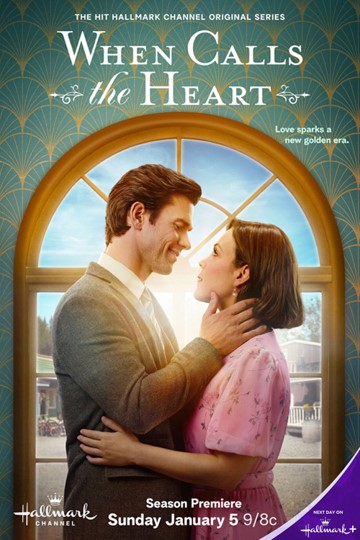
When Calls the Heartseason twelve poster created by Hallmark Media, Crown Media Family Networks and Hallmark Channel
Season: 12
Episode: 8
Name: The Show Must Go On
Major stories:
Rowlin Rockwell (Randell’s cousin), from Benson Hills Broadcasting, pays Rosemary and Fiona a visit in Hope Valley. He informs the ladies of the Daily Dialogue’s low listenership numbers, even lower than a radio show about animal sounds. In order to impress Rowlin, Rosemary quickly comes up with the idea of bringing her production of The Importance of Being Earnest to the radio. Rowlin is so impressed with this idea, he tells Rosemary she has to present the play the next day. At rehearsal later that day, when Rosemary announces this change in plans, Mike confesses he has a sore throat. Ava recommends Mike pay the hot springs a visit. Lee and Bill also take Ava’s advice. But the next day, Mike, Bill, and Lee end up sick with Laryngitis. This stresses Rosemary out because this means about half of the play’s cast is too unwell to perform. After some encouragement from the ladies of Hope Valley, Rosemary decides to host an all-female radio production of The Importance of Being Earnest instead. The performance ends up being a success! Even Rowlin’s family liked it!
Lucas hosts a meeting with the local ranchers about Allie and Oliver’s proposal. The most vocal objection comes from a rancher named McGinty. He doesn’t believe the ranchers should move their cows to a new pasture to cater to the local wildlife. The other ranchers agree with him, even Edie stands by McGinty’s opinion. But later in the episode, Edie reveals to Lucas McGinty has tricked the other ranchers, including her uncle, into signing a loan to use his land. This is the result of a mudslide destroying a path to a pasture years ago. At the meeting, Allie recognizes McGinty’s boots, believing he helped cover up cow tracks near the river back in this season’s sixth episode. Meanwhile, Nathan shares with Bill how Toddy claims a rancher gave him small batches of gold coins for five to six years. When the rancher passed away, Toddy stopped receiving the coins. Nathan tells Bill the remaining coins were sold in Amsterdam and the identity of the rancher is Ernest “Ernie” Martell, Edie’s uncle. When Bill and Nathan question Edie about Ernie’s acquisition of the coins, she claims to have no idea what they are talking about.
Elizabeth is scheduled to appear on an episode of the Daily Dialogue. During the recording of the episode, Elizabeth discusses her project-based learning idea with Eileen Bennett, a Superintendent from the Department of Education. Eileen doesn’t think Elizabeth’s idea is bad. However, Eileen believes the classroom’s purpose is to prepare students to be academically competitive. This lack of whole-hearted support makes Elizabeth feel discouraged. For most of this episode of When Calls the Heart, Elizabeth focuses on assisting Rosemary with the play. But after the radio performance, Elizabeth discovers a collection of letters from teachers who listened to her Daily Dialogue episode. The letters are supportive of Elizabeth’s idea, with some teachers even adopting project-based teaching. Using Nathan’s suggestion, Elizabeth reads some of the letters on The Valley Voice Radio Hour.
After selling her barber shop, Fiona still plans on marrying a man named Harold. She confesses to Faith her reason for wanting to get married; Harold is a lawyer who could help Fiona make a difference. Fiona even asks Faith to be her Maid of Honor. Later in the episode, Elizabeth shares with Fiona her reason for breaking up with Lucas in season ten; the relationship didn’t feel right in her heart. She also encourages Fiona to follow her heart and tells her how she should spread her wings to fly. After the radio performance of The Importance of Being Earnest, Rowlin is not only thrilled with the success of the play, he also likes the successful response of Elizabeth’s Daily Dialogue episode. He reveals to Fiona and Rosemary he just acquired a license for a new radio station in Port Townsen and wants to recruit them to be in charge of the station’s programming. While Rosemary turns down the offer, Fiona accepts. Before leaving for her new adventure, Fiona mentions calling off her engagement to Harold. As a going away present, Faith gives Fiona a locket, so she can fill the locket with what her heart desires.
Now that When Calls the Heart is more than halfway through season twelve, I’ve noticed parts of the story introduced earlier in the season have been abandoned. Back in this season’s third episode, Lee reveals to Faith how his father died of an unnamed medical condition. He even shares his concerns of developing the medical condition himself. Since then, the story has not acknowledged this part of Lee’s medical history. With four episodes left in season twelve, I’m not sure how that can be resolved?
In this season’s second episode, Allie was concerned about not having a special interest. But what started as a chance encounter with an animal print in the dirt led to Allie’s interest in the Great Timber Wolf. Allie’s story in season twelve has been well-written. It has provided her with character development, helped her make a new friend, and connected with one of the season’s major stories. I do wonder if Allie will, indeed, find a way for the Great Timber Wolves to return?
As I mentioned in this re-cap, Elizabeth receives letters from teachers who support her project-based learning idea. Some teachers even claimed they were already utilizing project-based teaching in their classroom. Based on those letters, I got the impression those teachers were using project-based teaching before Elizabeth came up with her idea. With that said, why did Elizabeth submit her idea for publication if her idea already exists?
In Elizabeth’s opening monologue in this When Calls the Heart episode, Elizabeth says Fiona “makes everything seem possible”. Looking back on Fiona’s time on this show, there’s truth to Elizabeth’s statement. Ever since her debut in season six, Fiona has accomplished whatever she’s set her mind to. She has helped bring telephone technology to Hope Valley, started her own business, and even assisted Rosemary with her radio show. Fiona has also been a friend to lean on, a provider of advice, and a contributing member of Hope Valley. Fiona is just one example of how the show’s characters have found success not only in Hope Valley, but in the world of When Calls the Heart. In fact, I can’t think of a character on this show who hasn’t received a success story. I haven’t read the books this series is based on. However, I would assume some of the overarching themes in those books are achieving personal success and accomplishing goals.
Just a reminder: If you did not see this episode of When Calls the Heart, there will be spoilers within this re-cap.
When Calls the Heartseason twelve poster created by Hallmark Media, Crown Media Family Networks and Hallmark Channel
Season: 12
Episode: 7
Name: Dance the Night Away
Major stories:
Elizabeth surprises Nathan with tickets to Buster Keaton’s new movie! So, the pair travel to the city to embark on their adventure. After enjoying the movie, Nathan and Elizabeth cross paths with Toddy Davis, who still believes Nathan is an estate dealer named Danny. When Toddy’s wife, Trudy, approaches the group, she invites Elizabeth and Nathan to a party she and Toddy are hosting that night. Keeping up the appearance of Danny and his wife, Diane, Nathan and Elizabeth accept the invitation. At the Davis’ party, Elizabeth and Nathan make up their relationship’s backstory as they go along. As Elizabeth and Nathan talk about “their song”, Trudy encourages them to sing it. So, the pair effortlessly perform “their song” in front of the party guests. Before Elizabeth and Nathan leave, Toddy offers Nathan some gold pocket watches with a double-headed bird on them. Toddy claims the watches came from a rancher who passed away the previous year. Nathan tells Toddy he’ll check in with his “buyer”.
After seeing a performance of The Importance of Being Earnest in Cape Fullerton, Rosemary is inspired to host her own presentation of that play. She recruits some of Hope Valley’s residents to fill each role. One eager participant is Ava. One evening, at rehearsal, Ava presents her knowledge of the play by reciting some lines from the script. She claims she performed The Importance of Being Earnest at her boarding school in Maryland. Surprised by Ava’s acting experience, Rosemary puts her in charge of the prop department. Ever since Ava came to Hope Valley, Rosemary hasn’t liked her. That evening, after rehearsal, Rosemary shares with Lee how she thinks Ava is too dramatic. Lee reminds his wife how she was once known for being too dramatic and how there’s no one like her. Eventually, Rosemary decides to give Ava a part in her production.
Theater seats image created by weatherbox at freeimages.com. “FreeImages.com/weatherbox.”
Minor stories:
While hiking in the forest, Oliver and Allie discover an unclaimed pasture. This discovery inspires the duo present their findings to Lucas. Allie and Oliver propose a solution for the cows to roam and the salmon to spawn. Lucas actually likes their idea, believing it could be the best of both worlds. He even presents the idea to Edie. She encourages Lucas to draft a proposal for the idea to, at least, be considered. But later in the episode, during a card game, Edie tells him to forget the unclaimed pasture even exists. When Lucas asks her why, Edie says it’s lawyer/client confidentiality. Not happy with this response, he ends the card game early.
Fiona receives an offer for her barber shop. Before she can accept the offer, Fiona needs to check with her business partner, Mr. Weaver, first. While she’s waiting for Mr. Weaver’s approval, Mei pays Fiona a visit at the barber shop. Sensing Fiona may be sacrificing her own happiness, Mei reminds her friend how she has a spark and must follow it. After hearing this advice, Fiona gets the call from Mr. Weaver approving of the barber shop’s offer. A few moments later, a sold sign to put on the barber shop’s door.
As I said in this re-cap, Elizabeth and Nathan play the roles of Diane and Danny. What works in their favor is how no one at the party knew who they were. But I find it hard to believe no one recognized Elizabeth, especially after she became an author. Elizabeth’s book about living in Hope Valley drew Ava to visit the town for herself. She even recognized Elizabeth the moment they met. It’s unknown if Elizabeth’s book was a bestseller in the world of When Calls the Heart. If her book or even her project-based learning lesson plans bring her any amount of celebrity status, the idea of Elizabeth being unrecognizable seems unrealistic.
Season twelve of When Calls the Heart is now a little past the half-way point. At this time, Hearties are no closer to learning the truth about Ava, as her story has just given them more questions. I understand the show’s creative team need to keep their audience invested in the story throughout the season. But I’m worried all this build-up may lead to an underwhelming reveal of who Ava truly is. This, kind of, feels reminiscent of how Mei’s story was drawn-out back in season nine.
In this re-cap, I mentioned Fiona selling her barber shop. While it’s sad to see a beloved Hope Valley business sold, I wonder what the fate of the barber shop will be? Will it remain as a barber shop or become a completely different establishment? With Elizabeth and Nathan going to the movies and Rosemary producing a play, could this be foreshadowing Hope Valley finally receiving a theater?
Three years ago, I created a tier rank list of every Hallmark Hall of Fame movie I’d seen. These films were categorized by my overall impression of each presentation. In honor of 18 Cinema Lane turning five, I promised my readers I would revisit one of my past articles. I’ve seen more Hallmark Hall of Fame movies since I published my original tier rank list, so that’s the article I’ve selected! Along with adding more Hallmark Hall of Fame productions, I changed the names of each tier category. This decision was made to better reflect whether a film is worth its retail price of twenty dollars a DVD compared to its quality. The new tier category names are the following:
Bottom of the Barrel – Not Even Worth a Dime
Ok – Catch it on TV/Youtube
Decent/Fine – Bought It at a Garage Sale for a Dollar
Good – Get It On Sale for Half Off
Great – Where Do I Pay Full Price?
For each movie I added or moved to a different tier, I will share my thoughts on them. If I wrote about a movie on my blog, I will add the link to this article.
Screenshot taken by me, Sally Silverscreen
Bottom of the Barrel – Not Even Worth a Dime
Durango
Reviewed for the Legends of Western Cinema Week Blogathon, I stated Durango should have been a David and Goliath story. That’s because a David and Goliath reference was placed within the last nineteen minutes of the movie, the creative team’s attempt to include a higher stake into the story. But this attempt didn’t work because the majority of the film had lower stakes. The protagonist and his plan to transport cattle worked out perfectly, too perfectly for the standards of the western genre. This takes away any room for concern the audience could have for the characters and their well-being.
As I explained in my list of the top ten worst movies I saw in 2022, the audience was not given a reason to care about the characters and their story in Journey. This flaw was achieved because the film’s creative team didn’t provide explanations for the characters’ choices. It also did not help how annoying Grandpa Marcus was, his photography hobby becoming an obsession. A major theme of Journey is memories being irreplaceable. That theme was poorly delivered in Journey, as Marcus’ hobby creates a plot hole within the story. Also, I’ve seen Hallmark Hall of Fame movies express this theme better, such as The Lost Valentine.
A Place for Annie
When it comes to movies that are products of their time, they can fit into one of two categories: movies that serve as visual time capsules and those that are dated on arrival. A Place for Annie, sadly, falls into the latter category. The majority of the story focuses on the medical information of HIV/AIDS that was known during the late ‘80s to mid ‘90s. That focus causes the film to show its age more obviously. The way foster care/adoption is discussed in this story is so oversimplified, I couldn’t take that part of the movie seriously. Similar to what I said about Journey, the theme of adoption is expressed better in other Hallmark Hall of Fame stories, like Redwood Curtain.
The Corsican Brothers
Alexandre Dumas’ stories are, more often than not, filled with adventure, intrigue, and suspense. But in the case of The Corsican Brothers, these elements were lacking. Granted, I still haven’t read the book this movie is based on. Though I do wonder how similar the 1985 adaptation is to the source material? If the original story primarily revolves around Louis attending fancy events in Paris, that would explain why the adaptation is so underwhelming. However, the original story could explain some of the confusing parts of the movie, such as the woman giving some of the characters fates.
The 1996 movie, The Summer of Ben Tyler, feels like Hallmark Hall of Fame wanted to create their own version of To Kill a Mockingbird. Upon reflection of this film, it doesn’t seem like the creative team displayed a strong understanding for what made Harper Lee’s story work. If anything, it feels like ideas are copied from Harper’s novel and pasted into the Hallmark Hall of Fame presentation, making The Summer of Ben Tyler a little too similar to To Kill a Mockingbird. This is a case of if you’ve seen one movie, you’ve basically seen the other. So, if you’ve seen the adaptation of To Kill a Mockingbird, you’ve already seen The Summer of Ben Tyler.
Decoration Day
The way I feel about Decoration Day is similar to Promise; the majority of the story is very “slice-of-life”. To me, this makes both films less memorable than other Hallmark Hall of Fame titles. However, I did find Gee Pennywell’s dilemma over receiving the Congressional Medal of Honor the most interesting part of the movie. In fact, I wish Decoration Day had solely revolved around that dilemma.
Foxfire
Hallmark Hall of Fame has a history of adapting plays into films. Sometimes, a movie’s creative team will take advantage of the expansive nature of cinema, allowing the story to move beyond the boundaries of the stage. For Foxfire, though, the story was confined to the four walls of Annie’s house. A smaller cast and a condensed story also caused the 1987 Hallmark Hall of Fame project will feel more like a televised play. If I choose to watch Hallmark Hall of Fame film, I expect to watch a film. Foxfire subverted my expectations, but in a disappointing way.
Calm at Sunset is one of those movies where better, more interesting ideas were woven into the fabric of this story. One example is when the protagonist spots a cruise ship and imagines the types of people aboard that ship. Honestly, I wish Calm at Sunset was about that cruise ship instead. Similar to what I said about The Corsican Brothers, I haven’t read the book this movie is based on, so I don’t know which parts of the production came straight from the source material. If the book is pretty close to the film, it would explain why the adaptation was lackluster.
Witness for the Prosecution
Based on the adaptations of Agatha Christie’s books I’ve seen, the protagonist will play an active role in solving the mystery. Witness for the Prosecution is the exception to this statement, as Wilfred focuses more on the legal case he’s working to resolve. In a story where the protagonist doesn’t actively solve the story’s mystery, it can be difficult to get the audience invested in the story itself. Because Wilfred’s case is the primary focus of the story, the film is more dialogue heavy, putting emphasis on telling instead of showing. Hallmark Hall of Fame’s Witness for the Prosecution is a mystery that is light on the mystery.
In my editorial about the adaptation of The Flamingo Rising, I explained how the story should have been adapted into a television show or a multi-part mini-series. This is because the story itself is drawn out over the course of the protagonist’s life. Reflecting on the adaption, it felt like Hallmark Hall of Fame tried to fit The Flamingo Rising into their brand of storytelling. In this attempt, several parts of the source material were omitted or changed due to them not being “Hallmark appropriate”. As I did in the aforementioned editorial, I questioned why Hallmark Hall of Fame would choose to adapt Larry Baker’s story over a story that was more “Hallmark appropriate”?
Having read the source material and seen the adaptation of O Pioneers!, I can say the movie is respectful toward the book. With that said, if you’ve seen the film, you’ve already read the novel. Speaking of the adaptation, I said in my review how the story should have been adapted into a mini-series or a television show. With so many characters and so many parts of the story, maybe O Pioneers! would have benefitted from receiving more time. The 1992 Hallmark Hall of Fame presentation is a western that didn’t leave a memorable impression on me.
I’ve stated before on 18 Cinema Lane how the 1972 adaptation of Harvey is better than the original from 1950. While this statement is still true, the 1972 and 1950 versions of this story felt like a copy of one another. It makes me wonder why Hallmark Hall of Fame would choose to adapt Harvey if they knew they were going to make a lot of the same creative decisions as the original film? Despite the similarities, I did like the changes in the 1972 adaptation. One example is how the made-for-tv movie chose a dramatic tone for their version of the story instead of being both a drama and comedy.
Decent/Fine – Bought It at a Garage Sale for a Dollar
The Locket
For a movie titled The Locket, the locket itself is treated as an afterthought. What the story focuses on instead is the protagonist and his hardships. But from what I remember, the 2002 project addressed the importance of elder care. Since that topic is rarely brought up in Hallmark’s programming, I appreciate that creative decision. Marguerite Moreau is one of the reasons why I chose to watch The Locket. Her performance was so good, she ended up outshining the other actors in the movie! Unfortunately, Marguerite was kind of under-utilized in this film, as her on-screen appearances were not as consistent as I expected.
I said in my review of Saint Maybe how the adaptation is faithful to the source material. However, there are changes the film made from the book. One notable example is how religion/faith is downplayed in the Hallmark Hall of Fame presentation. Meanwhile, religion/faith played a significant role in the novel. For years, Saint Maybe was included in Hallmark Movies & Mysteries’ ‘Miracles of Christmas’ marathon. Now that I have seen the adaptation, I understand why the network would make this decision. Personally, I wouldn’t call Saint Maybe a Christmas story/movie, as the story itself takes place over several years.
The Lost Child serves as a good introduction to Native American culture, specifically the Navajo culture. Through dialogue and character interactions, the audience receives a glimpse into life on a Navajo reservation. For the story itself, The Lost Child didn’t leave a strong impression on me. The most interesting part of the film, Rebecca’s search of her family, wasn’t emphasized as much as her adjustment to reservation life. Also, Rebecca’s search for her twin brother was abandoned after she meets her biological family.
I’ve finally seen Loving Leah in its entirety! The way I feel about the 2009 movie is similar to The Lost Child; it’s a good introduction to Jewish religion and culture. Throughout the story, the audience receives a glimpse into the many aspects of Jewish life. Like The Lost Child, Loving Leah didn’t leave as strong of an impression as other Hallmark Hall of Fame titles. From what I remember, the story was a little too drawn out. But from what I also remember, it was nice to see the protagonists’ relationship unfold. With all that said, the movie was pleasant!
Good – Get It On Sale for Half Off
An American Story/After the Glory
Since publishing my review of An American Story/After the Glory, it has become one of my most popular reviews, garnering 1,838 views and counting! The innovative and compelling nature of the project is likely the reason why this particular title is so well-received on 18 Cinema Lane! Like I said in my review, An American Story/After the Glory felt kind of ahead of its time. This feeling is achieved by incorporating the discussion of veterans’ mental health into the script. The way veteran related topics are included in the story is reverent and respectful. An American Story/After the Glory is definitely one of Hallmark’s better military themed productions!
The Love Letter is one of Hallmark Hall of Fame’s more unique titles, as fantastical elements are rarely found in this collection of films. Yet this part of the story worked in the 1998 movie, helping to create a love story that was simple yet intriguing! The characters were not only well written, but also well-acted! Since the protagonists were multi-dimensional, their connection throughout the film was interesting to watch. I also liked the historical accuracy in The Love Letter, as the attention to detail was handled with care!
In my five years of movie blogging, I have discovered very few films that were better than their respective source material. Hallmark Hall of Fame’s Redwood Curtain is one of those films, as I found myself liking it over the play! The movie’s creative team took advantage of the expansive nature of cinema, broadening the horizons in Geri’s life. More characters were added to the story, giving them characterization that the play didn’t provide. Geri’s personality was more likable in the movie, which made me like her as a character. Redwood Curtain is a Hallmark Hall of Fame presentation I wish was re-released on DVD.
As of the publication of this list, Caroline? is, so far, the best movie I’ve all year! That’s because the 1990 production is a close to perfect example of what a Hallmark Hall of Fame presentation can and should be. From the younger actors’ performances to the differentiation of time, I could tell there was a lot of effort and care put into this project! Even though the story of a long-lost family member’s return is nothing new, the way Caroline? was written was creative, allowing this story to have its own identity. This movie is one I wish more Hallmark fans acknowledged!
During my blogging years, I have seen Charles Dickens adaptations I have liked. The 1980 version of A Tale of Two Cities is definitely one of those films! Despite the movie being two hours and thirty-six minutes, the story never felt too long. The immersive nature of the story helped the pacing, as I was invested in what was happening on screen. This Hallmark Hall of Fame production was so good, it makes me want to read the source material! It’s also another film from this collection that deserves more recognition!
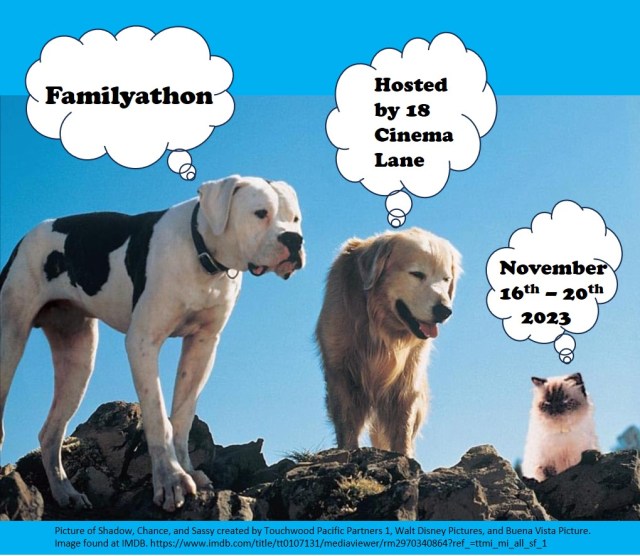
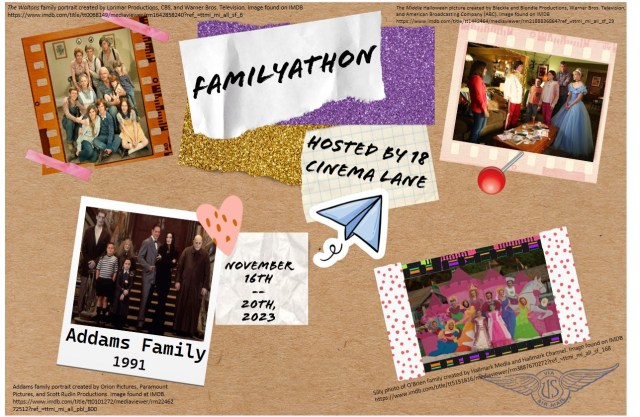
Hello everyone! This post is to remind anyone who is interested in participating in the Familyathon Blogathon that there is still time to sign up for the event! Information about the blogathon can be found at the link below:
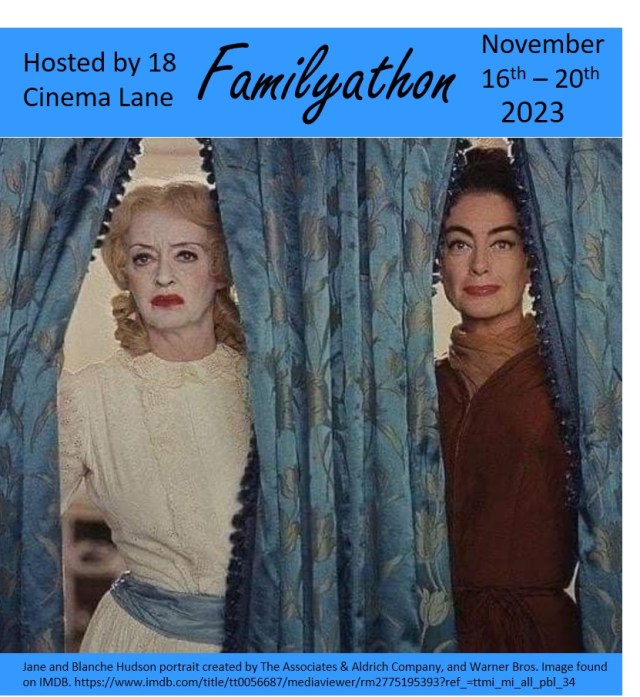
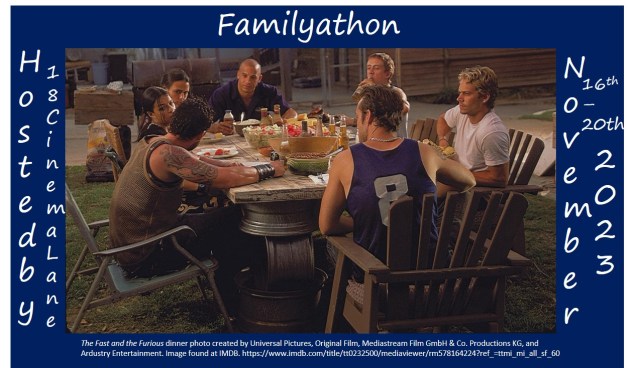
As I was coming up with a theme for my next blogathon, I first reflected on late Autumn to early Winter, the time when the event will take place. Several holidays where family gathers together take place during this time of year. This common theme inspired my new blogathon, which is called “Familyathon”! November 16th to 20th is when the event will take place. Since the subject of ‘family’ is so broad, I’ll list some ideas on potential topics:
Themes relating to the subject of ‘family’ (ex: how of the theme of ‘family’ is woven into the Fast & Furious franchise)
Stories revolving around a family (ex: I Remember Mama, The Middle, etc.)
Characters joining a family (ex: birth, marriage, adoption, etc.)
Characters departing from a family (ex: someone going to college, someone moving out of the neighborhood, etc.)
Families losing a family member (ex: a family member passing away, a family member going missing, etc.)
Stories about siblings (ex: What Ever Happened to Baby Jane?, etc.)
Stories of “found family” (a group of unrelated people forming their own family)
The subject of ‘family’ from a pet’s perspective (ex: Homeward Bound: The Incredible Journey, etc.)
Familyathon blogathon banner created by Sally Silverscreen of 18 Cinema Lane
If you’re interested in joining Familyathon and have an idea in mind, here are the official rules every participant must follow:
Please be respectful toward other participants and the subject(s) you’re writing about
Please let me know in advance if you plan on publishing your post(s) earlier or later than the allotted time-frame (November 16th to 20th).
Only new posts will be eligible for the event.
Duplicate entries will not be allowed, as the subject of ‘family’ is broad.
Each participant can only submit a total of three entries.
All entries must be original work.
Subjects from any genre, year, or country are allowed.
If you’re interested in participating, please share your idea(s) in the comment section below.
Choose one of the four banners and let others know about Familyathon!
Participants of Familyathon
Sally from 18 Cinema Lane – Review of …and Your Name Is Jonah (1979)
Gill from Realweegiemidget Reviews — A list article of the theme of family from the Fast and Furious franchise
Rebecca from Taking Up Room — Review for Life Begins for Andy Hardy (1941)
Hamlette from Hamlette’s Soliloquy — Review of Mr. Mom (1983)
Ruth from Silver Screenings — Review of Old Yeller (1957)
Quiggy from Midnite Drive-In — Review of The Godfather(1972)
Erica from Poppity Talks Classic Film — Review of Sabrina (1954)
Grace Avender — A list of Grace’s top five favorite families
Katherine — An article about Katherine’s three favorite film families
Familyathon blogathon banner created by Sally Silverscreen of 18 Cinema Lane
Familyathon blogathon banner created by Sally Silverscreen of 18 Cinema Lane
Familyathon blogathon banner created by Sally Silverscreen of 18 Cinema Lane
As the sun begins to set on 2022, it’s time to publish my best and worst movies of the year lists! Last year, every film on my best list had been reviewed on 18 Cinema Lane. But that’s not the case this time around. For this list, only two movies were not reviewed, while another movie served as an editorial subject. Any film I covered on my blog will have a link included in this post. I’m thankful another year was filled with more good movies than bad. I’ll even have more titles in my Honorable Mentions! While these lists have become great traditions on their own, the variety of this collection of films has become another tradition. So, without any delay, let’s begin the list of the best movies I saw in 2022!
Honorable Mentions
Cut, Color, Murder, Sailor Moon S: The Movie, Cyrano de Bergerac (1950), Children of a Lesser God, Sweet Revenge: A Hannah Swensen Mystery, Aurora Teagarden Mysteries: Honeymoon, Honeymurder, The Princess and the Pirate, Dirty Little Secret, Singin in the Rain, McBride: Tune in for Murder, McBride: Dogged, McBride: Requiem, Hugo, Akeelah and the Bee, The Shoplifting Pact, and Secrets at the Inn
When I reviewed the 1971 musical back in February, I said it was too early to say whether it would be one of the best movies I saw this year. But Fiddler on the Roof captivated me so much, the film ended up on my annual top ten list! I described the movie as a well-made quilt, with each of the film’s strengths representing a different quilt piece. The inclusion of Jewish faith/culture also gave the project a unique identity by asking questions and discussing topics that aren’t often found in musicals. Looking back on this movie, Fiddler on the Roof was three hours well spent. It’s a special project in both the world of musicals and cinema. I hope to check out more Jewish cinematic stories in 2023!
Out of all the movies on my best list for 2022, The Lost Empire/The Monkey King is the most unique one! A fantasy film based on Chinese folklore, this was an imaginative production I enjoyed watching. The story was sometimes thought-provoking and even somewhat educational, as it included literature related discussions. Strong acting performances brought to life characters who seemed believable. The set designs boasted a realistic and fantastical setting, which effectively presented the illusion of an immersive world. I wish Hallmark created more movies like The Lost Empire/The Monkey King, where the stories and ideas are more creative. With the network prioritizing rom-coms and dramas, though, I don’t know what their decisions will be in the new year.
Talking about this movie is bittersweet, as it is the last film in the Aurora Teagarden series. I’ve thought about all the moments the fans will never get to see, such as Aurora and Nick’s first Christmas, Phillip’s college graduation, and Sally falling in love. But if this is where the story must end, at least it ended on a strong note. The realistic and supernatural elements of the story complimented each other nicely. Supernatural elements being incorporated at all gave this chapter a more creative approach to the series. It was nice to spend time with Lawrenceton’s favorite residents; the acting performances and on-screen camaraderie remaining consistent. Even though I would have loved to see the Aurora Teagarden series continue for many more years, I know nothing lasts forever. But as the saying goes “Don’t cry because it’s over. Smile because it happened”.
7. Redwood Curtain
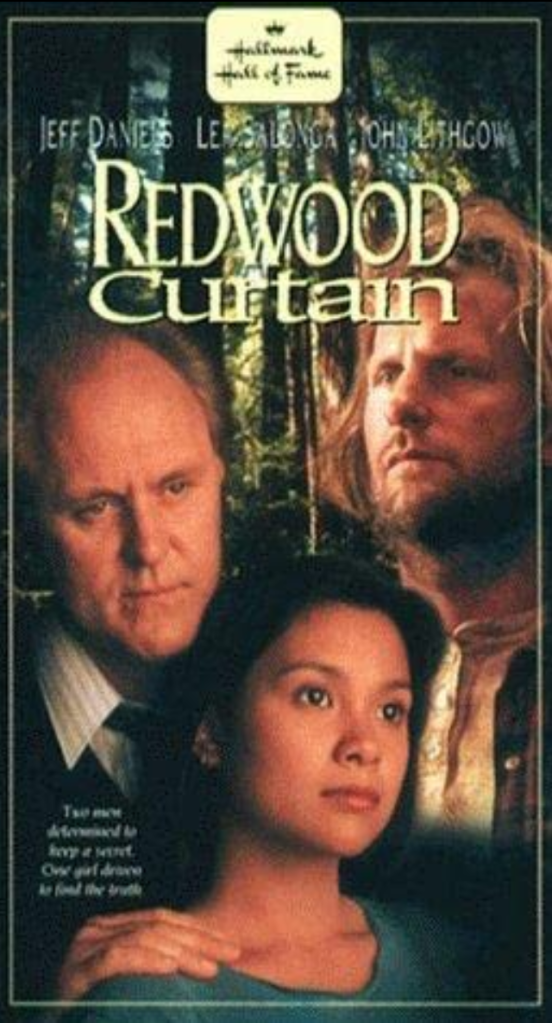
There are very few movies I found better than their source material. Redwood Curtain just so happens to be one of them! The creative team behind the Hallmark Hall of Fame adaptation took advantage of the expansive nature of film by providing the story with more locations. Allowing characters like Julia and Laird to appear in the movie showcase the Riordan family dynamic not present in the play. I found Geri more likable as a character in the movie. Lea’s performance paired with the screenwriting gave Geri an empathetic and understanding personality. Redwood Curtain is a Hallmark Hall of Fame presentation I wish was re-released on DVD.
The Pit and the Pendulum was one of the biggest pleasant surprises of 2022! Despite the film not being my first choice for its respective blogathon, I thought it was engaging and entertaining. Vincent’s performance didn’t disappoint, as his portrayal of Nicholas was versatile and fueled on emotion. The mystery not only started right away, but it also allowed the audience to experience the journey alongside Francis, the main character. The Pit and the Pendulum is, to me, one of the more effective horror movies, like 1962’s Cape Fear. While this film would be a perfect choice to watch on Halloween, I’m glad I had the opportunity to see it around Vincent’s birthday!
Redwood Curtain poster created by Chris/Rose Productions, Hallmark Hall of Fame Productions, American Broadcasting Company (ABC), and Republic Pictures (II)
5. The Song of Bernadette
And another film of Vincent’s joins my list! Faith based films come in two forms; those that emphasize a message and those that emphasize a story. The Song of Bernadette falls into the latter category, as it revolves around religious phenomena affecting a small town. What I like about the 1943 film is how different perspectives relating to the phenomena are explored, highlighting how various members of the town view the events unfolding. The story doesn’t choose sides on the main topic, allowing the audience to come to their own conclusions about what is taking place in the movie. Even though The Song of Bernadette was released during the Breen Code era, the film is a good representation of the quality from that period in cinema. As I said in my review, Easter would be an appropriate time to watch the movie!
Heaven Is for Real shares a major similarity with The Song of Bernadette. The 2014 film also revolves around religious phenomena affecting a small town. But what Heaven Is for Real does differently is encourage the audience to have a conversation about their beliefs on Heaven. Like I previously stated, faith based films come in two forms; those that emphasize a message and those that emphasize a story. However, I’ve rarely seen a movie of this nature start a discussion about one of their themes. This creative decision brings something new to the table and gives Heaven Is for Real a unique identity.
3. Words on Bathroom Walls
It seems like I’ve been talking about this title for as long as my blog has been around. But I’m glad I finally got the chance to see Words on Bathroom Walls this year, as it was such a good adaptation! There were changes between text and film. Despite that, the adaptation was, for the most part, respectful to its source material. The visual presentation of the story gave the audience a glimpse inside Adam’s mind. Interactions between the characters were believable, thanks to the actors’ performances and screenwriting. As I mentioned in my review a month ago, the adaptation for Words on Bathroom Walls seems more underrated. Based on the response my review received, my statement may be wrong.
I’m going to be honest; I had low expectations for Top Gun: Maverick. That’s because sequels released over ten years after their predecessor can be hit or miss. Top Gun: Maverick ended up surpassing my expectations, making it in the top three of my best of the year list! From what I know about Top Gun, the sequel respected what came before it. At the same time, new elements were added to the story, like focusing on an overarching mission. In a cinematic landscape where a film receiving over a billion dollars has become a rarity, Top Gun: Maverick achieved what some studios only dream of. As the 2020s move forward, maybe more filmmakers will turn to this film as an example of what can be cinematically possible.
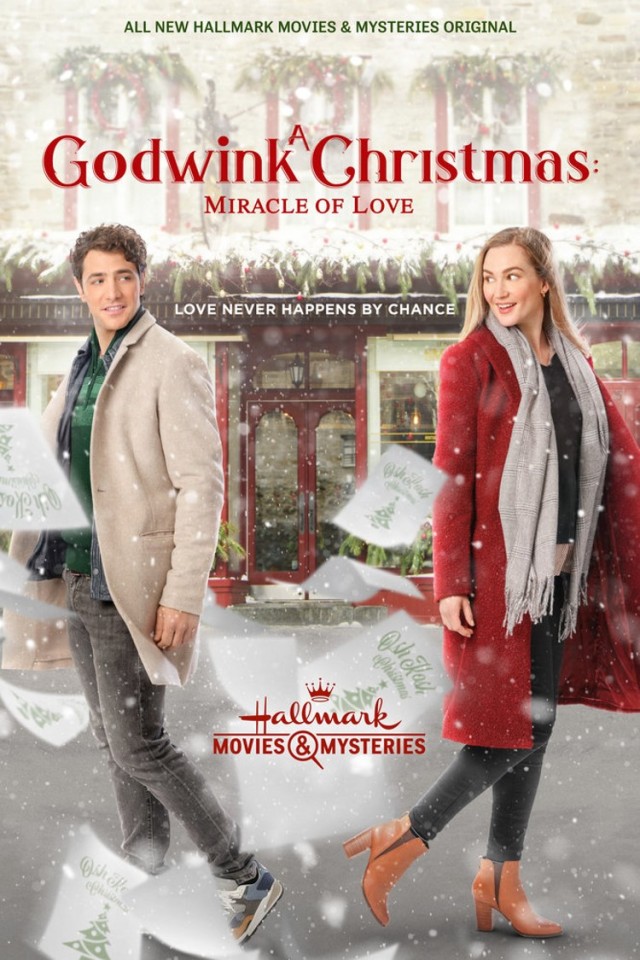
When it comes to “Godwink” stories, I prefer those that focus on a conflict. While that is the case for A Godwink Christmas: Miracle of Love, I found the overall production impressive! The interactions among the characters, as well as each volunteer’s talent being showcased, provided a nice amount of character development. Christmas activities were incorporated in more unique ways, such as the Romero family’s gift exchange. The inclusion of Advent was a newer approach to the Christmas movie genre. I don’t know what’s in store for the Godwink series. But I’d love to see more adaptations of these stories!
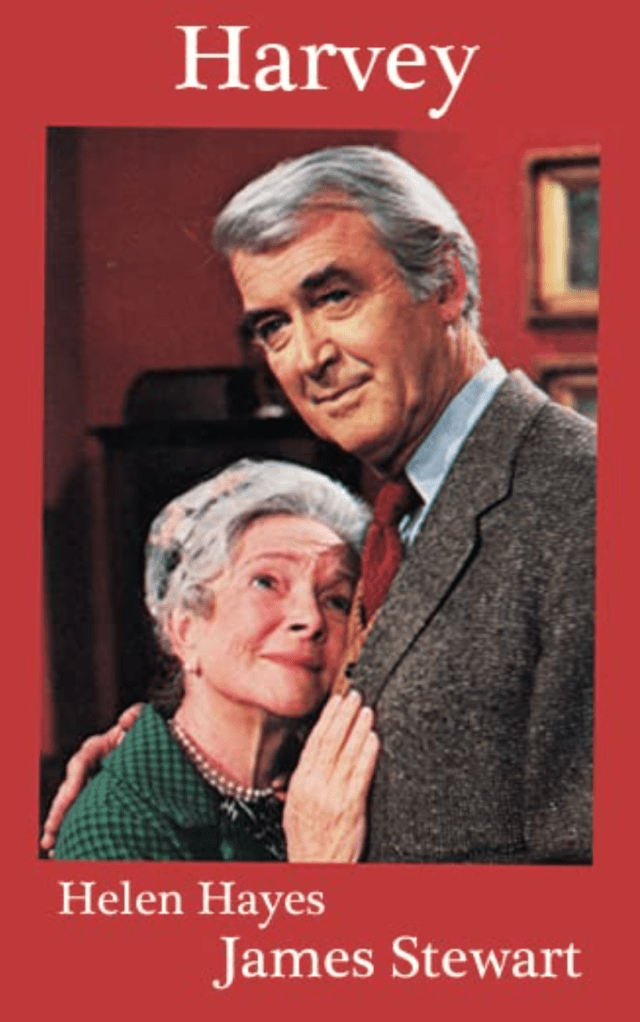
One of the first movies I reviewed this year was the 1950 film, Harvey. Since publishing my review back in January, that movie has become the most disappointing one I’ve seen this year, so far. Jillian, from The Classic Film Connection, recommended I give this story a second chance by checking out the 1972 Hallmark Hall of Fame production. Since this title is a remake and since I’m participating in The “Take Two!” Blogathon (which focuses on remakes), I found the perfect opportunity to watch this movie! When I reviewed 1950’s Harvey, I questioned what the point of the story was. This is because I was confused by what the movie’s creative team was trying to say through their project. Will I be less confused by the 1972 adaptation? Keep reading if you want to find out!
Harvey(1972) poster created by Foote, Cone and Belding Productions, Hallmark Hall of Fame Productions, Talent Associates-Norton Simon, and National Broadcasting Company (NBC)
Things I liked about the film:
Changes from the original film: As I said in my review of the 1950 film, there were things about Harvey I didn’t like. One of them was the medical negligence Veta experiences at Chumley’s Rest. In the 1972 version, that specific scene plays out differently. When Veta is being interviewed by Dr. Lyman Sanderson, he notices how distressed Veta appears. Her body language, tone of voice, and tears are noted by the doctor as he listens to what Veta has to say. This leads Dr. Lyman to admit Veta into the hospital for her well-being. The mix-up is presented as an example of good intentions leading to bad results. The film’s dramatic tone also helps elaborate how terrifying Veta’s experience would be.
A sense of magical realism: An element I thought was lacking in the 1950 version of Harvey was a sense of ‘magical realism’. Because the story featured a 6 foot 3 ½ inch, invisible white rabbit, I thought that aforementioned element would be automatically included in the film. In the 1972 adaptation, there was a stronger sense of ‘magical realism’ within the overall story. At the hospital, a hat with two holes on top is found in Dr. Lyman Sanderson’s office. The staff question who this hat could possibly belong to. Since the holes on the hat would allow rabbit ears to stick out, the hat itself implies Harvey does exist. This along with other strange occurrences in the story show how the film’s creative team put more effort into including ‘magical realism’.
The acting: When I reviewed the 1950 version of Harvey, I talked about James Stewart’s portrayal of Elwood P. Dowd, saying it was “laid-back” and “somewhat philosophical”. Reprising this role in the 1972 version of the story, James brought these same elements to his performance. But this time, his portrayal of Elwood reminded me of Mister Rogers from Mister Rogers Neighborhood. What I mean by this is Elwood came across as the type of man you’d want to spend hours having a conversation with. Elwood’s approachable and pleasant persona make him such a fascinating individual. If Elwood P. Dowd existed in the real world, I’d like to think he’d come up with an interesting TED Talk!
Despite appearing in the film for a limited period of time, I liked Madeline Kahn’s portrayal of Nurse Ruth Kelly! Her pleasant on-screen personality allowed her to stand out and give a memorable performance! Her interactions with the other characters also came across as realistic. After Veta was admitted to the hospital, Dr. Lyman has difficulty finding her. In a state of panic, he thinks Veta escaped. Sensing Dr. Lyman’s panic, Ruth becomes concerned. Her face has fallen from the smile she usually carries and her tone of voice contains a sense of dread. There’s even an ounce of timidness to her overall demeanor. Scenes like this one make me wish Madeline was given more on-screen appearances.
Most of the story being rehashed: When creating a remake of a pre-established story, it’s important to do two things: respect the source material that came before your project and bring your own voice to the table. In the case of Hallmark Hall of Fame’s version of Harvey, more emphasis was placed on respecting the original film. While this idea isn’t a bad one, the 1972 movie’s creative team didn’t allow themselves to create a unique identity for their project. The sets in this film looked almost exactly like they did in the 1950 film. The story, more often than not, followed the 1950 movie’s narrative, making very few deviations. While watching the 1972 version of Harvey, I wondered, at times, why this remake exists?
A televised version of a play: In my review of Hallmark Hall of Fame’s Foxfire, I talked about how that title felt more like a televised play. This is because the 1987 film contained a smaller cast and a condensed story. The 1972 adaptation of Harvey also felt like a televised version of a play. Fewer locations are a reason why. In the 1950 version, Elwood is shown taking Harvey to Charlie’s Pub. Elwood simply recalls this experience in the 1972 version. What’s also important to note is how the 1972 story takes place in either the hospital or the Dowd family home.
The underutilization of Betty Chumley: At one point in the 1972 story, Elwood makes plans with Dr. Chumley’s wife, Betty, to meet at Charlie’s Pub and share drinks. But because this trip was never shown on-screen, Betty received one less on-screen appearance. Within the story, she only appeared in two scenes. Personally, I think Betty should have had a stronger significance in the film.
After publishing my review of the 1950 version of Harvey, Jillian, from The Classic Film Connection, explained how the story’s point was “about the right to be uniquely yourself and live life on your own terms”. Now that I’ve seen the 1972 version of this story, I think the Hallmark Hall of Fame film did a better job at executing this idea. What worked in the movie’s favor was how the story was just a drama instead of trying to be both a drama and comedy. Scenes like Veta’s hospital admittance elaborated how terrifying her situation would be. There was also a sense of ‘magical realism’, something I thought was lacking in the 1950 film. However, the majority of the 1972 movie was a copy of the 1950 movie. In 1993, Hallmark Hall of Fame released the film, To Dance With the White Dog. Based on what I know about the story, it sounds like a version of Harvey. But this time, a man sees a white dog only he can see. Maybe I’ll write about that movie in a future review.
Overall score: 6.1 out of 10
Have you seen any version of Harvey? Are there any Hallmark Hall of Fame movies you’d like to see me review? Let me know in the comment section below!
The Hallmark Hall of Fame adaptation of Redwood Curtain is based on a Broadway play. It was also released in 1995. With these facts in mind, I found Redwood Curtain to be the perfect subject for the Fifth Broadway Bound Blogathon. Prior to this event, I saw the movie and read the play. This lent itself to an interesting idea. Discussions about film adaptations often feature films adapted from books, short stories, or poems. Movies born from plays aren’t often included in the conversation. So, I decided to write an editorial highlighting the similarities and differences between the Redwood Curtain play and film. This article contains spoilers for the story of Redwood Curtain.
On the stage, Redwood Curtain contains three characters: Lyman, Geri, and Geneva. While there are other characters in the story, they’re only mentioned within the dialogue. Geri’s father, Laird, is one of these characters. According to the script, Laird was a desk-jockey lieutenant in the Vietnam War. This means he “didn’t see a day’s fighting, to come completely unglued in the war.” Laird taught Geri how to play the piano simply to entertain dinner guests. He also developed a dependence on alcohol and died two years prior to the play’s events. Laird is even described as a “drunk.” Because Laird never physically appears in the play, all the information about him is hearsay.
John Lithgow portrays Laird in the film adaptation. The film version of Laird did fight in the Vietnam War, though his specific role was never mentioned. Like in the play, he develops a dependence on alcohol. However, this dependence was Laird’s attempt to cope with war-related trauma. Toward the end of the movie, Geneva shares with Geri how Laird wanted to be a pianist, but didn’t feel he was talented enough. So, he became invested in Geri’s piano career, appearing to live vicariously through his daughter. His presence in the movie shows the audience the strained, yet close relationship between Geri and Laird. Laird’s death within the film’s first half and Geri’s discovery that Laird is her biological father are presented as bittersweet moments.
Redwood Curtain poster created by Chris/Rose Productions, Hallmark Hall of Fame Productions, American Broadcasting Company (ABC), and Republic Pictures (II)
Expanding the World
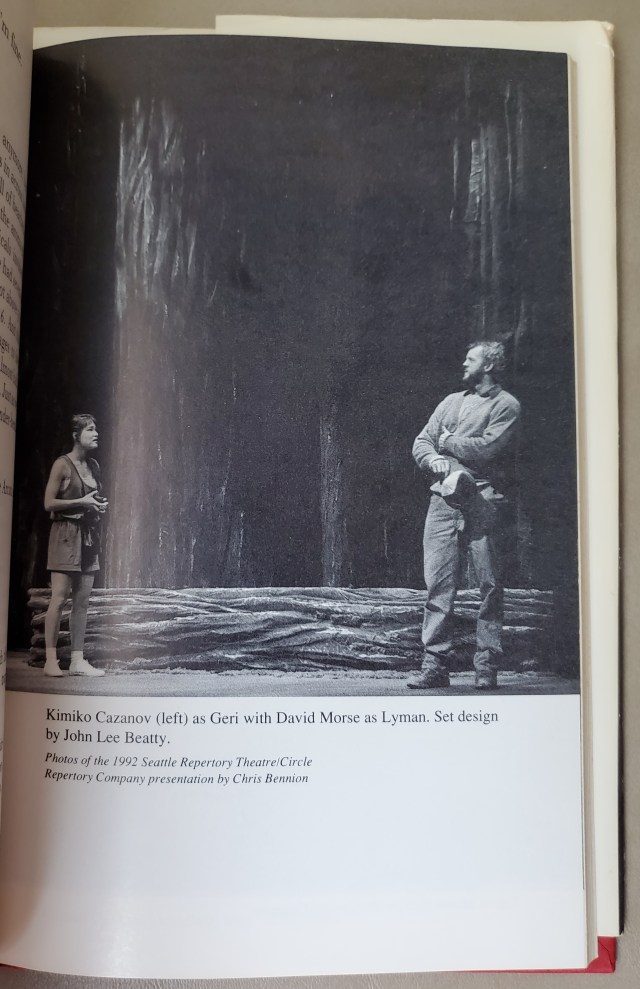
The majority of Redwood Curtain’s story in the play takes place in Arcata’s redwood forest. A few scenes happen in Geneva’s house, Geneva’s car, or a local coffee house. Geri’s first encounter with Lyman is when the play starts, with the lead-up to this moment woven into the dialogue. Events such as Laird’s death take place off stage, prior to the play’s story. The creative team behind a play is given a limited amount of space and time to work with. Therefore, designating a few key locations makes sense among these limitations. In the Redwood Curtain play, Geneva’s house is described as “a large and very fine Victorian house.” The script states her house contains a music room as well. When presenting this play at a theater, only the home’s sitting room and music room would be staged and the style of the house would be heavily implied through décor and set structure.
A plus side to film-making is the freedom to take the story wherever the film-maker chooses. If a movie’s creative team desires to adapt a stage play, that story has the opportunity to grow beyond the boundaries of a stage. In the case of the Redwood Curtain film, the events from the play are contained in the story’s second half. That means the movie’s first half takes place in and around the Riordan family home. This inclusion not only expands the world the characters exist in, but also gives the audience a glimpse into Geri’s world that they wouldn’t have seen otherwise. Filming on location provides benefits to visual storytelling. However, that creative decision has its own limitations. Using Geneva’s house in the movie as an example, a location scout might not be able to secure a location similar to one described in the source material. Even if they succeeded, there’s a process in order to film at a residential building, especially if it’s someone’s real-life home. That’s probably why Geneva’s house is presented as a smaller log cabin with a large deck, but no music room.
A picture of the Redwood Curtain play from my copy of the play’s script. Screenshot taken by me, Sally Silverscreen
Geri’s Motive
In both the play and movie, Geri attempts to search for her biological father. This attempt is the story’s main conflict. Geri’s reason for her search was different in each version of Redwood Curtain. In the play, Geri knew some information about her past. Prior to the start of the play, Geri discovered Lyman tried to help her and her biological mother get to the United States. The script mentions that Geri began her search when she was twelve. Her search turns into an obsession, to the point of abandoning her musical endeavors. In fact, the play’s synopsis states Redwood Curtain “is a story of obsession and discovery.” Though the information Geri received was partly true, she eventually learns more through her interactions with Lyman.
The movie version of Geri has three motives for her search. Wanting to receive answers about her past was the first motive. The film’s script heavily implies Geri did not know much about her past until the events of the movie. Yes, she was aware she was adopted. But Geri’s belief that Lyman was her biological father stemmed from a photo and a note bearing the name ‘Raymond Farrow’ that Laird gave his daughter after he died. At various moments in the movie, Geri expresses how she feels she doesn’t belong. She even shares these thoughts with the Riordan’s house-keeper, Matilda. These feelings fuel Geri’s journey of self-discovery and finding her biological family. Her third and final motive is her music, which plays a crucial role in Geri’s life. Geri believes if she finds her biological father, she will be able to incorporate more emotion into her musical pieces.
As I’ve said before on my blog, a film’s title can serve as a promise to the audience. In the case of Redwood Curtain, the audience should expect not only to see redwoods, but also to receive an explanation of what the “redwood curtain” is. The “redwood curtain,” in both the play and movie, is the redwood forest itself, where Vietnam veterans choose to live their lives. This is one of the reasons Geri meets with Lyman in the forest. While Geri learns about the “redwood curtain” in each version of the story, the way she learns about it is different. An Arcata Union reporter provides the explanation for the “redwood curtain” to Geri in the play. In the movie, she is given this same explanation by a gentleman working at Arcata’s veterans’ office.
As I mentioned above, the majority of Redwood Curtain’s story in the play takes place in Arcata’s redwood forest. The redwood forest in the movie only appears in the story’s second half. Because of how often or little this location appears in the story, its association with the characters and the themes connected to it depend on these appearances. Topics relating to the environment are brought up throughout the play. When Lyman asks Geri why she’s visiting Arcata, she tells him she’s studying horticulture and botany at the local college. Geri also claims to have magical powers, which allow her to do things such as control the weather. Within the play, Geneva talks about how her family’s portion of the redwood forest is being bought out by investors. While this part of the story is also in the movie, it is discussed in more detail in the play, from Geneva bringing up the specifics of the sale itself to describing Arcata’s weather. The theme of family connects with the redwood forest in the movie. The Riordan family owns a portion of the redwood forest. While Geri stays at Geneva’s house, Geneva shows her niece a wall of family photos. These photos showcase various members of the Riordan family in the redwood forest. The number of photos and whether or not the photos are in black-and-white indicate how the forest has been in the family for generations.
When I brought up the movie version of Laird, I mentioned how he depended on alcohol to cope with war-related trauma. I also mentioned how Geri learns about the “redwood curtain” at Arcata’s veterans’ office. These are just two examples of how the movie includes the subject of veterans’ well-being. In the history of Hallmark films, veterans have been presented with a sense of reverence and respect. Veteran-related issues have also been included in Hallmark’s programming. An example is a veteran struggling with trauma in Signed, Sealed, Delivered: Lost Without You. Even though the film adaptation of Redwood Curtain was released a decade before Hallmark debuted the Hallmark Channel, this tradition can be seen and felt in this Hallmark Hall of Fame presentation. At Laird’s funeral, Geri shares with Geneva how she wished the family had addressed Laird’s alcohol dependency sooner. Geneva reminds her niece how Laird had a problem related to his experiences in the war. Geri says the family’s politeness and willingness to skirt the issue are what enabled Laird’s struggles. The points Geri makes to her aunt highlight how seriously these topics are taken in this adaptation.
While veteran-related issues are brought up in the play, it was never enough to be one of the story’s main topics. Compared to the movie, there isn’t the same amount of reverence for veterans. During her first interaction with Lyman, Geri’s personality is pessimistic and bitter. When Lyman asks Geri about the translation of her hometown’s name, Geri responds by saying, “Well, you’re not Spanish. You must belong to the other half of the country’s population.” After Geri learns Laird was her biological father, she says, “You’re right, Lyman, he was the saddest man I’ve ever known.” Geri also says, “And I thought I was joking when I said to follow in my father’s footsteps I had to mope and pine and drink myself to death. Not a very promising path he’s laid out for me to follow.” With the way veterans’ well-being wasn’t addressed, it made the play seem less hopeful. It also seemed like none of the characters were willing to find any solutions.
As mentioned above, I said Lyman, Geri, and Geneva were the only three characters to physically appear in the play. These three characters also serve prominent roles in the movie. Geri’s personality in the play was pessimistic and bitter. She was also disrespectful when talking to Lyman or talking about Laird. In the movie, however, Geri was a more empathetic character. While interacting with Matilda in the Riordan family kitchen, Laird recalls a memory of Geri when she was younger. In this memory, Laird was tearing up as he was chopping onions. Upon seeing this, Geri asks if Laird is sad because the onions are hurt.
Lyman, in both the play and movie, shares parts of his life story with Geri. In the play, though, more of this information is given. Toward the end of the movie, Lyman tells Geri how, before the war, he would fix and race cars with his dad. He also talks about how he never dated a crush he had. Lyman in the play not only drag-raced vehicles, he also worked in his dad’s garage. He recalls owning a Mustang Boss 302 and never having a girlfriend. Geneva’s family’s portion of the redwood forest was being bought out by investors. As a result of this, Geneva, in the play, is planning on moving to Key Biscayne, Florida, with her husband, Barney. In the movie, however, Geneva expresses no interest in moving out of Arcata. In fact, after one of Geri’s piano performances, Geneva tells Laird how she plans on fighting to keep her land. She and Barney are also divorced.
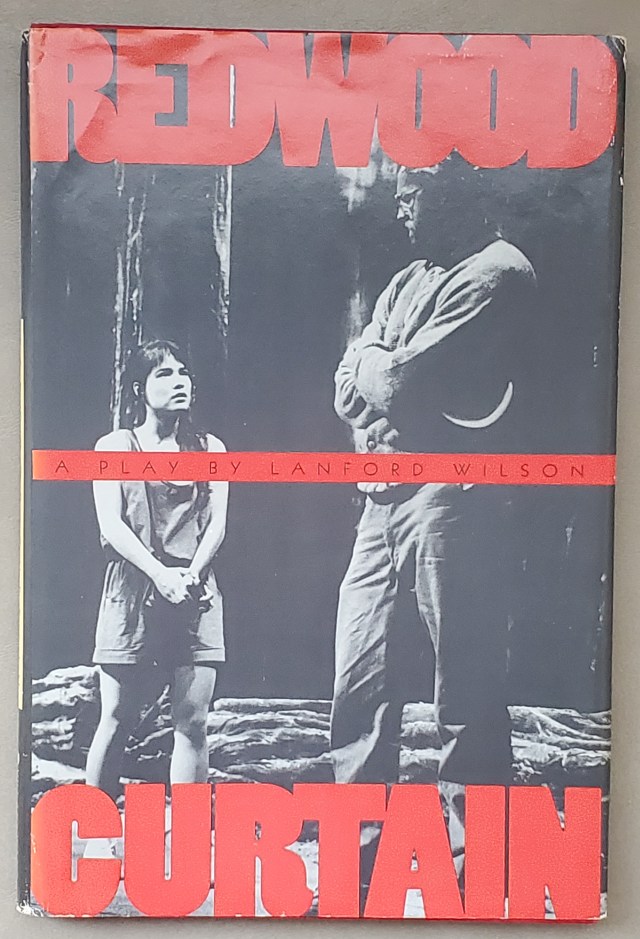
The cover of my copy of the play’s script. Screenshot taken by me, Sally Silverscreen
After I watched and read Redwood Curtain, I ended up liking the movie adaptation over the source material. What worked in the Hallmark Hall of Fame presentation’s favor was how the story was expanded. Not only were more locations added to the characters’ world, more context was given than the play provided. Even though there were more characters added to the film, the cast as a whole was smaller. Through their interactions, the audience gets a more intimate look into the characters’ relationships. The changes to the characters from the play made them more likable, especially Geri. Both the screenwriting and acting allowed Geri to be one of the strongest protagonists in Hallmark movie history. Redwood Curtain reminded me of another Hallmark Hall of Fame movie based on a play: The Boys Next Door. Similar to Redwood Curtain, The Boys Next Door contained multiple locations and provided context to each of the key characters. Since I have seen the 1996 adaptation, but have never read the play, perhaps another comparison and contrast editorial is in order.
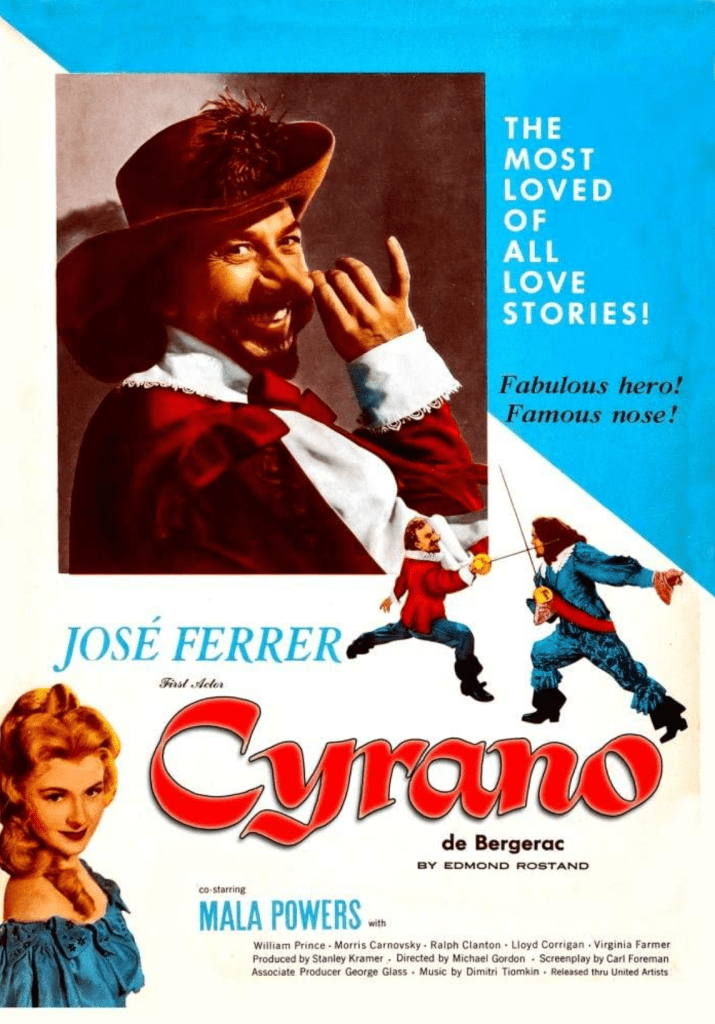
Two years ago, when I reviewed the 1990 adaptation of Cyrano de Bergerac, I was given a movie recommendation by Le from Crítica Retrô. That recommendation was Cyrano de Bergerac’s 1950 adaptation! Like any film suggestion I’m given, I wanted to make the time to watch and/or review this title. The opportunity finally came this month! March’s film for Genre Grandeur is Oscar Nominated /Winning Films. From what I’ve gathered, 1950’s Cyrano de Bergerac was nominated for and won an Oscar for Best Actor. Then I discovered The Bonnets and Bustles: Costume Blogathon. While thinking about what to write for the event, I realized Cyrano de Bergerac would be an eligible topic. Therefore, I’ve decided to review this movie for both blogathons!
Cyrano de Bergerac(1950) poster created by Stanley Kramer Productions and United Artists
Things I liked about the film:
The acting: I am not familiar with José Ferrer’s filmography. Despite this, the one word I would use to describe his performance in Cyrano de Bergerac is confident! The confidence within José’s portrayal helped him stand out against Gérard Depardieu’s portrayal in the 1990 adaptation. This confidence was also a consistent component that made Cyrano a force to be reckoned with! Toward the beginning of the film, Cyrano engages in a duel at the local theater. Throughout this scene, the protagonist speaks eloquently and with sophistication. He holds his own in the duel, with his posture and skills showing the audience that he knows what he’s doing. But this aforementioned confidence never comes across as cocky. Instead, Cyrano is presented as being sure of himself, despite his flaws and imperfections.
Christian de Neuvillette is portrayed by William Prince. What makes his portrayal stand out from Vincent Perez’s performance is how Christian came across as a hopeless romantic. This can be seen when he visits Roxane one evening. During their conversation, Christian becomes tongue-tied. He struggles to find the right words without Cyrano’s help. But the passion he feels for Roxane is displayed on his face. William’s body language also proved how much his character wanted to be with Roxane. Speaking of Roxane, let’s talk about Mala Powers’ performance. In this adaptation of Cyrano de Bergerac, Roxane was mesmerized by the romantic words of Cyrano and passionate gestures of Christian. The balcony scene is a perfect example. As Christian quotes Cyrano’s poetry, Roxane is overcome by her feelings. Her voice contains emotion, expressing through words what is in her heart. Roxane’s body language longs for a romantic embrace, as she searches in the night for the one she loves. Mala’s performance is one of the reasons why that scene packed such a punch!
The sword fights: In this adaptation of Cyrano de Bergerac, there were some exciting sword fights! Part of that excitement comes from the quality of the choreography! As I said earlier in this review, I talked about Cyrano’s involvement in a duel at a theater. While that fight was captivating to watch, that wasn’t the only fight to feature good choreography. One evening, Cyrano guards a local baker on his way home. Along the way, they become surrounded by the baker’s enemies. Throughout this scene, the fight choreography is sharp, fast-paced, and precise. These elements allow the fights to appear professional, like the actors involved are taking this part of their performance seriously. What also made these fights exciting was the different camera angles used to capture the shots. The various angles let the audience witness the fights from different perspectives.
Cyrano and Roxane’s interactions: Because Cyrano and Roxane have known each other prior to the events of the film, they have a pre-existing friendship. The on-screen camaraderie between José Ferrer and Mala Powers made my experience watching Cyrano and Roxane’s interactions enjoyable! During these interactions, Roxane and Cyrano share a genuine tenderness that comes across as sweet and good-natured. At the bakery one day, Cyrano learns Roxane has developed feelings for Christian. Even though he is not pleased to learn this news, Cyrano seems to place Roxane’s happiness before his own. Later in the film, when Roxane is sharing Christian’s “poetry” with Cyrano, Cyrano adopts a protectiveness toward Roxane. Meanwhile, Roxane doesn’t miss a beat. She recites Cyrano’s words in a heart-felt way, her vocal inflections indicating how much she enjoys the words. Interactions like this one make me wish Roxane appeared more in the film.
An orange tint: Throughout the film, the picture was coated in an orange tint. Though this tint was not consistently present, it was somewhat distracting. The colors of the costumes and set design appeared faded because of this tint. However, I’m not sure if the tint was caused by the use of lighting or the cinematic technology of the ‘50s.
Few interactions with Christian and Roxane: A major plot-point in Cyrano de Bergerac is the growing relationship between Roxane and Christian de Neuvillette. What makes this plot-point so memorable is how Roxane is smitten by Christian’s words, which were composed by Cyrano. In this adaptation of the story, Christian and Roxane don’t spend much time together. Looking back on the film, I can think of only three scenes featuring their interactions. Because of Roxane and Christian’s limited time together, Mala and William’s on-screen chemistry wasn’t as strong as it could have been.
No build-up to the war storyline: When I reviewed the 1990 adaptation of Cyrano de Bergerac, I wrote about the war storyline that dominated the movie’s second half. In my review, I said this storyline pulled a “bait and switch” with the film’s overall tone. I also said the build-up toward the war and the reasoning behind it felt too “inside baseball”. While there is a war in the 1950 adaptation, there is no build-up or reason for this event. It feels like the war was placed in the middle of the movie for the sake of providing more action in the story. I still have not read this story’s source material, so I don’t know the historical context of this text. However, some build-up and/or a reason for the war would have been appreciated in the 1950 adaptation.
A singular adaptation of any story is not the “end all, be all”. Part of that is due to film itself being so subjective. Cyrano de Bergerac from 1950 is the second adaptation of this narrative I’ve seen. But I ended up liking it about as much as the 1990 version. 1950’s Cyrano de Bergerac follows similar beats to 1990’s adaptation. But the movie itself is distinct enough to stand out on its own. The differences in the 1950 version added enjoyment to the overall project, such as the sword fights. But, like the 1990 film, the 1950 project had its flaws. I will say Cyrano de Bergerac from 1950 is the more accessible movie of the two. But no matter which version you choose, the romance, wit, and ways with words are still the same.
Overall score: 7.5 out of 10
Have you seen any adaptation of Cyrano de Bergerac? If so, which one is your favorite? Let me know in the comment section!
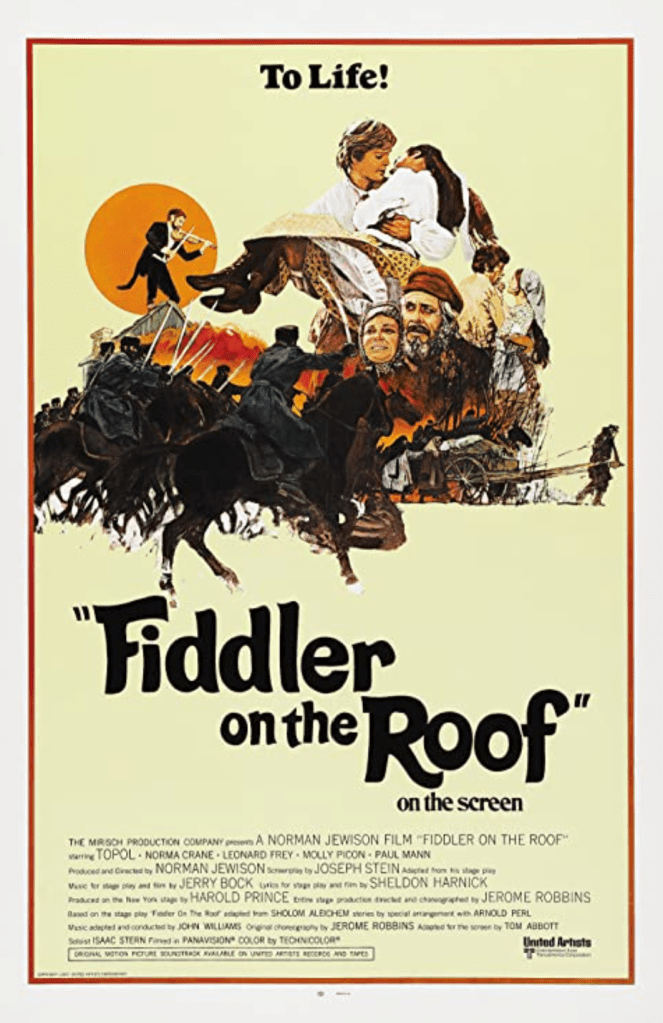
As I write this review, Rebecca, from Taking Up Room, is hosting the John Williams Blogathon! When signing up for this event, I knew John’s high-profile projects were going to be some of the most popular selections among fellow participants. Therefore, I decided to go off the beaten path by choosing a title that wasn’t associated with a franchise. As I scrolled through John’s filmography on IMDB, I discovered he conducted the music in the 1971 musical, Fiddler on the Roof. With this newfound knowledge, I chose that film to review for Rebecca’s blogathon! Prior to this event, I had seen about half of this film. I have also reviewed very few films revolving around Jewish stories. In fact, the only movies including Jewish stories and/or characters I have written about so far is Holiday Date and The Lost Child. But will I enjoy Fiddler on the Roof like I enjoyed the 2019 Hallmark Channel film or will I think it is just fine like the 2000 Hallmark Hall of Fame production? As a composer starts his or her cue for their orchestra, it’s time for this review to begin!
Fiddler on the Roof poster created by The Mirisch Production Company and United Artists
Things I liked about the film:
The acting: Fiddler on the Roof is a film with an ensemble cast. Despite its large size, the film’s cast was, as a whole, solid! But within this ensemble, there were some performances that really stood out to me. The most notable one came from Topol! Throughout the movie, Topol presented a versatile portrayal of his character, Tevye. This versatility allowed Tevye to be seen as a realistic individual who is trying to make sense of the changes taking place in his world. At several points in the story, Tevye speaks with God and contemplates his faith. Tevye’s emotions matched whatever dilemma he faced. When one of his daughters comes to him with serious news, Tevye is angry and frustrated. As he receives the aforementioned news, Tevye questions how far he’s willing to go for his faith, talking through the situation while genuine emotion finds a place in his voice, facial expressions, and body language. Moments like the one I described show a sincerity that gave Tevye the opportunity to be Fiddler on the Roof’s “every man”!
Motel is a tailor from Tevye’s village. Portrayed by Leonard Frey, Motel wants to marry Tevye’s oldest daughter, but lacks the confidence to approach Tevye with this proposal. Through a consistent performance, the audience can watch Motel grow from a timid tailor to a man who genuinely believes in himself and his abilities. Having Tzeitel as Motel’s inspiration certainly helped his case. Tzeitel is Tevye’s oldest daughter, who is portrayed by Rosalind Harris. She worries about who she will end up marrying in the near future. Despite this, Rosalind gave a performance that was well-rounded and enjoyable to watch! When Motel tells Tevye about his marriage plans, the confidence he once lacked steadily grows within his voice. His facial expressions become stronger with each statement toward Tevye, finding the words Motel had suppressed for too long. Meanwhile, Tzeitel appropriately reacts to this discussion, expressions of worry and joy being displayed on her face. This scene shows how the acting abilities of both Leonard and Rosalind work well together!
The musical numbers: When thinking about music composed by John Williams, pieces of music that make any scene feel grand and larger-than-life come to mind. The music in Fiddler on the Roof certainly accomplished this, as John’s contributions to the film elaborate on a scene’s large scale! One of these songs is “Tradition”, which can be heard at the beginning of the movie. This song highlights how the traditions of the Jewish community of Anatevka affected every member, with each role and its significance explained through the song’s lyrics. Bold, orchestral melodies accompany these lyrics, as an excited greeting to the film’s incoming audience. Looking beyond the music, the musical numbers themselves were well-choreographed and fit within the context of the story! A musical number I really enjoyed seeing was “Tevye’s Dream”! In this scene, Tevye is recounting a dream he had regarding Tzeitel’s marriage prospects. Tevye and his wife, Golde, find themselves in a graveyard that boasts a gray hue. Headstones of decreased villagers surround the graveyard, with these decreased villagers appearing as the scene progresses. Though the musical number itself is very fantastical compared to the film’s other numbers, its uniqueness in presentation allows “Tevye’s Dream” to stand out and be memorable!
The incorporation of Jewish faith/culture: As I previously mentioned, Anatevka is a small village that hosts a Jewish community. Throughout Fiddler on the Roof, aspects of the Jewish faith/culture are incorporated not only into the film’s story, but into the songs and musical numbers as well. When talking about these musical numbers in the previous paragraph, I brought up the song, “Tradition”, and how it highlights some of the traditions among the villagers in Anatevka. At the beginning of the film, Tevye explains directly to the audience how he and other members of the community wear a special garment related to prayer. During a wedding ceremony, the bride and groom are lifted on chairs by wedding guests. This action is part of a dance called the Horah, which is typically performed at Jewish special occasions, such as weddings. The Horah was seamlessly woven into a larger musical number called “Wedding Celebration”, which also featured a group of bottle dancers. The incorporation of Jewish faith/culture gave the movie its own unique identity. It also provides an introduction to Jewish customs and traditions.
No answers about The Fiddler: I have mentioned before how a film’s title can serve as a promise to its respective audience. The title can also let the audience know what to expect. This 1971 film is called Fiddler on the Roof. Yet the audience never learns more about the titular character, as he only appears in a handful of scenes. While watching this movie, I noticed how the Fiddler wore bright clothes compared to the villagers and even those from imperial Russia. Because of this, it caused me to speculate what role the Fiddler had within the overall story. Was he a spirit meant to guide Tevye through life or simply a peculiar individual? These are just two of the questions I’ll probably never get answers to.
An inconsistent conflict: When I learned this movie took place during imperial Russia, I expected the overarching conflict to revolve around the fall of the Romanov family. However, the overarching conflict was about how the government wanted the villagers to evacuate from Anatevka, for reasons the script never shared. This conflict complimented the film’s theme of change. But the story focused on this conflict in the film’s second half, with the conflict having a limited presence in its first half. I know this creative decision was meant to emphasize the tonal change within the story. I just wish it had a more consistent presence in the movie.
A limited inclusion of a broken fourth wall: At the beginning of Fiddler on the Roof, Tevye talks directly to the audience about his village, the people who live there, and the titular Fiddler. Because broken fourth walls are not common in musicals, I was looking forward to seeing the story told from Tevye’s perspective and watching the movie presented in a creative way. But for the rest of the film, Tevye didn’t break the fourth wall. I found this as such a missed opportunity, because, as I already said, broken fourth walls are not often found in musicals. While Fiddler on the Roof is a unique musical, Tevye consistently breaking the fourth wall could have added more uniqueness.
Fiddler on the Roof is a little over three hours. Therefore, you need to set aside time if you’re interested in watching this film. Despite the longer run-time, Fiddler on the Roof is a good movie! Almost every year, I come across that one musical that pleasantly stood out and captivated me. While it’s way too early to say whether this 1971 title will end up as one of the best movies I saw this year, it definitely captivated me, as I found it enjoyable! John Williams’ musical contributions provided some of the fabric of the story’s cinematic quilt, accompanied by well-choreographed and entertaining numbers. The ensemble cast binds these pieces of fabric with a strong thread, holding each scene together with solid acting performances. Incorporations of the Jewish faith/culture help the overall production gain a unique identity, asking questions and discussing topics that wouldn’t typically be found in a musical. Combining all these elements together, Fiddler on the Roof is a special project not just in the world of cinema, but also among musicals! With that, I’d say John Williams is a special composer. To those who don’t pay attention to the musical aspect of a given film, one might wonder how John is different from any other composer. But when you look at his body of cinematic work and the scores associated with those works, maybe that is more than enough to set him apart.
Overall score: 7.9 out of 10
Have you seen Fiddler on the Roof? Which John Williams composed film do you enjoy watching? Please tell me in the comment section!
















 18 Cinema Lane