
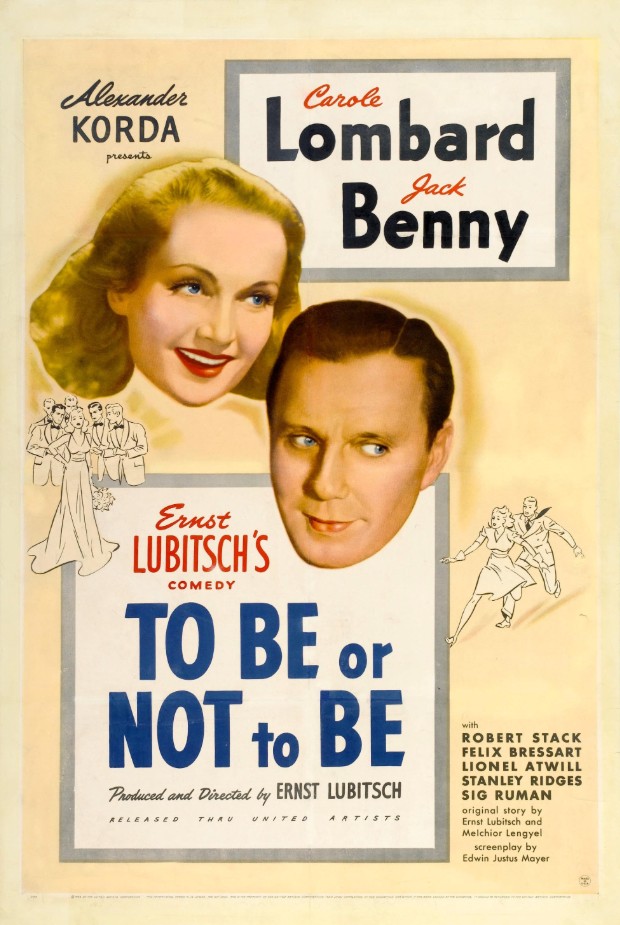
When one of my readers recommends a movie to me, I add that title to my film recommendation board on Pinterest and then write about it in one of my reviews. A movie that has been featured on the board for a while is 1942’s To Be or Not to Be. This presentation was suggested by Patricia (from Caftan Woman), Vincent (from Carole & Co.) and Allen Rizzi. Originally, I was going to select it for an upcoming Blog Follower Dedication Review. But when I learned about Hoofers and Honeys’ Carole Lombard Blogathon, I found a good reason to write about the movie sooner! While I received recommendations of Carole’s films, I’ve only reviewed two of those which she received a starring role. The first picture, In Name Only, was fine and likable. Meanwhile, Twentieth Century, is one of the worst movies I’ve ever seen. Now that To Be or Not to Be is the third film of Carole’s I’m discussing on 18 Cinema Lane, it’ll be interesting to see where I rank this title compared to Twentieth Century and In Name Only.
Things I liked about the film:
The on-screen chemistry of Carole Lombard and Robert Stack: In To Be or Not to Be, Carole Lombard portrays a Polish actress named Maria Tura. Toward the beginning of the movie, Maria develops an attraction for a Lieutenant named Stanislav Sobinski. Portrayed by Robert Stack, Stanislav is enthusiastic to meet Maria, especially since he’s never met an actress before. Though they shared very few scenes together, the on-screen chemistry between Carole and Robert was pleasant! The scene where Stanislav and Maria first meet is a perfect example, as their interaction felt so realistic. During the conversation, Maria confidently talks about her career, carrying an easy-going personality. But when Stanislav asks her about a farm she brought up in an interview, she is caught off guard, but uses her acting skills to adapt to what Stanislav told her. Meanwhile, Stanislav is so happy to see Maria. A genuinely bright smile is displayed on his face and his eyes light up. Because of the strength of Carole’s and Robert’s acting abilities, they sold the idea of their characters sharing a mutual relationship.
Clever writing: While good writing receives praise and accolades, clever writing can, sometimes, become underappreciated. This is why I take the time to address when a movie’s script contains clever writing. That was certainly the case for To Be or Not to Be, as I was impressed with some of the writing in the film. A great example can be heard during a conversation between Maria and her husband, Joseph. She accuses him of seeking opportunities to steal attention away from her. Maria even claims, “if we should ever have a baby, I’m not so sure I’d be the mother”. Joseph reassuringly tells his wife, “I’m satisfied to be the father”. The aforementioned conversation could have been straightforward, which would have made it sound typical. But the screenwriting, as well as Jack Benny’s delivery, allowed scenes like this one to be memorable!
How war was incorporated in the film: Some of the opening shots in To Be or Not to Be focus on shops in Warsaw, Poland, specifically the names of those who own these shops. When, later in the movie, war breaks out in Poland, those same shops are burned down, torn to shreds, or collapsed. The names on those shops are also destroyed. These shots are a good representation of how war ruins not just buildings, but livelihoods, daily routines, and human connections. One of the actors who performs alongside Maria and Joseph is Greenberg. When he first observes the destruction in his neighborhood, he quotes Shylock’s monologue from the play, The Merchant Venice. This quote spoken against the backdrop of Poland during World War II changes the context of the quote itself, making it seem relevant to the story of To Be or Not to Be. Through visuals and the script, the film’s creative team addressed the seriousness of war and its impact on anyone of any profession.
What I didn’t like about the film:
A dialogue heavy story: Dialogue is an important component of any movie. It helps the audience learn more about the characters, discover potential plot twists, and follow along with the story. But in the case of To Be or Not to Be, the script was very dialogue heavy. There were long stretches of time where characters shared conversations with each other. This is the result of how much the creative team relied on telling instead of showing. If one isn’t actively paying attention to the story, they may miss important details. Had play performances or more action-focused scenes been evenly sprinkled throughout To Be or Not to Be, it would have created a balance between what the characters say and what the characters do.
The run-time: IMDB lists To Be or Not to Be’s run-time as an hour and thirty-nine minutes. This run-time, to me, seemed much longer. The long stretches of time of characters’ conversations I already mentioned made the film feel drawn-out. There are also parts of the story that don’t lead anywhere, such as Maria’s concerns about Joseph trying to steal attention away from her. If the script had been trimmed down, the run-time of To Be or Not to Be could have been an hour and thirty minutes or less.
Inconsistent sense of urgency: As I discussed earlier in this review, To Be or Not to Be takes place in Poland during World War II. The characters are directly impacted by this global conflict, even going undercover to stop the Nazis. These parts of the story create a sense of urgency. But this sense of urgency isn’t consistent within the 1942 presentation. That flaw was caused by the dialogue-heavy scenes I referenced in my review. These scenes’ length of time takes away from moments where immediate situations can be resolved. The imminent threat of war is also placed to the side because of the dialogue-heavy scenes. Having a more consistent sense of urgency would have strengthened the suspense and intrigue in To Be or Not to Be.

My overall impression:
Last year, I reviewed For Me and My Gal, a film I ended up liking. One of the reasons why I gave that movie a good review is because of how World War I was incorporated into the script. With a steady progression and subtle changes, realism was woven into a musical like For Me and My Gal. I’d actually prefer that movieover To Be or Not to Be. Though To Be or Not to Be is a fine, interesting film, the run-time felt longer than an hour and thirty-nine minutes. The story’s sense of urgency was inconsistent and the script was too dialogue-heavy. However, there are merits within the 1942 title. I wish Carole and Robert shared more screen-time together because their on-screen chemistry was pleasant. How war was incorporated in the film allowed the creative team to show the seriousness of war and its impact on anyone of any profession. I also liked the movie’s clever writing. Compared to the other films of Carole’s I’ve written about, Twentieth Century and In Name Only, To Be or Not to Be is somewhere in the middle. With over seventy movies on her IMDB filmography, I have plenty more projects of Carole’s to check out!
Overall score: 7 out of 10
Have you seen To Be or Not to Be? Would you like to see me review more of Carole Lombard’s movies? Let me know in the comment section!
Have fun at the movies!
Sally Silverscreen
 18 Cinema Lane