Take 3: El Dorado (1966) Review

Whenever I’ve participated in the Legends of Western Cinema Week Blogathon, I, more often than not, review a movie from the Western genre. Since I review Western genre films so infrequently, this blogathon serves as a good opportunity to expand my cinematic horizons. For the 2024 edition, I decided to select a title that has been recommended to me. Suggested by J-Dub from Dubsism, I am reviewing the 1966 film, El Dorado! Years ago, I saw pieces of this movie. At the time, I thought it was boring. But I was willing to give El Dorado a second chance, wondering if my perspective had changed. I also have seen very few films from John Wayne’s filmography. So, reviewing this film gave me a chance to check out more of his movies!
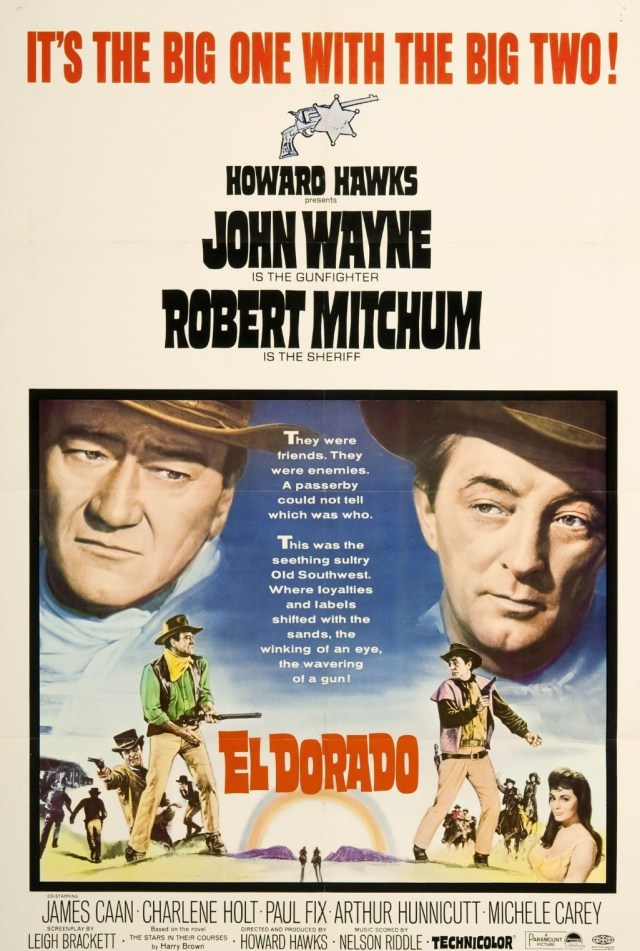
El Dorado (1966) poster created by Paramount Pictures, Laurel Productions, and Polyphony Digital

Things I liked about the film:

The on-screen chemistry: Relationships in movies, whether romantic or platonic, can come across believably on screen if there is a strong sense of chemistry between the actors. This is what happened in El Dorado! Toward the beginning of the movie, J.P., portrayed by Robert Mitchum, meets up with Cole, portrayed by John Wayne, to talk about a potential job opportunity. Cole and J.P. carry no-nonsense demeanors, but their cordialness to each other shows the respect between them. The scene’s mood becomes lighter when Maudie, portrayed by Charlene Holt, shows up. Her friendly, playfulness emphasizes the friendship these characters share. When Maudie talks about her late husband and Cole with J.P., the empathetic reflection indicates how much she cares about both Cole and J.P.. Not only was there strong on-screen chemistry among the actors, this strong on-screen chemistry was consistent throughout the film. The on-screen relationships were interesting to watch because of these factors!

The dialogue: One of the most important components of a movie’s script is the dialogue. Through dialogue, characters can memorably stand-out, important information can be shared, and characters’ problems can be solved. The quality of a script’s dialogue depends on how well written it is. While watching El Dorado, I took note of the cleverness of the dialogue. After a son from the MacDonald family dies, Cole visits the family to share the sad news. The patriarch of the family, Kevin, asks what happened, with Cole telling him how he got “a boy to do a man’s work”. Later, when Cole returns to El Dorado, he reconnects with J.P.. When J.P. asks Cole what he’s doing back in El Dorado, Cole tells his friend, “I’m lookin’ at a tin star with a…drunk pinned on it”. Dialogue like the two examples I provided show how cleverly words were used as well as the eloquent ways intended points were phrased.

Breen Code Era moments: As I’ve explained before on 18 Cinema Lane, the Breen Code was a series of guidelines studios had to follow between 1934 and 1954. El Dorado was released in 1966, a decade after the Breen Code Era ended. However, there were moments sprinkled throughout the movie that felt reminiscent of the Breen Code Era. Before Cole leaves El Dorado, he kisses Maudie. The kiss itself isn’t shown on-screen because Cole’s hat is blocking their faces. When Mississippi, portrayed by James Caan, is first introduced to the audience, he uses a knife in self-defense against a man he claims killed his friend. As Mississippi retrieves his knife, the aforementioned man is hidden behind a table to prevent some of the violence from being shown on screen. The way these moments were written and presented were thoughtful presentations of an era gone by.
Legends of Western Cinema Week Blogathon banner created by Hamlette from Hamlette’s Soliloquy, Heidi from Along the Brandywine, and Olivia from Meanwhile, in Rivendell

What I didn’t like about the film:

A prolonged conflict: Before watching El Dorado, I had seen two of John Wayne’s films: Stagecoach and Allegheny Uprising. In those movies, the story revolves around an overarching conflict some of the characters are consistently trying to resolve. While there was an overarching conflict in El Dorado, it primarily resided in the film’s second half. The first half of the movie consisted of a series of loosely connected vignettes. These vignettes, more often than not, contained low stakes. El Dorado’s first and second halves felt like they belonged in their own separate movies.

Inconsistent sense of urgency: Like I just said when talking about El Dorado’s prolonged conflict, the first half of the movie was a series of loosely connected vignettes, while the film’s overarching conflict resided in the story’s second half. Within the second half of the movie, scenes containing low stakes were woven into the production. One example is Cole addressing a back injury he received earlier in the story. El Dorado’s two halves and the low stakes scenes from the film’s second half are two reasons why this movie’s sense of urgency was inconsistent.

Enabling the Sheriff: J.P., the Sheriff of El Dorado, develops an alcohol addiction due to a romantic relationship gone wrong. When Cole and Mississippi go to El Dorado, they, as well as Bull, try to help J.P. overcome his addiction. Mississippi even creates a liquid concoction to sober J.P. up. But hours after receiving Mississippi’s concoction, J.P. is looking for alcohol. Bull tells J.P. exactly where a bottle of alcohol is located, in the upper left-hand drawer of his desk. Later that evening, Cole allows J.P. to go to the local saloon by himself, where he not only purchases a whole bottle of alcohol, he’s also laughed at by the film’s antagonists. J.P. does eventually become sober in order to help his friends. But toward the end of the movie, J.P. shares a shot of alcohol with Bull. If a screenwriter is going to incorporate a serious topic like addiction into their script, they need to be mindful about how that topic is included in the film. In my opinion, the way addiction was addressed in El Dorado could have been more thoughtful.

Sheriff badge image created by Freepik at freepik.com. <a href=’https://www.freepik.com/free-vector/brown-cowboy-label-set_1543252.htm’>Designed by Freepik</a>. <a href=”https://www.freepik.com/free-photos-vectors/vintage”>Vintage vector created by Freepik</a>. Image found at freepik.com.

My overall impression:

El Dorado is not only the third film of John Wayne’s I’ve seen, it’s the second film of John’s I’ve reviewed. Out of these three films, Stagecoach, Allegheny Uprising, and El Dorado, I haven’t found a title that’s left a strong impression on me. Looking back on Stagecoach, I think the movie is just fine. Allegheny Uprising was ok. Now that I’ve seen El Dorado in its entirety, I feel the 1966 project is also ok. The two halves of this movie and the low stakes scenes woven into the movie’s second half are likely the reason for El Dorado’s inconsistent sense of urgency. The topic of addiction could have been handled in a more thoughtful way. However, the movie does have its strengths. Some of these strengths are the on-screen chemistry among the cast and how well the dialogue was written. Personally, I found El Dorado to be a mixed bag. Hopefully, the next film of John’s I watch and review will be stronger than this one.

Overall score: 6 out of 10

Have you seen El Dorado? Which film from John Wayne’s filmography would you like me to review? Let me know in the comment section!

Have fun at the movies!

Sally Silverscreen

The Winners of The 4th Annual Gold Sally Awards + the Future of the Gold Sally Awards

Since 2019, I created the Gold Sally Awards. What was once a way to recognize the best Hallmark had to offer, it evolved into a series of polls highlighting the films covered or discussed on 18 Cinema Lane. In the beginning, voter turn-out was strong. The polls served their purpose of allowing readers to interact with my blog’s content. But as time went on, voter turn-out dwindled. There were times when I’ve had to select the winners because a particular poll didn’t receive any votes. With all that said, I will continue the Gold Sally Awards. But starting next year, there will no longer be voting polls. Instead, I am going to create separate, individual awards that are more unique/creative/fun. Now that this update is out of the way, it’s time to announce the winners of this year’s Gold Sally Awards!

Similar to last year, I created a collage on PowerPoint of this year’s winners. Screenshot taken by me, Sally Silverscreen.

Best Movie: The King and I

Best Story: The Three Musketeers

Best Ensemble: The Karate Kid

Best On-Screen Couple: Marshall Williams and Natalie Hall — Sincerely, Yours, Truly

Best Actress: Janel Parrish – Holly & Ivy

Best Actor: Marshall WilliamsSincerely, Yours, Truly

Best Supporting Actress: Jean Porter – Bathing Beauty

Best Supporting Actor: Robert Mitchum – Cape Fear

Sally’s Star of the Year: Bai Ling

Have fun at the movies!

Sally Silverscreen
Take 3: The Sundowners (1960) Review

Here at 18 Cinema Lane, I try to go out of my way to watch, and review, as many film recommendations as possible. In fact, I have a board on Pinterest dedicated to these recommendations. Two years ago, when I reviewed Marriage on the Rocks, Maddy, from Maddy Loves Her Classic Films, suggested I check out the 1960 picture, The Sundowners. Shortly after Debbie, from Moon in Gemini, invited me to her Foreign Western Blogathon, I finally found an opportunity to write about the movie! The Sundowners fits two of the four blogathon categories: ‘directed by foreign directors’ and ‘shot in a foreign country’. According to IMDB, the film’s director, Fred Zinnemann, is from Austria-Hungary. The movie was also filmed in Australia, where the story takes place. Foreign westerns are not a new concept on 18 Cinema Lane. Neither are Australian films. Within the four years of my movie blogging journey, I reviewed Another Man, Another Chance, Interrupted Melody, and Hallmark Hall of Fame’s Durango. If you’re interested, I’ll provide the links to these reviews toward the beginning of this article.

Take 3: Another Man, Another Chance Review

Take 3: Interrupted Melody Review

Take 3: Hallmark Hall of Fame’s Durango Review

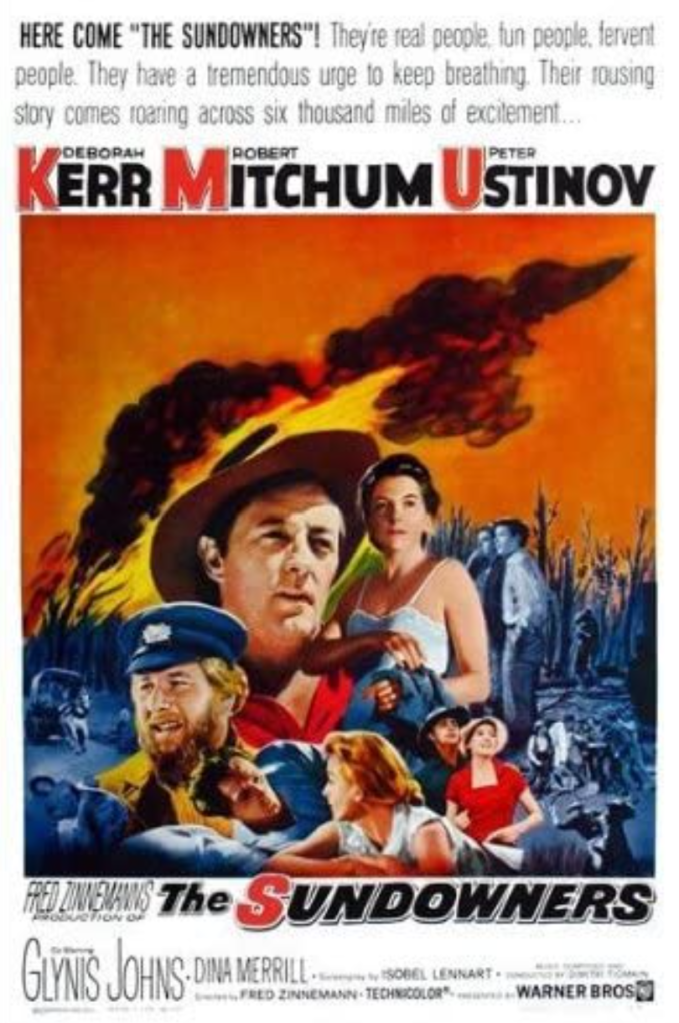
The Sundowners (1960) poster created by Warner Bros.

Things I liked about the film:

The cinematography: Like I said in the introduction, The Sundowners was filmed in Australia. The movie’s creative team took advantage of the country’s natural surroundings through cinematography! One long shot showcased Australia’s farmlands. What made this shot beautiful were the rays of sunlight showering over the green landscape, offering a light only nature could provide. The cinematography also did a good job putting things into perspective. During a forest fire, Ida is driving her family’s wagon away from the forest. While this maneuver is taking place, the camera is situated inside the back of the wagon. It looks out toward the road, giving the audience the illusion they are riding in the wagon with Ida.

Higher stakes: When I reviewed Hallmark Hall of Fame’s Durango last year, I talked about low stakes being one of the film’s biggest flaws. In The Sundowners, higher stakes were featured in a few scenes! A notable example is the forest fire I previously mentioned. While the Carmody family is herding sheep, a nearby forest fire breaks out. This leads all the characters to be in danger. The scene chronicled the entire process of the fire, starting from the detection of smoke and ending in the fire’s aftermath. Cut-away shots of scared wildlife are spliced into the story, emphasizing the other lives in harm’s way. Dramatic music can be heard in the background, elevating the sense of urgency. With all these elements combined, this scene was the perfect example of the higher stakes I expect from a western film!

The historical accuracy: With any “period film”, the historical accuracy can make or break that production. In the case of The Sundowners, the story takes place in the 1920s. From the looks of it, the 1960 project appears historical accurate! The forms of transportation are one indicator. While the Carmody family is working on the sheep farm, the employees sometimes rode in antique trucks with open beds. At least one motorcycle is featured in the story, revealing exposed gears and a model very different from the motorcycles of today. A covered wagon is the preferred vehicle of the Carmody family, with Paddy and Sean riding horses on a few occasions. This aspect of the film’s historical accuracy reminded me of a production like The Grapes of Wrath.

The Foreign Western Blogathon banner created by Debbie from Moon in Gemini

What I didn’t like about the film:

A “slice of life” story: Westerns, like any genre, contain a wide range of narratives. If given the choice, I’d rather watch a western with, at least, one conflict instead of a story that’s more “slice of life”. Unfortunately, the majority of The Sundowners is a “slice of life” story. The script primarily focuses on the daily operations of sheep farming. At first, this topic was interesting. But as the film carried on, the elements of sheep farming became repetitive. Had this movie contained one or two major conflicts, I might have found this story more intriguing.

Lack of Irish accents: According to Wikipedia, the Carmody family is Irish, a fact Sean tells Rupert early in the film. Michael Anderson Jr., Robert Mitchum, and Deborah Kerr must have missed that detail in the script, as none of them could successfully carry an Irish accent. Throughout The Sundowners, Deborah sounded like she was speaking in a British accent. Meanwhile, Robert and Michael sounded Australian. I don’t think Robert, Deborah, and Michael are bad actors. In fact, pulling off any accent can be a difficult skill to master. However, their lack of Irish accents was, for me, jarring.

The run-time: The Sundowners contains a straight-forward story about a family searching for employment in order to afford a place of their own. With that said, I found it unnecessary for the film’s run-time to be two hours and thirteen minutes. Some scenes felt drawn out in an attempt to satisfy this run-time, the shearing contest Paddy enters being one example. That scene lasts about five minutes, even though it could have only featured the most exciting parts of the contest. If scenes like that one had been cut shorter, the movie could have had a run-time of about an hour and thirty minutes.

A “bait and switch” ending: In my review of 1961’s The Pit and the Pendulum, I incorporated spoilers to explain my thoughts on a specific portion of the movie. Similarly, I will be including spoilers in this part of my review. If you haven’t seen The Sundowners, please skip this part and continue reading where it states “My overall impression”.

As I stated earlier in this review, The Sundowners contains a straight-forward story. I also stated how the movie is two hours and thirteen minutes. Within that run-time, the Carmody family receives the funds to afford a farm that was featured toward the beginning of the film. All seems to be going well until the last ten minutes in the story. While in a drunken state, Paddy makes several I-O-Us, losing the family’s finances in the process. In an attempt to earn back some of those funds, the family enters their race-horse, Sundowner, in an upcoming horse race. Not only does Sundowner and Sean win the race, Paddy also wins a bet. Even though they have enough money to make a down payment on the aforementioned farm, Ida changes her mind, saying Paddy can keep the race horse instead. This statement contradicts Ida’s goal throughout the movie; getting a place to put down roots. Moments later, an announcement declares Sundowner is disqualified from the race due to a pass interference. This means the Carmody family lost all the money they just won. The movie ends exactly how it begins; with the family on the road looking for employment and a place to stay. If I had known the story would end this way, I wouldn’t have become invested in the Carmody family’s ordeal.

Horse with saddle photo created by Topntp26 at freepik.com. <a href=’https://www.freepik.com/free-photo/stallion-black-equine-race-sky_1104246.htm’>Designed by Freepik</a>. <a href=”https://www.freepik.com/free-photos-vectors/background”>Background image created by Topntp26 – Freepik.com</a>. Image found at freepik.com.

My overall impression:

When it comes to film-making, one of the worst things you can do is waste the audience’s time. The way I feel about The Sundowners is similar to how I felt about The Birds; like I truly wasted two hours and thirteen minutes. I understand circumstances in western films aren’t always fair. Heck, life itself is sometimes unfair. But what is also not fair is giving your characters and audience hope for two hours, then taking that hope away in the film’s last ten minutes. With the way The Sundowners turned out for me, it almost seemed like history repeated itself. As I mentioned in this review, I wrote about Hallmark Hall of Fame’s Durango last year. That 1999 presentation was a foreign western I didn’t like. Both Durango and The Sundowners have one thing in common. Even though there were things about each film I liked, they contained a weak script. A script is the foundation of any cinematic production. If it isn’t strong, there’s only so much you can do to remedy the issue. Before I end this review, I want to make it clear that I have nothing against foreign westerns or Australian cinema. I’m confident there are stellar Australian and foreign western pictures I haven’t seen yet. Unfortunately, The Sundowners isn’t one of them.

Overall score: 4.7 out of 10

Have you watched any foreign westerns? If so, which ones would you recommend? Let me know in the comment section!

Have fun at the movies!

Sally Silverscreen

Gold Sally Awards Returns with the Best Supporting Actor and Actress Polls!

Hello everyone! The Gold Sally Awards’ polls are back! This time, you get to choose who will be crowned best supporting actor and actress of the year. Both polls will begin today, on April 1st, and end on April 8th. While you can vote for more than one nominee, you can only vote once per person. The link to the polls will be located under each poll. Just click on the word ‘PollMaker’.

Who is the Best Supporting Actor of 2021?


1. Noriyuki “Pat” Morita — The Karate Kid (1984)
2. Van Heflin — The Three Musketeers (1948)
3. Jeff Conaway — Making of a Male Model
4. William R. Moses — Perry Mason: The Case of the Telltale Talk Show Host
5. Anthony Hopkins — The Elephant Man
6. John Huntington — Rigoletto
7. Robert Mitchum — Cape Fear (1962)
8. Booboo Stewart — Let Him Go
9. Andy Devine — A Star Is Born (1937)
10. Reilly Dolman — Poisoned in Paradise: A Martha’s Vineyard Mystery
Created with PollMaker
Who is the Best Supporting Actress of 2021?


1. Marion O’Dwyer — Chasing Leprechauns
2. Jacqueline Chan — The World of Suzie Wong
3. Lesley Manville — Let Him Go 
4. Alex Datcher — Perry Mason: The Case of the Telltale Talk Show Host
5. Jean Porter — Bathing Beauty
6. Tracey Williams — Rigoletto
7. Marisol Nichols — Holly and Ivy
8. Rita Moreno — The King and I (1956)
9. Lori Martin — Cape Fear (1962)
10. Nhi Do — Poisoned in Paradise: A Martha’s Vineyard Mystery
Created with PollMaker

Have fun voting!

Sally Silverscreen

Take 3: Cape Fear (1962) Review

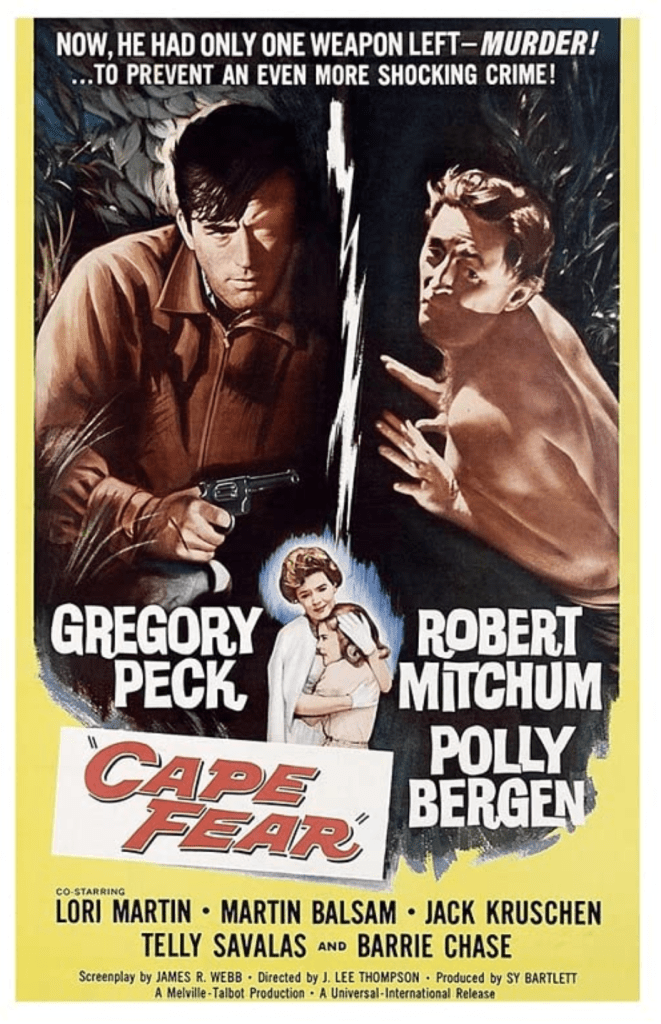
Happy Halloween to all my followers and readers! Like last year, I am participating in the Spooky Classic Movie Blogathon! For the first event, I reviewed 1953’s House of Wax, a movie I enjoyed. This time around, I’m reviewing the 1962 film, Cape Fear! When it comes to choosing which movie to watch around Halloween-time, the usual selections with fictious monsters, ghost stories, and haunted tales are preferred. But in my opinion, the most effective “scary movies” are the ones that involve real-life situations. In Cape Fear, a former prisoner seeks revenge against the lawyer who testified against him. This synopsis alone sounds more realistic and terrifying than even those scary movies that are considered “classic”. But is this movie as terrifying as it sounds? The only way to find out is if you keep reading!

Cape Fear (1962) poster created by Melville Productions, Talbot Productions, and Universal Pictures

Things I liked about the film:

The acting: Before watching Cape Fear, I had seen and reviewed Heaven Knows, Mr. Allison. One of the best aspects of that film was Robert Mitchum’s performance. In the 1962 movie, Robert’s portrayal of Max Cady stole the show! As a character, Max was a creepy and gross fellow. This was made possible through Robert’s facial expressions, body language, and dialogue. In Max’s first scene with Sam, there is a twinge of anger in Max’s voice. But his demeanor was controlled by a sense of calm. The combination of anger and calm within Max Cady added to the character’s unsettling nature. Another actor that effectively balanced two emotions was Lori Martin! In a scene that takes place after a family emergency, Lori’s character, Nancy, appears calm. Yet, she can be seen crying as she talks to her mother in an angry tone. Without spoiling anything, Nancy did have a legitimate reason to be both sad and angry. But I found this performance impressive, especially for an actress so young!

I’ve seen and reviewed To Kill a Mockingbird and Amazing Grace and Chuck. Based on these two movies, it seems like Gregory Peck gets type-casted as either a lawyer or a politician. While he portrays a lawyer in Cape Fear, the script emphasized how his character is a family man. Like the aforementioned movies, Gregory carried his character, Sam, with professionalism and classiness. At the same time, he was given plenty of opportunity to express emotion. A great example is when Sam meets Max at a nearby restaurant. As Max is telling his story, Sam grows increasingly angry. This scene highlights the fierce protectiveness of a husband and a father. It also gave a sense of realism to Gregory’s character!

The music: Legendary composer Bernard Herrmann provided the music for Cape Fear. Throughout the film, his signature musical style could be consistently heard. Bernard’s strength is using music to elevate the suspense within a given scene.  At the very beginning of the movie, Max is walking through the town as an ominous tune can be heard in the background. This effectively clued the audience in of what would come later in the story.  It also let the audience know to pay attention to Max. With all that said, the music definitely added something special to the overall project!

The cinematography: I was not expecting the cinematography in Cape Fear to be as memorable as it was! It, honestly, reminded me of pictures directed by Alfred Hitchcock! One of my favorite scenes is when Peggy, Sam’s wife, has a dream about her and Sam. While Peggy is sleeping, ghostly images of her and Sam are presented over the main image. These images reveal their concerns over the movie’s events, as well as emphasize their desire for action. This way of presenting dialogue and character interactions was very interesting. It added a sense of spookiness to an already suspenseful story!

2nd Annual Spooky Classic Movie Blogathon banner created by Kristen of Hoofers and Honeys

What I didn’t like about the film:

An exposition heavy beginning: Within the first twelve minutes of Cape Fear, the audience learns about Sam Bowden, his family, Max Cady, his arrest, and why he was arrested. Personally, I felt this was too much information to present in the film’s beginning. In fact, I was disappointed Max’s secrets were revealed so soon. What the screenwriter should have done was sprinkle this information throughout the story. That way, the audience would have a greater reason to stay invested in the mystery.

Dumb decisions from the characters: After a family emergency involving a dog, Sam warns his wife and daughter of Max’s dangerous nature. He instructs his daughter, Nancy, to only leave school and home with either him or his wife, Peggy. But more often than not, Nancy is left by herself, with Sam and Peggy putting her in a vulnerable position. One example is when Nancy gets out of school to find her mother’s car empty. While waiting in the car, Nancy sees Max and attempts to get away from him. Even though she succeeds in this plan, she ends up getting hit by an oncoming car in the process. I know her parents are human and humans make mistakes. However, these mistakes felt unbelievable after some time.

An unrelated court case: Featured in a few scenes, a court case involving an arthritic patient receiving surgery was addressed in Cape Fear. But the only connection this case had with the rest of the story was Sam as one of the associated lawyers. I wish the case had a more significant reason to be in the film. Maybe it could have something to do with Max’s past crime, with two separate mysteries becoming one. I, honestly, wanted to learn more about that case, but was sadly not given the chance.

Scared audience image created by Katemangostar at freepik.com. <a href=’https://www.freepik.com/free-photo/terrified-friends-watching-horror-movie-in-cinema_1027311.htm’>Designed by Freepik</a>. <a href=”https://www.freepik.com/free-photos-vectors/people”>People image created by Katemangostar – Freepik.com</a>. Image found at freepik.com.

My overall impression:

As I said in my introduction, the most effective “scary movies” are the ones that involve real-life situations. Even though this is a fictional story, it is effective at being a scarier film! Max Cady is one of the most unsettling characters in film, with Robert Mitchum’s acting abilities highlighting the reason why. Come to think of it, this performance showed a different side to Robert’s talents. Bernard Herrmann’s music added to the scary nature of the story, emphasizing the suspense within the script. But the multiple dumb decisions of the characters took away some from the film’s believability. The beginning of the film was also exposition heavy. However, the overall production felt like an Alfred Hitchcock picture without actually being affiliated with Alfred Hitchcock. With this said, I’d recommend Cape Fear as your next pick for Halloween!

Overall score: 7.5 out of 10

Have you seen Cape Fear? Which movie would you watch on Halloween? Tell me in the comment section!

Have fun at the movies!

Sally Silverscreen

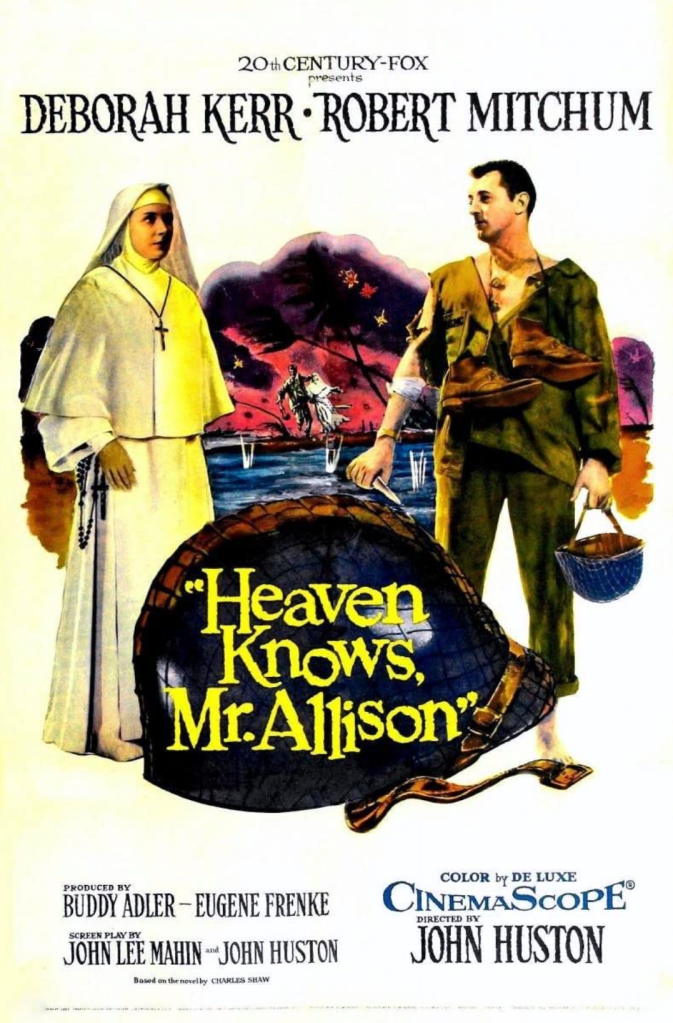
Take 3: Heaven Knows, Mr. Allison Review

Easter is just around the corner. Because of this, Pure Entertainment Preservation Society is hosting The Faith in Film Blogathon! This event has given me the perfect opportunity to review Heaven Knows, Mr. Allison, which was recommended to me by Maddy from Maddy Loves Her Classic Films. Since the movie features a Nun as one of the main characters, I knew there would be some religious themes within this script. However, I have never seen this film before, so I didn’t know what these themes would be. Choosing Heaven Knows, Mr. Allison also gave me an excuse to watch more movies from Deborah Kerr’s filmography. So, let’s start this review to see where this film ranks!

Heaven Knows, Mr. Allison poster created by 20th Century Fox.

Things I liked about the film:

The acting: Because Robert Mitchum and Deborah Kerr are the only two actors in this movie’s main cast, those are the only two performances I will be discussing in this review. This is the third film of Deborah Kerr’s I’ve seen, with the previous two being Edward, My Son and Marriage on the Rocks. The one consistent part of Deborah’s acting abilities is how she uses emotions and expressions to her advantage. This allows her to make each of her roles seem well-rounded! While Sister Angela, Deborah’s character, and Mr. Allison are fishing, Mr. Allison tries to catch a turtle with a tool he built himself. When Mr. Allison falls into the ocean, Sister Angela appears shocked and horrified, as the situation happened so quickly. Later in the film, Sister Angela and Mr. Allison are discussing their plans if they leave the island. As Mr. Allison is talking about how he has grown closer to Sister Angela, tears can be seen forming in Sister Angela’s eyes. Deborah’s face in that scene said so much more than dialogue could. Robert Mitchum is an actor I’ve heard of, but am not familiar with. Even though I have seen pieces of El Dorado and Scrooged, I don’t remember his performance in those projects. As I watched his portrayal of the titular character, it appeared as a combination of the laid-back personality of Clark Gable and the tough persona of John Wayne. But for Robert, his eyes contained emotion throughout his performance. As Sister Angela falls ill, you can tell Mr. Allison is genuinely concerned for her. Robert’s eyes are what worked in his favor, as they held a sense of sympathy for Sister Angela and longing for her well-being. The first scene of this movie contained no dialogue, as it focused on Mr. Allison’s reaction when he first arrives on the island. Because of this, Robert had to rely on his facial expressions and body language to explain what his character was going through. I found these creative decisions gave the film a good first impression, as it brought some realism to this story!

The scenery: According to IMDB, Heaven Knows, Mr. Allison was filmed in Trinidad and Tobago. Even though the location is not specified in the film, the scenery made the movie very photogenic! There is so much foliage to be seen, from the tall palm trees to the smaller bushes. The ocean boasted a consistent shade of blue, which was definitely appealing to the eye. Sandy beaches and dark brown rocks complete the natural look this space had to offer. Based on appearances alone, this island looked inviting!

The parallels between the religious order and the Marines: Within Mr. Allison and Sister Angela’s conversations, parallels between the Marines and the religious order are brought up. One of the them is discussed while they are building a sail for their raft. Sister Angela addresses the preparations she had to go through in order to become a Nun. She even talks about one mentor within the religious order she wasn’t a fan of. Meanwhile, Mr. Allison shares his basic training before he officially became a Marine. He also brings up a drill Sergeant that he didn’t like. I never thought about these parallels until I saw this film, so I like how this story was somewhat thought-provoking. The parallels between the religious order and the Marines also showed how Sister Angela and Mr. Allison were similar than they first realized.

The Faith in Film Blogathon banner created by the Brannan sisters from Pure Entertainment Preservation Society.

What I didn’t like about the film:

The limited presence of faith: While I did like seeing the parallels between the religious order and the Marines, I was disappointed by how limited faith’s presence was. Before watching Heaven Knows, Mr. Allison, I expected faith to be a cornerstone of this story, similar to films like Ben-Hur. Because the movie takes place during World War II, a correlation with the David and Goliath story would make sense. Seeing one of the characters question their faith or have their faith tested would be appropriate, given their circumstances. But faith in Heaven Knows, Mr. Allison was served in small doses.

A basic conflict: In movies, television shows, or books, I like conflicts that contain more depth. But the conflicts in Heaven Knows, Mr. Allison were more basic than I hoped. In theory, the idea of a Marine and a Nun surviving on an abandoned island sounds interesting. But as the story progresses, the conflict is the same as other films of this nature. Even when Japanese soldiers invade the island, survival is still a major conflict. Because of everything I mentioned, few new ideas were brought to this particular table.

Lack of resolution: At one point in the film, Sister Angela explains to Mr. Allison how some women change their minds when it comes to the religious order. Several scenes later, Mr. Allison tries to dissuade Sister Angela from taking her final vows by telling her he loves her. She even starts to weigh her options when it came to her future. However, we never find out what her final decision was. A brief explanation in the script would be solved this problem. But because this explanation was nowhere to be found, a sense of closure was missing.

Cute Easter image created by Freepik at freepik.com. <a href=”https://www.freepik.com/free-photos-vectors/background”>Background vector created by freepik – http://www.freepik.com</a>. Image found at freepik.com.

My overall impression:

Heaven Knows, Mr. Allison is a fine movie. Even though I found it better than Edward, My Son and Marriage on the Rocks, I was expecting more from this third film. I was hoping faith would have a bigger role in the story, especially since Heaven Knows, Mr. Allison was released two years before Ben-Hur. However, as I said in my review, faith was served in small doses. The conflict itself was typical for a movie that involves characters being stranded on an island. Because I like conflicts with more depth, this creative decision was disappointing. But the movie did have its strengths, such as the acting and the thought-provoking parallels. With all this said, this is a film I would still recommend to older viewers just in time for Easter!

Overall score: 7.2 out of 10

Have you seen Robert Mitchum’s or Deborah Kerr’s films? If so, which ones would you recommend? Let me know in the comment section below!

Have fun at the movies!

Sally Silverscreen