Take 3: The 39 Steps Review

For the first annual Master of Suspense Blogathon (hosted by Maddy from Classic Film And TV Corner), I wrote about the 1955 film, To Catch a Thief. While I addressed how it was a “pretty looking movie”, I found To Catch a Thief prioritizing style over substance. In this year’s event, I have selected the 1935 production, The 39 Steps, which was recommended by Maddy from Maddy Loves Her Classic Films! There are several titles in Alfred Hitchcock’s filmography that have gained popularity over the years. But The 39 Steps has been overshadowed by Alfred’s more well-known projects. In fact, before signing up for the second annual Master of Suspense Blogathon, I knew very little about the film. However, I was familiar with Alfred’s forte for mystery and suspense, assuming I was, at least, going to see a creative concept come to life on screen. Was I correct in my assumption? Keep reading my review of The 39 Steps to find out!
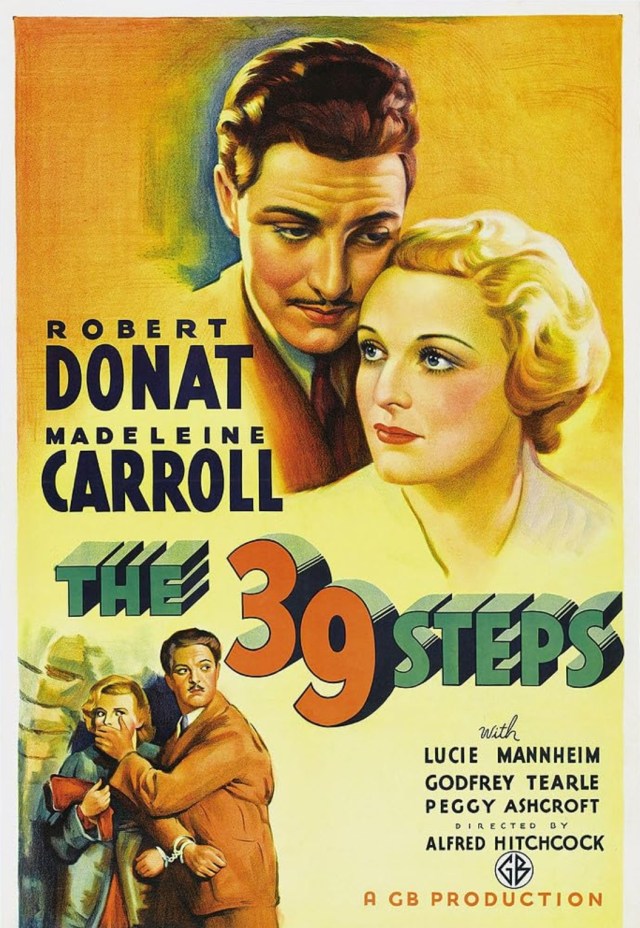
The 39 Steps poster created by Gaumont British Picture Corporation and Gaumont British Picture Corporation of America

Things I liked about the film:

Robert Donat’s performance: Throughout The 39 Steps, I found the acting performances ranging from fine to well-done. However, I did like Robert Donat’s portrayal of Richard Hannay! What stood out to me was how at ease Robert appeared on screen. A perfect example is when Richard shares some of his family history with Pamela, who was portrayed by Madeleine Carroll. While telling Pamela about his family, Richard was comfortable giving this information, despite barely knowing Pamela. His body language appears relaxed and his facial expressions presented on his face effortlessly. The story itself rolled off Richard’s tongue as if he had told it multiple times. During this conversation, Richard was also yawning, indicating how tired he was by the events surrounding him during the film’s story.

The set design of Alt-na-Shellach: During the movie, Richard visits Alt-na-Shellach, the home of a man named Professor Jordan. The only room shown on screen was the sitting room, where a party was taking place. Despite appearing in only one scene, the room boasted nice set design pieces! Characters were greeted by a large, carved, wooden door. These carvings were intricately detailed, showing how much care went into creating that door. A big, ornate rug covered the majority of the floor, nicely complimenting the space. But the showstopper was the huge window overlooking a nearby river and featuring stained glass designs. I wish more scenes had taken place at Alt-na-Shellach, as I’m pretty sure other rooms would have looked great on screen too!

The mise-en-scène: For those who aren’t familiar with the term, mise-en-scène, it means how a scene is presented in a movie. In The 39 Steps, mise-en-scène was utilized in clever and visually intriguing ways. A great example is when Richard boards a train. On this trip, Richard is sitting across from two men. To avoid eye contact, Richard hides his face behind a newspaper. Wondering if the two men are watching him, Richard peeks over the top of the newspaper, where the audience can only see the men’s eyes. These visuals symbolized how Richard was hiding something behind the windows of his soul, how the eyes are sometimes described.
The Second Master Of Suspense Blogathon banner created by Maddy from Classic Film And TV Corner

What I didn’t like about the film:

Limited sense of urgency: Based on Alfred Hitchcock’s films I’ve seen, I’ve come to expect his stories to be filled with mystery and suspense. Because of these elements, I also expect a given story to contain a strong sense of urgency. While there were suspenseful, urgent moments sprinkled throughout The 39 Steps, these moments were not consistent. This made the story take its time being told instead of getting straight to the point sooner. During these suspenseful, urgent moments, there was no music playing in the background. A low amount of adrenaline and excitement was present in these moments partly due to the lack of music.

The “Insta-love” trope: In my recent review of Easter Parade, I explained what the “insta-love” trope was and why it was a major flaw in the 1948 movie. The “insta-love” trope was a major flaw in The 39 Steps as well. Richard and Pamela do not like each other. Even after being arrested, they continue to dislike one another. When they check into a hotel and pose as a married couple, Pamela and Richard’s dislike carries on. But hours later, they act like they’ve always been in a romantic relationship. The inclusion of the “insta-love” trope caused Richard and Pamela’s attraction to be abrupt, with the abruptness preventing on-screen chemistry between Robert and Madeleine.

An over-shadowed mystery: As I just mentioned in this review, I have come to expect stories filled with mystery based on Alfred Hitchcock’s movies I’ve seen. Because of those selected titles from Alfred’s filmography, I expect the mystery to be the story’s primary focus. In The 39 Steps, however, the story’s mystery was overshadowed due to the film’s creative team emphasizing Richard being on the run from the authorities. The mystery taking a backseat in the movie means the mystery itself wasn’t solved until the very end of the film. A longer wait time for answers causes The 39 Steps to feature a limited amount of intrigue.

Essentials of Scotland image created by macrovector_official at freepik.com. <a href=”https://www.freepik.com/free-photos-vectors/background”>Background vector created by macrovector_official – http://www.freepik.com</a>. Image found at freepik.com.

My overall impression:

Alfred Hitchcock has obtained a reputation for creating memorable productions. Whether it’s incorporating “modern” technology in The Birds or showcasing a pretty location in To Catch a Thief, Alfred’s movies have boasted his stamp of approval through various creative ideas. But out of Alfred’s films I have seen, and even reviewed, The 39 Steps is the most “meh” title from his filmography. The 1935 picture had such a limited sense of urgency and intrigue, I almost fell asleep while watching it. Richard and Pamela’s relationship was heavily affected by the “insta-love” trope, causing the relationship to feel like it belonged in a different film. This is a movie that seems longer than an hour and twenty-six minutes, creating a slow and boring build-up to a reveal that feels kind of ridiculous and anti-climactic. With all the flaws I discussed in this review, it’s a shame The 39 Steps turned out this way. That’s because there were aspects of this movie I liked, such as Robert Donat’s performance.

Overall score: 5 out of 10

Have you seen The 39 Steps? Are there any films of Alfred Hitchcock’s you like or don’t like? Let me know in the comment section!

Have fun at the movies!

Sally Silverscreen

Take 3: Goodbye, Mr. Chips (1939) Review (Clean Movie Month #1)

1939; a year that many people have considered the “Golden Year of Film”. As I mentioned in my editorial, What the Code Means to Me: Breen, Hallmark, and Me, it seems like there was something for everyone at the cinema. Several films that are well known today were able to find success in the box office in 1939. One of those films was Goodbye, Mr. Chips. I had planned on reviewing this film exclusively for The Robert Donat Blogathon. But because July is Pure Entertainment Preservation Society’s Clean Movie Month, I decided to review Goodbye, Mr. Chips for that event as well. Like last year, I will be writing about films that were released during the Breen Code Era. Some of my other submissions for upcoming blogathons will also double as entries for Clean Movie Month. Now, it’s time to read this review of the 1939 movie, Goodbye, Mr. Chips!

Goodbye, Mr. Chips poster created by Metro-Goldwyn-Mayer and Denham Studios. Image found at http://www.tcm.com/tcmdb/title/76737/Goodbye-Mr–Chips/#.

Things I liked about the film:

The acting: This was my first time watching any of Robert Donat’s performances, so I didn’t know what to expect. However, I was impressed with what I saw! Robert did a good job using a multitude of emotions at various moments in the film. Even when he wasn’t speaking, his performance still carried emotional weight. A great example is anytime something bad happened to Mr. Chips, as his facial expressions alone show how emotionally exhausted he can become. Despite appearing in the film for a limited amount of time, Greer Garson gave a pleasant performance as Katherine Ellis! Not only did she have a good on-screen personality, but she also had good on-screen chemistry with Robert Donat. One of their best interactions took place on a mountain in Austria. As they exchange witty banter, it is obvious to see that both actors enjoy each other’s company. Because most of the story takes place at the Brookfield school, many young actors are present in various scenes. Even though the movie doesn’t favor one child or a small group of children, the acting from the young actors was very on-point for what those scenes called for. On April Fool’s Day, the students are excited at the idea of pranking their teacher. As soon as one of their fellow classmates shares some unfortunate news about Mr. Chips, their happy expressions quickly turn somber. This collective acting quality shows what these young actors are capable of talent-wise!

The set design: A visually appealing aspect of this film was definitely the set design! The Brookfield school alone boasted several eye-catching design choices. One of those was the ornate detailing found on wood surfaces, such as doors and walls. In the Headmaster’s office, you can even see these details over the marble fireplace. Exposed stone walls are a consistent feature at the school, bearing the old-world charm found in structures with a long life-span. These design elements reminded me of Hogwarts from the Harry Potter series. Brookfield is not the only place that highlights fine details. The ballroom in Vienna was a showstopper! Like the Headmaster’s office, there was ornate wood detailing found on the walls. It also showcased sparkling chandeliers and a spacious layout. All of the combined elements gave this room a grand and larger-than-life personality!

The dialogue: Throughout the movie, I was very impressed by the characters’ dialogue! As I mentioned before, the banter between Mr. Chips and Katherine was witty. But it’s also important to point out how the dialogue was written with care and thought. During a private gathering, one of the fellow teachers of Brookfield states that he read a book by H.G. Wells. Another teacher comments about H.G. Wells’ short-term success, saying that his works are too “fantastical” for a lasting career. Earlier in the film, Mr. Chips falls ill. When his housekeeper tells him to address his medical concerns to the doctor, Mr. Chips says he’ll give the doctor “a piece of his mind”. The film is based on a pre-existing novel, so I’m not sure if some of the dialogue can also be found in the book. However, the lines in the movie were memorable and, at times, thought provoking because they were crafted so well!

The Robert Donat Blogathon banner created by Maddy from Maddy Loves Her Classic Films. Image found at https://maddylovesherclassicfilms.wordpress.com/2020/02/29/announcing-the-robert-donat-blogathon/.

What I didn’t like about the film:

Little to no impact on the students: In stories about teachers playing a role in the lives of their students, the audience comes to know the students as characters while witnessing their growth as young scholars and individuals. Since there were so many students at Brookfield, there was no possibility for this to happen. Even when this opportunity arose in the story, it was not taken advantage of. When Mr. Chips reflects on his past, he remembers meeting a new student that was so upset, he ends up crying on the train. Several scenes and years later, this same student visits Mr. Chips to thank him for changing his life. This exchange would have been emotionally affective had we seen this character evolve from a scared child to an independent young man.

Some parts feeling rushed: I know there is only so much a movie can accomplish in an hour and fifty-four minutes. But this should not be an excuse to rush through important parts of a story. When Mr. Chips starts looking back on his past, he recalls his time as a new teacher at Brookfield. After a montage featuring students during various sporting activities, the story progresses by several years, making Mr. Chips a seasoned teacher. Personally, I don’t feel this was a smooth transition between the two points in time, as it made the story feel like it was in a hurry to reach its destination. What would have helped instead was showing a title card with the year before a new part of the story started.

A weaker plot: Before watching Goodbye, Mr. Chips, I knew the story would be about Mr. Chips’ life. While this was the case, it made the story straight-forward. The straight-forwardness of the narrative left little to no room for intrigue. Like I mentioned earlier in this review, the evolution of the students was not shown. This means that the ways Mr. Chips impacted his students or how his lessons affected the people around him wasn’t put on display. There was never an opportunity to wonder how Mr. Chips would accomplish his goals or what would happen to the students. Instead, the story put more emphasis on his private life than his career as a teacher.

Clean Movie Month banner created by Tiffany and Rebekah Brannan from Pure Entertainment Preservation Society. Image found at https://pureentertainmentpreservationsociety.wordpress.com/2020/07/01/cleanmoviemonth2020-is-here/.

My overall impression:

This is the first movie of Robert Donat’s I’ve ever seen. As I said in my review, I didn’t know what to expect, so I approached this film with an open mind. Now that I have seen Goodbye, Mr. Chips, I can honestly say that it was a fine film. There are definitely elements that help make the project a likeable picture. These are the strengths of the movie, from acting performances that come across as believable to dialogue that is clever and witty. But it does contain flaws that hold Goodbye, Mr. Chips back from being better than it was. Parts of the story were rushed and the plot was on the weaker side. This film is mostly Breen Code friendly. However, I was surprised by some of the language used in the movie. One example is when some of the students say the word “ass” as a swear word. I’m aware of how Gone with the Wind was able to include the word “damn” in their script. But I guess I was naïve to think that was the only exception in the Breen Code Era.

Overall score: 7 out of 10

Have you seen either version of Goodbye, Mr. Chips? Are you looking forward to my Clean Movie Month reviews? Let me know in the comment section!

Have fun at the movies!

Sally Silverscreen